

Europe Textile Colorant Market Size & Forecast:
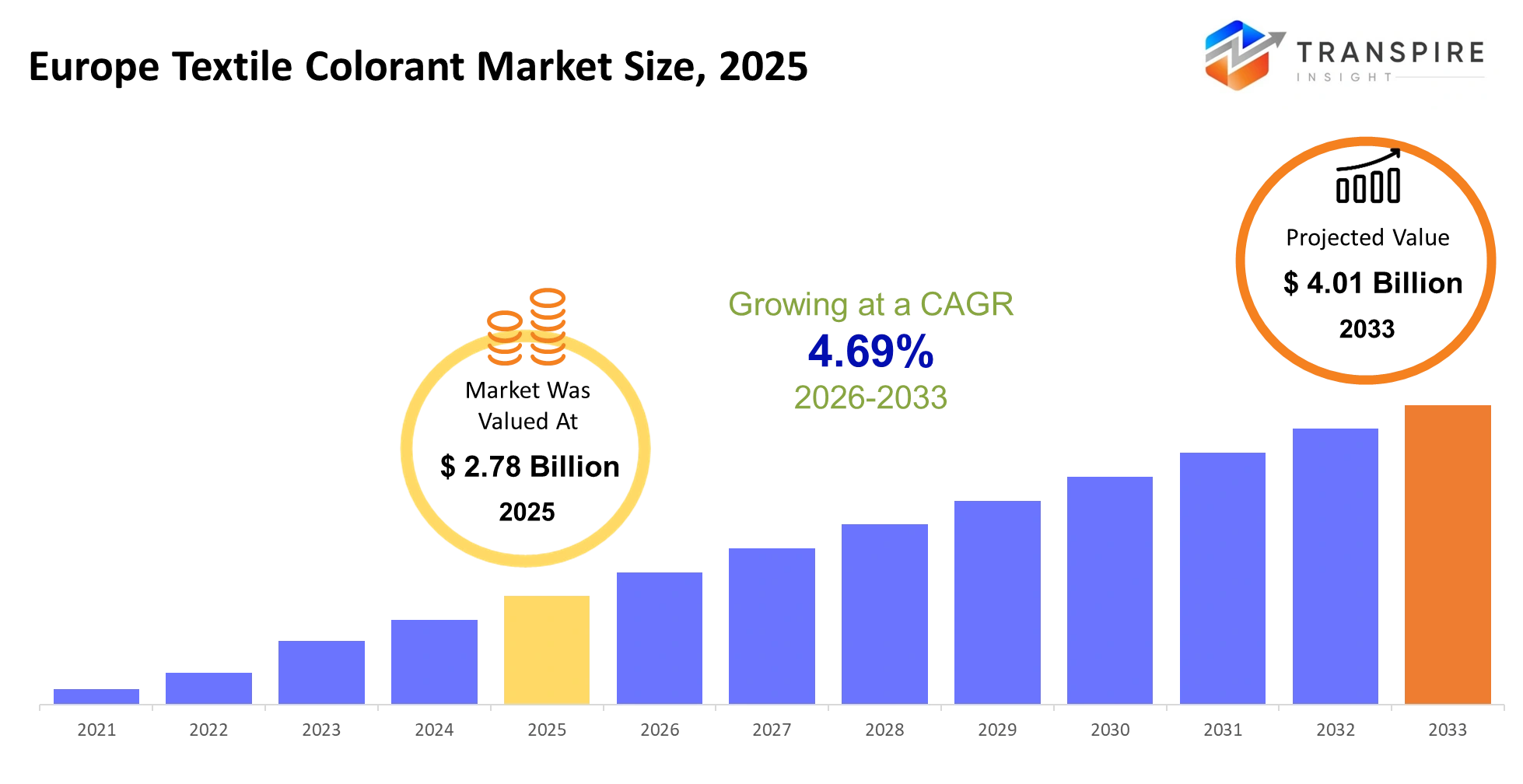
- Europe Textile Colorant Market Size 2025: USD 2.78 Billion
- Europe Textile Colorant Market Size 2033: USD 4.01 Billion
- Europe Textile Colorant Market CAGR: 4.69%
- Europe Textile Colorant Market Segments: By Type (Dyes, Pigments, Reactive Colorants, Disperse Dyes, Others), By Application (Apparel, Home Textiles, Industrial Textiles, Others), By End-User (Textile Industry, Fashion Industry, Manufacturing, Others), By Form (Liquid, Powder, Granules, Others).
To learn more about this report,  Download Free Sample Report
Europe Textile Colorant Market Summary:
The Europe Textile Colorant Market size is estimated at USD 2.78 Billion in 2025 and is anticipated to reach USD 4.01 Billion by 2033, growing at a CAGR of 4.69% from 2026 to 2033. European textile dyeing market provides essential support for manufacturers who create clothing and automotive parts and home textiles and technical fabrics to maintain consistent color quality which meets durability standards and production regulations during their manufacturing processes. The functionality of textile colorants extends beyond visual appeal because they establish the wash fastness and UV resistance and chemical stability requirements which essential materials need to protect premium fabrics and performance textiles used across industrial supply chains.
The market has established a new direction during the past five years which now favors environmentally friendly bio-based colorant systems that work with digital technologies instead of traditional synthetic dyes. The industry made this transition because European authorities enforced stricter regulations which monitored dyeing facilities that used excessive amounts of water and energy resources. European manufacturers needed to find local sources after the pandemic disrupted chemical exports from Asia because European countries relied on imported production materials. Mills are implementing modern solutions for color management and water-efficient dyeing processes because brands require them to produce textiles which can be traced and certified as sustainable. This enables suppliers to acquire more valuable contracts while establishing predictable revenue streams for extended periods.
Key Market Insights
- The European Textile Colorant Market in 2025 experienced German market leadership which reached 28% because of the country's advanced textile processing methods and heavy industrial dye usage.
- The Eastern European market through 2032 shows the highest growth rate because manufacturers are shifting operations to areas with cheaper textile production costs.
- The Europe textile colorant market in 2025 showed more than 35% market share for reactive dyes because these dyes provide better color fastness and work well with cotton textiles.
- The Europe Textile Colorant Market identified Disperse dyes as its second largest segment because of their use in polyester fabrics which are created for automotive and sportswear applications.
- Digital printing colorants are forecast to register the fastest growth rate between 2026 and 2032 because they use less water and complete production processes more quickly.
- The application of apparel manufacturing took first place in demand for 2025 because fashion brands chose to focus on high-quality color results and environmentally friendly fabric finishing methods.
- The industrial filtration industry and automotive interior market and protective clothing sector drove technical textiles to become the fastest expanding application segment.
- Fashion and apparel companies remained the leading end-user category which accounted for more than 50% of market revenue across European textile supply chains.
- Home furnishing and upholstery manufacturers recorded significant growth as consumers shifted toward customized and eco-certified interior textile products.
- European chemical compliance sustainability regulations which started enforcement in 2022 led to more companies using bio-based pigments and low-emission textile dyeing methods.
What are the Key Drivers, Restraints, and Opportunities in the Europe Textile Colorant Market?
The European textile colorant market experiences its most powerful growth through the implementation of stricter regulations that control chemical discharges and wastewater treatment in textile production facilities. European authorities strengthened restrictions on hazardous dye intermediates and industrial discharge limits, forcing textile processors to replace conventional dye systems with compliant, high-performance formulations. The regulatory changes created higher demand for reactive dyes and digital printing inks and low-liquor-ratio dyeing technologies which decrease both water and energy consumption during each production cycle. Colorant manufacturers that provided traceable certified formulations obtained better-paying contracts and extended supply agreements as apparel brands shifted their supplier contracts to compliant mills.
Europe depends on imported dye intermediates and specialty chemicals from Asian countries which creates the market's most significant structural barrier. To establish regional chemical processing facilities, companies must invest substantial funds and obtain environmental permits while waiting for extended periods to receive necessary approvals which creates obstacles for immediate localization efforts. Manufacturers face supply chain challenges because they must deal with shipping cost changes and material availability problems and currency exchange rate movements. The end result creates unpredictable pricing patterns which lead to extended procurement times for textile processors who face cost increases but lack the ability to reduce their production capacity.
Digital textile printing represents the most obvious path for future expansion. Textile manufacturers in Italy, Turkey, and Eastern Europe are investing in digitally controlled coloration systems that reduce inventory waste and enable short-run customized production. The industry requires specialized pigment inks and automated color management software and high-precision colorant formulations which fast-turnaround fashion and technical textiles need.
What Has the Impact of Artificial Intelligence Been on the Europe Textile Colorant Market?
Artificial intelligence together with advanced digital technologies are transforming the Europe Textile Colorant Market because they enhance accuracy and decrease operational waste and boost manufacturing output in dyeing and finishing processes. Textile manufacturers are using AI-powered color management systems which automatically modify dye amounts and temperature controls and chemical application throughout production processes. The systems decrease color differences while decreasing water and chemical usage especially in factories that process large quantities of cotton and polyester materials.
Manufacturers are now adding machine learning algorithms to their predictive maintenance systems which monitor dyeing equipment and pumps and digital printing machines. Manufacturers can detect equipment breakdowns through shutdowns by examining vibration measurements and thermal patterns and operational cycle information. European textile factories have observed decreased unexpected downtime and better equipment efficiency since they began using predictive analytics in their automated dyeing systems.
Fashion manufacturers can achieve better operational efficiency through advanced digital printing technologies which help reduce their storage needs and shorten their product development processes. Textile processors can achieve energy savings and faster production results through automated color matching processes which enable them to produce smaller custom orders.
The implementation of AI technology in various industries encounters two significant challenges. The majority of small and mid-sized textile mills still operate their old machines which do not have any sensors that can be detected by modern data systems. The process of connecting AI systems into existing production systems from previous decades requires manufacturing companies to invest both financial resources and develop specialized skills which results in delayed adoption throughout different areas of the supply chain.
Key Market Trends
- The European textile mills adopted digital printing systems since 2022 which reduced their traditional dye bath requirements because these systems use 60 percent less water.
- German and Italian companies boosted their funding for automated color-matching software after premium fashion brands established stricter shade consistency standards which extended to their supplier networks.
- Textile manufacturers changed their sourcing methods after European logistics disruptions in 2021 demonstrated the regions excessive reliance on Asian dye intermediates and specialty chemicals.
- The cotton processing facilities implemented reactive dye systems because European environmental frameworks mandated stricter wastewater discharge limits which required all facilities to follow.
- The period from 2020 to 2025 saw luxury apparel brands demand bio-based pigments because they established traceable chemistry requirements for their procurement contracts.
- Archroma and DyStar expanded their low-salt dye product lines to help European textile exporters meet their compliance requirements.
- Eastern European polyester textile producers raised their disperse dye usage because manufacturing for automotive interiors and performance sportswear increased in that region.
- The small-batch production systems implemented by textile processors after 2023 led them to adopt digitally controlled coloration technology which offers faster processing and reduced inventory requirements.
- European regulators escalated their chemical traceability investigations because PFAS restrictions increased their examination of textile finishing and coloration supply chains.
- Manufacturers implemented AI-enabled dyeing systems in 2024 to achieve their goals of reducing reprocessing rates and enhancing machine utilization in automated dye houses.
Europe Textile Colorant Market Segmentation
By Type
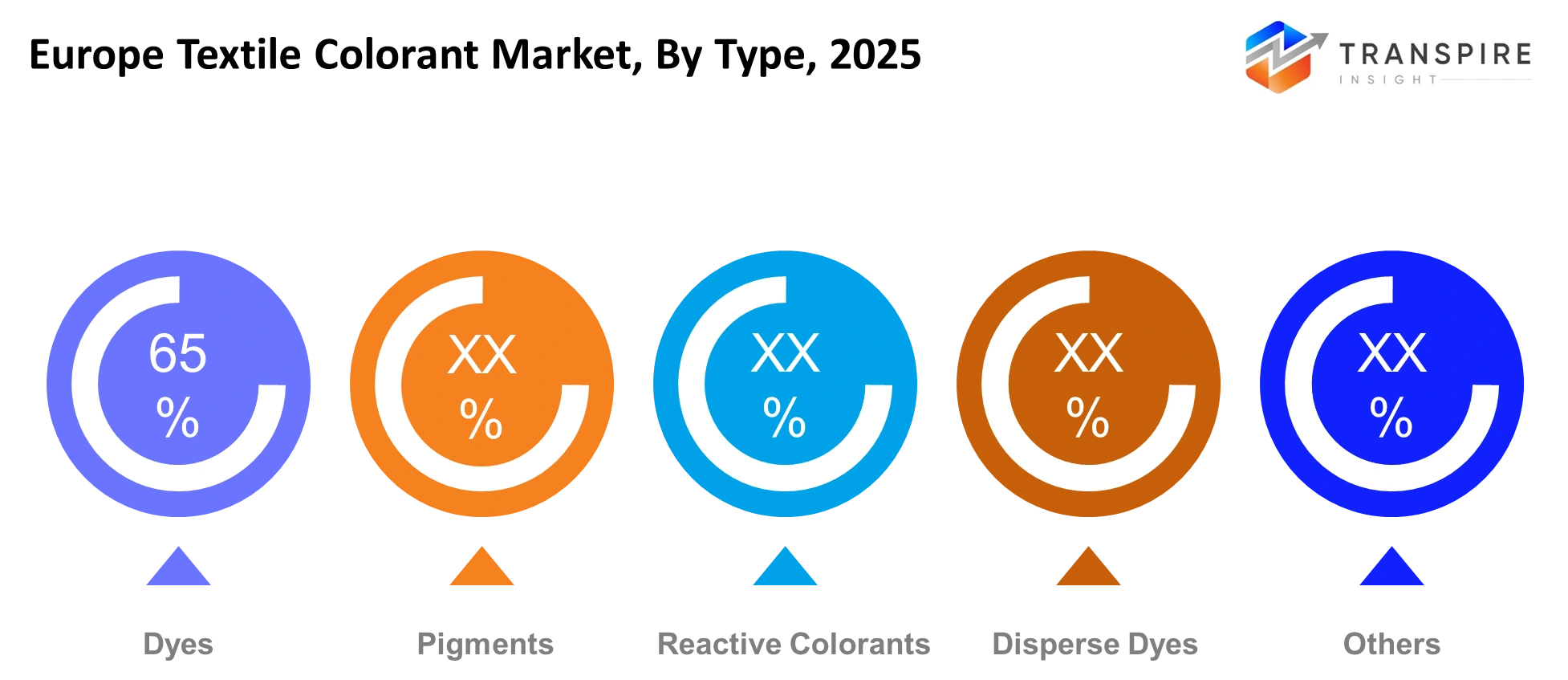
Dyes hold the leading position within the type segment because large-scale apparel and home textile manufacturing still depends on high color penetration, wash durability, and cost-efficient processing. The three countries Germany, Italy, and Turkey use reactive dyes for cotton applications because these dyes provide strong compatibility with natural fibers and premium fashion brands demand higher quality standards. Disperse dyes maintain a strong position in polyester processing because sportswear and automotive fabrics and technical textiles continue to increase their use of synthetic blended materials. Manufacturers are increasingly adopting pigments and specialty colorants for digital textile printing because they need printing solutions that require less water and enable faster production times.
European wastewater regulations now enforce stricter chemical discharge limits which have resulted in the expansion of bio-based and low-salt formulations. The type segment will experience future growth through advanced colorant systems which provide traceability and automatic dyeing equipment compatibility while consuming less energy. Chemical suppliers that develop eco-friendly formulations and digital printing inks will help textile processors establish long-term supply agreements.
To learn more about this report, Download Free Sample Report
By Application
Apparel remains the dominant application segment because European fashion supply chains require large-scale coloration for cotton, polyester, and blended fabrics across fast fashion and premium clothing categories. The strong export activities from Italy and Eastern Europe result in stable dye consumption throughout the entire garment manufacturing process. Home textiles represent the second-largest application because there is constant demand for upholstery fabrics and curtains and bedding and decorative textiles which need fade resistance and durable coloration. The industrial textiles sector is growing more rapidly because automotive interiors and filtration materials and protective clothing need specialized dyes that provide UV stability and heat resistance and antimicrobial properties.
The rising technical performance standards of industrial applications resulted in increased demand for custom formulations and high-profit specialty colorants. Digital textile printing changed how people shop for clothing and home decor products because it enables manufacturers to create smaller production runs while they can quickly change their designs. Future market growth will focus on technical textile applications because performance-based color systems enable businesses to charge higher prices while they maintain extended relationships with their suppliers.
By End-User
The textile industry operates as the biggest end-user sector because dye houses and integrated fabric manufacturers use substantial amounts of reactive and disperse and pigment-based colorants during their continuous production processes. Fashion industry participants also maintain significant purchasing influence as luxury brands and sportswear companies increasingly require traceable chemical sourcing and certified low-impact coloration systems. Manufacturing industries, particularly automotive and industrial equipment producers, require technical textiles which possess advanced color stability and chemical resistance. The textile industry operates as the biggest end-user sector because dye houses and integrated fabric manufacturers use substantial amounts of reactive and disperse and pigment-based colorants during their continuous production processes.
Fashion industry participants also maintain significant purchasing influence as luxury brands and sportswear companies increasingly require traceable chemical sourcing and certified low-impact coloration systems. The manufacturing industries which include automotive production and industrial equipment manufacturing require technical textiles that possess advanced color stability and chemical resistance properties. The last five years brought about a change in procurement priorities as end users selected suppliers based on compliance requirements instead of choosing suppliers based on their pricing. Textile processors adopted water-saving dye systems and automated color management technologies because European environmental regulations and retailer sustainability targets required such practices.
By Form
The form segment of the market currently receives its main colorant options from powder-based colorants because textile manufacturers prefer these products for their extended product life and decreased shipping expenses and their capacity to be stored in bulk at their dyeing facilities. The textile industry uses powder formulations to produce dyes because they enable precise dosage measurement which helps maintain production quality during large-scale manufacturing. The demand for liquid colorants is increasing because automated dyeing systems and digital textile printing technologies need faster mixing and less dust production and easier machine setup. Liquid formulations support advanced textile finishing facilities by providing shorter production times and better operational performance.
Customized industrial applications maintain their niche demand for granules and specialty forms because these materials enable controlled dissolution and decrease handling risks which enhances processing stability. The shift of buyer preferences towards liquid and digital colorant systems is happening because companies are putting money into automated production systems. The upcoming development activities in the form segment will concentrate on creating solutions that enhance operational efficiency while minimizing waste and enabling compatibility with AI-powered dye management systems. Automated textile operations will see manufacturers who develop user-friendly products and accurate dosing systems achieve better market success.
What are the Key Use Cases Driving the Europe Textile Colorant Market?
The main application which drives textile colorant usage throughout Europe exists in apparel manufacturing. Fashion brands and contract textile mills require high-performance dyes for cotton, polyester, and blended fabrics that meet strict color consistency, wash durability, and chemical compliance standards under European environmental regulations.
The home furnishing and automotive textile markets are showing increasing growth because manufacturers now require permanent color solutions for their upholstery fabrics and carpets and curtains and vehicle interior materials. Sportswear producers are also increasing adoption of advanced disperse dyes and digital printing inks to support lightweight synthetic fabrics and short production cycles.
The emerging market includes smart textiles and medical fabrics which require antimicrobial coatings and UV-reactive pigments and conductive coloration systems. The industrial filtration materials industry and protective workwear market are creating demand for specialized colorants which can sustain their performance during high heat and chemical exposure and multiple sterilization procedures.
|
Report Metrics |
Details |
|
Market size value in 2025 |
USD 2.78 Billion |
|
Market size value in 2026 |
USD 2.91 Billion |
|
Revenue forecast in 2033 |
USD 4.01 Billion |
|
Growth rate |
CAGR of 4.69% from 2026 to 2033 |
|
Base year |
2025 |
|
Historical data |
2021 - 2024 |
|
Forecast period |
2026 - 2033 |
|
Report coverage |
Revenue forecast, competitive landscape, growth factors, and trends |
|
Regional scope |
Europe (Germany, United Kingdom, France, Italy, Spain and Rest of Europe) |
|
Key company profiled |
BASF, Huntsman, Archroma, DyStar, Clariant, Kiri Industries, Atul Ltd, LANXESS, Sumitomo Chemical, Zhejiang Longsheng, Everlight Chemical, Colourtex, Jihua Group, Jay Chemical, Meghmani Organics. |
|
Customization scope |
Free report customization (country, regional & segment scope). Avail customized purchase options to meet your exact research needs. |
|
Report Segmentation |
By Type (Dyes, Pigments, Reactive Colorants, Disperse Dyes, Others), By Application (Apparel, Home Textiles, Industrial Textiles, Others), By End-User (Textile Industry, Fashion Industry, Manufacturing, Others), By Form (Liquid, Powder, Granules, Others). |
Which Regions are Driving the Europe Textile Colorant Market Growth?
The textile colorant market in Western Europe maintains its top position because of advanced textile manufacturing facilities and strict environmental regulations and high-end fashion brands which dominate the region. The textile industry in Germany and Italy and France requires compliant dye systems because of their strict requirements for wastewater treatment and chemical tracking. The area benefits from research networks which already exist and automated dyeing systems and the close collaboration between chemical manufacturers and clothing producers. Western Europe maintains its dominant position in high-value textile applications because of ongoing investments in digital textile printing and sustainable coloration technologies.
Southern Europe stands as the second-largest regional contributor because its market development follows different patterns from Western Europe which depends on flexible production methods and textile factories that focus on exporting goods. The three countries of Italy and Spain and Portugal show consistent demand for colorants because their specialized fabric production and luxury apparel supply chains and home furnishing exports. The textile mills in these nations keep investing in water-saving dye systems so they can compete with manufacturers who have lower production expenses. The established purchasing agreements between local textile manufacturers and European fashion houses create dependable revenue streams which maintain market stability during times of economic downturn.
Eastern Europe has become the fastest-growing area as textile manufacturing moves to cheaper production centers in Poland and Romania and Turkey. The period after 2021 showed increased investment in local dyeing and finishing facilities because Western European countries faced rising labor expenses and companies wanted to diversify their supply networks.
Who are the Key Players in the Europe Textile Colorant Market and How Do They Compete?
The Europe textile colorant market maintains a state of moderate fragmentation because global chemical companies are competing against both local specialty dye producers and niche formulation businesses. The focus of competition has shifted away from price assessments toward three main areas which include regulatory compliance requirements and water-efficient dye chemistry and digital textile printing compatibility. Major companies maintain their market positions by using certified low-impact products and providing technical assistance to textile mills which must comply with European wastewater treatment standards. Meanwhile, smaller companies are establishing themselves as leaders in bio-based pigments and AI-powered color management systems and custom digital ink solutions designed for short textile runs.
Archroma concentrates its research efforts on developing environmentally friendly dye solutions and creating systems for textile production that enable complete traceability. The company distinguishes itself from competitors by presenting bluesign-certified products together with low-salt reactive dyes and sustainability assessment tools which enable textile manufacturers to achieve European regulatory requirements. DyStar competes in the market through its advanced knowledge of disperse and reactive dye technologies while developing digital color control systems for use in automated textile production environments. DyStar establishes permanent procurement agreements with premium European fashion brands through its partnerships with apparel supply chains and its textile certification programs.
BASF uses its advanced chemical research facilities and extensive regional production capabilities to create high-performance pigment dispersions and environmentally friendly textile processing solutions. The company achieves benefits through its strong connection to European industrial textile producers who need special formulations for their automotive and technical fabric requirements.
Company List
- BASF
- Huntsman
- Archroma
- DyStar
- Clariant
- Kiri Industries
- Atul Ltd
- LANXESS
- Sumitomo Chemical
- Zhejiang Longsheng
- Everlight Chemical
- Colourtex
- Jihua Group
- Jay Chemical
- Meghmani Organics
Recent Development News
In February 2026, Sparxell raises €4.2 million to scale plant-based colour technology for fashion and textiles: UK-based Sparxell raised €4.2 million to scale bio-based cellulose pigments for textile and fashion applications, targeting replacement of petrochemical dyes in Europe’s colorants supply chain. The funding will support industrial-scale manufacturing and commercialization in 2026.
Source: https://www.eu-startups.com
In February 2026, Mutares completes acquisition of Venator Ultramarine Blue Pigments business: Private equity group Mutares finalized acquisition of Venator’s ultramarine blue and manganese violet pigment business in Europe, strengthening its specialty chemicals and pigment portfolio used in textiles, coatings, and plastics. The deal expands European pigment production capacity.
Source: https://live.euronext.com
What Strategic Insights Define the Future of the Europe Textile Colorant Market?
The Europe textile colorant market moves toward digitally based low environmental impact coloring systems which use chemical compliance and supply chain tracking and automated processes. The primary force behind this transition is the convergence of stricter European environmental regulation with fashion brands’ growing reliance on shorter production cycles and localized sourcing strategies. Over the next five to seven years, competitive advantage will increasingly depend on a supplier’s ability to deliver water-efficient formulations compatible with AI-enabled dye management and digital textile printing platforms.
One underrecognized risk is the tightening availability of specialty dye intermediates linked to global chemical supply concentration. The European textile industry faces supply chain risks because only a few Asian companies control essential material distribution channels which cause price fluctuations and procurement difficulties for textile manufacturers.
Eastern Europe presents an emerging opportunity because its automated textile parks and export manufacturing facilities drive new digital coloration technology implementation. Market participants should establish partnerships with automated textile processors while making early investments in digital traceable colorant systems that meet future compliance standards and sourcing regulations.
Europe Textile Colorant Market Report Segmentation
By Type
- Dyes
- Pigments
- Reactive Colorants
- Disperse Dyes
- Others
By Application
- Apparel
- Home Textiles
- Industrial Textiles
- Others
By End-User
- Textile Industry
- Fashion Industry
- Manufacturing
- Others
By Form
- Liquid
- Powder
- Granules
- Others
Frequently Asked Questions
Find quick answers to common questions.
The approximate Europe Textile Colorant Market size for the market will be USD 4.01 Billion in 2033.
The key segments of the Europe Textile Colorant Market are By Type (Dyes, Pigments, Reactive Colorants, Disperse Dyes, Others), By Application (Apparel, Home Textiles, Industrial Textiles, Others), By End-User (Textile Industry, Fashion Industry, Manufacturing, Others), By Form (Liquid, Powder, Granules, Others).
Major players in the Europe Textile Colorant Market are BASF, Huntsman, Archroma, DyStar, Clariant, Kiri Industries, Atul Ltd, LANXESS, Sumitomo Chemical, Zhejiang Longsheng, Everlight Chemical, Colourtex, Jihua Group, Jay Chemical, Meghmani Organics.
The current market size of the Europe Textile Colorant Market is USD 2.78 Billion in 2025.
The Europe Textile Colorant Market CAGR is 4.69%.
- BASF
- Huntsman
- Archroma
- DyStar
- Clariant
- Kiri Industries
- Atul Ltd
- LANXESS
- Sumitomo Chemical
- Zhejiang Longsheng
- Everlight Chemical
- Colourtex
- Jihua Group
- Jay Chemical
- Meghmani Organics
Recently Published Reports
-
Apr 2026
Healthcare Polymer Packaging Market
Healthcare Polymer Packaging Market Size, Share & Analysis Report By Packaging Type (Syringes, IV Bottles and Pouches, Clamshells, Blisters, Bottles & Jars, Containers, Tubes, IV Parental Packaging, Others), By Type (Regulated, Non-regulated), By Polymer Type (LDPE (Low-Density Polyethylene), HDPE (High-Density Polyethylene), Homo-polymer (Homo), Random Copolymer (Random), Block Copolymer (Block), PET, Polystyrene, Polyvinyl Chloride, Polyamide/EVOH, Others), and Geography (North America, Europe, Asia-Pacific, Middle East and Africa, South and Central America), 2021 - 2031
-
Apr 2026
Hydrophilic Tape (Waterstop) Market
Hydrophilic Tape (Waterstop) Market Size, Share & Analysis Report By Type (Bentonite-Based Hydrophilic Tape, Rubber-Based Hydrophilic Tape), By Application (Residential Buildings, Commercial Buildings, Infrastructure Projects), and Geography (North America, Europe, Asia-Pacific, Middle East and Africa, South and Central America), 2021 - 2031
-
Apr 2026
Metalens Market
Metalens Market Size, Share & Analysis Report By Type (Visible Light Metalens, and Infrared Metalens), By Application (Consumer Electronics, Automotive Electronics, Industrial, Medical, and Others), and Geography (North America, Europe, Asia-Pacific, Middle East and Africa, South and Central America), 2021 - 2031
-
Apr 2026
PBT Resin Market
PBT Resin Market Size, Share & Analysis Report By Type (Reinforced PBT Resin, Unreinforced PBT Resin), By Processing Method (Injection Molding, Extrusion, Blow Molding, Others), By End-User (Automotive, Electrical & Electronics, Consumer Appliances, Industrial Machinery, Medical Devices, Packaging, Others), and Geography (North America, Europe, Asia-Pacific, Middle East and Africa, South and Central America), 2021 - 2031