
South Korea Smart Ticketing Market Size & Forecast:
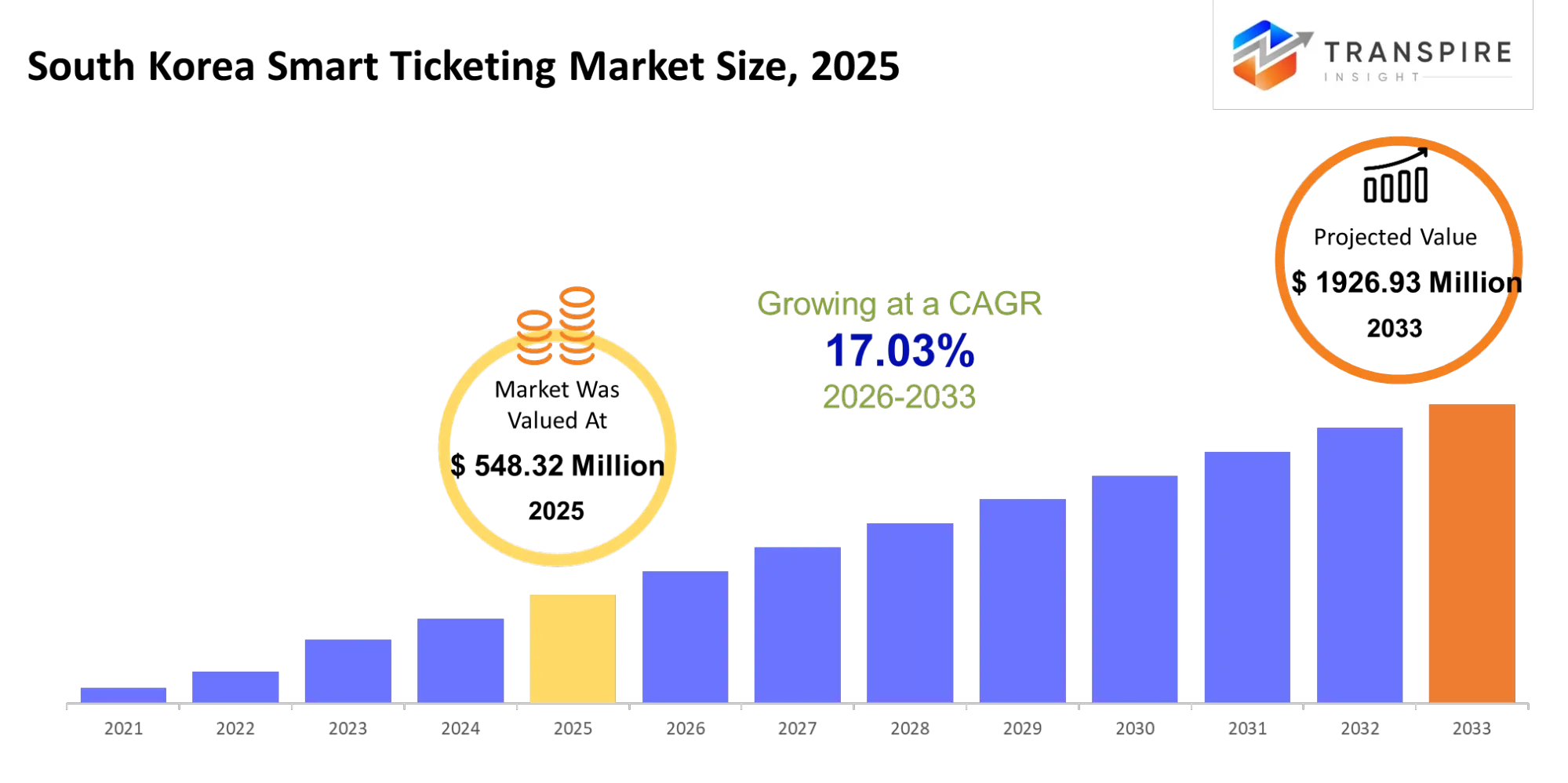
- South Korea Smart Ticketing Market Size 2025: USD 548.32 Million
- South Korea Smart Ticketing Market Size 2033: USD 1926.93 Million
- South Korea Smart Ticketing Market CAGR: 17.03%
- South Korea Smart Ticketing Market Segments: By Ticket Type (Transit Tickets, Event Tickets, Parking Tickets, Airline Tickets, Others); By Technology (NFC-based Ticketing, QR Code Ticketing, RFID Ticketing, Mobile App-based Ticketing, Others); By Application (Public Transportation, Sports & Entertainment, Parking Management, Tourism, Others); By End User (Transportation Authorities, Event Organizers, Airports, Smart Cities, Others); By Payment Mode (Digital Wallets, Contactless Cards, Bank Transfers, Others)
To learn more about this report,  Download Free Sample Report
South Korea Smart Ticketing Market Summary
The South Korea Smart Ticketing Market was valued at USD 548.32 Million in 2025. It is forecast to reach USD 1926.93 Million by 2033. That is a CAGR of 17.03% over the period.
South Korea Smart Ticketing Market really matters for how people, sort of casually, get in and pay for transportation, events, parking facilities and other public services. Instead of relying on paper tickets and cash heavy habits, the shift is toward digital, contactless options. That change cuts down transaction times, makes passenger movement smoother, and lets operators run things more efficiently, largely because they can see real-time information. Over roughly the last five years, the market has changed in a more structural way, moving away from isolated card based systems and toward integrated mobile plus QR code ticketing platforms. Those platforms help with smoother multimodal trips, and they also fit with digital payments.
One of the bigger triggers behind this change was the COVID-19 pandemic, it basically made contactless payments feel more normal and it nudged service providers to modernise their ticketing infrastructure. Because of that, new opportunities are showing up for technology vendors and transportation authorities, since operations can be improved and maintenance costs may drop. And as South Korea keeps investing in smart city initiatives and connected mobility ecosystems, smart ticketing solutions are starting to look like a core piece of digital public infrastructure. In practice, that means wider adoption across transportation systems and many urban services, step by step.
Key Market Insights
- The Seoul Capital Area is really big in the South Korea Smart Ticketing Market. It has 45 percent of the market in 2025. This is because it has a lot of transit networks.
- Busan and Incheon are the places that are growing the fastest until 2030. This is happening because of mobility and urban digitalization projects.
- The governments in these areas are making transportation platforms that work together. This is creating chances for people who make and provide smart ticketing services.
- People are using apps to buy tickets and it is very popular. In 2025 it has 35 percent of the market. This is because almost everyone has a smartphone.
- NFC-based Ticketing is the most popular way to buy tickets. This is because it is already being used in a lot of public transportation systems.
- QR Code Ticketing is growing the fastest. This is because it does not cost a lot to set up and it can be used in different ways.
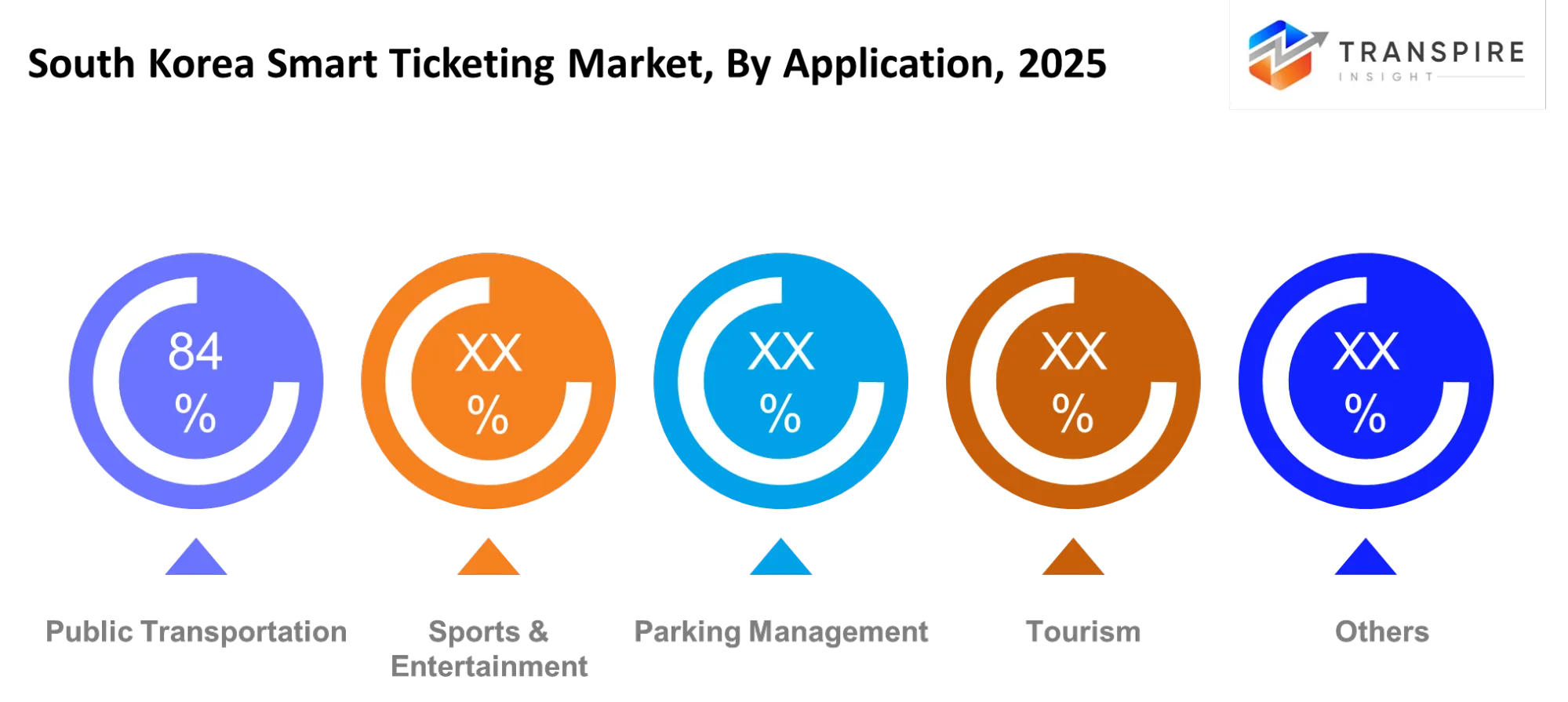
- Public Transportation is the part of the market. In 2025 it has 55 percent of the market. This is because there are a lot of metro, bus and rail networks.
- The Sports and Entertainment part of the market is growing the fastest. This is because stadiums and other venues are starting to use tickets and contactless entry systems.
- People are also starting to use parking and tourism ticketing solutions. This is happening because cities are making platforms that help people move around easily.
- The people, in charge of transportation have the part of the market. In 2025 they have 50 percent of the market revenue.
What are the Key Drivers, Restraints, and Opportunities in the South Korea Smart Ticketing Market?
The primary force pushing the South Korea Smart Ticketing Market forward is the fast integration of digital payment systems into public transit and, kind of, urban mobility services. In practice, Government backed smart city initiatives and nationwide rollout of mobile payment platforms have nudged transit operators to modernize older ticketing setups. When people use smartphones and digital wallets so much, it turns out they rely less on physical cards and cash. That means operators can process payments quicker,and also capture useful passenger data. This whole change improves operational efficiency, lowers transaction costs and opens up recurring income paths for tech suppliers providing cloud-based ticketing, analytics, and payment linking solutions
The biggest hang up, though, is still the complexity of upgrading long established transportation infrastructure. A lot of transit networks keep running on legacy systems, which in the end means substantial investment is needed,and technical compatibility work before modern ticketing tech can be used. This is kinda structural, since transportation authorities have to coordinate hardware swapping, software migration cybersecurity checks, plus interoperability standards across multiple stakeholders. So deployment timelines can stretch for several years. That delays adoption and it limits the revenue potential for solution providers in the meantime.
A noticeable growth chance shows up with the expansion of Mobility-as-a-Service, the kind that pulls multiple travel modes into one digital environment. In South Korea, smart city spending is setting up favorable conditions for unified ticketing across buses, metro networks, ride hailing services, and shared mobility corridors. As these platforms grow up, vendors that can
What Has the Impact of Artificial Intelligence Been on the South Korea Smart Ticketing Market?
Artificial intelligence and more advanced digital tech are reshaping South Korea’s smart ticketing ecosystem, somehow. They’re making fare collection, passenger oversight, and daily system operations feel a lot more efficient than before. Transit operators are adopting AI-powered platforms more and more, to automate ticket validation, fraud detection, and even passenger flow monitoring across subway, bus, and rail routes. With computer vision in place, unauthorized entry attempts can be recognized in real time, while automated fare management tools cut down the need for manual work and also boost the correctness of each transaction.
At the same time, machine learning models are adding predictive features across the whole ticketing setup. Operators use predictive analytics to estimate passenger demand, spot the most busy commuting hours, and adjust ticketing resources accordingly. In practice, these models let transportation authorities foresee congestion, distribute capacity more effectively, and improve overall service dependability. There are also AI-driven maintenance systems that watch ticket gates, validators and payment terminals, flagging signs of equipment trouble before it turns into an actual disruption.
The benefits at operation level are pretty clear. Digital ticketing platforms can shrink transaction processing time, raise system uptime, reduce upkeep expenses, and strengthen revenue protection because fraud detection gets more capable. Plus, real-time analytics allow operators to decide sooner, and they can improve the customer experience with smoother journeys.
Still, AI adoption isn’t fully simple. Blending AI into older transportation infrastructure often demands substantial funding, and if data systems are fragmented, model accuracy can drop. That same fragmentation can slow down how quickly advanced analytics roll out across huge transit networks, even when there is interest.
Key Market Trends
- Since 2020 transportation operators have been moving away from physical transit cards and towards wallets and QR-based ticketing platforms.
- This change happened fast.
- Contactless payment became very popular after the pandemic so metro and bus networks started to allow people to pay digitally.
- Between 2021 and 2025 cities started initiatives to make ticketing systems work together for transportation, parking and public services.
- Now transportation operators use tools that help them figure out how many people are using their services so they can plan better and reduce crowds during busy times.
- Transportation authorities like using cloud-based ticketing systems because they are easier to scale and access.
- They are getting rid of the systems that were only on their own premises.
- Companies like Samsung SDS and LG CNS are working with public transit agencies to make digital mobility better.
- People want to be able to use their payment systems on any network so open-loop payment systems are becoming more popular.
- Now people do not just want to buy tickets for one service they want to be able to use services like buses, metro services and ride-hailing all on one platform.
South Korea Smart Ticketing Market Segmentation
By Ticket Type:
Transit Tickets still kind of keep a big share, mainly because public transportation is a daily need in most urban centers. Digital ticketing solutions have made it easier to board buses, metro services, and rail lines, mainly by shaving down waiting times and making fare payments feel more simple. When you add mobile apps into the mix and use contactless payment methods, adoption got even stronger, like really faster and smoother. Transportation authorities also keep modernizing fare collection systems to boost operational efficiency, in a practical sense.
Event Tickets are now more widely accepted too, since sports venues, entertainment hubs, and cultural attractions are leaning into digital entry systems. Parking Tickets are moving away from paper formats as well, switching into mobile options and QR-enabled approaches that help vehicles move quicker and also automate payment processing. Airline Tickets still matter as a key category, mostly because more travelers prefer digital travel management and self service platforms.
Other ticket categories are growing too, as digital access systems become common across tourism locations, exhibitions, and public facilities. The overall convenience, lower administrative costs, and a better user experience should keep fueling demand across a range of ticketing formats.
By Technology:
NFC based Ticketing it still stays pretty widely used, because it offers quick transaction speeds and it’s already deployed across a lot of transportation networks. The earlier infrastructure investments help keep things running with contactless smart cards plus mobile payments solutions, you know. What really helps is the reliable performance and how easy it feels for customers, so in high volume transit areas NFC tends to be the go to choice. And upgrades keep coming, which is improving system interoperability in a steady way, also customer convenience.
QR code Ticketing is expanding fast, mainly because the deployment needs less infrastructure investment than many of the older or traditional systems. Then there is RFID Ticketing, which keeps being picked for use cases needing secure access control and efficient passenger flow, basically. Mobile App based Ticketing is also gaining ground, mostly because smartphone adoption makes it easier to handle purchasing, ticket storage, and validation without too much friction.
Other technologies are starting to show up in the market too, usually through innovation in digital identity management, cloud platforms, and these integrated mobility solutions. Technology providers keep rolling out updates, aimed at better security, more flexibility, and better real time operational visibility.
By Application:
Public Transportation still feels like the primary application area, mainly because huge numbers of passengers really need an efficient, dependable fare collection setup. Metro networks, bus operators, and rail services keep putting money into digital platforms that, frankly, make the ride feel better and cut down on day to day operational troubles. Contactless payments along with integrated ticketing systems now show up as core parts of modern transit management. Also, real time data abilities help with smarter service planning.
Sports & Entertainment is growing too, because stadiums and event sites want quicker entry steps and better ways to handle the crowd flow. Parking Management is getting more sophisticated, with mobile payments automated access gates, and digital validation tools being used more often. Tourism related services are leaning harder on electronic ticketing as it helps visitors get in with fewer delays, and it trims the manual work that would otherwise pile up.
Other application areas also keep appearing, especially as organizations see the advantages of digital access management. With more connectivity across different services, broader adoption of smart ticketing platforms should come over the next years.
To learn more about this report, Download Free Sample Report
By End User:
Transportation authorities count for a big chunk of demand, mostly because public transit systems need big ticketing setups and ongoing modernization, not just a one time thing. The investments in unified mobility platforms have basically nudged adoption of newer fare collection techniques. Even with all that, operational efficiency, revenue management, and passenger ease are still the main targets. And the long run digital transformation initiatives keep backing the rollout of fresh tech.
Event organizers are also leaning into digital ticketing to better manage attendance and cut down on entry delays, it helps them a lot, honestly. Airports meanwhile are taking up more advanced ticketing and access technologies so journeys feel smoother and their operational control gets stronger. Smart cities are folding transportation, parking, and public services into linked digital ecosystems, that kind of connected approach tends to improve urban mobility, step by step.
Other end users keep testing digital ticketing applications too, aiming to tighten operations and boost customer experiences. On top of that, wider development of digital infrastructure should unlock more chances across several different industries.
By Payment Mode:
Digital Wallets have kind of become a preferred payment option, mainly because most people already carry smartphones, and mobile financial services are more accepted lately. They allow fast transaction processing and the whole ease of use part helps, so they get plugged into transportation systems and event ticketing platforms, pretty smoothly. Service providers keep enhancing compatibility with the big payment ecosystems. Consumers also seem to like contactless transactions, and that support keeps the adoption going.
Contactless Cards still matter a lot, mostly due to familiarity, reliability, and that long built-in infrastructure across transit networks. Bank Transfers keep showing up in certain situations, when a direct account based transaction is what people want. Secure payment processing and regulatory compliance also stay important, across essentially every payment channel you can think of.
Other payment methods are developing in parallel, along with improvements in financial technology and digital commerce. Continued innovation in payment solutions should help strengthen convenience, security, and accessibility on ticketing platforms over time.
What are the Key Use Cases Driving the South Korea Smart Ticketing Market?
Public transportation still stays the main use case that supports adoption across South Korea. Metro operators, rail networks, and bus systems depend on digital fare collection to deal with very high passenger volumes, efficiently. Smart ticketing cuts down transaction times, helps passenger movement, and backs real time travel management, so it becomes a crucial piece of urban mobility infrastructure and yea, it kind of holds everything together.
At the same time sports venues and entertainment facilities are pushing harder on digital access systems, mainly to handle entry management better, and also to reduce congestion when big crowds show up. Airports are also increasing the rollout of integrated ticketing and payment platforms in order to keep passenger journeys smoother, while parking operators are moving toward automated payment and access technologies.
Newer applications are starting to appear inside Mobility-as-a-Service platforms, where multiple transportation options get bundled under one payment environment. Tourism destinations are even exploring unified digital access systems that tie together transportation, attractions, and local services, so the whole experience feels more seamless for domestic and international visitors during the forecast period.
|
Report Metrics |
Details |
|
Market size value in 2025 |
USD 548.32 Million |
|
Market size value in 2026 |
USD 640.99 Million |
|
Revenue forecast in 2033 |
USD 1926.93 Million |
|
Growth rate |
CAGR of 17.03% from 2026 to 2033 |
|
Base year |
2025 |
|
Historical data |
2021 - 2024 |
|
Forecast period |
2026 - 2033 |
|
Report coverage |
Revenue forecast, competitive landscape, growth factors, and trends |
|
Regional scope |
South Korea |
|
Key company profiled |
Samsung SDS, LG CNS, Cubic Transportation Systems, Thales Group, Conduent, HID Global, Masabi, Scheidt & Bachmann, NEC Corporation, INIT Innovations, Siemens Mobility, SK Telecom, NXP Semiconductors, Xerox Corporation, Indra Sistemas |
|
Customization scope |
Free report customization (country, regional & segment scope). Avail customized purchase options to meet your exact research needs. |
|
Report Segmentation |
By Ticket Type (Transit Tickets, Event Tickets, Parking Tickets, Airline Tickets, Others); By Technology (NFC-based Ticketing, QR Code Ticketing, RFID Ticketing, Mobile App-based Ticketing, Others); By Application (Public Transportation, Sports & Entertainment, Parking Management, Tourism, Others); By End User (Transportation Authorities, Event Organizers, Airports, Smart Cities, Others); By Payment Mode (Digital Wallets, Contactless Cards, Bank Transfers, Others) |
Which Regions are Driving the South Korea Smart Ticketing Market Growth?
The Seoul Capital Area is still kinda the top spot in the South Korea Smart Ticketing Market, mostly because it has a dense transportation network, a huge commuter crowd, and also solid government support for digital mobility programs. Seoul and the nearby cities run some of the most advanced metro, bus, and rail systems in the country, which sets up a really good base for big, wide ticketing rollouts. Public authorities keep putting money into integrated payment platforms, linking multiple transportation services with one user experience, so adoption stays high. And because the technology ecosystem is already quite mature backed by major IT providers and payment companies, regional leadership remains pretty steady.
On the other hand, the southeastern region, led by Busan and Ulsan, adds growth in a steady way, it’s driven by a balanced mix of transportation, tourism, and commercial activity. Compared with the Seoul Capital Area, this area grows more through dependable infrastructure extension rather than simply higher passenger density. Local governments continue upgrading transit systems and, at the same time, keep the longer term digital transformation plans in motion. With ongoing investment in transportation modernization, the region becomes a trustworthy source of market revenue.
Meanwhile, the quickest growth seems to be showing up in Incheon and in a number of developing smart city zones across the country. Newer spending on smart mobility projects, integrated transportation platforms, and digital public services has sped up the take up of advanced ticketing tools. Also, the rollout of airport connected transit links and other linked urban infrastructure has opened additional deployment opportunities for technology providers. All that momentum should bring promising angles for new market entrants and investors, especially when they want exposure to next generation mobility solutions during the 2026 to 2033 window.
Who are the Key Players in the South Korea Smart Ticketing Market and How Do They Compete?
Competition in the South Korea Smart Ticketing market is moderately concentrated, with big technology providers competing, while specialized mobility and fare collection firms also push in. In practice, technology capability has turned into the main way they fight for space, because transportation authorities increasingly want integrated platforms that do ticketing together with payment processing, analytics and mobility control, all in one go. The older providers stay on defense by leaning on long-term relationships with public sector bodies, but digital mobility specialists keep rolling out more flexible cloud-based offerings that, somewhat, challenge the old deployment style. Interoperability matters a lot here, along with cybersecurity readiness, and the ability to back multimodal transport networks without breaking the flow.
Samsung SDS is mainly focused on technology-driven mobility platforms that link payment systems, transportation services, and real-time data handling inside one unified ecosystem. The companys strength in digital transformation initiatives becomes a helpful edge when it supports big public infrastructure programs. LG CNS differentiates through smart city integration capabilities, which lets transportation authorities tie the ticketing setup into wider urban digital services. Ongoing collaboration with government agencies and transportation operators supports further movement into newer mobility programs.
NEC Corporation tends to compete via advanced biometric authentication, AI powered analytics, and secure transportation technologies that help raise operational efficiency and improve passenger management. Cubic Transportation Systems specializes in integrated fare collection plus account based ticketing solutions, aimed at smooth travel across multiple transportation modes. Thales Group strengthens its stance through
Company List
- Samsung SDS
- LG CNS
- Cubic Transportation Systems
- Thales Group
- Conduent
- HID Global
- Masabi
- Scheidt & Bachmann
- NEC Corporation
- INIT Innovations
- Siemens Mobility
- SK Telecom
- NXP Semiconductors
- Xerox Corporation
- Indra Sistemas
Recent Development News
In April 2026, Tmoney launched the MobileTmoney transit application on Apple's App Store through a strategic collaboration with Apple and Mastercard. The launch enables international travelers to top up transit balances using Mastercard cards in Apple Wallet and use iPhones or Apple Watches for public transportation payments across South Korea, expanding contactless smart ticketing accessibility and supporting digital fare collection growth.https://ffnews.com
In October 2025, the Seoul Metropolitan Government announced the implementation of an EMV-based open-loop transit payment system in partnership with international card networks including Visa and Mastercard. The initiative includes installing EMV-certified modules on bus terminals during 2025–2026 and establishing a new payment back office, enabling passengers to use global contactless bank cards directly for transit payments and accelerating modernization of South Korea’s smart ticketing infrastructure.https://english.seoul.go.kr
What Strategic Insights Define the Future of the South Korea Smart Ticketing Market?
Over the next five to seven years, the South Korea Smart Ticketing Market is expected to move beyond digital fare collection, toward fully connected mobility ecosystems where ticketing, payments, identity verification, and transportation planning kind of run through one unified platform. Theres a push here thats not just technical though, smart city investments, better real time data infrastructure, and a growing habit for seamless multimodal travel experiences are all meeting at once. In the future, the value that gets created will rely less on standalone ticketing features and more on platform interoperability, like how well everything can “talk” together.
A less obvious risk is the way the market can concentrate around a small set of technology providers, plus specific payment ecosystems. As transportation networks get more dependent on integrated digital platforms, switching costs might climb, and that could make it harder for new players to enter. In turn, competition could soften and innovation may slow down, especially if procurement options start to feel narrow or constrained.
There is also a newer opportunity showing up, digital identity technologies woven directly into mobility services. This seems especially relevant for airport linked transportation networks, and for next generation smart city districts. If adoption happens early, it could unlock new revenue streams via personalized mobility services and automated access management. Market participants should focus on open and interoperable platform architectures, so integrations work across transportation modes, payment networks, and public services too. That way, solutions can better capture long term value as these mobility ecosystems keep getting more and more connected.
South Korea Smart Ticketing Market Report Segmentation
By Ticket Type
- Transit Tickets
- Event Tickets
- Parking Tickets
- Airline Tickets
- Others
By Technology
- NFC-based Ticketing
- QR Code Ticketing
- RFID Ticketing
- Mobile App-based Ticketing
- Others
By Application
- Public Transportation
- Sports & Entertainment
- Parking Management
- Tourism
- Others
By End User
- Transportation Authorities
- Event Organizers
- Airports
- Smart Cities
- Others
By Payment Mode
- Digital Wallets
- Contactless Cards
- Bank Transfers
- Others
Frequently Asked Questions
Find quick answers to common questions.
The expected South Korea Smart Ticketing Market size for the market will be USD 1926.93 Million in 2033.
Key segments for the South Korea Smart Ticketing Market are By Ticket Type (Transit Tickets, Event Tickets, Parking Tickets, Airline Tickets, Others); By Technology (NFC-based Ticketing, QR Code Ticketing, RFID Ticketing, Mobile App-based Ticketing, Others); By Application (Public Transportation, Sports & Entertainment, Parking Management, Tourism, Others); By End User (Transportation Authorities, Event Organizers, Airports, Smart Cities, Others); By Payment Mode (Digital Wallets, Contactless Cards, Bank Transfers, Others).
Major South Korea Smart Ticketing Market players are Samsung SDS, LG CNS, Cubic Transportation Systems, Thales Group, Conduent, HID Global, Masabi, Scheidt & Bachmann, NEC Corporation, INIT Innovations, Siemens Mobility, SK Telecom, NXP Semiconductors, Xerox Corporation, Indra Sistemas.
The South Korea Smart Ticketing Market size is USD 548.32 Million in 2025.
The South Korea Smart Ticketing Market CAGR is 17.03% from 2026 to 2033.
- Samsung SDS
- LG CNS
- Cubic Transportation Systems
- Thales Group
- Conduent
- HID Global
- Masabi
- Scheidt & Bachmann
- NEC Corporation
- INIT Innovations
- Siemens Mobility
- SK Telecom
- NXP Semiconductors
- Xerox Corporation
- Indra Sistemas
About the Authors

Mayur Shinde
I am Mayur Shinde, a Senior Research Analyst at Transpire Insight, specializing in the Automotive & Transportation and Information & Communication Technology (ICT) Industry. My work focuses on analyzing emerging market trends, technological advancements, competitive landscapes, and industry developments to deliver accurate, data-driven insights. I am passionate about transforming complex market information into clear, actionable content that helps businesses, professionals, and decision-makers stay informed and make confident strategic decisions.

Chakradhar Khansole
Chakradhar serves as the Research Director at Transpire Insight, bringing over 8 years of experience in technology, innovation, and strategic market intelligence. He specializes in transforming complex market data into actionable business insights that enable organizations to make informed, growth-oriented decisions. Recognized for his strategic vision and analytical expertise, Chakradhar leads high-impact research initiatives, delivering comprehensive market assessments, competitive intelligence, and forward-looking industry analysis.
Recently Published Reports
-
Apr 2026
3D Optical Profiler Market
3D Optical Profiler Market Size, Share & Analysis Report By Type (Desktop 3D Optical Profiler, and Portable 3D Optical Profiler), By Technology (Confocal Technology, and White Light Interference), By End-Use Industry (Manufacturing, Research Institutions, Automotive, Aerospace and Defense, Medical Devices, and Other), and Geography (North America, Europe, Asia-Pacific, Middle East and Africa, South and Central America), 2021 - 2031
-
Apr 2026
Depth Sensor Market
Depth Sensor Market Size, Share & Analysis Report By Type (Infrared Depth Sensors, Time-of-Flight (ToF) Sensors, Stereo Vision Sensors, Structured Light Sensors, Ultrasonic Depth Sensors), By Application (Automotive, Robotics, Gaming, Consumer Electronics, Industrial Automation, Healthcare, Security & Surveillance, Others), By End Users (Automotive Manufacturers, Consumer Electronics Companies, Healthcare Providers, Industrial Companies, Security Agencies, Gaming Companies, Robotics Companies, Others), and Geography (North America, Europe, Asia-Pacific, Middle East and Africa, South and Central America), 2021 – 2031
-
Apr 2026
Digital Manufacturing Market
Digital Manufacturing Market Size, Share & Analysis Report By Component (Hardware, Software, and Services), By Technology (Robotics, 3D Printing, Internet of Things (IoT), and Others), By Application (Automotive and Transportation, Aerospace and Defense, Consumer Electronics, Industrial Machinery, and Others), By Process Type (Computer-Based Designing, Computer-Based Simulation, Computer 3D Visualization, Analytics, and Others), and Geography (North America, Europe, Asia-Pacific, Middle East and Africa, South and Central America), 2021 – 2031
-
Apr 2026
Digital Visa Services Market
Digital Visa Services Market Size, Share & Analysis Report By Type (Individual Travelers, Group Travelers), By Application (Tourism, Business Travel, Others), and Geography (North America, Europe, Asia-Pacific, Middle East and Africa, South and Central America), 2021 – 2031