

Europe Smart Parking Systems Market Size & Forecast:
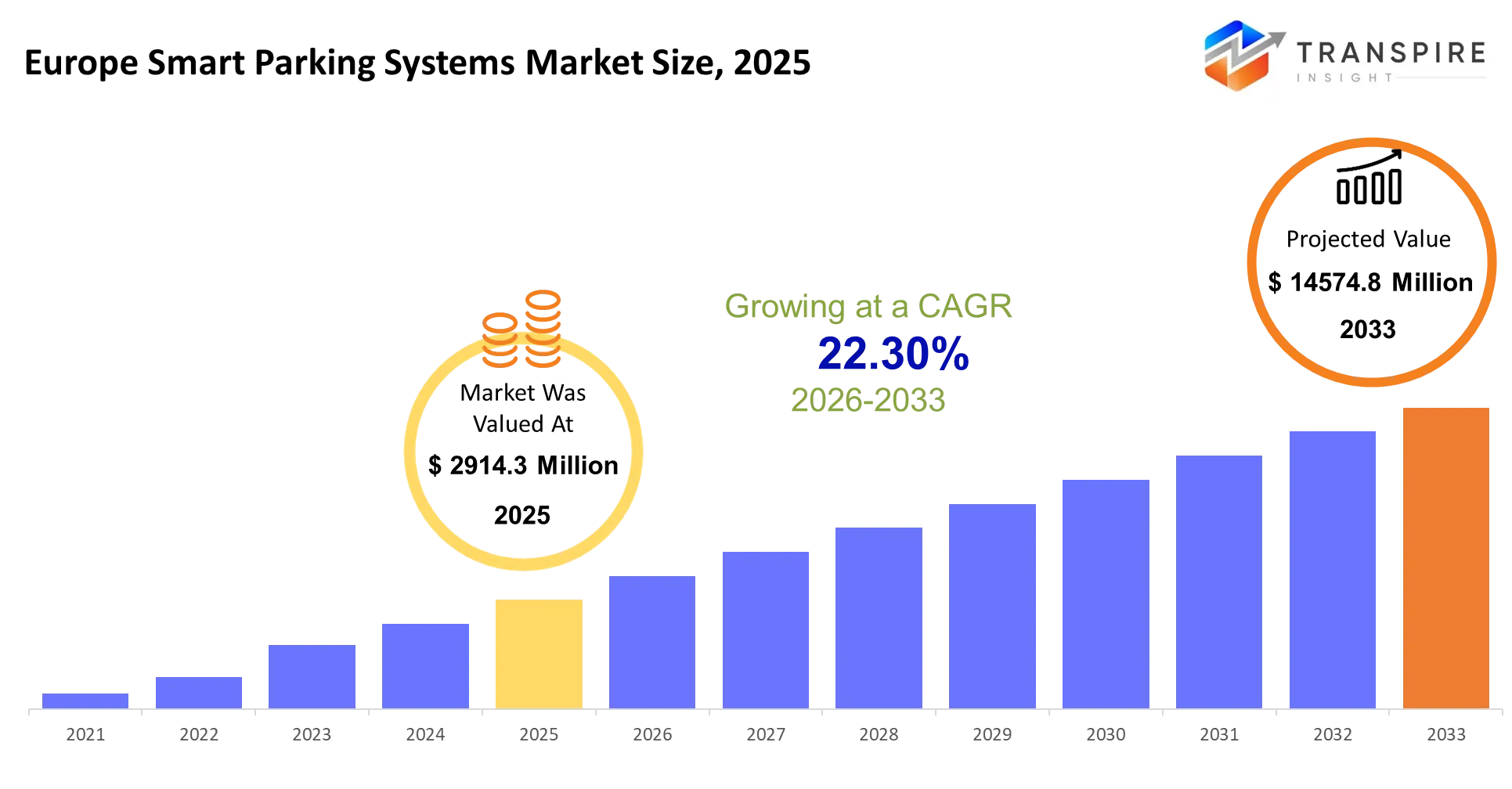
- Europe Smart Parking Systems Market Size 2025: USD 2914.3 Million
- Europe Smart Parking Systems Market Size 2033: USD 14574.8 Million
- Europe Smart Parking Systems Market CAGR: 22.30%
- Europe Smart Parking Systems Market Segments: By Type (Hardware, Software, Services, Sensors, Others); By Application (On-street Parking, Off-street Parking, Commercial Parking, Residential Parking, Smart Cities, Others); By End-User (Municipalities, Enterprises, Transport Authorities, Real Estate Developers, Retail Centers, Others); By Deployment (Cloud, On-premise, Hybrid, Others)
To learn more about this report,  Download Free Sample Report
Europe Smart Parking Systems Market Summary
The Europe Smart Parking Systems Market was valued at USD 2914.3 Million in 2025. It is forecast to reach USD 14574.8 Million by 2033. That is a CAGR of 22.30% over the period.
Smart parking systems in Europe deal with an essential urban challenge which involves excessive vehicles searching for limited parking space. The systems utilize sensors and cameras together with software platforms to direct drivers toward available parking spaces while they process payments and enable city officials to handle parking resources more effectively. The dense urban environment enables better traffic flow and reduced pollution while people make better use of current transportation systems without needing to build new facilities.
The market has undergone a complete transformation during the last three to five years because businesses now prefer platform-based solutions which provide real-time data and mobile applications and adaptive pricing methods. Cities are making investments in interconnected systems instead of purchasing individual hardware components. The implementation of stronger urban emissions regulations by major European cities has compelled local governments to decrease vehicle traffic which results from drivers searching for parking spots.
The current development is creating an upward trend because cities now view parking management as an essential component of their smart mobility initiatives. The vendors now experience a business shift because they obtain extensive multi-year agreements which link digital infrastructure enhancements to their services instead of making single equipment purchases.
Key Market Insights
- Western Europe dominates the Europe Smart Parking Systems Market, which will reach 45% market share in 2025 because Germany France and the UK lead the region.
- The fastest-growing area Northern Europe will experience development until 2030 because of its robust smart city projects and exceptional digital infrastructure growth.
- Smart parking sensors maintain their market leadership by controlling approximately 40% of the market which exists in both on-street and off-street parking systems.
- Parking management software maintains its position as the second-largest market segment because more people need platforms that provide centralized control and enable data-driven performance improvement.
- AI-powered parking analytics platforms represent the fastest-growing segment from 2026 to 2030 because they enable organizations to forecast traffic patterns and monitor space occupancy.
- The Europe Smart Parking Systems Market shows its largest share through commercial applications which operate in shopping centers airports and office complexes.
- The fastest-growing market segment for smart city applications and municipal applications develops through government programs that support urban mobility and programs designed to reduce traffic congestion.
- Municipal authorities will control around 48% of the market share in 2025 because cities spend money on smart infrastructure projects that enhance traffic management while decreasing greenhouse gas emissions.
- The end-user group which shows the fastest growth includes private operators and real estate developers who use smart parking systems to boost asset value while improving user experience.
- Technology advancements in cloud platforms mobile integration and dynamic pricing models help companies gain competitive advantage and market share growth.
What are the Key Drivers, Restraints, and Opportunities in the Europe Smart Parking Systems Market?
The Europe Smart Parking Systems Market experiences its primary growth driver because major cities including London and Paris and Amsterdam implement stricter urban emissions regulations. Low-emission zones and congestion pricing policies have made traffic reduction a measurable policy target rather than a long-term ambition. Municipalities have begun funding smart parking systems because these systems help decrease vehicle driving time to find parking spaces. Drivers will search less time for parking spaces which helps cities meet air quality standards while their traffic system functions better. The direct connection between policies and procurement processes has resulted in bigger contracts which allow faster adoption of multi-year digital infrastructure projects that create ongoing revenue streams for solution providers.
The unified structure of municipal governance and existing infrastructure creates a major obstacle that affects European countries. The different procurement processes and budgeting approaches and technical requirements used by cities create difficulties for establishing widespread systems. Many urban areas still rely on outdated parking meters and siloed IT systems that are not easily integrated with modern platforms. The system upgrade process demands high initial financial investment and requires collaboration among multiple public departments. The process requires multiple steps which cause delays in making decisions and executing projects, which results in lost earnings and slows down the process of establishing common standards between cities.
Smart parking systems need to connect with electric vehicle charging stations in order to create their most profitable growth opportunity. Cities and private operators are developing parking and charging hubs which will help them manage their space and energy needs because electric vehicle adoption continues to grow.Northern European cities are testing platforms which direct drivers to both open parking spaces and available charging stations. The combined system provides premium services which support dynamic pricing together with energy management capabilities that enhance revenue collection and user engagement.
What Has the Impact of Artificial Intelligence Been on the Europe Smart Parking Systems Market?
The development of intelligent parking systems has advanced from basic detection capabilities into real-time operational control through the implementation of artificial intelligence and modern digital technologies. The present-day AI systems installed by cities operate as automated systems which handle three functions: occupancy tracking and pricing adjustments and enforcement procedures. Computer vision systems process camera feeds to identify available spaces, detect violations, and trigger digital ticketing without manual intervention. The enforcement process becomes more efficient through these automated control systems because they cut operational expenses while boosting compliance rates in areas with high commercial activity.
Parking infrastructure now benefits from machine learning models which predict future needs. Operators use historical occupancy data, traffic patterns, and event schedules to forecast demand at specific locations and times. This system enables automatic adjustments to pricing and driver guidance towards alternate routes before traffic congestion reaches critical levels. The predictive maintenance tools in some deployments track both sensor functionality and network performance, which leads to decreased system outages and increased equipment longevity.
The technologies provide measurable improvements to operational performance. The cities experience a 30% reduction in search time, which results in better space utilization and steadier revenue streams that increase through dynamic pricing based on demand. The system faces significant challenges because it requires extensive financial resources for integration while existing systems maintain separate databases. The absence of standardized digital systems in various municipalities restricts AI solutions from achieving optimal performance in real-world conditions, which results in decreased accuracy and limited scalability.
Key Market Trends
- The cities of London and Paris adopted platform-based systems that combine payment processing and enforcement mechanisms and real-time occupancy monitoring systems which they began using in 2021.
- Municipal buyers moved toward subscription-based procurement models after 2022, replacing one-time hardware purchases with recurring software and service contracts.
- The implementation of low-emission zone policies between 2020 and 2024 required cities to minimize parking search traffic which resulted in increased funding for smart parking technology development.
- Vendors such as Siemens AG and SWARCO expanded from hardware supply to full-stack solutions, combining IoT, AI, and cloud platforms for competitive differentiation.
- More than 60 percent of Western European urban drivers will use app-based parking payments by 2025 which resulted in demand for mobile-first user interfaces.
- The electric vehicle charging infrastructure had its first integration through parking systems which became accessible to drivers in Norwegian and Dutch cities after the year 2023.
- Data-driven dynamic pricing gained traction, with pilot programs showing up to 20% improvement in space utilization in dense commercial districts.
- The European Union funded smart city programs to support Eastern European cities which increased their adoption rates, thereby decreasing the technology gap between this region and Western Europe.
- Vendors developed end-to-end urban transport solutions through partnerships with telecom and mobility providers which became their new competitive strategy.
Europe Smart Parking Systems Market Segmentation
By Type:
The hardware and sensors category maintains a dominant market share because these components serve as essential tools for detecting vehicle presence which accounts for nearly 50% of total deployments. Cities and operators need to upgrade their physical infrastructure because they need to replace outdated meters which enable them to track real-time occupancy. The segment experiences expansion because accurate data collection functions as a fundamental requirement for all subsequent software and analytics components. The high costs of installation and the need for ongoing maintenance create obstacles which result in delayed technology adoption by smaller municipalities.
The second largest market segment consists of software platforms and services which people use to obtain centralized control and analytics capabilities. The market expansion for this segment occurs because integrated ecosystems now deliver solutions which handle pricing enforcement and user interaction through mobile applications. The upcoming forecast period will show a market transition towards software-led business models which generate ongoing revenue from platform and service sales that exceed hardware sales.
By Application:
Current deployments for on-street parking systems remain the most common choice because municipalities prioritize congestion control and compliance with regulations. The segment leads the market because it directly influences both urban traffic patterns and the effectiveness of revenue collection operations. Cities allocate substantial financial resources to digitize their curbside parking systems because they aim to decrease vehicle circulation and enhance their enforcement capabilities.
The off-street and commercial parking segments continue to grow at a steady rate which benefits airports and malls and office complexes that seek greater space utilization. Smart city applications show the fastest growth which integrated urban mobility programs drive. Application demand will eventually move towards systems which create links between different parking spaces. This trend will motivate vendors to develop solutions which enable seamless parking system operation.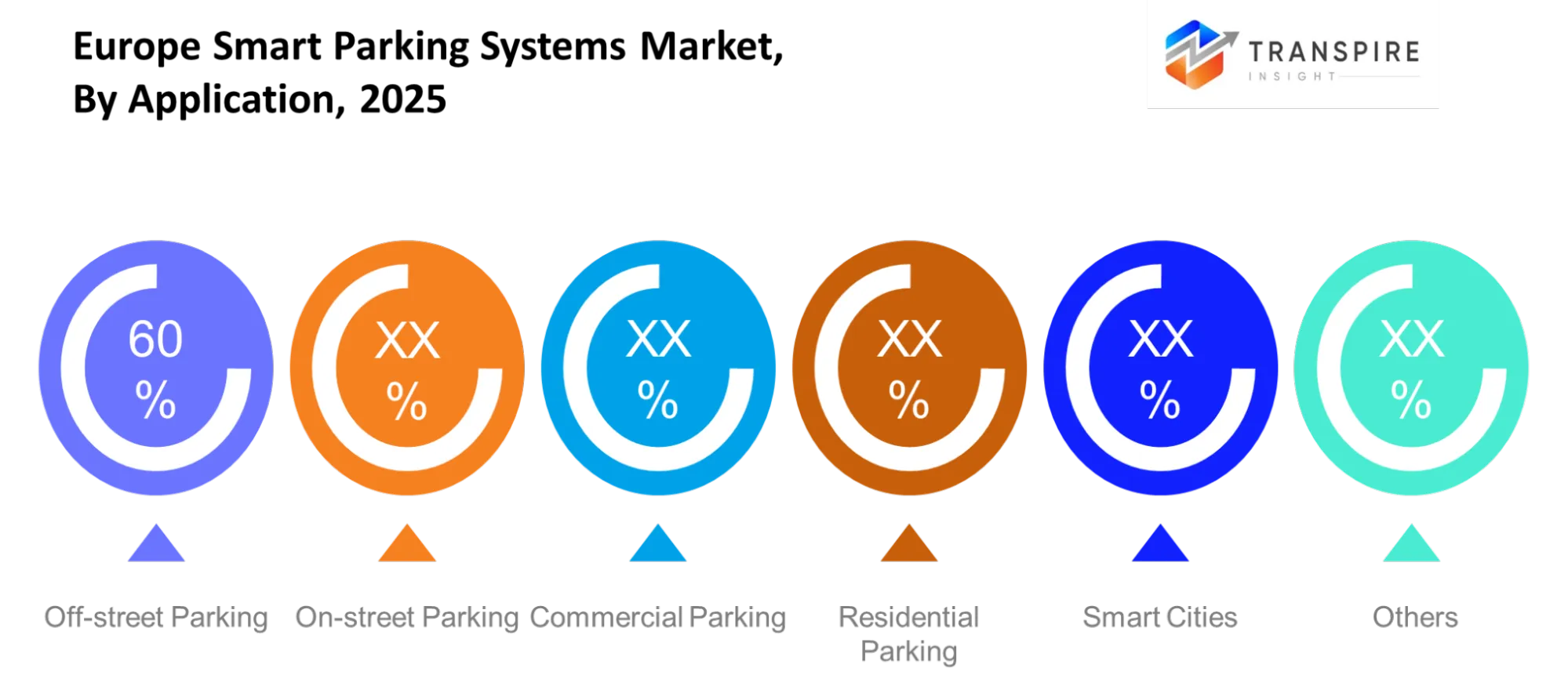
To learn more about this report, Download Free Sample Report
By End-User:
The municipal sector functions as the primary end-user group which generates almost 50 percent of total urban traffic and parking infrastructure demand because municipalities control these systems. Public sector investments exist because policies require emissions reduction and congestion control measures to be implemented. The combination of budget cycles with procurement processes creates adoption delays which prevent organizations from implementing new systems at their desired speed.
The sectors of enterprises, transport authorities, and real estate developers have become primary users who will experience rapid growth. Smart parking systems get adopted by these segments to create better customer experiences while boosting commercial asset value. The growth of the business sector will determine whether companies invest in unified transportation systems which will enable vendors to create products that extend beyond governmental infrastructure requirements.
By Deployment:
Cloud-based deployment leads with a significant share, supported by scalability, lower upfront costs, and ease of integration with mobile and IoT platforms. Operators select cloud solutions to achieve real-time data processing and remote system management capabilities. The model enables quick updates while providing analytical capabilities which require minimal local system resources.
Cities with strict data governance rules and cities that use old IT systems still find on-premise systems useful. The adoption of hybrid models is increasing because they offer organizations both operational control and deployment flexibility which suits their demanding needs. The forecast period will result in increased cloud adoption which will compel solution providers to enhance their cybersecurity and data management and interoperability systems.
What are the Key Use Cases Driving the Europe Smart Parking Systems Market?
The Europe Smart Parking Systems Market functions as an urban municipal parking management system which enables cities to use sensors and software for managing both on-street and off-street parking areas. The application generates maximum demand because it directly tackles downtown traffic problems while enhancing both revenue collection operations and adherence to traffic regulations.
Commercial real estate and transport hubs find expanded applications which include airports and shopping centers. Smart parking platforms enable private operators to direct vehicle movements while they provide mobile payment solutions and improve customer service, which results in increased asset usage and longer customer stay periods at retail spaces.
The industry now develops new use cases which will connect electric vehicle charging networks with multimodal mobility platforms. Northern European cities conduct tests of systems which merge parking availability data with electric vehicle charger information and public transport details to establish a more integrated urban transportation network.
|
Report Metrics |
Details |
|
Market size value in 2025 |
USD 2914.3 Million |
|
Market size value in 2026 |
USD 3561.2 Million |
|
Revenue forecast in 2033 |
USD 14574.8 Million |
|
Growth rate |
CAGR of 22.30% from 2026 to 2033 |
|
Base year |
2025 |
|
Historical data |
2021 - 2024 |
|
Forecast period |
2026 - 2033 |
|
Report coverage |
Revenue forecast, competitive landscape, growth factors, and trends |
|
Regional scope |
Europe (Germany, United Kingdom, France, Italy, Spain, Rest of Europe) |
|
Key company profiled |
Siemens, Bosch, Cisco, IBM, Schneider Electric, Kapsch TrafficCom, Swarco, Amano, ParkMobile, T2 Systems, Flowbird, SKIDATA, Nedap, INRIX, FlashParking |
|
Customization scope |
Free report customization (country, regional & segment scope). Avail customized purchase options to meet your exact research needs. |
|
Report Segmentation |
By Type (Hardware, Software, Services, Sensors, Others); By Application (On-street Parking, Off-street Parking, Commercial Parking, Residential Parking, Smart Cities, Others); By End-User (Municipalities, Enterprises, Transport Authorities, Real Estate Developers, Retail Centers, Others); By Deployment (Cloud, On-premise, Hybrid, Others) |
Which Regions are Driving the Europe Smart Parking Systems Market Growth?
The market in Western Europe expands because cities like London Paris and Amsterdam strictly enforce their urban mobility regulations and low-emission zones. The governments of this region establish direct connections between parking management and air quality targets which leads to increased funding for intelligent parking systems. The leadership position of the organization exists because the organization maintains a complete digital ecosystem which includes extensive IoT networks and high smartphone usage and active public-private partnership agreements. The three groups of technology providers telecom operators and municipal authorities work together to establish a continuous flow of large-scale projects which extend over multiple years.
The region of Northern Europe provides steady output because enforcement requirements do not affect its progress which depends on ongoing digital advancements and complete infrastructure development. The countries of Norway Sweden and Denmark establish their smart city frameworks through early investments which enable parking systems to operate at full capacity. The presence of electric vehicles and digital payment systems creates a strong business case for implementing advanced parking technologies. The region demonstrates stable growth patterns because its public finances remain strong and its cities follow their long-term urban development plans without making emergency policy changes.
The fastest-growing area in Eastern Europe develops because EU funding became accessible and urban modernization efforts gained speed after 2022. Polish and Hungarian and Romanian cities are modernizing their existing parking systems by implementing cloud-based technology for the first time. The transition demonstrates a widespread movement toward digital improvement and better urban transportation standards. The region enables new businesses and investors to enter the market between 2026 and 2033 because it experiences fast growth and requires cost-effective solutions that can be expanded.
Who are the Key Players in the Europe Smart Parking Systems Market and How Do They Compete?
The current state of competition shows moderate fragmentation because various industrial technology companies and mobility specialists and niche software companies compete in the market. The established companies protect their market presence by developing integrated digital platforms which extend their existing hardware products. The primary basis of competition between businesses has changed because companies now compete based on their platform capabilities and data analytics abilities and their long-term service contracts. Buyers now evaluate vendors on interoperability, scalability, and ability to integrate with broader smart city systems rather than standalone product performance.
Siemens AG focuses on technology-led differentiation by embedding smart parking into wider urban mobility and infrastructure platforms. The company uses its strong relationships with municipalities to obtain long-term contracts which include digital city upgrade projects. Robert Bosch GmbH emphasizes sensor accuracy and IoT integration, offering end-to-end solutions that connect parking data with vehicle systems. Bosch established partnerships with automakers and smart city initiatives to create an interconnected network which supports its business development.
The traffic management expertise of SWARCO AG enables the company to create a unique market position through its development of parking systems that integrate with signaling systems and road safety systems. Kapsch TrafficCom builds strength in tolling and mobility platforms, extending capabilities into parking through unified urban mobility solutions. Amano Corporation focuses on automation and payment technologies, expanding across Europe through localized partnerships and tailored solutions for commercial operators, which strengthens its foothold in private parking segments.
Company List
- Siemens
- Bosch
- Cisco
- IBM
- Schneider Electric
- Kapsch TrafficCom
- Swarco
- Amano
- ParkMobile
- T2 Systems
- Flowbird
- SKIDATA
- Nedap
- INRIX
- FlashParking
Recent Development News
In April 2026, Siemens AG announced the acquisition of a minority stake in a European smart mobility startup specializing in AI-based parking optimization, aiming to strengthen its smart city infrastructure portfolio. https://www.reuters.com
In March 2026, Nedap N.V. acquired a regional parking solutions provider in Southern Europe to expand its footprint in integrated access control and smart parking systems. https://www.nedap.com
What Strategic Insights Define the Future of the Europe Smart Parking Systems Market?
The Europe Smart Parking Systems Market is moving toward fully integrated urban mobility platforms where parking functions as one node within a broader data-driven transport ecosystem. The European Smart Parking Systems Market is currently pursuing this path because cities need to meet stricter emissions targets while managing their restricted available space without building new infrastructure. The next five to seven years will see software orchestration layers that link parking systems with traffic management and electric vehicle charging functions become the primary source of value creation.
Public sector budget dependence combined with public sector policy stability presents a hidden danger. Municipal funding cycles will experience delays when political parties abandon their commitment to strict mobility regulations which will result in a slowdown of large-scale urban deployment and reduce vendor availability.
Western European pilot zones offer an emerging opportunity for parking systems to connect with autonomous vehicle infrastructure. Market participants should prioritize interoperable platforms and invest in partnerships with mobility and energy providers to secure long-term relevance and recurring revenue streams.
Europe Smart Parking Systems Market Report Segmentation
By Type
- Hardware
- Software
- Services
- Sensors
- Others
By Application
- On-street Parking
- Off-street Parking
- Commercial Parking
- Residential Parking
- Smart Cities, Others
By End-User
- Municipalities
- Enterprises
- Transport Authorities
- Real Estate Developers
- Retail Centers
- Others
By Deployment
- Cloud
- On-premise
- Hybrid
- Others
Frequently Asked Questions
Find quick answers to common questions.
The Europe Smart Parking Systems Market size is USD 14574.8 Million in 2033.
Key Segments for the Europe Smart Parking Systems Market are By Type (Hardware, Software, Services, Sensors, Others); By Application (On-street Parking, Off-street Parking, Commercial Parking, Residential Parking, Smart Cities, Others); By End-User (Municipalities, Enterprises, Transport Authorities, Real Estate Developers, Retail Centers, Others); By Deployment (Cloud, On-premise, Hybrid, Others).
Major Europe Smart Parking Systems Market Players are Siemens, Bosch, Cisco, IBM, Schneider Electric, Kapsch TrafficCom, Swarco, Amano, ParkMobile, T2 Systems, Flowbird, SKIDATA, Nedap, INRIX, FlashParking.
The Current Europe Smart Parking Systems Market size is USD 2914.3 Million in 2025.
The Europe Smart Parking Systems Market CAGR is 22.30% from 2026 to 2033.
- Siemens
- Bosch
- Cisco
- IBM
- Schneider Electric
- Kapsch TrafficCom
- Swarco
- Amano
- ParkMobile
- T2 Systems
- Flowbird
- SKIDATA
- Nedap
- INRIX
- FlashParking
Recently Published Reports
-
Apr 2026
3D Optical Profiler Market
3D Optical Profiler Market Size, Share & Analysis Report By Type (Desktop 3D Optical Profiler, and Portable 3D Optical Profiler), By Technology (Confocal Technology, and White Light Interference), By End-Use Industry (Manufacturing, Research Institutions, Automotive, Aerospace and Defense, Medical Devices, and Other), and Geography (North America, Europe, Asia-Pacific, Middle East and Africa, South and Central America), 2021 - 2031
-
Apr 2026
Depth Sensor Market
Depth Sensor Market Size, Share & Analysis Report By Type (Infrared Depth Sensors, Time-of-Flight (ToF) Sensors, Stereo Vision Sensors, Structured Light Sensors, Ultrasonic Depth Sensors), By Application (Automotive, Robotics, Gaming, Consumer Electronics, Industrial Automation, Healthcare, Security & Surveillance, Others), By End Users (Automotive Manufacturers, Consumer Electronics Companies, Healthcare Providers, Industrial Companies, Security Agencies, Gaming Companies, Robotics Companies, Others), and Geography (North America, Europe, Asia-Pacific, Middle East and Africa, South and Central America), 2021 – 2031
-
Apr 2026
Digital Manufacturing Market
Digital Manufacturing Market Size, Share & Analysis Report By Component (Hardware, Software, and Services), By Technology (Robotics, 3D Printing, Internet of Things (IoT), and Others), By Application (Automotive and Transportation, Aerospace and Defense, Consumer Electronics, Industrial Machinery, and Others), By Process Type (Computer-Based Designing, Computer-Based Simulation, Computer 3D Visualization, Analytics, and Others), and Geography (North America, Europe, Asia-Pacific, Middle East and Africa, South and Central America), 2021 – 2031
-
Apr 2026
Digital Visa Services Market
Digital Visa Services Market Size, Share & Analysis Report By Type (Individual Travelers, Group Travelers), By Application (Tourism, Business Travel, Others), and Geography (North America, Europe, Asia-Pacific, Middle East and Africa, South and Central America), 2021 – 2031