
United Kingdom QR Code Payments Market Size & Forecast:
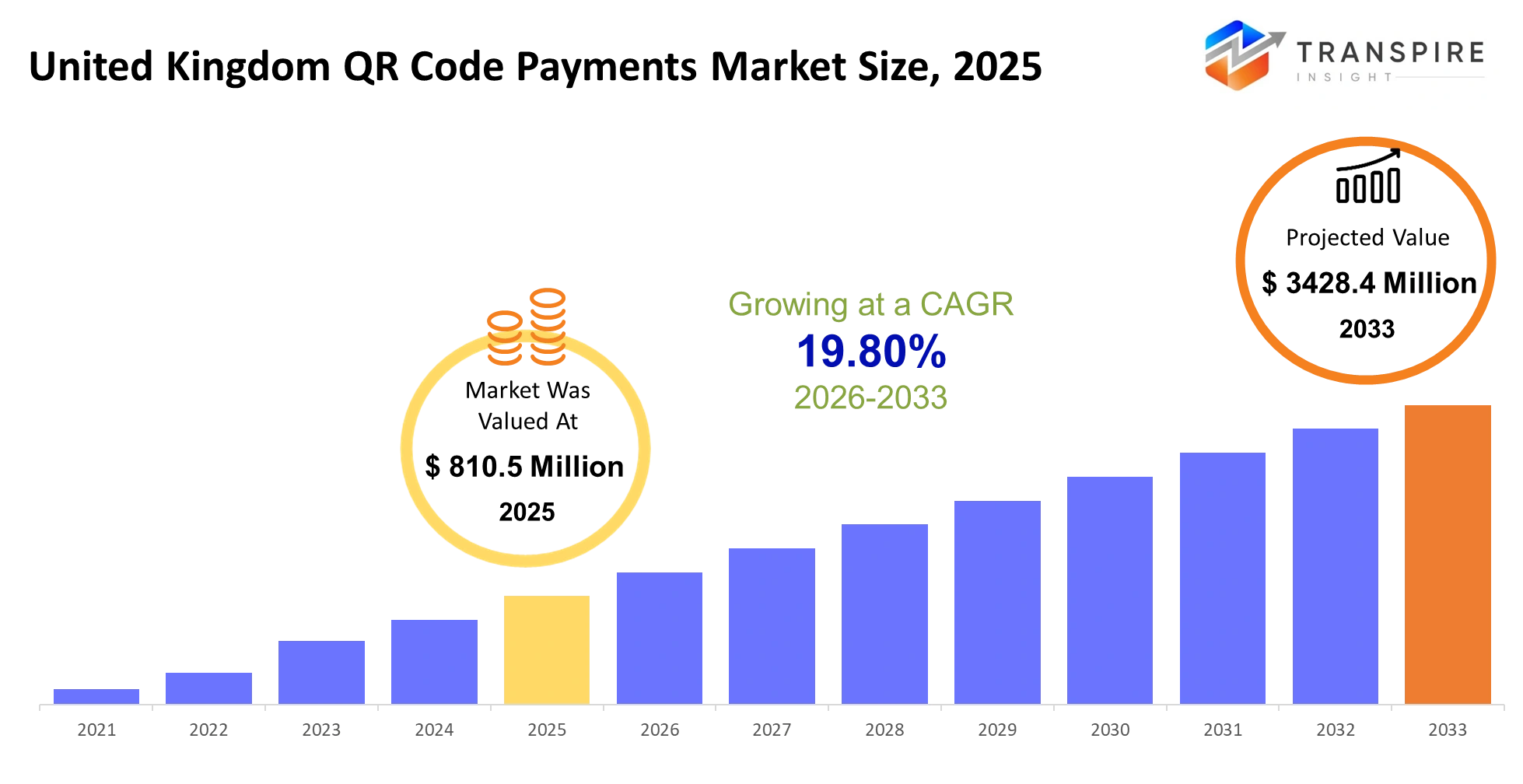
- United Kingdom QR Code Payments Market Size 2025: USD 810.5 Million
- United Kingdom QR Code Payments Market Size 2033: USD 3428.4 Million
- United Kingdom QR Code Payments Market CAGR: 19.80%
- United Kingdom QR Code Payments Market Segments: By Payment Type (Merchant Payments, Peer-to-peer Payments, Bill Payments, Cross-border Payments, Transit Payments, Others); By Deployment (Static QR Codes, Dynamic QR Codes, Cloud-based Payment Platforms, AI-enabled Payment Systems, Others); By Application (Retail Stores, Restaurants, Transportation, E-commerce, Hospitality, Healthcare, Others); By End User (Consumers, SMEs, Enterprises, Banks, Payment Service Providers, Others); By Technology (NFC-integrated QR Payments, Mobile Wallet Integration, Blockchain-enabled Payments, Others).
To learn more about this report,  Download Free Sample Report
United Kingdom QR Code Payments Market Summary
The United Kingdom QR Code Payments Market was valued at USD 810.5 Million in 2025. It is forecast to reach USD 3428.4 Million by 2033. That is a CAGR of 19.80% over the period.
In the United Kingdom, the QR code payments market has kinda moved out of the “nice extra” zone in cafes and retail chains, and more into this practical transaction layer that shows up across transport, hospitality, healthcare, and small business commerce. QR based payments, honestly, solve an operational headache because merchants can accept digital transactions without putting serious money into card terminals or dealing with complicated point-of-sale setups. For consumers, it tends to lower the hassle at checkout and it fits the whole app based banking habit that already feels normal for everyday spending.
Over the last five years, the whole market picture has shifted away from card dominated contactless payments, and toward mobile first account to account transactions. A big reason is open banking frameworks, plus fintech integration, working together in the background. Then the COVID-19 pandemic came in as a major trigger, and businesses moved quickly to touch free payment methods to keep things running during social distancing. That moment changed how merchants operate, and not just temporarily. Now banks, fintech companies, and retailers are using QR systems to cut down transaction processing costs, speed things up, and also gather real time customer data. And that data piece helps push adoption further among independent merchants and service operators across the UK economy.
Key Market Insights
- The United Kingdom QR Code Payments Market is helped by more than 92% smartphone penetration, which really does make QR transactions easier in everyday retail and hospitality, across the board.
- Open banking integration is now one of the biggest demand pulls, because it allows swifter account-to-account QR payments, with reduced processing expenses for merchants, generally speaking.
- What consumers started doing during 2020–2022 for contactless, still keeps showing up, so payment choices lean that way too, and it helps grow QR payment market share in major city trading areas.
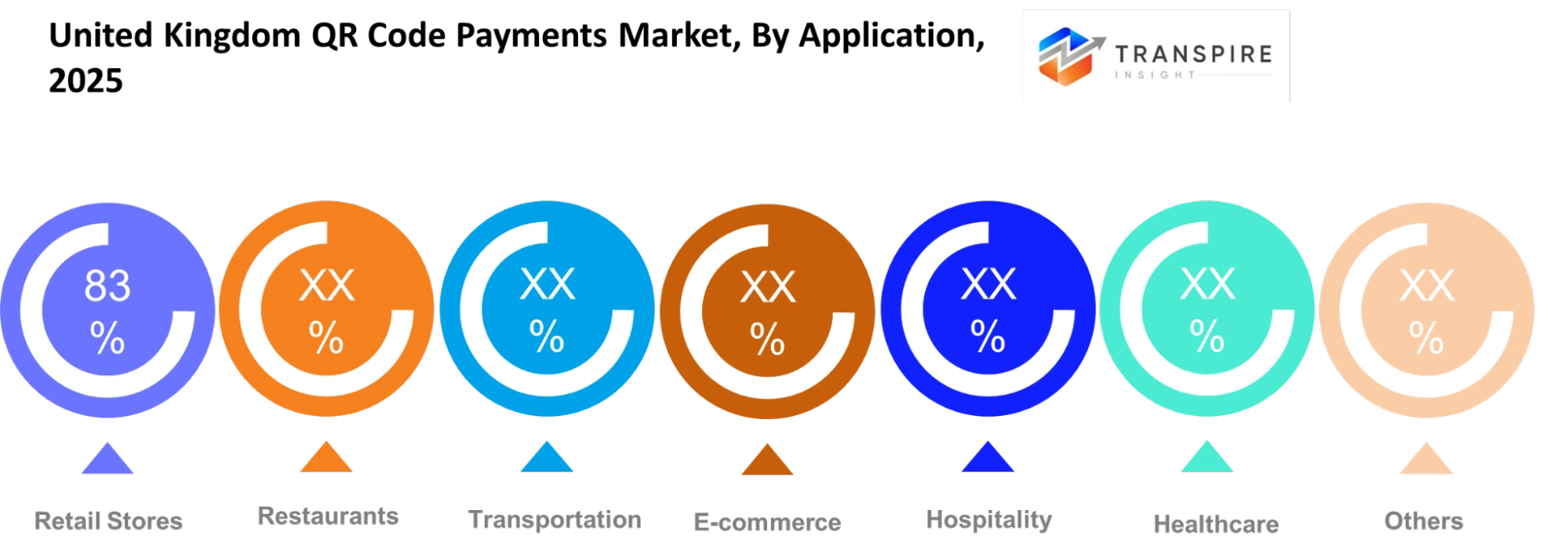
- In terms of use, retail and e-commerce applications are leading the United Kingdom QR Code Payments Market, holding close to 38% share in 2025.
- London remains the top regional center; it will contribute about 41% of industry revenue in 2025, mainly due to dense fintech tooling and active digital commerce.
- Merchant-presented QR codes remain the front-running segment with roughly 46% share in 2025, mostly because hardware deployment costs are lower and onboarding can be faster.
- Dynamic QR code payment solutions are in second place, they’re propelled by stronger transaction protection and automated invoice linking features that reduce manual steps.
- Cross-border QR payment platforms are expected to be the fastest-growing segment by 2030, as tourism rebounds and international wallet interoperability initiatives move forward.
- Retail checkout apps lead among applications too, capturing nearly 35% market share, driven by repeated consumer shopping trips and broader omnichannel payment connection.
- Transportation and mobility payments look like the fastest growth lane, since rail operators, parking providers, and urban transit services keep expanding digital ticketing
What are the Key Drivers, Restraints, and Opportunities in the United Kingdom QR Code Payments Market?
The most powerful thing pushing the United Kingdom QR Code Payments Market forward is basically the fast buildout of open banking infrastructure , plus the steady merchant demand to get card processing costs down. After UK regulators urged financial institutions to back secure account-to-account payment methods, fintech teams have ended up embedding QR payment features straight into mobile banking apps , and also into retail checkout workflows. With that switch, merchants can often avoid parts of the usual card interchange fees and still move money with less delay. And as inflation keeps squeezing operating expenses , especially for retailers and hospitality operators, they increasingly treat QR payments like a straightforward cost control lever, not some minor add-on option. The outcome is that transaction volumes are rising, and payment service providers keep seeing more repeat platform revenue.
Still, the market’s biggest structural hitch is a kind of fragmented payments environment. A lot of smaller merchants run older point-of-sale setups that don’t properly support QR, while consumers juggle several banking apps and wallets , each with its own interoperability rules. Fixing that needs joint investment across banks , fintech companies, retailers, and payment gateways, which doesn’t usually happen in a hurry. So adoption tends to lag beyond the bigger cities, and independent merchants often generate revenue later, since many of them still depend on the standard card terminals and cash routines.
Putting integrated QR payments inside public transport and mobility services is, kinda a big future growth chance. Transport operators all over London and in a bunch of regional UK cities are putting money into digital ticketing systems that let people use their smartphones for access, with quick payment authentication. As the transit authorities modernize their infrastructure and the tourism activity picks up, QR-enabled mobility ecosystems could end up unlocking huge daily transaction volumes, while also making customers more used to QR payment behavior in other commercial sectors too.
What Has the Impact of Artificial Intelligence Been on the United Kingdom QR Code Payments Market?
Artificial intelligence along with advanced digital technologies is kind of reshaping the United Kingdom QR Code Payments Market, mostly by boosting fraud detection, changing transaction routing, and pushing merchant-level payment automation. Right now payment platforms tend to run AI monitored systems that watch transactions in real time, so banks and fintech providers can flag suspicious QR based payment behavior within seconds. This sort of thing lowers chargeback exposure and, at the same time, it makes consumers feel more comfortable using mobile transactions. Also machine learning models are helping fine tune payment authorization routes by guessing transaction success rates across banking networks, which in turn reduces failed payments and lifts checkout completion rates for retailers and e-commerce operators.
At the same time digital payment providers are leaning more into predictive analytics inside merchant dashboards to estimate customer spending habits, spot peak transaction windows and even understand settlement flows. Those views help businesses run liquidity with more discipline while also sharpening promotional targeting through app based payment ecosystems. In areas like transport and hospitality, automated QR payment systems are shortening checkout times, and they also reduce reliance on physical terminals plus cash handling infrastructure, which is kinda important.
Still, AI adoption can run into limits, mainly because banking systems are fragmented, and data sharing standards are not consistent across different payment providers. A lot of small merchants don’t have the technical groundwork for integrating advanced analytics tools, and the differing interoperability rules keep restricting real time optimization across the wider UK digital payments ecosystem.
Key Market Trends
- Since 2021, UK retailers have increasingly replaced standalone payment terminals with app-linked QR arrangements, trying to cut down transaction processing expenses, and also decrease hardware dependency, in general.
- After 2020, open banking rules sped up account-to-account QR payments, so fintech firms could sidestep parts of the usual card interchange machinery.
- From 2022 to 2025, transport operators across London rolled out QR-enabled digital ticketing more widely, which bumped up mobile payments for daily commuters as well as tourists, pretty noticeably.
- After the pandemic, hospitality groups leaned more into table-side QR payments , this eased staffing strain a bit, and shortened the typical checkout duration across many city locations.
- Fintech players like Revolut and Stripe pushed merchant relationships harder, to reinforce embedded payment functions inside mobile commerce platforms.
- Fraud monitoring systems changed a lot after 2022, with AI-driven transaction oversight reducing unauthorized QR payment events, and also improving banking compliance efficiency.
- Small businesses started using static QR payment formats more aggressively after inflation raised card acceptance costs during 2022 and 2023, across a lot of the UK retail scene.
- In 2024, cross-border QR interoperability picked up speed, mainly because tourism rebounded and encouraged payment providers to back international digital wallet compatibility.
- Consumer habits moved toward app-based checkout flows, especially for younger customers, who used loyalty-linked QR transactions for retail runs and food delivery orders.
- Meanwhile, banks and payment gateways put more money into real-time settlement infrastructure, since merchants asked for quicker cash-flow clarity, and fewer reconciliation delays during transactions.
United Kingdom QR Code Payments Market Segmentation
By Payment Type:
Merchant payments have a pretty major place in the United Kingdom QR Code Payments Market, since retail chains, supermarkets, and food outlets keep rolling out mobile checkout workflows for quicker billing, and lower costs tied to transaction handling. Broader smartphone access, along with digital banking availability, helps maintain everyday payment behavior across both city centers and suburban areas, kinda consistently.
Peer-to-peer payments keep getting more attention, especially from younger consumers and freelance workers, because they like instant money movement via banking applications and mobile wallets. In the meantime, bill payments and transit payments are also moving forward, utility providers plus transportation operators are introducing QR-enabled ticketing, and invoice settlement systems. Cross-border payments are growing too, with tourism recovery and stronger compatibility among international wallets, all of that together helps.
By Deployment:
Static QR codes are still heavily used by smaller businesses and independent retailers, mostly because the setup costs stay low, and payment acceptance gets simpler without needing advanced hardware purchases. Cafes, local vendors, and various service providers continue to use printed QR arrangements, for direct account-based payments across a range of commercial situations.
Dynamic QR codes are showing up more often with bigger retailers and hospitality players, because transaction values, invoice data, and customer details can update right away. Cloud hosted payment platforms enable real-time transaction tracing and settlement control, while AI enabled payment systems support fraud prevention and continuous transaction monitoring for financial institutions and payment providers.
By Application:
Retail stores are a pretty strong application segment, like supermarkets, fashion outlets and even convenience chains, they are increasingly adding QR based checkout routines into their mobile commerce approach. With swifter billing cycles, reduced payment processing costs, and a more fluid customer flow , stores in the United Kingdom QR Code Payments Market keep moving toward these options.
Restaurants, cafes and hospitality operators are also leaning into QR linked ordering and payment workflows, partly so customers wait less and teams can run things in a calmer, more organized manner. Meanwhile, transportation providers and e-commerce platforms are reinforcing their digital payment foundations via app ticketing, delivery payments, and those contactless style transactions. In healthcare too, clinics and providers are slowly introducing QR payment choices for appointments and pharmacy purchases.
To learn more about this report, Download Free Sample Report
By End User:
A big reason adoption stays strong is that consumers make up a major share of transaction activity, since mobile banking remains widely used and smartphone access is still high across the United Kingdom. QR payment systems help with faster everyday spending for shopping, meals, commuting, and digital services, and they also cut down the need to keep dealing with physical cash.
SMEs keep adopting QR enabled platforms mainly because the initial setup expenses are lower than those traditional card terminals. Larger enterprises and banks, for their part, invest heavily in connected digital payment ecosystems to gain better transaction visibility and a stronger customer engagement loop. Payment service providers tend to concentrate on growing merchant onboarding networks plus improving real time settlement, because that’s how they aim to sustain longer term platform revenue.
By Technology:
Mobile wallet integration keeps, more or less leading tech adoption, because customers increasingly lean toward app based payment systems that link straight to banking services and loyalty programs . QR enabled wallets also make for faster authentication, smoother transaction tracking, and a more secure digital checkout, across retail together with service industries.
NFC integrated QR payments are slowly expanding, since retailers are mixing contactless card infrastructure with smartphone QR functionality , so the whole process feels more seamless. Blockchain enabled payment systems are still kind of early, but they’re getting attention for cross border payments and better payment security improvements . Financial technology firms keep testing advanced authentication tools and AI driven fraud prevention systems, to deliver stronger payment reliability.
What are the Key Use Cases Driving the United Kingdom QR Code Payments Market?
Retail checkout still feels like the most solid use case in the United Kingdom QR Code Payments Market, because supermarkets, convenience stores, and restaurant chains keep saying the same thing faster, cheaper digital transactions. In practice, QR based systems let merchants trim card processing costs and at the same time speed up the checkout flow, especially when footfall is high, which is kinda always.
Transportation and hospitality are starting to gather momentum too, mostly in regional cities and tourism hubs. Rail operators, parking providers, hotels, and quick service restaurants are more and more relying on QR linked ticketing plus payments, so customers can enter easily and there’s less hassle with physical cash handling. SMEs and independent businesses are also moving toward mobile centered QR solutions, mainly for direct account payments.
And then the newer stuff is coming in, like healthcare invoicing, event triggered digital payments, and cross border wallet interoperability for travelers. Hospitals and private clinics are trialing QR enabled invoice settlement, while fintech companies look into blockchain supported payment authentication, and add AI driven fraud monitoring to make long term transaction security stronger, and to keep consumer confidence steady.
|
Report Metrics |
Details |
|
Market size value in 2025 |
USD 810.5 Million |
|
Market size value in 2026 |
USD 968.2 Million |
|
Revenue forecast in 2033 |
USD 3428.4 Million |
|
Growth rate |
CAGR of 19.80% from 2026 to 2033 |
|
Base year |
2025 |
|
Historical data |
2021 - 2024 |
|
Forecast period |
2026 - 2033 |
|
Report coverage |
Revenue forecast, competitive landscape, growth factors, and trends |
|
Regional scope |
Middle East and Africa (Saudi Arabia, United Arab Emirates, South Africa, Rest of Middle East and Africa) |
|
Key company profiled |
PayPal, Visa, Mastercard, Stripe, Adyen, Square, Revolut, Google Pay, Apple Pay, Samsung Pay, Alipay, WeChat Pay, Worldpay, Barclays, Checkout.com. |
|
Customization scope |
Free report customization (country, regional & segment scope). Avail customized purchase options to meet your exact research needs. |
|
Report Segmentation |
By Payment Type (Merchant Payments, Peer-to-peer Payments, Bill Payments, Cross-border Payments, Transit Payments, Others); By Deployment (Static QR Codes, Dynamic QR Codes, Cloud-based Payment Platforms, AI-enabled Payment Systems, Others); By Application (Retail Stores, Restaurants, Transportation, E-commerce, Hospitality, Healthcare, Others); By End User (Consumers, SMEs, Enterprises, Banks, Payment Service Providers, Others); By Technology (NFC-integrated QR Payments, Mobile Wallet Integration, Blockchain-enabled Payments, Others). |
Which Regions are Driving the United Kingdom QR Code Payments Market Growth?
London and Southeast England are still leading the United Kingdom QR Code Payments Market a bit like, because the region kind of gathers the country’s biggest fintech ecosystem , the strongest banking framework, and the highest digital transaction amounts. A bunch of major retailers, transport operators and hospitality chains in London picked QR-enabled payment systems earlier than other places , largely due to the strong pressure around checkout efficiency and the whole “customer convenience” factor. There is also a solid open banking integration and fast fintech cooperation which helps a quicker rollout of mobile based payment infrastructure across commercial areas. Plus the mix of global payment providers, digital banks, and tech startups leaves behind a kind of mature environment, so transaction frequency stays high and investment continues.
Northern England sits as the second biggest regional contributor, but the growth story feels different. Adoption here seems driven more by hands on business digitization, not by a heavy fintech concentration. Retailers, regional transport operators , and smaller businesses across Manchester, Leeds and Liverpool keep putting money into low cost payment acceptance solutions, mainly to keep operational stability steadier. Regional economic robustness and government supported digital transformation programs back a gradual but consistent expansion of QR enabled commerce infrastructure. Companies in this area often look for affordability, compatibility between systems and dependable transaction settlement, rather than chasing premium engagement tools that are more “marketing heavy”.
Scotland is kind of emerging as the quickest-growing regional market, because modernization is happening fast across tourism, transport, and even public service payment systems. Recently there was more investment in digital ticketing infrastructure, plus cashless public service initiatives which basically helped QR payment adoption pick up speed across busy urban areas and places that get a lot of tourism. Hospitality businesses, and also those independent merchants , are increasingly rolling out mobile-first payment platforms, to serve international travelers and younger consumers who often lean toward app-based transactions. And this whole momentum should open up solid opportunities for fintech providers, payment gateways, and AI-driven fraud monitoring companies that are looking for regional expansion between 2026 and 2033.
Who are the Key Players in the United Kingdom QR Code Payments Market and How Do They Compete?
The competitive setup of the United Kingdom QR Code Payments Market stays sort of moderately fragmented, since big global payment firms, local fintech players, banks, and mobile wallet providers keep pushing their way through multiple transaction ecosystems. Lately the fight feels more tied to how fast transactions move, how quickly merchants get onboarded, how well fraud is prevented, and how smoothly everything plugs into open banking platforms. Even the older style payment providers still defend their market share with more infrastructure and enterprise partnerships, while newer fintech entrants lean into more flexible low-cost digital payment models for SMEs and people who live mostly on mobile. In the end, technology innovation plus ecosystem integration seems to affect who wins, more than hardware deployment by itself.
Revolut basically stands out due to its tight mobile banking integration and cross-border payment functionality, which really targets digitally active consumers and also international travelers. They continue to roll out QR-linked merchant payment tools, for places like restaurants, retail chains, and smaller standalone businesses, and this keeps happening across the United Kingdom. Stripe meanwhile leans very hard into developer-friendly payment integration and embedded commerce infrastructure, so e-commerce platforms and subscription-driven companies can launch QR-enabled checkout systems pretty fast. With advanced API customization and automated settlement features, Stripe manages to win adoption, especially among technology-focused enterprises, where speed and flexibility matter.
PayPal keeps a competitive edge mainly because people trust it, it has a big merchant acceptance network, and the wallet style checkout feels smooth across online plus in person retail. The firm is also still pushing QR payments forward by doing more partnerships with retailers and hospitality operators, the type that want faster mobile transactions. On the other side Visa and Mastercard are both working to broaden QR interoperability while upgrading real time payment infrastructure, and they are doing it by coordinating with banks and various fintech firms across the UK market. In practice, they get an extra lift from their existing banking ties and the huge transaction processing setups they already run, so they can scale secure QR payment ecosystems more quickly across transport, retail, and other commercial payment routes.
Company List
- PayPal
- Visa
- Mastercard
- Stripe
- Adyen
- Square
- Revolut
- Google Pay
- Apple Pay
- Samsung Pay
- Alipay
- WeChat Pay
- Worldpay
- Barclays
- Checkout.com
Recent Development News
In March 2025, Noda launched a new QR payment solution for offline businesses in the United Kingdom. The solution enabled merchants to accept account-to-account payments through customizable QR codes, helping small businesses reduce transaction costs and expand QR-based payment adoption across retail and service sectors.
Source: https://thepaypers.com/
In April 2025, PXP entered a partnership with PayXpert to enable UK merchants to accept QR-based payments, including Alipay+ and WeChat Pay. The collaboration strengthened QR payment infrastructure for international travelers in the UK and expanded alternative payment acceptance among merchants.
Source: https://thepaypers.com/
What Strategic Insights Define the Future of the United Kingdom QR Code Payments Market?
The United Kingdom QR Code Payments Market is moving toward a more deeply integrated account-to-account payment environment, where QR transactions get embedded across retail, mobility, healthcare, and public services rather than working like standalone payment tools. Open banking infrastructure, real-time settlement capabilities, and the fact that merchants keep pushing to lower transaction costs will keep nudging this structural change during the next five to seven years. Payment providers that tie QR systems with loyalty programs, AI-based fraud analytics, and digital identity verification will likely feel stronger long term in terms of competition.
There is also a less obvious risk, related to market concentration, where a small set of dominant banking and payment infrastructure providers gets more control. Smaller fintech firms might find compliance costs harder to swallow , plus cybersecurity investments, and interoperability standards that don’t really bend. In practice, this could shrink innovation variety over time. At the same time, digitization of regional public transport, and cross-border wallet interoperability, is showing up as a real opportunity especially in Scotland and Northern England, where investment in digital infrastructure keeps accelerating.
So market participants should really focus on partnerships with transport operators , local governments, and SME networks. Transaction frequency and repeated user engagement inside those ecosystems will, in the end, shape the next phase of scalable QR payment adoption.
United Kingdom QR Code Payments Market Report Segmentation
By Payment Type
- Merchant Payments
- Peer-to-peer Payments
- Bill Payments
- Cross-border Payments
- Transit Payments
By Deployment
- Static QR Codes
- Dynamic QR Codes
- Cloud-based Payment Platforms
- AI-enabled Payment Systems
By Application
- Retail Stores
- Restaurants
- Transportation
- E-commerce
- Hospitality
- Healthcare
By End User
- Consumers
- SMEs
- Enterprises
- Banks
- Payment Service Providers
By Technology
- NFC-integrated QR Payments
- Mobile Wallet Integration
- Blockchain-enabled Payments
Frequently Asked Questions
Find quick answers to common questions.
The United Kingdom QR Code Payments Market size is USD 3428.4 Million in 2033.
Key segments for the United Kingdom QR Code Payments Market are By Payment Type (Merchant Payments, Peer-to-peer Payments, Bill Payments, Cross-border Payments, Transit Payments, Others); By Deployment (Static QR Codes, Dynamic QR Codes, Cloud-based Payment Platforms, AI-enabled Payment Systems, Others); By Application (Retail Stores, Restaurants, Transportation, E-commerce, Hospitality, Healthcare, Others); By End User (Consumers, SMEs, Enterprises, Banks, Payment Service Providers, Others); By Technology (NFC-integrated QR Payments, Mobile Wallet Integration, Blockchain-enabled Payments, Others).
Major United Kingdom QR Code Payments Market players are PayPal, Visa, Mastercard, Stripe, Adyen, Square, Revolut, Google Pay, Apple Pay, Samsung Pay, Alipay, WeChat Pay, Worldpay, Barclays, Checkout.com.
The United Kingdom QR Code Payments Market size is USD 810.5 Million in 2025.
The United Kingdom QR Code Payments Market CAGR is 19.80% from 2026 to 2033.
- PayPal
- Visa
- Mastercard
- Stripe
- Adyen
- Square
- Revolut
- Google Pay
- Apple Pay
- Samsung Pay
- Alipay
- WeChat Pay
- Worldpay
- Barclays
- Checkout.com
About the Authors

Mayur Shinde
I am Mayur Shinde, a Senior Research Analyst at Transpire Insight, specializing in the Automotive & Transportation and Information & Communication Technology (ICT) Industry. My work focuses on analyzing emerging market trends, technological advancements, competitive landscapes, and industry developments to deliver accurate, data-driven insights. I am passionate about transforming complex market information into clear, actionable content that helps businesses, professionals, and decision-makers stay informed and make confident strategic decisions.

Chakradhar Khansole
Chakradhar serves as the Research Director at Transpire Insight, bringing over 8 years of experience in technology, innovation, and strategic market intelligence. He specializes in transforming complex market data into actionable business insights that enable organizations to make informed, growth-oriented decisions. Recognized for his strategic vision and analytical expertise, Chakradhar leads high-impact research initiatives, delivering comprehensive market assessments, competitive intelligence, and forward-looking industry analysis.
Recently Published Reports
-
Apr 2026
3D Optical Profiler Market
3D Optical Profiler Market Size, Share & Analysis Report By Type (Desktop 3D Optical Profiler, and Portable 3D Optical Profiler), By Technology (Confocal Technology, and White Light Interference), By End-Use Industry (Manufacturing, Research Institutions, Automotive, Aerospace and Defense, Medical Devices, and Other), and Geography (North America, Europe, Asia-Pacific, Middle East and Africa, South and Central America), 2021 - 2031
-
Apr 2026
Depth Sensor Market
Depth Sensor Market Size, Share & Analysis Report By Type (Infrared Depth Sensors, Time-of-Flight (ToF) Sensors, Stereo Vision Sensors, Structured Light Sensors, Ultrasonic Depth Sensors), By Application (Automotive, Robotics, Gaming, Consumer Electronics, Industrial Automation, Healthcare, Security & Surveillance, Others), By End Users (Automotive Manufacturers, Consumer Electronics Companies, Healthcare Providers, Industrial Companies, Security Agencies, Gaming Companies, Robotics Companies, Others), and Geography (North America, Europe, Asia-Pacific, Middle East and Africa, South and Central America), 2021 – 2031
-
Apr 2026
Digital Manufacturing Market
Digital Manufacturing Market Size, Share & Analysis Report By Component (Hardware, Software, and Services), By Technology (Robotics, 3D Printing, Internet of Things (IoT), and Others), By Application (Automotive and Transportation, Aerospace and Defense, Consumer Electronics, Industrial Machinery, and Others), By Process Type (Computer-Based Designing, Computer-Based Simulation, Computer 3D Visualization, Analytics, and Others), and Geography (North America, Europe, Asia-Pacific, Middle East and Africa, South and Central America), 2021 – 2031
-
Apr 2026
Digital Visa Services Market
Digital Visa Services Market Size, Share & Analysis Report By Type (Individual Travelers, Group Travelers), By Application (Tourism, Business Travel, Others), and Geography (North America, Europe, Asia-Pacific, Middle East and Africa, South and Central America), 2021 – 2031