South Korea Sensor Fusion Market Summary:
According to Transpire Insights, a detailed research report on the South Korea Sensor Fusion Market reflects that the Advanced Driver Assistance Systems (ADAS) application segment dominates the market, supported by the increasing integration of radar, LiDAR, camera, and ultrasonic sensors for real-time perception, object detection, collision avoidance, and autonomous driving functions. Hyundai Mobis leads the market with a strong position in ADAS sensors, sensor fusion modules, and integrated automotive electronics, making it a leading contributor to South Korea’s market development, technological innovation, advanced sensor-fusion solutions, expanding autonomous-driving capabilities, and overall market growth dynamics. The market is further strengthened by South Korea’s advanced semiconductor ecosystem, growing electric-vehicle adoption, software-defined vehicle development, and increasing investment in autonomous-driving technologies.
Market Snapshot
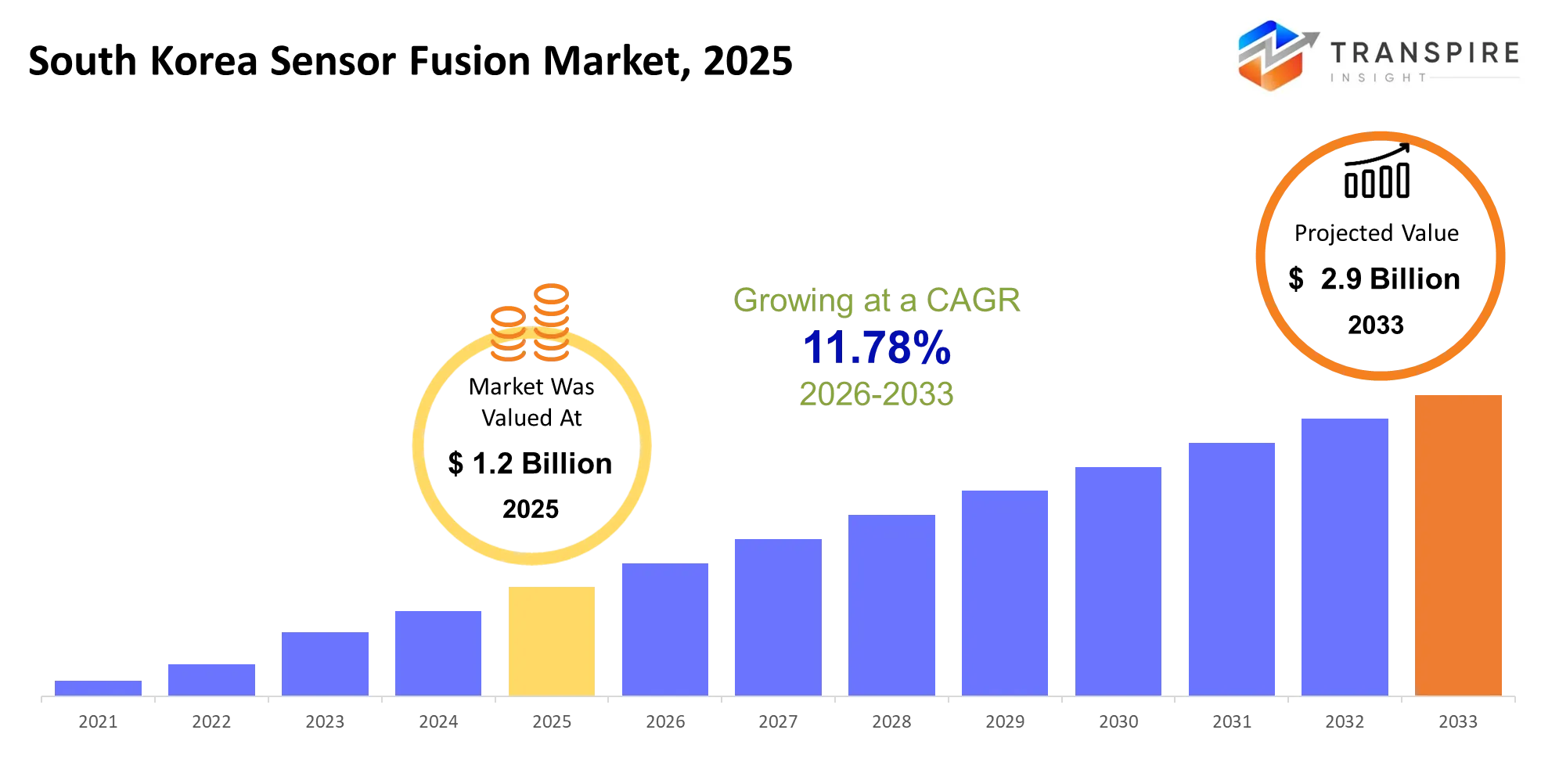
- Market Value (2025): USD 1.2 Billion.
- Expected Market Value (2026): USD 1.33 Billion.
- Estimated Market Value (2033): USD 2.9 Billion.
- Forecast CAGR (2026–2033): 11.78%
Introduction
South Korea’s sensor fusion market is a rapidly growing market segment of the larger South Korean technology and automotive innovation landscape. Sensor fusion is the combination of data from several independent sources (such as cameras, radar, lidar and inertial sensors) using complex algorithms to create a single, highly accurate representation of the environment around an object. The country’s world-class semiconductor manufacturing base, a strong automotive ecosystem and government backing for artificial intelligence and edge computing continue to accelerate adoption of this technology. Strong demand is seen in particular in advanced driver assistance systems, electric vehicles, consumer electronics, and smart factory automation. As domestic industry leaders step up their investments in AI-powered edge processing, sensor fusion is becoming a key enabler for South Korea’s next-generation manufacturing and mobility infrastructure.
Key Market Highlights: -
- 1 By Fusion Type, the Radar-camera dominated the market and holds approximately 43.56% share in 2025 and is projected to grow at a substantial CAGR during the forecast period.
- By Sensor Input, the Adaptive Cruise Control (ACC) dominated the market and holds approximately 23% share in 2025 and is projected to grow at a substantial CAGR during the forecast period.
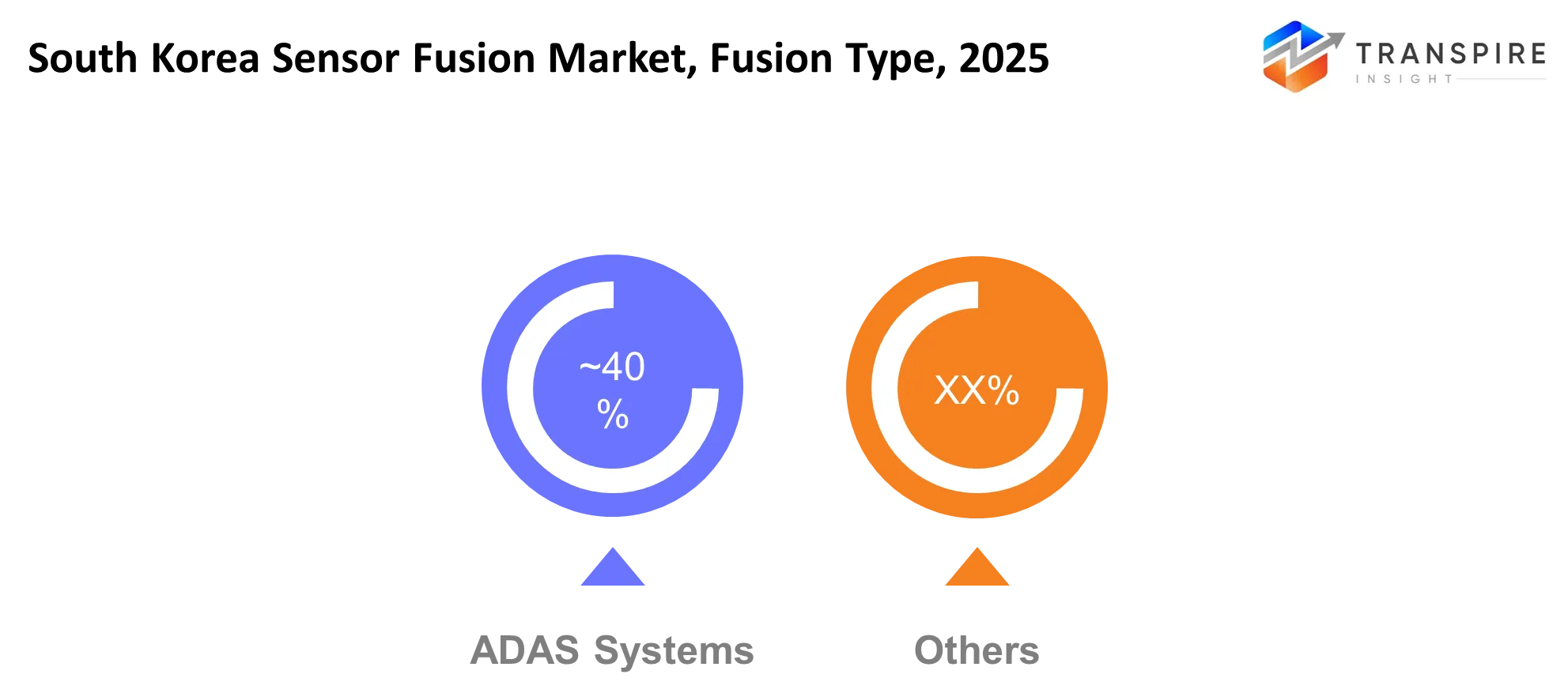
- By Application, the ADAS Systems (Advanced Driver Assistance Systems) Manufacturers segment dominated the market and holds approximately 85.12% share in 2025 and is projected to grow at a substantial CAGR during the forecast period.
- South Korea’s Digital New Deal is investing trillions of KRW in sensor and artificial intelligence (AI) technologies, and next-generation sensor fusion is a key pillar of the nation’s fourth industrial revolution strategy.
How is Technology Driving Growth in the South Korea Sensor Fusion Market?
Technology remains the core growth driver in South Korea’s sensor fusion market, with the country experiencing advancements in artificial intelligence, semiconductor manufacturing, and the integration of autonomous systems. Machine learning and artificial intelligence combine data from cameras, radar and LiDAR sensors to make real-time decisions. High-bandwidth memory and advanced microchips needed for heavy data fusion workloads are available from domestic semiconductor leaders such as Samsung Electronics and SK Hynix. Meanwhile, automotive electrification, ADAS adoption and government-backed Industry 4.0 initiatives continue to accelerate IoT sensor deployment across manufacturing plants and smart city infrastructure in the country.
Market Drivers
The South Korean sensor fusion market is bolstered by government-backed smart infrastructure, a robust automotive and electronics ecosystem, and increasing consumer demand for advanced safety systems. Government-backed autonomous driving pilot projects continue to accelerate the deployment of multi-sensor integration suites around the country. As demand for premium vehicle features grows, domestic automakers are embedding ADAS systems based on camera, radar and LiDAR in new models. National investments in IoT infrastructure and smart city development are furthering demand for data fusion across a wide range of urban and industrial use cases. South Korea’s advanced semiconductor manufacturing base provides the key engineering base to support edge-AI processing and sensor hardware production.
Restrain
There are different structural constraints in South Korea’s sensor fusion market. The increasing costs of LiDAR, MEMS and AI-enabled hardware are driving up the costs of production, while dependence on imported optics and processing chips puts manufacturers at a geopolitical and supply chain risk. The integration complexity across legacy systems, skill shortages in the workforce for specialized engineering, and the stringent requirements for certification under Korean Industrial Standards (KIS) further extend development cycles, which limits the ability of smaller enterprises to compete in the high-end sensor fusion technology space.
|
Driver |
Relative Impact on Growth (%) |
Geographic Relevance |
Impact Timeline |
Demand Strength |
Growth Mechanism |
Key Beneficiaries |
Major Constraint |
|
Driver 1: Accelerating ADAS and Autonomous Driving Adoption |
28% |
Seoul, Gyeonggi, Incheon, Major Automotive Hubs |
Long-term (≥4 years) |
High |
Expands multi-sensor perception across advanced vehicles. |
Automakers, Tier-1 suppliers, sensor vendors, AI developers |
High system costs and complex sensor calibration |
|
Driver 2: Rising AI-Based Sensor Fusion and Software-Defined Vehicles |
23% |
Seoul, Gyeonggi, Daejeon, Pangyo |
Medium-term (2–4 years) |
High |
Combines sensor data for faster, accurate decisions. |
AI firms, semiconductor companies, software vendors, OEMs |
High computational requirements and validation complexity |
|
Driver 3: Government Support for Autonomous Vehicle Commercialization |
19% |
Nationwide, Pilot Operation Zones, Expressway Corridors |
Short-term (≤2 years) |
High |
Accelerates testing, deployment, and commercialization of autonomous systems. |
Mobility operators, technology suppliers, OEMs, infrastructure providers |
Regulatory compliance and safety certification requirements |
|
Driver 4: Expansion of EVs and Intelligent Vehicle Electronics |
17% |
Seoul Capital Area, Gyeonggi, Ulsan, Major EV Production Hubs |
Medium-term (2–4 years) |
High |
Increases demand for integrated perception electronics. |
EV manufacturers, semiconductor firms, sensor suppliers, Tier-1s |
Semiconductor shortages and component costs |
|
Driver 5: Growing Autonomous Logistics and Smart Mobility Services |
13% |
Seoul–Metropolitan Area, Logistics Corridors, Industrial Regions |
Medium-term (2–4 years) |
Medium |
Enables safer automated freight and mobility operations. |
Logistics firms, fleet operators, OEMs, mobility platforms |
Infrastructure readiness and operational safety challenges |
Analysis of Prices and Consumer Behaviour
In the South Korea Sensor Fusion Market, advanced sensor fusion systems (68% share of total market; mostly owing to the needs of the automotive, ADAS, autonomous driving, and intelligent mobility sectors) dominate. The price of an advanced sensor-fusion system is estimated to be 35% higher compared to those of alternative systems since the technology is developed using advanced AI algorithms, multi-sensor integration, certified components, and reliable perception accuracy. About 45% of all units of sensor-fusion systems are deployed in integrated platforms of software and hardware. Deployment of such technologies occurs owing to the versatility of the sensor fusion technology in application in autonomous vehicles, ADAS, robotics, and smart mobility and the relatively long life cycle of integrated solutions. The automobile and intelligent mobility sectors constitute about 70% of the demand from these sectors. The purchasing preferences of the clients show that 55% pay the most attention to sensor-fusion precision, reliability, and standardized multi-sensor integration. Moreover, 33% of the clients prefer bulk purchases and long-term contracts as they try to minimize the expenses on technology procurement and provide themselves with the continuous supply of sensor-fusion systems.
|
Company |
Est. Revenue Share Range |
Key Offerings |
Strategic Positioning |
Geographic Strength |
Technology Focus |
|
Hyundai Mobis |
15–20% (Estimated) |
ADAS controllers; radar and camera systems; LiDAR; integrated driving/parking controllers |
Integrated Korean Tier-1 system integration leadership |
Asia Pacific; North America; Europe |
Sensor fusion; ADAS; LiDAR; radar; SDV controllers |
|
Valeo |
9–13% (Estimated) |
ADAS systems; ultrasonic sensors; radar; cameras; SCALA LiDAR |
Broad ADAS portfolio with localized Korean manufacturing |
Europe; Asia Pacific; North America |
LiDAR; radar; cameras; ultrasonic fusion |
|
Aptiv |
8–12% (Estimated) |
Gen 8 radar; Gen 6 ADAS platform; PULSE sensor; automated parking |
Software-driven perception and scalable ADAS platforms |
North America; Europe; Asia Pacific |
AI/ML; radar fusion; perception; automated driving |
|
Bosch |
7–11% (Estimated) |
Radar systems; camera systems; ADAS integration platforms; vehicle computers |
End-to-end automotive sensing and integration expertise |
Europe; Asia Pacific; North America |
AI sensor fusion; radar perception; computer vision |
|
Continental |
6–10% (Estimated) |
Xelve ADAS/AD; radar; LiDAR integration; camera systems |
Scalable L2-L4 architecture across vehicle segments |
Europe; Asia Pacific; North America |
Low-level fusion; radar; LiDAR; automotive software |
|
ZF |
5–8% (Estimated) |
ProAI; OnGuardMAX; Smart Camera; radar-camera ADAS |
Central-compute and sensor-integration platform strategy |
Europe; Asia Pacific; North America |
Sensor fusion; central computing; computer vision; AI |
|
LG Electronics |
4–7% (Estimated) |
Sensor-fusion systems; ADAS cameras; cross-domain controllers; HPC platforms |
Integrated electronics and SDV ecosystem differentiation |
Asia Pacific; North America; Europe |
Camera-radar fusion; HPC; AI; SDV |
|
NVIDIA |
3–6% (Estimated) |
NVIDIA Hyperion; DRIVE/automotive computing; AI software; simulation platforms |
AI-compute platform leadership through OEM partnerships |
North America; Asia Pacific; Europe |
Accelerated computing; AI; perception; simulation |
|
Qualcomm Technologies |
3–6% (Estimated) |
Snapdragon Ride; Snapdragon Ride Flex; Ride Vision; automotive AI SoCs |
Scalable SoC ecosystem for software-defined vehicles |
North America; Asia Pacific; Europe |
AI SoCs; sensor fusion; computer vision; central compute |
|
Mobileye |
2–5% (Estimated) |
Mobileye Surround ADAS; EyeQ6H; SuperVision; Chauffeur |
Vision-centric ADAS with multi-sensor fusion |
North America; Europe; Asia Pacific |
Computer vision; camera-radar fusion; EyeQ; REM |
Who are the Key Players in the South Korea Sensor Fusion Market and how do they compete?
Market competitiveness of the South Korea Sensor Fusion Market is determined by those companies that have expertise in innovations in the field of technologies, industry-specific solutions, and development of distribution networks at the international level. Firms compete not only on pricing but also on innovations in the field of advanced sensors, intelligent perception, connectivity, and integrations with digital and automotive operation systems; such an approach to competition results in continuous product innovation as well as in safety, efficiency, fast decision-making, optimization of resources, and operation visibility.
Advanced sensor fusion systems, ADAS solutions, autonomous driving technologies, and connected car platform developments contribute to the competitive advantages of Hyundai Mobis. Advanced sensor technologies designed for automotive perception, autonomous driving, radar, LiDAR, and camera applications allow HL Klemove to distinguish itself from its competitors. Development of integrated solutions for automotive sensing, camera modules, LiDAR solutions, and advanced mobility systems allow LG Innotek to develop its competitive advantage.
Top Companies in the South Korea Sensor Fusion Market
- Hyundai Mobis
- HL Klemove
- LG Innotek
- Samsung Electronics
- Bosch
- Continental
- Aptiv
- ZF
- Valeo
- Denso
- NXP Semiconductors
- Renesas Electronics
- Infineon Technologies
- Qualcomm
- Autoliv
South Korea Sensor Fusion Market Segmentation
The South Korea Sensor Fusion Market share is divided into five categories: By Fusion Type, By Sensor Input, By Application, By End User, By Technology
The Radar-camera dominated the market, accounting for nearly 43.56% in 2025 and is expected to rise at a significant CAGR during the forecast period.
The South Korea Sensor Fusion Market is segmented by fusion type into lidar + radar fusion, camera + ultrasonic, imu + gps fusion, multi-sensor ai fusion, radar + camera, lidar + camera, radar + ultrasonic. Among these, the Radar-camera segment dominated the market, accounting for nearly 43.56% in 2025 and expected to increase at a significant CAGR during the forecast period. Radar-Camera Fusion technology prevails because of its better all-weather performance, cost-effectiveness, and reliable detection of objects and distances as well as the surroundings of vehicles.
The Adaptive Cruise Control (ACC) dominated the market, accounting for nearly 23% in 2025, and is expected to rise at a significant CAGR during the forecast period.
The South Korea Sensor Fusion Market is segmented by sensor input into object detection, parking assist, motion navigation, all sensor streams, lane detection, driver monitoring, environmental perception. Among these, the Adaptive Cruise Control (ACC) dominated the market, accounting for nearly 23% in 2025 and expected to increase at a significant CAGR during the forecast period. Adaptive Cruise Control technology prevails because of its mass adoption by consumers, mandatory safety regulations, and easy integration into both mass-produced and high-end car segments.
The ADAS Systems (Advanced Driver Assistance Systems) dominated the market, accounting for nearly 85.12% in 2025 and is expected to rise at a significant CAGR during the forecast period.
The South Korea Sensor Fusion Market is segmentedby application into adas systems, blind spot & obstacle avoidance, robotics & drone control, real-time decision support, autonomous driving, industrial automation, smart mobility. Among these, the ADAS Systems (Advanced Driver Assistance Systems) dominated the market, accounting for nearly 85.12% in 2025 and expected to increase at a significant CAGR during the forecast period. ADAS Systems prevail because of their safety regulations, adoption of autonomous vehicles, and demand for assistance technology by consumers.
Future Market Trends for the South Korea Sensor Fusion Market:-
Autonomous Mobility and ADAS Growth Level 3–5 autonomous platforms are fueling multi-sensor integration across cameras, radar, LiDAR, and ultrasonic systems with Hyundai and Kia leading domestic adoption.
Smart Cities and Environmental Monitoring Urban IoT sensor networks are rapidly expanding in Seoul and other large cities, enabling real-time data fusion for air quality and environmental monitoring projects.
Edge AI and Localized Processing: On-device data fusion is reducing latency and cloud dependence, supported by emerging edge AI chips and South Korea’s extensive 5G infrastructure.
Recent Development
- In March 2026 Smart Infrastructure & Environmental Monitoring: Seoul's subway and urban pollution-abatement initiatives launched ongoing deployment of integrated environmental sensor arrays and real-time data fusion platforms across the city.
- In September 2026 Data & Tech Fusion Expansion: Naver Labs, KT Corporation, and expanding analytics platforms launched accelerated urban digital twin and smart transportation data-fusion deployments across South Korean metropolitan sectors.
- Early 2026 Automotive & Edge-AI Convergence: LG Innotek and Samsung Electro-Mechanics launched high-reliability hardware lines combining camera, radar, and LiDAR data stacks to satisfy strict automotive safety standards.
Market Segmentation
This study forecasts revenue at Japan, regional and country levels from 2020 to 2033. Transpire Insights has segmented the South Korea Sensor Fusion Market based on the below-mentioned segments:
South Korea Sensor Fusion Market, By Fusion Type
- LiDAR + Radar Fusion
- Camera + Ultrasonic
- IMU + GPS Fusion
- Multi-Sensor AI Fusion
- Radar + Camera
- LiDAR + Camera
- Radar + Ultrasonic
South Korea Sensor Fusion Market, By Sensor Input
- Object Detection
- Parking Assist
- Motion Navigation
- All Sensor Streams
- Lane Detection
- Driver Monitoring
- Environmental Perception
South Korea Sensor Fusion Market, By Application
- ADAS Systems
- Blind Spot & Obstacle Avoidance
- Robotics & Drone Control
- Real-Time Decision Support
- Autonomous Driving
- Industrial Automation
- Smart Mobility
South Korea Sensor Fusion Market, By End User
- Autonomous Car OEMs
- Vehicle Electronics Makers
- Mobility Equipment Vendors
- Self-Driving Platforms
- Robotics Companies
- Drone Manufacturers
- Industrial Automation Companies
South Korea Sensor Fusion Market, By Technology
- AI-Based Fusion
- Kalman Filtering
- Deep Learning
- Computer Vision
- Edge Computing
- Sensor Calibration
- Real-Time Processing
Frequently Asked Questions
Find quick answers to common questions.
AI adoption, autonomous driving, ADAS deployment, semiconductor capabilities, smart infrastructure, and government-backed technology investments are accelerating sensor fusion adoption.
Radar-camera fusion dominates because it provides reliable object detection, cost efficiency, and improved all-weather performance across automotive applications.
ADAS systems lead the market, supported by safety requirements, autonomous vehicle adoption, and growing consumer demand for advanced assistance technologies.
AI-based fusion, deep learning, computer vision, edge computing, sensor calibration, and real-time processing are shaping next-generation sensor fusion systems.
High hardware costs, supply-chain risks, integration complexity, specialized skill shortages, and stringent certification requirements constrain market expansion opportunities.
- Hyundai Mobis
- HL Klemove
- LG Innotek
- Samsung Electronics
- Bosch
- Continental
- Aptiv
- ZF
- Valeo
- Denso
- NXP Semiconductors
- Renesas Electronics
- Infineon Technologies
- Qualcomm
- Autoliv
About the Authors

Mayur Shinde
I am Mayur Shinde, a Senior Research Analyst at Transpire Insight, specializing in the Automotive & Transportation and Information & Communication Technology (ICT) Industry. My work focuses on analyzing emerging market trends, technological advancements, competitive landscapes, and industry developments to deliver accurate, data-driven insights. I am passionate about transforming complex market information into clear, actionable content that helps businesses, professionals, and decision-makers stay informed and make confident strategic decisions.

Chakradhar Khansole
Chakradhar serves as the Research Director at Transpire Insight, bringing over 8 years of experience in technology, innovation, and strategic market intelligence. He specializes in transforming complex market data into actionable business insights that enable organizations to make informed, growth-oriented decisions. Recognized for his strategic vision and analytical expertise, Chakradhar leads high-impact research initiatives, delivering comprehensive market assessments, competitive intelligence, and forward-looking industry analysis.
Recently Published Reports
-
Apr 2026
ATV & UTV Market
ATV & UTV Market Size, Share & Analysis Report By Type (ATV, and UTV), By Variants (Less Than 400 CC, 400 CC To 800 CC, and More Than 800 CC), and Geography (North America, Europe, Asia-Pacific, Middle East and Africa, South and Central America), 2021 - 2031
-
Apr 2026
Automotive Central Gateway Module Market
Automotive Central Gateway Module Market Size, Share & Analysis Report By Type (Ethernet Central Gateway Module, CAN Central Gateway Module, LIN Central Gateway Module, and FlexRay), By Application (Powertrain Control, Body Control, Infotainment System, Advanced Driver Assistance Systems (ADAS), and Others), By End User (Passenger Vehicles, and Commercial Vehicles), and Geography (North America, Europe, Asia-Pacific, Middle East and Africa, South and Central America), 2021 - 2031
-
Apr 2026
Automotive Engine Oil Filter Market
Automotive Engine Oil Filter Market Size, Share & Analysis Report By Filter Type (Fuel Filter, Engine Oil Filter, Hydraulic Oil Filter, and Others), By Filter Media (Cellulose, Synthetic, and Micro), By Sales Channel (OEMs, and Aftermarket), By Vehicle Type (Passenger Cars, Light Commercial Vehicles, Heavy Duty Trucks, Buses and Coaches, and Off-road Vehicles), and Geography (North America, Europe, Asia-Pacific, Middle East and Africa, South and Central America), 2021 - 2031
-
Apr 2026
Automotive Parts Aluminium Die Casting Market
Automotive Parts Aluminium Die Casting Market Size, Share & Analysis Report By Production Process (Pressure Die Casting, Vacuum Die Casting, Squeeze Die Casting, Gravity Die Casting), By Application (Body Parts, Engine Parts, Transmission Parts, Battery And Related Components, Other Application Types), and Geography (North America, Europe, Asia-Pacific, Middle East and Africa, South and Central America), 2021 - 2031
Our Clients