

Europe Autonomous Cars Market Summary
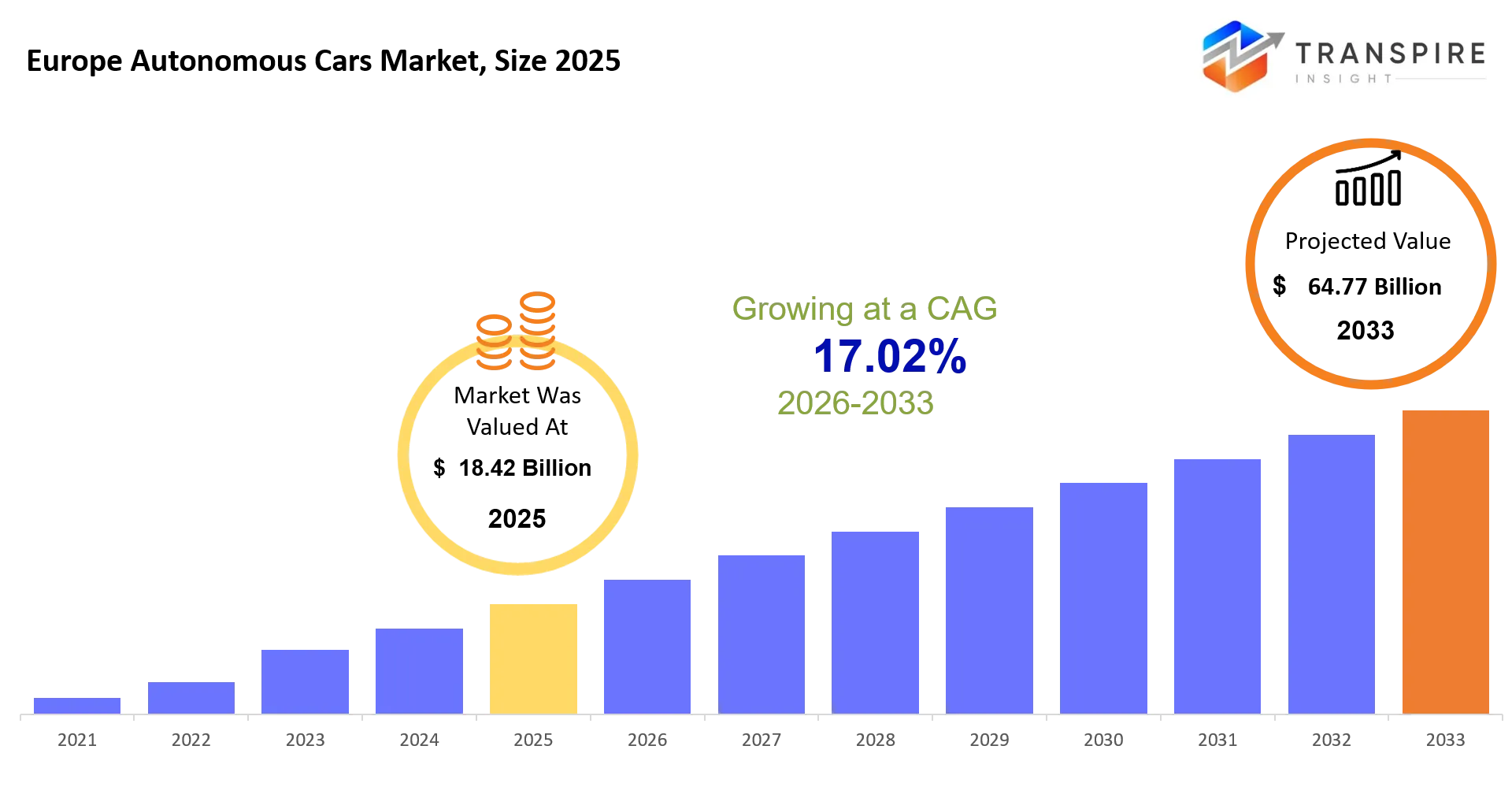
As per Transpire Insight Analysis the Europe Autonomous Cars Market size is estimated at USD 18.42 Billion in 2025 and is anticipated to reach USD 64.77 Billion by 2033, growing at a CAGR of 17.02% from 2026 to 2033.
The Europe Autonomous Cars Market kind of takes on a real transport headache, like trimming down human driving slip ups, easing traffic streams, and making daily mobility feel more secure for both passenger vehicles and commercial fleets. In practice, automakers, mobility providers, and logistics groups plug in autonomous tech, not just to automate, but to calibrate vehicle behavior, lessen incident exposure, and help transportation networks operate more smoothly.
Over the last five years, things moved away from small isolated pilot programs, and toward bigger rollouts that combine advanced driver assistance and higher levels of automated driving. That shift is getting supported by software-defined vehicle architectures, so the whole stack is easier to update and coordinate. At the same time, stricter European vehicle safety rules, along with connected mobility initiatives, helped accelerate investment, yet semiconductor shortages, caused by broader global supply chain disruptions, prompted manufacturers to pause and rethink where they source parts. They also had to prioritize higher-value autonomous features first, for now.
Now, digital infrastructure, artificial intelligence, and regulatory frameworks are maturing more or less together, and deployment confidence overall is getting stronger, which is really encouraging broader fleet adoption. It also opens up expanded software-based revenue options and is slowly shaping longer-term business models across the European automotive ecosystem, and honestly it feels like the momentum is sticking.
Europe Autonomous Cars Market Size & Forecast:
- Europe Autonomous Cars Market Size 2025: USD 18.42 Billion
- Expected Market Value 2033: USD 64.77 Billion
- Forecast CAGR: 17.02%
- Leading region in 2025: Germany, France, United Kingdom, Netherlands
- Fastest Growing region: Poland, Czech Republic, Hungary, Romania
- Key Profile: Mercedes-Benz, BMW Group, Volkswagen Group, Stellantis, Volvo Cars, Renault Group, Tesla, Mobileye, Waymo, Bosch, Continental, Valeo, Aptiv, Nvidia, ZF Friedrichshafen
Key Market Insights
- Western Europe sort of dominated the Europe Autonomous Cars Market, holding around 68% market share in 2025, mostly backed by long-standing automotive manufacturing and yes, favorable autonomous vehicle regulations.
- Central and Eastern Europe will still be the fastest-growing area during 2025–2033, fueled by smart mobility investments and also by broader automotive production capacity ramp ups.
- For product type, passenger autonomous vehicles basically led the pack with nearly 72% share in 2025, a result of stronger rollout, from premium automotive manufacturers across Europe.
- Commercial autonomous vehicles stayed in the second-largest position, because logistics operators moved faster with automated freight, plus last-mile mobility trial programs.
- When it comes to autonomy level, Level 4 autonomous vehicles are set to post the fastest growth through 2033, helped by more urban mobility pilots, and better artificial intelligence capabilities too.
- In terms of applications, passenger transportation grabbed about 64% market share in 2025, supported by advanced driver assistance integration, and also by premium vehicle sales.
- Logistics and goods transportation will likely become the quickest-growing application across the forecast, as autonomous freight corridors keep expanding through Europe.
- On the customer side, private mobility providers accounted for nearly 61% share in 2025, while fleet operators pushed ahead, with autonomous technology being folded into premium vehicle portfolios.
- Shared mobility and autonomous fleet operators will see the biggest expansion through 2033 as city transportation models increasingly adopt driverless technologies, bit by bit.
What are the Key Drivers, Restraints, and Opportunities in the Europe Autonomous Cars Market?
The most powerful driver for market expansion is the move toward software defined vehicles, backed by refreshed European vehicle safety rules and also connected mobility policies. Nowadays, automakers are folding in advanced sensing , artificial intelligence processors, and over the air software updates while the vehicle is still being designed, not just tacking them on later. That kind of pivot makes the innovation cycles shorter, and it also builds recurring software revenue next to normal vehicle sales. Plus, when automation capability rises, it tends to boost consumer comfort, so premium vehicle uptake goes up, and bigger budgets follow for autonomous mobility programs.
Still, the main structural obstacle is the sheer complexity of validating autonomous systems across various European road environments, plus the fact that national regulations are split into many pieces. Certification approaches, cybersecurity requirements, and liability guidelines don’t match neatly from one country to the next, so fast commercialization becomes kinda hard. In practice, validation takes a lot, think thousands of extra testing hours before anything can be deployed. From Transpire Insight review of the regional procurement news and launch timing, the biggest execution risk is supply chain concentration. Semiconductor availability, along with high performance computing hardware, keeps affecting launch schedules, which then delays commercial rollouts and reduces near term revenue opportunities.
A big opportunity is coming to the surface via autonomous logistics corridors, and smart city ecosystems spanning Western and Central Europe. 5G style connectivity along with edge computing and vehicle-to-everything exchanges will make automated freight movement a lot more secure. In the background, governments are still putting money into digital road infrastructure that can sustain higher automation thresholds.At the same time, strategic support for cloud fleet control and AI driven mobility platforms will bring in brand new repeat software income, and it will also widen autonomous transit beyond the typical high end passenger cars.
What Has the Impact of Artificial Intelligence Been on the Europe Autonomous Cars Market?
Artificial intelligence has become kind of the base layer for autonomous mobility across Europe, because it lets vehicles interpret road scenes, spot hazards, and then choose driving actions in real time. More advanced neural networks keep chewing through incoming data from cameras , radar, lidar and ultrasonic sensors, so automated control systems can get better at navigation precision, while also staying aligned with road safety rules that keep evolving. On top of that, machine learning strengthens predictive servicing, by noticing component wear well before failures pop up, which cuts down on surprise downtime for commercial fleets and helps tune maintenance routines via ongoing vehicle diagnostics.
Digital twins plus cloud analytics also let manufacturers sort of predict software behavior ahead of time, verify new driving algorithms, and move faster on over-the-air feature releases without pausing day to day operations. Altogether these pieces help operational efficiency, shorten development cycles, and increase vehicle readiness, while at the same time lowering life cycle maintenance costs. Artificial intelligence also helps with traffic forecasting and route optimization, this in turn improves fleet utilization across city mobility corridors. The costs to integrate are high, real world driving situations are inconsistent, regulations are fragmented across countries, and the sheer volume of high quality driving data needed for continuous algorithm training. Those factors keep large scale commercialization limited across multiple European markets.
Key Market Trends
- European Union vehicle safety rules put in place after 2022 kind of sped up the whole process, where advanced driver assistance tech gets integrated like stepping stones, to reach higher autonomous driving levels .
- Software defined vehicle setups have basically moved the focus away from hardware-first development, so manufacturers can push constant feature improvements via over the air software updates , kind of like a living system .
- AI processors with higher compute power have helped bring down perception delay , which improves real time driving choices while dealing with complicated city traffic situations that keep changing .
- Automotive companies now partner more and more with cloud providers plus semiconductor firms, to build autonomous software ecosystems with more muscle , not just leaning on in-house teams and internal work .
- Commercial freight operators also rolled out more autonomous logistics pilots from 2023 to 2025 , aiming at better highway freight efficiency and reduced operating expenses, more or less.
- Connected road infrastructure spending across Germany, France, and the Nordic region improved vehicle to everything communication , which supports safer automated mobility .
- Premium vehicle makers have increasingly turned Level 3 autonomous driving features into real products , while also ramping up development efforts for wider Level 4 rollout .
- Cybersecurity expectations have been tightened since 2024, so investment in secure software platforms is higher and remote vehicle monitoring keeps running, day after day .
- Testing for cross border autonomous mobility grew along European transport corridors too, helping align regulations and making it faster to commercialize automated driving technologies, overall .
Europe Autonomous Cars Market Segmentation
By Vehicle Type:
Passenger Cars kept the biggest slice, mainly because automotive manufacturers kept stitching in advanced driver assistance and automated driving features into both premium and mid-range vehicles, kinda steadily, and without too much pause. People also started to accept the tech more, while tighter safety standards showed up and software-based upgrades helped adoption move along across many big European countries. Then Commercial Vehicles came next, with more investment into autonomous freight transport, warehouse logistics, and long-distance delivery runs, which in turn boosted day to day operational efficiency.
Robo-Taxis drew a lot of attention due to city based pilot programs, those were kept controlled, and they were backed by smart city plans plus digital infrastructure improvements. Luxury Vehicles stayed relevant too, since premium brands rolled out higher automation capabilities earlier than the wider market rollout. Over the forecast period, Electric Autonomous Vehicles, Delivery Vehicles, Shared Mobility Vehicles, and Others should keep opening fresh business opportunities as connected transportation networks and fleet driven mobility services keep expanding.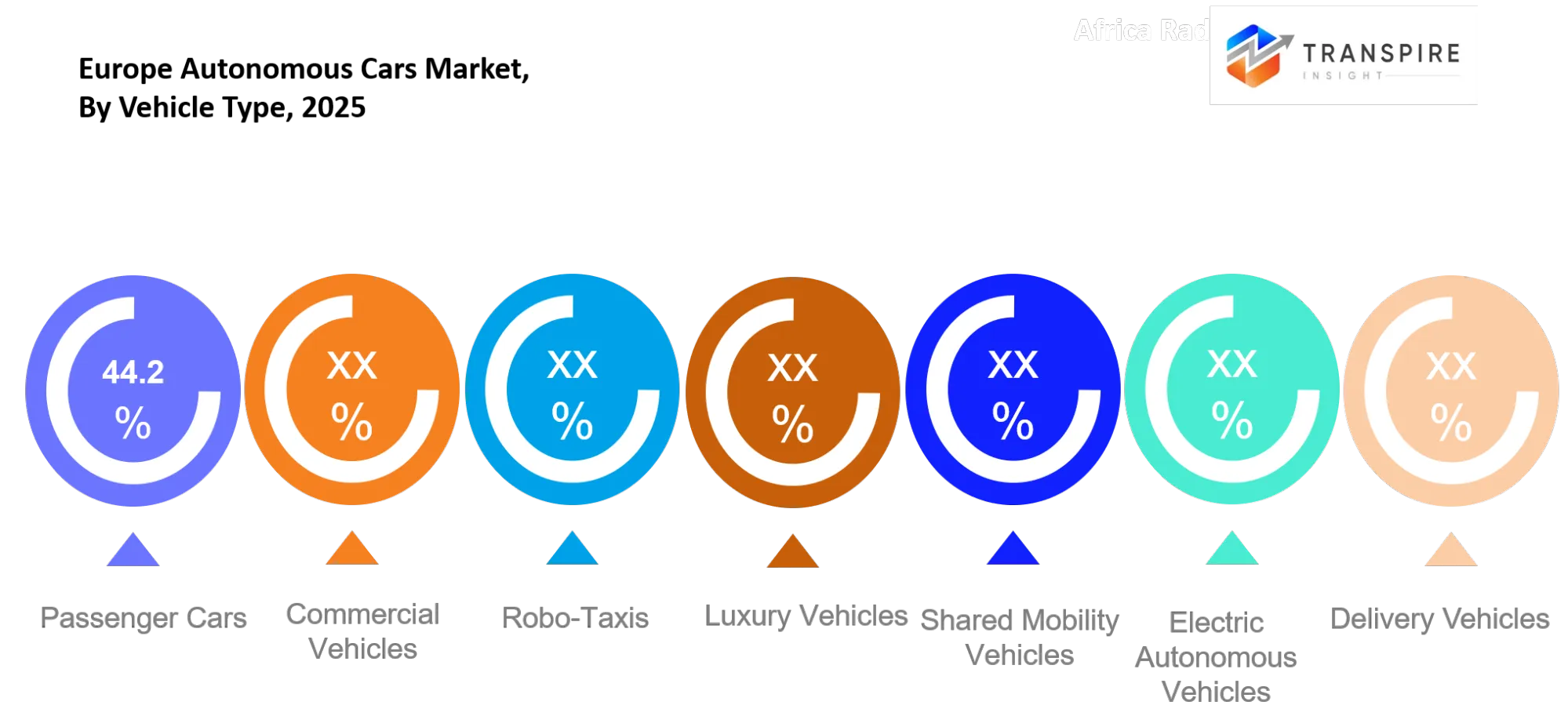
By Automation Level:
Level 2 held the lead kind of easily because real field rollouts, matched with the existing rules and what drivers expect day to day, which helped the whole thing work.Things like more advanced lane keeping, adaptive cruise, and automated parking let firms put these solutions out more often across lots of different vehicle types. Level 3 turned into the next biggest slice, mostly because regulatory approvals kind of loosened up over time, which pointed toward conditional automated driving, though only in some particular areas.
Level 4 will see the quickest growth because vendors keep refining artificial intelligence, sensor precision, and compute power for more difficult road scenes. Semi-Autonomous Systems kept a wide foothold, mainly due to ongoing feature upgrades pushed by the big automakers. Fully Autonomous Systems, Level 5, Level 1 and the remaining Others, will move step-by-step as certification rules, digital infrastructure, and safety verification keep maturing across Europe.
By Technology:
Camera Systems were the big one ,mostly on cost efficiency reasons, plus continuous improvements in image processing, and also because they fit well with more advanced driver assistance features. That combination made it easier to deploy at scale , even when teams were cautious. Radar stayed in second place, mainly due to dependable object detection in adverse weather, and the kind of low visibility situations where other inputs get less useful. Sensor Fusion then kind of tied everything together by stitching multiple sensor inputs together ,so the vehicle can make better driving decisions, not just one-off guesses.
AI Platforms should see the fastest growth ,since software defined vehicle development is accelerating. In practice that means more demand for intelligent driving algorithms and real time data processing. HD Mapping and V2X Communication also kept expanding, pushed by investments in connected transport infrastructure and smart mobility programs. And LiDAR ,along with other technologies, will likely get a boost as component costs keep dropping and as collaboration between semiconductor firms and automotive manufacturers becomes stronger.
By Propulsion:
Battery electric vehicles kinda took the lead in propulsion simply because zero-emission policies were pushing hard, plus the charging network kept expanding, and the software side fit in with autonomous driving development. Hybrid vehicles ended up with the second-biggest slice, mostly because they still give operational flexibility while the market transitions toward full vehicle electrification . At the same time, automotive manufacturers kept rolling out automated features across both battery electric and hybrid product lines, sort of like a steady march forward.
Fuel cell vehicles and plug-in hybrid models pulled in more strategic investment for commercial transport, and also for longer-haul use cases where you really want that extended driving range. Internal combustion engine vehicles stayed relevant in a few specific applications, especially where fleet replacement moves more slowly. Solar assisted vehicles, dual power vehicles, and other variants will likely open up new opportunities too, as energy efficiency technologies improve alongside autonomous mobility solutions .
By End User:
Private Consumers counted as the leading end user segment, basically because advanced safety tech, connected vehicle services, and those more premium mobility features kept pushing steady vehicle buying. Automotive Manufacturers sat in the second-largest lane, mostly driven by ongoing investments in research, software platforms, and autonomous driving validation campaigns, which is kinda a big deal for timelines. Logistics Companies together with Fleet Operators also kept scaling deployment to boost route efficiency , maintain operational consistency and, overall, keep long term fleet productivity in a better place.
Mobility Service Providers are expected to clock the fastest growth, since city transportation keeps moving toward shared autonomous mobility plus subscription based travel services. Government Organizations continued giving support via digital infrastructure projects , regulatory actions and smart transportation investments. Research Institutes and other end users helped fortify innovation through testing programs, technology validation, and cooperative projects. That mix should help speed up future commercialization, sooner than later.
What are the Key Use Cases Driving the Europe Autonomous Cars Market?
Passenger mobility is still sort of the main use case, because vehicle makers and private buyers keep adopting cars with advanced autonomous features, aiming for safer everyday trips. The premium car brands end up driving the highest purchase volume too, mainly by pairing automated driving with connected digital services, which then boost comfort, make traffic handling smoother, and raise operational efficiency at the same time.
On the logistics side, companies are rolling out autonomous vehicles for moving freight and handling last mile delivery. This tends to lower day to day operating expenses and keeps routes more consistent. Mobility service providers are moving in a similar direction, bringing automated transport options into contained urban areas, where supportive rules and smart infrastructure actually make commercial work feasible without too much friction.
Also, autonomous shuttles for airports , industrial campuses and business parks look like they could be a very strong long term bet, especially as new infrastructure investments continue. At the municipal level, authorities are reviewing automated public transit units and even road maintenance vehicles, but usually for controlled settings. That, combined with regulatory frameworks getting clearer and digital connectivity getting better across European transport corridors, is opening up fresh opportunities.
|
Report Metrics |
Details |
|
Market size value in 2025 |
USD 18.42 Billion |
|
Market size value in 2026 |
USD 21.55 Billion |
|
Revenue forecast in 2033 |
USD 64.77 Billion |
|
Growth rate |
CAGR of 17.02% from 2026 to 2033 |
|
Base year |
2025 |
|
Historical data |
2021 - 2024 |
|
Forecast period |
2026 - 2033 |
|
Report coverage |
Revenue forecast, competitive landscape, growth factors, and trends |
|
Country scope |
Europe (Germany, United Kingdom, France, Italy, Spain and Rest of Europe) |
|
Key company profiled |
Mercedes-Benz, BMW Group, Volkswagen Group, Stellantis, Volvo Cars, Renault Group, Tesla, Mobileye, Waymo, Bosch, Continental, Valeo, Aptiv, Nvidia, ZF Friedrichshafen . |
|
Customization scope |
Free report customization (country, regional & segment scope). Avail customized purchase options to meet your exact research needs. |
|
Report Segmentation |
By Vehicle Type (Passenger Cars, Commercial Vehicles, Robo-Taxis, Luxury Vehicles, Shared Mobility Vehicles, Electric Autonomous Vehicles, Delivery Vehicles, Others); By Automation Level (Level 1, Level 2, Level 3, Level 4, Level 5, Semi-Autonomous Systems, Fully Autonomous Systems, Others); By Technology (LiDAR, Radar, Camera Systems, Sensor Fusion, AI Platforms, HD Mapping, V2X Communication, Others); By Propulsion (Battery Electric, Hybrid, Internal Combustion Engine, Fuel Cell Vehicles, Plug-in Hybrid, Solar Assisted Vehicles, Dual Power Vehicles, Others); By End User (Private Consumers, Mobility Service Providers, Logistics Companies, Automotive Manufacturers, Fleet Operators, Government Organizations, Research Institutes, Others) |
Which Regions are Driving the Europe Autonomous Cars Market Growth?
Western Europe accounted for around 68% of regional revenue in 2025, and so it stays the dominant regional market really. Because vehicle safety rules are strong, plus autonomous driving policies that actually support deployment, and also the digital transport backbone is pretty extensive, commercial rollout has sped up across a lot of major economies. Meanwhile, global car makers, semiconductor vendors, software developers, and engineering services have ended up forming a tightly linked innovation ecosystem which is backed by both long-term public and private investment. Ongoing research budgets, a bigger charging network, and regulatory coordination, should keep this regional lead through the whole forecast window.
Northern Europe comes next as the second-largest regional contributor, mostly because transport policy, digital connectivity, and even public sector planning remain steady across several countries. With economic stability staying strong, long-term funding for intelligent mobility ventures can continue without big stops or nasty surprises. There is also collaboration between tech teams, municipalities and automotive companies, which helps with practical testing while still keeping safety standards high. This kind of predictable investing setting creates dependable revenue chances, and it also supports a slow but real commercial expansion for passenger solutions and fleet mobility programs.
Central and Eastern Europe will likely see the fastest growth, as automotive manufacturing modernization and transport infrastructure investment speed up, including deployment of autonomous mobility. In the last few years, industrial expansion, digital road development, and stronger involvement in European smart mobility initiatives, have basically built up momentum across the region. At the same time, automotive suppliers keep stretching their engineering and manufacturing capacity, which makes the overall picture much more favorable for advanced vehicle technologies. All of this should translate into interesting opportunities for makers, software developers, and infrastructure investors, who are looking for new growth markets between 2026 and 2033.
Who are the Key Players in the Europe Autonomous Cars Market and How Do They Compete?
Competition across the Europe Autonomous Cars Market stays moderately consolidated, mostly because, a relatively small circle of global automotive manufacturers and technology companies really end up controlling the bulk of the most advanced autonomous driving efforts. In a way, it is not only vehicle pricing, or not even primarily that. Technology know-how, software development, artificial intelligence integration, and regulatory compliance tend to shape how companies position themselves, more than the sticker price alone. Still, established automotive manufacturers keep reinforcing their footing by leaning into software-defined vehicle platforms, and meanwhile specialist technology companies push faster innovation via strategic alliances, plus autonomous driving software development.
Mercedes-Benz stands out with certified Level 3 automated driving systems, built to support commercial deployment under approved operating conditions. Ongoing software enhancements and premium vehicle integration help keep customer trust higher, while also widening where autonomous driving can realistically be used across European markets. BMW Group, for its part, concentrates on scalable digital vehicle architectures that let autonomous capabilities expand through over-the-air software updates, which then supports value creation well beyond the first purchase.
Volkswagen Group put money, a lot of it, into software development partnerships to form unified autonomous platforms across multiple vehicle brands, improving development efficiency and making technology scaling less painful. Stellantis boosts its artificial intelligence capabilities via technology collaborations, which reinforce connected mobility and improve automated driving performance across a broad range of vehicle models. Volvo Cars leans into safety-centric autonomous systems, relying on advanced sensor integration and strategic partnerships, and it creates a competitive edge through dependable vehicle performance, delivered progressively rather than all at once commercial deployment.
Company List
- Mercedes-Benz
- BMW Group
- Volkswagen Group
- Stellantis
- Volvo Cars
- Renault Group
- Tesla
- Mobileye
- Waymo
- Bosch
- Continental
- Valeo
- Aptiv
- Nvidia
- ZF Friedrichshafen
Recent Development News
In May 2026, Mercedes-Benz announced the rollout of its MB.DRIVE ASSIST PRO urban assisted driving system in selected German cities, developed with NVIDIA. The launch strengthens Europe's commercial deployment of advanced automated driving technologies and supports Germany's position as an autonomous vehicle innovation hub.
Source https://www.reuters.com/
In February 2026, Wayve secured a USD 1.2 billion funding round backed by Mercedes-Benz, Stellantis, Nissan, Uber, NVIDIA, and Microsoft. The investment will accelerate robotaxi deployment and autonomous driving software commercialization, reinforcing Europe's autonomous mobility technology ecosystem. Source https://www.reuters.com/
What Strategic Insights Define the Future of the Europe Autonomous Cars Market?
Over the next five to seven years , the Europe Autonomous Cars Market will drift toward commercially scalable mobility platform stuff where software, artificial intelligence, and connected infrastructure end up creating more value than just hardware alone . In the meantime, harmonized vehicle regulations , digital road infrastructure, and recurring software revenue models will be the main thing pushing long-term expansion. A quieter risk also shows up, kind of less visible, from supply chain concentration for advanced semiconductors and high-performance computing systems, and that could end up delaying vehicle launches , even if customer demand stays hot and regulatory approval remains favorable.
At the same time, there is an opportunity that feels a bit more in the spotlight in Central and Eastern Europe where manufacturing expansion and smart transport investments will help deployment go beyond the classic automotive hubs. For market participants, the best outcomes will usually come from building longer-term partnerships with software developers , semiconductor suppliers, and infrastructure providers, while also investing in modular autonomous platforms that can adjust quickly to new regulations and shifting technology standards , without needing a total vehicle redesign.
Europe Autonomous Cars Market Report Segmentation
By Vehicle Type
- Passenger Cars
- Commercial Vehicles
- Robo-Taxis
- Luxury Vehicles
- Shared Mobility Vehicles
- Electric Autonomous Vehicles
- Delivery Vehicles
By Automation Level
- Level 1
- Level 2
- Level 3
- Level 4
- Level 5
- Semi-Autonomous Systems
- Fully Autonomous Systems
By Technology
- LiDAR
- Radar
- Camera Systems
- Sensor Fusion
- AI Platforms
- HD Mapping
- V2X Communication
By Propulsion
- Battery Electric
- Hybrid
- Internal Combustion Engine
- Fuel Cell Vehicles
- Plug-in Hybrid
- Solar Assisted Vehicles
- Dual Power Vehicles
By End User
- Private Consumers
- Mobility Service Providers
- Logistics Companies
- Automotive Manufacturers
- Fleet Operators
- Government Organizations
- Research Institutes
Frequently Asked Questions
Find quick answers to common questions.
The Expected Europe Autonomous Cars Market size for the Market will be USD 64.77 Billion in 2033.
Key Segments for the Europe Autonomous Cars Market are By Vehicle Type (Passenger Cars, Commercial Vehicles, Robo-Taxis, Luxury Vehicles, Shared Mobility Vehicles, Electric Autonomous Vehicles, Delivery Vehicles, Others); By Automation Level (Level 1, Level 2, Level 3, Level 4, Level 5, Semi-Autonomous Systems, Fully Autonomous Systems, Others); By Technology (LiDAR, Radar, Camera Systems, Sensor Fusion, AI Platforms, HD Mapping, V2X Communication, Others); By Propulsion (Battery Electric, Hybrid, Internal Combustion Engine, Fuel Cell Vehicles, Plug-in Hybrid, Solar Assisted Vehicles, Dual Power Vehicles, Others); By End User (Private Consumers, Mobility Service Providers, Logistics Companies, Automotive Manufacturers, Fleet Operators, Government Organizations, Research Institutes, Others).
Major Europe Autonomous Cars Market players are Mercedes-Benz, BMW Group, Volkswagen Group, Stellantis, Volvo Cars, Renault Group, Tesla, Mobileye, Waymo, Bosch, Continental, Valeo, Aptiv, Nvidia, ZF Friedrichshafen.
The Current Europe Autonomous Cars Market size is USD 18.42 Billion in 2025.
The Europe Autonomous Cars Market CAGR is 17.02% from 2026 to 2033.
- Mercedes-Benz
- BMW Group
- Volkswagen Group
- Stellantis
- Volvo Cars
- Renault Group
- Tesla
- Mobileye
- Waymo
- Bosch
- Continental
- Valeo
- Aptiv
- Nvidia
- ZF Friedrichshafen
About the Authors

Mayur Shinde
I am Mayur Shinde, a Senior Research Analyst at Transpire Insight, specializing in the Automotive & Transportation and Information & Communication Technology (ICT) Industry. My work focuses on analyzing emerging market trends, technological advancements, competitive landscapes, and industry developments to deliver accurate, data-driven insights. I am passionate about transforming complex market information into clear, actionable content that helps businesses, professionals, and decision-makers stay informed and make confident strategic decisions.

Chakradhar Khansole
Chakradhar serves as the Research Director at Transpire Insight, bringing over 8 years of experience in technology, innovation, and strategic market intelligence. He specializes in transforming complex market data into actionable business insights that enable organizations to make informed, growth-oriented decisions. Recognized for his strategic vision and analytical expertise, Chakradhar leads high-impact research initiatives, delivering comprehensive market assessments, competitive intelligence, and forward-looking industry analysis.
Recently Published Reports
-
Apr 2026
ATV & UTV Market
ATV & UTV Market Size, Share & Analysis Report By Type (ATV, and UTV), By Variants (Less Than 400 CC, 400 CC To 800 CC, and More Than 800 CC), and Geography (North America, Europe, Asia-Pacific, Middle East and Africa, South and Central America), 2021 - 2031
-
Apr 2026
Automotive Central Gateway Module Market
Automotive Central Gateway Module Market Size, Share & Analysis Report By Type (Ethernet Central Gateway Module, CAN Central Gateway Module, LIN Central Gateway Module, and FlexRay), By Application (Powertrain Control, Body Control, Infotainment System, Advanced Driver Assistance Systems (ADAS), and Others), By End User (Passenger Vehicles, and Commercial Vehicles), and Geography (North America, Europe, Asia-Pacific, Middle East and Africa, South and Central America), 2021 - 2031
-
Apr 2026
Automotive Engine Oil Filter Market
Automotive Engine Oil Filter Market Size, Share & Analysis Report By Filter Type (Fuel Filter, Engine Oil Filter, Hydraulic Oil Filter, and Others), By Filter Media (Cellulose, Synthetic, and Micro), By Sales Channel (OEMs, and Aftermarket), By Vehicle Type (Passenger Cars, Light Commercial Vehicles, Heavy Duty Trucks, Buses and Coaches, and Off-road Vehicles), and Geography (North America, Europe, Asia-Pacific, Middle East and Africa, South and Central America), 2021 - 2031
-
Apr 2026
Automotive Parts Aluminium Die Casting Market
Automotive Parts Aluminium Die Casting Market Size, Share & Analysis Report By Production Process (Pressure Die Casting, Vacuum Die Casting, Squeeze Die Casting, Gravity Die Casting), By Application (Body Parts, Engine Parts, Transmission Parts, Battery And Related Components, Other Application Types), and Geography (North America, Europe, Asia-Pacific, Middle East and Africa, South and Central America), 2021 - 2031
Our Clients



