
South Korea Autonomous Emergency Braking System Market Size & Forecast:
- South Korea Autonomous Emergency Braking System Market Size 2025: USD 202.8 Million
- South Korea Autonomous Emergency Braking System Market Size 2033: USD 688.9 Million
- South Korea Autonomous Emergency Braking System Market CAGR: 16.52%
- South Korea Autonomous Emergency Braking System Market Segments: By Vehicle Type (Passenger Cars, SUVs, LCVs, HCVs, Electric Vehicles, Autonomous Vehicles, Others) | By Technology (Camera-Based, Radar-Based, LiDAR-Based, Sensor Fusion, Infrared-Based, Ultrasonic Sensors, Others) | By Component (Sensors, Electronic Control Units, Cameras, Radar Modules, Software, Actuators, Others) | By End User (OEMs, Aftermarket, Fleet Operators, Logistics Companies, Ride-Hailing Operators, Others)
South Korea Autonomous Emergency Braking System Market Summary
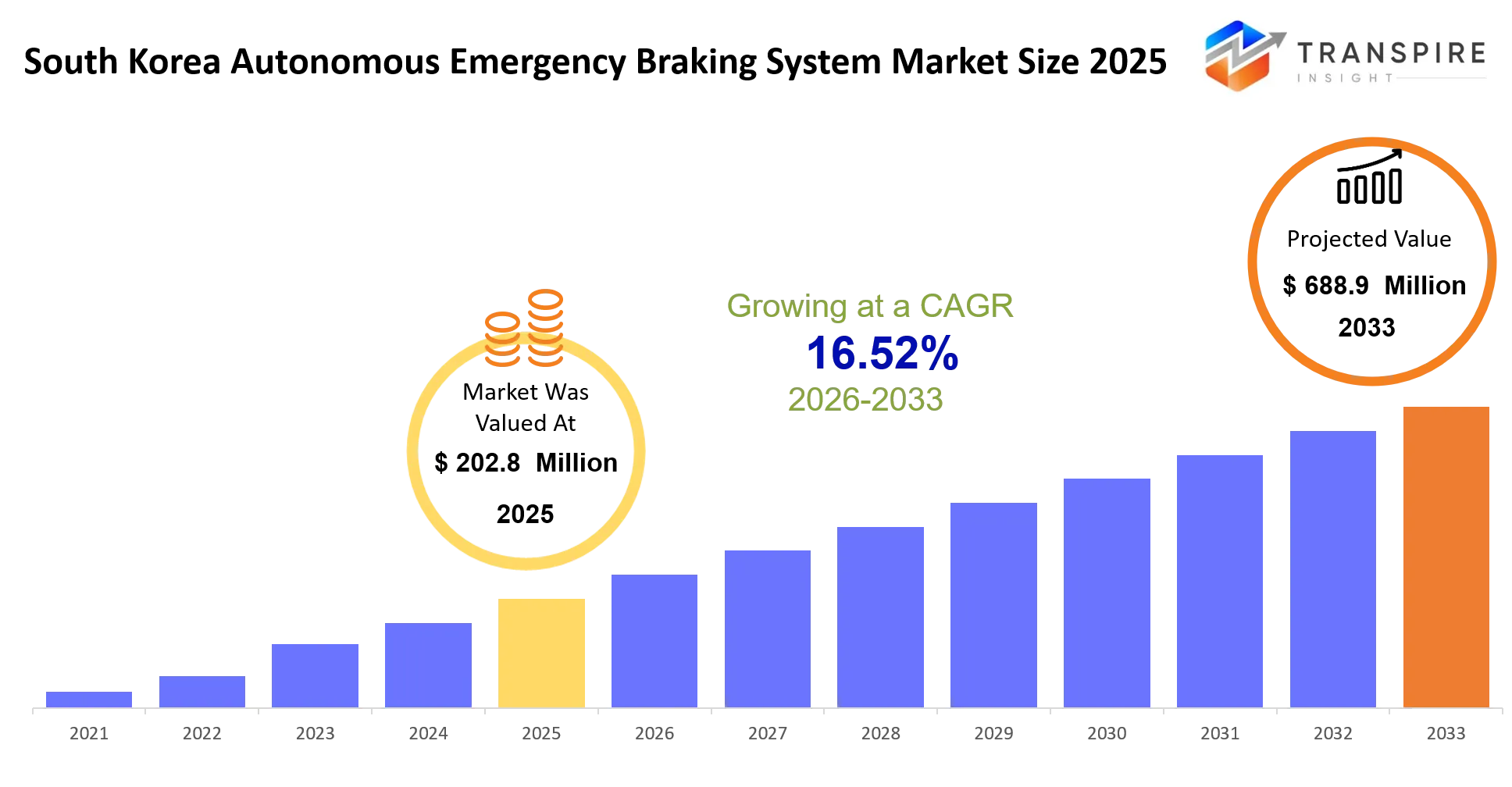
The South Korea Autonomous Emergency Braking System Market was valued at USD 202.8 Million in 2025. It is forecast to reach USD 688.9 Million by 2033. That is a CAGR of 16.52% over the period.
The South Korea Autonomous Emergency Braking (AEB) system market is mostly about technology that keeps watch for near-future forward collisions and then does braking on its own when a driver does not react fast enough. It mainly helps lower the number of urban rear-end incidents and, at the same time, reduces how severely pedestrians get hurt, across both passenger vehicles and commercial fleets. In the last 3–5 years, things have changed in a pretty noticeable way, from mostly premium-only safety bundles to AEB being more normal, like, even in mid-range and sometimes entry-level models. This happened because radar-camera fusion is getting tighter inside scalable ADAS platforms.
One big reason is the ongoing strengthening of Korea NCAP, plus the closer alignment with Euro NCAP protocols. That pressure made OEMs like Hyundai and Kia lean harder into better safety results so they can stay competitive in export markets. Meanwhile after the pandemic, semiconductor supply disruptions sort of sped up software-defined vehicle architectures, and that nudged automakers to group braking, sensing and control into modular building blocks. The end result is better cost efficiency, and fleets adopt these systems faster, even when budgets are not exactly generous.
Key Market Insights
- Seoul–Capital region kind of dominates the South Korea Autonomous Emergency Braking System Market, with almost 45% share in 2025, mostly because there are a lot of vehicles jammed together and the OEM R&D hubs are concentrated there too.
- Meanwhile the Southeast industrial corridors show the quickest growth through 2026–2030, helped by broader automotive component manufacturing clusters and a more export driven production style, which is kinda bringing extra demand.
- In tech terms, radar-camera fusion systems take the lead, holding over 50% share. This is tied to cost effective scalability when ADAS platforms are rolled out across mass-market vehicles.
- Standalone camera based AEB solutions stay as the second-largest group, largely because they’re more affordable for entry level passenger cars, and they’re easier to deploy.
- LiDAR assisted AEB systems are the fastest growing segment out to 2030 since high precision autonomy testing keeps expanding, so adoption pressure rises there.
- Passenger vehicles dominate overall usage with nearly 70% share, mainly due to OEM integration mandates.
- Commercial fleet safety systems are the ones growing fastest, because logistics operators focus on collision reduction and they also want insurance linked safety compliance.
- OEM installed systems lead with more than 75% share, reflecting factory level integration across Hyundai and Kia production lines.
- Aftermarket ADAS retrofitting is also moving fast, especially in city commercial fleets that want practical safety upgrades without overspending.
What are the Key Drivers, Restraints, and Opportunities in the South Korea Autonomous Emergency Braking System Market?
The primary driver is Korea NCAP alignment with global safety benchmarks, so it kind of compels OEMs to slip autonomous emergency braking in as a default safety function. This regulatory nudge actually bumps factory-fit adoption right away, which raises component needs across radar, camera, and ECU supply chains, and it also shores up that recurring revenue flow for Tier-1 suppliers
A key structural restraint is the hefty system integration cost for multi-sensor AEB setups, especially for those entry-level vehicles where budgets are tight. Because of this, full feature deployment gets held back in cost sensitive lanes, so penetration moves slower in price-competitive trims. Even with the regulation pressure, it tends to cap short-term volume growth
The strongest opportunity sits with AI-enhanced predictive braking systems, paired with connected vehicle infrastructure. South Korea’s rollout of 5G-V2X pilot zones in major cities like Seoul is expanding, and it supports real-time hazard data sharing, which means next-gen AEB can foresee collision scenarios sooner and then improve response precision in a noticeable way
What Has the Impact of Artificial Intelligence Been on the South Korea Autonomous Emergency Braking System Market?
Artificial intelligence is kind of reshaping the South Korea Autonomous Emergency Braking System Market, not in a small way, by supporting real-time object sensing, flexible brake actions, and ongoing system refinement using road experiences. The AI based perception models go through radar and camera information at the same time, which tends to boost recognition quality for pedestrians , cyclists, and those tougher city movements where traffic is layered and unpredictable. In practice, this improved reliability seems to cut down the number of unwanted braking moments, and it also helps drivers feel more confident with ADAS vehicles.
At the same time, predictive machine learning is getting used more often to improve sensor alignment and also to flag early signs of wear inside braking components. As a result, platforms run longer and service downtime goes down, with some estimates pointing to about 15–20% fewer maintenance cycles in newer OEM configurations. AI further helps with over-the-air software updates, so performance can be tuned continuously , without needing physical recalls.
Still, uptake hits a snag mainly because the real-world training data isn’t always consistent, especially in extreme weather and when urban congestion gets really dense across South Korea. That situation can leave accuracy gaps for unusual edge cases, so OEMs and suppliers have to do more validation work over time, which can raise development costs and slow progress a bit.
Key Market Trends
- Autonomous emergency braking, kind of moved away from premium-only setups in 2019 , and by 2025 it was basically in the standard mid-range vehicles across most major Korean OEMs.
- Then after 2022, radar + camera fusion started replacing the earlier single sensor approach, so detection accuracy got better, and collision false positives went down quite a bit.
- Also, the Korea NCAP safety rules got tighter in 2023 , which sort of sped up how fast OEMs rolled in advanced braking functions on export focused car lines.
- Hyundai Motor Company, for example , pushed ADAS standardization across the Hyundai Ioniq and SUV lineup, and that raised the penetration rate beyond 80% on newer models.
- During the semiconductor shortages in 2021–2022, a more modular ADAS design became common. That helped the supply chain stay steadier , and made the engineering less convoluted overall.
- After 2023, AI enabled object recognition use grew fast, and pedestrian detection got noticeably stronger in crowded urban streets where things are dense and chaotic.
- Commercial fleet operators started adopting AEB retrofitting systems between 2024–2026, largely because insurance linked safety incentives showed up and liability risks were reduced.
- Mobileye together with Tier-1 suppliers also expanded their work with Korean OEMs, focusing on scalable vision driven braking platforms.
- Finally, the V2X trial work in Seoul introduced real time hazard signaling , which improved preemptive braking behavior in congested traffic corridors, you know where stop and go is constant.
South Korea Autonomous Emergency Braking System Market Segmentation
By Vehicle Type :
Passenger cars are likely to grab the strongest demand in the South Korea Autonomous Emergency Braking System market, mainly because safety rules keep pushing normal fitment into mass models. SUVs, meanwhile, will keep climbing at a steady pace since the accident risk feels higher in urban traffic, so drivers and buyers pay more attention. Electric vehicles as well as autonomous vehicle programs should see faster expansion too, because the smart driving stack really needs stronger braking response for safety control
LCVs and HCVs will take on AEB setups at a quicker rhythm. This is tied to the growing push for accident reduction in delivery and freight movement. Fleet operators also tend to put money into safety upgrades, mostly to lower liability costs and avoid headaches during claims. For other vehicle categories, the adoption will look more limited, but still gradual , because basic compliance keeps becoming part of everyday new vehicle production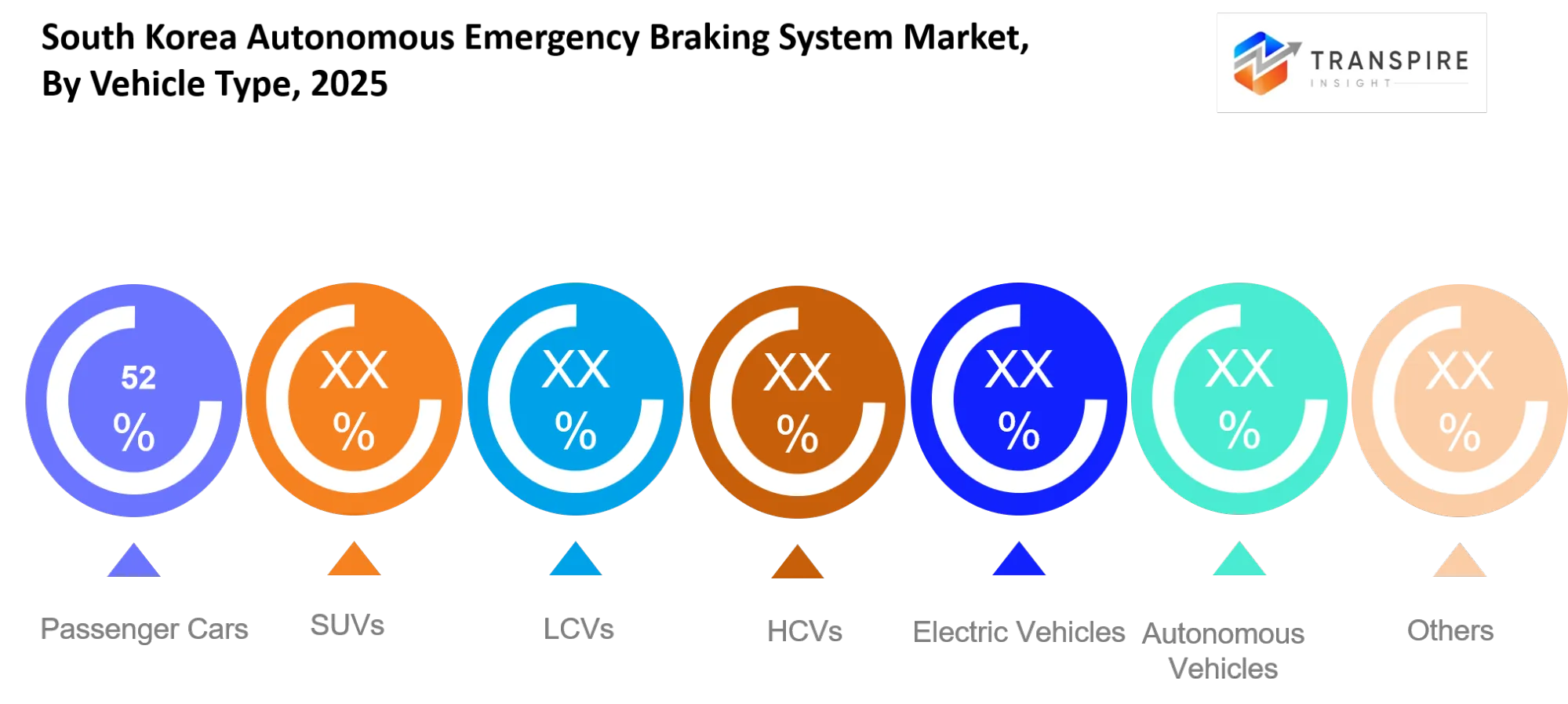
By Technology :
In terms of tech, camera based and radar based systems will end up leading the South Korea market. The reasons are pretty clear, lower cost and solid detection ability during normal driving conditions. Sensor fusion will also rise, kind of naturally, since combined input helps accuracy in tricky road layouts and can cut down false alerts in packed city traffic, where everything is happening at once.
LiDAR based solutions should grow faster within premium vehicle plans and autonomous programs, where very high precision matters. Infrared and ultrasonic sensors will still play a supporting role for short range needs, like parking safety and low speed collision control. Overall, the technology direction is shifting toward integrated multi sensor platforms, simply because they can improve response time and keep system reliability more consistent across different scenarios.
By Component :
Sensors and radar modules will kinda be the core demand layer in the South Korea Autonomous Emergency Braking System Market, because real time object detection really needs dependable input data. Cameras help a lot with visual recognition, like pedestrians vehicles, even road signs, especially when the lighting is not cooperating, and that tends to boost overall system reliability .
Electronic control units and software will get more weight over time, mainly because braking judgments require rapid processing and high algorithm accuracy. Actuators then take those system choices and turn them into real physical braking force, so the safety response actually happens the way it should. Demand growth will tilt toward software centered upgrades, the kind that improve system performance without forcing major hardware replacement.
By End User :
OEMs will dominate the South Korea Autonomous Emergency Braking System Market, mostly due to factory level integration inside new vehicles that are shaped by safety regulations. When big automakers move early, installation stays steady across both passenger and utility segments.
On the other hand aftermarket demand will keep climbing, especially through upgrades for older cars in dense urban areas. Fleet operators and logistics companies will likely expand adoption to cut accident losses and keep operational safety on track. Ride hailing providers will also push higher usage , mainly to strengthen passenger protection and to hold service reliability standards across their heavily used vehicle groups.
What are the Key Use Cases Driving the South Korea Autonomous Emergency Braking System Market?
Passenger vehicle collision prevention still sits at the center of the South Korea Autonomous Emergency Braking System Market, and it feels pretty much like the core use case. This is pushed by strict road safety requirements and also by mandatory ADAS fitment in newly produced models. In day to day situations, busy urban traffic, plus those really common low speed rear end mishaps, make automatic braking a make or break feature for normal driving safety and for keeping insurance risks under control.
On the commercial side, delivery fleets, logistics trucks, and related operators are grabbing the technology more and more, mostly because they want fewer service halts, and less cost tied to accidents. At the same time, ride-hailing providers are rolling AEB capabilities into their fleets too, aiming to keep riders safer while still meeting service reliability expectations. This becomes especially noticeable on high traffic city routes, where sudden braking moments happen a lot, and yeah it can get messy fast.
There are also newer, emerging uses that keep expanding in quieter ways. For example, semi-autonomous highway driving assistance in electric and connected vehicles is growing, where the system can coordinate braking with adaptive cruise control. Another area that’s picking up steam is public transport safety, where bus operators, and some municipal mobility programs are trying AEB setups to lower pedestrian collision exposure along congested urban lanes, even if conditions change by the minute.
|
Report Metrics |
Details |
|
Market size value in 2025 |
USD 202.8 Million |
|
Market size value in 2026 |
USD 236.3 Million |
|
Revenue forecast in 2033 |
USD 688.9 Million |
|
Growth rate |
CAGR of 16.52% from 2026 to 2033 |
|
Base year |
2025 |
|
Historical data |
2021 - 2024 |
|
Forecast period |
2026 - 2033 |
|
Report coverage |
Revenue forecast, competitive landscape, growth factors, and trends |
|
Country scope |
South Korea |
|
Key company profiled |
Hyundai Mobis, Bosch, Continental, Denso, ZF Friedrichshafen, Valeo, Aptiv, Magna, Autoliv, Mobileye, Hyundai Motor, Kia, Hitachi Astemo, Veoneer, Hella |
|
Customization scope |
Free report customization (country, regional & segment scope). Avail customized purchase options to meet your exact research needs. |
|
Report Segmentation |
By Vehicle Type (Passenger Cars, SUVs, LCVs, HCVs, Electric Vehicles, Autonomous Vehicles, Others) | By Technology (Camera-Based, Radar-Based, LiDAR-Based, Sensor Fusion, Infrared-Based, Ultrasonic Sensors, Others) | By Component (Sensors, Electronic Control Units, Cameras, Radar Modules, Software, Actuators, Others) | By End User (OEMs, Aftermarket, Fleet Operators, Logistics Companies, Ride-Hailing Operators, Others) |
Which Regions are Driving the South Korea Autonomous Emergency Braking System Market Growth?
Seoul–Capital Region is kind of the reason South Korea Autonomous Emergency Braking System Market is leading there, mainly because vehicle ownership is high, traffic stays thick in the city, and safety compliance is taken seriously under Korea NCAP. Also, the region has a lot of OEM headquarters around, so production plus R&D facilities are nearby, which helps ADAS integration happen faster. On top of that, there’s a solid automotive testing setup and road infrastructure that’s already pretty advanced, so validation is quicker and braking systems can be rolled out across new vehicle models, not in some slow way.
Then you’ve got the Southeast industrial belt, like Busan and Ulsan, and it keeps feeding steady demand. This part feels more tied to manufacturing clusters and export focused vehicle production, so it grows differently from the capital area. In other words, it’s less about urban traffic safety pressure, and more about industrial output plus long-term supply contracts. Port connectivity stays strong too, and finished vehicles keep moving in a consistent pattern. So autonomous emergency braking systems get integrated into export vehicles fairly smoothly, and that keeps bringing revenue back to the South Korea Autonomous Emergency Braking System Market.
Meanwhile the central areas, plus the emerging provincial regions, are where the fastest growth is happening. That’s mostly because government backed smart mobility projects are spreading outside the biggest cities now. Newer investments in connected road infrastructure, along with pilot “smart highway” programs, have boosted how often ADAS enabled vehicles are tested. This changes the adoption route a bit, especially for fleet operators and regional transport providers who are trying to keep up. Over 2026–2033, that momentum should create more entry points for technology suppliers, and it will also strengthen more decentralized demand for the South Korea Autonomous Emergency Braking System Market.
Who are the Key Players in the South Korea Autonomous Emergency Braking System Market and How Do They Compete?
The South Korea Autonomous Emergency Braking System Market looks kind of moderately consolidated, where global Tier-1 players are still in the mix with a lot of domestic OEM-led integration. Like, competition doesn’t just stay on one front, it mostly leans on sensor accuracy, faster software responsiveness and also cost efficiency for ADAS platforms that have to scale well. Some established names keep their ground through long-term OEM arrangements, while smaller tech specialists try to stand out using more advanced perception algorithms, plus better system integration ability.
Robert Bosch GmbH keeps pushing with high precision radar, and braking control systems that are made for scalable use across multiple vehicle platforms. They also build influence by working closely with Korean automakers, aiming at standardized ADAS modules that cut down on integration time, and integration cost too. Their expansion is basically driven by continuous software upgrades that lift system performance, without turning it into a major hardware redesign every time.
Continental AG tends to focus on cost optimized braking solutions paired with solid ECU and sensor integration skills, which helps them get adopted in both mid-range and premium models. ZF Friedrichshafen AG, on the other hand, leans into advanced chassis control systems where braking decisions connect more tightly with vehicle dynamics, so the safety response can be sharper and more reliable. Both companies also expand by doing co-development with OEMs, to speed up the rollout of next gen ADAS, sooner than later.
Mobileye wins attention with vision based AI systems, which in turn lowers how much the setup relies on complicated sensor stacks. That makes it easier to scale across mass-market vehicles. Hyundai Motor Company boosts its position by embedding AEB directly into in house vehicle platforms, so dependency on external suppliers drops and deployment speed rises across new models.
Company List
- Hyundai Mobis
- Bosch
- Continental
- Denso
- ZF Friedrichshafen
- Valeo
- Aptiv
- Magna
- Autoliv
- Mobileye
- Hyundai Motor
- Kia
- Hitachi Astemo
- Veoneer
- Hella
Recent Development News
In March 2026, Hyundai Motor Group announced the launch of the MobED Alliance. The initiative brings together suppliers and technology partners to commercialize advanced mobility and automation platforms, strengthening integration pathways for sensor-driven safety systems that support braking automation in new vehicle architectures. Sourcehttps://www.hyundai.com/
In January 2025, Mobileye announced collaboration initiatives with global automotive safety stakeholders to advance AI-based automatic emergency braking capabilities. The development focused on enhancing vision-driven collision detection in complex urban driving conditions and improving real-time response accuracy across ADAS platforms.
Sourcehttps://www.mobileye.com/
What Strategic Insights Define the Future of the South Korea Autonomous Emergency Braking System Market?
The South Korea Autonomous Emergency Braking System market is kind of moving, structurally, toward full software-defined safety integration, where braking decisions will depend more and more on centralized vehicle computing and continuous AI model updates. This change is also pushed by tighter Korea NCAP alignment with global safety frameworks, plus the rapid standardization of ADAS across basically all vehicle classes, which will shrink the space for optional configurations and make AEB a baseline requirement for new vehicle platforms.
There is another less obvious, but still real risk too. Supplier concentration in core ADAS software and sensor fusion stacks is growing, and that could mean automakers become dependent on a small circle of technology providers. In turn it can trigger pricing pressure and supply constraints during component shortages, you know. And over time, this concentration may reduce innovation diversity a bit, so improvements become more uniform or slower.
A major emerging opportunity sits in vehicle-to-everything enabled predictive braking, especially as Seoul expands connected road infrastructure pilots. With real-time hazard data sharing, vehicles can intervene earlier than onboard sensors normally allow. Market participants should really focus on modular, software-upgradable AEB platforms that also include V2X readiness, so they can adapt faster to regulatory upgrades and lock in longer-term OEM contracts.
South Korea Autonomous Emergency Braking System Market Report Segmentation
By Vehicle Type
- Passenger Cars
- SUVs
- LCVs
- HCVs
- Electric Vehicles
- Autonomous Vehicles
By Technology
- Camera-Based
- Radar-Based
- LiDAR-Based
- Sensor Fusion
- Infrared-Based
- Ultrasonic Sensors
By Component
- Sensors
- Electronic Control Units
- Cameras
- Radar Modules
- Software
- Actuators
By End User
- OEMs
- Aftermarket
- Fleet Operators
- Logistics Companies
- Ride-Hailing Operators
Frequently Asked Questions
Find quick answers to common questions.
The South Korea Autonomous Emergency Braking System Market size is USD 688.9 Million in 2033.
Key Segments for the South Korea Autonomous Emergency Braking System Market are By Vehicle Type (Passenger Cars, SUVs, LCVs, HCVs, Electric Vehicles, Autonomous Vehicles, Others) | By Technology (Camera-Based, Radar-Based, LiDAR-Based, Sensor Fusion, Infrared-Based, Ultrasonic Sensors, Others) | By Component (Sensors, Electronic Control Units, Cameras, Radar Modules, Software, Actuators, Others) | By End User (OEMs, Aftermarket, Fleet Operators, Logistics Companies, Ride-Hailing Operators, Others).
Major South Korea Autonomous Emergency Braking System Market Players are Hyundai Mobis, Bosch, Continental, Denso, ZF Friedrichshafen, Valeo, Aptiv, Magna, Autoliv, Mobileye, Hyundai Motor, Kia, Hitachi Astemo, Veoneer, Hella.
The Current South Korea Autonomous Emergency Braking System Market size is USD 202.8 Million in 2025.
The South Korea Autonomous Emergency Braking System Market CAGR is 16.52% from 2026 to 2033.
- Hyundai Mobis
- Bosch
- Continental
- Denso
- ZF Friedrichshafen
- Valeo
- Aptiv
- Magna
- Autoliv
- Mobileye
- Hyundai Motor
- Kia
- Hitachi Astemo
- Veoneer
- Hella
About the Authors

Mayur Shinde
I am Mayur Shinde, a Senior Research Analyst at Transpire Insight, specializing in the Automotive & Transportation and Information & Communication Technology (ICT) Industry. My work focuses on analyzing emerging market trends, technological advancements, competitive landscapes, and industry developments to deliver accurate, data-driven insights. I am passionate about transforming complex market information into clear, actionable content that helps businesses, professionals, and decision-makers stay informed and make confident strategic decisions.

Chakradhar Khansole
Chakradhar serves as the Research Director at Transpire Insight, bringing over 8 years of experience in technology, innovation, and strategic market intelligence. He specializes in transforming complex market data into actionable business insights that enable organizations to make informed, growth-oriented decisions. Recognized for his strategic vision and analytical expertise, Chakradhar leads high-impact research initiatives, delivering comprehensive market assessments, competitive intelligence, and forward-looking industry analysis.
Recently Published Reports
-
Apr 2026
ATV & UTV Market
ATV & UTV Market Size, Share & Analysis Report By Type (ATV, and UTV), By Variants (Less Than 400 CC, 400 CC To 800 CC, and More Than 800 CC), and Geography (North America, Europe, Asia-Pacific, Middle East and Africa, South and Central America), 2021 - 2031
-
Apr 2026
Automotive Central Gateway Module Market
Automotive Central Gateway Module Market Size, Share & Analysis Report By Type (Ethernet Central Gateway Module, CAN Central Gateway Module, LIN Central Gateway Module, and FlexRay), By Application (Powertrain Control, Body Control, Infotainment System, Advanced Driver Assistance Systems (ADAS), and Others), By End User (Passenger Vehicles, and Commercial Vehicles), and Geography (North America, Europe, Asia-Pacific, Middle East and Africa, South and Central America), 2021 - 2031
-
Apr 2026
Automotive Engine Oil Filter Market
Automotive Engine Oil Filter Market Size, Share & Analysis Report By Filter Type (Fuel Filter, Engine Oil Filter, Hydraulic Oil Filter, and Others), By Filter Media (Cellulose, Synthetic, and Micro), By Sales Channel (OEMs, and Aftermarket), By Vehicle Type (Passenger Cars, Light Commercial Vehicles, Heavy Duty Trucks, Buses and Coaches, and Off-road Vehicles), and Geography (North America, Europe, Asia-Pacific, Middle East and Africa, South and Central America), 2021 - 2031
-
Apr 2026
Automotive Parts Aluminium Die Casting Market
Automotive Parts Aluminium Die Casting Market Size, Share & Analysis Report By Production Process (Pressure Die Casting, Vacuum Die Casting, Squeeze Die Casting, Gravity Die Casting), By Application (Body Parts, Engine Parts, Transmission Parts, Battery And Related Components, Other Application Types), and Geography (North America, Europe, Asia-Pacific, Middle East and Africa, South and Central America), 2021 - 2031
Our Clients



