

South Korea Sea Based C4ISR Market Size & Forecast:
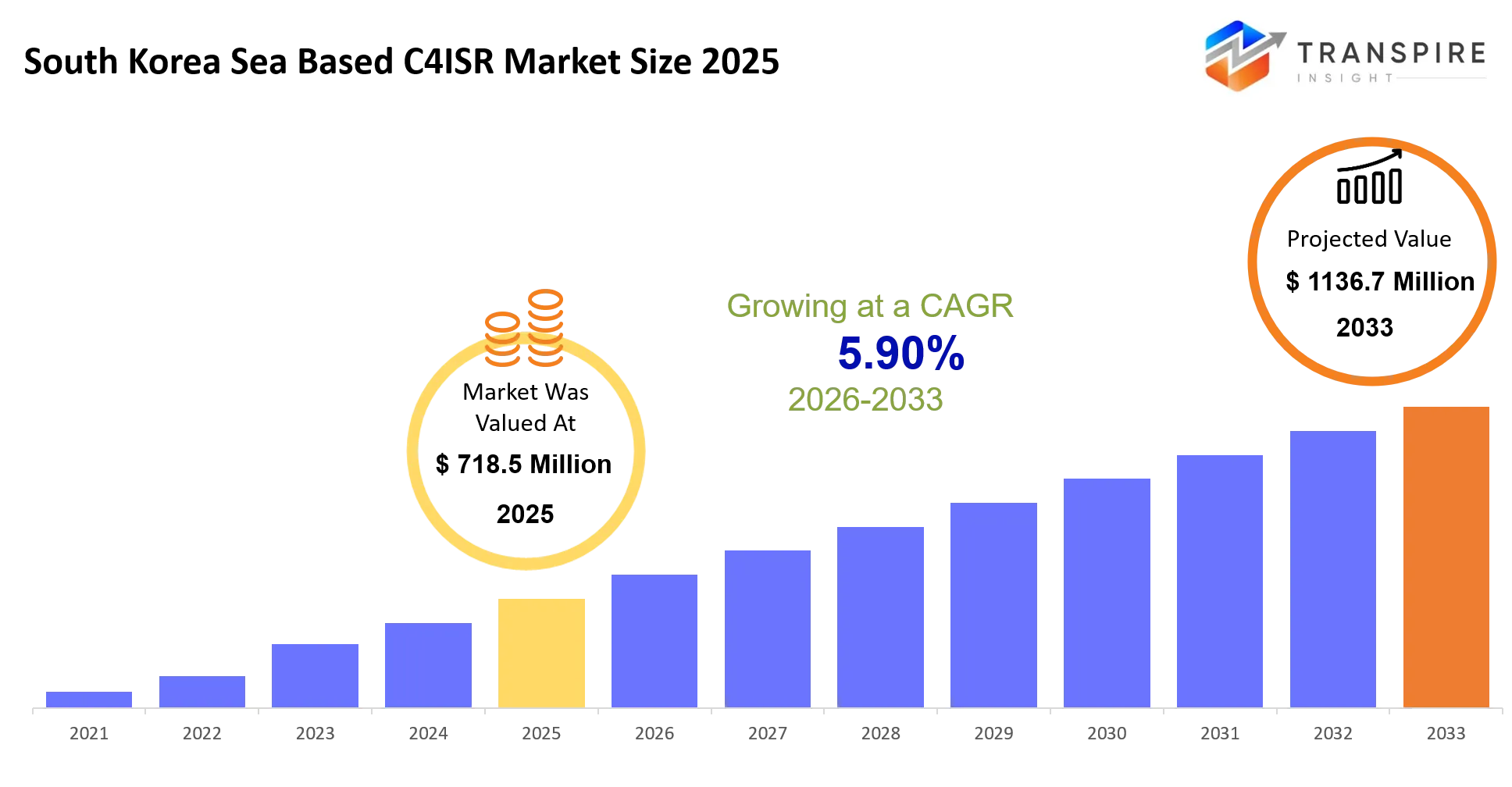
- South Korea Sea Based C4ISR Market Size 2025: USD 718.5 Million
- South Korea Sea Based C4ISR Market Size 2033: USD 1136.7 Million
- South Korea Sea Based C4ISR Market CAGR: 5.90%
- South Korea Sea Based C4ISR Market Segments: By System Type (Command Systems, Control Systems, Communications, Computers, Intelligence Systems, Surveillance Systems, Reconnaissance Systems, Others); By Platform (Destroyers, Frigates, Submarines, Patrol Vessels, Amphibious Ships, Aircraft Carriers, Unmanned Vessels, Others); By Application (Maritime Surveillance, Border Security, Naval Warfare, ISR Missions, Search & Rescue, Coastal Monitoring, Fleet Management, Others); By End User (Navy, Coast Guard, Defense Agencies, Homeland Security, Intelligence Agencies, Shipbuilders, Government Bodies, Others)
South Korea Sea Based C4ISR Market Summary
The South Korea Sea Based C4ISR Market was valued at USD 718.5 Million in 2025. It is forecast to reach USD 1136.7 Million by 2033. That is a CAGR of 5.90% over the period.
South Korea's Undersea C4ISR markets South Korea's undersea C4ISR capabilities are positioned in the world's decision making epicenter of the seas-allowing naval forces to identify adversaries and nuclei, bundle and cross cue Navy data, synchronize entire fleets and sustain a complete situational awareness picture in a contested contact environment. In operation, these systems save time, enhance fire control, and empower commanders to anticipate challenges in ever more intricate theater missions.
A fundamental transition over the last five years has been from a platform-focused paradigm to a network-centric, data-driven architecture that relies on data collection and fusion capabilities across sensors, satellites, unmanned systems, and AI-enabled analytics to generate a shared operational picture (SOP). This was driven and accelerated by the increased regional tensions and missile testing in Northeast Asia that revealed the Achilles' heel of disconnected, siloed surveillance, command, and control networks. As a result, defense spending now favors more interoperable, software-driven capabilities that can be upgraded on short cycles. This market is growing because navies see information dominance as a key warfighting function and a source of new annuity streams in system integration, cybersecurity, and data handling and modernization investments, rather than subsequent procurement programs.
Key Market Insights
- Market Status (by Country and Region) South Korea Sea Based C4ISR appears to be moving towards network-centric architectures, as the integrated command system substitutes the platform specific one since 2021.
- The eastern coast of the naval stations accounts for almost 55% of the installations in 2025 owing to the strategic positioning of the area in the maritime domain.
- The southern maritime zone is the most rapidly expanding region through 2030 as investments in surveillance infrastructure and naval modernization gather pace.
- Command & Control has the greatest market share at about 32% which is primarily owing to the requirement for real time situational awareness and multi domains co-ordination.
- Intelligence and surveillance solutions comprise the second largest category, with the fastest growing category being AI-enabled ISR platforms for the forecast period.
- Naval combat operations account for a substantial close to 48% share and unmanned maritime surveillance missions have surfaced as the fastest growing application.
- The South Korea Seas Based C4ISR Market is leaning more and more on destroyers and frigates that represent more than 50 percent of the end user deployment value.
- There is growing interest in autonomous surface & underwater vehicles where procurement budgets have seen a steady increase since 2023 for various maritime defense programmes.
- Software is now king as defense contractors look towards software-defined systems, with upgrades achieved faster and reduction in reliance on hardware over legacy naval architecture.
- Defense Companies Form Strategic alliances can be transformative, accelerating innovation, establishing national supply chains, and facilitating interoperability across maritime command networks.
What are the Key Drivers, Restraints, and Opportunities in the South Korea Sea Based C4ISR Market?
The key growth driver is South Korea's migration to a net-centric warfare approach and an integrated maritime security framework. Increased regional tensions such as missile testing and naval force growth in Northeast Asia have prompted this transformation, encouraging greater spending by national defense bodies on new surveillance radar systems, combat management technologies and networked communications capabilities. Such investment creates direct revenue growth for system integrators, sensor producers and software companies because new naval vessels need to be continually updated instead of merely purchasing equipment as a one-off expense.
One of the biggest challenges is that there are considerable technical complexities in integrating new C4ISR systems on legacy vessels of the naval fleets. The system challenge exists for systemic reasons given ships are in active service for over twenty years; old hardware platforms lack the integration support for current digital technologies, and that can result in significant lead times in systems integration and, as a result, defer the total value of program expenditures. The major opportunities for market growth in South Korea Sea Based C4ISR Market is from integration of autonomous maritime systems with advanced AI (artificial intelligence) driven commands and controlling systems.
South Korea is investing heavily in unmanned sea and underwater vessels based on intelligent command systems for better information and control functions and also on improved sensors and better integration features. South Korea sea based C4ISR Market is predicted to witness strong traction from all types of software provider companies which offer advanced mission management for unmanned vehicles, AI-driven capabilities for enhancing threat assessment and Cybersecurity.
What Has the Impact of Artificial Intelligence Been on the South Korea Sea Based C4ISR Market?
The integration of artificial intelligence into South Korea’s maritime-based C4ISR infrastructure can be explained by: increased data exploitation for naval forces AI helps to achieve an automated fusion of various sources – from radar and sonar to satellite data and communication traffic to a complete operational picture, lowering the operational burden and significantly reducing decision making time from sensor data collection. The use of machine learning models – many naval missions and electronic systems may employ ML models to predict failures on systems through condition monitoring.
This improves availability for the fleet and lower unexpected maintenance costs in naval platforms in a predictive manner. More sophisticated threat detection systems will exploit a diverse array of artificial intelligence systems (such as ship recognition algorithms), that would detect anomalies on normal shipping patterns and priorities for targeting within maritime traffic congestion zones advanced analytical applications are employed to improve mission up time, reduction of false alarms and optimization of available assets within maritime forces digital twin technologies for optimization of naval system performance are used extensively. But the limitations also exist; maritime data remains incomplete – maritime data varies considerably due to the influence of weather, communication delays, interference. The complexity of these data sets means increased complexity for integration and development, and a decreased accuracy in ML model accuracy thus delaying large-scale roll-out.
Key Market Trends
- Naval operators since 2021 have replaced self-contained combat systems with integrated digital networks to facilitate more dynamic and collaborative sea operations.
- AI intelligence fusion has advanced beyond pilot programs into active deployments to increase targeting accuracy and decrease time to action.
- Procurement strategies have moved more and more towards software-defined systems to allow for quicker upgrades and lessen dependency on hardware specific to original equipment manufacturers (OEMs).
- Unmanned surface vessels and unmanned undersea vehicles have picked up the pace since 2023, as naval services need to maintain persistent monitoring with reduced man-in-the-loop risk.
- Indigenous manufacturers increased capabilities for domestically produced radars and electronic warfare equipment, resulting in greater supply chain independence.
- Naval cybersecurity investments saw a dramatic increase in the last five years as digitally interconnected naval systems face increased risk of attack.
- Open architectures became much more of a selling point in recent years as buyers look to more easily integrate a variety of naval platforms with satellites and drones, as well as incorporate into existing ships.
- Defense initiatives co-developed with domestic companies and international partners have provided a faster track for development as technology is being transferred back into the country.
- Real-time maritime intelligence sharing was also identified as a significant and evolving concern within naval defense and prompted greater use of cloud-based commanding systems and capabilities.
- Most competitive distinctions between competing naval platforms currently focus on AI, automation and predictive maintenance capabilities versus their traditional hardware design.
South Korea Sea Based C4ISR Market Segmentation
By System Type:
Command Systems aids in decision-making processes through the consolidation and delivery of mission-related data. Control Systems manage operational procedures and integrate various defense assets throughout operations. Communications Systems facilitate the secure transmission of information among naval vessels for voice, data and visual communication. Computers offer the computational power for processing, data storage, and analytical operations as well as aiding mission planning activities.
Intelligence Systems are employed to collect and analyze data from disparate sources to ascertain operational threats and operational opportunities. Surveillance Systems monitor maritime movements continuously and maintain broad situational awareness in the battlespace. Reconnaissance Systems gather in-depth details on targets and their immediate environments. Support systems are also essential for enhancing integration, cybersecurity, and overall operational effectiveness throughout defense networks.
By Platform:
Destroyers are warfighting warships with comprehensive armaments capable of operating at sea to conduct strike missions, defensive and anti-submarine warfare missions. Frigates are multi-mission warships used to conduct operations such as maritime escort, surveillance, and homeland security missions. Submarines operate beneath the surface of the water, providing stealth, deterrence, intelligence collection capabilities, and power projection. Patrol Vessels are smaller vessels with offensive capability that conduct maritime security operations and coastal surveillance.
Amphibious Ships support movement and transport of soldiers, their equipment, supplies, and even humanitarian aid during military operations. Aircraft Carriers are essentially mobile air bases with facilities to launch and recover aircraft at sea and can be used to conduct a range of operations. Unmanned Vessels, which are designed to operate with little or no direct human control, are often used for sensitive or risky surveillance missions. Auxiliary ships and a variety of specialized maritime assets also round out a typical force mix.
By Application:
Maritime Surveillance provides solutions for identifying the movement of all sea going vessels, following defined sea lines of communication and alerting on any unusual activity within territorial waters. Border Security solutions enhance maritime border surveillance and help prevent border crossing, unauthorized entry or illegal activities. Naval Warfare solutions provide an effective command and control communication and facilitates shared awareness among multiple maritime combat platforms.
ISR Mission helps ensure enhanced mission awareness and responsiveness through a combination of all ISR aspects. Search & Rescue application aids in location and response to distressed individuals and vessels at sea. Coastal Monitoring provides environmental and security awareness to coastal areas while Fleet Management enables better management of multiple assets. Additional application areas support other specific defence and security needs.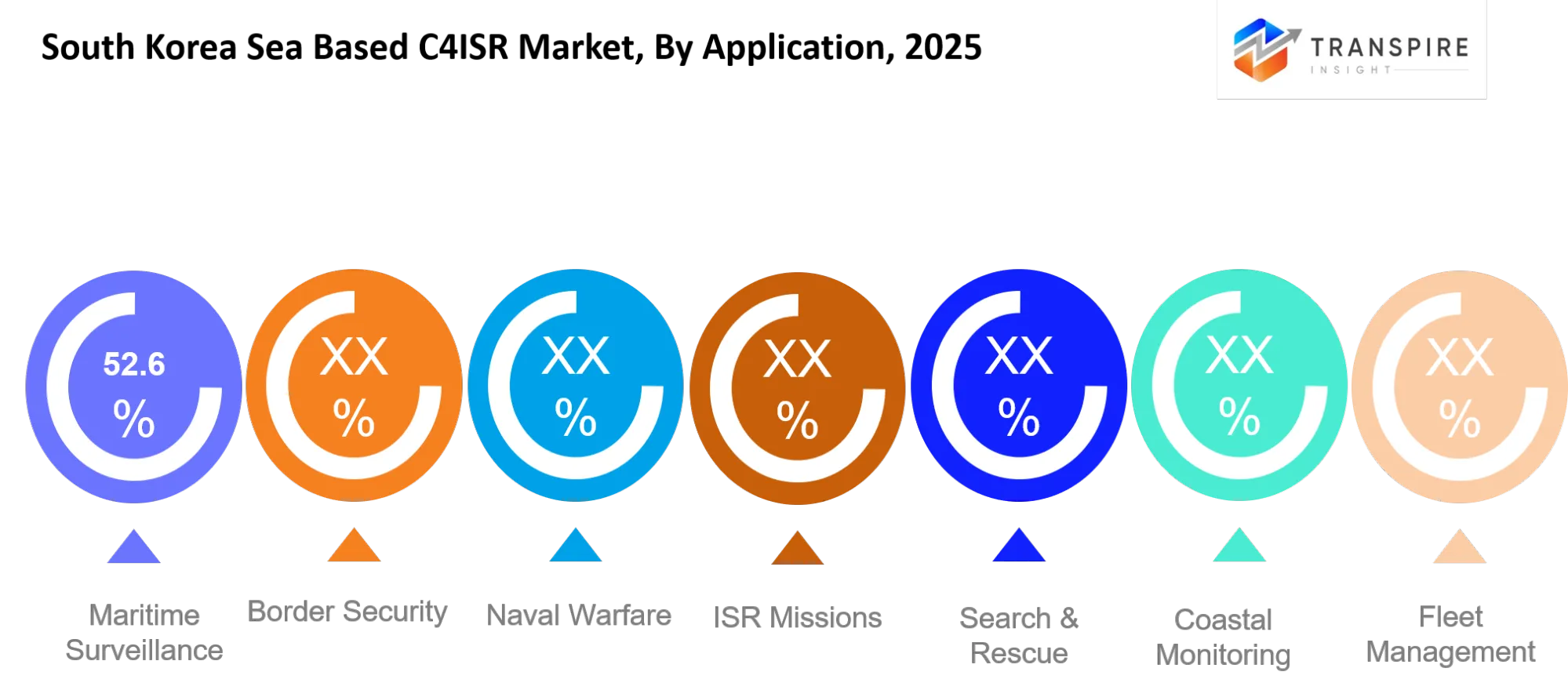
By End User:
Major end-users are the Navy organizations due to their continued investment on modernising the maritime defence capabilities and operation. Other important users are: Coast Guard organisations for sea border security, vigilance and response to maritime emergencies. Defence Agencies that require high levels of information integration for strategic decision and operation. Homeland Security agencies committed to protecting national borders from maritime threats.
Intelligence Agencies who need sophisticated information systems for information analysis and threat detection.Shipbuilders that seek to equip new vessels with advanced maritime technology. Government Bodies that need effective information systems in support of strategic policies, defence planning and procurements.
What are the Key Use Cases Driving the South Korea Sea Based C4ISR Market?
Maritime surveillance is still the top application by revenue for the South Korea Sea Based C4ISR Market because of the need of naval powers to maintain a clear picture of the territorial waters as well as crucial sea lines. Utilizing advanced sensors, encrypted communication as well as Command and control solutions helps in identifying the threats promptly as well as in developing coordination amongst destroyers, frigates, as well as coastal defense forces.
Border surveillance & Search and rescue is growing applications as the coast guard firms are boosting monitoring near high traffic seas, as well as fishing areas. Real-time details sharing and monitoring capabilities assist in curbing illegal actions and promptly reacting to search and rescue missions and marine mishaps.
Future trends The rise of autonomous maritime operations and AI helped mission preparation would witness substantial uptake in the sea-based C4ISR systems as countries boost their investment in intelligent naval systems and operations. These autonomous surface vehicles will likely boost adoption with increasing investment from the defense sector over the expected period.
|
Report Metrics |
Details |
|
Market size value in 2025 |
USD 718.5 Million |
|
Market size value in 2026 |
USD 760.9 Million |
|
Revenue forecast in 2033 |
USD 1136.7 Million |
|
Growth rate |
CAGR of 5.90% from 2026 to 2033 |
|
Base year |
2025 |
|
Historical data |
2021 - 2024 |
|
Forecast period |
2026 - 2033 |
|
Report coverage |
Revenue forecast, competitive landscape, growth factors, and trends |
|
Country scope |
South Korea |
|
Key company profiled |
Hanwha Systems, LIG Nex1, Korea Aerospace Industries, Hyundai Heavy Industries, Lockheed Martin, RTX, Thales, Saab, BAE Systems, Northrop Grumman, Leonardo, Elbit Systems, General Dynamics, Hensoldt, Rheinmetall |
|
Customization scope |
Free report customization (country, regional & segment scope). Avail customized purchase options to meet your exact research needs. |
|
Report Segmentation |
By System Type (Command Systems, Control Systems, Communications, Computers, Intelligence Systems, Surveillance Systems, Reconnaissance Systems, Others); By Platform (Destroyers, Frigates, Submarines, Patrol Vessels, Amphibious Ships, Aircraft Carriers, Unmanned Vessels, Others); By Application (Maritime Surveillance, Border Security, Naval Warfare, ISR Missions, Search & Rescue, Coastal Monitoring, Fleet Management, Others); By End User (Navy, Coast Guard, Defense Agencies, Homeland Security, Intelligence Agencies, Shipbuilders, Government Bodies, Others) |
Which Regions are Driving the South Korea Sea Based C4ISR Market Growth?
The southeast region still constitutes the predominant market share within the South Korea Sea Based C4ISR Market, supported by a significant naval presence and port infrastructure in major cities including Busan and Jinhae. The considerable naval fleet based in the region requires state-of-the-art command, surveillance, and intelligence technologies, fostering enhanced maritime security and defense preparedness. With persistent government defense budget allocation for modernization projects to boost capabilities along coastal and offshore regions, supported by a well-established ecosystem including shipbuilders, defense companies, and R&D institutions, future growth prospects appear optimistic in this region.
In the western region, steady revenues are registered from market operations and growth trends remain distinct compared to that of the eastern region. The stable economic landscape and a continuous commitment towards enhanced coastal security systems drive stable demand for reconnaissance and communications technologies. The region’s naval installations prioritize operating efficiency and assets augmentation over expansion; therefore providing a conducive environment for consistent demand for defense technologies by suppliers.
The eastern region is predicted to be the fastest developing region due to the escalating geopolitical instability in the region. This area, along with rapid investments in state-of-the-art radars, unmanned maritime systems (UMVs), and surveillance technologies, is leading the rapid adoption rate of technologies across the naval operations segment. Increased focus has been placed on enhancing intelligence and surveillance capabilities by defense forces in the region and this will translate into significant market growth and opportunities for technology providers and investors from 2026-2033.
Who are the Key Players in the South Korea Sea Based C4ISR Market and How Do They Compete?
The South Korean Sea Based C4ISR market has a moderately concentrated structure and includes not only domestic defense providers but also global tech firms. Product and system interoperability-seamless integration of intelligence, surveillance, and communications in naval platforms-is key differentiator in this market. The major players of this market such as Hanwha Systems, LIG Nex1, and HD Hyundai Heavy Industries are consolidating their shares by securing and maintaining long-term defense contracts while other specialized companies are differentiating by investing in emerging trends such as artificial intelligence, unmanned systems, and cybersecurity solutions.
Hanwha Systems competes based on the development of superior naval combat systems and integrated sensors for network-centric warfare. It has aggressively invested in AI capabilities to realize speedier data processing and greater battlefield awareness. LIG Nex1's competitive advantage relies on its expertise in advanced sensors, electronic warfare, precision-guided weapons, radar systems, etc., with which it supports highly specialized and complex maritime operations, including cyber defenses and space assets. Its robust R&D and established defense partnerships will help it to defend against competition in this niche field, while expanding opportunities to take on next-generation defense programs that utilize AI-based features.
HD Hyundai Heavy Industries differentiates its offers by incorporating advanced C4ISR systems into the construction and integration of its newly built vessels, aiming to guarantee complete platform-system interoperability for both new builds and retrofits of naval ships. As one of the leading American defense companies, Lockheed Martin continues to differentiate itself through technology partnership with domestic naval shipbuilders and providing state-of-the-art combat management systems (CMS) and related C4ISR solutions to enhance coalition warfighting interoperability and effectiveness across allied navies. Thales primarily differentiates itself by supplying integrated maritime security, surveillance and communications solutions to navies across the world with a strong commitment to digital modernization initiatives and cyber solutions to better protect naval vessels.
Company List
- Hanwha Systems
- LIG Nex1
- Korea Aerospace Industries
- Hyundai Heavy Industries
- Lockheed Martin
- RTX
- Thales
- Saab
- BAE Systems
- Northrop Grumman
- Leonardo
- Elbit Systems
- General Dynamics
- Hensoldt
- Rheinmetall
Recent Development News
In January 2026, Hanwha signed multiple strategic memorandums of understanding with Algoma Steel, Telesat, MDA Space, Cohere, and PV Labs to support Canada's Patrol Submarine Project. The partnerships expanded Hanwha's naval ecosystem by integrating AI, satellite communications, and maritime defense technologies, strengthening future C4ISR capabilities for submarine and naval platforms. Sourcehttps://www.hanwha.com/
In October 2025, HD Hyundai Heavy Industries entered a memorandum of agreement with Huntington Ingalls Industries to collaborate on distributed shipbuilding and pursue joint development of auxiliary and commercial vessels. The agreement expanded international naval cooperation and created opportunities to integrate advanced combat, communications, and maritime mission systems across future vessel programs. Sourcehttps://hii.com/n
What Strategic Insights Define the Future of the South Korea Sea Based C4ISR Market?
The South Korean Sea-based C4ISR Market will see the rise of naval systems characterized by hyper-connectivity and software. In five to seven years, what will dominate this sector are integrated networks linking ships, unmanned vessels, satellite assets and coast guard networks enabling the instantaneous exchange of data. The focus of expenditures will transition from discrete, standalone hardware purchases to integrated systems, adept in handling vast quantities of information.
However, the market also faces a less evident challenge: market concentration and the reliance on a few dominant domestic defence contractors. Dependence on a restricted supplier pool can impede the pace of technological progress, elevate acquisition prices and strain supply chains. In turn, AI’s role in the area of autonomous vessels, in the form of AI-based intelligent autonomous ships, is a growing opportunity in naval applications as demand increases for both uncrewed ships and submarines. Future entrants to the market will fare best by adopting open architecture platforms and investing strategically in cybersecurity, ensuring future military tenders consider them for their data interoperability and safety features.
South Korea Sea Based C4ISR Market Report Segmentation
By System Type
- Command Systems
- Control Systems
- Communications
- Computers
- Intelligence Systems
- Surveillance Systems
- Reconnaissance Systems
By Platform
- Destroyers
- Frigates
- Submarines
- Patrol Vessels
- Amphibious Ships
- Aircraft Carriers
- Unmanned Vessels
By Application
- Maritime Surveillance
- Border Security
- Naval Warfare
- ISR Missions
- Search & Rescue
- Coastal Monitoring
- Fleet Management
By End User
- Navy
- Coast Guard
- Defense Agencies
- Homeland Security
- Intelligence Agencies
- Shipbuilders
- Government Bodies
Frequently Asked Questions
Find quick answers to common questions.
The South Korea Sea Based C4ISR Market size is USD 1136.7 Million in 2033.
Key Segments for the South Korea Sea Based C4ISR Market are By System Type (Command Systems, Control Systems, Communications, Computers, Intelligence Systems, Surveillance Systems, Reconnaissance Systems, Others); By Platform (Destroyers, Frigates, Submarines, Patrol Vessels, Amphibious Ships, Aircraft Carriers, Unmanned Vessels, Others); By Application (Maritime Surveillance, Border Security, Naval Warfare, ISR Missions, Search & Rescue, Coastal Monitoring, Fleet Management, Others); By End User (Navy, Coast Guard, Defense Agencies, Homeland Security, Intelligence Agencies, Shipbuilders, Government Bodies, Others).
Major South Korea Sea Based C4ISR Market Players are Hanwha Systems, LIG Nex1, Korea Aerospace Industries, Hyundai Heavy Industries, Lockheed Martin, RTX, Thales, Saab, BAE Systems, Northrop Grumman, Leonardo, Elbit Systems, General Dynamics, Hensoldt, Rheinmetall.
The Current South Korea Sea Based C4ISR Market size is USD 718.5 Million in 2025.
The South Korea Sea Based C4ISR Market CAGR is 5.90% from 2026 to 2033.
- Hanwha Systems
- LIG Nex1
- Korea Aerospace Industries
- Hyundai Heavy Industries
- Lockheed Martin
- RTX
- Thales
- Saab
- BAE Systems
- Northrop Grumman
- Leonardo
- Elbit Systems
- General Dynamics
- Hensoldt
- Rheinmetall
About the Authors

Tejashri Dhatrak
I am Tejashri Dhatrak, a Senior Research Analyst at Transpire Insight, specializing in the Aerospace and Defence sector. My work focuses on analyzing industry trends, defence technologies, market developments, and emerging innovations that shape the global aerospace and security landscape. At Transpire Insight, I research complex topics, evaluate credible sources, and transform technical insights into accurate, well-structured, and easy-to-understand content for industry professionals and decision-makers. My goal is to provide reliable, research-backed information that helps readers stay informed about defence capabilities, aerospace advancements, strategic developments, and the evolving dynamics of the global defence ecosystem.

Chakradhar Khansole
Chakradhar serves as the Research Director at Transpire Insight, bringing over 8 years of experience in technology, innovation, and strategic market intelligence. He specializes in transforming complex market data into actionable business insights that enable organizations to make informed, growth-oriented decisions. Recognized for his strategic vision and analytical expertise, Chakradhar leads high-impact research initiatives, delivering comprehensive market assessments, competitive intelligence, and forward-looking industry analysis.
Recently Published Reports
-
Apr 2026
Aerospace Fluoropolymers Market
Aerospace Fluoropolymers Market Size, Share & Analysis Report By Type (PTFE, FEP, PFA, ETFE, and Others), By Application (Electrical Insulation, Seals & Gaskets, Coatings, and Others), By End User (Commercial Aviation, Military Aviation, General Aviation, and Others), and Geography (North America, Europe, Asia-Pacific, Middle East and Africa, South and Central America), 2021 - 2031
-
Apr 2026
Airborne SATCOM System Market
Airborne SATCOM System Market Size, Share & Analysis Report By Type (SATCOM Terminals, Transceivers, Airborne Radio, Modems and Routers, SATCOM Radomes, and Other), By Application (Government and Defense and Commercial), and Geography (North America, Europe, Asia-Pacific, Middle East and Africa, South and Central America), 2021 – 2031
-
Apr 2026
Ship Leasing Market
Ship Leasing Market Size, Share & Analysis Report By Vessel Type (Container Ships, Bulk Carriers, Tankers, and Specialized Vessels), By Lease Duration (Short-Term Lease (Less than 1 year), Medium-Term Lease (1-5 years), and Long-Term Lease (More than 5 years)), By Lease Type (Bareboat Charter, Time Charter, Financial Lease, and Others), By End-User Industry (Oil and Gas, Manufacturing and Industrial, Automotive, Agriculture and Food, Retail and Consumer Goods, and Others), and Geography (North America, Europe, Asia-Pacific, Middle East and Africa, South and Central America), 2021 – 2031
-
Apr 2026
Thread Rolling Dies Market
Thread Rolling Dies Market Size, Share & Analysis Report By Type (Flat Thread Rolling Dies, Circular (Cylindrical) Dies, Tangential Thread Rolling Dies, Planetary Thread Rolling Dies, and Other Types), By Material Type (High-Speed Steel (HSS), Carbide, Tool Steel, Alloy Steel, and Other Specialized Alloys), By Distribution Channel (Direct Sales, Distributors and Dealers, and Online Platforms), By Application (Automotive Industry, Aerospace and Defense, Construction and Infrastructure, Industrial Machinery, Electronics and Electrical Components, Medical Devices, and Fastener Production), and Geography (North America, Europe, Asia-Pacific, Middle East and Africa, South and Central America), 2021 – 2031
Our Clients





