

Middle East and Africa Nitrogen Oxide Control Systems Market Size & Forecast:
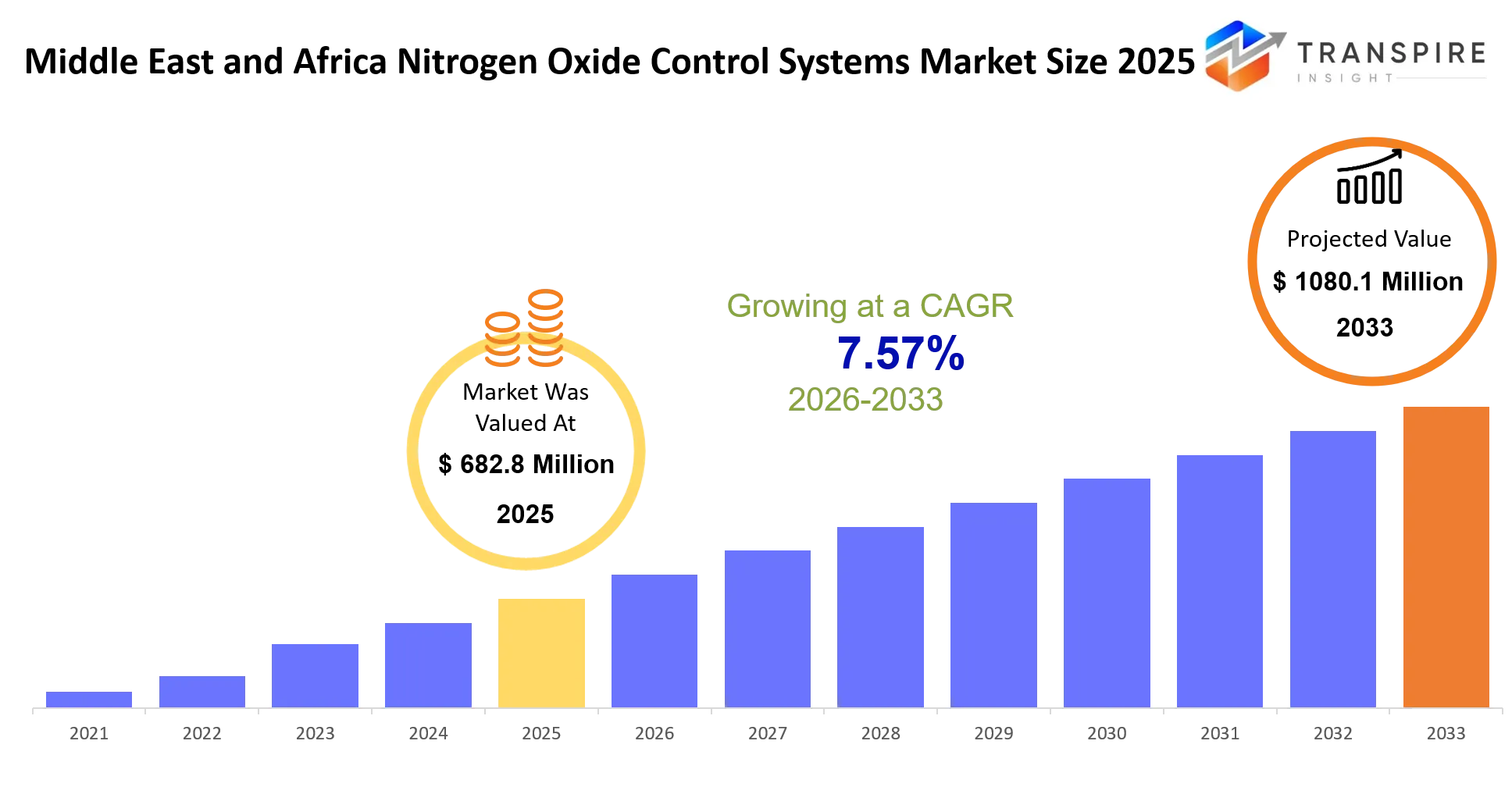
- Middle East and Africa Nitrogen Oxide Control Systems Market Size 2025: USD 682.8 Million
- Middle East and Africa Nitrogen Oxide Control Systems Market Size 2033: USD 1080.1 Million
- Middle East and Africa Nitrogen Oxide Control Systems Market CAGR: 7.57%
- Middle East and Africa Nitrogen Oxide Control Systems Market Segments: By Technology (SCR, SNCR, Low-NOx Burners, Flue Gas Recirculation, Catalytic Reduction, Hybrid Systems, Others); By Application (Power Plants, Cement Plants, Refineries, Steel Plants, Chemical Plants, Others); By End User (Utilities, Industrial Manufacturing, Oil & Gas, Government Projects, Others); By Component (Catalysts, Reactors, Control Systems, Monitoring Systems, Others)
Middle East and Africa Nitrogen Oxide Control Systems Market Summary
The Middle East and Africa Nitrogen Oxide Control Systems Market was valued at USD 682.8 Million in 2025. It is forecast to reach USD 1080.1 Million by 2033. That is a CAGR of 7.57% over the period.
Nitrogen oxides control systems actually play a crucial role in trimming down harmful emissions coming from power plants, refineries, cement factories, steel mills and chemical processing units. They assist industrial operators stay within air quality rules , but also keep production running well and—yes—lower environmental liabilities. In the last five years, the market kind of moved away from only basic compliance-focused installations, toward higher efficiency approaches like Selective Catalytic Reduction (SCR) and hybrid emission control solutions, plus digitally monitored systems. One of the big triggers behind this shift, has been the tightening of industrial emission regulations across Gulf countries and South Africa, together with bigger investments in energy and manufacturing infrastructure.
As industrial facilities grow their capacity and as governments reinforce pollution control requirements, operators are more often placing bets on advanced NOx reduction technologies. This ongoing movement is supporting sustained equipment demand, catalyst replacement revenues, and longer service contracts. At the same time the growing retrofit activity across older industrial assets is opening up fresh chances for both technology providers and engineering firms.
Key Market Insights
- Saudi Arabia and the GCC area account for an estimated 38%+ share of the regional market in 2025 , helped mostly by big power and refining infrastructure that keeps getting built out.
- Southern Africa shows up as the fastest-moving regional cluster through 2033, essentially pushed by power plant upgrading and emissions compliance initiatives that don't just sit on paper.
- SCR technology is still the main player, with roughly 53% market share, because its NOx reduction efficiencies can run past 90% in real-world conditions.
- SNCR stays second in size, usually chosen when budgets are tighter in industrial uses, like cement operations and waste processing facilities.
- Hybrid NOx control systems are expected to post the strongest adoption growth through 2033, since operators keep chasing performance tuning and better outcomes.
- When it comes to what actually drives demand, power generation makes up more than 33% of total needs, so it remains the biggest application segment by a wide margin.
- Refineries are one of the quicker expanding application areas, mainly due to refinery expansion programs running across GCC economies, step by step.
- For end users , utilities are still the front runner group, with an estimated 35%+ market contribution, and it ties back to thermal power generation assets.
- Industrial manufacturing is turning into the fastest-growing end-user category, as emission standards keep stretching into heavier industries.
- Big names such as Mitsubishi Heavy Industries, Johnson Matthey, Babcock & Wilcox, GE Vernova, Thermax, and BASF are extending their capabilities around digital monitoring, catalyst effectiveness , and regional service coverage, all at once in many cases.
What are the Key Drivers, Restraints, and Opportunities in the Middle East and Africa Nitrogen Oxide Control Systems Market?
The main growth driver seems to be the tightening, of industrial emission rules across power production, refining, cement making, and chemical handling segments. In effect, Governments across the Gulf Cooperation Council countries as well as South Africa have pushed harder on environmental compliance structures, to cut down industrial contamination. This matters for purchasing choices, because plants have to install more advanced NOx reduction technologies in order to obtain permits , keep things running, and sidestep penalties. Because of that, engineering contractors, catalyst providers, and equipment makers keep seeing demand from brand new installations as well as retrofit work.
Still, the biggest brake is the high capital cost tied to installing, integrating, and then continuously swapping out catalysts. A lot of industrial facilities in newer African economies run older infrastructure, so they often need major changes before emission control systems can be rolled out properly. The issue feels structural, modernization efforts tend to ride on long investment timelines , depends heavily on financing availability, and is also linked to broader industrial development objectives. When investments get postponed, it reduces revenue chances and drags technology adoption timelines in multiple markets.
One big opportunity is the blending of digital emissions management platforms with advanced SCR and hybrid control methods. Industrial operators are increasingly asking for solutions that not only reduce emissions but also improve day-to-day performance. Big spends on petrochemical hubs, gas-fired power stations, and industrial estates across Saudi Arabia , the UAE, and Egypt create a strong base for vendors offering smart monitoring, predictive maintenance, and overall performance optimization functions.
What Has the Impact of Artificial Intelligence Been on the Middle East and Africa Nitrogen Oxide Control Systems Market?
Artificial intelligence is now shifting how industrial facilities handle nitrogen oxide emissions, partly by boosting operational efficiency and compliance outcomes. Nowadays, the control platforms a lot of plants are using lean on AI algorithms, to automate combustion tuning, reagent dosing, and emissions surveillance. In big power stations and refinery settings, intelligent systems continuously scan the process variables and then tweak operating settings on the fly, so they stay within regulatory rules while also trimming operating expenses.
Machine learning is also pushing predictive maintenance further ahead. By looking at catalyst degradation trends, temperature swings, pressure variations, and even older performance logs, AI models can estimate when maintenance is needed before a failure happens. That method cuts down on unexpected downtime, and it tends to raise equipment availability. A lot of industrial operators say they see tangible gains in catalyst utilization, overall system uptime, and day to day operating efficiency from these data driven optimization efforts.
On top of that, advanced analytics help with emissions forecasting. This means facilities can foresee compliance risks earlier, and adjust operating conditions in a more proactive way. Digital monitoring platforms also make reporting more accurate and improve regulatory transparency, in practice.
Still, there is a real catch with AI adoption. The integration costs can stay high, especially for plants running legacy infrastructure that was built years ago. Also, uneven data quality and limited historical operating datasets in some industrial facilities can reduce prediction accuracy, which then slows deployment across certain zones in the region.
Key Market Trends
- After 2021 SCR adoption went up pretty sharply, hitting something like 53% technology share because the NOx removal is… well, just more efficient.
- Industrial operators, meanwhile , tend to favor retrofit projects over completely replacing an entire facility, mainly so they can still satisfy the newer emissions requirements that keep showing up.
- Digital monitoring platforms also got broader traction across large facilities between 2022 and 2026, and that helped make emissions reporting more accurate, kinda consistently.
- Catalyst optimization technologies then stepped in and brought down reagent consumption by an estimated 10%–20% in a few selected industrial use cases.
- In the GCC , refinery operators pushed more environmental investments after newer, tighter industrial emissions frameworks arrived in 2021.
- Hybrid emission control systems started gaining real traction too, since operators wanted both compliance performance and lower operating costs, not one or the other.
- Service contracts and lifecycle maintenance agreements became more significant revenue streams than equipment-only sales.
- And during 2025–2026, GE Vernova plus its industrial partners put extra emphasis on low-emission combustion approaches.
- Also, regional buyers are increasingly judging suppliers by their digital capabilities rather than equipment performance by itself.
- Finally, local manufacturing partnerships expanded across the region , which cuts down delivery timelines and reduces import dependency.
Middle East and Africa Nitrogen Oxide Control Systems Market Segmentation
By Technology
SCR, sometimes Selective Catalytic Reduction, is still the go to solution for plants dealing with tight emission limits. The big reason is the high NOx removal efficiency, so it tends to get picked in power generation, refining, and chemical processing. With catalyst-assisted reactions in the middle of the process, operators can usually reach substantial reductions while also keeping operational stability. Because of that, large industrial projects often end up selecting SCR systems when the long term compliance demands make the higher capital investment feel acceptable.
SNCR, Low-NOx Burners, and Flue Gas Recirculation are considered other ways to push emissions down. SNCR can look cheaper up front for medium sized facilities, while Low-NOx Burners cut NOx right at combustion time. Flue Gas Recirculation works by lowering combustion temperatures, which then limits NOx formation overall. Catalytic Reduction, Hybrid Systems, and other methods keep showing up in discussions too, especially when plant operators want better performance, more flexibility, and smoother integration with digital monitoring platforms.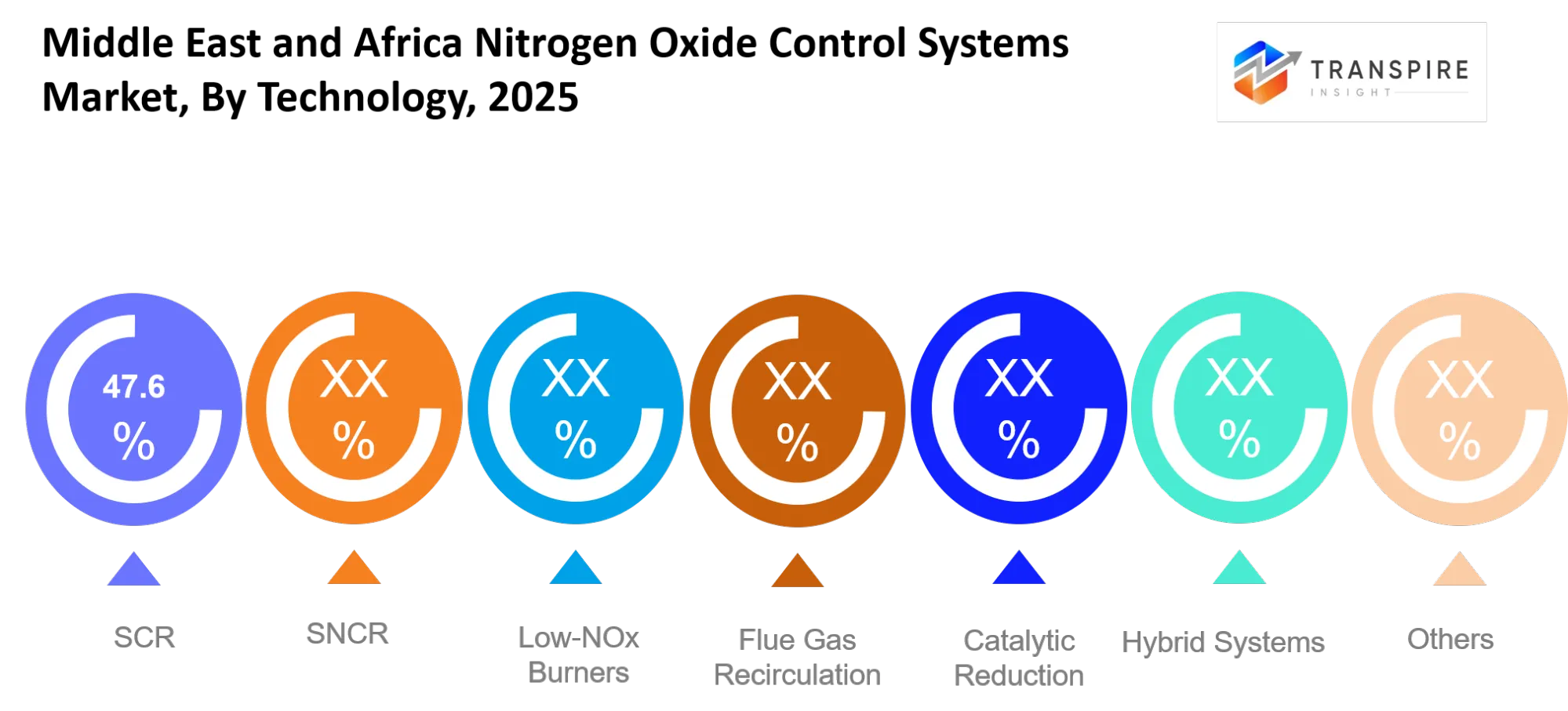
By Application
Power Plants kind of represent the biggest deployment area, because thermal generation facilities do create substantial NOx emissions that really need continuous treatment, at least in practice. Meanwhile growing electricity consumption across developing economies tends to keep sustaining demand for advanced control technologies. So, compliance requirements and operational reliability stay as the main investment things to consider.
Cement Plants, Refineries, Steel Plants, Chemical Plants, and a few Others also create notable opportunities, since the production is often very energy intensive. In particular, cement facilities commonly use SNCR and burner optimization technologies, not always in the same sequence though. Refineries and chemical facilities usually lean toward high efficiency systems to satisfy strict environmental standards. Meanwhile steel manufacturing operations keep putting money into integrated emission control infrastructure, as modernization programs advance and push the timeline.
By End User
Utilities account for the largest share because power generation facilities run with strict environmental oversight, but also constant monitoring, so it ends up being kind of heavy on spend. Large utility operators often invest in advanced systems to back up long-term compliance and day to day efficiency. Retrofit projects still keep producing substantial spending across the existing thermal assets.
Industrial Manufacturing, Oil & Gas, Government Projects and Others are seen as key growth pockets too, even if the pattern looks a bit different quarter to quarter. Manufacturing facilities are increasingly adopting emission reduction technologies as environmental rules keep broadening. Oil and gas operators put compliance first, especially across refining and processing assets, that’s the main driver. Government supported industrial expansion initiatives also help push technology adoption through those strategic sectors.
By Component
Catalysts are like a really critical bit in the whole system, because the efficiency thing relies a lot on how well the catalyst performs and how long it keeps going. When there is continuous replacement it also makes sort of recurring revenue chances for the suppliers, again and again. Recent improvements in catalyst formulation, they tend to aim at stretching operational life more, and also bumping up conversion efficiency.
Then there are Reactors, control systems , monitoring systems and some other pieces that help the system work as a whole. Reactors give the proper setting for emission reduction reactions to happen, while the control systems fine tune performance when operating conditions change. Monitoring systems help with real time compliance verification, and they support predictive maintenance strategies too. On top of that, the whole digitalization trend is boosting investments in advanced monitoring and automation platforms.
What are the Key Use Cases Driving the Middle East and Africa Nitrogen Oxide Control Systems Market?
The biggest use case still feels like thermal power generation , where plant operators have to cut emissions from coal and gas plants , while staying able to deliver dependable electricity. The tighter environmental rules and the sheer size of the emission volumes make power installations essentially the first place demand shows up.
More adoption keeps showing across refineries, petrochemical complexes, cement factories, and steel making facilities. These sectors run high-temperature combustion steps that produce a meaningful amount of NOx. Staying compliant with regulations and keeping operations stable are both still driving investment choices , year after year.
On the newer side, you also see hydrogen-ready power facilities, more advanced gas processing initiatives, and integrated industrial zones built around lower-emission operation. These kinds of projects are increasingly folding in digital emissions management capabilities from the earliest planning stage, and that is opening up room for advanced technology suppliers .
|
Report Metrics |
Details |
|
Market size value in 2025 |
USD 682.8 Million |
|
Market size value in 2026 |
USD 722.4 Million |
|
Revenue forecast in 2033 |
USD 1080.1 Million |
|
Growth rate |
CAGR of 7.57% from 2026 to 2033 |
|
Base year |
2025 |
|
Historical data |
2021 - 2024 |
|
Forecast period |
2026 - 2033 |
|
Report coverage |
Revenue forecast, competitive landscape, growth factors, and trends |
|
Regional scope |
United States; Canada; Mexico; United Kingdom; Germany; France; Italy; Spain; Denmark; Sweden; Norway; China; Japan; India; Australia; South Korea; Thailand; Brazil; Argentina; South Africa; Saudi Arabia; United Arab Emirates |
|
Key company profiled |
Babcock & Wilcox, Mitsubishi Heavy Industries, Johnson Matthey, Ducon, CECO Environmental, Hitachi Zosen, Thermax, Yara, BASF, Haldor Topsoe, Andritz, Siemens Energy, GE Vernova, Fuel Tech, Doosan |
|
Customization scope |
Free report customization (country, regional & segment scope). Avail customized purchase options to meet your exact research needs. |
|
Report Segmentation |
By Technology (SCR, SNCR, Low-NOx Burners, Flue Gas Recirculation, Catalytic Reduction, Hybrid Systems, Others); By Application (Power Plants, Cement Plants, Refineries, Steel Plants, Chemical Plants, Others); By End User (Utilities, Industrial Manufacturing, Oil & Gas, Government Projects, Others); By Component (Catalysts, Reactors, Control Systems, Monitoring Systems, Others) |
Which Regions are Driving the Middle East and Africa Nitrogen Oxide Control Systems Market Growth?
In the Gulf Cooperation Council region, it kinda leads market revenue making because of heavy refining capacity, petrochemical setup, and really large thermal power generation assets. Environmental rules have been getting stricter bit by bit across Saudi Arabia, the UAE, and nearby economies too. At the same time, meaningful government spending on industrial diversification keeps pushing people toward adoption. There is also a fairly seasoned engineering ecosystem, plus ongoing infrastructure rollouts that basically lock in the regional lead.
Then, South Africa comes next as the second-largest contributor, but its growth model feels a bit different. Here, market activity is backed by established mining, metals, and power generation industries that still need ongoing emissions management. The way regulations are being applied has moved forward steadily rather than suddenly, which makes for a calmer investment climate. Because the industrial base has been around for a long time, there is continual pull for upgrades, plus maintenance services.
North Africa is where things look fastest growing as a regional opening. Egypt, Morocco, and surrounding countries are putting more money into energy infrastructure, industrial development, and environmental modernization efforts. More recently, power generation projects along with industrial expansion have increased the need for better emission control solutions. So this trajectory ends up looking particularly attractive for technology providers, engineering businesses and longer-horizon investors through 2033.
Who are the Key Players in the Middle East and Africa Nitrogen Oxide Control Systems Market and How Do They Compete?
Competition still looks somewhat fragmented, in the sense that big global engineering groups are in the same arena as specialized emission control providers, and it’s not just about who has the fanciest brochures. In practice the main levers are technology performance, catalyst efficiency, how good the regional service coverage is, and simply how strong the project execution experience really is. Customers are also moving faster toward judging suppliers by lifecycle operating costs and digital monitoring capabilities, rather than only by equipment specifications, end of story.
Mitsubishi Heavy Industries stands out with large-scale industrial emission control know-how plus integrated environmental solutions for power and industrial facilities. Johnson Matthey leans hard on catalyst innovation and performance tuning, so customers can push NOx reduction efficiency while keeping catalyst life more or less stretched. Babcock & Wilcox leans on established utility-sector relationships and strong retrofit capability for existing power generation assets.
Thermax goes for practical and cost-effective industrial solutions, with regional project execution strength as a parallel advantage. GE Vernova expands by combining advanced combustion technologies, digital optimization platforms, and lower-emission power generation solutions. BASF and Haldor Topsoe improve their standing through catalyst research, measurable performance improvements, and targeted industrial applications that fit specific needs. Overall, these approaches create separation via technology leadership and longer-term operational value, even if the wording differs by supplier.
Company List
- Babcock & Wilcox
- Mitsubishi Heavy Industries
- Johnson Matthey
- Ducon
- CECO Environmental
- Hitachi Zosen
- Thermax
- Yara
- BASF
- Haldor Topsoe
- Andritz
- Siemens Energy
- GE Vernova
- Fuel Tech
- Doosan
Recent Development News
In March 2026, GE Vernova and IHI successfully demonstrated 100% ammonia combustion in a full-scale F-class gas turbine. The milestone supports next-generation low-emission power generation technologies and advances future NOx management solutions.https://www.gevernova.com
In March 2026, IHI and GE Vernova continued joint development activities following successful full-scale ammonia combustion testing. The achievement accelerated commercialization plans for advanced low-emission turbine systems targeted for deployment by 2030.https://www.powermag.com
What Strategic Insights Define the Future of the Middle East and Africa Nitrogen Oxide Control Systems Market?
The market is moving toward integrated emissions management ecosystems that bring together high-efficiency NOx reduction methods with advanced analytics, predictive maintenance, and automated compliance reporting. The real push behind this change is basically the meeting, or convergence, of tighter environmental regulation and industrial digitalization. More and more facilities are looking for approaches that cut emissions while also keeping operating costs down and boosting asset utilization at the same time.
There’s also a quieter risk that doesn’t get talked about much, catalyst supply concentration and the availability of raw materials. If something disrupts catalyst production, project expenses could rise and you may see delays spreading across big industrial sites. Meanwhile, intelligent emissions management platforms are also showing up as a meaningful opportunity, maybe even an emerging one. Digital optimization is still underpenetrated in many industrial facilities especially across Africa, and also parts of the Middle East.
Market players should focus their investments on digital monitoring, predictive maintenance functions, and regional service infrastructure. The organizations that pair emission control hardware with long-term operational intelligence services, are likely to be in a stronger spot to win recurring revenue and maintain customer loyalty, over the next ten years.
Middle East and Africa Nitrogen Oxide Control Systems Market Report Segmentation
-
By Technology
SCR
SNCR
Low-NOx Burners
Flue Gas Recirculation
Catalytic Reduction
Hybrid Systems
Others -
By Application
Power Plants
Cement Plants
Refineries
Steel Plants
Chemical Plants
Others -
By End User
Utilities
Industrial Manufacturing
Oil & Gas
Government Projects
Others -
By Component
Catalysts
Reactors
Control Systems
Monitoring Systems
Others
Frequently Asked Questions
Find quick answers to common questions.
The Expected Middle East and Africa Nitrogen Oxide Control Systems Market size for the Market will be USD 1080.1 Million in 2033.
Key Segments for the Middle East and Africa Nitrogen Oxide Control Systems Market are By Technology (SCR, SNCR, Low-NOx Burners, Flue Gas Recirculation, Catalytic Reduction, Hybrid Systems, Others); By Application (Power Plants, Cement Plants, Refineries, Steel Plants, Chemical Plants, Others); By End User (Utilities, Industrial Manufacturing, Oil & Gas, Government Projects, Others); By Component (Catalysts, Reactors, Control Systems, Monitoring Systems, Others).
Major Middle East and Africa Nitrogen Oxide Control Systems Market Players are Babcock & Wilcox, Mitsubishi Heavy Industries, Johnson Matthey, Ducon, CECO Environmental, Hitachi Zosen, Thermax, Yara, BASF, Haldor Topsoe, Andritz, Siemens Energy, GE Vernova, Fuel Tech, Doosan.
The Current Middle East and Africa Nitrogen Oxide Control Systems Market size is USD 682.8 Million in 2025.
The Middle East and Africa Nitrogen Oxide Control Systems Market CAGR is 7.57% from 2026 to 2033.
- Babcock & Wilcox
- Mitsubishi Heavy Industries
- Johnson Matthey
- Ducon
- CECO Environmental
- Hitachi Zosen
- Thermax
- Yara
- BASF
- Haldor Topsoe
- Andritz
- Siemens Energy
- GE Vernova
- Fuel Tech
- Doosan
About the Authors

Avinash Kumar
I’m Avinash Kumar, a Senior Research Analyst at Transpire Insight, with expertise in the Electronics and Semiconductor and Energy & Power industry. My work focuses on analyzing emerging technologies, market trends, industry developments, and innovation across these sectors. I specialize in transforming complex technical and market insights into clear, research-backed content that helps professionals, businesses, and decision-makers stay informed. Through continuous industry research and data-driven analysis, I strive to deliver accurate, reliable, and practical perspectives on the latest advancements shaping the semiconductor and energy landscape.

Chakradhar Khansole
Chakradhar serves as the Research Director at Transpire Insight, bringing over 8 years of experience in technology, innovation, and strategic market intelligence. He specializes in transforming complex market data into actionable business insights that enable organizations to make informed, growth-oriented decisions. Recognized for his strategic vision and analytical expertise, Chakradhar leads high-impact research initiatives, delivering comprehensive market assessments, competitive intelligence, and forward-looking industry analysis.
Recently Published Reports
-
Apr 2026
Active Power Filter Market
Active Power Filter Market Size, Share & Analysis Report By Type (Shunt Active Power Filters, Series Active Power Filter, Hybrid Active Power Filter), By Application (Harmonics Mitigation, Reactive Power Compensation, Voltage Regulation, Power Factor Correction), By Phase (Single Phase, Three Phase), By End-User Industry (Manufacturing, Healthcare, Commercial, Automotive, Oil and Gas, Others), and Geography (North America, Europe, Asia-Pacific, Middle East and Africa, South and Central America), 2021 - 2031
-
Apr 2026
Electrical Transformer Market
Electrical Transformer Market Size, Share & Analysis Report By Core (Closed, Shell, and Berry), By Insulation (Gas, Oil, Solid, Air, and Other), By Phase (Single, and Three), By Rating (100 MVA to 500 MVA, 501 MVA to 800 MVA, and 801 MVA to 1200 MVA), and Geography (North America, Europe, Asia-Pacific, Middle East and Africa, South and Central America), 2021 – 2031
-
Apr 2026
Hydraulic Piston Pumps Market
Hydraulic Piston Pumps Market Size, Share & Analysis Report By Type (Axial Piston Pumps, Radial Piston Pumps), By Operating Pressure (Low Pressure, Medium Pressure, High Pressure), By Application (Construction, Mining, Agriculture, Automotive, Oil & Gas, Industrial Machinery, Others), By End-User (OEMs, Aftermarket), and Geography (North America, Europe, Asia-Pacific, Middle East and Africa, South and Central America), 2021 – 2031
-
Apr 2026
Laboratory Gas Generators Market
Laboratory Gas Generators Market Size, Share & Analysis Report By Product (Nitrogen Gas Generator, Hydrogen Gas Generator, Zero Air Gas Generator, Purge Gas Generator, TOC Gas Generators, Others), By Application (Gas Chromatography, Liquid Chromatography-mass Spectrometry (LC-MS), Gas Analyzers, Others), By End-user (Life Science, Chemical & Petrochemical, Food & Beverage, Others), and Geography (North America, Europe, Asia-Pacific, Middle East and Africa, South and Central America), 2021 – 2031