
South Korea Rehabilitation Robots Market Size & Forecast:
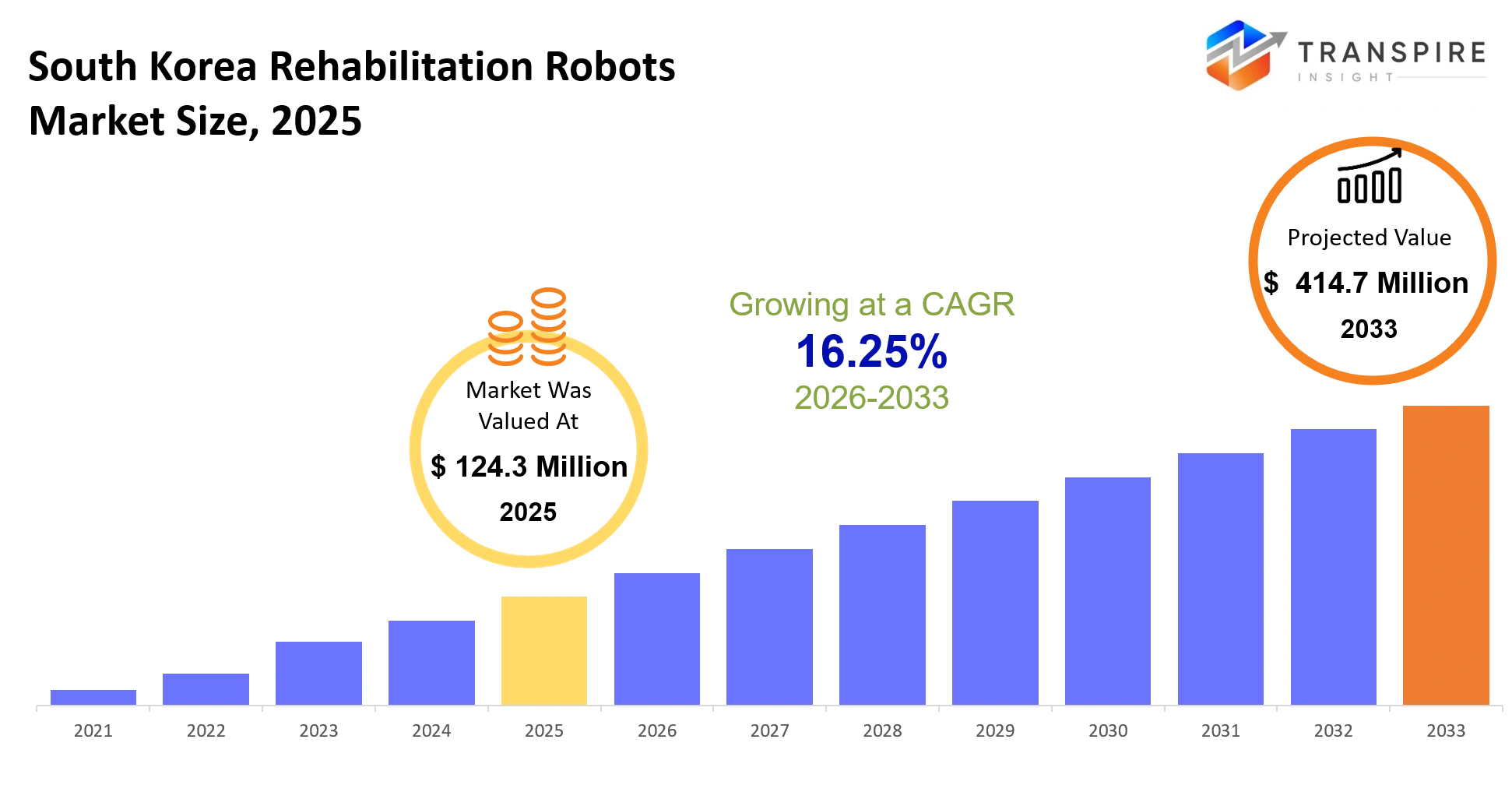
- South Korea Rehabilitation Robots Market Size 2025: USD 124.3 Million
- South Korea Rehabilitation Robots Market Size 2033: USD 414.7 Million
- South Korea Rehabilitation Robots Market CAGR: 16.25%
- South Korea Rehabilitation Robots Market Segments: By Robot Type (Exoskeleton Robots, Therapy Robots, Assistive Robots, Gait Training Robots, Upper Limb Robots, Lower Limb Robots, Balance Training Robots, Others); By Application (Neurological Rehabilitation, Orthopedic Rehabilitation, Stroke Recovery, Elderly Care, Spinal Injury Recovery, Pediatric Rehabilitation, Sports Injury Recovery, Others); By End User (Hospitals, Rehabilitation Centers, Clinics, Home Care Settings, Research Institutes, Elderly Care Centers, Military Rehabilitation Units, Others); By Technology (AI-enabled Robots, Sensor-based Robots, Wearable Robots, Autonomous Robots, Cloud-connected Robots, Mechatronic Systems, Smart Robotics Platforms, Others)
South Korea Rehabilitation Robots Market Summary
The South Korea Rehabilitation Robots Market was valued at USD 124.3 Million in 2025. It is forecast to reach USD 414.7 Million by 2033. That is a CAGR of 16.25% over the period.
The market for South Korea rehabilitation robots is in its growth phase solving a common clinical issue: How can stroke victims, elderly populations, and patients with neurological/musculoskeletal disabilities accelerate movement rehabilitation or improve therapeutic efficacy compared to traditional treatment methods? Healthcare providers at hospitals and rehab facilities have expanded robot-assisted physical and occupational therapy with the help of robotic exoskeleton (WEAR), treadmill-walking robots, upper-limb robotic assistants. In the past five years, the rehabilitation robot market in South Korea has experienced a paradigm shift from primarily hospital-focused rehab to increasingly tech-enabled patient-focused treatments incorporating remote monitoring, home rehabilitation robots, and WEAR devices.
This evolution has amplified following theCOVID-19 pandemic with the widespread acknowledgment of labor shortages and interrupted schedules of patient visits. Facing aging populations and ever increasing the prevalence of functional impairment in the population, Korean hospitals and facilities have been increasing their commitment to rehabilitation robots to scale up their treatment offerings and boost recovery prospects.
Key Market Insights
- Seoul Metropolitan Region is set to dominate the South Korea Rehabilitation Robots Market, and it could account for nearly 45% of the industry revenue in 2025 , mostly because of the advanced hospital infrastructure that keeps getting upgraded.
- Meanwhile the southern provinces, like Busan and Daegu, are likely to see strong market expansion, emerging as the quickest regional markets through 2032, largely driven by the rising usage of robots in rehabilitation centers.
- As for the product view, exoskeleton robots are expected to hold a major slice—around 40% in 2025 , since gait restoration and mobility assistance are turning into must-haves for hospitals.
- Upper-limb rehabilitation systems are poised to stand as the second-largest application area as incidents related to stroke and neurological diseases continue to hold sway. Wearable rehabilitation robots segment will record swift growth rate through 2032 as at-home care and remote patient monitoring practices expand.
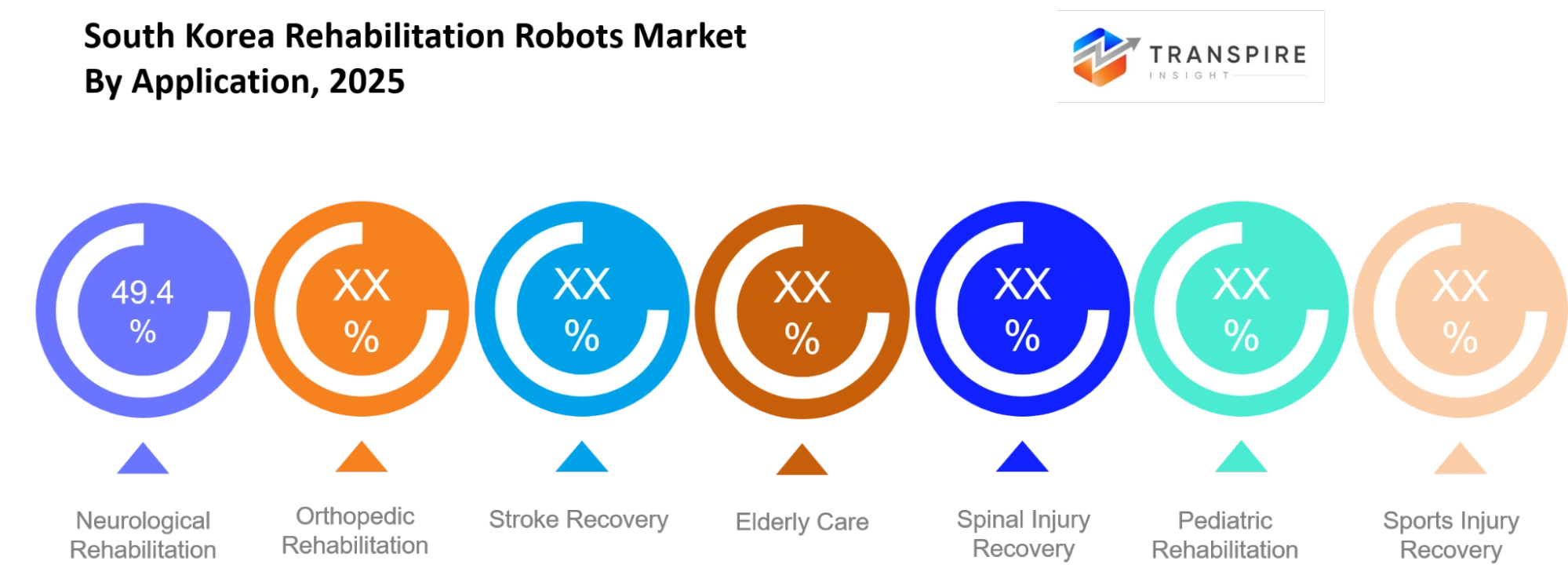
- The neurological rehabilitation segment is expected to witness massive growth in applications, holding over 50% market share, as stroke treatment regimens integrate robotic therapies extensively.
- Orthopedic rehabilitation applications are expected to exhibit notable growth through 2032, owing to increasing instances of sports injuries and use of robotic aid in post-operative rehabilitation.
- In the end-user segment, hospitals will continue to lead with close to 60% of market share, whereas the fastest growing segment is the rehabilitation centers segment.
- Market players have been focusing on integration of AI, motion analysis tools, and cloud connectivity, which allows for personalized patient sessions and enhances their engagement.
- Strategic partnerships are being witnessed between leading healthcare service providers and robotics manufacturers, and even research universities too, so that the quick commercialization of fresh robotic products can happen and development timelines get shortened, starting in 2022.
What are the Key Drivers, Restraints, and Opportunities in the South Korea Rehabilitation Robots Market?
The biggest growth engine is kind of clear: an aging Korean population running into a lack of therapists. The South Korea market is really booming because the aging trend is strong, while there is also a shortage of rehabilitation therapists, that’s driving demand for stroke care and mobility impairment treatment. At the same time, operational complexity is getting reduced , so adoption feels easier and faster.
Robotic rehabilitation equipment manufacturers are capitalizing on this because robots enable more therapy sessions, standard treatment procedures and higher throughput, which results in better equipment utilization. They leverage software to provide update services and ongoing software subscriptions.
Despite the trend of improved robot hardware and AI in motion analysis technologies reducing operating costs, the most substantial roadblock for robotic rehabilitation remains high upfront acquisition costs and complexity of setup and configuration for rehabilitation robots.
More expensive exoskeleton systems and gait training systems that demand substantial CapEx and training are often just too large for most clinics. This is not going to change much in the future since the reimbursements system and smaller therapy clinics cannot provide the return on the initial investment needed for rehabilitation robots. However, home health robotic rehabilitation and telehealth represents a huge potential in the market. Robotic rehabilitation system is small and smart enough to be used by people in home or community center, monitored via web-cam with AI algorithms for therapists at remote locations.Home care ecosystem (e.g. Sensors in furniture and environment) coupled with health data infrastructure for telemedicine are the foundation for a home health robotic solution to take the next leap to expand the market.
What Has the Impact of Artificial Intelligence Been on the South Korea Rehabilitation Robots Market?
Rehabilitation robots – traditionally simple mechanical assist devices – have begun to move toward a more versatile platform driven by the continued integration of AI and other sophisticated digital technologies. Rehabilitation machines now incorporate AI software that evaluates patient motion, muscle activation, and gait performance to provide instant adjustments to resistance level and treatment intensity. This helps therapists cut down on administrative tasks while enhancing their capacity to develop tailored rehabilitation interventions for individual patients.
The robotic system includes embedded sensors that can monitor joint fatigue, motor output, and general efficiency so that clinics are prepared for any maintenance needs. Machine learning models can also be used in clinics to predict outcomes for patients to optimize therapy plans and patient performance trends. This leads to faster up times and saves money. The latest innovations to improve operating costs now include the concept of digital twins and a new way of networking with devices via cloud technology.
But not everything is perfect for AI because high start-up prices, disjointed patient medical history data, and a lack of standardized data collection in therapy, has given us less accuracy in algorithms, to the effect that deployment hasn’t widespread although potential exists in the long term for this device.
Key Market Trends
- From 2021 onward, hospitals seem to have leaned away from fixed robotic setups and toward wearable exoskeletons ,that help patients move better and also support outpatient rehab programs, more smoothly than before.
- AI powered motion analysis has really gone mainstream, which means therapists can adjust treatment in real time, and build more tailored treatment plans across neurological rehab environments, without so much guess work.
- After the pandemic , home based rehab solutions started picking up momentum, so patients depend less on frequent hospital visits. At the same time remote patient monitoring has expanded in a noticeable way, almost like it became standard.
- Manufacturers increasingly focus on lighter materials and ergonomic design choices, so robotic devices feel more comfortable, and they’re better for longer duration therapy sessions.
- Strategic partnerships between hospitals and robotics companies have also sped things up, helping commercialization move faster. That often shortens product development cycles, and clinical validation timelines as well, which sounds small but matters a lot.
- Since around 2022, cloud connectivity has grown rapidly, and now therapists can watch progress from a distance. They can then optimize rehabilitation programs using data from real life, not only from clinic sessions.
- Competition is no longer only about raw hardware performance. Instead it’s about complete software ecosystems ,with AI analytics, predictive indications, and tele-rehabilitation functions that work together.
- Domestic players have been investing more in rehabilitation robotics too, which reduces reliance on imports and strengthens South Korea healthcare technology ecosystem, overall.
- Finally, regulatory support for digital healthcare and smart hospitals has encouraged wider uptake of robotic rehabilitation technologies, across tertiary care and specialty care facilities.
South Korea Rehabilitation Robots Market Segmentation
By Robot Type:
Exoskeleton robots help with movement and the “strength comeback” thing. Therapy robots do repetitive exercises for training, while assistive robots kind of boost everyday mobility, like you know getting around without so much hassle. Then there are gait training robots, upper limb robots, lower limb robots, balance training robots, and some other configurations that widen the options across rehab environments, really.
As demand keeps growing it also pushes broader product development and more active patient engagement. Newer, more advanced designs improve comfort, precision, and treatment throughput across different healthcare facilities.
By Application:
Neurological rehab is still a huge application area, basically because there are more and more cases tied to nerve problems and brain disorders, and well you know the health systems notice it. Orthopedic rehabilitation too, stroke recovery, care for the elderly, spinal injury rehabilitation , pediatric rehab , sports injury recovery , and a bunch of related uses all make sure demand stays steady.
When rehab results keep getting better, more clinics and programs decide to use these approaches in multiple treatment areas at once. And ongoing innovation keeps things moving faster—meaning quicker recovery, improved mobility, and generally a higher level of care for many different patient groups, not just one.
By End User:
Hospitals show up as a major end user segment, mainly because of their advanced treatment infrastructure and highly skilled professionals. At the same time, rehabilitation centers, clinics, home care scenarios, research institutes, elderly care centers, military rehabilitation units, and various other facilities add quite a lot to market growth, in a kind of steady way.
As healthcare investments keep rising, it drives wider installation of robotic rehabilitation systems. There’s also a strong emphasis on recovery efficiency, plus patient contentment, so opportunities expand across different care environments.
By Technology:
AI enabled robots help with decision making in a more refined, almost human way, and they can also tailor therapy sessions. Then you have sensor based robots, they do movement tracking with a pretty good level of accuracy, while wearable robots tends to boost flexibility and overall comfort, which is kind of essential. There are also autonomous robots, cloud connected units, mechatronic systems, smart robotics platforms, and a mix of other related technologies that end up strengthening rehabilitation abilities.
Plus, rapid technological progress keeps pushing new ideas in robotic rehabilitation solutions. With better connectivity, higher precision , and improved data analytics , treatment delivery can be more efficient, and it also supports long term market expansion.
What are the Key Use Cases Driving the South Korea Rehabilitation Robots Market?
The key application to address the South Korea Rehabilitation Robots Market is neurological rehabilitation, due to an increasing prevalence of patients with strokes, spinal disorders, and age-related neurological impairments. These conditions necessitate a repetitive form of exercise to facilitate recovery. Medical institutions invest considerably in these robots to ensure better mobility, lesser rehabilitation time and reduced physical load of physical therapists managing patients.
Orthopedic rehabilitation and elderly care sectors are steadily gaining traction with numerous hospitals and care centers.
The demand in both these categories is high as people age, they require assisted locomotion in the event of orthopedic surgery and to regain mobility due to musculoskeletal pain and injury. Robotic therapy strengthens balance, core stability and improves overall balance & coordination. Novel and innovative applications such as military injury rehabilitation and pediatric rehabilitation are expected to register impressive traction during the forecast period, due to the rising adoption in specialized settings with personalized programs.
|
Report Metrics |
Details |
|
Market size value in 2025 |
USD 124.3 Million |
|
Market size value in 2026 |
USD 144.5 Million |
|
Revenue forecast in 2033 |
USD 414.7 Million |
|
Growth rate |
CAGR of 16.25% from 2026 to 2033 |
|
Base year |
2025 |
|
Historical data |
2021 - 2024 |
|
Forecast period |
2026 - 2033 |
|
Report coverage |
Revenue forecast, competitive landscape, growth factors, and trends |
|
Country scope |
South Korea |
|
Key company profiled |
Ekso Bionics, ReWalk Robotics, Hocoma, Cyberdyne, Bionik Laboratories, Rex Bionics, Fourier Intelligence, Honda Robotics, Hyundai Robotics, Samsung Medical Center Robotics, Wandercraft, Kinova, DIH Medical, Ottobock, Parker Hannifin |
|
Customization scope |
Free report customization (country, regional & segment scope). Avail customized purchase options to meet your exact research needs. |
|
Report Segmentation |
By Robot Type (Exoskeleton Robots, Therapy Robots, Assistive Robots, Gait Training Robots, Upper Limb Robots, Lower Limb Robots, Balance Training Robots, Others); By Application (Neurological Rehabilitation, Orthopedic Rehabilitation, Stroke Recovery, Elderly Care, Spinal Injury Recovery, Pediatric Rehabilitation, Sports Injury Recovery, Others); By End User (Hospitals, Rehabilitation Centers, Clinics, Home Care Settings, Research Institutes, Elderly Care Centers, Military Rehabilitation Units, Others); By Technology (AI-enabled Robots, Sensor-based Robots, Wearable Robots, Autonomous Robots, Cloud-connected Robots, Mechatronic Systems, Smart Robotics Platforms, Others) |
Which Regions are Driving the South Korea Rehabilitation Robots Market Growth?
In South Korea, rehabilitation robots are most prevalent in Seoul, the nation’s capital. This is primarily because of its significant presence of major hospitals, research facilities, and healthcare tech companies. Seoul also enjoys substantial government backing for the digitization of healthcare and support for robotics innovation. The sheer volume of potential patients coupled with the concentration of expert Rehabilitation professionals naturally results in a robust and ongoing demand for modern robotic tools. Furthermore, cooperative efforts between hospital administrators, university faculties and robot creators are fostering quicker adoption of novel rehabilitation methods.
Next in the rankings by South Korea Rehabilitation Robots Market is Gyeonggi Province, the only region developing at a steady rate. Because this area is also a manufacturing hub, component suppliers, developers of sensors, and robotic system assemblers all have a strong presence here. Thanks to consistent private hospital funding and rehab centers throughout the area, steady consumer demand continues to come into play year over year. Easy transport infrastructure throughout the capital makes adoption easier for healthcare institutions there.
Busan is predicted to have the quickest developing sector of growth in coming years. Its rehab program currently focuses on health and aging patient treatment. The aging population and an overhaul of all of the region's facilities mean new and modern tech such as robotic rehab systems are being implemented. As hospitals and care facilities invest more money into modern rehab technology to serve a higher number of cases at once, demand for rehab robotics will continue to climb in Busan throughout 2026-2033.
Who are the Key Players in the South Korea Rehabilitation Robots Market and How Do They Compete?
Innovation-driven competition defines the South Korea rehabilitation robotics market. Several innovative healthcare robotics firms such as cyberdyne, hocoma, fourier intelligence, and Hyundai motor group lead innovation and market share in the sector and collaborate on enhancing therapeutic efficiency by leveraging modern technologies and AI. Cyberdyne’s wearable rehabilitation exoskeletons are used by individuals with neurologic conditions to enhance movement mobility and support their physical rehabilitation therapy; cyberdyne uses partnerships to boost technological application in the clinical setting.
Its advanced rehabilitation systems and the widespread usage of its rehabilitation robot are also driven by technological improvements.
Hocoma provides advanced gait training and therapy solutions designed for various rehabilitation activities, including intensive patient care and neurological rehab. Its unique rehab robots offer highly precise physical rehabilitation to optimize movement quality. Fourier intelligence innovates intelligent rehabilitation robots with intuitive functions to support patient rehabilitation and recovery. Their expertise in rehab automation technology and collaborations with other healthcare stakeholders is driving industry innovation.Hyundai motor group leverages its advanced robotics expertise to support the physical recovery and mobility of disabled patients through smart wearable rehabilitation machines.It uses cutting-edge AI and ML algorithms to produce rehabilitation devices which assist in improving patients' mobility and rehabilitation effectiveness.
Company List
- Ekso Bionics
- ReWalk Robotics
- Hocoma
- Cyberdyne
- Bionik Laboratories
- Rex Bionics
- Fourier Intelligence
- Honda Robotics
- Hyundai Robotics
- Samsung Medical Center Robotics
- Wandercraft
- Kinova
- DIH Medical
- Ottobock
- Parker Hannifin
Recent Development News
In February 2026, Hyundai Motor Group signed an investment agreement with the South Korean government to build a robot manufacturing factory in Saemangeum. The project includes an investment of KRW 400 billion for producing robots, including wearable robots used in rehabilitation, strengthening domestic manufacturing capacity and supporting long-term healthcare robotics growth. Sourcehttps://www.reuters.com/
In June 2026, Hyundai Motor announced a partnership with Asan Medical Center and Citizens' Coalition for Safety to expand the use of wearable rehabilitation robots for paraplegic patients. The collaboration combines robotic rehabilitation services with clinical research, helping accelerate adoption of wearable assistive technologies in South Korea's healthcare system. Source https://www.hyundai.news/
What Strategic Insights Define the Future of the South Korea Rehabilitation Robots Market?
Moving toward integrated care – From niche technology, a future where robotic devices are a standard piece in rehabilitation rather than being restricted to major facilities. Key driver – rapid pace of demographic aging, growing lack of talent of rehabilitation professionals and ongoing investments of healthcare automation, over next five to seven years demand will be more concentrated toward versatile machines capable of combining both machine intelligence (AI) and telemetry and tailored treatment modalities.
Supply chain and pricing pressures– market concentration and reliance on supply and few manufacturers of robotic machines for critical components will lead to increased pressures for pricing and would expose companies to risks in case of disruptions in the supply chain. Home care opportunity – The growing trend of at-home based rehabilitation using wearable robots and integrated cloud technology services, which can revolutionize the treatment of numerous patient cohorts for rehabilitation are an opportunity, which are yet to capitalize.
South Korea Rehabilitation Robots Market Report Segmentation
By Robot Type
- Exoskeleton Robots
- Therapy Robots
- Assistive Robots
- Gait Training Robots
- Upper Limb Robots
- Lower Limb Robots
- Balance Training Robots
By Application
- Neurological Rehabilitation
- Orthopedic Rehabilitation
- Stroke Recovery
- Elderly Care
- Spinal Injury Recovery
- Pediatric Rehabilitation
- Sports Injury Recovery
By End User
- Hospitals
- Rehabilitation Centers
- Clinics
- Home Care Settings
- Research Institutes
- Elderly Care Centers
- Military Rehabilitation Units
By Technology
- AI-enabled Robots
- Sensor-based Robots
- Wearable Robots
- Autonomous Robots
- Cloud-connected Robots
- Mechatronic Systems
- Smart Robotics Platforms
Frequently Asked Questions
Find quick answers to common questions.
The South Korea Rehabilitation Robots Market size is USD 414.7 Million in 2033.
Key segments for the South Korea Rehabilitation Robots Market are By Robot Type (Exoskeleton Robots, Therapy Robots, Assistive Robots, Gait Training Robots, Upper Limb Robots, Lower Limb Robots, Balance Training Robots, Others); By Application (Neurological Rehabilitation, Orthopedic Rehabilitation, Stroke Recovery, Elderly Care, Spinal Injury Recovery, Pediatric Rehabilitation, Sports Injury Recovery, Others); By End User (Hospitals, Rehabilitation Centers, Clinics, Home Care Settings, Research Institutes, Elderly Care Centers, Military Rehabilitation Units, Others); By Technology (AI-enabled Robots, Sensor-based Robots, Wearable Robots, Autonomous Robots, Cloud-connected Robots, Mechatronic Systems, Smart Robotics Platforms, Others).
Major South Korea Rehabilitation Robots Market players are Ekso Bionics, ReWalk Robotics, Hocoma, Cyberdyne, Bionik Laboratories, Rex Bionics, Fourier Intelligence, Honda Robotics, Hyundai Robotics, Samsung Medical Center Robotics, Wandercraft, Kinova, DIH Medical, Ottobock, Parker Hannifin.
The South Korea Rehabilitation Robots Market size is USD 124.3 Million in 2025.
The South Korea Rehabilitation Robots Market CAGR is 16.25% from 2026 to 2033.
- Ekso Bionics
- ReWalk Robotics
- Hocoma
- Cyberdyne
- Bionik Laboratories
- Rex Bionics
- Fourier Intelligence
- Honda Robotics
- Hyundai Robotics
- Samsung Medical Center Robotics
- Wandercraft
- Kinova
- DIH Medical
- Ottobock
- Parker Hannifin
About the Authors

Pankaj Ghogare Patil
I am Pankaj Ghogare Patil, a Senior Research Analyst at Transpire Insight, specializing in the Pharmaceutical, Chemicals & Materials, Healthcare IT, and Biotechnology industry. My expertise lies in conducting comprehensive market research, analyzing industry trends, evaluating competitive landscapes, and translating complex data into actionable insights. At Transpire Insight, I closely follow emerging technologies, regulatory developments, and market innovations to create accurate, well-researched, and informative content that helps businesses and professionals make informed decisions. I am committed to producing credible, evidence-based articles that reflect industry best practices while making technical topics accessible and valuable for a broad audience.

Chakradhar Khansole
Chakradhar serves as the Research Director at Transpire Insight, bringing over 8 years of experience in technology, innovation, and strategic market intelligence. He specializes in transforming complex market data into actionable business insights that enable organizations to make informed, growth-oriented decisions. Recognized for his strategic vision and analytical expertise, Chakradhar leads high-impact research initiatives, delivering comprehensive market assessments, competitive intelligence, and forward-looking industry analysis.
Recently Published Reports
-
Apr 2026
AI in Diabetic Retinopathy Market
AI in Diabetic Retinopathy Market Size, Share & Analysis Report By Type (Screening AI Systems, Diagnostic AI Systems, and Predictive AI Models), By Application Segment (Hospitals, Ophthalmology Clinics, Diagnostic Centers, and Research and Development), and Geography (North America, Europe, Asia-Pacific, Middle East and Africa, South and Central America), 2021 - 2031
-
Apr 2026
Psychometric Tests Market
Psychometric Tests Market Size, Share & Analysis Report By Type (Personality Tests, Ability/Aptitude Tests, Skill/Knowledge Tests, and Others), By Application (Talent Acquisition and Talent Management), and Geography (North America, Europe, Asia-Pacific, Middle East and Africa, South and Central America), 2021 – 2031
-
Apr 2026
Rare Biological Sample Collection Market
Rare Biological Sample Collection Market Size, Share & Analysis Report By Type (Isolation Kits & Reagent, Blood Collection Tubes, and Others), By Application (Oncology, Transcriptomics, Pharmacogenomics, and Others), and Geography (North America, Europe, Asia-Pacific, Middle East and Africa, South and Central America), 2021 – 2031
-
Jul 2026
Diabetic Retinopathy Market
Diabetic Retinopathy Market Size, Share & Analysis Report By Type (Proliferative Diabetic Retinopathy, and Diabetic Macular Edema (DME)), By Treatment Type (Anti VEGF Drug, Steroid Implants, Laser Surgeries, and Vitrectomy), and Geography (North America, Europe, Asia-Pacific, Middle East and Africa, South and Central America), 2021 – 2031
Our Clients







