

South Korea Protease Enzyme Market Size & Forecast:
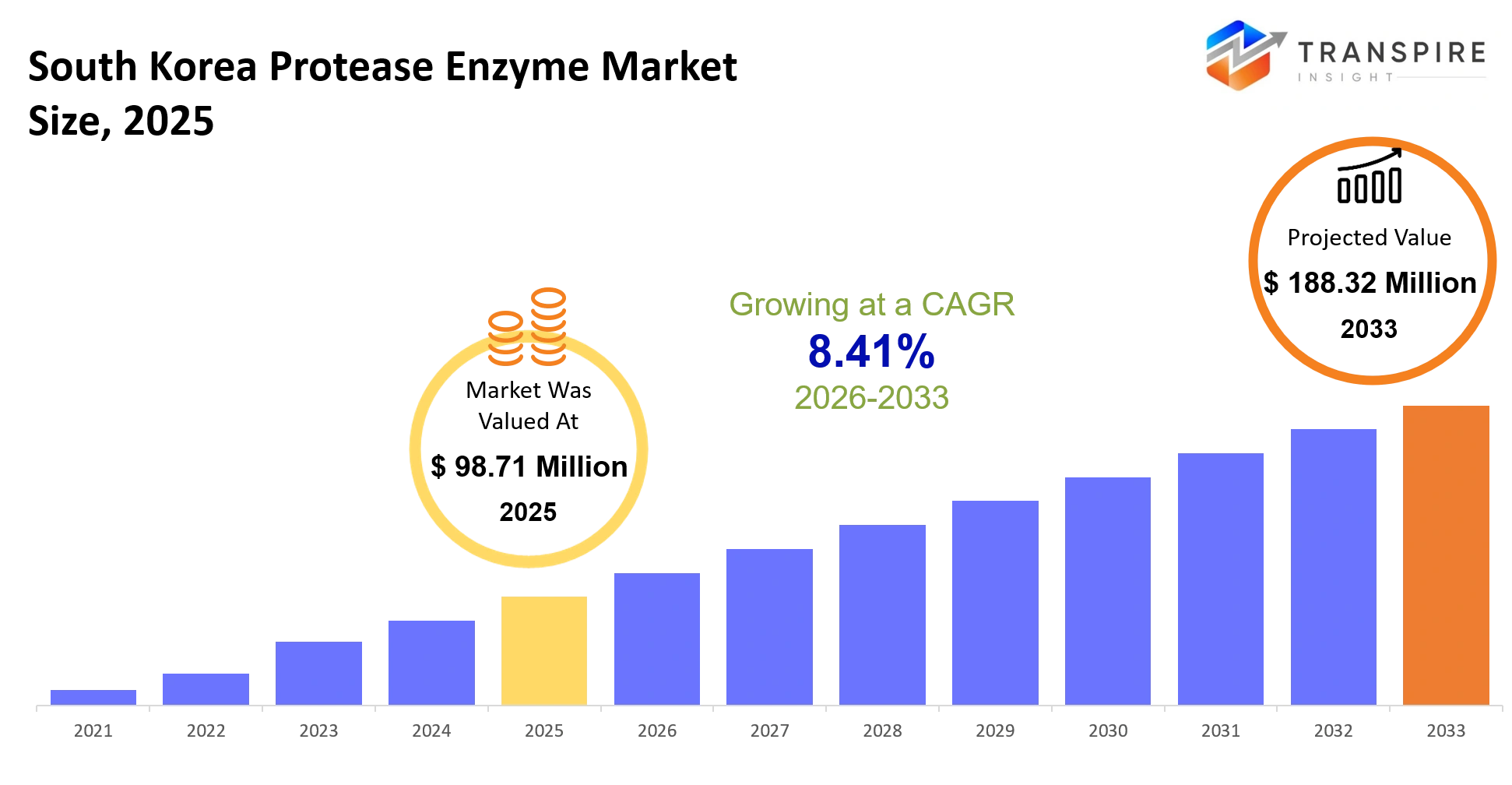
- South Korea Protease Enzyme Market Size 2025: USD 98.71 Million
- South Korea Protease Enzyme Market Size 2033: USD 188.32 Million
- South Korea Protease Enzyme Market CAGR: 8.41%
- South Korea Protease Enzyme Market Segments: By Type (Serine Proteases, Aspartic Proteases, Cysteine Proteases, Metalloproteases, Others); By Source (Microbial Proteases, Plant-based Proteases, Animal-based Proteases, Others); By Application (Detergents, Food & Beverage Processing, Pharmaceuticals, Animal Feed, Others); By Form (Liquid Proteases, Powder Proteases, Granular Proteases, Others); By End User (Chemical Industry, Food Industry, Pharmaceutical Industry, Agriculture Industry, Others)
To learn more about this report,  Download Free Sample Report
South Korea Protease Enzyme Market Summary
The South Korea Protease Enzyme Market was valued at USD 98.71 Million in 2025. It is forecast to reach USD 188.32 Million by 2033. That is a CAGR of 8.41% over the period.
The South Korea protease enzyme market plays a pretty useful role in boosting industrial efficiency by breaking down proteins in day to day manufacturing and processing. In practice, these protease enzymes show up in detergent formulations , food and beverage production, pharmaceutical processing, animal nutrition, and also in some niche industrial uses where they help cut down processing time, lift product quality, and reduce chemical consumption. The real value is that manufacturers can push productivity forward while still dealing with tougher sustainability and performance expectations.
In the past three to five years, there’s been a noticeable change in how proteases are sourced and produced, mostly moving toward microbial and biotechnology-derived proteases. These types tend to bring better stability, stronger activity levels, and smoother compatibility with modern production systems. One of the biggest reasons for that shift was the increasing pressure from environmental and sustainability standards across multiple industrial sectors , basically nudging companies away from harsh chemical routes and toward enzyme based alternatives. With manufacturers paying more attention to resource efficiency and cleaner production, protease use is spreading across different industries. That expansion also opens fresh revenue opportunities for enzyme suppliers and supports steadier growth over the long term.
Key Market Insights
- The Seoul area is the part of South Koreas protease enzyme market making up over 40% of it in 2025. This is because Seoul has a biotechnology and manufacturing base.
- The Gyeonggi Province is going to grow fast in this market by 2030. This is because more and more money is being invested in life sciences and industrial processing there.
- Many industrial areas in cities are helping to make South Koreas protease enzyme industry bigger and better.
- Serine proteases are the popular type making up over 35% of the market in 2025. This is because they are used a lot in detergents and industrial products.
- Metalloproteases are the biggest type. They are used in food processing and biotechnology which helps them.
- Microbial protease variants are going to grow the fastest by 2030. This is because they work well and can be made in large quantities.
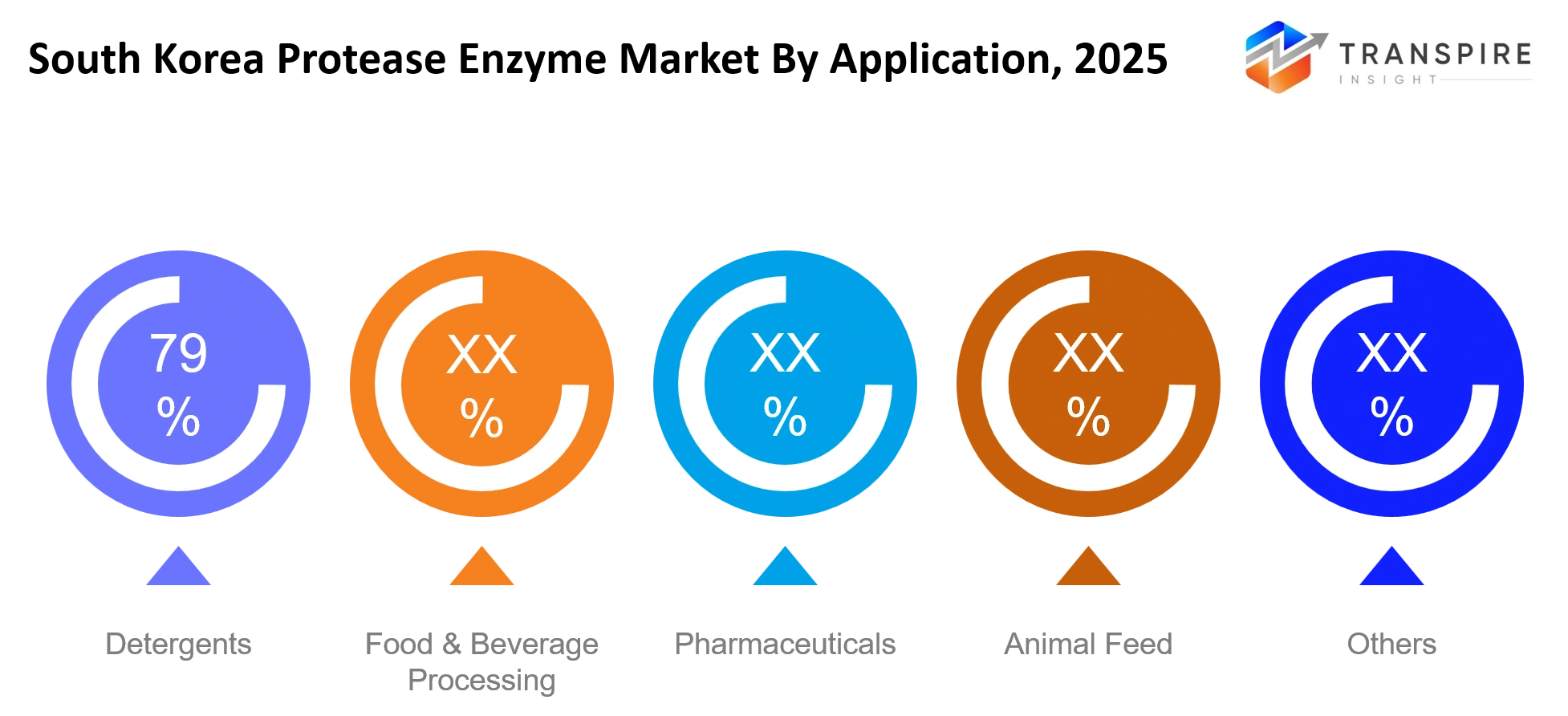
- Detergents are the market for protease enzymes making up over 30% of the total revenue in 2025. This is because people want cleaning products.
- The food and beverage industry is also an user of protease enzymes. They use these enzymes to change proteins and make their processes better.
- Pharmaceutical companies are going to start using protease enzymes really fast. This is because enzymes are being used more in medicine and manufacturing.
- The food industry is the user of protease enzymes in South Korea making up over 28% of the market in 2025. This is because food manufacturing, in South Korea is really advanced.
What are the Key Drivers, Restraints, and Opportunities in the South Korea Protease Enzyme Market?
The main force pushing the South Korea Protease Enzyme Market is basically this move toward enzyme based industrial processing , to squeeze better production efficiency and reduce the dependence on classic chemical treatments. And yeah, this change has been nudged along by more strict environmental compliance rules, plus corporate sustainability goals across food, detergent, and pharmaceutical segments. Protease makers are being picked more often , since these enzymes just work well in regulated conditions, they tend to use less energy, and they raise processing yields. So when production sites look for hard cost reductions and steadier product quality, enzyme suppliers can grab bigger contract volumes and even deeper integration into the daily manufacturing flow, which then directly feeds revenue growth across the whole market.
Still , the biggest obstacle is the high technical complexity behind enzyme development, formulation, and that kind of application specific tailoring. Protease performance doesn’t stay the same it swings with temperature, pH levels, and the real production environment , meaning there’s a lot of research and testing that must happen before something is ready for commercial use. This is kind of structural, because it leans on long term biotechnology know how, specialized facilities, and regulatory review, all at the same time. Because of this, smaller manufacturers often postpone adoption, while product development cycles stay drawn out, which slows how fast new uses can reach commercial scale, and in turn limits overall market expansion.
A big opportunity sits in advanced microbial fermentation, and also in precision biotechnology platforms, it’s kind of a combined deal. In South Korea, the rising investment into biotechnology research is making the playing field easier for next generation protease production, and you can see that in the way resources are moving. Like, engineered microbial strains can deliver stronger enzyme yields, while also keeping things more stable over time. That, in turn, helps suppliers craft more specialized solutions for pharmaceutical manufacturing and for high-value food processing uses. And as these technologies keep maturing, they should gradually open up new commercial uses, plus push deeper into the market, not just in one corner.
What Has the Impact of Artificial Intelligence Been on the South Korea Protease Enzyme Market?
Artificial intelligence , and advanced digital technologies are pretty much increasingly changing the South Korea Protease Enzyme Market. The main angle is that enzyme discovery is getting better faster, production efficiency improves, and quality control gets more disciplined, sort of in a continuous way. Biotechnology firms are now leaning on AI-driven platforms to review big biological datasets, then spot promising enzyme candidates much quicker than the older lab screening routines. At the same time, machine learning models support teams by forecasting enzyme activity, stability, and protein interactions ahead of any physical testing, so development timelines get shorter , and research costs can drop.
On the manufacturing side, automated process control systems keep watching fermentation conditions like temperature, pH, oxygen levels, and nutrient concentrations, all the time. AI tools then read the real-time production signals and they can automatically tweak operating parameters to push higher enzyme yield while also keeping product quality stable. With these systems in place, manufacturers tend to cut down batch failures, raise production uptime, and make better use of raw materials.
Predictive analytics is also getting more and more relevant in enzyme production facilities . In many cases machine learning models are able to forecast equipment failures, set up maintenance schedules ahead of time before a breakdown happens, and spot process inefficiencies that might influence the final output . This kind of approach helps keep operating expenses lower and makes production timelines much more dependable. At the same time digital twin technologies are supporting producers by letting them mimic fermentation processes, then test performance improvements in advance, before they are actually put into practice.
Even with all that, AI adoption still hits a major wall. To build models that are really accurate, you need huge amounts of high quality biological and production data , and collecting that data can be hard , plus it tends to cost a lot. On top of that, integration expenses can be steep and there’s also the matter of specialized biotechnology know how which is not always easy to find. Smaller enzyme manufacturers often feel these issues more, so they can get stuck waiting a bit longer.
Key Market Trends
- Food manufacturers have been changing the way they do things since 2021. They are now using protease formulations that help them process protein more efficiently and reduce losses when they make food on a large scale.
- Microbial proteases are being used more instead of proteases that come from animals. This is because food manufacturers want to get results be able to make more of their products and follow the rules more easily.
- From 2022 to 2025 the companies that make enzymes put money into new technologies that help make enzymes stronger and cheaper to make.
- The companies that make detergents are using high-performance proteases to get rid of stains when washing clothes in cold water and to use less energy.
- Pharmaceutical companies are using enzyme solutions more and more to help them make their products, especially in South Korea where the biotechnology sector is getting bigger.
- Since 2023 big companies like Novozymes, DSM and BASF have been working together more to come up with enzyme ideas and products.
- Nowadays enzyme production facilities are using tools to keep an eye on their processes, which helps them control the quality of their products better and make enzymes more efficiently.
- Because of problems with getting the things they need manufacturers have been trying to get their supplies from places and make more of their own products locally.
- The people who buy enzymes, for industry are not using the enzyme products as much anymore. Instead they want enzymes that are made specifically for what they need to do.
- The goals to be more sustainable that have been set by manufacturers have made them start using enzymes to help with processing instead of using certain chemicals.
South Korea Protease Enzyme Market Segmentation
By Type:
Protease enzymes play a big role in industrial processing, helping break down proteins in a pretty efficient way across many manufacturing activities, and honestly the whole setup benefits. Ongoing, nonstop advances in biotechnology have been pushing enzyme stability, activity level, and overall process performance forward, so these solutions become more useful for commercial use. Right now industrial users tend to choose enzyme formulations that are consistent in results, while still supporting production efficiency, rather than just “working at some point”. Meanwhile, research work keeps growing the variety of available enzyme technologies and their uses.
Manufacturers are also leaning into specialized formulations, the kind that fit specific operating conditions and industry needs, not a one-size solution. Better production methods have led to higher-quality enzyme products with improved functionality, and more reliability too. Strong adoption across food processing, detergents and pharmaceutical manufacturing keeps feeding market growth. And the investment in new ideas, or innovation, should keep boosting product performance and commercial opportunities in the coming years, with maybe even faster momentum.
By Source:
Advancements in enzyme production technologies have helped push wider use of biologically derived protease solutions across multiple industrial sectors. These newer production approaches usually make things more consistent, more scalable, and more commercially sensible, so manufacturers can keep up with the rising performance expectations. Also there’s been a bigger focus on efficient production processes, which in turn supports the arrival of high-quality enzyme products . Meanwhile, research programs keep looking at fresh biological sources that might bring extra, or just more capable functionality.
At the same time, diversifying the production sources gives manufacturers more flexibility when they’re serving very different industries . Better extraction methods, fermentation pathways, and broader biotechnology processes have boosted product quality while still keeping manufacturing costs lower. People in the industry are still putting money into production optimization, so they can stay competitive and keep supply steadier. Taken together, these developments are helping form a stronger, more adaptable industry landscape, even when conditions shift a bit.
By Application:
Protease enzymes have turned into pretty valuable tools for boosting efficiency, product quality, and day to day operational results across a bunch of industries. More and more companies are adding enzyme based solutions into their manufacturing workflows, so they can handle processing issues more easily and get steadier output. There’s been a strong focus on productivity improvements, and that has encouraged wider commercial take up. Even now technological progress keeps showing up with new possibilities for industrial use, not just theory.
On top of that innovation in processing techniques has stretched the set of commercial uses, and it also makes the whole approach more effective, kind of in a practical way. Businesses are actively looking for solutions that help with improved resource utilization, while still keeping product standards in place. Ongoing investment in research and development is also pushing forward application specific formulations that are tailored to what each industry actually needs. Overall this movement is slowly but surely strengthening long term adoption across many end use sectors.
To learn more about this report, Download Free Sample Report
By Form:
The availability of protease enzymes across various commercial formats lets manufacturers sort of pick what fits their operational requirements and production settings, more or less. Product design changes have also improved how the materials behave during use, plus better storage stability and compatibility with different processes. Firms keep directing attention toward formulations that make transportation easier and support industrial deployment, while trying to stay consistent in day to day operations. In practice, these shifts contribute to stronger customer satisfaction and steadier operational output.
Meanwhile the growing push for manufacturing efficiency has nudged suppliers toward formats that slot in neatly with automated production systems. Better stability and dependable performance are still the main priorities for vendors who want a competitive edge. Ongoing innovation keeps widening industrial adoption, and it also expands possible application scenarios. Market players are continuing to invest in formulation technologies aimed at boosting functionality and reliability, not just for the present run, but for future scaling too.
By End User:
Industrial sectors are more and more bringing protease enzymes into their production setups, to make everything run faster, better, and with tighter cost management. Some companies really like enzyme technologies, because they can back optimized operations while also lowering the need for old fashioned processing routes. There’s still a big push on productivity and process improvement, and it keeps nudging adoption forward. At the same time ongoing tech improvements are opening up extra commercial possibilities in several industries.
More investment in biotechnology ,and in advanced manufacturing practices, is also helping enzyme based solutions become normal in more places. Firms are hunting for products that show clear, measurable operational advantages, not just theory, and that can create long term value. Meanwhile, expanding industrial uses continue to reinforce demand across well known as well as up and coming sectors. The next round of growth should ride on innovation, process optimization, and the creation of even more specialized enzyme technologies, rather than just generic ones.
What are the Key Use Cases Driving the South Korea Protease Enzyme Market?
The biggest share of protease enzyme usage comes, kind of, from detergent manufacturing where enzymes help lift protein based stains more efficiently while also backing lower temperature washing cycles. This use case makes demand rise quite a bit, because detergent producers are always looking for cleaner results , less energy use and better ways to stand out in a crowded consumer market.
Past detergents, food processing companies are increasingly turning to protease enzymes to enhance texture, drive protein modification, and raise production efficiency across processed foods. On the pharmaceutical side, manufacturers lean on enzyme technologies during certain production stages, which supports steadier quality and smoother day to day operations. These areas have mattered more recently as companies push for higher yields and try to cut manufacturing costs.
Meanwhile, new opportunities seem to be forming in precision biotechnology and more advanced protein processing applications. Enzyme assisted production approaches are getting attention in niche pharmaceutical development and higher value nutritional products. Also, research using engineered microbial strains is showing promise for next generation enzyme solutions with better stability and performance, so it could eventually enable new commercial uses during the forecast period.
|
Report Metrics |
Details |
|
Market size value in 2025 |
USD 98.71 Million |
|
Market size value in 2026 |
USD 107.01 Million |
|
Revenue forecast in 2033 |
USD 188.32 Million |
|
Growth rate |
CAGR of 8.41% from 2026 to 2033 |
|
Base year |
2025 |
|
Historical data |
2021 - 2024 |
|
Forecast period |
2026 - 2033 |
|
Report coverage |
Revenue forecast, competitive landscape, growth factors, and trends |
|
Regional scope |
South Korea |
|
Key company profiled |
Novozymes, BASF, DuPont, DSM, Amano Enzyme, Advanced Enzyme Technologies, AB Enzymes, Chr. Hansen, Kerry Group, Enzyme Development Corporation, Biocatalysts Ltd., Specialty Enzymes & Probiotics, Roche, Sunson Industry Group, Maps Enzymes |
|
Customization scope |
Free report customization (country, regional & segment scope). Avail customized purchase options to meet your exact research needs. |
|
Report Segmentation |
By Type (Serine Proteases, Aspartic Proteases, Cysteine Proteases, Metalloproteases, Others); By Source (Microbial Proteases, Plant-based Proteases, Animal-based Proteases, Others); By Application (Detergents, Food & Beverage Processing, Pharmaceuticals, Animal Feed, Others); By Form (Liquid Proteases, Powder Proteases, Granular Proteases, Others); By End User (Chemical Industry, Food Industry, Pharmaceutical Industry, Agriculture Industry, Others) |
Which Regions are Driving the South Korea Protease Enzyme Market Growth?
Seoul Capital Area stays ahead, mostly because there’s a heavy clustering of biotechnology companies, research institutes, and advanced manufacturing plants. With solid government backing for life sciences innovation and ongoing funding for research infrastructure, the whole setup ends up looking pretty friendly for enzyme development and later commercialization. You also have major universities, technology centers, and industrial clusters that keep feeding the system with know-how, and product innovation. So, manufacturers can scale production in a smoother way, while keeping tight, frequent cooperation with end-use industries.
Then comes the Southeast region, including Busan, Ulsan, and the nearby industrial pockets, which acts as the second biggest contributor. But unlike the leading region, the momentum here is powered more by an established industrial manufacturing base than by research density alone. Chemical processing and food manufacturing, plus broader industrial production facilities, basically generate stable demand for enzyme based solutions across a range of use cases. Steady capital investment and a diversified industrial layout also help keep market activity stable, even when the economy feels a bit shaky, or unpredictable.
Gyeonggi Province looks like it is becoming the fastest-growing regional market, even if biotechnology investments keep moving past the usual innovation hubs. Over the last couple years, more progress in biopharmaceutical facilities, higher fermentation capacity , and improved production technologies has really boosted how competitive the region feels. Both public and private sector funding are helping push the creation of fresh biotechnology ventures as well as manufacturing projects, so you end up seeing momentum. Overall growth across the area should open up solid prospects for suppliers, technology providers, and investors who want exposure to the expanding ability to produce enzymes, from 2026 through 2033.
Who are the Key Players in the South Korea Protease Enzyme Market and How Do They Compete?
Competition in the South Korea Protease Enzyme Market is sort of moderately consolidated, with a cluster of global enzyme manufacturers keeping strong footing, mainly thanks to solid research skills, broad product portfolios and long standing customer ties. In day to day terms, technology innovation is still the main stage of competition, especially around enzyme performance, production efficiency , and customization for specific use cases. Big multinational suppliers keep defending their market share with continued spending in biotechnology and fermentation technologies, but smaller specialized players tend to go after slimmer, more niche applications, and they usually provide tailored solutions. Lately, winning feels like it depends less on raw pricing and more on proving real, measurable process upgrades, even if the pitch sounds simple.
Novozymes kind of sets itself apart with advanced enzyme engineering, and a fermentation know-how that helps deliver high performance protease formulations for detergents, food processing, and other industrial uses too. They keep reinforcing their edge via research collaborations and product innovation initiatives, aimed at boosting enzyme stability and overall activity. BASF on the other hand plays it by combining enzyme solutions with wider industrial and chemical expertise, so customers can tap into complementary technologies through one supplier relationship. That whole setup gives manufacturers some practical operational advantages, especially when they want integrated process optimization without juggling multiple partners.
Amano Enzyme , it is mainly about specialized enzyme applications where precision has to be near perfect and where technical support really matters, especially in food and pharmaceutical processing. Then there is Advanced Enzyme Technologies, they tend to expand by doing customized product development and more application oriented solutions, built for particular industry needs. DSM, for its part, stresses biotechnology innovation along with strategic partnerships, sort of pushing commercialization of next generation enzyme products sooner than expected. All these firms keep putting money into production capabilities, ongoing research programs , and customer collaboration initiatives, to improve how they stand apart, and to grab new growth chances across high value industrial segments.
Company List
- Novozymes
- BASF
- DuPont
- DSM
- Amano Enzyme
- Advanced Enzyme Technologies
- AB Enzymes
- Chr. Hansen
- Kerry Group
- Enzyme Development Corporation
- Biocatalysts Ltd.
- Specialty Enzymes & Probiotics
- Roche
- Sunson Industry Group
- Maps Enzymes
Recent Development News
- "In March 2025, Novonesis launched Progress® Beyond and Progress® Go protease enzymes for liquid laundry detergents. The new protease products were designed to improve removal of protein-based stains under cold and quick-wash conditions, strengthening advanced enzyme offerings used across Asian detergent markets, including South Korea.https://www.novonesis.com
- "In March 2025, SEQENS entered a strategic partnership with Novonesis. The partnership was established to expand customer access to industrial biocatalytic processes and enzyme-based manufacturing solutions, supporting broader commercialization of specialty enzymes, including protease-related applications, in fine chemicals and biotechnology markets.https://www.seqens.com
What Strategic Insights Define the Future of the South Korea Protease Enzyme Market?
The South Korea Protease Enzyme Market seems to be moving into a more specialized, technology driven setup over the next five to seven years, at least that’s what many analysts are pointing at. In the coming period growth is expected to come more from high value applications rather than just expanding sheer volume. Things like microbial engineering, precision fermentation, and a lot of biotechnology research are likely to redirect the industry toward customized enzyme solutions, made for specific industrial food and pharmaceutical steps. With that kind of shift companies that can prove application specific performance should gain clearer separation from rivals and also higher margin potential, kind of a more stable upside.
There’s also a less visible risk that doesn’t get as much attention, but it could matter later. The market can become concentrated around a small number of global enzyme technology providers. If manufacturers lean heavily on just a few suppliers for advanced strains, fermentation know how, and intellectual property, supply vulnerability can rise, and downstream players may have less competitive wiggle room. Still, even with that concern, there’s an opportunity showing up in enzyme enabled biopharmaceutical manufacturing. This seems especially relevant as South Korea increases investments in biotechnology infrastructure and advanced therapy production.
Market players should probably focus on partnerships with biotechnology institutes and also invest in proprietary enzyme development platforms. Over the forecast horizon, building differentiated strengths in specialized enzyme use cases may matter far more than competing only on production scale, or trying to win purely through pricing like, the lowest cost angle.
South Korea Protease Enzyme Market Report Segmentation
By Type
- Serine Proteases
- Aspartic Proteases
- Cysteine Proteases
- Metalloproteases
- Others
By Source
- Microbial Proteases
- Plant-based Proteases
- Animal-based Proteases
- Others
By Application
- Detergents
- Food & Beverage Processing
- Pharmaceuticals
- Animal Feed
- Others
By Form
- Liquid Proteases
- Powder Proteases
- Granular Proteases
- Others
By End User
- Chemical Industry
- Food Industry
- Pharmaceutical Industry
- Agriculture Industry
- Others
Frequently Asked Questions
Find quick answers to common questions.
The expected South Korea Protease Enzyme Market size for the market will be USD 188.32 Million in 2033.
Key segments for the South Korea Protease Enzyme Market are By Type (Serine Proteases, Aspartic Proteases, Cysteine Proteases, Metalloproteases, Others); By Source (Microbial Proteases, Plant-based Proteases, Animal-based Proteases, Others); By Application (Detergents, Food & Beverage Processing, Pharmaceuticals, Animal Feed, Others); By Form (Liquid Proteases, Powder Proteases, Granular Proteases, Others); By End User (Chemical Industry, Food Industry, Pharmaceutical Industry, Agriculture Industry, Others).
Major South Korea Protease Enzyme Market players are Novozymes, BASF, DuPont, DSM, Amano Enzyme, Advanced Enzyme Technologies, AB Enzymes, Chr. Hansen, Kerry Group, Enzyme Development Corporation, Biocatalysts Ltd., Specialty Enzymes & Probiotics, Roche, Sunson Industry Group, Maps Enzymes.
The South Korea Protease Enzyme Market size is USD 98.71 Million in 2025.
The South Korea Protease Enzyme Market CAGR is 8.41% from 2026 to 2033.
- Novozymes
- BASF
- DuPont
- DSM
- Amano Enzyme
- Advanced Enzyme Technologies
- AB Enzymes
- Chr. Hansen
- Kerry Group
- Enzyme Development Corporation
- Biocatalysts Ltd.
- Specialty Enzymes & Probiotics
- Roche
- Sunson Industry Group
- Maps Enzymes
About the Authors

Pankaj Ghogare Patil
I am Pankaj Ghogare Patil, a Senior Research Analyst at Transpire Insight, specializing in the Pharmaceutical, Chemicals & Materials, Healthcare IT, and Biotechnology industry. My expertise lies in conducting comprehensive market research, analyzing industry trends, evaluating competitive landscapes, and translating complex data into actionable insights. At Transpire Insight, I closely follow emerging technologies, regulatory developments, and market innovations to create accurate, well-researched, and informative content that helps businesses and professionals make informed decisions. I am committed to producing credible, evidence-based articles that reflect industry best practices while making technical topics accessible and valuable for a broad audience.

Chakradhar Khansole
Chakradhar serves as the Research Director at Transpire Insight, bringing over 8 years of experience in technology, innovation, and strategic market intelligence. He specializes in transforming complex market data into actionable business insights that enable organizations to make informed, growth-oriented decisions. Recognized for his strategic vision and analytical expertise, Chakradhar leads high-impact research initiatives, delivering comprehensive market assessments, competitive intelligence, and forward-looking industry analysis.
Recently Published Reports
-
Apr 2026
AI in Diabetic Retinopathy Market
AI in Diabetic Retinopathy Market Size, Share & Analysis Report By Type (Screening AI Systems, Diagnostic AI Systems, and Predictive AI Models), By Application Segment (Hospitals, Ophthalmology Clinics, Diagnostic Centers, and Research and Development), and Geography (North America, Europe, Asia-Pacific, Middle East and Africa, South and Central America), 2021 - 2031
-
Apr 2026
Psychometric Tests Market
Psychometric Tests Market Size, Share & Analysis Report By Type (Personality Tests, Ability/Aptitude Tests, Skill/Knowledge Tests, and Others), By Application (Talent Acquisition and Talent Management), and Geography (North America, Europe, Asia-Pacific, Middle East and Africa, South and Central America), 2021 – 2031
-
Apr 2026
Rare Biological Sample Collection Market
Rare Biological Sample Collection Market Size, Share & Analysis Report By Type (Isolation Kits & Reagent, Blood Collection Tubes, and Others), By Application (Oncology, Transcriptomics, Pharmacogenomics, and Others), and Geography (North America, Europe, Asia-Pacific, Middle East and Africa, South and Central America), 2021 – 2031
-
Jul 2026
Diabetic Retinopathy Market
Diabetic Retinopathy Market Size, Share & Analysis Report By Type (Proliferative Diabetic Retinopathy, and Diabetic Macular Edema (DME)), By Treatment Type (Anti VEGF Drug, Steroid Implants, Laser Surgeries, and Vitrectomy), and Geography (North America, Europe, Asia-Pacific, Middle East and Africa, South and Central America), 2021 – 2031
Our Clients







