
South Korea Polyimide Film Market Size & Forecast:
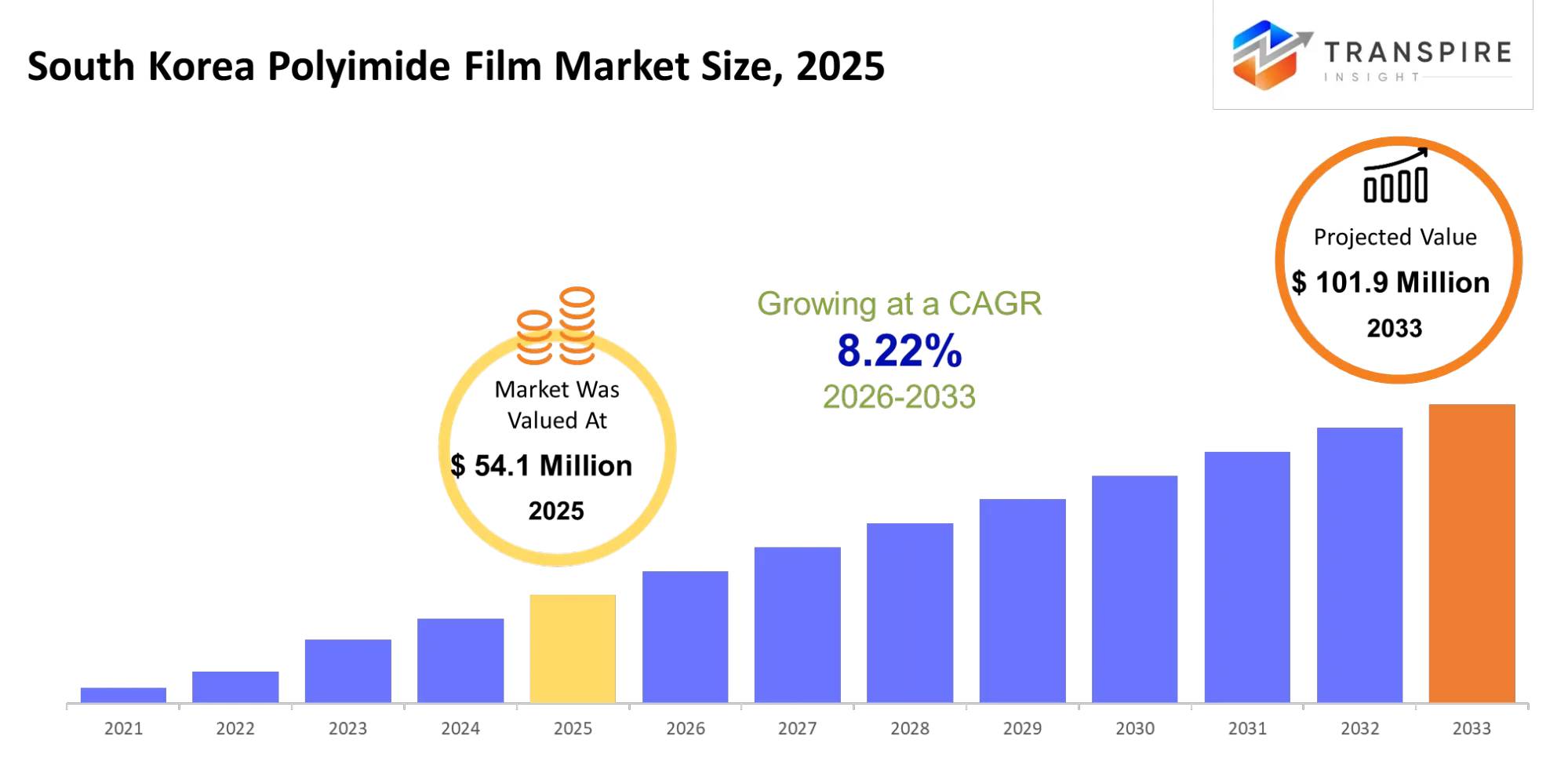
- South Korea Polyimide Film Market Size 2025: USD 54.1 Million
- South Korea Polyimide Film Market Size 2033: USD 101.9 Million
- South Korea Polyimide Film Market CAGR: 8.22%
- South Korea Polyimide Film Market Segments: By Type (Transparent PI Film, Black PI Film, Conventional PI Film, Others); By Application (Flexible Displays, Electronics, Aerospace, Automotive, Others); By End User (Electronics, Automotive, Industrial, Others)
To learn more about this report,  Download Free Sample Report
South Korea Polyimide Film Market Summary
The South Korea Polyimide Film Market was valued at USD 54.1 Million in 2025. It is forecast to reach USD 101.9 Million by 2033. That is a CAGR of 8.22% over the period.
South Korea’s polyimide film market kind of underpins high reliability insulation and thermal buffering in places where electronics really have to live through heat , vibration, and those tight spaces, like semiconductor packaging, flexible displays, electric vehicle battery platforms, and marine grade wiring. In real life it helps enable thinner lighter, more long lasting electronic assemblies, so overall performance improves and the lifespan stays steadier in advanced industrial setups.
Over the last five years, the market has gradually shifted in a structural way toward ultra thin , top performance films, mainly because flexible electronics are spreading and EV battery systems are getting more compact. One big trigger was the global supply chain disruption during the COVID 19 period , which made it painfully clear that there was heavy dependence on imported specialty polymers. That, in turn, nudged Korean producers to regionalize material sourcing, and it also pushed faster expansion of domestic capacity. You can also see closer cooperation between chemical producers and electronics OEMs. So adoption has gone from sort of niche aerospace and industrial uses into mainstream manufacturing conditions, and that supports more stable revenue plus longer term contract pull .
Key Market Insights
- In South Korea , the Polyimide Film Market is pretty much pushed forward by the adoption of flexible electronics, and in 2025 around 38% of the demand is concentrated where semiconductor and display applications take the lead.
- The Seoul Capital Region seems to dominate the production clusters , with roughly 40% share figured in, mostly because there’s a dense ecosystem for electronics plus materials manufacturing, sort of intertwined over there.
- Meanwhile, Gyeonggi Province is leading the capacity buildout, while the southeastern industrial zones are moving the quickest, especially with EV supply chain integration taking more and more space.
- When it comes to product types, Ultra-thin polyimide films (under 25 microns) are showing the fastest growth rate during the 2024 to 2030 forecast period.
- Standard-grade polyimide films still hold the biggest portion, largely due to their common use across insulation, circuit boards, and industrial wiring systems; they're just used everywhere.
- Electronics manufacturing still sits at the center of the South Korea Polyimide Film Market, it is the dominant end-use and it accounts for over 45% share, roughly.
- Electric vehicle battery systems are showing the fastest-growing application, mainly because thermal resistance is critical, and safety requirements are also non-negotiable, in practice.
- Key players, DuPont, SKC, Toray Industries, Kaneka Corporation, LG Chem and Samsung SDI are getting mentioned a lot, and they tend to focus on material innovation, plus strategic partnerships, to keep momentum.
- At the same time companies are trying to build a stronger competitive advantage by pouring more into R&D for heat-resistant polymers and also pushing localized production expansion across South Korea.
What Has the Impact of Artificial Intelligence Been on the South Korea Polyimide Film Market?
So, the main engine behind the South Korea Polyimide Film Market seems to be the fast scale up of semiconductor packaging and EV battery manufacturing. Kinda like, this momentum was pulled along by stricter thermal reliability rules in high density electronics and also by government backed funding for advanced production ecosystems. In the end the buying behavior shifts, it’s not really just conventional insulation anymore , it turns into higher value flexible circuitry and energy storage setups, which then boosts revenue per single unit and pushes longer procurement arrangements further into the future.
But there is a pretty clear drag. It comes from how dependent this market is on specialized raw polymer precursors. These inputs still sit in a partially import reliant situation, so they get hit by global price swings. That kind of structural limitation makes it harder to do rapid cost optimization, and it slows down scaling for mid tier manufacturers that do not have a fully connected supply chain. Plus, it tends to cap margin expansion, especially when semiconductor demand starts wobbling around.
Still, the biggest chance is in next generation foldable and wearable electronics, where ultra thin film improvements are finally becoming commercially workable. In South Korea, investment into flexible OLED displays and wearable medical devices is building a new demand loop. As those production lines get more mature, localized innovation in high flex durability films could open up the next growth stretch for the South Korea Polyimide Film Market.
Key Market Trends
- Between 2021 and 2025, demand shifted more toward semiconductors and those flexible displays, it went from insulation uses to like 38% share in the advanced electronics supply chains, even if the proportions aren’t perfectly linear.
- After 2020 supply chain disruptions, South Korean producers kinda sped up localization, with SKC expanding domestic polyimide capacity in order to curb import dependency from Japanese suppliers, which was a big deal then.
- Since 2022, EV battery manufacturers started taking heat-resistant polyimide films more often, mainly because thermal safety rules got stricter, and also electric vehicle production grew pretty quickly.
- From 2023 onward, ultra-thin films under 25 microns gained real traction, slowly replacing the conventional thicker variants in those compact semiconductor and foldable display uses, sometimes they call it “thinner first” strategy.
- Over 2021–2024, reliance on imported specialty polymers went down, and domestic firms like LG Chem and SKC strengthened their integrated production ecosystems, sort of vertically aligned.
- Between 2022 and 2026, flexible OLED and wearable device production expanded, and that automatically lifted demand for bendable yet high-durability polyimide film substrates, especially where lifetime matters.
- Since 2023, global players such as DuPont and Toray intensified their R&D collaborations with Korean manufacturers, to secure next generation film performance edge, not just steady supply.
- Between 2021 and 2025, tighter electronics thermal resistance standards forced manufacturers to upgrade material specifications across industrial and automotive applications, so it wasn’t only one sector.
South Korea Polyimide Film Market Segmentation
By Type :
Transparent PI Film ,and Black PI Film are showing more frequent use in newer display panels and bendable electronic parts, and that is pulling demand away from the earlier insulation-only habits. The black types are getting more attention for light-blocking display layers, but the transparent versions back flexible circuit routes and next generation foldable screens too, mainly in high performance manufacturing sites where material control matters.
Meanwhile, conventional PI Film still keeps a fairly stable role in electrical insulation and industrial wiring, though its share slowly eases down as the higher performance variants grow. A few other specialty films stay busy with more niche needs like heat shielding and smaller scaled electronic assemblies, which fits that broader move toward customized material solutions across precision driven manufacturing ecosystems in South Korea.
By Application :
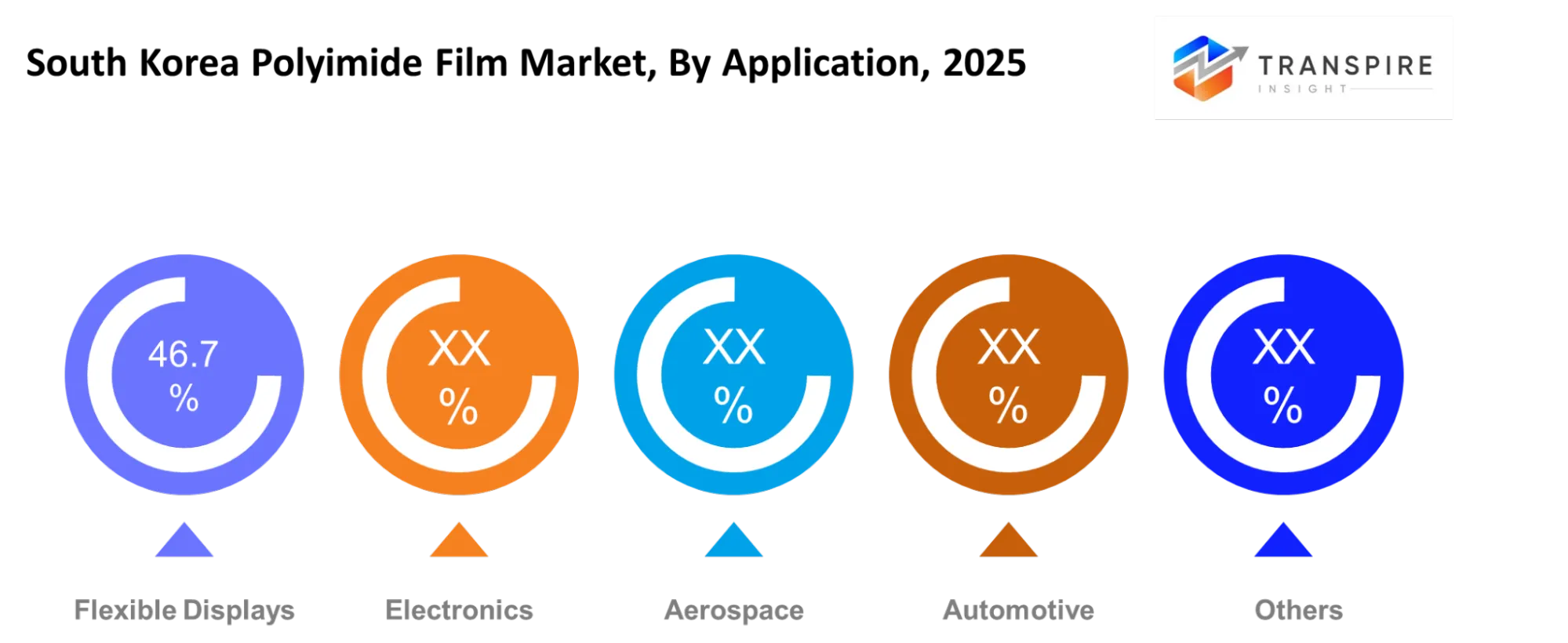
Flexible Displays and Electronics are leading the strongest shift ,with makers taking on bendable substrates and thin-film insulation for compact devices and high density circuits. There is also a clear swing from rigid assemblies to foldable and light weight designs, which keeps pushing continual upgrades in production methods and material engineering practices along display manufacturing lines.
In aerospace, demand is staying relatively steady for heat resistant insulation materials. Automotive use is trending higher as electric vehicle battery systems become more common, and those systems need thermal steadiness plus better safety. Other areas, like industrial equipment and specialty devices ,also expand gradually as manufacturers choose polyimide films for durability and for reliable performance when things get harsh during operation.
To learn more about this report, Download Free Sample Report
By End User :
Electronics end users basically take over the day to day use, and it feels mostly pulled along by semiconductor packaging, flexible display technology, and high performance circuit manufacturing. In procurement, the buying behavior slowly leans toward ultra thin, high durability materials, because device miniaturization keeps speeding up across both consumer and industrial electronics supply chains in South Korea, yeah.
Automotive end users are also climbing steadily, largely because electric vehicle momentum keeps rising, plus stricter thermal safety rules inside battery systems. Industrial users remain pretty consistent in their need for insulation and protective layers, while a few smaller, niche sectors expand bit by bit too—think precision instruments and specialized engineering work where stable heat resistance and overall reliability really matter.
What are the Key Use Cases Driving the South Korea Polyimide Film Market?
The core demand sort of comes from semiconductor packaging, and also from flexible display manufacturing in South Korea, where polyimide film gives heat resistance, electrical insulation, and mechanical stability for those miniaturized, high density electronic assemblies that need to work reliably under continuous thermal stress and bending stress at production sites.
On top of that, the expanding use cases show up in electric vehicle battery insulation, plus high temperature automotive electronics, where manufacturers depend on thin films not just for safety but also for efficiency. Aerospace electronics adopt these materials too, mainly because they keep stable performance under vibration, heat, and operational cycles in really demanding conditions.
There are also emerging use cases like foldable consumer devices and wearable health sensors, where the need keeps growing for ultra thin, flexible substrates. Advanced printed electronics see adoption tied to lightweight, durable material needs, in precision systems, you know.
|
Report Metrics |
Details |
|
Market size value in 2025 |
USD 54.1 Million |
|
Market size value in 2026 |
USD 58.6 Million |
|
Revenue forecast in 2033 |
USD 101.9 Million |
|
Growth rate |
CAGR of 8.22% from 2026 to 2033 |
|
Base year |
2025 |
|
Historical data |
2021 - 2024 |
|
Forecast period |
2026 - 2033 |
|
Report coverage |
Revenue forecast, competitive landscape, growth factors, and trends |
|
Country scope |
South Korea |
|
Key company profiled |
PI Advanced Materials, DuPont, Kaneka, Kolon Industries, SKC, Ube Industries, Taimide, Toray, Saint-Gobain, Arakawa Chemical, Flexcon, Wacker, LG Chem, Sumitomo Chemical, Mitsubishi Chemical |
|
Customization scope |
Free report customization (country, regional & segment scope). Avail customized purchase options to meet your exact research needs. |
|
Report Segmentation |
By Type (Transparent PI Film, Black PI Film, Conventional PI Film, Others); By Application (Flexible Displays, Electronics, Aerospace, Automotive, Others); By End User (Electronics, Automotive, Industrial, Others) |
Which Regions are Driving the South Korea Polyimide Film Market Growth?
The Seoul Capital Region actually keeps the top spot in the South Korea Polyimide Film Market, mainly because there’s this heavy knot of semiconductor fabs, display makers, plus advanced materials R&D centers all in pretty close reach. On top of that the policy push for high tech manufacturing clusters really does give extra confidence, so domestic as well as global suppliers keep spending steadily over the long run. There’s also this integrated supply chain thing going on, where chemical producers , electronics OEMs, and research institutes sort of work side by side. In practice this lets companies do rapid product testing and get advanced polyimide film applications commercialized quicker than you might expect in other areas.
Then you have Gyeonggi Province which works more like a solid secondary hub, supported by its proximity to Seoul yet still providing big industrial zones for large scale mass production work. Compared with the capital core, the vibe here leans toward manufacturing continuity and cost efficient expansion rather than early-stage ingenuity. With steady regulatory rollouts and consistent capital spending from mid tier electronics and automotive suppliers, the province stays useful for supply chain balancing. That steady setup turns into dependable demand for polyimide films used in insulation layers, and also for mid performance electronic parts.
Meanwhile the southeastern industrial belt, which includes Busan and Ulsan, shows the fastest growth momentum recently. This is tied to expansion in electric vehicle and battery related manufacturing. Port infrastructure upgrades at a large scale have improved export efficiency , which then pulls in more investments for automotive and energy storage production lines. Even shipbuilding linked electronics plus heavy industrial use cases help broaden demand for heat resistant materials. Over 2026 to 2033, this area’s acceleration should create new entry points for suppliers trying to plug into export oriented production ecosystems.
Who are the Key Players in the South Korea Polyimide Film Market and How Do They Compete?
In South Korea, the Polyimide Film Market looks somewhat moderately consolidated, you know, global chemical leaders are pushing against pretty capable local material producers. The way they compete is not so much, like price only, but rather thermal steadiness, ultra-thin film precision, and long-run supply dependability. The older incumbents tend to hold their ground via advanced polymer engineering and very tight working links with electronics manufacturers, although, at the same time, a few selective new capacity ramps from Korean firms raise the domestic pressure level. And honestly, tech performance plus where the supply chain is localized now matters more than raw scale, especially for semiconductor work and flexible display uses.
DuPont positions itself with high performance polyimide mixes built for extreme heat and electrical stress, and it also leans into that by locking in long-term supply agreements tied to semiconductor packaging. Toray Industries seems to emphasize material accuracy and that consistent ultra-thin film output, and it’s expanding by forming partnerships with Korean display makers for next generation flexible panels. Kaneka Corporation on its side differentiates with specialty grade films aimed at high reliability electronics, plus it supports specific aerospace needs and advanced industrial applications.
On the domestic side, firms intensify competition through local production and deeper integration with downstream industries. SKC is expanding capacity inside Korea to cut down import dependence and keep supply stable for electronics customers, while LG Chem is investing in polymer innovation, mainly for EV battery insulation and high heat resistance tasks. Samsung SDI, meanwhile, gains demand-side influence by embedding advanced film materials into energy storage systems, so the collaboration gets tighter between battery engineering and the material suppliers, rather than treating them as separate things.
Company List
- PI Advanced Materials
- DuPont
- Kaneka
- Kolon Industries
- SKC
- Ube Industries
- Taimide
- Toray
- Saint-Gobain
- Arakawa Chemical
- Flexcon
- Wacker
- LG Chem
- Sumitomo Chemical
- Mitsubishi Chemical
Recent Development News
In February 2026, SKC announced a KRW 1 trillion rights offering to strengthen its next-generation semiconductor materials business, with a significant portion allocated to advanced packaging materials including glass substrates and related film-based materials. The funding is aimed at accelerating development in semiconductor packaging, which directly overlaps with downstream demand for high-performance polyimide films used in flexible and advanced electronic substrates.Source https://www.ic-pcb.com/
In May 2026, SKC reportedly considered asset sales and affiliate restructuring to refocus its portfolio on semiconductor back-end materials and glass substrates, further reducing exposure to legacy film and display materials businesses. This strategic shift signals continued restructuring of Korea’s polyimide film-linked supply chain, as SKC had historically been a key participant in PI film joint ventures and related display materials development.
Source https://www.ic-pcb.com/
What Strategic Insights Define the Future of the South Korea Polyimide Film Market?
South Korea’s Polyimide Film Market is kinda moving toward deeper fusion with high density electronics and energy storage systems, pushed by ongoing shrinkage in semiconductors and also this rising thermal pressure coming from EV batteries. In the next 5 to 7 years, the pace of growth will depend less on just adding more volume and more on materials precision, so producers are focusing on ultra-thin high reliability films that can back flexible, high performance layouts. This trend is also reinforced by stricter design rules across the advanced manufacturing ecosystem in South Korea.
There’s also a risk that is not as visible, more like a quiet one—raw material concentration, especially when dependence builds around a smaller group of global suppliers for certain polymer precursors. If that upstream flow gets hit, production continuity can wobble fast and pricing can become unstable, even if downstream demand stays strong. Another constraint could come from substitution, where alternative high performance polymers might replace traditional polyimide in a few specific low heat use cases.
Meanwhile, there’s a solid opportunity showing up in foldable and wearable medical electronics, where the need for biocompatible, ultra flexible substrates is still in an early growth phase. Players in the market should put more effort into localized R&D collaborations with Korean electronics companies and healthcare device makers, to secure early design-in traction and basically lock in long term supply ties.
South Korea Polyimide Film Market Report Segmentation
By Type
- Transparent PI Film
- Black PI Film
- Conventional PI Film
By Application
- Flexible Displays
- Electronics
- Aerospace
- Automotive
By End User
- Electronics
- Automotive
- Industrial
Frequently Asked Questions
Find quick answers to common questions.
The expected South Korea Polyimide Film Market size is USD 101.9 Million in 2033.
Key segments for the South Korea Polyimide Film Market are By Type (Transparent PI Film, Black PI Film, Conventional PI Film, Others); By Application (Flexible Displays, Electronics, Aerospace, Automotive, Others); By End User (Electronics, Automotive, Industrial, Others).
Major South Korea Polyimide Film Market players are PI Advanced Materials, DuPont, Kaneka, Kolon Industries, SKC, Ube Industries, Taimide, Toray, Saint-Gobain, Arakawa Chemical, Flexcon, Wacker, LG Chem, Sumitomo Chemical, Mitsubishi Chemical.
The South Korea Polyimide Film Market size is USD 54.1 Million in 2025.
The South Korea Polyimide Film Market CAGR is 8.22% from 2026 to 2033.
- PI Advanced Materials
- DuPont
- Kaneka
- Kolon Industries
- SKC
- Ube Industries
- Taimide
- Toray
- Saint-Gobain
- Arakawa Chemical
- Flexcon
- Wacker
- LG Chem
- Sumitomo Chemical
- Mitsubishi Chemical
About the Authors

Pankaj Ghogare Patil
I am Pankaj Ghogare Patil, a Senior Research Analyst at Transpire Insight, specializing in the Pharmaceutical, Chemicals & Materials, Healthcare IT, and Biotechnology industry. My expertise lies in conducting comprehensive market research, analyzing industry trends, evaluating competitive landscapes, and translating complex data into actionable insights. At Transpire Insight, I closely follow emerging technologies, regulatory developments, and market innovations to create accurate, well-researched, and informative content that helps businesses and professionals make informed decisions. I am committed to producing credible, evidence-based articles that reflect industry best practices while making technical topics accessible and valuable for a broad audience.

Chakradhar Khansole
Chakradhar serves as the Research Director at Transpire Insight, bringing over 8 years of experience in technology, innovation, and strategic market intelligence. He specializes in transforming complex market data into actionable business insights that enable organizations to make informed, growth-oriented decisions. Recognized for his strategic vision and analytical expertise, Chakradhar leads high-impact research initiatives, delivering comprehensive market assessments, competitive intelligence, and forward-looking industry analysis.
Recently Published Reports
-
May 2026
Healthcare Polymer Packaging Market
Healthcare Polymer Packaging Market Size, Share & Analysis Report By Packaging Type (Syringes, IV Bottles and Pouches, Clamshells, Blisters, Bottles & Jars, Containers, Tubes, IV Parental Packaging, Others), By Type (Regulated, Non-regulated), By Polymer Type (LDPE (Low-Density Polyethylene), HDPE (High-Density Polyethylene), Homo-polymer (Homo), Random Copolymer (Random), Block Copolymer (Block), PET, Polystyrene, Polyvinyl Chloride, Polyamide/EVOH, Others), and Geography (North America, Europe, Asia-Pacific, Middle East and Africa, South and Central America), 2021 - 2031
-
Apr 2026
Hydrophilic Tape (Waterstop) Market
Hydrophilic Tape (Waterstop) Market Size, Share & Analysis Report By Type (Bentonite-Based Hydrophilic Tape, Rubber-Based Hydrophilic Tape), By Application (Residential Buildings, Commercial Buildings, Infrastructure Projects), and Geography (North America, Europe, Asia-Pacific, Middle East and Africa, South and Central America), 2021 - 2031
-
Apr 2026
Metalens Market
Metalens Market Size, Share & Analysis Report By Type (Visible Light Metalens, and Infrared Metalens), By Application (Consumer Electronics, Automotive Electronics, Industrial, Medical, and Others), and Geography (North America, Europe, Asia-Pacific, Middle East and Africa, South and Central America), 2021 - 2031
-
Apr 2026
PBT Resin Market
PBT Resin Market Size, Share & Analysis Report By Type (Reinforced PBT Resin, Unreinforced PBT Resin), By Processing Method (Injection Molding, Extrusion, Blow Molding, Others), By End-User (Automotive, Electrical & Electronics, Consumer Appliances, Industrial Machinery, Medical Devices, Packaging, Others), and Geography (North America, Europe, Asia-Pacific, Middle East and Africa, South and Central America), 2021 - 2031