
Europe Polyimide Films Market Size & Forecast:
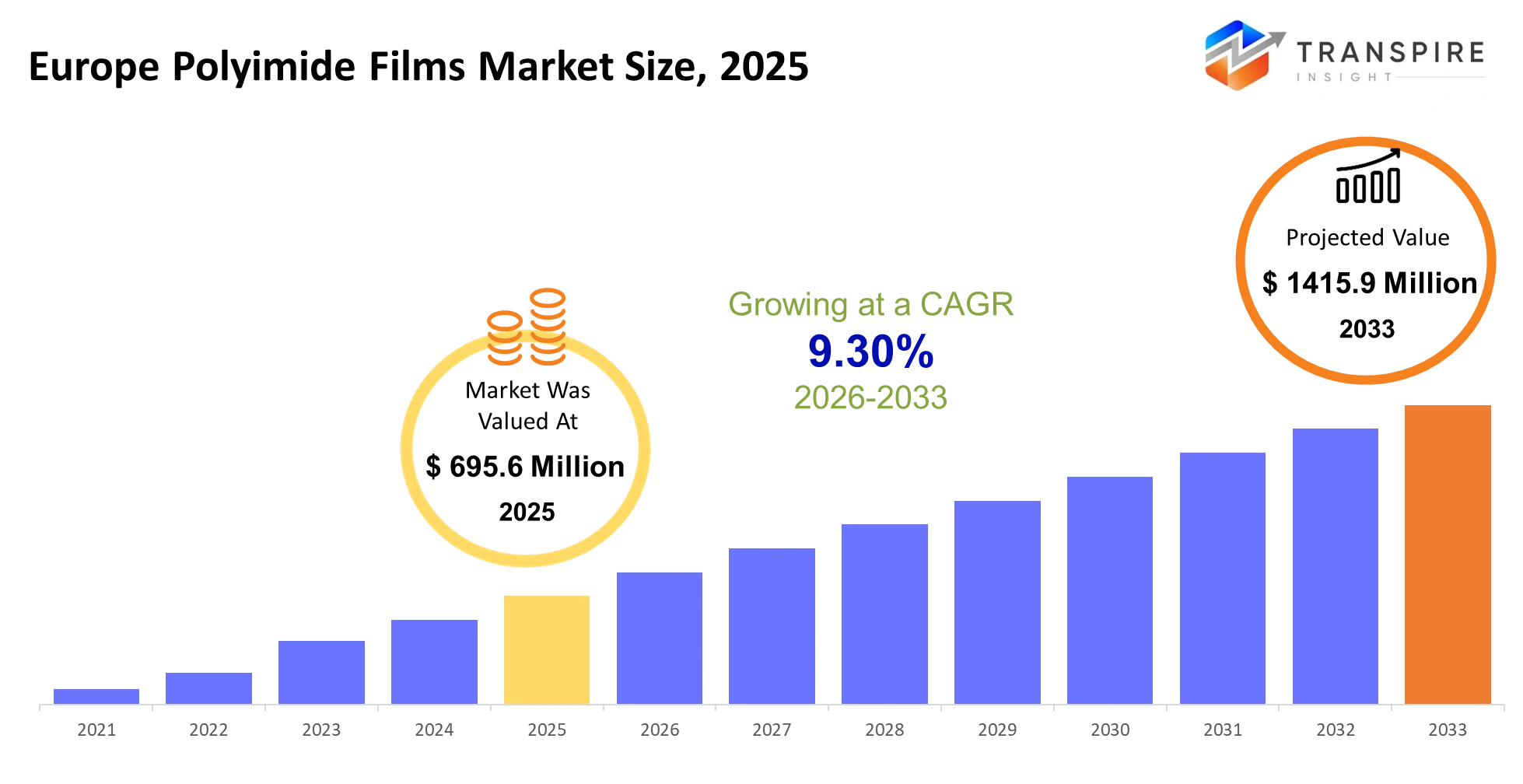
- Europe Polyimide Films Market Size 2025: USD 695.6 Million
- Europe Polyimide Films Market Size 2033: USD 1415.9 Million
- Europe Polyimide Films Market CAGR: 9.30%
- Europe Polyimide Films Market Segments: By Type (Aromatic Polyimide, Aliphatic Polyimide, Thermoplastic PI, Thermoset PI, Others); By Application (Flexible Electronics, Aerospace, Automotive, Electrical Insulation, Solar Cells, Others); By End-User (Electronics Industry, Aerospace & Defense, Automotive, Energy, Industrial Firms, Others); By Thickness (Ultra-thin, Thin, Medium, Thick, Others).
To learn more about this report,  Download Free Sample Report
Europe Polyimide Films Market Summary
The Europe Polyimide Films Market was valued at USD 695.6 Million 2025. It is forecast to reach USD 1415.9 Million by 2033. That is a CAGR of 9.30% over the period.
The Europe Polyimide Films Market supplies ultra-thin, heat-resistant insulating materials which protect delicate electronic components that operate in aerospace systems and electric vehicles and industrial motors and high-frequency communication devices. The films operate as protective barriers which stop thermal breakdown and electrical failure from occurring in high-power environments that exceed the resilience of conventional plastics under extreme temperature conditions and voltage stress.
The market underwent permanent structural changes during the last 3 to 5 years because electrification requirements from EV battery systems and advanced semiconductor packaging became the main drivers of demand which needed better thermal performance and smaller insulation materials. Europe demonstrated its reliance on imported specialty polymers when supply chain disruptions from geopolitical conflicts and pandemic-related shipping interruptions so now companies are making local production investments while testing new supplier options. The combination of these two factors has accelerated the process which aerospace and automotive original equipment manufacturers use to evaluate their products for approval according to their rigorous reliability standards.
Current expansion results from companies adopting lightweight designs which enable their electronic systems to achieve better operational performance. The design process now uses polyimide films because manufacturers create smaller power electronics which need these materials. Designers who use polyimide films at the design stage will increase their material selection process. The suppliers will gain better revenue forecasts through long-term contracts while their product adoption rates will grow.
Key Market Insights
- The European Polyimide Films Market will be led by Western Europe in 2025 when it achieves a 48% market share which results from the aerospace centers located in Germany and France.
- The fastest-growing area in Eastern Europe between 2025 and 2030 will experience growth because of increasing electronics production and affordable polymer manufacturing capabilities.
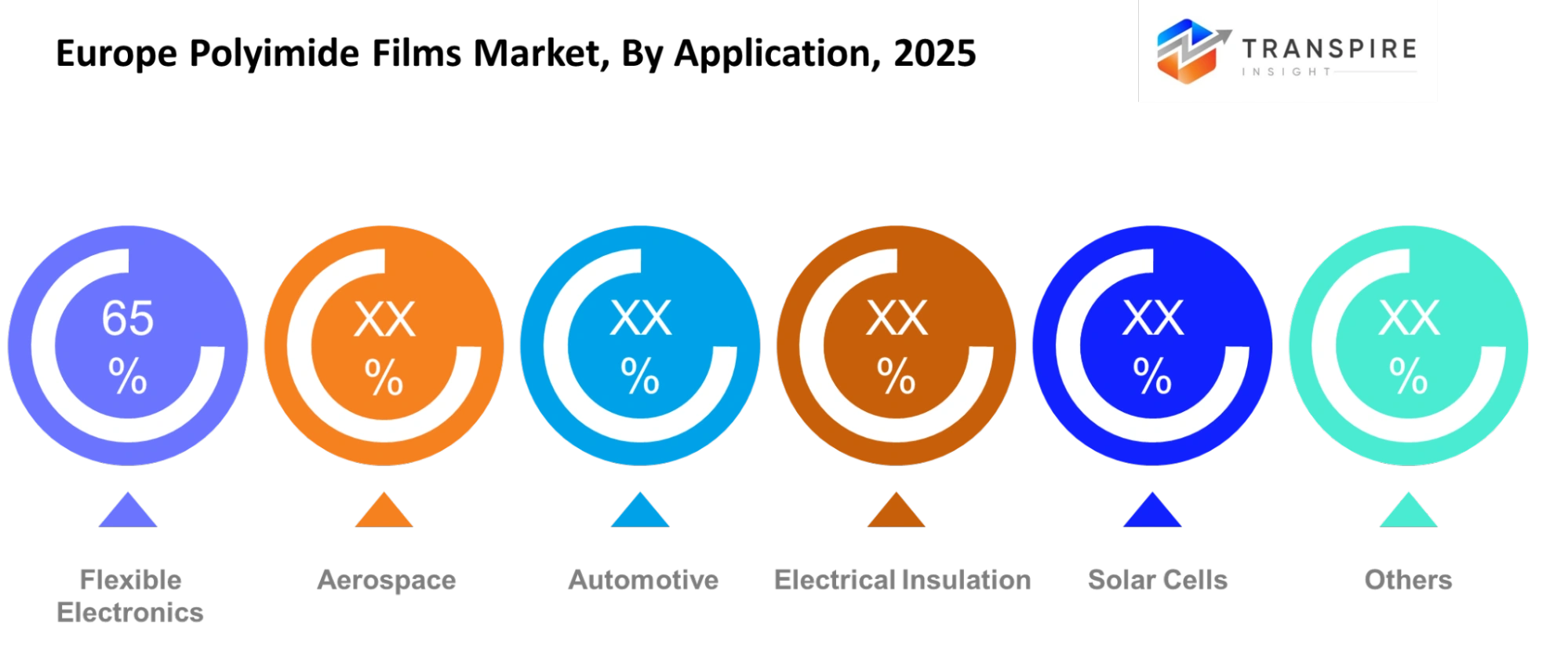
- The Europe Polyimide Films Market will be led by flexible polyimide films which will capture approximately 55% of the market share in 2025 because of their application in electronics insulation.
- Coated polyimide films which are used for aerospace wiring and high-voltage motor insulation systems make up the second-largest market segment.
- The ultra-thin specialty films market will achieve the fastest growth rate between 2025 and 2030 because of semiconductor miniaturization trends.
- The electronics and semiconductors industry controls 52% of the market because compact devices need materials with exceptional thermal stability.
- The electric vehicle market represents the most rapidly expanding application sector because it requires battery insulation and protection for high-voltage systems.
- Electronics manufacturers hold the leading position in the Europe Polyimide Films Market because they purchase large quantities from OEM supply chains.
- The automotive industry experiences its most rapid growth through electric vehicle development which is currently transforming manufacturing processes in Germany and France.
- Advanced polymer processing technologies make it possible to create thermal resistance improvements which give businesses an advantage in their high-end product development.
What are the Key Drivers, Restraints, and Opportunities in the Europe Polyimide Films Market?
The Europe Polyimide Films Market experiences its main growth because automotive and industrial systems undergo fast electrification which demands electric vehicle high-voltage systems to use materials that maintain dielectric stability during extreme temperature conditions. The automotive industry experienced this transformation because EU emissions regulations became more stringent while electric vehicle platforms needed to be established after 2022, which led original equipment manufacturers to create new battery protection systems and power management technologies. The application of polyimide films has advanced to the stage where designers use these materials in their initial design processes which leads to increased supplier contract demand and better revenue predictions for aerospace and automotive and semiconductor markets.
The manufacturing process faces its biggest challenge because it requires complicated procedures while needing rare chemical materials which must be imported from Asia. The present structural design prevents European companies from achieving quick production growth while their manufacturing expenses remain higher than those of standard polymer film products. The European Polyimide Films Market experiences demand growth, yet domestic feedstock supplies remain insufficient and aerospace and electronics industries have rigorous qualification standards that prolong supplier switching periods which results in reduced short-term revenue growth and increased hurdles for new companies entering the market.
Regions in Germany and the Netherlands are experiencing localized semiconductor packaging expansion which creates a major business opportunity through advanced chip assembly facilities that operate under EU semiconductor sovereignty programs. These manufacturing plants need ultra-thin insulation materials which can endure high temperatures to support the development of advanced chip technologies.
What Has the Impact of Artificial Intelligence Been on the Europe Polyimide Films Market?
European Polyimide Films Market undergoes transformation through artificial intelligence and advanced digital systems which help manufacturers achieve precise polymer production and successful quality control. AI-based automation in high-performance film production enables manufacturers to control extrusion temperatures and coating thickness while detecting defects through real-time monitoring which reduces the need for manual inspections and enhances product consistency. Smart factory systems achieve better energy efficiency during high-temperature curing processes which results in decreased production expenses for each square meter of film.
Machine learning models are increasingly applied for predictive maintenance of coating equipment and vacuum deposition systems which identify wear patterns before breakdowns occur. Predictive tools enable manufacturers to maintain a steady production output while decreasing unplanned downtime which is essential for producing aerospace-grade and semiconductor-grade polyimide films. Producers who implement digital monitoring for their processes achieve better equipment uptime and consistent dielectric performance through improved process control.
AI integration benefits operations by increasing throughput efficiency and decreasing scrap rates in precision film lines which mainly operate in Germany and France where advanced materials production mainly occurs. The requirement for specialized training data about polymer processes limits organizations from applying advanced machine learning solutions. The Europe Polyimide Films Market continues to experience operational challenges because many legacy plants maintain outdated sensor systems which disrupt model accuracy and prevent companies from implementing intelligent production systems at full capacity.
Key Market Trends
- The EU EV adoption surge which started in 2022 drove an increased need for high-voltage insulation films which led to a shift in procurement practices towards long-term OEM supply contracts.
- The semiconductor industry needs ultra-thin polyimide films after 2023 because manufacturers require better packaging solutions than traditional polymer insulation materials used for advanced chip systems.
- The aerospace industry introduced stricter certification requirements in 2024 which extended the time needed to achieve qualification so DuPont needed to extend its testing periods for new film materials.
- European buyers adopted regional sourcing partnerships during supply chain disruptions from 2022 to 2023 which helped them decrease their reliance on specialty chemical imports from Asia.
- Automotive OEMs increased their EV platform investments after 2023 which led to higher use of thermal-resistant films in battery and inverter insulation systems.
- German manufacturers experienced a strong increase in smart manufacturing adoption after 2024 because they used AI technology to detect defects during their precise film production process.
- Industrial automation expansion created a demand for flexible dielectric materials which needed to replace rigid insulation materials used in compact motor designs throughout Europe.
- Kaneka Corporation and SKC Inc. established new European partnerships to enhance their market presence while they decreased the time needed for product testing and certification.
- The aerospace industry and renewable energy electrical systems started using high-performance films as standard practice because energy efficiency regulations began to require their use after 2025.
Europe Polyimide Films Market Segmentation
By Type:
The Polyimide Films Market in Europe is dominated by Aromatic polyimide because its thermal resistance and dielectric stability perform better than other materials in extreme conditions. The aerospace and semiconductor industries depend on this chemical combination because it maintains operational capability at temperatures that exceed standard limits. The secondary category of Thermoplastic PI follows because its processability makes it suitable for use in flexible electronic systems.
Aliphatic polyimide remains limited due to lower thermal endurance, yet it finds selective use in cost-sensitive insulation applications. Thermoset PI has started to receive recognition for its use in structural electronics because its permanent curing process leads to better mechanical strength. The various types of growth logic exist because the demand for high-temperature electronics in EVs and aerospace systems has increased which creates a preference for aromatic formulations.
Aromatic polyimide will continue to hold market dominance throughout the forecast period while thermoplastic materials will experience faster growth because of their application in flexible electronics. Material innovators will develop hybrid chemistries that create a balance between high performance and easy production to direct investment toward advanced polymer research and development.
By Application:
The market for polyimide films in Europe has its main application segment in flexible electronics because of increasing demand for foldable displays and wearable devices and compact sensors. The aerospace industry follows close behind because aircraft systems need strict certification standards and their insulation systems have long operational lifespans. Electrical insulation also maintains a strong base across industrial motors and high-voltage systems.
The automotive industry needs to develop its applications because electric vehicles require both battery insulation and inverter protection. The solar cell market remains small today but is expanding because renewable energy installations need backing materials that can withstand high temperatures. The market for this segment expands because industries are implementing electrification and miniaturization technologies.
The future development work will focus on automotive and flexible electronics fields which now use polyimide films as their standard design element. The suppliers will develop high-performance lightweight materials which will provide performance benefits for upcoming electronic design technologies.
To learn more about this report, Download Free Sample Report
By End-User:
The total market for polyimide films in Europe is led by the electronics sector which uses these films for semiconductor packaging and circuit board production and flexible display technology. Aerospace and defense maintain a strong position, supported by strict safety requirements and long-term procurement cycles for critical systems. Industrial firms also contribute steady demand through machinery insulation and automation systems.
The fastest growth in automotive end-user markets occurs because electric vehicle platforms need advanced materials for thermal and electrical insulation. The energy sector is gradually expanding its usage in power electronics for renewable integration and grid stability systems. The demand patterns of today are becoming more dependent on electrification together with the design requirements of high-density electronic systems.
The automotive and energy sectors will create incremental market growth throughout the years but the electronics sector will continue to be the primary market segment. Manufacturers will establish stronger alliances with original equipment manufacturers to obtain early-stage material integration during product design development.
By Distribution:
The Europe Polyimide Films Market contains its largest market share in thin polyimide films because these films serve as essential materials for flexible electronics and circuit insulation needs. Medium thickness films support industrial and automotive electrical systems where moderate durability and flexibility are required. Aerospace applications and heavy industrial operations employ thick films as their standard material.
Semiconductor miniaturization and high-density electronic packaging requirements drive the fastest growth of ultra-thin films as their most popular product segment. These films enable tighter circuit integration and improved thermal management in compact devices. The development of chip design and wearable electronics leads to strong growth in the market.
The upcoming demand for ultra-thin films and engineered multi-layer films will emerge because device architectures continue their trend toward smaller sizes. Producers will focus their investments on developing precision coating technologies together with nano-scale thickness control methods which they will use to develop high-value electronics applications.
What are the Key Use Cases Driving the Europe Polyimide Films Market?
The Europe Polyimide Films Market uses flexible electronics and semiconductor packaging as its primary application because compact high-frequency circuits need heat-resistant insulation materials. Electronics manufacturers use these films to keep dielectric properties stable in their small devices that function in high-heat conditions.
Aerospace contractors and automotive OEMs use polyimide films for lightweight thermal protection because these films provide high reliability in their applications for aerospace wiring systems and electric vehicle battery insulation. The demand for industrial motor insulation services remains stable because automation systems need strong electrical protection solutions.
Emerging use cases include ultra-thin dielectric layers in next-generation semiconductor chips and advanced solar energy systems using high-temperature backing films. The EU semiconductor investment programs together with renewable energy expansion better material qualification processes for these applications.
|
Report Metrics |
Details |
|
Market size value in 2025 |
USD 695.6 Million |
|
Market size value in 2026 |
USD 759.6 Million |
|
Revenue forecast in 2033 |
USD 1415.9 Million |
|
Growth rate |
CAGR of 9.30% from 2026 to 2033 |
|
Base year |
2025 |
|
Historical data |
2021 - 2024 |
|
Forecast period |
2026 - 2033 |
|
Report coverage |
Revenue forecast, competitive landscape, growth factors, and trends |
|
Regional scope |
Europe (Germany, United Kingdom, France, Italy, Spain, Rest of Europe) |
|
Key company profiled |
DuPont, Ube Industries, Kaneka, SKC Kolon PI, Taimide Tech, Toray, Saint-Gobain, 3M, SABIC, Mitsubishi Chemical, Sumitomo Chemical, Arakawa Chemical, Kolon Industries, PI Advanced Materials, Flexcon. |
|
Customization scope |
Free report customization (country, regional & segment scope). Avail customized purchase options to meet your exact research needs. |
|
Report Segmentation |
By Type (Aromatic Polyimide, Aliphatic Polyimide, Thermoplastic PI, Thermoset PI, Others); By Application (Flexible Electronics, Aerospace, Automotive, Electrical Insulation, Solar Cells, Others); By End-User (Electronics Industry, Aerospace & Defense, Automotive, Energy, Industrial Firms, Others); By Thickness (Ultra-thin, Thin, Medium, Thick, Others). |
Which Regions are Driving the Europe Polyimide Films Market Growth?
The European Polyimide Films Market in Western Europe exists because the region contains multiple aerospace manufacturing centers and advanced semiconductor production sites and regulations that control high-performance materials usage. The strict electrical safety standards together with the early adoption of electric vehicle technology and avionics systems in Germany and France and the Netherlands create a strong demand in these countries. The ecosystem exists as a complete system which includes chemical producers and precision converters and OEM integration centers that create advanced insulation materials through their ongoing innovation process.
The Northern European region operates under different conditions which establish a permanent industrial base while providing stability to the area. The countries of Sweden and Denmark and Finland maintain their consumption of polyimide films through their commitment to energy efficiency and advanced industrial automation systems. The region demonstrates growth based on its systematic approach to capital investments and its ongoing processes of industrial system enhancements unlike Western Europe which experiences rapid shifts in technological adoption.
The electronics manufacturing sector in Eastern Europe has experienced expansion since 2023 which has resulted in increased foreign direct investment to become the fastest growing area. The production costs in Poland and Hungary and the Czech Republic attract semiconductor and automotive suppliers who benefit from the EU-supported industrial relocation initiatives. The localized production ecosystems which exist today will expand through 2033 according to current market trends which create strong investment prospects for investors. These ecosystems will enhance cost efficiency and supply chain resilience for advanced material manufacturers.
Who are the Key Players in the Europe Polyimide Films Market and How Do They Compete?
The Europe Polyimide Films Market shows moderate competition because a few international specialty chemical manufacturers control advanced supply networks as local manufacturers meet specific industrial needs. The existing companies maintain their market position by using material certifications and extended qualification processes and complete system connections to aerospace and automotive and semiconductor original equipment manufacturers. New companies encounter major obstacles because the industry demands both strict product performance requirements and expensive manufacturing operations which results in technology dependability and regulatory adherence becoming the main points of competition instead of pricing.
DuPont advances its business through its development of advanced Kapton film technology which provides high-temperature insulation for aerospace and electric vehicle systems that require extended thermal stability testing. The company establishes its market position through its extensive qualification partnerships with aerospace original equipment manufacturers and its ongoing material development for extreme operating conditions. The organization increases its capacity through partnerships that enable joint development of specific applications with electronics manufacturers.
Kaneka Corporation establishes its market position through its development of advanced polyimide chemistry which manufacturers flexible electronics and semiconductor products. The company focuses on developing ultra-thin films which will enable future devices to achieve higher circuit density. SKC Inc. establishes a stronger presence in Europe by creating supply chain partnerships with automotive and electronics manufacturers which emphasize building delivery systems that operate within local areas to shorten shipment times.
UBE Corporation competes through its thermally stable film products which are used in insulation systems for industrial applications while Kolon Industries focuses on specialized material development to serve high-performance niche markets.The companies achieve growth through their partnerships with original equipment manufacturers and their regional alliances which enable them to establish material integration during the initial design phases of their projects.
Company List
- DuPont
- Ube Industries
- Kaneka
- SKC Kolon PI
- Taimide Tech
- Toray
- Saint-Gobain
- 3M
- SABIC
- Mitsubishi Chemical
- Sumitomo Chemical
- Arakawa Chemical
- Kolon Industries
- PI Advanced Materials
- Flexcon
Recent Development News
In April 2026, Toray Industries announced the acquisition of a European specialty films manufacturer to strengthen its advanced polyimide film production capacity in the region. The deal is aimed at expanding its footprint in high-performance electronics and EV insulation materials.
Source: https://www.toray.com
In March 2026, UBE Corporation completed the acquisition of a German high-performance polymer business to enhance its polyimide film portfolio and accelerate growth in the European electronics supply chain. The move supports strategic expansion in semiconductor and flexible display applications.
Source: https://www.ube.com
What Strategic Insights Define the Future of the Europe Polyimide Films Market?
The Europe Polyimide Films Market needs advanced materials which provide exceptional thermal performance for its shrinking electronic devices and aerospace and electric vehicle and semiconductor systems. The current market trends are driven by ongoing electrification demands and European Union semiconductor sovereignty programs which require faster development of modern insulation solutions. The demand for products now requires companies to deliver specific technologies through contract agreements rather than meeting general volume requirements.
Manufacturers who depend on specialty polyimide precursors face hidden dangers because raw material sourcing is restricted to a few suppliers which creates both price fluctuations and risks from political unrest. The current restriction will prevent companies from increasing their production capacity despite strong demand from their target markets.
The Central and Eastern European region is developing an opportunity for local ultra-thin film manufacturing which will benefit from new semiconductor assembly facilities and EU industrial funding programs. The region is becoming a prime location for companies to establish operations that need high-performance materials in their manufacturing processes. Companies which build production facilities in their operational areas and develop advanced coating methods will gain a competitive edge because they will meet industrial requirements of aerospace and EV manufacturers.
Europe Polyimide Films Market Report Segmentation
By Type
- Aromatic Polyimide
- Aliphatic Polyimide
- Thermoplastic PI
- Thermoset PI
- Others
By Application
- Flexible Electronics
- Aerospace
- Automotive
- Electrical Insulation
- Solar Cells
- Others
By End-User
- Electronics Industry
- Aerospace & Defense
- Automotive
- Energy
- Industrial Firms
- Others
By Thickness
- Ultra-thin
- Thin
- Medium
- Thick
- Others
Frequently Asked Questions
Find quick answers to common questions.
The Europe Polyimide Films Market size is USD 1415.9 Million in 2033.
Key segments for the Europe Polyimide Films Market are By Type (Aromatic Polyimide, Aliphatic Polyimide, Thermoplastic PI, Thermoset PI, Others); By Application (Flexible Electronics, Aerospace, Automotive, Electrical Insulation, Solar Cells, Others); By End-User (Electronics Industry, Aerospace & Defense, Automotive, Energy, Industrial Firms, Others); By Thickness (Ultra-thin, Thin, Medium, Thick, Others).
Major Europe Polyimide Films Market players are DuPont, Ube Industries, Kaneka, SKC Kolon PI, Taimide Tech, Toray, Saint-Gobain, 3M, SABIC, Mitsubishi Chemical, Sumitomo Chemical, Arakawa Chemical, Kolon Industries, PI Advanced Materials, Flexcon.
The Europe Polyimide Films Market size is USD 695.6 Million in 2025.
The Europe Polyimide Films Market CAGR is 9.30% from 2026 to 2033.
- DuPont
- Ube Industries
- Kaneka
- SKC Kolon PI
- Taimide Tech
- Toray
- Saint-Gobain
- 3M
- SABIC
- Mitsubishi Chemical
- Sumitomo Chemical
- Arakawa Chemical
- Kolon Industries
- PI Advanced Materials
- Flexcon
Recently Published Reports
-
Apr 2026
Healthcare Polymer Packaging Market
Healthcare Polymer Packaging Market Size, Share & Analysis Report By Packaging Type (Syringes, IV Bottles and Pouches, Clamshells, Blisters, Bottles & Jars, Containers, Tubes, IV Parental Packaging, Others), By Type (Regulated, Non-regulated), By Polymer Type (LDPE (Low-Density Polyethylene), HDPE (High-Density Polyethylene), Homo-polymer (Homo), Random Copolymer (Random), Block Copolymer (Block), PET, Polystyrene, Polyvinyl Chloride, Polyamide/EVOH, Others), and Geography (North America, Europe, Asia-Pacific, Middle East and Africa, South and Central America), 2021 - 2031
-
Apr 2026
Hydrophilic Tape (Waterstop) Market
Hydrophilic Tape (Waterstop) Market Size, Share & Analysis Report By Type (Bentonite-Based Hydrophilic Tape, Rubber-Based Hydrophilic Tape), By Application (Residential Buildings, Commercial Buildings, Infrastructure Projects), and Geography (North America, Europe, Asia-Pacific, Middle East and Africa, South and Central America), 2021 - 2031
-
Apr 2026
Metalens Market
Metalens Market Size, Share & Analysis Report By Type (Visible Light Metalens, and Infrared Metalens), By Application (Consumer Electronics, Automotive Electronics, Industrial, Medical, and Others), and Geography (North America, Europe, Asia-Pacific, Middle East and Africa, South and Central America), 2021 - 2031
-
Apr 2026
PBT Resin Market
PBT Resin Market Size, Share & Analysis Report By Type (Reinforced PBT Resin, Unreinforced PBT Resin), By Processing Method (Injection Molding, Extrusion, Blow Molding, Others), By End-User (Automotive, Electrical & Electronics, Consumer Appliances, Industrial Machinery, Medical Devices, Packaging, Others), and Geography (North America, Europe, Asia-Pacific, Middle East and Africa, South and Central America), 2021 - 2031