
South Korea Platinum-Based Catalysts Market Size & Forecast:
- South Korea Platinum-Based Catalysts Market Size 2025: USD 196.3 Million
- South Korea Platinum-Based Catalysts Market Size 2033: USD 364.6 Million
- South Korea Platinum-Based Catalysts Market CAGR: 8.05%
- South Korea Platinum-Based Catalysts Market Segments: By Catalyst Type (Platinum, Platinum-Rhodium, Platinum-Palladium, Bimetallic, Others) | By Application (Automotive Catalysts, Petrochemicals, Fuel Cells, Chemicals, Pharmaceuticals, Others) | By Form (Powder, Pellets, Granules, Others) | By End User (Automotive, Energy, Chemicals, Healthcare, Others)
South Korea Platinum-Based Catalysts Market Summary
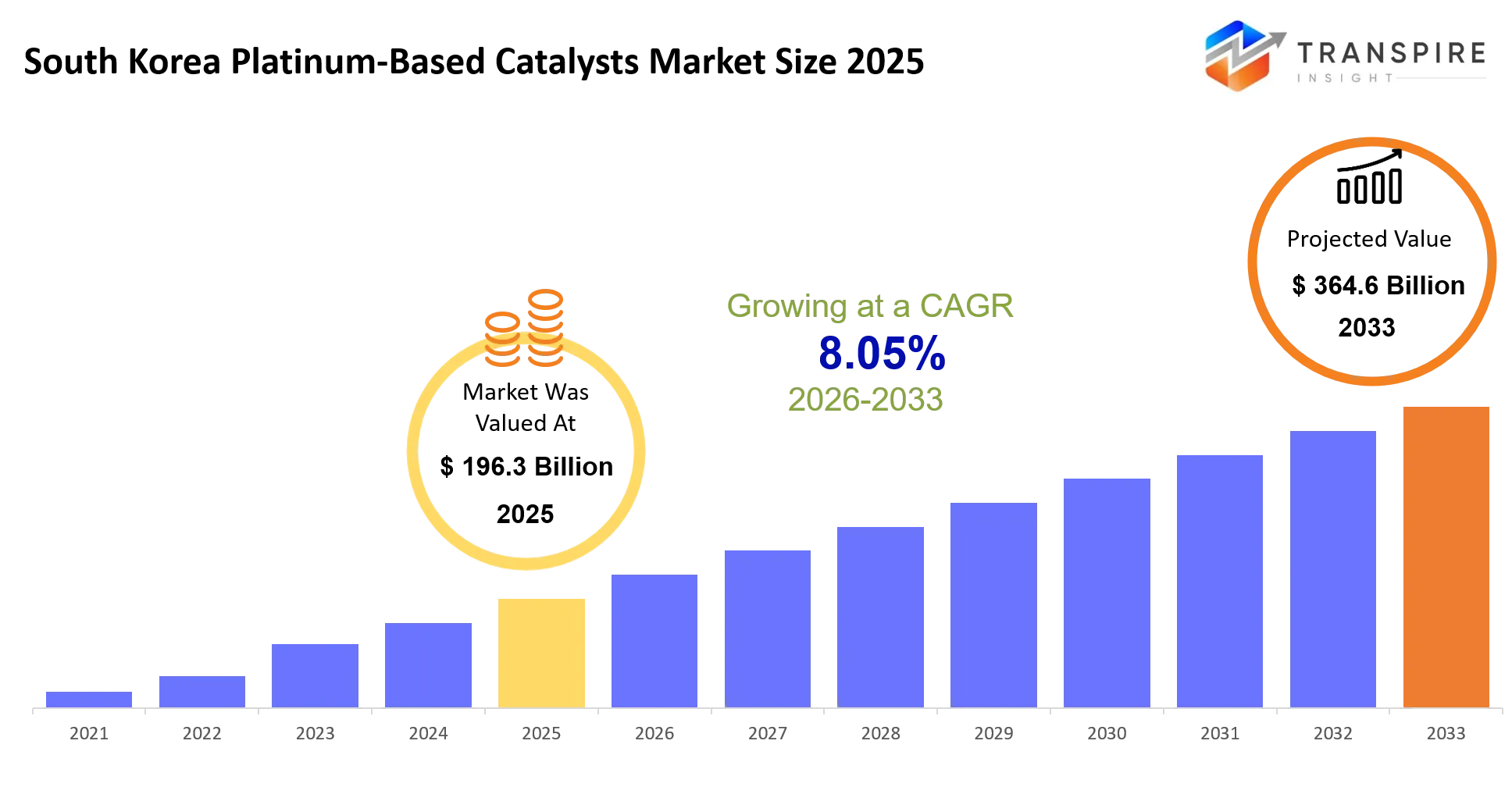
The South Korea Platinum-Based Catalysts Market was valued at USD 196.3 Million in 2025. It is forecast to reach USD 364.6 Million by 2033. That is a CAGR of 8.05% over the period.
South Korea’s platinum based catalysts market does a lot of heavy lifting, kind of quietly, in the sense that it really helps industrial facilities and energy systems reach their performance goals while also hitting tougher emissions targets. These catalysts speed up chemical reactions in places like petroleum refining, petrochemicals, hydrogen production, fuel cells, and even automotive emission control. So you get better efficiency , less pollutants, and often lower operational costs too.
In the last three to five years the whole thing seems to be changing, more toward clean energy and hydrogen related uses, not just the old patterns. There are government supported hydrogen economy programs, plus decarbonization commitments, that have pushed platinum catalysts further than traditional refining and typical automotive needs. Meanwhile, supply chain hiccups, along with precious metal price swings after geopolitical pressures and global shipping slowdowns , pushed producers to use smarter amounts of catalyst and also improve recycling routines. So yeah, optimization became a kind of survival mode.
Right now, growth is basically coming from the overlap between stricter environmental rules and industrial modernization. As refiners, chemical makers, and hydrogen value chain participants invest in cleaner and more efficient approaches, the uptake of advanced platinum catalysts keeps rising. That supports both replacement demand and new income possibilities across those higher value industrial use cases.
Key Market Insights
- Ulsan kinda dominates the South Korea Platinum-Based Catalysts Market, with an estimated 35%+ share in 2025 , and it’s backed by those big refining and petrochemical complexes that keep running at scale.
- Yeosu still keeps a meaningful grip on the market too, mostly because chemical manufacturing investment is concentrated there , plus catalyst replacement cycles just keep going.
- Chungcheong region is the quickest mover through 2030, tied to hydrogen infrastructure buildout and a steady push toward advanced materials.
- Industrial clusters close to major ports keep pulling in catalyst processing and recycling facilities , which basically helps lock in stronger regional market share.
- On the product side, refining catalysts stay on top, making up around 40% of the industry size in 2025.
- Petrochemical catalysts sit second, supported by capacity modernization projects that don’t really slow down.
- For applications, petroleum refining leads with nearly 45% market share, mostly from continuous demand for cleaner fuel production.
- Hydrogen production and fuel cell use cases are the fastest-growing application category across the forecast period.
- End-users are led by refining and petrochemical companies, they hold more than 50% of total market revenue.
- Hydrogen energy developers are forecast to be the fastest-growing end-user group through 2030.
What are the Key Drivers, Restraints, and Opportunities in the South Korea Platinum-Based Catalysts Market?
The main force pushing the South Korea Platinum-Based Catalysts Market ahead is basically the country’s intentional drive toward a hydrogen-centered industrial setup. There are government-supported hydrogen roadmaps, plus fuel cell rollout programs, and decarbonization goals for industry which have, honestly, boosted spending on production pathways that lean on platinum catalysts. For hydrogen production, purification, and fuel cell operation, you need catalytic materials that are tuned for top-tier efficiency so they can hit commercial expectations. So as refiners, chemical producers, and power firms scale up hydrogen capacity, platinum catalyst usage tends to climb too , right next to the bigger capital expenses. In a direct way, this supports revenue growth because platinum-based catalysts still matter a lot for keeping reaction performance high, staying inside emissions rules, and protecting day to day operational dependability in premium industrial settings
The biggest structural drag is platinum price swings, and also the fact that supply is concentrated. Platinum output stays tightly tied to a small set of mining regions worldwide, so availability can get shaken by geopolitical turbulence, labor interruptions, and general output limits. In other words, industrial buyers can’t just swap platinum for other materials in most high-performance uses without giving up efficiency or long-term endurance. Because of that, when precious metal costs keep moving, it creates uncertainty for projects, pushes procurement plans later, and ends up dulling investment in applications that consume a lot of catalyst. This is considered structural because building fresh mining capacity and developing substitute catalytic chemistries takes years of funding and eventual commercialization.
A pretty major future opportunity shows up in next generation hydrogen ecosystems, plus catalyst recycling tech too. South Korea is really pushing investments into clean hydrogen production, fuel cell mobility, and the industrial hydrogen infrastructure aspect. At the same time, progress in platinum recovery systems lets makers reclaim valuable metals from spent catalysts , which boosts the economic returns. So the firms that blend high performance catalyst technologies with closed loop recycling abilities can catch these upcoming growth chances while also dialing down their exposure to raw material supply risks.
What Has the Impact of Artificial Intelligence Been on the South Korea Platinum-Based Catalysts Market?
Artificial intelligence plus advanced digital tech are now gradually changing how catalyst manufacturing, refining operations and hydrogen production plants in South Korea work. At the same time, industrial folks are rolling out AI monitoring platforms, to help automate process control, get reaction conditions more on point, and keep evaluating catalyst performance without stopping. These setups look at temperature, pressure , feedstock makeup and conversion rates in real time, so plant teams can react quicker and with fewer mistakes when they need to tune the process.
Machine learning is also strengthening predictive maintenance. It does this by reading equipment behavior and the usual catalyst degradation tracks, then it can guess when maintenance will be needed, before a drop in performance actually shows up. That style of approach helps cut down on those surprise shutdowns, raises asset utilization , and generally extends the service life of the catalyst. In refineries and petrochemical use cases, AI optimization platforms can nudge process efficiency higher, reduce energy use, and back up more strict emissions requirements.
On top of that, advanced analytics can support emissions forecasting and production planning. It happens by pulling together operational information from several facilities into one view. With that, manufacturers can push throughput while also lowering operating costs, and reducing resource waste that often slips through gaps. For hydrogen production, digital twins together with AI-driven simulations speed up catalyst screening as well as process optimization, like testing faster but still staying disciplined.
Still, AI adoption has some friction. The big blockers are high integration costs, fragmented industrial data systems, and the fact that long-term catalyst performance datasets aren’t always available, which can drag down model accuracy and slow deployment. A lot of plants end up needing to fund digital infrastructure first, before they can actually feel the full benefits of AI-enabled catalyst optimization.
Key Market Trends
- Since 2021, hydrogen focused projects have accelerated catalyst demand kind of past the usual traditional refining, and petrochemical use cases.
- Platinum recycling adoption moved up a lot from 2022 through 2025, as manufacturers looked for protection against precious metal price swings.
- Refiners now more often deploy digital catalyst monitoring systems, to push conversion efficiency higher, and also cut down on sudden maintenance surprises.
- BASF, Johnson Matthey, and Heraeus expanded advanced catalyst portfolios aimed at hydrogen, and also low carbon industrial processes which are, well, pretty related but still distinct.
- Industrial buyers increasingly lean toward catalysts with lower platinum loading, while keeping reaction performance standards basically equivalent.
- Since 2020, supply chain disruptions pushed users toward localized sourcing strategies and tighter inventory management.
- Catalyst developers are also integrating AI assisted materials discovery tools, to shorten product development, plus testing cycles which take time otherwise.
- Environmental compliance requirements have redirected purchasing decisions toward higher efficiency catalyst systems that last longer in operation.
- Strategic collaborations between energy companies and catalyst suppliers have been rising, to back hydrogen infrastructure development.
- And since 2023, investment in closed loop catalyst recovery systems has become a key competitive strategy in practice.
South Korea Platinum-Based Catalysts Market Segmentation
By Catalyst Type :
Platinum catalysts are kind of widely used, since they show strong catalytic activity and also reliability during industrial processing, emission control, and general chemical production. You end up seeing consistent performance even when operating conditions get quite demanding, and that helps justify adoption in a number of industries that want fast reaction rates, plus stable output quality , without much wobble.
Platinum-rhodium catalysts are often chosen for uses where you need extra resistance to high temperatures and better durability overall. Meanwhile, platinum-palladium catalysts tend to give a more even, balanced performance along with cost advantages in certain processes. There are also bimetallic and other catalyst types, which combine different metals to push efficiency, selectivity, and operational flexibility , based on what the specific industrial requirement is at the moment.
By Application :
Automotive catalysts matter a lot for reducing vehicle emissions and helping meet environmental compliance standards. In petrochemical work, platinum-based catalysts are used to lift refining efficiency, and also to support the production of fuels and chemical feedstocks that various manufacturing sectors rely on. Fuel cell applications keep getting more attention, because platinum-based materials can help increase energy conversion efficiency.
Chemical and pharmaceutical industries use these catalysts for specialized reactions, better product purity , and to keep process consistency. Other uses include research, industrial processing, and advanced material production, where these catalyst behaviors are really tested and tuned.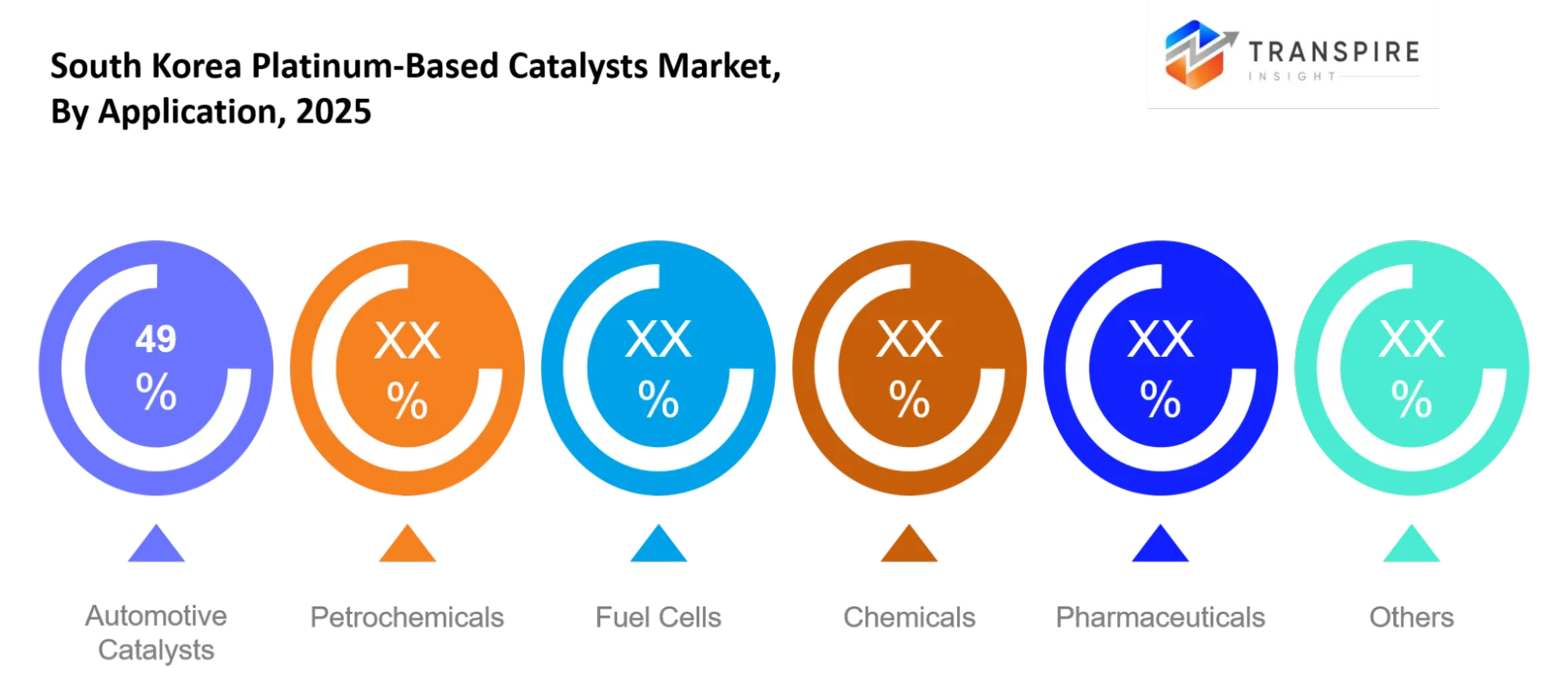
By Form :
Powder form catalysts are often used, mainly because they have a large surface area and, frankly, strong reaction efficiency too. In general this kind of form works well when you need fast contact between the catalyst material and the reactants, so powder catalysts become pretty valuable in chemical manufacturing as well as in lab settings, where speed and interaction matter.
Pellets tend to be the go-to option in systems where handling is easier and the flow stays more controlled. Granules, meanwhile, sort of sit in the middle—good surface area while still being practical for day to day operation. There are also other shapes that are developed for specific industrial jobs, where the process design, how the equipment is configured, and what performance is required end up steering the choice of catalyst and how it’s used.
By End User :
The automotive sector is a big end user, largely because emissions must be reduced effectively and companies have to stay aligned with regulatory requirements. Energy companies also rely on platinum-based catalysts for refining tasks, hydrogen production, and fuel cell technologies, aiming to boost efficiency while supporting cleaner energy routes.
Chemical manufacturers depend on these catalysts to tune production processes and improve reaction results. In healthcare, organizations use platinum-based catalyst technologies for pharmaceutical manufacturing and certain specialized medical applications. Beyond that, other end users include research institutions, industrial facilities, and advanced manufacturing firms that need high performance catalytic solutions in the real world, not just on paper.
What are the Key Use Cases Driving the South Korea Platinum-Based Catalysts Market?
The main use case that is pushing adoption in the South Korea Platinum-Based Catalysts Market is petroleum refining , along with emission control, sort of together. Refineries depend on platinum-based catalysts to boost the overall fuel processing efficiency, improve product quality, and also stay inside strict environmental rules. And because refineries keep rolling out modernization projects, the demand stays pretty steady, since catalyst performance touches output, it also shapes operating costs and regulatory compliance, in a pretty direct way.
Then beyond refining , platinum-based catalysts are showing up more often in hydrogen production and fuel cell systems. Energy groups are putting money into hydrogen infrastructure , while chemical manufacturers are leaning on advanced catalyst systems to increase reaction efficiency, and to reduce process waste. These uses are getting even more noticeable as industrial facilities look for lower-emission production approaches, basically they want cleaner methods all around.
Some emerging use cases are starting to appear too, like green hydrogen creation using advanced electrolysis systems and next-generation fuel cell mobility solutions. Research institutions and technology developers are also testing platinum-based catalysts for carbon utilization processes and for advanced chemical synthesis. Even if these applications are still kind of early, the ongoing investment and technology development , kind of keep pointing toward solid long-term growth potential.
|
Report Metrics |
Details |
|
Market size value in 2025 |
USD 196.3 Million |
|
Market size value in 2026 |
USD 212.1 Million |
|
Revenue forecast in 2033 |
USD 364.6 Million |
|
Growth rate |
CAGR of 8.05% from 2026 to 2033 |
|
Base year |
2025 |
|
Historical data |
2021 - 2024 |
|
Forecast period |
2026 - 2033 |
|
Report coverage |
Revenue forecast, competitive landscape, growth factors, and trends |
|
Country scope |
South Korea |
|
Key company profiled |
Johnson Matthey, BASF, Umicore, Heraeus, Clariant, Evonik, Honeywell, Sinopec Catalyst, W.R. Grace, Albemarle, Topsoe, Axens, SABIC, Tanaka, Mitsui Chemicals |
|
Customization scope |
Free report customization (country, regional & segment scope). Avail customized purchase options to meet your exact research needs. |
|
Report Segmentation |
By Catalyst Type (Platinum, Platinum-Rhodium, Platinum-Palladium, Bimetallic, Others) | By Application (Automotive Catalysts, Petrochemicals, Fuel Cells, Chemicals, Pharmaceuticals, Others) | By Form (Powder, Pellets, Granules, Others) | By End User (Automotive, Energy, Chemicals, Healthcare, Others) |
Which Regions are Driving the South Korea Platinum-Based Catalysts Market Growth?
South Korea kind of leads the regional picture for platinum on catalysts, mainly because it has a strong build up of refining, petrochemical, and hydrogen related activity. Big industrial zones around Ulsan, Yeosu and Daesan keep demand steady for catalyst use across several value chains. On top of that, government support for hydrogen rollout and industrial decarbonization has pushed companies to keep putting money into more advanced catalytic methods. There’s also an entire ecosystem, meaning refiners, chemical producers, research outfits, and catalyst suppliers, working together in a way that just supports the region’s top position.
Japan is seen as the second most important regional market, though the momentum is a bit different from what you see in South Korea. Consumer demand stays backed by a mature industrial foundation, ongoing environmental compliance efforts, and longer term investments into higher value chemical and energy use cases. Instead of leaning on huge capacity expansions, many Japanese firms tend to pursue process streamlining, better catalyst performance, and upgrades to existing technologies. That style—more refinement than expansion—makes replacement demand feel steady, and it tends to keep revenue reliable, even when the wider economy is a little uncertain.
China seems to be coming up as the fastest-growing regional market, largely because more refining capacity is being added, hydrogen infrastructure is developing quickly, and the country keeps pouring money into advanced manufacturing. Lately, policy moves that back clean energy initiatives along with industrial modernization have kind of sped up catalyst uptake in multiple segments, even when the timelines differ a bit. Also , higher spend on fuel cell technology plus emissions reduction programs is reinforcing the growth momentum even more. So for market participants, this overall expansion should translate into fresh openings—think about technology alliances, catalyst supply deals and smarter strategic investments spanning the 2026–2033 window.
Who are the Key Players in the South Korea Platinum-Based Catalysts Market and How Do They Compete?
In the South Korea Platinum-Based Catalysts Market, the competitive setup is not totally fragmented, but it is kind of moderately consolidated, where rivalry is mostly about how well the catalyst performs, how precious metals are optimized, the level of technical know-how, and recycling know-how. Established international players keep trying to hold their share by leaning on advanced R&D and long-term customer ties, but smaller or specialized firms tend to push ahead with more application tuned offerings. At the same time, technology improvement has turned into a bigger differentiator than just pricing, because industrial buyers often care about efficiency, long lasting durability, and meeting regulatory requirements exactly.
BASF works out of a catalyst engineering angle and process optimization, especially for refining, petrochemical, and hydrogen related use cases. What stands out is their broad research footprint and custom catalyst formulations, which in turn help customers raise operational efficiency. Johnson Matthey, meanwhile, highlights low platinum loading approaches and circular economy oriented solutions, like precious metal recovery as well as recycling services, so customers face less exposure to raw material swings.
Heraeus leans on expertise in precious metal stewardship and catalyst recycling, delivering integrated options that bundle catalyst supply with metal recovery programs. Umicore also aims to strengthen its position using advanced materials technology, plus investments tied to clean mobility and hydrogen adjacent applications. Clariant differentiates through specialized catalyst systems made for particular industrial routes, and then continues collaboration with energy and chemical partners to support its move into emerging low carbon production pathways.
Company List
- Johnson Matthey
- BASF
- Umicore
- Heraeus
- Clariant
- Evonik
- Honeywell
- Sinopec Catalyst
- W.R. Grace
- Albemarle
- Topsoe
- Axens
- SABIC
- Tanaka
- Mitsui Chemicals
Recent Development News
In March 2026, BASF announced the start-up of the world's first industrial-scale production plant for X3D® 3D-printed catalysts in Ludwigshafen, Germany. The new facility enables large-scale production of advanced catalysts that improve reactor throughput, reduce energy consumption, and enhance process efficiency for refining and chemical manufacturing customers.
Source https://www.basf.com/
In May 2025, Honeywell agreed to acquire Johnson Matthey's Catalyst Technologies business for £1.8 billion (approximately US$2.4 billion). The transaction expands Honeywell's capabilities in catalysts used for sustainable fuels, hydrogen, and energy transition applications, while reshaping competition across the global catalyst industry. Sourcehttps://www.wsj.com/
What Strategic Insights Define the Future of the South Korea Platinum-Based Catalysts Market?
The South Korea Platinum-Based Catalysts Market is kind of moving , more or less, toward higher value uses that connect to hydrogen production , fuel cells , advanced petrochemicals, and low-carbon industrial processes. The main push isn’t only about environmental compliance either, it feels more like a wider shift in South Korea’s industrial base, toward energy security , better process efficiency, and manufacturing that depends on technology. Over the next five to seven years, catalyst suppliers that can lift performance while they also reduce platinum loading, they’ll likely grab a larger chunk of what the industry is spending.
There’s also a risk that’s a bit less seen, and it comes from technology substitution . If alternative catalyst materials keep improving, especially non-platinum options and other lower-cost metal systems, then platinum intensity could slowly drop in some specific applications. And this concern gets even stronger because precious metal prices stay volatile, and global supply sources remain pretty concentrated.
On the other side, there’s an opportunity that’s starting to show up more clearly: catalyst recycling , plus closed-loop recovery networks for precious metals that tie into South Korea’s hydrogen ecosystem. Participants in the market should really start investing early in integrated catalyst supply together with recycling capabilities , so they can offer a more differentiated value, while also lowering their exposure to raw material disruptions and those sudden cost swings.
South Korea Platinum-Based Catalysts Market Report Segmentation
By Catalyst Type
- Platinum
- Platinum-Rhodium
- Platinum-Palladium
- Bimetallic
By Application
- Automotive Catalysts
- Petrochemicals
- Fuel Cells
- Chemicals
- Pharmaceuticals
By Form
- Powder
- Pellets
- Granules
By End User
- Automotive
- Energy
- Chemicals
- Healthcare
Frequently Asked Questions
Find quick answers to common questions.
The South Korea Platinum-Based Catalysts Market size is USD 364.6 Million in 2033.
Key Segments for the South Korea Platinum-Based Catalysts Market are By Catalyst Type (Platinum, Platinum-Rhodium, Platinum-Palladium, Bimetallic, Others) | By Application (Automotive Catalysts, Petrochemicals, Fuel Cells, Chemicals, Pharmaceuticals, Others) | By Form (Powder, Pellets, Granules, Others) | By End User (Automotive, Energy, Chemicals, Healthcare, Others).
Major South Korea Platinum-Based Catalysts Market Players are Johnson Matthey, BASF, Umicore, Heraeus, Clariant, Evonik, Honeywell, Sinopec Catalyst, W.R. Grace, Albemarle, Topsoe, Axens, SABIC, Tanaka, Mitsui Chemicals.
The Current South Korea Platinum-Based Catalysts Market size is USD 196.3 Million in 2025.
The South Korea Platinum-Based Catalysts Market CAGR is 8.05% from 2026 to 2033.
- Johnson Matthey
- BASF
- Umicore
- Heraeus
- Clariant
- Evonik
- Honeywell
- Sinopec Catalyst
- W.R. Grace
- Albemarle
- Topsoe
- Axens
- SABIC
- Tanaka
- Mitsui Chemicals
About the Authors

Avinash Kumar
I’m Avinash Kumar, a Senior Research Analyst at Transpire Insight, with expertise in the Electronics and Semiconductor and Energy & Power industry. My work focuses on analyzing emerging technologies, market trends, industry developments, and innovation across these sectors. I specialize in transforming complex technical and market insights into clear, research-backed content that helps professionals, businesses, and decision-makers stay informed. Through continuous industry research and data-driven analysis, I strive to deliver accurate, reliable, and practical perspectives on the latest advancements shaping the semiconductor and energy landscape.

Chakradhar Khansole
Chakradhar serves as the Research Director at Transpire Insight, bringing over 8 years of experience in technology, innovation, and strategic market intelligence. He specializes in transforming complex market data into actionable business insights that enable organizations to make informed, growth-oriented decisions. Recognized for his strategic vision and analytical expertise, Chakradhar leads high-impact research initiatives, delivering comprehensive market assessments, competitive intelligence, and forward-looking industry analysis.
Recently Published Reports
-
Apr 2026
Active Power Filter Market
Active Power Filter Market Size, Share & Analysis Report By Type (Shunt Active Power Filters, Series Active Power Filter, Hybrid Active Power Filter), By Application (Harmonics Mitigation, Reactive Power Compensation, Voltage Regulation, Power Factor Correction), By Phase (Single Phase, Three Phase), By End-User Industry (Manufacturing, Healthcare, Commercial, Automotive, Oil and Gas, Others), and Geography (North America, Europe, Asia-Pacific, Middle East and Africa, South and Central America), 2021 - 2031
-
Apr 2026
Electrical Transformer Market
Electrical Transformer Market Size, Share & Analysis Report By Core (Closed, Shell, and Berry), By Insulation (Gas, Oil, Solid, Air, and Other), By Phase (Single, and Three), By Rating (100 MVA to 500 MVA, 501 MVA to 800 MVA, and 801 MVA to 1200 MVA), and Geography (North America, Europe, Asia-Pacific, Middle East and Africa, South and Central America), 2021 – 2031
-
Apr 2026
Hydraulic Piston Pumps Market
Hydraulic Piston Pumps Market Size, Share & Analysis Report By Type (Axial Piston Pumps, Radial Piston Pumps), By Operating Pressure (Low Pressure, Medium Pressure, High Pressure), By Application (Construction, Mining, Agriculture, Automotive, Oil & Gas, Industrial Machinery, Others), By End-User (OEMs, Aftermarket), and Geography (North America, Europe, Asia-Pacific, Middle East and Africa, South and Central America), 2021 – 2031
-
Apr 2026
Laboratory Gas Generators Market
Laboratory Gas Generators Market Size, Share & Analysis Report By Product (Nitrogen Gas Generator, Hydrogen Gas Generator, Zero Air Gas Generator, Purge Gas Generator, TOC Gas Generators, Others), By Application (Gas Chromatography, Liquid Chromatography-mass Spectrometry (LC-MS), Gas Analyzers, Others), By End-user (Life Science, Chemical & Petrochemical, Food & Beverage, Others), and Geography (North America, Europe, Asia-Pacific, Middle East and Africa, South and Central America), 2021 – 2031