
South Korea Nitrogen Trifluoride Market Size & Forecast:
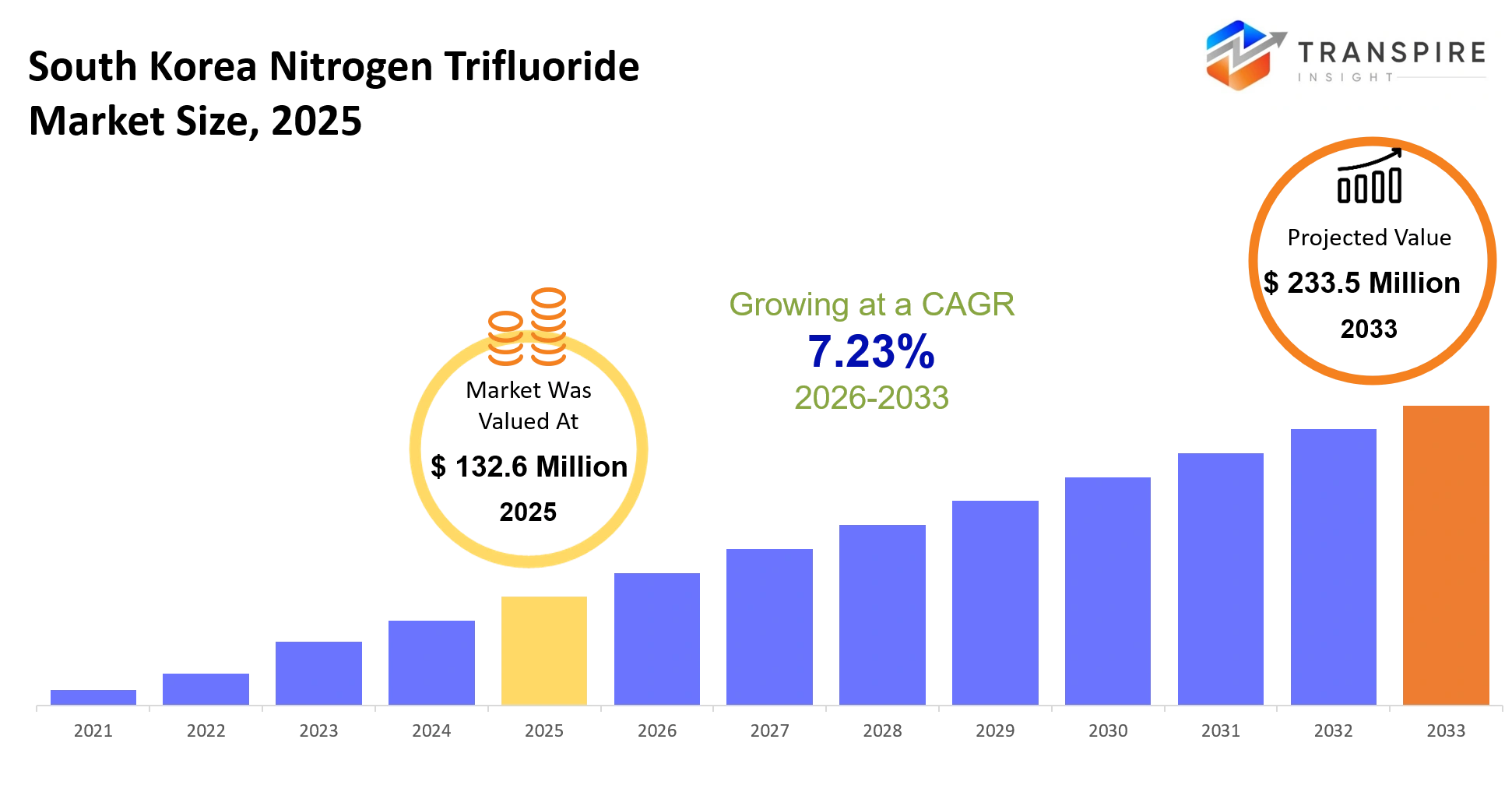
- South Korea Nitrogen Trifluoride Market Size 2025: USD 132.6 Million
- South Korea Nitrogen Trifluoride Market Size 2033: USD 233.5 Million
- South Korea Nitrogen Trifluoride Market CAGR: 7.23%
- South Korea Nitrogen Trifluoride Market Segments: By Application (Semiconductor Manufacturing, Flat Panel Displays, Solar Cells, Others); By Grade (Electronic Grade, Industrial Grade, Others); By End User (Electronics, Solar Industry, Others)
To learn more about this report,  Download Free Sample Report
South Korea Nitrogen Trifluoride Market Summary
The South Korea Nitrogen Trifluoride Market was valued at USD 132.6 Million in 2025. It is forecast to reach USD 233.5 Million by 2033. That is a CAGR of 7.23% over the period.
South Korea’s nitrogen trifluoride (NF3) market kind of matters a lot for the country’s semiconductor and display making ecosystem. In real practice, NF3 gets used to clean deposition chambers and other process equipment, so chipmakers and panel producers can keep day to day production moving, lower contamination risks, and push better yield during high volume fabrication. If cleaning gases aren't dependable, then advanced manufacturing lines end up with less throughput and also higher operating costs, fairly quickly.
Over the last five years, there’s been a noticeable structural shift. It’s the move to more advanced semiconductor nodes plus higher value display technologies, like OLED production. These steps need tighter contamination control, and they tend to call for equipment cleaning more often, which then lifts NF3 consumption at each manufacturing site. One main thing that shaped how the market behaves was the global semiconductor supply chain disruption, followed by the push for domestic capacity expansion. When South Korean manufacturers put money into new fabs and upgraded older lines, demand for specialty electronic gases strengthened too. This whole investment cycle has effectively broadened NF3 adoption, and it supports revenue growth across suppliers serving semiconductor and display customers.
Key Market Insights
- Somewhat oddly, the Gyeonggi Province region sort of ends up dominating the South Korea Nitrogen Trifluoride Market, taking around 45%+ of the pie in 2025, mostly because the semiconductor cluster stays really concentrated there.
- On the product side, Electronic-grade nitrogen trifluoride looks like the clear leader, with more than 70% share in 2025. That growth is backed by demanding purity requirements, and honestly it has to stay that way.
- Meanwhile Standard industrial-grade NF3 hangs in as the second-largest segment, supporting specialized industrial process work.
- Then there’s Ultra-high-purity NF3, which is set to be the fastest-growing segment through 2030 , since newer semiconductor nodes need more rigorous contamination control than before.
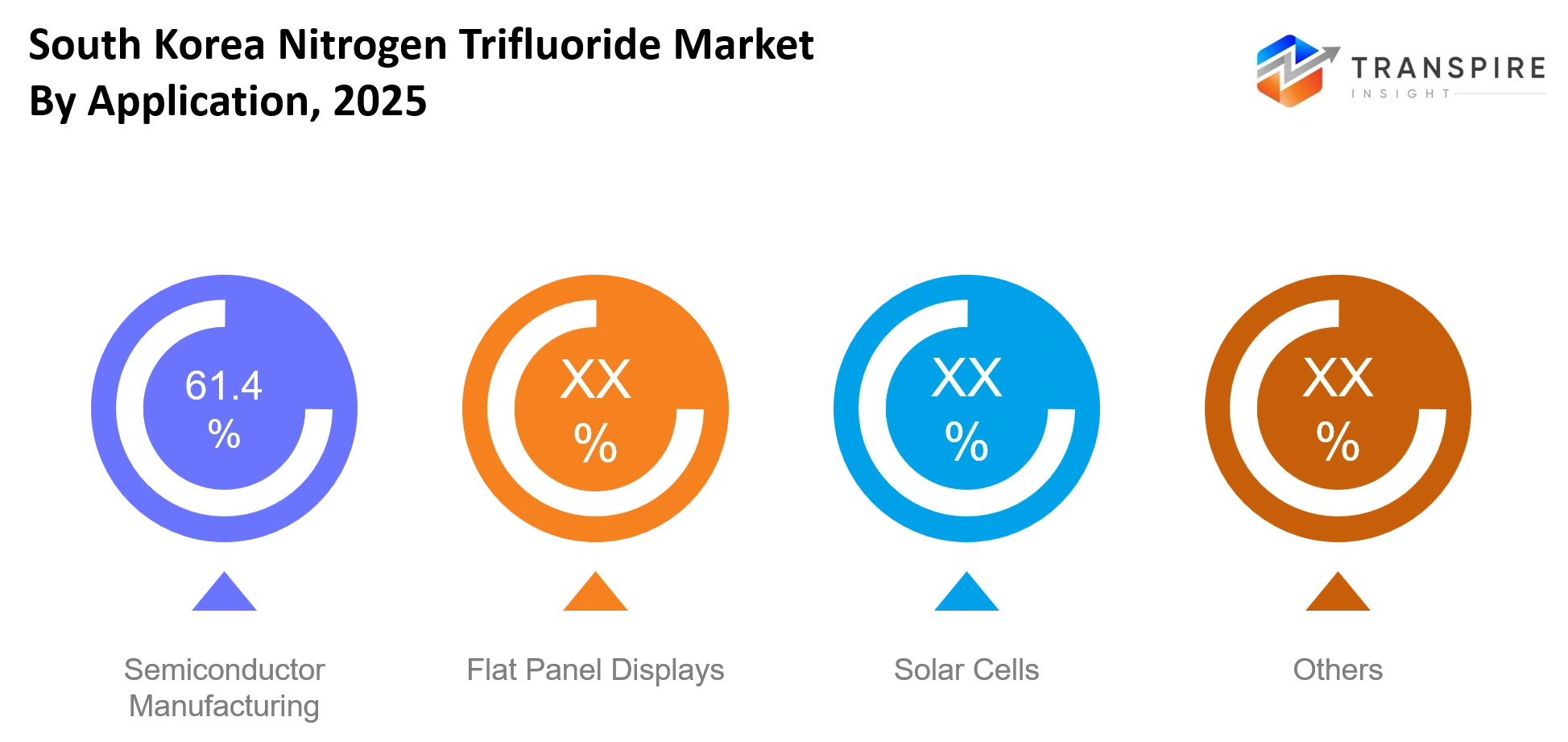
- For applications, Semiconductor chamber cleaning is leading overall, driving roughly 60% of the South Korea Nitrogen Trifluoride Market revenue in 2025.
- OLED, and those advanced display panel stuff, is currently the fastest growing application segment in the forecast period.
- Memory chip fabrication keeps driving really substantial NF3 consumption across most major production facilities, like you would expect.
- Semiconductor manufacturers are still holding the leading end user share, and they’re projected to exceed 55% of industry revenue in 2025.
- For South Korea specifically, display panel producers show up as the second largest end user group in the Nitrogen Trifluoride Market, kinda clearly.
- Also, advanced logic combined with AI chip manufacturing facilities make up the quickest expanding end user segment all the way through 2030.
What Has the Impact of Artificial Intelligence Been on the South Korea Nitrogen Trifluoride Market?
The South Korea Nitrogen Trifluoride Market is mainly driven by the fast expansion of advanced semiconductor manufacturing . In the past several years, the big chip makers have poured a lot into memory, logic, and AI centered fabrication capacity, not only to secure supply, but also to back next generation electronics. As the device dimensions get smaller , and the process complexity climbs, the fabrication tools need more frequent and more exact chamber cleaning. Nitrogen trifluoride delivers strong cleaning efficiency and keeps yields stable, so consumption volumes go up in a real way. That whole link between fab scaling and specialty gas usage has basically built a steady revenue route for NF3 suppliers that serve both semiconductor plants and display manufacturers.
The biggest restraint is the market’s reliance on a small set of semiconductor, and display manufacturing customers. The issue is structural, since the fabs call for major capital outlays , long qualification cycles, and infrastructure that’s fairly specialized. New players can’t be brought in quickly . So when semiconductor investment ramps up or slows down, purchasing activity can stall, capacity utilization can soften, and specialty gas revenue in the near term can dip across the entire supply chain.
A major opening seems to be in ramping up AI semiconductor output and the next generation of packaging tech, I mean there is a lot going on there. South Korea keeps drawing investments for more advanced chip fabrication plus high bandwidth memory production too. These sites usually run under tighter contaminant-control rules and end up using bigger amounts of ultra high purity process gases. So companies that go further into advanced purification methods and build nearby or localized production networks are set up nicely to grab the next stretch of the South Korea Nitrogen Trifluoride Market growth.
Key Market Trends
- Since 2021 semiconductor manufacturers have started to put more money into those advanced process nodes, which in turn makes them use a lot more high-purity nitrogen trifluoride, especially for chamber cleaning, yeah.
- Between 2022 and 2025 the suppliers shifted away from purely volume-driven output and toward ultra-high-purity NF3 offerings in order to satisfy those tighter contamination-control rules .
- After the global chip shortages showed up, a few big manufacturers sped up their fab expansion strategies, so the demand outlook for specialty gas producers became more visible, not just hypothetical.
- Since 2023 companies like SK Materials have tried to secure supply reliability via localized production, plus long-term customer agreements that lock things in.
- Display manufacturers, after 2021 they have been moving more and more toward advanced OLED production lines, so NF3 usage intensity went up compared to the older display technologies
- Also, environmental scrutiny has been increasing since 2022. so manufacturers have been investing in process optimization and in emissions abatement systems alongside the NF3 deployment, even when budgets get tight.
- Procurement strategies kinda shifted from short term buying to multi year contracts, as semiconductor producers were trying to get some protection from supply disruptions , you know the usual kind.
- Global suppliers like Linde plc and Air Liquide , expanded their support for South Korean semiconductor customers.
- During 2024 to 2026, AI semiconductor progress and high bandwidth memory investments started to gain real momentum, which in turn boosted demand for gases that are compatible with these very complicated manufacturing environments.
- More and more manufacturers are folding in digital monitoring plus gas management technologies, and that helps improve utilization efficiency , while cutting down operational losses compared with earlier production models.
South Korea Nitrogen Trifluoride Market Segmentation
By Application :
In South Korea, Semiconductor manufacturing is pretty much the main application segment for the Nitrogen Trifluoride Market . Nitrogen trifluoride is used a lot, mainly for cleaning process chambers and the equipment that goes into wafer fabrication . When the cleaning is effective, it helps keep production efficiency high and also lowers contamination risks, which is important for producing newer advanced semiconductor devices. And because investments keeps increasing in memory chips, logic chips, and AI related semiconductor production, the role of this application just keeps getting stronger, even if demand shifts a bit.
Then you have Flat panel displays, which is also a significant area , especially for OLED and more advanced display panels. In those manufacturing steps, nitrogen trifluoride supports processes that need clean and stable conditions. Solar cells and other industrial applications use the gas too, usually for equipment cleaning and process support, but overall the usage is still lower compared with semiconductor and display manufacturing.
To learn more about this report, Download Free Sample Report
By Grade :
Electronic grade nitrogen trifluoride takes up the biggest share of the South Korea Nitrogen Trifluoride Market, mostly because semiconductor and display production sites really insist on strict purity specs. Basically high purity gas, lets manufacturers hit more exact production results while also lowering the odds of defects, so overall yields feel steadier. And as manufacturing methods keep improving, the demand for electronic grade material keeps climbing, or at least it doesn’t really slow down.
Industrial grade nitrogen trifluoride is typically chosen when purity demands are not as intense as they are in electronics making. It supports a range of industrial operations that still need steady cleaning and solid day to day performance. Meanwhile other grades handle specialized needs, kind of like niche use cases, so customers can pick what fits their own production specifications, even if those requirements are a bit unusual, or more narrow.
By End User :
The electronics industry is basically the dominant end user segment in the South Korea Nitrogen Trifluoride Market, at least that’s how it looks. Semiconductor manufacturers as well as display panel producers consume large volumes of nitrogen trifluoride to back up chamber cleaning and smooth production efficiency . Because there are continuous investments in more advanced electronics manufacturing facilities, demand keeps staying steady from this segment too, generally speaking.
Solar industry also matters, it shows up as an important end user category, using nitrogen trifluoride in a few manufacturing and upkeep steps linked with solar cell production. Beyond that, there are other end users such as industrial facilities that need specialized cleaning gases, so equipment operation stays reliable. Even if their scale is smaller, these kinds of industries still bring extra chances for market participation and revenue generation.
What are the Key Use Cases Driving the South Korea Nitrogen Trifluoride Market?
Semiconductor fabrication still stays the main use case behind adoption in the South Korea Nitrogen Trifluoride Market. Chip makers use nitrogen trifluoride to clean deposition chambers, and also the process equipment between production cycles. When cleaning works well it lowers buildup, enhances wafer yields, and keeps output steady for advanced memory, logic, and AI semiconductor plants. So yeah these day to day operational needs make semiconductor manufacturing the biggest driver of NF3 consumption.
After that, display panel production is starting to look like a real growth pocket. OLED and other newer display manufacturers depend on nitrogen trifluoride to keep processing zones clean, and to hold product quality consistent. At the same time demand is rising in a few solar cell manufacturing lines where equipment needs reliable chamber-cleaning approaches.
Meanwhile, some newer use cases are also showing up with next-generation semiconductor packaging and more advanced chip structures. As South Korea boosts spending on high bandwidth memory, and AI oriented semiconductor technologies, fabrication steps become more intricate. That means contamination control has to be tighter. In turn, this is expected to open additional doors for high purity nitrogen trifluoride applications across the forecast period.
|
Report Metrics |
Details |
|
Market size value in 2025 |
USD 132.6 Million |
|
Market size value in 2026 |
USD 143.2 Million |
|
Revenue forecast in 2033 |
USD 233.5 Million |
|
Growth rate |
CAGR of 7.23% from 2026 to 2033 |
|
Base year |
2025 |
|
Historical data |
2021 - 2024 |
|
Forecast period |
2026 - 2033 |
|
Report coverage |
Revenue forecast, competitive landscape, growth factors, and trends |
|
Country scope |
South Korea |
|
Key company profiled |
SK Materials, Hyosung, Kanto Denka Kogyo, Air Products, Linde, Versum Materials, OCI, REC Silicon, Solvay, Mitsui Chemicals, Air Liquide, Daikin, Showa Denko, Matheson, Foosung |
|
Customization scope |
Free report customization (country, regional & segment scope). Avail customized purchase options to meet your exact research needs. |
|
Report Segmentation |
By Application (Semiconductor Manufacturing, Flat Panel Displays, Solar Cells, Others); By Grade (Electronic Grade, Industrial Grade, Others); By End User (Electronics, Solar Industry, Others) |
Which Regions are Driving the South Korea Nitrogen Trifluoride Market Growth?
The Seoul Capital Area remains the most dominant region in the South Korea Nitrogen Trifluoride Market because it carries the country’s largest cluster of semiconductor processing and display manufacturing facilities. Big funding moves for advanced memory chips, logic semiconductors, and OLED output keep NF3 usage looking steady. On top of that, the area has a pretty mature industrial surroundings, with specialty gas suppliers, equipment builders, academic research institutions, and even logistics networks. When gas producers are close to the fabrication sites, supply reliability tends to look better, and day to day operations become more efficient too, so regional leadership is pretty much sustained.
Chungcheong region grows in a slightly different way, more like a steady blend of manufacturing expansion alongside industrial steadiness. Instead of leaning heavily on tight concentration, the market here grows by slow but sure development of new production ability. Ongoing investments into semiconductor linked infrastructure, and industrial parks, give NF3 demand a solid base. Also, long term capital commitments from electronics manufacturers makes it a dependable source of industry revenue, year after year.
The Gyeongsang region is showing the strongest growth momentum recently, because of investments in next-generation semiconductor and advanced materials production. There are expansion projects tied to AI chips, high-bandwidth memory and supporting supply chains, and they've really strengthened demand for high-purity process gases. Manufacturers are pushing up production capacity, to back future technology requirements, and that s creating fresh chances for specialty gas suppliers, kind of a quiet opening in the background. For market participants, and also investors, this kind of growth indicates that by 2026 to 2033 the region may become an even more important destination, for capacity expansion and for strategic partnerships as well.
Who are the Key Players in the South Korea Nitrogen Trifluoride Market and How Do They Compete?
Competition in the South Korea Nitrogen Trifluoride market stays kinda concentrated, not because everyone is small, but because making electronic grade NF3 needs advanced purification methods, tight quality control, and those long customer sign off periods. Usually firms go after advantage via product purity, supply reliability, production output, and technical support, not price alone. The long term players keep market share by keeping close ties with semiconductor and display manufacturers, and lately the rivalry is more about backing advanced manufacturing, and the whole workflow around it.
SK Materials leans into tech based differentiation by focusing on high purity specialty gases, designed around semiconductor usage. Their relationship network with domestic chip makers gives some operational headroom, and more long run supply chances. The company keeps putting money into production abilities that can handle advanced semiconductor nodes, and changing fab requirements as well. Hyosung Chemical takes a different route, through manufacturing know-how and deep integration into South Korea’s industrial ecosystem. Solid domestic production scale helps keep supply stable for customers running large fabrication lines, where interruptions aren't an option.
Linde plc kind of differentiates itself with global technical expertise, integrated gas management services and a lot of know-how from supporting semiconductor production around the world. Air Liquide on the other hand keeps its position strong thanks to advanced gas handling solutions, plus collaborative development programs with electronics manufacturers, they seem to work well together. Meanwhile, Kanto Denka Kogyo really zeroes in on specialty electronic materials, and also high purity gas technologies that have to match the strict semiconductor manufacturing standards without compromise.
Company List
- SK Materials
- Hyosung
- Kanto Denka Kogyo
- Air Products
- Linde
- Versum Materials
- OCI
- REC Silicon
- Solvay
- Mitsui Chemicals
- Air Liquide
- Daikin
- Showa Denko
- Matheson
- Foosung
Recent Development News
In January 2026, Air Liquide completed its acquisition of DIG Airgas, one of South Korea’s leading industrial and electronic gas suppliers. The transaction strengthened Air Liquide’s position in South Korea’s semiconductor materials ecosystem—including electronic gases such as nitrogen trifluoride (NF₃)—and expanded its capacity to serve advanced chip manufacturing customers. Source https://www.airliquide.com/
In June 2026, Air Liquide entered a long-term supply agreement with SK Hynix and announced an investment of nearly €200 million ($233 million) in South Korea to support semiconductor packaging and testing operations. The investment expands industrial gas infrastructure for the country’s semiconductor sector, a key end-use market that drives demand for electronic specialty gases such as nitrogen trifluoride. Source https://www.wsj.com/
What Strategic Insights Define the Future of the South Korea Nitrogen Trifluoride Market?
South Korea Nitrogen Trifluoride Market is likely to drift toward a more specialized, technology heavy structure during the next five to seven years. The growth will depend more and more on making advanced semiconductors, AI processors, high bandwidth memory, and next generation packaging technologies, not just on plain increases in manufacturing volume . This change, kind of points to the idea that suppliers who can keep delivering ultra high purity NF3 in a steady way will end up grabbing a bigger portion of industry value.
One risk that often feels under talked about is customer concentration. A rather large share of NF3 consumption is linked to a relatively small set of semiconductor and display manufacturers. So if there is any delay in fabrication investments, technology transitions, or just the normal production cycles, it could hit supplier revenues in a bigger way than people expect, and quickly too.
There is also a developing opening, in helping advanced packaging facilities and AI centered semiconductor ecosystems that ask for stricter contamination control rules. Market actors should start investing sooner into purification technologies, nearby production capability, and long term technical relationships with semiconductor manufacturers. These kinds of investments will help solidify competitive posture when customers start weighing reliability, purity, and process optimization, even more heavily than before.
South Korea Nitrogen Trifluoride Market Report Segmentation
By Application
- Semiconductor Manufacturing
- Flat Panel Displays
- Solar Cells
By Grade
- Electronic Grade
- Industrial Grade
By End User
- Electronics
- Solar Industry
Frequently Asked Questions
Find quick answers to common questions.
The expected South Korea Nitrogen Trifluoride Market size is USD 233.5 Million in 2033.
Key segments for the South Korea Nitrogen Trifluoride Market are By Application (Semiconductor Manufacturing, Flat Panel Displays, Solar Cells, Others); By Grade (Electronic Grade, Industrial Grade, Others); By End User (Electronics, Solar Industry, Others).
Major South Korea Nitrogen Trifluoride Market players are SK Materials, Hyosung, Kanto Denka Kogyo, Air Products, Linde, Versum Materials, OCI, REC Silicon, Solvay, Mitsui Chemicals, Air Liquide, Daikin, Showa Denko, Matheson, Foosung.
The South Korea Nitrogen Trifluoride Market size is USD 132.6 Million in 2025.
The South Korea Nitrogen Trifluoride Market CAGR is 7.23% from 2026 to 2033.
- SK Materials
- Hyosung
- Kanto Denka Kogyo
- Air Products
- Linde
- Versum Materials
- OCI
- REC Silicon
- Solvay
- Mitsui Chemicals
- Air Liquide
- Daikin
- Showa Denko
- Matheson
- Foosung
About the Authors

Pankaj Ghogare Patil
I am Pankaj Ghogare Patil, a Senior Research Analyst at Transpire Insight, specializing in the Pharmaceutical, Chemicals & Materials, Healthcare IT, and Biotechnology industry. My expertise lies in conducting comprehensive market research, analyzing industry trends, evaluating competitive landscapes, and translating complex data into actionable insights. At Transpire Insight, I closely follow emerging technologies, regulatory developments, and market innovations to create accurate, well-researched, and informative content that helps businesses and professionals make informed decisions. I am committed to producing credible, evidence-based articles that reflect industry best practices while making technical topics accessible and valuable for a broad audience.

Chakradhar Khansole
Chakradhar serves as the Research Director at Transpire Insight, bringing over 8 years of experience in technology, innovation, and strategic market intelligence. He specializes in transforming complex market data into actionable business insights that enable organizations to make informed, growth-oriented decisions. Recognized for his strategic vision and analytical expertise, Chakradhar leads high-impact research initiatives, delivering comprehensive market assessments, competitive intelligence, and forward-looking industry analysis.
Recently Published Reports
-
May 2026
Healthcare Polymer Packaging Market
Healthcare Polymer Packaging Market Size, Share & Analysis Report By Packaging Type (Syringes, IV Bottles and Pouches, Clamshells, Blisters, Bottles & Jars, Containers, Tubes, IV Parental Packaging, Others), By Type (Regulated, Non-regulated), By Polymer Type (LDPE (Low-Density Polyethylene), HDPE (High-Density Polyethylene), Homo-polymer (Homo), Random Copolymer (Random), Block Copolymer (Block), PET, Polystyrene, Polyvinyl Chloride, Polyamide/EVOH, Others), and Geography (North America, Europe, Asia-Pacific, Middle East and Africa, South and Central America), 2021 - 2031
-
Apr 2026
Hydrophilic Tape (Waterstop) Market
Hydrophilic Tape (Waterstop) Market Size, Share & Analysis Report By Type (Bentonite-Based Hydrophilic Tape, Rubber-Based Hydrophilic Tape), By Application (Residential Buildings, Commercial Buildings, Infrastructure Projects), and Geography (North America, Europe, Asia-Pacific, Middle East and Africa, South and Central America), 2021 - 2031
-
Apr 2026
Metalens Market
Metalens Market Size, Share & Analysis Report By Type (Visible Light Metalens, and Infrared Metalens), By Application (Consumer Electronics, Automotive Electronics, Industrial, Medical, and Others), and Geography (North America, Europe, Asia-Pacific, Middle East and Africa, South and Central America), 2021 - 2031
-
Apr 2026
PBT Resin Market
PBT Resin Market Size, Share & Analysis Report By Type (Reinforced PBT Resin, Unreinforced PBT Resin), By Processing Method (Injection Molding, Extrusion, Blow Molding, Others), By End-User (Automotive, Electrical & Electronics, Consumer Appliances, Industrial Machinery, Medical Devices, Packaging, Others), and Geography (North America, Europe, Asia-Pacific, Middle East and Africa, South and Central America), 2021 - 2031