

Europe Flat Panel Display Market Size & Forecast:
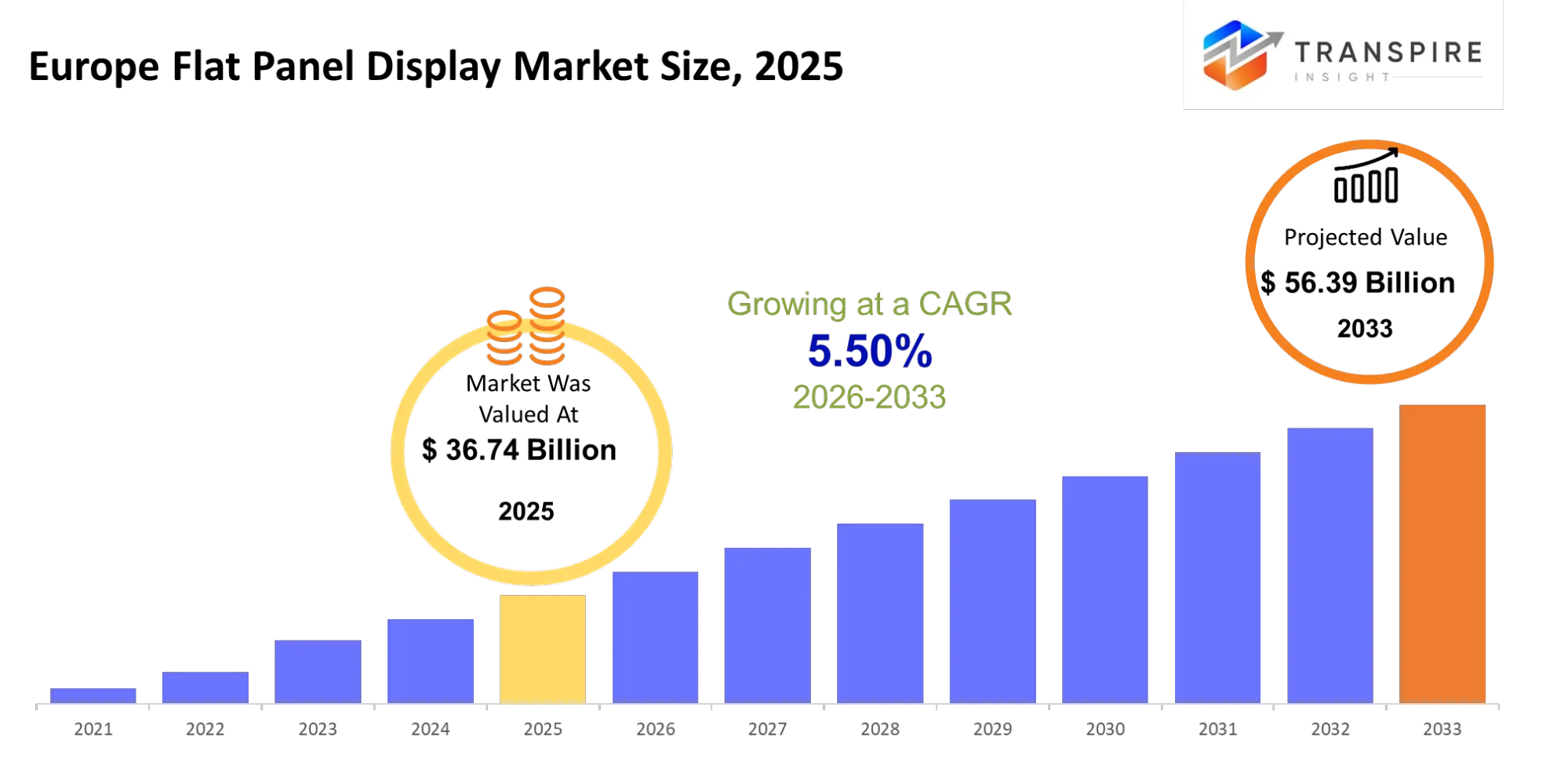
- Europe Flat Panel Display Market Size 2025: USD 36.74 Billion
- Europe Flat Panel Display Market Size 2033: USD 56.39 Billion
- Europe Flat Panel Display Market CAGR: 5.50%
- Europe Flat Panel Display Market Segments: By Type (LCD, OLED, LED, MicroLED, AMOLED, Others), By Application (TVs, Smartphones, Laptops, Automotive Displays, Wearables, Others), By End-User (Consumer Electronics, Automotive, Industrial, Healthcare, Others), By Size (Small, Medium, Large, Ultra-large, Others).
To learn more about this report,  Download Free Sample Report
Europe Flat Panel Display Market Summary:
The Europe Flat Panel Display Market size is estimated at USD 36.74 Billion in 2025 and is anticipated to reach USD 56.39 Billion by 2033, growing at a CAGR of 5.50% from 2026 to 2033. The Europe Flat Panel Display Market serves as the main hub for the region's digital hardware system which supports various applications including automotive dashboard display and industrial control display and medical imaging display and retail signage display and next-generation consumer electronics display. Flat panel displays fulfill an essential operational requirement because they provide high-resolution visual displays which consume low energy in small sizes that enable automation and real-time tracking and user interactive experiences in multiple business sectors.
The market has experienced a structural transformation during the last five years because manufacturers shifted their production methods from traditional LCD displays to OLED and Mini-LED technologies to meet their design goals of creating thinner products with reduced energy needs and improved display capabilities. Europe needed to rely on imported display parts which became evident when the semiconductor shortage affected global supply chains and Asian manufacturing operations experienced disruptions. The OEMs established new sourcing methods while increasing their investments to strengthen their local electronics manufacturing capabilities. The current market growth shows the effect of industrial digitalization which has made advanced displays essential components that businesses use to control productivity and mobility and smart device operations.
Key Market Insights
- Germany controlled almost 24% of the European Flat Panel Display Market during 2025 because of its strong automotive electronics industry and its industrial manufacturing capabilities.
- The forecast period showed France as the fastest-growing regional market because the country developed smart healthcare infrastructure and made investments in connected mobility.
- Western Europe maintained a major share of the regional market because consumers adopted advanced electronics and enterprises increased their spending on digital transformation.
- The growing manufacturing base of electronics assembly and automotive component production in Eastern Europe has created new requirements for industrial display panels.
- The Europe Flat Panel Display Market 2025 showed LCD panels as the leading display technology because they provide cost-effective solutions for businesses to use throughout their operations which led to their 48% market share.
- Premium smartphones and automotive dashboards together with high-resolution monitors have established OLED displays as the second largest market segment.
- Manufacturers will choose Mini-LED technology because it provides them with better brightness and energy efficiency and extended display lifespan which makes it the fastest growing segment until 2030.
- The market is expanding for flexible and foldable display technologies which manufacturers are using in both wearable electronics and upcoming consumer device products.
- The application demand for consumer electronics reached 41% market share during 2025 because consumers purchased smart TVs and gaming monitors and mobile devices.
- The automotive display systems sector experienced its highest growth rate because of three technologies: connected vehicle platforms and digital cockpits and electric vehicle dashboard systems.
- Manufacturing automation and logistics monitoring together with energy management systems saw strong adoption of industrial control panels.
What are the Key Drivers, Restraints, and Opportunities in the Europe Flat Panel Display Market?.
The Europe Flat Panel Display Market experiences its strongest growth because electric vehicles increasingly adopt digital cockpit systems and advanced human-machine interfaces. European automotive manufacturers shifted aggressively toward OLED and high-resolution display technologies after stricter vehicle safety and connectivity standards increased the importance of real-time driver information systems. Premium and mid-range EV models now use larger curved displays together with instrument clusters and infotainment panels as their unique design elements.The process increases display content per vehicle which results in higher component value and creates additional revenue streams for panel suppliers and integration partners.
The European Union gas market faces its biggest structural challenge because of its need to import semiconductor and display components from Asian countries. The production of advanced flat panel displays needs European countries to invest large capital amounts and establish dedicated manufacturing facilities and spend extended periods to complete their supplier qualification processes. The supply disruptions that occurred during the semiconductor shortages revealed this weakness which resulted in automotive production delays and electronics product launch postponements. European original equipment manufacturers who rely on imported panels experience both restricted short-term revenue growth and diminished capacity to set prices.
Industrial automation provides long-term business prospects which will benefit both Germany and all Central European countries. Modern factories need durable display systems which consume little power to support their robotic operations and machine surveillance and system maintenance forecasting. The development of Industry 4.0 infrastructure together with AI-powered manufacturing systems creates an ongoing need for robust industrial display solutions.
What Has the Impact of Artificial Intelligence Been on the Europe Flat Panel Display Market?
The Europe Flat Panel Display Market experiences transformation through artificial intelligence together with advanced digital technologies which enhance manufacturing accuracy and supply chain agility and device performance. Display manufacturers increasingly use AI-driven inspection systems to automate defect detection during OLED and LCD panel production. Computer vision algorithms identify microscopic pixel irregularities together with backlight inconsistencies and material contamination at a faster rate than manual inspection processes which decrease production waste and increase yield rates across high-volume fabrication lines.
Display manufacturing facilities use machine learning models to implement predictive maintenance systems. AI platforms process the operational datasets which semiconductor deposition equipment and robotic handling systems and cleanroom infrastructure produce to predict component failures before breakdowns occur. European electronics plants achieve measurable reductions in unplanned downtime and maintenance costs after implementing predictive analytics tools. AI-enabled display controllers dynamically adjust brightness together with refresh rates and power consumption to improve energy efficiency in automotive dashboards and smart TVs and industrial panels based on actual usage conditions.
The regional display ecosystem adopts advanced digital twins which enable manufacturers to test production scenarios and enhance throughput before they start actual production. The system still faces a major challenge because of its expensive integration requirements. European manufacturing facilities from the past continue to operate with disconnected automation systems which create high costs and technical difficulties for electronics suppliers who want to use AI technology.
Key Market Trends
- European automotive OEMs increased OLED dashboard integration after 2022 which enabled them to use displays as premium features that distinguished their electric and connected vehicle systems from competitors.
- Manufacturers adopted new sourcing methods after the semiconductor shortage because they wanted to decrease their reliance on East Asian display systems through regional supplier partnerships.
- Enterprise buyers selected Mini-LED technology in 2024 because they wanted to achieve industrial display systems that provided brighter output while using less energy and lasting for an extended period.
- German industrial automation companies increased their use of rugged displays for smart factory monitoring and robotics implementation by more than 20 percent since 2021.
- Samsung Electronics and LG Display expanded their European automotive partnerships to establish new supply agreements for next-generation cockpit display systems.
- European regulators implemented stricter energy efficiency requirements for consumer electronics which compelled manufacturers to develop display systems that consumed less power from 2023 onward.
- Health device manufacturers adopted lightweight screens from foldable and flexible display technologies which they used in portable diagnostic equipment during 2025.
- AI-powered defect inspection systems replaced manual quality checks in advanced panel fabrication facilities which led to consistent production yield improvements and reduced material waste.
- The retail and transportation sectors began to upgrade their digital signage systems in 2022 by replacing old display systems with modern interactive high-resolution commercial display networks.
- Chinese display suppliers used aggressive pricing and local partnerships to expand their operations in Europe which resulted in higher competitive pressure on existing premium display manufacturers.
Europe Flat Panel Display Market Segmentation
By Type
The established supply networks enable manufacturers to produce LCD displays at reduced expenses which permits LCD technology to remain the dominant display technology for manufacturing purposes across various product categories such as televisions and monitors and industrial equipment. The market for LED-backlit LCD panels continues to grow because manufacturers provide customers with products that deliver both superior performance and reasonable pricing in their mass-market electronic offerings. OLED displays achieve rapid growth within premium smartphones and automotive dashboards and high-end televisions because they deliver better contrast ratios and flexible design options and lower power usage.
The market adoption of AMOLED technology has increased for wearable devices and flagship mobile products because users prefer products that have slimmer designs and support higher refresh rates. MicroLED technology faces challenges in commercial adoption because its manufacturing process requires complex setup and results in expensive production costs, yet investors continue to show interest in making long-term financial commitments. Suppliers will increasingly compete through energy efficiency and display durability and manufacturing scalability as they work to protect their profit margins within premium visual technologies while remaining cost-effective for mainstream markets.

To learn more about this report, Download Free Sample Report
By Application
Televisions remain the largest application segment because replacement cycles, larger screen preferences, and smart entertainment ecosystems continue to support steady shipment demand across Europe. The major share of smartphone displays exists because manufacturers use OLED panels and foldable screens and higher refresh rates in their premium product portfolios. The field of automotive displays has become an expanding market because electric vehicle technology and connected mobility systems keep growing in adoption.
Digital instrument clusters, infotainment systems, and passenger displays now represent higher-value components within modern vehicles. The demand for laptops and tablets reached its current level because remote work requirements increased while enterprise refresh cycles continued to drive commercial purchasing.The market for wearable devices keeps growing because health monitoring and fitness tracking applications need compact, energy-efficient display technologies. The upcoming application growth will mainly depend on display technology that integrates into smart systems instead of relying on individual hardware capabilities, which will drive manufacturers to develop software-based and flexible display solutions.
By End-User
The consumer electronics market maintains its capacity to satisfy user needs through its distribution of highest shipment volumes together with annual replacement rates of televisions and smartphones and gaming systems and personal computing devices. The competitive environment between electronics companies drives them to develop display technologies which enhance refresh rates and resolution quality and energy efficiency. The end-user segment which grows fastest consists of automotive manufacturers who increase electric vehicle production throughout Germany and France and Nordic countries.Vehicle manufacturers now consider digital cockpit systems and interactive driver interfaces as essential components that will help them differentiate their products in the market.
The industrial sector demonstrates constant requirements for ruggedized displays which industrial users employ in factory automation and robotics and process monitoring applications that need dependable operational performance. The healthcare sector is growing because diagnostic imaging systems and portable medical devices need high-resolution visualization technology. Future funding patterns indicate that display suppliers will work more closely with equipment manufacturers in specific industries which need tailored visual interfaces that impact both productivity and user interactions.
By Size
The current display market experiences its highest shipment value through large displays because televisions and commercial signage systems and enterprise presentation screens need larger screens which provide better visual performance. Medium-sized panels maintain broad deployment across laptops, industrial monitors, and automotive systems where balance between portability and viewing performance remains important. Global competition creates intense pricing pressure for small-sized displays which manufacturers use in smartphones and wearable devices and handheld medical equipment.
Businesses today invest in immersive customer engagement technologies because these technologies drive the need for ultra-large displays which they use in advanced home entertainment systems and transportation centers and retail advertising networks. Future demand patterns will require display systems that use less material weight while maintaining complete visual performance and operational efficiency. Future market direction will lead to higher investment levels in flexible panel designs that support different display sizes through their scalable design. The display industry will achieve greater supply chain strength and long-term financial success through display manufacturers who enhance their production yield for all display sizes.
What are the Key Use Cases Driving the Europe Flat Panel Display Market?
European countries use flat panel displays primarily in consumer electronics with smart televisions and smartphones and gaming monitors being the main applications. Customers buy new products and upgrade to premium displays because they want screen resolution and energy efficiency and entertainment systems that work together.
Electric vehicle manufacturers are rapidly expanding their automotive applications by incorporating digital instrument clusters and infotainment systems and passenger displays into their connected mobility platforms. Industrial manufacturers are using rugged touch displays to control robotics and operate predictive maintenance systems and manage factory automation systems which use Industry 4.0 technologies.
Retail advertising currently employs transparent OLED displays while healthcare visualization and advanced engineering systems use augmented reality interfaces as their emerging use cases. European innovation hubs are currently using flexible and foldable display technologies in their development of wearable medical devices and next-generation portable computing devices.
|
Report Metrics |
Details |
|
Market size value in 2025 |
USD 36.74 Billion |
|
Market size value in 2026 |
USD 38.76 Billion |
|
Revenue forecast in 2033 |
USD 56.39 Billion |
|
Growth rate |
CAGR of 5.50% from 2026 to 2033 |
|
Base year |
2025 |
|
Historical data |
2021 - 2024 |
|
Forecast period |
2026 - 2033 |
|
Report coverage |
Revenue forecast, competitive landscape, growth factors, and trends |
|
Regional scope |
Europe (Germany, United Kingdom, France, Italy, Spain and Rest of Europe) |
|
Key company profiled |
Samsung Display, LG Display, BOE Technology, AU Optronics, Innolux, Sharp, Japan Display, Tianma, Visionox, E Ink, Panasonic, Sony, Philips, TCL, Hisense |
|
Customization scope |
Free report customization (country, regional & segment scope). Avail customized purchase options to meet your exact research needs. |
|
Report Segmentation |
By Type (LCD, OLED, LED, MicroLED, AMOLED, Others), By Application (TVs, Smartphones, Laptops, Automotive Displays, Wearables, Others), By End-User (Consumer Electronics, Automotive, Industrial, Healthcare, Others), By Size (Small, Medium, Large, Ultra-large, Others) |
Which Regions are Driving the Europe Flat Panel Display Market Growth?
The flat panel display industry in Western Europe reaches its highest point because automotive and industrial electronics and consumer technology sectors remain strong in Germany and France and the United Kingdom. The region achieves its current status through its advanced manufacturing capabilities and its businesses' high investments in automation and its energy-efficiency regulations which encourage users to adopt premium display systems. German automotive original equipment manufacturers now use OLED display technology for their electric vehicle manufacturing process because they plan to produce digital cockpit systems and dashboard displays in their production facilities. The combination of strong research networks and semiconductor partnerships and established electronics supply chains enables companies to develop new products and bring advanced display platforms to market more quickly.
Northern Europe represents the second-largest regional contributor, but growth dynamics differ from Western Europe because stability comes from technology modernization and consistent enterprise investment rather than large-scale manufacturing output. Finland and Sweden and Denmark show continuous demand for industrial displays and healthcare visualization systems and smart infrastructure solutions because their digital economies remain strong. The public and private sectors continue to create funding programs for automation enhancements and connected vehicle systems and energy management solutions which need long-lasting high-definition display systems. The display manufacturers that focus on specialized commercial and industrial applications find Northern Europe to be a dependable market because of its stable regulations and low market fluctuations.
Who are the Key Players in the Europe Flat Panel Display Market and How Do They Compete?
The current state of the European Flat Panel Display Market shows moderate consolidation because major Asian manufacturers control advanced panel production while European companies concentrate on combining their products with automotive and industrial systems. The competition between companies has shifted to technology innovation because customers now prefer OLED technology which offers better efficiency and flexible display options and advanced visual performance compared to standard low-cost panels. The existing manufacturers maintain their market dominance by using automotive supply agreements which last for several years together with their unique production methods and their research into future display technologies. The Chinese panel manufacturers are changing the price system for standard LCD products which compels their rivals to enhance their premium offerings and form strategic partnerships in different markets.
Samsung Electronics uses its strong dedication to developing OLED and QD-OLED technology which focuses on high-end television systems and gaming displays and automotive display solutions as its market advantage. The company establishes a stronger position in European markets through its partnerships with automotive original equipment manufacturers and its development of AI-based image optimization technology for premium display products. LG Display invests massive resources into developing OLED technology for large screens and transparent displays which create innovative solutions for retail signage and mobility systems and commercial visualization needs. The company's strong ability to produce large-format OLED products gives them a competitive edge for their high-end entertainment systems and digital signage solutions.
BOE Technology Group uses its cost-effective LCD and OLED manufacturing capabilities which rely on its extensive production facilities and its aggressive drive to establish European partnerships as its primary competitive strength.
Company List
- Samsung Display
- LG Display
- BOE Technology
- AU Optronics
- Innolux
- Sharp
- Japan Display
- Tianma
- Visionox
- E Ink
- Panasonic
- Sony
- Philips
- TCL
- Hisense
Recent Development News
In May 2026, Samsung Display Showcases Next-Gen OLED at SID Display Week 2026: Samsung Display unveiled its latest OLED and flat-panel technologies at SID Display Week 2026 in Los Angeles, with strong relevance to the European flat-panel ecosystem through its AI-driven display roadmap and export supply chain to EU TV/monitor brands. Key highlights include 3,000-nit OLED panels, Sensor OLED integration, and EL-QD next-gen display prototypes, which are expected to enter global (including European) TV and signage supply chains.
Source: https://global.samsungdisplay.com
In February 2026, Samsung Launches Glasses-Free 3D Digital Signage: At ISE 2026 in Spain (Europe’s largest display exhibition), Samsung launched its glasses-free 3D Spatial Signage displays, targeting European commercial display markets including retail, transport hubs, and digital advertising. This marks a key flat-panel expansion in Europe for immersive display technology used in public and commercial environments.
Source: https://news.samsung.com
What Strategic Insights Define the Future of the Europe Flat Panel Display Market?
The Europe Flat Panel Display Market is moving to develop display systems which meet specific application needs because of their greater value instead of producing standard display panels in bulk. The upcoming five to seven years will see growth majorly driven by automotive digital cockpits and industrial automation interfaces plus medical visualization systems and AI-enabled smart devices which depend on display performance for their essential operational and user functions. The transition to advanced OLED and Mini-LED and low-power display systems stems from Europe’s digital industrialization strategy and its requirements for energy-efficient technologies.
The hidden danger arises from our increasing need to rely on specific materials and semiconductor components which we must import from non-European countries. The ongoing geopolitical conflicts together with export bans on rare earth elements and display glass and semiconductor manufacturing tools will result in price fluctuations and production delays for the entire supply chain during times of high demand.
The growth of transparent and flexible OLED displays presents a new opportunity for smart retail systems and mobility infrastructure development in Western European cities. Market participants should establish technology ties with regional partners while creating local production facilities to protect their supply chains and gain access to specialized industrial and automotive contracts.
Europe Flat Panel Display Market Report Segmentation
By Type
- LCD
- OLED
- LED
- MicroLED
- AMOLED
- Others
By Application
- TVs
- Smartphones
- Laptops
- Automotive Displays
- Wearables
- Others
By End-User
- Consumer Electronics
- Automotive
- Industrial
- Healthcare
- Others
By Size
- Small
- Medium
- Large
- Ultra-large
- Others
Frequently Asked Questions
Find quick answers to common questions.
The approximate Europe Flat Panel Display Market size for the market will be USD 56.39 Billion in 2033.
The key segments of the Europe Flat Panel Display Market are By Type (LCD, OLED, LED, MicroLED, AMOLED, Others), By Application (TVs, Smartphones, Laptops, Automotive Displays, Wearables, Others), By End-User (Consumer Electronics, Automotive, Industrial, Healthcare, Others), By Size (Small, Medium, Large, Ultra-large, Others).
Major players in the Europe Flat Panel Display Market are Samsung Display, LG Display, BOE Technology, AU Optronics, Innolux, Sharp, Japan Display, Tianma, Visionox, E Ink, Panasonic, Sony, Philips, TCL, Hisense.
The current market size of the Europe Flat Panel Display Market is USD 36.74 Billion in 2025.
The Europe Flat Panel Display Market CAGR is 5.50%.
- Samsung Display
- LG Display
- BOE Technology
- AU Optronics
- Innolux
- Sharp
- Japan Display
- Tianma
- Visionox
- E Ink
- Panasonic
- Sony
- Philips
- TCL
- Hisense
Recently Published Reports
-
Apr 2026
Fiber Optic Faceplates Market
Fiber Optic Faceplates Market Size, Share & Analysis Report By Type (< 300 mm2, 300-350 mm2, and > 350 mm2, By Application (Night Vision, Holographic Imaging, Medical, and Others), and Geography (North America, Europe, Asia-Pacific, Middle East and Africa, South and Central America), 2021 - 2031
-
Apr 2026
High Temperature Superconductors Market
High Temperature Superconductors Market Size, Share & Analysis Report By Type (1G HTS, and 2G HTS), By Application (Power Cable, Fault Current Limiter, and Transformer), and Geography (North America, Europe, Asia-Pacific, Middle East and Africa, South and Central America), 2021 - 2031
-
Apr 2026
Industrial Plugs and Socket Market
Industrial Plugs and Socket Market Size, Share & Analysis Report By Type (Industrial Plugs, Industrial Sockets), By Current (Up to 32 A, 32 to 125 A, Above 125 A), By Protection (Dustproof and Splash Proof, Waterproof, Explosion Proof), By End User (Heavy Industries, Oil and Gas, Chemicals and Pharmaceuticals, Power Generation, Others), and Geography (North America, Europe, Asia-Pacific, Middle East and Africa, South and Central America), 2021 - 2031
-
Apr 2026
InGaAs Avalanche Photodiodes Market
InGaAs Avalanche Photodiodes Market Size, Share & Analysis Report By Type (1100 - 1700 nm, and 1000 - 1600 nm), By Application (Missile Warning System, Muzzle Flash Detection, Wafer Defect Inspection, Laser Rangefinders, and Others), and Geography (North America, Europe, Asia-Pacific, Middle East and Africa, South and Central America), 2021 - 2031