

Asia Pacific Multi Junction Solar Cell Market Size & Forecast:
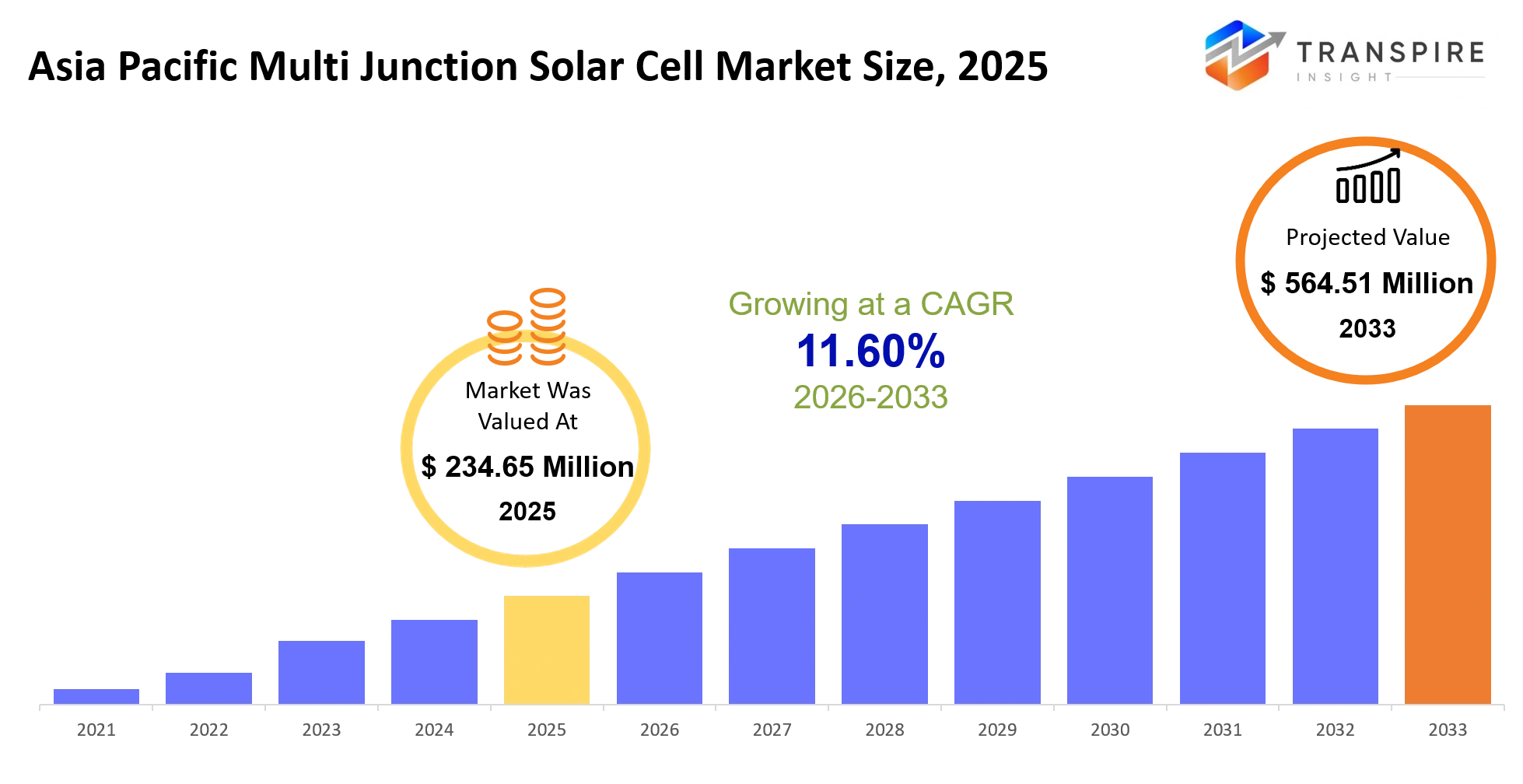
- Asia Pacific Multi Junction Solar Cell Market Size 2025: USD 234.65 Million
- Asia Pacific Multi Junction Solar Cell Market Size 2033: USD 564.51 Million
- Asia Pacific Multi Junction Solar Cell Market CAGR: 11.60%
- Asia Pacific Multi Junction Solar Cell Market Segments: By Product Type (Dual Junction Solar Cells, Triple Junction Solar Cells, Quad Junction Solar Cells, Others); By Application (Space Applications, Defense Systems, Concentrated Photovoltaics, Others); By End User (Space Agencies, Defense Sector, Solar Manufacturers, Others).
To learn more about this report,  Download Free Sample Report
Asia Pacific Multi Junction Solar Cell Market Summary
The Asia Pacific Multi Junction Solar Cell Market was valued at USD 234.65 Million in 2025. It is forecast to reach USD 564.51 Million by 2033. That is a CAGR of 11.60% over the period.
Across Asia Pacific, multi-junction solar cells power high efficiency generation, where space is kind of tight and performance matters a lot, like on satellites , high altitude platforms , defense systems, and now even more, early concentrated photovoltaic industrial setups. These cells take in a broader slice of daylight and turn it into electricity, so they can keep a steady output in harsh or faraway places, where regular silicon panels tend to lag.
Over the last 3 to 5 years, the market sort of moved away from mostly aerospace demand and toward early terrestrial… and hybrid uses, especially tandem structures that pair perovskite with silicon. This change has been pushed harder by government space initiatives in China , India, and Japan, plus stronger energy security goals after the global supply chain issues during the pandemic era.
Export controls on advanced semiconductor materials and the growing manufacturing incentives have also sped up local production. So adoption is no longer only for niche space missions, it’s reaching more strategic industrial energy programs, which helps scalability and backs higher margin commercialization routes across the region.
Key Market Insights
- In 2025, Asia Pacific will grab roughly 38% of the Asia Pacific Multi Junction Solar Cell Market share, but it is basically led by China’s solid space plus semiconductor manufacturing ecosystem.
- China is dominating the regional demand , because it runs large scale satellite launches and also defense driven solar power integration programs.
- Meanwhile India looks like the fastest-growing market through 2030, shaped by ISRO missions and the steady expansion of a commercial space ecosystem.
- When it comes to technology, triple-junction solar cells take the lead in the Asia Pacific Multi Junction Solar Cell Market with more than 55% share, mostly due to superior conversion efficiency when used for space.
- Tandem perovskite-silicon cells sit in second place, and they are gaining momentum in early commercial roll out phases.
- For growth speed, III-V compound semiconductor cells look like the fastest-growing segment through 2026–2030, driven by efficiency breakthroughs and better performance.
- On the application side, defense and high altitude UAV systems are the fastest-growing, expanding quickly through 2030.
- Concentrated photovoltaic industrial systems stay a smaller, still emerging niche , but pilot installations are rising.
- And government space agencies hold nearly 50% share in the Asia Pacific Multi Junction Solar Cell Market, tied to ongoing satellite deployment programs.
- As an end-user group, commercial satellite operators are moving the fastest, backed by private space exploration investments, and that seems to keep accelerating.
What are the Key Drivers, Restraints, and Opportunities in the Asia Pacific Multi Junction Solar Cell Market?
The main growth driver is basically the rapid spread of satellite constellations and space exploration programs across China, India, and Japan. Government backed missions and private launch activity have, more or less, increased the appetite for high-efficiency multi-junction solar cells that can deliver stable power even in radiation-heavy orbital surroundings. This shift came after a meaningful cost threshold improvement in III-V semiconductor fabrication, which reduced the per-watt production costs , and it also made broader procurement cycles possible. Since mission frequency keeps climbing, long term supply arrangements are getting wider, and that directly strengthens revenue visibility for manufacturers in the Asia Pacific Multi Junction Solar Cell Market.
Even with strong momentum, the market still sits behind a few hard limits—mainly extremely high manufacturing complexity and a dependency on specialized materials such as gallium arsenide substrates. These inputs are facing limited global supply concentration, so production becomes vulnerable to export restrictions and pricing upswings. And this kind of structural bottleneck is not something you fix quickly, because scaling epitaxial growth processes needs capital intensive infrastructure and long certification timeframes, especially for space grade reliability. So commercialization outside aerospace stays sluggish, which then suppresses wider revenue diversification.
A big forward-looking opening is tandem perovskite–multi junction integration for ground based concentrated photovoltaics. Pilot deployments in Japan and Australia are showing high-efficiency hybrid modules for industrial energy parks. If scalability improves even more, this could create a new commercial segment beyond satellites, and that would expand the addressable base for the Asia Pacific Multi Junction Solar Cell Market quite substantially.
What Has the Impact of Artificial Intelligence Been on the Asia Pacific Multi Junction Solar Cell Market?
Artificial intelligence, plus newer digital techs, are slowly… but increasingly, reshaping production, testing, and even the whole in-orbit performance management vibe inside the Asia Pacific Multi Junction Solar Cell Market. Especially, when we talk about space-grade and high-efficiency photovoltaic ecosystems.
In the manufacturing world, AI-powered automation is now being used in epitaxial growth routines like MOCVD, yes metal-organic chemical vapor deposition, to nudge layer composition in real time, kinda “on the fly” . At the same time, computer vision systems are spotting tiny wafer defects with more steady results than human inspection, so yield goes up, and there is less material wasted in the III-V compound semiconductor lines. And because of those day-to-day gains, throughput improves , while per-unit production costs come down, which makes the whole commercialization part feel more achievable across the Asia Pacific Multi Junction Solar Cell Market.
Then there are predictive analytics models that help estimate equipment wear-and-tear, and they also help organize maintenance for those high-precision deposition chambers. The goal is to cut the annoying unplanned downtime, so fabrication line uptime stays higher. For satellites, machine learning routines comb through telemetry data to anticipate power output degradation under radiation exposure, which makes mission energy planning more exact, and it also helps extend the working lifespan of space assets.
Still, the adoption story is not smooth sailing: it is held back by a lack of high-quality training datasets and by the expensive effort required to integrate AI systems into these ultra-specialized semiconductor manufacturing setups. Those problems stall broader scaling, and it hits smaller manufacturers hardest, especially those without the right digital infrastructure.
So overall, AI is lifting efficiency, boosting reliability, and keeping cost control tighter, but uneven digital maturity around the region keeps things from fully transforming everywhere at the same pace.
Key Market Trends
- Since 2022, the satellite program expansion has kinda bumped up procurement of triple junction cells , and that has shifted demand away from the old single-junction space solar approach . In other words it’s like the market slowly decided to move on, with less emphasis on legacy tech, even if the transition wasn’t instant.
- China’s 2023–2025 localization push cut imported III-V material dependence by almost 18%, which in turn improved domestic production resilience across the Asia Pacific Multi Junction Solar Cell market. Basically, less reliance on outside inputs, more control inside the region.
- After 2023, India also expanded ISRO and private launch partnerships, and this sped up adoption of high-efficiency multi-junction panels for low-Earth orbit satellite constellations. The timing mattered, because new launches needed more reliable power conversion quickly.
- Meanwhile, tandem perovskite-silicon prototypes went from lab scale to pilot testing in Japan by 2024, which is kind of a sign of early diversification beyond the classic compound semiconductor architectures.
- Also, in 2022, export restrictions on gallium arsenide materials tightened, and that pushed manufacturers like AZUR SPACE Solar Power to juggle, diversify, and restructure their regional supply chains.
- Between 2023–2025, AI enabled fabrication monitoring showed up , and it improved wafer defect detection accuracy by more than 20%. That helped reduce yield losses in those expensive deposition processes, so less waste overall.
- On the defense side, UAV energy systems in South Korea and Japan increased demand for lightweight multi-junction modules, so application priorities shifted after 2023, even if the drivers were practical and urgent.
- In 2024, commercial satellite operators leaned into longer procurement contracts , replacing short-term buys with multi-year supply agreements for stable orbital power systems. That change basically made planning easier for everyone involved.
- Finally, manufacturing investment moves by companies like Sharp Corporation and LONGi Green Energy Technology accelerated regional capacity scaling between 2023 and 2025, and the expansion kept building from there.
Asia Pacific Multi Junction Solar Cell Market Segmentation
By Product Type:
Dual junction solar cells basically use two semiconductor layers to grab sunlight and turn it into usable energy, with an efficiency and price balance that works out in practice. They stay a solid choice for straightforward space missions and for situations where output needs to be steady, not just peak. Adoption keeps moving forward especially where money control is more important than squeezing out the absolute maximum efficiency.
Triple junction solar cells, though, tend to lead in real use because they reach higher conversion efficiency by working across multiple light spectra. Quad junction and other newer designs are still being refined, and they are usually in those early adoption phases. That’s mainly where the mission is specialized, needing maximum power output, and also having limited space for the hardware.
By Application:
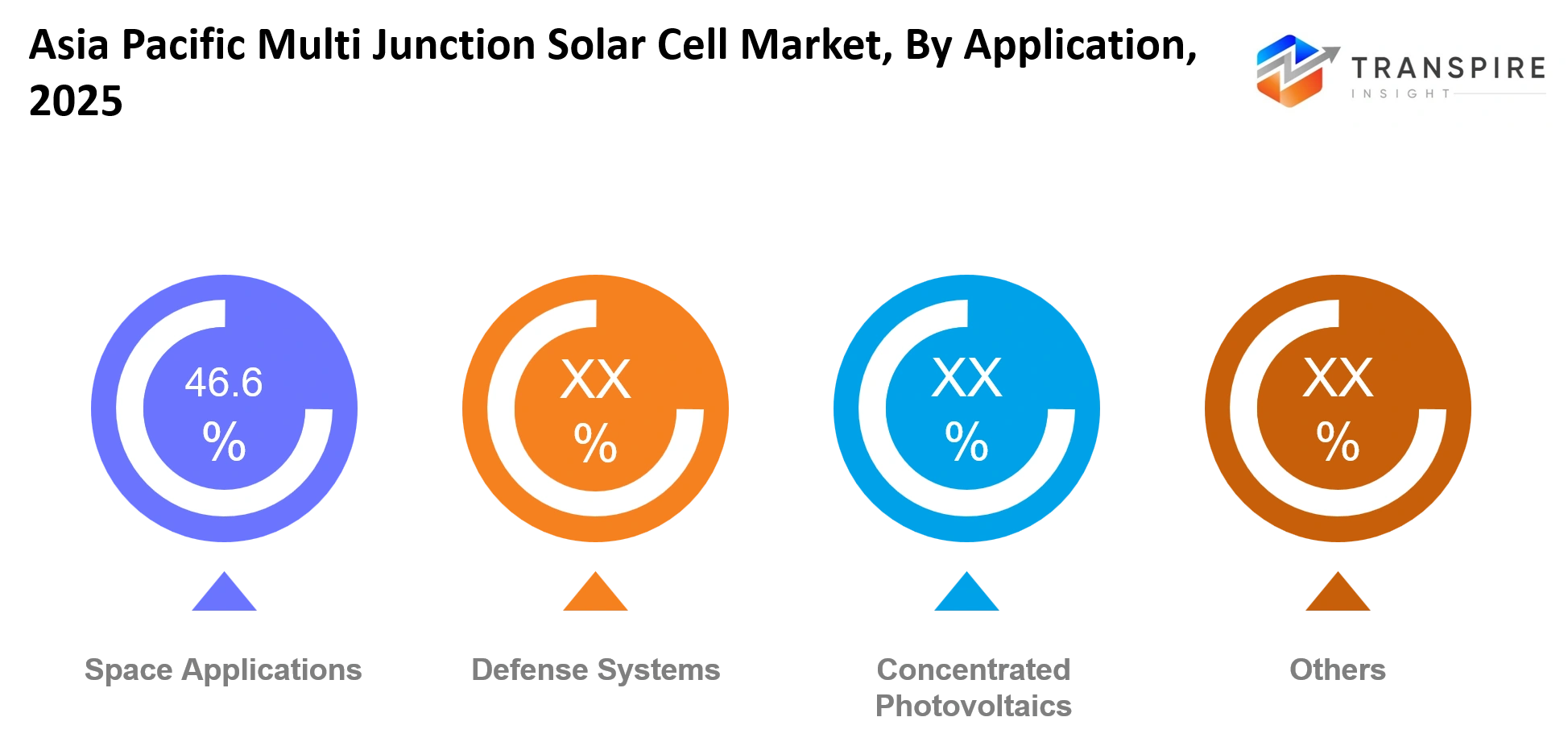
In space they show up a lot in satellites and orbital systems, where reliable power is required while facing harsh radiation conditions. The demand has gone up in recent years, partly because satellite launches have increased across multiple regional space programs.
For defense systems, these cells are used in UAVs and surveillance platforms, since they need something lightweight but dependable for power. Concentrated photovoltaics then take a similar idea, using high-efficiency cells for industrial energy generation, and additional applications can include experimental high-altitude projects, plus research-based energy efforts.
To learn more about this report, Download Free Sample Report
By End User:
Space agencies still count as the main buyers, deploying these cells in satellite missions and exploratory programs that have long life requirements and high energy reliability. In the last few years, procurement has shifted more toward long-term supply agreements, not just short buys.
Defense adoption also keeps rising with stronger demand for advanced monitoring and unmanned systems. Solar manufacturers use multi-junction technology for research and development, while other groups like research institutes and commercial space operators focus on next generation energy systems, mostly as a way to stay ahead on performance.
What are the Key Use Cases Driving the Asia Pacific Multi Junction Solar Cell Market?
The strongest demand in the Asia Pacific Multi Junction Solar Cell market is in the domain of satellite power systems, where multi junction cells output an efficient level of power in high-radiation orbit. Reliability and longevity are the prime demands of space agencies utilizing communications and earth observation satellites.
Wider adoption can be seen in defense UAV platforms and security agencies utilizing high altitude surveillance systems, in addition to industrial solar experiments focusing on concentrated PV and high-efficiency cell application to optimize power generation in restricted space.
The latest emerging application domains are within lunar missions, deep space exploration and orbital servicing, and early stage tandem cell development for upcoming spacecraft requiring increased power output for long endurance exploratory missions.
|
Report Metrics |
Details |
|
Market size value in 2025 |
USD 234.65 Million |
|
Market size value in 2026 |
USD 261.86 Million |
|
Revenue forecast in 2033 |
USD 564.51 Million |
|
Growth rate |
CAGR of 11.60% from 2026 to 2033 |
|
Base year |
2025 |
|
Historical data |
2021 - 2024 |
|
Forecast period |
2026 - 2033 |
|
Report coverage |
Revenue forecast, competitive landscape, growth factors, and trends |
|
Regional scope |
Asia Pacific (India, China, Japan, Australia,South Korea, Rest of Asia Pacific) |
|
Key company profiled |
Spectrolab, AZUR SPACE Solar Power, SolAero Technologies, Sharp Corporation, Boeing, Emcore, MicroLink Devices, CESI, Fraunhofer ISE, Mitsubishi Electric, Hanwha Q CELLS, SunPower, First Solar, JinkoSolar, Trina Solar. |
|
Customization scope |
Free report customization (country, regional & segment scope). Avail customized purchase options to meet your exact research needs. |
|
Report Segmentation |
By Product Type (Dual Junction Solar Cells, Triple Junction Solar Cells, Quad Junction Solar Cells, Others); By Application (Space Applications, Defense Systems, Concentrated Photovoltaics, Others); By End User (Space Agencies, Defense Sector, Solar Manufacturers, Others). |
Which Regions are Driving the Asia Pacific Multi Junction Solar Cell Market Growth?
China is the leading region within the Asia Pacific Multi Junction Solar Cell Market. China has very well-integrated space programs, semiconductor manufacturing industry and substantial state-supported investments. Long-term demand for high-value multi-junction solar cells is generated by national space programs for deployment of satellites, which are launched in very large volumes and steadily. With a sophisticated III-V materials supply chain and established fabrication clusters such as Beijing, Shanghai and so forth,China'sconsistent output is well-supported.
This self-contained ecosystem minimizes external dependencies and increases the durability of output. Japan remains a stable but strong player, backed up by its technologically driven industrial infrastructure, and sustained, long-term investments in high-efficiency PV research and development. This market is not driven by satellite volumes, as demand is dominated by high-accuracy engineering criteria and continued investment in R & D.Companies and research organizations focus on increasing the reliability and improving the performance of multi-junction and tandem solar technologies. Thus,Japan follows a slower, steadier growth trend compared with China. India shows the quickest market growth, driven by expansion in ISRO space missions and growing private sector space sector participation.
Investment in space infrastructure, satellite communications, and related applications has led to an acceleration in demand for high-efficiency PV technologies. Supported by increasing focus on space commercialization policy,India is showing growth due to the establishment of new private participants and collaborative partnerships in advanced PV. High potential opportunity for long-term contracts between 2026 and 2033.
Who are the Key Players in the Asia Pacific Multi Junction Solar Cell Market and How Do They Compete?
There is a moderately consolidated market structure in the Asia Pacific Multi Junction Solar Cell Market at the high performance level, especially in aerospace. At the emergent terrestrial and hybrid space, it is a bit fractured and technology focused ( radiation resistance, certification process, technological accuracy), rather than pricing, which is very key in space-grade deployment. Long qualification cycles allow for the stable presence of existing players. New entrants need the high-end III-V fabrication capacity or government affiliated contract to break in.
Spectrolab fortifies its standing with a tight relationship with the defense and aerospace industries and high efficiency multijunction for long life satellite orbit. AZUR SPACE Solar Power differentiates with its strength of III-V compounds and stable supply with European and Asia Pacific space missions. Sharp Corporation taps into its long term collaboration and relationship with agencies like JAXA by offering high reliability solar solutions for reliable orbital operation. Panasonic also works on the module with the key words of durability, tested in orbit and gradual efficiency improvement.
LONGi Green Energy Technology boost competition through research and development of tandem perovskite-silicon cells to close the efficiency gap between space grade and terrestrial cell. First Solar will take on the future path with development of high efficiency PV for hybrid application beyond thin film. Strategic expansion is carried out through partnership with research institutes, material development projects, and establishment of its presence in the manufacturing supply chain in Asia Pacific to assure its future long term stake.
Company List
- Spectrolab
- AZUR SPACE Solar Power
- SolAero Technologies
- Sharp Corporation
- Boeing
- Emcore
- MicroLink Devices
- CESI
- Fraunhofer ISE
- Mitsubishi Electric
- Hanwha Q CELLS
- SunPower
- First Solar
- JinkoSolar
- Trina Solar
Recent Development News
In January 2026, JinkoSolar entered into a strategic partnership with XtalPi. The collaboration focuses on AI-driven high-throughput R&D for perovskite–crystalline silicon tandem solar cells, aiming to accelerate development of high-efficiency multi-junction architectures through automated experimentation and data-driven materials discovery.
Source: https://www.pv-magazine.com/
In April 2026, Trina Solar, JA Solar, and JinkoSolar launched China’s first TOPCon-focused photovoltaic patent pool. The initiative strengthens intellectual property coordination for advanced tandem and high-efficiency solar cell technologies, helping reduce licensing friction across next-generation multi-junction PV development.
Source: https://www.pv-magazine-australia.com/
What Strategic Insights Define the Future of the Asia Pacific Multi Junction Solar Cell Market?
In the next 5 to 7 years, the market for Multi Junction Solar Cells in the APAC region will shift towards increasingly closer coupling between space-grade performance criteria and early-stage commercial terrestrial production, thanks to rapid growth in satellite installation volumes and advancement in the manufacturability of both III-V and tandem cells. Power system demand is expected to heavily lean towards high-reliability systems for low-earth-orbit constellations, and defense-tied aerospace applications, creating demand pressure on manufacturers towards vertically integrated supply chains, and localized production facilities.
A lesser visible risk includes the concentration of materials dependencies. Specifically, those which rely on gallium arsenide and indium-based compounds, as the blockage of these materials through export control constraints or fragmentation of global semiconductor supply chain could threaten the robustness of the supply chain and significantly extend qualification processes-despite steady demand.
One emergent opportunity arises from the utilization of multi-junction architectures in terrestrial concentrated PV in hybrid space-to-earth applications via pilot parks (Japan, Australia), as they could generate a second stream of demand besides aerospace applications if the increase in efficiency can offset the increase in costs through massive deployment. Stakeholders are expected to focus on joint-development partnerships with space agencies and semiconductor manufacturers to acquire early access to the latest tandem and III-V integration technologies.
Asia Pacific Multi Junction Solar Cell Market Report Segmentation
By Product Type
- Dual Junction Solar Cells
- Triple Junction Solar Cells
- Quad Junction Solar Cells
By Application
- Space Applications
- Defense Systems
- Concentrated Photovoltaics
By End User
- Space Agencies
- Defense Sector
- Solar Manufacturers
Frequently Asked Questions
Find quick answers to common questions.
The Asia Pacific Multi Junction Solar Cell Market size is USD 564.51 Million in 2033.
Key segments for the Asia Pacific Multi Junction Solar Cell Market are By Product Type (Dual Junction Solar Cells, Triple Junction Solar Cells, Quad Junction Solar Cells, Others); By Application (Space Applications, Defense Systems, Concentrated Photovoltaics, Others); By End User (Space Agencies, Defense Sector, Solar Manufacturers, Others).
Major Asia Pacific Multi Junction Solar Cell Market players are Spectrolab, AZUR SPACE Solar Power, SolAero Technologies, Sharp Corporation, Boeing, Emcore, MicroLink Devices, CESI, Fraunhofer ISE, Mitsubishi Electric, Hanwha Q CELLS, SunPower, First Solar, JinkoSolar, Trina Solar.
The Asia Pacific Multi Junction Solar Cell Market size is USD 234.65 Million in 2025.
The Asia Pacific Multi Junction Solar Cell Market CAGR is 11.60% from 2026 to 2033.
- Spectrolab
- AZUR SPACE Solar Power
- SolAero Technologies
- Sharp Corporation
- Boeing
- Emcore
- MicroLink Devices
- CESI
- Fraunhofer ISE
- Mitsubishi Electric
- Hanwha Q CELLS
- SunPower
- First Solar
- JinkoSolar
- Trina Solar
About the Authors

Avinash Kumar
I’m Avinash Kumar, a Senior Research Analyst at Transpire Insight, with expertise in the Electronics and Semiconductor and Energy & Power industry. My work focuses on analyzing emerging technologies, market trends, industry developments, and innovation across these sectors. I specialize in transforming complex technical and market insights into clear, research-backed content that helps professionals, businesses, and decision-makers stay informed. Through continuous industry research and data-driven analysis, I strive to deliver accurate, reliable, and practical perspectives on the latest advancements shaping the semiconductor and energy landscape.

Chakradhar Khansole
Chakradhar serves as the Research Director at Transpire Insight, bringing over 8 years of experience in technology, innovation, and strategic market intelligence. He specializes in transforming complex market data into actionable business insights that enable organizations to make informed, growth-oriented decisions. Recognized for his strategic vision and analytical expertise, Chakradhar leads high-impact research initiatives, delivering comprehensive market assessments, competitive intelligence, and forward-looking industry analysis.
Recently Published Reports
-
Apr 2026
Active Power Filter Market
Active Power Filter Market Size, Share & Analysis Report By Type (Shunt Active Power Filters, Series Active Power Filter, Hybrid Active Power Filter), By Application (Harmonics Mitigation, Reactive Power Compensation, Voltage Regulation, Power Factor Correction), By Phase (Single Phase, Three Phase), By End-User Industry (Manufacturing, Healthcare, Commercial, Automotive, Oil and Gas, Others), and Geography (North America, Europe, Asia-Pacific, Middle East and Africa, South and Central America), 2021 - 2031
-
Apr 2026
Electrical Transformer Market
Electrical Transformer Market Size, Share & Analysis Report By Core (Closed, Shell, and Berry), By Insulation (Gas, Oil, Solid, Air, and Other), By Phase (Single, and Three), By Rating (100 MVA to 500 MVA, 501 MVA to 800 MVA, and 801 MVA to 1200 MVA), and Geography (North America, Europe, Asia-Pacific, Middle East and Africa, South and Central America), 2021 – 2031
-
Apr 2026
Hydraulic Piston Pumps Market
Hydraulic Piston Pumps Market Size, Share & Analysis Report By Type (Axial Piston Pumps, Radial Piston Pumps), By Operating Pressure (Low Pressure, Medium Pressure, High Pressure), By Application (Construction, Mining, Agriculture, Automotive, Oil & Gas, Industrial Machinery, Others), By End-User (OEMs, Aftermarket), and Geography (North America, Europe, Asia-Pacific, Middle East and Africa, South and Central America), 2021 – 2031
-
Apr 2026
Laboratory Gas Generators Market
Laboratory Gas Generators Market Size, Share & Analysis Report By Product (Nitrogen Gas Generator, Hydrogen Gas Generator, Zero Air Gas Generator, Purge Gas Generator, TOC Gas Generators, Others), By Application (Gas Chromatography, Liquid Chromatography-mass Spectrometry (LC-MS), Gas Analyzers, Others), By End-user (Life Science, Chemical & Petrochemical, Food & Beverage, Others), and Geography (North America, Europe, Asia-Pacific, Middle East and Africa, South and Central America), 2021 – 2031