
South Korea Dye Sensitized Solar Cell Dssc Market Size & Forecast:
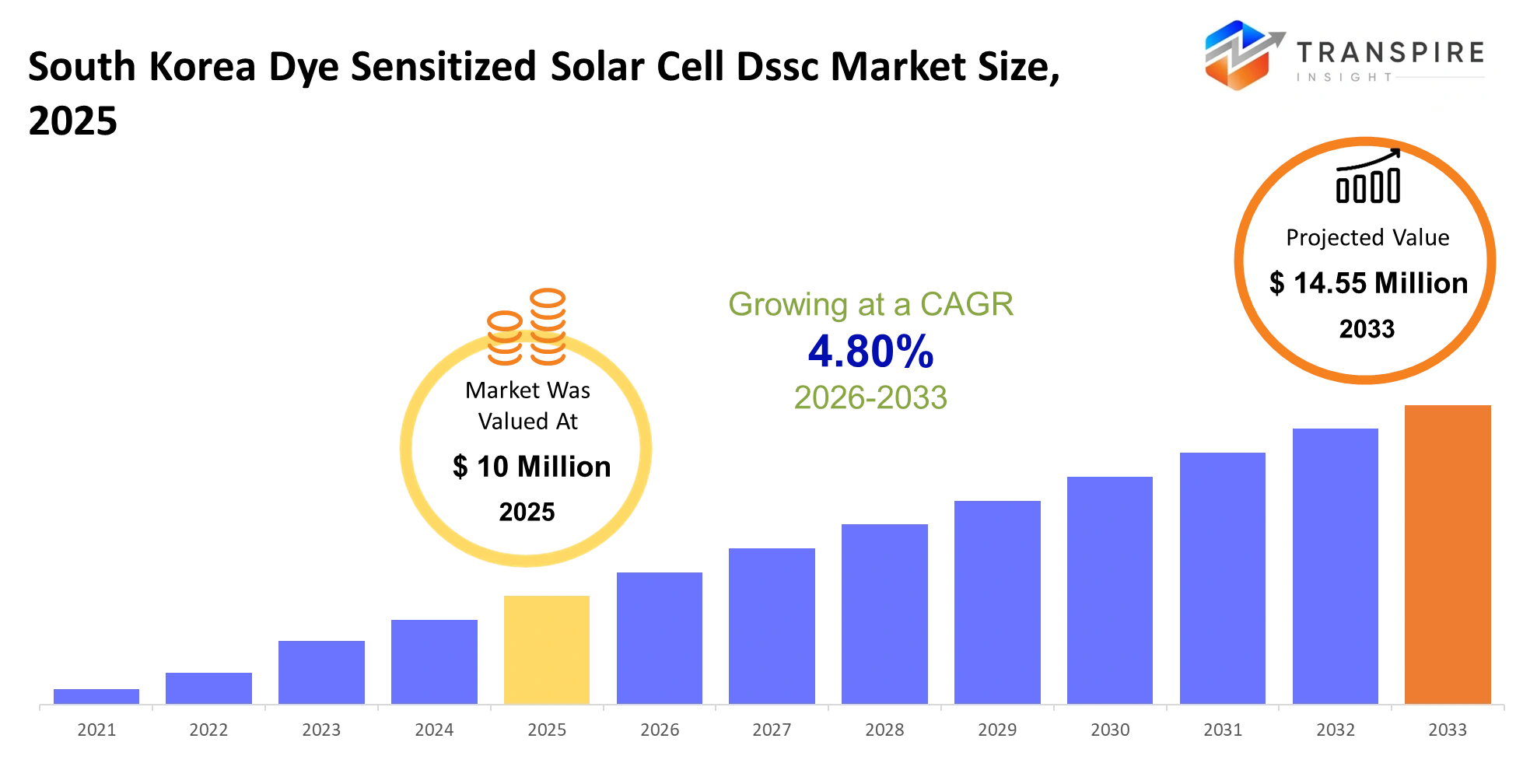
- South Korea Dye Sensitized Solar Cell Dssc Market Size 2025: USD 10 Million
- South Korea Dye Sensitized Solar Cell Dssc Market Size 2033: USD 14.55 Million
- South Korea Dye Sensitized Solar Cell Dssc Market CAGR: 4.80%
- South Korea Dye Sensitized Solar Cell Dssc Market Segments: By Type (Liquid Electrolyte, Solid State, Hybrid, Flexible), By Application (Consumer Electronics, Building Integrated PV, Wearables, Automotive), By End-User (Electronics Firms, Energy Companies, Research Institutes, OEMs).
To learn more about this report,  Download Free Sample Report
South Korea Dye Sensitized Solar Cell Dssc Market Summary:
South Korea Dye Sensitized Solar Cell Dssc Market size was estimated at USD 10 Million in 2025 and is anticipated to reach USD 14.55 Million by 2033, growing at a CAGR of 4.80% from 2026 to 2033.
The South Korea dye sensitized solar cell dssc market develops through its operations in the advanced renewable energy and next-generation photovoltaic sectors because its research work and design flexibility will determine its future development. These cells attract urban applications because their lightweight design and their ability to work in low light conditions make them suitable for portable electronic devices which differentiates them from standard silicon panels. South Korean consumers will demand architectural energy solutions that match their lifestyle needs, which will lead manufacturers to develop products that offer different color options and transparent designs and blend into their surroundings.
The laboratory advancements will progress toward commercial use as local research institutions and companies develop methods to boost product stability and performance efficiency. The South Korean government will establish distributed energy systems as the preferred method for energy distribution through its support of building and smart device pilot programs. The upcoming environmental standards will establish new requirements for material selection and production processes. The demand for energy solutions will increase because digital lifestyles need solutions that operate silently throughout daily activities without occupying space or creating visual disturbances.
Key Market Trends & Insights:
- The South Korea Dye Sensitized Solar Cell Dssc Market demonstrates rising interest in flexible solar technologies, which enable developers to create solar solutions for wearable devices and portable electronics and curved surfaces. The design-oriented industries demonstrate increasing demand for compact energy solutions that require minimal weight while delivering high efficiency and visual appeal.
- The South Korea Dye Sensitized Solar Cell Dssc Market demonstrates consistent financial commitment to research advanced materials which will enhance energy conversion efficiency and material durability. Researchers at academic institutions and industrial laboratories study new textile dyes and electrolytes and semiconductor structures to solve performance issues while extending operational capability across different environmental conditions.
- The South Korea Dye Sensitized Solar Cell Dssc Market advantages from increasing adoption of solar technologies, which building structures now use for Windows and building facades. The urban construction industry shows rising interest in transparent and semi-transparent DSSC panels, which produce energy while preserving building design and natural light access in contemporary infrastructure projects.
- The South Korea Dye Sensitized Solar Cell Dssc Market gains momentum from policy frameworks encouraging renewable energy adoption. The financial incentives and research grants together with clean energy targets create a major impact on the deployment of alternative solar technologies, which includes DSSC systems for pilot-scale and demonstration-based urban energy programs.
- The South Korea Dye Sensitized Solar Cell Dssc Market shows growth through partnerships between new startups and established electronics companies. The partnerships concentrate on three main objectives which include scaling production operations and reducing manufacturing expenses and speeding up the process of bringing products to market. This process results in a market environment which enables research findings to reach actual use more quickly between competing companies.
South Korea Dye Sensitized Solar Cell Dssc Market Segmentation
By Type :
- Liquid Electrolyte: The South Korea Dye Sensitized Solar Cell Dssc Market will experience steady demand for its liquid electrolyte segment based on its straightforward manufacturing process and its ability to absorb light effectively. Existing stability problems present obstacles which material progress maintains to support usage in budget-friendly solutions that require both efficient performance and cost-effective solutions for business use and research purposes.
- Solid State: The solid state segment of the South Korea Dye Sensitized Solar Cell Dssc Market will attract interest because it provides enhanced durability while minimizing the chances of system failure. The system achieves improved performance because it eliminates all liquid elements from the design. The organization faces increased manufacturing difficulties yet their solution delivers high-performance results which operate effectively in compact devices over extended periods.
- Hybrid: The South Korea Dye Sensitized Solar Cell Dssc Market Hybrid system combines the advantages of liquid and solid systems to create a system which maintains efficient performance. The research team examines how material compatibility affects their ability to maintain consistent performance. Innovation-oriented sectors show increasing interest which drives market growth because these sectors require applications that need intermediate flexibility and superior material durability.
- Flexible: The flexible segment in the South Korean market for Dye Sensitized Solar Cell Dssc products will experience rapid growth because its lightweight design enables products to maintain full functionality on curved surfaces. The market demand increases for portable and wearable technology products. The system achieves broader usage possibilities through its design which enables integration into unconventional products while the current efficiency and mechanical strength upgrades boost its business viability.
By Application :
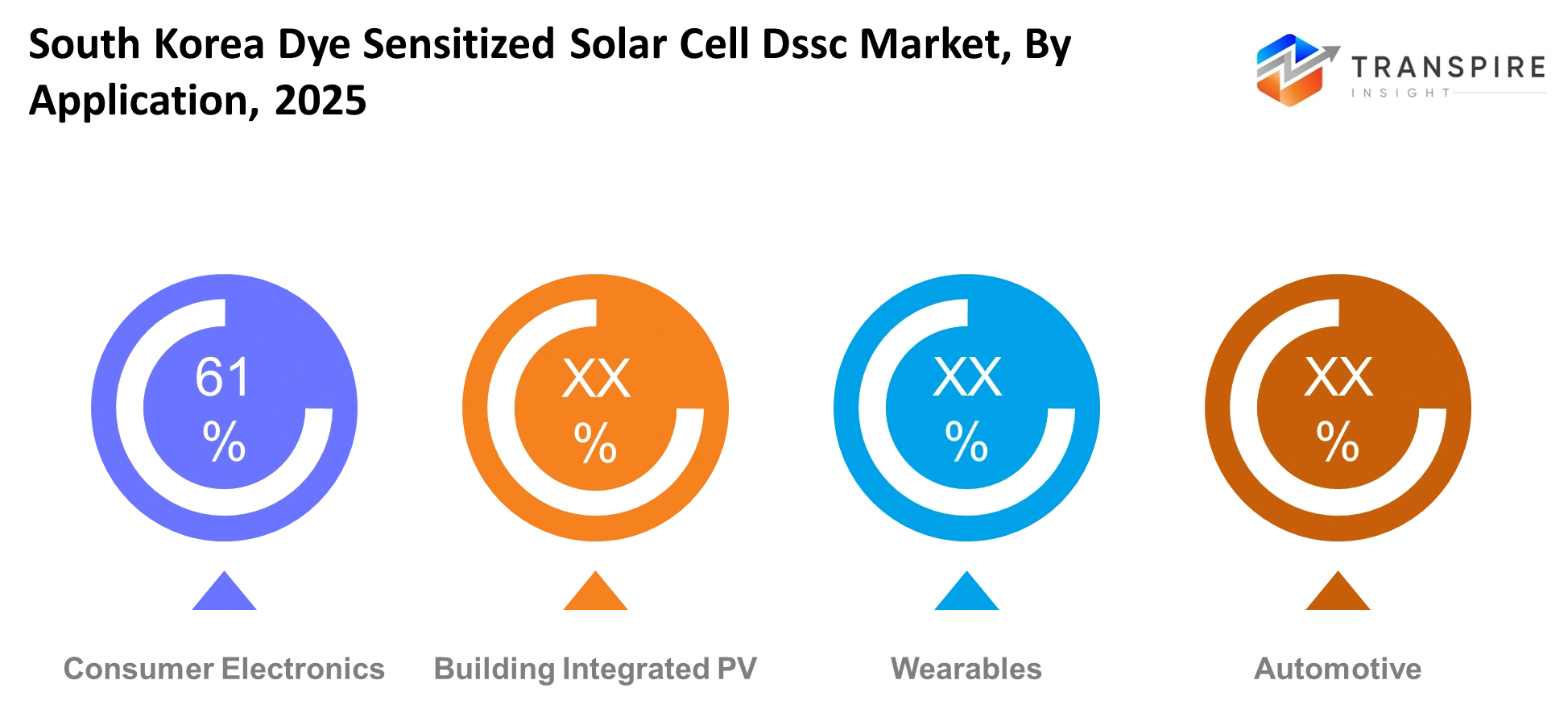
- Consumer Electronics: The South Korean market for dye sensitized solar cells will expand because consumers currently demand energy-saving products. The technology generates power continuously because it can be integrated into small devices like calculators and sensors. The technology enables development of modern electronic products because it has a compact design which works indoors.
- Building Integrated PV: The South Korean Dye Sensitized Solar Cell Dssc Market will experience growth through Building Integrated PV. The transparent and semi-transparent cell designs which can be installed in windows and facades. The combination of visual appeal and energy production capability creates strong demand from architects and construction professionals.
- Wearables: The South Korean Dye Sensitized Solar Cell Dssc Market for wearables will grow because of the increasing demand for self-sustaining devices. The material enables users to effortlessly embed it into their clothing and accessories through its lightweight and flexible features. The system operates continuously under indoor lighting which allows users to keep their devices running without needing to charge frequently.
- Automotive: The South Korean Dye Sensitized Solar Cell Dssc Market for automotive applications will develop gradually because energy efficiency has become the main focus in vehicle development. The system enables power generation through its integration with sunroofs and other internal vehicle components. Modern automotive solutions gain extra benefits through their ability to adapt design and work efficiently with diffused light.
To learn more about this report, Download Free Sample Report
By End-User :
- Electronics Firms: The South Korean electronics industry will drive the adoption of Dye Sensitized Solar Cell Dssc Market through their product innovations and their ability to create portable devices. The need for energy-efficient solutions which extend battery life drives product demand. The team maintains commercial development progress through their ongoing research on different materials and design concepts.
- Energy Companies: Energy companies in South Korea Dye Sensitized Solar Cell Dssc Market will explore technology for niche renewable solutions. The public shows interest in affordable solar power systems which work best in particular geographical locations. The research organization helps technology development through their joint projects while testing the system performance will determine its suitability for future use.
- Research Institutes: Research institutes in South Korea Dye Sensitized Solar Cell Dssc Market will play a key role in advancing material science and improving efficiency levels. The organization dedicates its resources to creating new solutions through experimental work and building functional models. The combination of academic research and industrial practice leads to slow product development and technology advancement.
- OEMs: South Korean OEMs in the Dssc Market will implement new technologies to develop products with distinct market features and environmentally sustainable capabilities. The technology creates additional market value because it can be applied to different product categories. The company meets current market demands through its product design which provides customers with energy-efficient solutions and flexible design options.
Country Insights
- The market for Dye Sensitized Solar Cells (DSSCs) in South Korea demonstrates continuous growth because the country prioritizes clean energy development and conducts advanced material research. Innovation programs sponsored by the government enable laboratory research and pilot testing which establishes a reliable foundation for development activities. The research institutes and universities in the region conduct tests to discover methods that will enhance efficiency and decrease costs, which enables them to slowly build their commercial readiness.
- The South Korean Dye Sensitized Solar Cell Dssc Market attracts industrial participation because electronics and chemical manufacturing companies show interest in this market. The manufacturing capacity of material suppliers and device developers increases through their collaborative partnerships. The operating capacity of small-scale production lines and prototype modules becomes evident through their use in indoor energy collection and low-light conditions which traditional solar panels cannot handle.
- DSSC technology gains acceptance in South Korea because consumers become more knowledgeable about sustainable energy options. The development of urban infrastructure and smart building projects creates a need for solar solutions that offer both design flexibility and visual adaptability. The combination of research funding and industry partnerships together with policy support will determine the future growth path of the organization while the team works to enhance efficiency and durability of their products.
Recent Development News
In January 2026, Advancement in DSSC stability under sustainable conditions. A 2026 scientific study highlighted improved long-term stability and indoor efficiency of DSSCs using advanced dye–electrolyte combinations. This is particularly relevant for South Korea’s strong focus on indoor IoT-powered energy systems.
In October 2025, High-efficiency DSSC architectures approach new performance benchmarks. Recent academic work demonstrated tandem DSSC configurations reaching ~12.89% efficiency, showing rapid progress toward commercial viability and influencing R&D directions in countries like South Korea.
|
Report Metrics |
Details |
|
Market size value in 2025 |
USD 10 Million |
|
Market size value in 2026 |
USD 10.48 Million |
|
Revenue forecast in 2033 |
USD 14.55 Million |
|
Growth rate |
CAGR of 4.80% from 2026 to 2033 |
|
Base year |
2025 |
|
Historical data |
2021 - 2024 |
|
Forecast period |
2026 - 2033 |
|
Report coverage |
Revenue forecast, competitive landscape, growth factors, and trends |
|
Country scope |
South Korea |
|
Key company profiled |
Sharp, Sony, Panasonic, Samsung, LG, Toshiba, Fujitsu, Dyenamo, Solaronix, G24 Power, Oxford PV, 3GSolar, Exeger, Ricoh, Merck. |
|
Customization scope |
Free report customization (country, regional & segment scope). Avail customized purchase options to meet your exact research needs. |
|
Report Segmentation |
By Type (Liquid Electrolyte, Solid State, Hybrid, Flexible), By Application (Consumer Electronics, Building Integrated PV, Wearables, Automotive), By End-User (Electronics Firms, Energy Companies, Research Institutes, OEMs). |
Key South Korea Dye Sensitized Solar Cell Dssc Company Insights
- The South Korea Dye Sensitized Solar Cell Dssc market shows a steady shift as research groups and industrial players focus on improving efficiency while keeping production costs manageable. Development activity will continue to center on flexible and lightweight solar solutions which provide advantages to portable electronic devices and building-integrated systems. Academic institutions and technology firms in South Korea will maintain close collaboration which will result in gradual advancements on material stability and device lifespan. The research process will continue to focus on finding less expensive options which will expand product use in specialized market segments. Market growth will depend on how well these cells perform under indoor and low-light conditions because these environments provide a distinct benefit over traditional silicon-based panels.
- The South Korea Dye Sensitized Solar Cell Dssc market shows participation from established electronics manufacturers and research-focused organizations which establish a dual market presence. Samsung SDI and LG Chem together with smaller photovoltaic startups will keep funding their work on prototype development and pilot-scale production. The university partnerships and government-supported programs will provide funding for research that will advance new electrolyte formulations and photoanode materials.Organizations will gain competitive advantage through their ability to develop unique uses of their products which include wearable devices and smart windows. The development of intellectual property will determine market presence because companies pursue patents and proprietary methods to achieve lasting value instead of prioritizing quick product launches.
South Korea Dye Sensitized Solar Cell Dssc Market Companies:
- Sharp
- Sony
- Panasonic
- Samsung
- LG
- Toshiba
- Fujitsu
- Dyenamo
- Solaronix
- G24 Power
- Oxford PV
- 3GSolar
- Exeger
- Ricoh
- Merck
South Korea Dye Sensitized Solar Cell Dssc Market Segmentation
By Type
- Liquid Electrolyte
- Solid State
- Hybrid
- Flexible
By Application
- Consumer Electronics
- Building Integrated PV
- Wearables
- Automotive
By End-User
- Electronics Firms
- Energy Companies
- Research Institutes
- OEMs
Frequently Asked Questions
Find quick answers to common questions.
The approximate South Korea Dye Sensitized Solar Cell Dssc Market size for the market will be USD 14.55 Million in 2033.
Key segments for the South Korea Dye Sensitized Solar Cell Dssc Market are By Type (Liquid Electrolyte, Solid State, Hybrid, Flexible), By Application (Consumer Electronics, Building Integrated PV, Wearables, Automotive), By End-User (Electronics Firms, Energy Companies, Research Institutes, OEMs).
Major South Korea Dye Sensitized Solar Cell Dssc Market players are Sharp, Sony, Panasonic, Samsung, LG, Toshiba, Fujitsu, Dyenamo, Solaronix, G24 Power, Oxford PV, 3GSolar, Exeger, Ricoh, Merck.
The South Korea Dye Sensitized Solar Cell Dssc Market size is USD 10 Million in 2025.
The South Korea Dye Sensitized Solar Cell Dssc Market CAGR is 4.80%.
- Sharp
- Sony
- Panasonic
- Samsung
- LG
- Toshiba
- Fujitsu
- Dyenamo
- Solaronix
- G24 Power
- Oxford PV
- 3GSolar
- Exeger
- Ricoh
- Merck
Recently Published Reports
-
Dec 2024
Active Power Filter Market
Active Power Filter Market Size, Share & Analysis Report By Type (Shunt Active Power Filters, Series Active Power Filter, Hybrid Active Power Filter), By Application (Harmonics Mitigation, Reactive Power Compensation, Voltage Regulation, Power Factor Correction), By Phase (Single Phase, Three Phase), By End-User Industry (Manufacturing, Healthcare, Commercial, Automotive, Oil and Gas, Others), and Geography (North America, Europe, Asia-Pacific, Middle East and Africa, South and Central America), 2021 - 2031
-
Jan 2025
Electrical Transformer Market
Electrical Transformer Market Size, Share & Analysis Report By Core (Closed, Shell, and Berry), By Insulation (Gas, Oil, Solid, Air, and Other), By Phase (Single, and Three), By Rating (100 MVA to 500 MVA, 501 MVA to 800 MVA, and 801 MVA to 1200 MVA), and Geography (North America, Europe, Asia-Pacific, Middle East and Africa, South and Central America), 2021 – 2031
-
Jan 2025
Hydraulic Piston Pumps Market
Hydraulic Piston Pumps Market Size, Share & Analysis Report By Type (Axial Piston Pumps, Radial Piston Pumps), By Operating Pressure (Low Pressure, Medium Pressure, High Pressure), By Application (Construction, Mining, Agriculture, Automotive, Oil & Gas, Industrial Machinery, Others), By End-User (OEMs, Aftermarket), and Geography (North America, Europe, Asia-Pacific, Middle East and Africa, South and Central America), 2021 – 2031
-
Jan 2025
Laboratory Gas Generators Market
Laboratory Gas Generators Market Size, Share & Analysis Report By Product (Nitrogen Gas Generator, Hydrogen Gas Generator, Zero Air Gas Generator, Purge Gas Generator, TOC Gas Generators, Others), By Application (Gas Chromatography, Liquid Chromatography-mass Spectrometry (LC-MS), Gas Analyzers, Others), By End-user (Life Science, Chemical & Petrochemical, Food & Beverage, Others), and Geography (North America, Europe, Asia-Pacific, Middle East and Africa, South and Central America), 2021 – 2031