
South Korea Military Drones Market Summary:
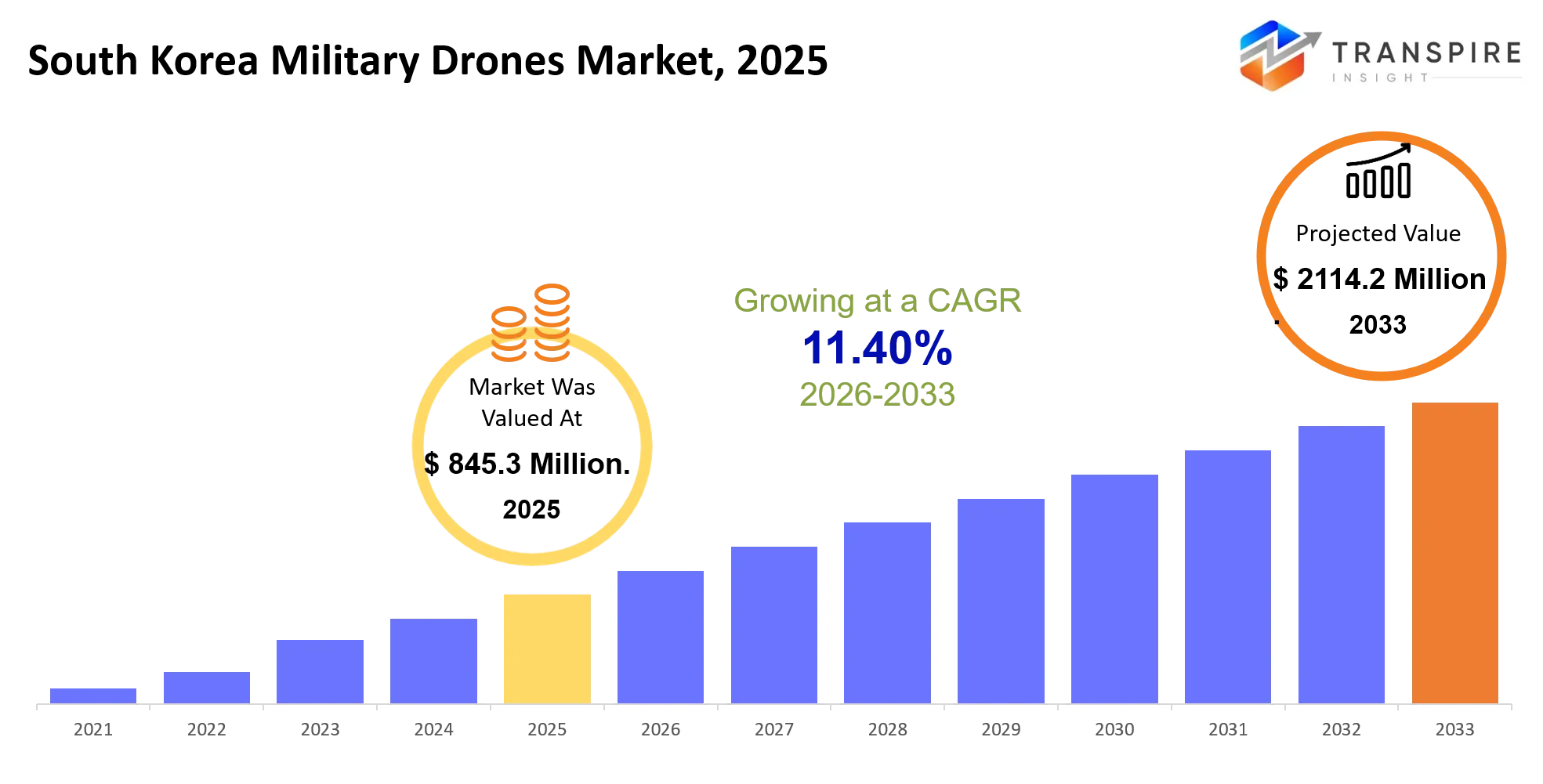
According to Transpire Insights, a detailed research report on the market reflects that the fixed-wing type segment dominates the South Korea Military Drones Market, accounting for approximately 77.27% of the total share in 2025. Hanwha Aerospace leads the market with approximately (around USD 18.5 billion) in annual revenue and an estimated leading position in the South Korea military drones market, making it a leading contributor to South Korea market development, innovation, advanced military drone production, expanding manufacturing capabilities, and growth dynamics.
Market Snapshot
- Market Value (2025): USD 845.3 Million.
- Expected Market Value (2026): USD 990.1 Million.
- Estimated Market Value (2033): USD 2114.2 Million.
- Forecast CAGR (2026–2033): 11.40%
Introduction
The market for military drones in South Korea includes the creation, acquisition, upkeep, and use of unmanned aerial vehicles (UAVs), unmanned combat aerial vehicles (UCAVs), target drones, loitering munitions, and counter-drone systems used solely by defense forces. This encompasses hardware, software payloads, AI navigation systems, and ground control systems meant for border surveillance, reconnaissance missions, intelligence capture, target gathering, and combat support operations. The South Korean Military Drones Market is developing through expertise in semiconductors, AI integrations, local constructions, and wider military usages. The electronics and semiconductor companies, together with the artificial intelligence capabilities in South Korea foster the development of lightweight payloads, sophisticated sensors, autonomous flying systems, and powerful drone platforms. The growing focus on the domestic defense supply chain is boosting the technology sovereignty and reducing dependence on foreign components. Military drones play a big role to enhance intelligence, reconnaissance, and surveillance (ISR), which opens doors for safer monitoring and support of operations. Moreover, the application of unmanned systems in the Army, Navy, Air Force, and Marine empowers new deployment possibilities and speeds up the implementation of highly advanced military drone technologies.
Key Market Highlights: -
- By drone type, the Rotary-Wing UAVs segment dominated the market and holds nearly 70% share in 2025 and is projected to grow at a substantial CAGR during the forecast period.
- By application, the Intelligence segment dominated the market and holds nearly 44% share in 2025 and is projected to grow at a substantial CAGR during the forecast period.
- By end user, the Army segment dominated the market and holds nearly 40% share in 2025 and is projected to grow at a substantial CAGR during the forecast period.
- Mass Procurement Objectives: By 2029, South Korea aims to manufacture about 110,000 drones, obtain nearly 60,000 commercial training drones, and purchase over 20,000 affordable expendable drones and loitering weapons. Achievements in terms of military updates, AIpowered military hardware, unmanned missions, and surveillance assets will contribute to the expansion of the South Korean military drone sector.
How is Technology Driving Growth in the South Korea Military Drones Market?
The South Korea Military Drones Market is quickly transitioning due to advancements in artificial intelligence technology, connectivity, and propulsion techniques. Advanced AI capabilities are contributing to autonomous operations, mission management, and swarm capabilities. Moreover, loyal-wingman projects are facilitating the incorporation of drones with manned weaponry. Furthermore, advanced 5G technology facilitates immediate command, control, and data processing of drones. Besides, the integration of miniaturized equipment and AI-based payloads ensures better efficiency in operations and missions with drones being constantly improved in terms of sustainability and efficiency through various electric and hybrid engines. Finally, the continued efforts of the domestic economy and supply chain in support of local production and the procurement policies initiated by the Administration of Defense Acquisition Program contribute to the MS struggle for efficiency and improvement of the technological potential of its own manufacturers.
Market Drivers
The South Korea Military Drones sector is witnessing increased opportunity owing to political troubles, advances in defense measures, advancements in technology, and support of the government. Worries regarding North Korea and the surrounding disputes have led to the need for advanced military drones that can be used for surveillance of borders, reconnaissance, and intelligence. Continued defense modernization is leading to increased spending on drone technology, unmanned aerial vehicles, and advanced drone features. South Korea also has a strong background on AI, robotics, electronics, and semiconductor technologies that help to boost the development of autonomous military drones. Moreover, the investments made by the government in procurement, as well as the R&D in the defense industry, promote local production. The use of advanced technologies in technology employment such as advanced 5G connectivity and local sourcing as well as government assistance aid the South Korea Military Drones market. They possess futuristic capabilities in terms of these areas such as semiconductor technology, use of robotic technology, use of artificial intelligence technology and miniaturization which enables the improved use of different sensors in the advanced use of flight controls in military drones. The 5G connectivity shows the possibility of real time data transfer across distances using lower communication latencies in the defense sector. Promoting local procurement of necessary equipment enhances production ability of different defense components. In addition, the government support of the investments in the development of various technologies in military spheres makes it possible for achieving the aims of the military drones market in South Korea.
Restrain
The sector of military drones in South Korea encounters several problems due to strict domestic sourcing rules, the high cost of R&D and procurement, dependence on particular technology, cyber security risks, and numerous regulations. The lack of sufficient advanced sensors and satellite communication components can make deployment time-consuming while complex electronic warfare threats necessitate more security features. Lastly, foreign export laws might slow down the transfer of military drone technology across the border and limit its growth in the market.
|
Driver |
Relative Impact on Growth (%) |
Geographic Relevance |
Impact Timeline |
Demand Strength |
Growth Mechanism |
Key Beneficiaries |
Major Constraint |
|
Defense Modernization and Drone Procurement |
30% |
South Korea, DMZ, coastal regions |
Short-term |
High |
Expands military drone procurement across operational units |
Drone manufacturers, defense contractors, military end-users |
Budget execution delays and lengthy procurement procedures |
|
AI-Enabled Autonomous and Unmanned Systems |
25% |
South Korea, military operational zones |
Medium-term |
High |
Improves autonomous navigation, targeting, surveillance, and coordination |
AI vendors, UAV developers, defense electronics companies |
Cybersecurity risks and complex system integration |
|
500,000 Drone Warriors and Training Expansion |
20% |
Nationwide South Korea |
Short-term |
High |
Creates large-scale demand for training and commercial drones |
Training providers, drone manufacturers, software suppliers |
Operator training capacity and certification requirements |
|
Manned-Unmanned Teaming and Swarm Technologies |
15% |
South Korea, frontline and tactical areas |
Medium-term |
High |
Enables coordinated operations between soldiers and autonomous platforms |
Robotics firms, UAV manufacturers, military technology providers |
Technology maturity and interoperability challenges |
|
Counter-Drone and Advanced Defense Capabilities |
10% |
DMZ, military bases, strategic facilities |
Long-term |
Medium |
Drives integrated detection, interception, and drone-defense systems |
Counter-UAS providers, sensor companies, defense integrators |
Rapidly evolving drone threats and high system costs |
Analysis of Prices and Consumer Behaviour
In South Korea's military drone industry, fixed-wing drones make up nearly 78% of revenue in 2025 because of their advantages in surveillance and long-duration missions. The market size for the South Korean military drone industry will stand at approximately USD 845.3 million in 2025 and reach USD 2,114.2 million by the year 2033 at a compound annual growth rate (CAGR) of 11.4% between the years 2026 and 2033. Overall market revenue was composed of almost 78% of revenues received from fixed-wing military drones during the reference year. The increasing demand for unmanned systems for border control, surveillance, and reconnaissance is the major growth driver of the mkt. The military drones market is analyzed according to rotary blade, fixed-wing and hybrid drones. Hybrid drones segment is expected to be the fastest growing segment during the period. Nevertheless, flight endurance, payload capacity, autonomous operation, surveillance and reliability are among the most common buying criteria. Finally, long-term purchase contracts are essential for defense clients due to the need for reliable supply of military equipment.
Who are the Key Players in the South Korea Military Drones Market and how do they compete?
Competitiveness within the South Korean military drone market hinges on companies making unmanned aerial vehicles, military technologies, mission-centric solutions, and creating successful innovations in aviation. This strategy involves not competing with rivals through prices, but through capabilities of unmanned vehicles companies making drones either through remote piloting, gathering intelligence, monitoring and reconnaissance (ISR) possibilities, long distance capabilities of drones, sophisticated electronic equipment, and ability to integrate drone technologies into military networks.
Examples of successful competitors are companies delivering successful unmanned aerial vehicles and unmanned technologies in the country. The technology company Hanwha Aerospace enjoys success in the country due to the possibility to produce high-tech unmanned vehicles operating in reconnaissance and surveillance. The aerospace company KAI specializes in production of military drones and this differentiation helps it gain competitive advantage over other companies in the industry.
Top Companies in the South Korea Military Drones Market
- Korea Aerospace Industries
- Hanwha Aerospace
- Hanwha Systems
- LIG Nex1
- Korean Air Aerospace Division
- Hyundai Rotem
- Uconsystem
- DJI
- General Atomics Aeronautical Systems
- Northrop Grumman
- Boeing
- Lockheed Martin
- AeroVironment
- Elbit Systems
- Israel Aerospace Industries
|
Company |
Est. Revenue Share Range |
Key Offerings |
Strategic Positioning |
Geographic Strength |
Technology Focus |
|
Korea Aerospace Industries (KAI) |
15–20% (Estimated) |
RQ-101, Next Corps Surveillance UAV, VTOL UAVs, UCAV programs |
Domestic UAV platform and systems leader |
Asia Pacific, South Korea, Southeast Asia |
AI autonomy, UCAVs, MUM-T systems |
|
Hanwha Systems |
12–17% (Estimated) |
MUAV, CUAV, DUAV, EO/IR systems, UAV datalinks |
Avionics and mission-system technology leader |
South Korea, Asia Pacific, Middle East |
EO/IR, datalinks, ISR, avionics |
|
Hanwha Aerospace |
10–15% (Estimated) |
UAS engines, unmanned systems, GE-STOL partnership, MUM-T solutions |
Vertical integration and UAS expansion |
South Korea, North America, Europe |
Propulsion, MUM-T, autonomy, unmanned platforms |
|
LIG Nex1 |
8–12% (Estimated) |
MUAV systems, sensors, mission electronics, loitering-munition technologies |
Precision-defense and mission-system specialist |
South Korea, Asia Pacific, Middle East |
Sensors, guidance, communications, autonomy |
|
Korean Air Aerospace Division |
7–10% (Estimated) |
MUAV, high-speed unmanned target aircraft, next-generation UAVs |
Large-platform UAV manufacturing specialist |
South Korea, Asia Pacific, Middle East |
AI, swarm control, autonomous missions |
|
Uconsystem |
4–7% (Estimated) |
REMO-EYE 002B, REMO-EYE 006A, T-ROTOR, DRONE KILLER |
Tactical UAV and counter-drone specialist |
South Korea, Asia Pacific |
Autonomous flight, EO/IR, GCS, counter-UAS |
|
General Atomics Aeronautical Systems |
3–6% (Estimated) |
Gray Eagle, Gray Eagle STOL, Predator-family UAS |
High-end MALE UAS technology challenger |
North America, South Korea, Middle East |
MALE UAS, STOL, ISR, MUM-T |
|
Israel Aerospace Industries (IAI) |
2–5% (Estimated) |
Heron, strategic ISR UAV technologies, mission systems |
Established high-end ISR supplier |
Middle East, Asia Pacific, Europe |
Long-endurance ISR, sensors, autonomy |
|
AeroVironment |
1–3% (Estimated) |
JUMP 20, tactical UAS, loitering-munition technologies |
Tactical and VTOL UAS specialist |
North America, Europe, Asia Pacific |
VTOL, autonomy, tactical ISR, loitering systems |
|
Elbit Systems |
1–3% (Estimated) |
Tactical UAVs, Hermes-family technologies, EO/IR and C4ISR |
Integrated ISR and defense-electronics challenger |
Israel, Europe, Asia Pacific |
C4ISR, EO/IR, autonomy, datalinks |
South Korea Military Drones Market Segmentation
The South Korea Military Drones Market share is divided into five categories: By drone type, application, payload, range and end user.
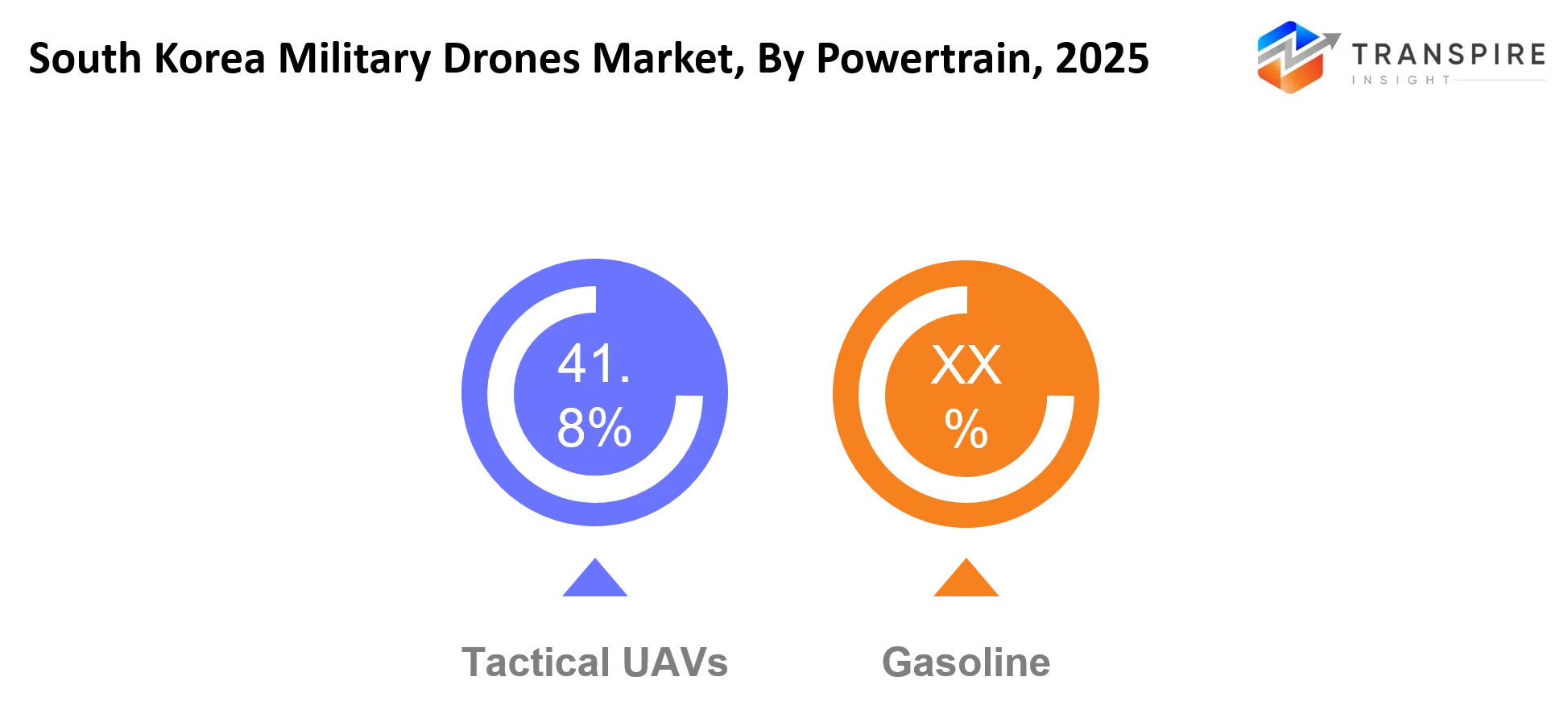
The Rotary-Wing UAVs dominated the market, accounting for nearly 70% in 2025 and is expected to rise at a significant CAGR during the forecast period.
The South Korea Military Drones Market is segmented by drone type into Fixed-Wing UAVs, Rotary-Wing UAVs, Hybrid VTOL UAVs, Loitering Munitions, Tactical UAVs, MALE UAVs, HALE UAVs, Micro UAVs, Swarm Drones, Others. Among these, the dietary supplements segment dominated the market, accounting for nearly 70% in 2025 and expected to increase at a significant CAGR during the forecast period. In the market for UAVs, rotary-winged products are the most popular. These machines held a market share of about 70% in 2025 and are likely to keep growing in the years to come, due to their distinct features vertical takeoff and landing, hovering capabilities, maneuverability, and suitability for missions of surveillance, reconnaissance, intelligence operations, and tactical purposes which facilitate their implementation and usage in various military and security applications.
The Intelligence dominated the market, accounting for nearly 44% in 2025, and is expected to rise at a significant CAGR during the forecast period.
The South Korea Military Drones Market is segmented by application into Intelligence, Surveillance & Reconnaissance, Border Security, Target Acquisition, Electronic Warfare, Combat Operations, Logistics, Communication Relay, Training, Others. Among these, the Intelligence segment dominated the market, accounting for nearly 44% in 2025 and expected to increase at a significant CAGR during the forecast period. The Intelligence segment will dominate the market and is estimated to hold almost 44% market share in 2025, growing further at a considerable CAGR during the forecast period. The growth of this segment can be attributed to the growing requirement for intelligent and real-time intelligence, reconnaissance, and surveillance capabilities, helping defense forces improve their situational awareness, threat detection capability, battlefield monitoring, and target identification, along with analyzing data using advanced unmanned systems.
The Army dominated the market, accounting for nearly 40% in 2025 and is expected to rise at a significant CAGR during the forecast period.
The South Korea Military Drones Market is segmented by end user into Army, Navy, Air Force, Defense Agencies, Border Security Forces, Special Forces, Others. Among these, the Army segment dominated the market, accounting for nearly 40% in 2025 and expected to increase at a significant CAGR during the forecast period. In 2025, nearly 40% of the market share is expected to belong to the Army, which will reflect a higher CAGR during the estimated period. The reason for the high share will be the increasing utilization of UAVs for intelligence, surveillance and reconnaissance, border control, tactical operations, target acquisition, and battlefield situation awareness, allowing armed forces to enhance their efficiency, safety and performance.
Future Market Trends for the South Korea Military Drones Market: -
- Artificial Intelligence and Autonomy: Progression to completely autonomous combat abilities and AI-altered targeting by around 2030.
- Loitering Munitions: Among the highest growth rates getting concurrent investments in counter-drone initiatives.
- Counter-UAS systems: Swift developments of drone-defense technologies in response to pressing threats.
- Domestic Production: Significant dependence on local production for airframes alongside high-end sensor and satellite imports.
Recent Development
- In August 2026: The Army of Korea constructed the Drone and Robotics Tactical Demonstration Unit to test the integration of manned-unmanned teaming, swarm drones, multi-legged robots, and unmanned ground vehicles in practical field conditions as part of the ongoing modernization of the army.
- In June 2026: The Republic of South Korea unveiled its “500,000 Drone Warriors” program, which aims to train as many as 500,000 operators in total, obtain an estimated 60,000 commercial training drones by the year 2029, advance K-LUCAS loitering munitions, and acquire low-cost expendable drones to bolster capabilities in unmanned warfare, modernize defense systems, implement AI systems, and boost the military drone market in South Korea.
Market Segment
This study forecasts revenue at South Korea, regional and country levels from 2020 to 2033. Transpire Insights has segmented the South Korea Military Drones Market based on the below-mentioned segments:
South Korea Military Drones Market, By Drone Type
- Fixed-Wing UAVs
- Rotary-Wing UAVs
- Hybrid VTOL UAVs
- Loitering Munitions
- Tactical UAVs
- MALE UAVs
- HALE UAVs
- Micro UAVs
- Swarm Drones
- Others
South Korea Military Drones Market, By Application
- Intelligence
- Surveillance & Reconnaissance
- Border Security
- Target Acquisition
- Electronic Warfare
- Combat Operations
- Logistics
- Communication Relay
- Training
- Others
South Korea Military Drones Market, By Payload
- Electro-Optical/Infrared
- Radar
- Electronic Warfare Systems
- Communication Equipment
- Weapons
- Sensors
- Cameras
- Others
South Korea Military Drones Market, By Range
- Short Range
- Medium Range
- Long Range
- Extended Range
- Beyond-Line-of-Sight
- Others
South Korea Military Drones Market, By End User
- Army
- Navy
- Air Force
- Defense Agencies
- Border Security Forces
- Special Forces
- Others
Frequently Asked Questions
Find quick answers to common questions.
The market reached USD 845.3 million in 2025 and is projected to reach USD 2,114.2 million by 2033.
Fixed-wing UAVs dominated 2025 revenue, supported by long endurance, surveillance, reconnaissance, border monitoring, and intelligence applications.
Defense modernization, North Korea-related security concerns, AI advancements, autonomous systems, domestic production, and government procurement programs drive market growth.
The strategy targets 500,000 trained operators, approximately 60,000 training drones by 2029, and expanded unmanned warfare capabilities.
Key companies include Korea Aerospace Industries, Hanwha Aerospace, Hanwha Systems, LIG Nex1, Korean Air, Hyundai Rotem, and Uconsystem.
- Korea Aerospace Industries
- Hanwha Aerospace
- Hanwha Systems
- LIG Nex1
- Korean Air Aerospace Division
- Hyundai Rotem
- Uconsystem
- DJI
- General Atomics Aeronautical Systems
- Northrop Grumman
- Boeing
- Lockheed Martin
- AeroVironment
- Elbit Systems
- Israel Aerospace Industries
About the Authors

Tejashri Dhatrak
I am Tejashri Dhatrak, a Senior Research Analyst at Transpire Insight, specializing in the Aerospace and Defence sector. My work focuses on analyzing industry trends, defence technologies, market developments, and emerging innovations that shape the global aerospace and security landscape. At Transpire Insight, I research complex topics, evaluate credible sources, and transform technical insights into accurate, well-structured, and easy-to-understand content for industry professionals and decision-makers. My goal is to provide reliable, research-backed information that helps readers stay informed about defence capabilities, aerospace advancements, strategic developments, and the evolving dynamics of the global defence ecosystem.

Chakradhar Khansole
Chakradhar serves as the Research Director at Transpire Insight, bringing over 8 years of experience in technology, innovation, and strategic market intelligence. He specializes in transforming complex market data into actionable business insights that enable organizations to make informed, growth-oriented decisions. Recognized for his strategic vision and analytical expertise, Chakradhar leads high-impact research initiatives, delivering comprehensive market assessments, competitive intelligence, and forward-looking industry analysis.
Recently Published Reports
-
Apr 2026
Aerospace Fluoropolymers Market
Aerospace Fluoropolymers Market Size, Share & Analysis Report By Type (PTFE, FEP, PFA, ETFE, and Others), By Application (Electrical Insulation, Seals & Gaskets, Coatings, and Others), By End User (Commercial Aviation, Military Aviation, General Aviation, and Others), and Geography (North America, Europe, Asia-Pacific, Middle East and Africa, South and Central America), 2021 - 2031
-
Apr 2026
Airborne SATCOM System Market
Airborne SATCOM System Market Size, Share & Analysis Report By Type (SATCOM Terminals, Transceivers, Airborne Radio, Modems and Routers, SATCOM Radomes, and Other), By Application (Government and Defense and Commercial), and Geography (North America, Europe, Asia-Pacific, Middle East and Africa, South and Central America), 2021 – 2031
-
Apr 2026
Ship Leasing Market
Ship Leasing Market Size, Share & Analysis Report By Vessel Type (Container Ships, Bulk Carriers, Tankers, and Specialized Vessels), By Lease Duration (Short-Term Lease (Less than 1 year), Medium-Term Lease (1-5 years), and Long-Term Lease (More than 5 years)), By Lease Type (Bareboat Charter, Time Charter, Financial Lease, and Others), By End-User Industry (Oil and Gas, Manufacturing and Industrial, Automotive, Agriculture and Food, Retail and Consumer Goods, and Others), and Geography (North America, Europe, Asia-Pacific, Middle East and Africa, South and Central America), 2021 – 2031
-
Apr 2026
Thread Rolling Dies Market
Thread Rolling Dies Market Size, Share & Analysis Report By Type (Flat Thread Rolling Dies, Circular (Cylindrical) Dies, Tangential Thread Rolling Dies, Planetary Thread Rolling Dies, and Other Types), By Material Type (High-Speed Steel (HSS), Carbide, Tool Steel, Alloy Steel, and Other Specialized Alloys), By Distribution Channel (Direct Sales, Distributors and Dealers, and Online Platforms), By Application (Automotive Industry, Aerospace and Defense, Construction and Infrastructure, Industrial Machinery, Electronics and Electrical Components, Medical Devices, and Fastener Production), and Geography (North America, Europe, Asia-Pacific, Middle East and Africa, South and Central America), 2021 – 2031
Our Clients





