
Europe Electronic Intelligence (ELINT) Market Summary
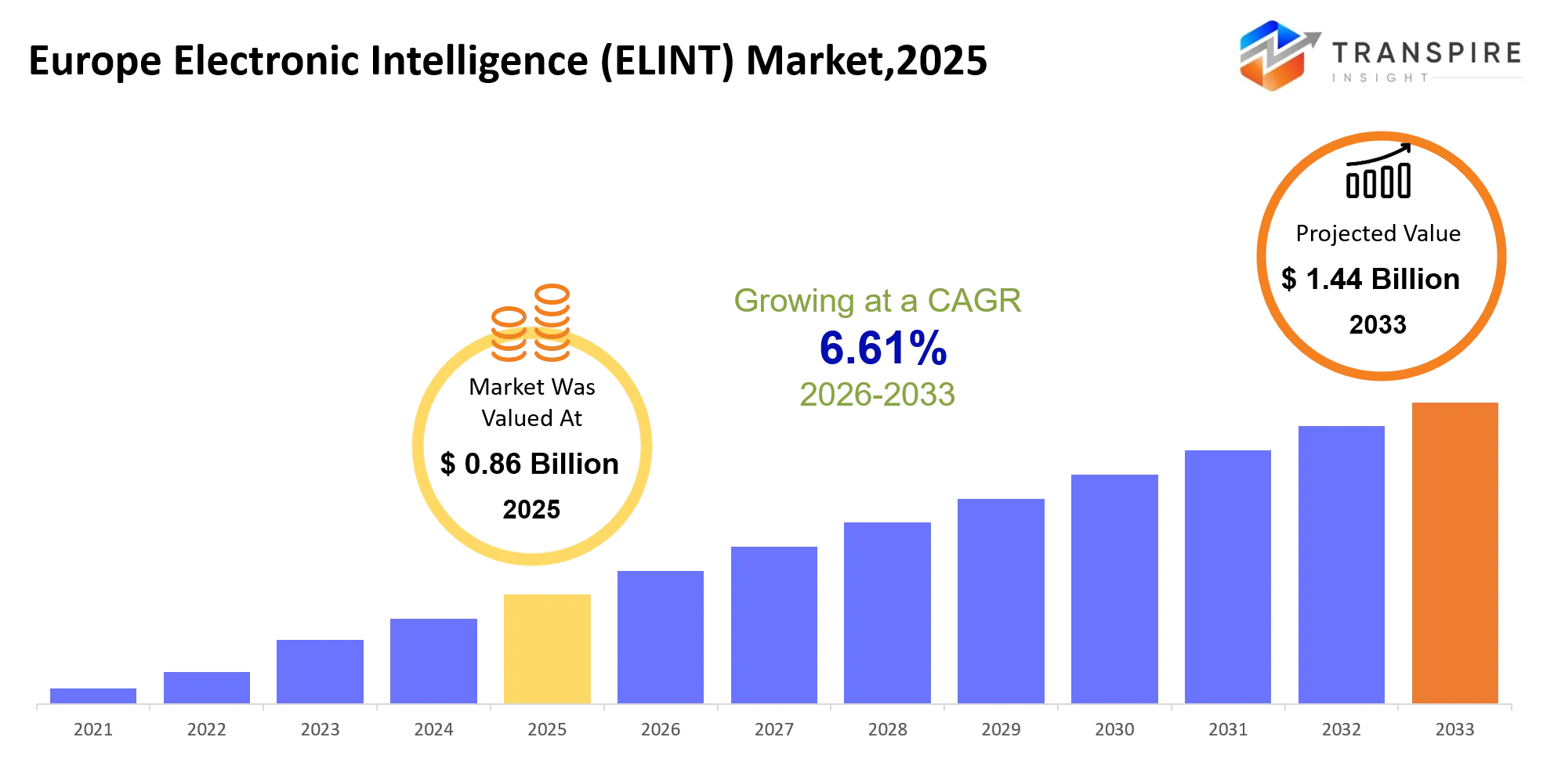
As per Transpire Insight Analysis the Europe Electronic Intelligence (ELINT) Market size is estimated at USD 0.86 Billion in 2025 and is anticipated to reach USD 1.44 Billion by 2033, growing at a CAGR of 6.61% from 2026 to 2033.
Europe’s ELINT market backs military units by finding, naming, and pinpointing electronic signals. It also covers the analysis of signals sent by radars, radios, and other transmitting sources. With this work, commanders get a more complete view of possible threats. It supports watch efforts, electronic warfare actions, and planning for missions.
In the last three to five years, buying in Europe has changed. Contracts now lean more toward networked setups and software-driven tools. They also pull in multi-domain intelligence. Data can come from aircraft, ships, land units, and satellites in one workflow.
Russia’s attack on Ukraine made the shift feel more urgent. It showed how much electromagnetic intelligence matters in live fights. It also showed why electronic warfare and quick threat checks are needed during operations.Defense budgets in Europe have risen as well. EU defense spending hit €343 billion in 2024. That is up 19% from 2023. More money for equipment and stronger push for system compatibility are helping new ELINT efforts. They are also driving updates to older systems.
Europe Electronic Intelligence (ELINT) Market Size & Forecast:
- Europe Electronic Intelligence (ELINT) Market Size 2025: USD 0.86 Billion
- Expected Market Value 2033: USD 1.44 Billion
- Forecast CAGR: 6.61%
- Leading region in 2025:Western Europe
- Fastest Growing region:Eastern Europe
- Key Profile: BAE Systems, Leonardo, Thales, Saab, Hensoldt, Rohde & Schwarz, L3Harris Technologies, Northrop Grumman, Lockheed Martin, Raytheon, Elbit Systems, Indra Sistemas, Airbus Defence and Space, Elettronica, MBDA
Key Market Insights
- Western Europe leads regional activity. This is tied to long running defense firms. It also reflects more mature intelligence tools. Big government buy programs add momentum.
- Eastern Europe is rising quickly. NATO states are upgrading watch systems. They are also adding electronic warfare tools.
- In the EU, defense budgets hit €343 billion in 2024. That is up 19% from 2023. The rise helped unlock new equipment buys.
- Equipment purchases in the EU climbed 39% to €88 billion in 2024. This improved money available for electronic intelligence tools.
- Airborne platforms still matter a lot. Planes can pick up signals over wide zones. They also help speed up threat checks when time is tight.
- Naval and ground systems are getting more attention too. European forces are pushing for constant surveillance. This includes work near borders, along coasts, and in tense areas.
- Digital signal processors, new receivers, and software are also more important now. Operators deal with bigger sets of hard electromagnetic data.
- Saab won a €130 million deal for Sirius passive surveillance and SIGINT. The order was signed in December 2025. Deliveries run through 2030.
- In November 2025, Saab got about €549 million for Arexis electronic warfare systems. These are for German Eurofighters.
- BAE Systems received a £453.5 million UK contract in January 2026. The deal covers advanced Typhoon radar. It supports electronic warfare and helps identify threats.
What are the Key Drivers, Restraints, and Opportunities in the Europe Electronic Intelligence (ELINT) Market?
European defense upgrades are a key reason for growth. In 2024, EU defense budgets hit €343 billion. At the same time, spending on new equipment rose by 39% to €88 billion. This shift is giving more money to areas like intelligence work, surveillance, electronic warfare, and sensor-related programs. Russia’s war in Ukraine also put electromagnetic intelligence in the spotlight. Many governments took that as a clear sign to improve detection and faster threat checking.
Even with that push, system build-outs stay hard. ELINT tools need many specific parts to work well. These include receivers, antennas, signal processing, and secure links for sharing data. They also rely on databases and tight fit with older command systems. Buying and testing can take a long time. Some places also lack enough specialists in engineering. That can slow down deals and push costs higher.
The best opening is in software-led and AI-enabled intelligence. Defense efforts in Europe are starting to blend cyber functions with electromagnetic tasks. The European Defence Agency is also pushing for more teamwork. Focus areas include electronic warfare, passive monitoring, and software-defined methods. Companies that sell modular systems may do best. These systems can connect to different platforms without much rework. As European governments aim for the same standards across services, and want quicker tech refreshes, modular options fit well.
What Has the Impact of Artificial Intelligence Been on the Europe Electronic Intelligence (ELINT) Market?
AI is reshaping electronic intelligence. It lets crews handle big sets of captured electromagnetic data in less time. In practice, machine-learning tools can sort radar emissions, spot repeat signal shapes, match fresh finds to stored electronic records, and flag odd emitters so a person can take a closer look. Saab’s Sirius setup already uses automated methods for radar-signal work and for labeling what is being seen. That helps cut the load on operators when the air is full of signals.
There is also a forward-looking side. The tools can notice shifts in how an emitter behaves and help analysts catch strange trends that show up across different missions. Saab’s Arexis work for German Eurofighters uses AI built by Saab and by its partner Helsing. The effort points to more AI-assisted electronic warfare tools. Better digital processing can speed up reactions and improve what operators can see, especially when units are dealing with many signals at once.Still, there are hard limits. The system needs good signal data, and the data must be kept current. If an opponent changes how it emits on purpose, that can lower the quality of the classification.
Key Market Trends
- European defense work is tying electronic intelligence more closely to cyber tools and electromagnetic jamming.
- AI tools for sorting signals are no longer only trials. They are being built into programs meant to run in real operations.
- After 2022, many European governments adjusted what they buy. More money is now going to higher readiness, wider watch, and better detection of electronic threats.
- In 2024, EU defense equipment buying rose by 39%. That jump is helping funds move toward smarter sensing and related tech.
- Saab also pushed its European SIGINT role. It won a Sirius deal worth 130 million euros, with deliveries planned through 2030.
- Digital receivers and software-based processing are taking over from older designs. Those newer setups avoid the slow hardware changes that used to be required.
- Defense agencies across Europe keep stressing interoperability. This matters because forces now mix systems from different national vendors.
- More teams are looking at UAV intelligence platforms. Unmanned aircraft can stay on station longer for surveillance, with less risk to crews.
- The UK raised its defense spending plans. That creates more openings for radar upgrades and electronic warfare systems.
- Procurement in Eastern Europe is also moving up in importance. Governments there are bolstering NATO’s eastern-flank monitoring and defense posture.
Europe Electronic Intelligence (ELINT) Market Segmentation
By System Type
ELINT Systems help collect and study radar and other electronic signals. This work supports threat assessment.Signals Intelligence Systems bring together electronic clues and communication data. The goal is a wider view of what is happening around us.Electronic Support Measures focus on electromagnetic activity. They detect it and analyze it so threats can be spotted quickly.Radar Warning Receivers track radar emissions. They send alerts when a possible threat shows up.
Electronic Surveillance Systems keep watch on electromagnetic activity. They do this across active areas.Signal Interception Systems capture signals for later analysis. They also help identify the source, or emitter.Direction Finding Systems estimate where the electromagnetic source is. They do it by comparing signals.Threat Identification Systems sort detected emitters. They back faster threat identification once an emitter is found.
By Platform
Airborne platforms help collect signals over large regions using aircraft. They also back intelligence work over big mission areas.Naval platforms focus on work at sea. They support maritime watch and electronic intelligence using ships.Ground systems track electromagnetic activity from land sites. These sites can be fixed or moved when needed.Space platforms cover wide areas of the planet. They extend intelligence reach across long distances.Vehicle mounted units move with troops. They can collect intelligence while units travel and operate.Fixed stations keep watch without stopping. They run from set facilities used for intelligence tasks.
UAV platforms fly collection routes with more flexibility. They also keep crew exposure lower than manned options.Portable systems give tactical teams light equipment. Teams can carry them into field conditions to collect intelligence.
By Frequency Range
VHF equipment is used to watch lower frequency signals. These signals show up in certain comms and radar uses.UHF gear helps gather signals from different communication and watch settings.L-Band systems track signals tied to radar, navigation, and communication units.
S-Band systems can be used to find signals for multiple radar and surveillance tasks.C-Band systems watch signals that appear in radar, comms, and surveillance devices. X-Band systems help collect intelligence from many high detail radar systems.Ku-Band systems work with higher frequency radar and satellite link signals.Ka-Band systems support watching newer high frequency radar and communication work.
By Application
Radar Intelligence maps radar behavior, normal settings, and likely threat origins.Threat Detection spots hostile or odd electromagnetic signals early.
Electronic Warfare takes the gathered signal data and uses it for both defense and attack. Military Surveillance keeps watching the operational zones without gaps. Border Security checks for electronic activity close to key lines and helps confirm what it is. Communications Intelligence studies signals tied to messaging to support intel needs. Maritime Security monitors activity near important shipping routes and naval work areas. Aerospace Defense gathers electronic intelligence for aircraft, air-defense systems, and broader aerospace missions.
By Component
Antennas pick up electromagnetic signals in the needed bands and in different conditions. Receivers take those signals and turn them into something later stages can use. After that, signal processors look at patterns in the signal and sort it fast.Direction finders estimate where the signal is coming from.Electronic support units also handle sensing and analysis, then add a view of likely risks. Data processing units deal with huge sets of gathered information. Software tools aid with sorting signals, running databases, doing analysis, and showing results. Communication systems pass intelligence from sensors to command posts and to field teams.
By End User
Defense forces roll out intel tools to improve situational awareness, jam or disrupt enemy signals, and watch for threats. Intel agencies also pull in signal data to support strategic work and broader national security reviews.Government offices back surveillance efforts, strengthen safety, and protect key systems and services.
Aerospace firms add intel features to planes, onboard sensor units, and military equipment. Naval forces use electromagnetic collection to track activity at sea and judge possible danger. Air forces place intel gear in aircraft for radar detection, electronic counter actions, and route or mission planning. Border security groups watch for electromagnetic signals near sensitive lines and restricted areas. Research groups build new methods for signal handling, sensing, and electronic intelligence tools.
What are the Key Use Cases Driving the Europe Electronic Intelligence (ELINT) Market?
Military planners want early warning. That means constant watch for threats. Units need to pick up radar returns and other radio activity fast. Flying platforms can scan big regions without delay. Teams on the ground also cover nearby areas around major sites. What is happening in Ukraine has made many groups pay closer attention to this same area.
Navies are upgrading how they gather information at sea. They want better monitoring and faster reading of what they detect. Air forces are adding new electronic sensing gear to aircraft. Saab’s Sirius system and the Arexis suite point to more passive listening and electronic intelligence in day to day use. These tools are showing up across land setups, ships, and aircraft.
More intelligence drones are also in the mix now. Help from AI for sorting and naming signals is starting to show value. Unmanned aircraft can keep running patrols for long stretches. Automation can also take over routine checks, which reduces time for human staff. Work between European defense teams across more than one field, and on radio awareness, may move these tools into wider use.
|
Report Metrics |
Details |
|
Market size value in 2025 |
USD 0.86 Billion |
|
Market size value in 2026 |
USD 0.92 Billion |
|
Revenue forecast in 2033 |
USD 1.44 Billion |
|
Growth rate |
CAGR of 6.61% from 2026 to 2033 |
|
Base year |
2025 |
|
Historical data |
2021 - 2024 |
|
Forecast period |
2026 - 2033 |
|
Report coverage |
Revenue forecast, competitive landscape, growth factors, and trends |
|
Regional scope |
Europe |
|
Key company profiled |
BAE Systems, Leonardo, Thales, Saab, Hensoldt, Rohde & Schwarz, L3Harris Technologies, Northrop Grumman, Lockheed Martin, Raytheon, Elbit Systems, Indra Sistemas, Airbus Defence and Space, Elettronica, MBDA |
|
Customization scope |
Free report customization (country, regional & segment scope). Avail customized purchase options to meet your exact research needs. |
|
Report Segmentation |
By System Type (ELINT Systems, Signals Intelligence Systems, Electronic Support Measures, Radar Warning Receivers, Electronic Surveillance Systems, Signal Interception Systems, Direction Finding Systems, Threat Identification Systems); By Platform (Airborne, Naval, Ground-Based, Space-Based, Vehicle-Mounted, Fixed Stations, UAV-Based, Portable Systems); By Frequency Range (VHF, UHF, L-Band, S-Band, C-Band, X-Band, Ku-Band, Ka-Band); By Application (Radar Intelligence, Threat Detection, Electronic Warfare, Military Surveillance, Border Security, Communications Intelligence, Maritime Security, Aerospace Defense); By Component (Antennas, Receivers, Signal Processors, Direction Finders, Electronic Support Systems, Data Processing Units, Software, Communication Systems); By End User (Defense Forces, Intelligence Agencies, Government Agencies, Aerospace Companies, Naval Forces, Air Forces, Border Security Agencies, Research Organizations) |
Which Regions are Driving the Europe Electronic Intelligence (ELINT) Market Growth?
Western Europe still sets the pace. Long run defence firms matter here. Aerospace work is also mature. Governments buy at steady levels. The UK, Germany, France, Italy, and Sweden keep many vendors in the mix. These include firms tied to electronic warfare, radar gear, intelligence sensors, and mission systems. In 2024, European defence spend hit €343 billion. That level helps fund new military equipment.
Northern and Central Europe hold steady demand. This comes from ongoing upgrades. NATO compatibility is a key driver. Germany has moved ahead with electronic warfare via Eurofighter updates. Sweden is pushing forward on newer watch systems and sensor projects. Saab also took a €130 million Sirius deal from a European NATO customer. That shows it is still backing long term intelligence work.
Eastern Europe looks like the quickest chance. Defence changes are happening faster along NATO’s eastern edge. Poland said it would spend 4.7% of GDP on defence in 2025. That sits near the top across NATO. The plan backs buys for surveillance and more advanced platforms. For companies and backers, the region offers chances in mobile surveillance, electronic warfare, UAV driven intelligence, and linked threat detection systems through 2033.
Who are the Key Players in the Europe Electronic Intelligence (ELINT) Market and How Do They Compete?
Competition is mostly between big defence firms in Europe and the US. Deals and positioning often come down to how good the sensors are, how well electronic warfare fits in, how the teams work with platforms, what the software can do, and what each country can buy.
BAE Systems, Leonardo, Thales, Saab, Hensoldt, and Rohde & Schwarz all take part in this race. They use mixes of electronic intelligence, radar, surveillance, communications, and command tools.
Saab puts extra weight on digital electronic warfare and passive intelligence. Its Arexis system links electronic support with intelligence tasks and countermeasure functions. Saab also has a 2025 order worth about €549 million to fit German Eurofighters. BAE Systems leans on strong UK defence ties and radar work. It also has a £453.5 million Typhoon ECRS Mk2 production deal from January 2026.
Hensoldt stays focused on sensors and electronic warfare for European aircraft and systems. Thales pairs intelligence functions with major radar and communications programs, plus other defence electronics work.
Leonardo tends to win through aircraft and defence-system pairing across European projects. Rohde & Schwarz instead leans on signal monitoring, measurement, and secure communications gear.In recent years, the edge has shifted toward making fast hardware work well with software-led processing. It also needs analysis support and the ability to work across NATO platforms.
Company List
- BAE Systems
- Leonardo
- Thales
- Saab
- Hensoldt
- Rohde & Schwarz
- L3Harris Technologies
- Northrop Grumman
- Lockheed Martin
- Raytheon
- Elbit Systems
- Indra Sistemas
- Airbus Defence and Space
- Elettronica
- MBDA
Recent Development News
"In January 2026, BAE Systems secured a £453.5 million production contract for the ECRS Mk2 radar for UK Typhoon aircraft. The advanced radar strengthens electronic warfare, detection, identification, and tracking capabilities while supporting 1,300 UK industry jobs.https://www.baesystems.com/en/article/typhoon-ecrs-mk2-production-contract-award "
"In December 2025, Saab secured a €130 million order for the Sirius passive signals intelligence and surveillance solution from a European NATO country. The order combines ELINT and communications intelligence capabilities and includes deliveries through 2030.https://www.saab.com/newsroom/press-releases/2025/saab-receives-order-for-signals-intelligence-and-surveillance-solution ."
"In November 2025, Saab received approximately €549 million in orders from Airbus Defence and Space for Arexis electronic warfare sensor suites for German Eurofighters. The program expands advanced electronic warfare and AI-supported sensing capabilities within European fighter modernization.https://www.saab.com/newsroom/press-releases/2025/saab-receives-orders-for-arexis-system-for-german-eurofighter "
What Strategic Insights Define the Future of the Europe Electronic Intelligence (ELINT) Market?
In the next five to seven years, electronic intelligence is likely to move away from stand alone sensing. It will lean more on linked networks, software control, and help from AI during electromagnetic operations. Defence budgets will still matter because they pay for the build out. But the ability for systems to work together will start to weigh more in purchase choices. That is true as European units tie aircraft, land forces, ships, and command tools into one picture.
There is also a risk that is easy to miss. Equipment can become outdated faster than planned. Opponents can alter frequencies, change waveforms, and shift how they emit signals. That pressure can force new hardware and software work before the original kit reaches the end of its planned life. At the same time, there is a chance to gain an edge with AI driven cognitive electronic warfare. Some systems can adjust how they sort signals and update their threat data more quickly than older rule based designs.
For the market, the practical goal should be open and modular builds. Focus should go toward systems with software that can be updated and processing that is ready for AI. Closed hardware packages may raise costs over time. Open designs can also help different European and NATO programs fit together with less friction.
Europe Electronic Intelligence (ELINT) Market Report Segmentation
By System Type
- ELINT Systems
- Signals Intelligence Systems
- Electronic Support Measures
- Radar Warning Receivers
- Electronic Surveillance Systems
- Signal Interception Systems
- Direction Finding Systems
- Threat Identification Systems
By Platform
- Airborne
- Naval
- Ground-Based
- Space-Based
- Vehicle-Mounted
- Fixed Stations
- UAV-Based
- Portable Systems
By Frequency Range
- VHF
- UHF
- L-Band
- S-Band
- C-Band
- X-Band
- Ku-Band
- Ka-Band
By Application
- Radar Intelligence
- Threat Detection
- Electronic Warfare
- Military Surveillance
- Border Security
- Communications Intelligence
- Maritime Security
- Aerospace Defense
By Component
- Antennas
- Receivers
- Signal Processors
- Direction Finders
- Electronic Support Systems
- Data Processing Units
- Software
- Communication Systems
By End User
- Defense Forces
- Intelligence Agencies
- Government Agencies
- Aerospace Companies
- Naval Forces
- Air Forces
- Border Security Agencies
- Research Organizations
Frequently Asked Questions
Find quick answers to common questions.
The expected Europe Electronic Intelligence (ELINT) Market size for the market will be USD 1.44 Billion in 2033.
Key segments for the Europe Electronic Intelligence (ELINT) Market are By System Type (ELINT Systems, Signals Intelligence Systems, Electronic Support Measures, Radar Warning Receivers, Electronic Surveillance Systems, Signal Interception Systems, Direction Finding Systems, Threat Identification Systems); By Platform (Airborne, Naval, Ground-Based, Space-Based, Vehicle-Mounted, Fixed Stations, UAV-Based, Portable Systems); By Frequency Range (VHF, UHF, L-Band, S-Band, C-Band, X-Band, Ku-Band, Ka-Band); By Application (Radar Intelligence, Threat Detection, Electronic Warfare, Military Surveillance, Border Security, Communications Intelligence, Maritime Security, Aerospace Defense); By Component (Antennas, Receivers, Signal Processors, Direction Finders, Electronic Support Systems, Data Processing Units, Software, Communication Systems); By End User (Defense Forces, Intelligence Agencies, Government Agencies, Aerospace Companies, Naval Forces, Air Forces, Border Security Agencies, Research Organizations)
Major Europe Electronic Intelligence (ELINT) Market players are BAE Systems, Leonardo, Thales, Saab, Hensoldt, Rohde & Schwarz, L3Harris Technologies, Northrop Grumman, Lockheed Martin, Raytheon, Elbit Systems, Indra Sistemas, Airbus Defence and Space, Elettronica, MBDA
The Europe Electronic Intelligence (ELINT) Market size is USD 0.86 Billion in 2025.
The Europe Electronic Intelligence (ELINT) Market CAGR is 6.61% from 2026 to 2033.
- BAE Systems
- Leonardo
- Thales
- Saab
- Hensoldt
- Rohde & Schwarz
- L3Harris Technologies
- Northrop Grumman
- Lockheed Martin
- Raytheon
- Elbit Systems
- Indra Sistemas
- Airbus Defence and Space
- Elettronica
- MBDA
About the Authors

Tejashri Dhatrak
I am Tejashri Dhatrak, a Senior Research Analyst at Transpire Insight, specializing in the Aerospace and Defence sector. My work focuses on analyzing industry trends, defence technologies, market developments, and emerging innovations that shape the global aerospace and security landscape. At Transpire Insight, I research complex topics, evaluate credible sources, and transform technical insights into accurate, well-structured, and easy-to-understand content for industry professionals and decision-makers. My goal is to provide reliable, research-backed information that helps readers stay informed about defence capabilities, aerospace advancements, strategic developments, and the evolving dynamics of the global defence ecosystem.

Chakradhar Khansole
Chakradhar serves as the Research Director at Transpire Insight, bringing over 8 years of experience in technology, innovation, and strategic market intelligence. He specializes in transforming complex market data into actionable business insights that enable organizations to make informed, growth-oriented decisions. Recognized for his strategic vision and analytical expertise, Chakradhar leads high-impact research initiatives, delivering comprehensive market assessments, competitive intelligence, and forward-looking industry analysis.
Recently Published Reports
-
Apr 2026
Aerospace Fluoropolymers Market
Aerospace Fluoropolymers Market Size, Share & Analysis Report By Type (PTFE, FEP, PFA, ETFE, and Others), By Application (Electrical Insulation, Seals & Gaskets, Coatings, and Others), By End User (Commercial Aviation, Military Aviation, General Aviation, and Others), and Geography (North America, Europe, Asia-Pacific, Middle East and Africa, South and Central America), 2021 - 2031
-
Apr 2026
Airborne SATCOM System Market
Airborne SATCOM System Market Size, Share & Analysis Report By Type (SATCOM Terminals, Transceivers, Airborne Radio, Modems and Routers, SATCOM Radomes, and Other), By Application (Government and Defense and Commercial), and Geography (North America, Europe, Asia-Pacific, Middle East and Africa, South and Central America), 2021 – 2031
-
Apr 2026
Ship Leasing Market
Ship Leasing Market Size, Share & Analysis Report By Vessel Type (Container Ships, Bulk Carriers, Tankers, and Specialized Vessels), By Lease Duration (Short-Term Lease (Less than 1 year), Medium-Term Lease (1-5 years), and Long-Term Lease (More than 5 years)), By Lease Type (Bareboat Charter, Time Charter, Financial Lease, and Others), By End-User Industry (Oil and Gas, Manufacturing and Industrial, Automotive, Agriculture and Food, Retail and Consumer Goods, and Others), and Geography (North America, Europe, Asia-Pacific, Middle East and Africa, South and Central America), 2021 – 2031
-
Apr 2026
Thread Rolling Dies Market
Thread Rolling Dies Market Size, Share & Analysis Report By Type (Flat Thread Rolling Dies, Circular (Cylindrical) Dies, Tangential Thread Rolling Dies, Planetary Thread Rolling Dies, and Other Types), By Material Type (High-Speed Steel (HSS), Carbide, Tool Steel, Alloy Steel, and Other Specialized Alloys), By Distribution Channel (Direct Sales, Distributors and Dealers, and Online Platforms), By Application (Automotive Industry, Aerospace and Defense, Construction and Infrastructure, Industrial Machinery, Electronics and Electrical Components, Medical Devices, and Fastener Production), and Geography (North America, Europe, Asia-Pacific, Middle East and Africa, South and Central America), 2021 – 2031
Our Clients