

Japan Airborne Wind Energy Market Summary:
According to Transpire Insights, a detailed research report on the market reflects that the Kites application segment dominates the Japan Airborne Wind Energy Market, accounting for approximately 45% of the total market share in 2025. The Remote Power segment leads the market with approximately 28% share, while Industrial Companies account for nearly 43%, making them significant contributors to Japan market development, advanced airborne wind-energy technology adoption, innovative power generation, expanding deployment capabilities, and growth dynamics.
Market Snapshot
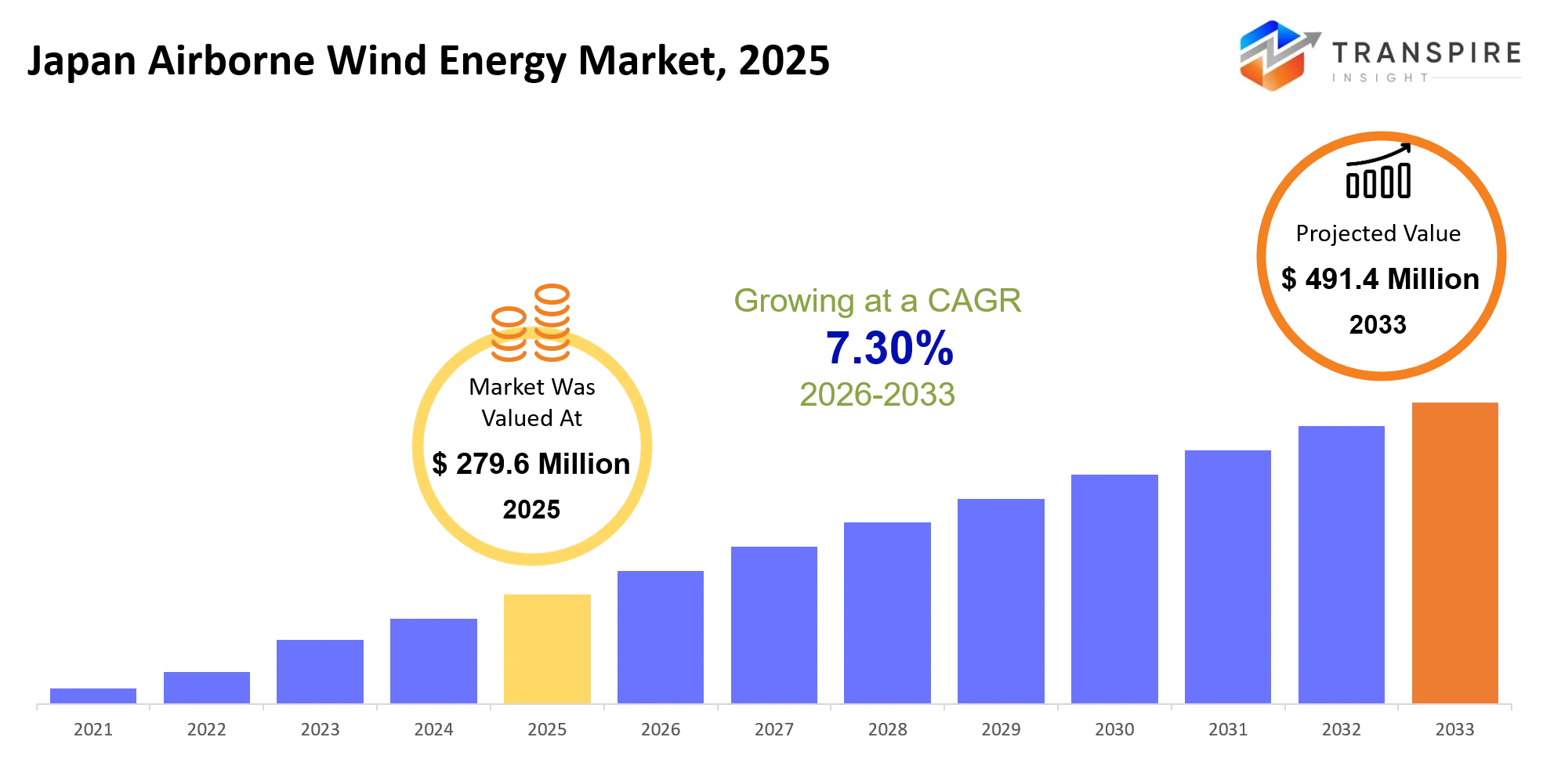
- Market Value (2025): USD 279.6 Million.
- Expected Market Value (2026): USD 300.1 Million.
- Estimated Market Value (2033): USD 491.4 Million.
- Forecast CAGR (2026–2033): 7.30%
Introduction
Airborne Wind Energy (AWE) is an emerging market that involves the creation, production, and installation of airborne flying machines, such as kites, gliders, balloons, or drones, which utilize stronger and more consistent high-altitude winds (from 300 to 10,000 meters) for the production of electricity without any huge towers. Airborne Wind Energy (AWE) is a renewable energy technology that is replacing the use of heavy tower structures on land with lighter airborne flying systems, like kites, drones, or wings. The Market for Airborne Wind Energy Systems (AWES) in Japan is moving forward using higher-altitude winds, lighter system designs, portability, and lower environmental impact. AWES devices have the ability to capture wind at altitudes that are hundreds of meters above the ground and thus can benefit from stronger winds that exist farther away from the ground. The need for less material such as larger towers and heavier foundations makes this technology potentially more cost-effective than traditional wind energy systems. Smaller size allows them to be placed in locations that may not be easily accessible. Being located in the air, these devices could also have fewer visual and noise impacts.
Key Market Highlights: -
- By technology, the Kites segment dominated the market and holds nearly 45% share in 2025 and is projected to grow at a substantial CAGR during the forecast period.
- By application, the Remote Power segment dominated the market and holds nearly 28% share in 2025 and is projected to grow at a substantial CAGR during the forecast period.
- By end user, the Industrial Companies segment dominated the market and holds nearly 43% share in 2025 and is projected to grow at a substantial CAGR during the forecast period.
- METI and NEDO Administration: METI and NEDO of Japan are involved in developing wind power, innovations in renewable energy, and advanced technologies. Through their various programs on offshore wind power generation, wind resource assessment, and cost reduction, they provide a conducive environment for development of AWES in Japan.
How is Technology Driving Growth in the Japan Airborne Wind Energy Market?
The Airborne Wind Energy Market in Japan is developing with the help of high-altitude technology, offshore technology, robotics, artificial intelligence, and materials technology. Research and development programs are examining the prospects of tethered kites and floating wind technology that allow accessing stronger and more stable winds and compensating for deep-sea conditions in Japan. Resistant to typhoons, floating wind and vertical axis designs are used to increase structural stability during storms. Marine engineering solutions, such as an efficient ballast system, make it possible to ensure the stability of platforms on turbulent sea surface. Robotics and artificial intelligence allow conducting maintenance and inspection of wind energy devices autonomously. Advanced materials such as carbon fibers, coatings, and durable materials improve performance and reliability of systems.
Market Drivers
The market for Japan’s AWES is primarily driven by factors such as land scarcity, carbon neutrality goals, the capacity for tapping into high altitude wind, and the rising demand for decentralized renewable energy solutions. Given Japan’s geographic features, which include many mountains, the country has limited land to develop onshore wind energy installations. Therefore, the drive for space-saving wind energy solutions has been propelled by land availability concerns. Carbon neutrality goals set by the Japanese government for 2050 provide support for innovations in renewable energy technology solutions. AWES will be able to tap into high altitude winds that are much stronger and constant. Airborne Wind Energy Systems (AWES) have multiple benefits to offer when it comes to the renewable energy sector in Japan because they make use of powerful winds at high altitudes, which can result in increased energy generation. Thanks to their simpler structure, AWES systems require fewer materials than traditional wind turbine structures. The flexible implementation of AWES is possible in regions where Japan’s topography, limited space and offshore regions limit the construction of traditional wind power plants. AWES can also help reduce visual impact due to smaller infrastructure on the ground level.
Restrain
The Japan Airborne Wind Energy Systems Market is exposed to the risks of severe weather conditions, constraints in transmission networks, high capital needs, and technical risks. Inclement weather conditions like typhoons and earthquakes and unfavorable operating conditions could increase operation and maintenance as well as structural protection costs. Transmission grid constraints could limit the deployment of the projects, while other technical risks include deep water.
Analysis of Prices and Consumer Behaviour
The market of Japan Airborne Wind Energy is mainly powered by the advancement in high-altitude and advanced airborne wind energy technology, along with the use of kite and tethered airborne flying robots owing to the overall renewable energy transition in Japan. In the Japanese wind energy market, the major part is occupied by the onshore market and will make up 95.12% of the market in 2025, whereas, in the market size, the share of 3-6 MW turbines is 47.65% and the utility scale accounts for 84.12%. The offshore wind market is anticipated to grow at 67.1% CAGR till 2031. The research in Japanese AWE is mainly focused on prototypes, autonomy of flights, use of tethers for transmitting energy, and high altitude winds. There are no Japan-specific verified sources about the market share, premium percentage, unit configuration, consumer preference, and procurement contract in AWE products.
Top Companies in the Japan Airborne Wind Energy Market
- Makani Technologies
- SkySails Power
- Kitemill
- Kitekraft
- EnerKite
- Ampyx Power
- TwingTec
- TwingTec Japan
- Altaeros Energies
- Windlift
- Twingtec
- SoftBank
- Mitsubishi Heavy Industries
- Toshiba Energy Systems
- IHI Corporation
Japan Airborne Wind Energy Market Segmentation
The Japan Airborne Wind Energy Market share is divided into six categories: By technology, system, application, capacity, location and end user.
The Kites dominated the market, accounting for nearly 45% in 2025 and is expected to rise at a significant CAGR during the forecast period.
The Japan Airborne Wind Energy Market is segmented by technology intoTethered Aircraft, Kites, Drones, Airborne Turbines, Gliders, Autogyros, Hybrid Systems, High-Altitude Platforms.. Among these, the Kites segment dominated the market, accounting for nearly 45% in 2025 and expected to increase at a significant CAGR during the forecast period. Segment 'Kites' is leading the market because of its capacity to capture strong and stable high altitude winds without needing much infrastructure on the ground. Their light weight and ability to deploy as per requirement makes them favorable, along with the increased investment in renewable energy and decarbonization efforts.
The Remote Power dominated the market, accounting for nearly 28% in 2025, and is expected to rise at a significant CAGR during the forecast period.
The Japan Airborne Wind Energy Market is segmented by application into Utility-Scale Power, Remote Power, Offshore Energy, Rural Electrification, Military Applications, Disaster Relief, Industrial Power, Microgrids. Among these, the Remote Power segment dominated the market, accounting for nearly 28% in 2025 and expected to increase at a significant CAGR during the forecast period. The Remote Power segment comes on top owing to the growing need for decentralized and dependable energy in Japan’s mountainous and isolated regions. The Airborne Wind Energy System requires little in terms of ground infrastructure and offers flexibility in renewable energy generation in areas where conventional grid access is difficult.
The Industrial Companies dominated the market, accounting for nearly 43% in 2025 and is expected to rise at a significant CAGR during the forecast period.
The Japan Airborne Wind Energy Market is segmented by end user into Utilities, Industrial Companies, Defense, Remote Communities, Oil & Gas, Mining, Telecom, Government. Among these, the Industrial Companies segment dominated the market, accounting for nearly 43% in 2025 and expected to increase at a significant CAGR during the forecast period. The leadership of the Industrial Companies Segment can be attributed to the rising popularity of Airborne Wind Energy Systems, which provide decentralized and reliable sources of renewable energy, along with optimization of costs. There is a rising demand among the industrial sector to utilize low-carbon energy and become less dependent on traditional energy systems.

Future Market Trends for the Japan Airborne Wind Energy Market: -
- AI-powered Autonomous Flight Control: AI will optimize trajectories of kites and tethers using real-time information about winds and weather.
- Hybrid Solar-PV Systems: Systems that combine both airborne wind energy and the PV system will be used to deliver the energy balance.
- Offshore & Floating Technology: The use of floating tethers allows harnessing winds from deeper waters, which enables extending maritime zones for development in Japan.
- Microgrid Power Plants: Portable and modular AWE systems will be aimed at distant Japanese islands and industries.
- Digital Twins & Robotics: Automation of ground stations and predictive maintenance will cut operational costs.
Recent Development
- In January 2026: Goto Floating Offshore Wind Power Project: The Japanese 16.8MW Goto floating offshore wind power project in Nagasaki is an example of how advanced offshore wind power technology is being implemented in Japan. Despite the fact that the project uses traditional wind turbines and not AWES systems, it can still be used as a learning experience for airborne wind projects.
- In July 2026: There was an experimental model of a Floating Axis Wind Turbine (FAWT), built by a Japanese consortium, located in Iki City, Nagasaki Prefecture. The wind turbine is rated at 20 kW, and it has a simplified design of a floating axis that is suitable for low-cost offshore deployment.
Market Segment
This study forecasts revenue at Japan, regional and country levels from 2020 to 2033. Transpire Insights has segmented the Japan Airborne Wind Energy Market based on the below-mentioned segments:
Japan Airborne Wind Energy Market, By Technology
- Tethered Aircraft
- Kites
- Drones
- Airborne Turbines
- Gliders
- Autogyros
- Hybrid Systems
- High-Altitude Platforms
Japan Airborne Wind Energy Market, By System Type
- Ground-Gen
- Fly-Gen
- Lift-Mode
- Drag-Mode
- Buoyant Systems
- Tethered Systems
- Autonomous Systems
- Hybrid Systems
Japan Airborne Wind Energy Market, By Application
- Utility-Scale Power
- Remote Power
- Offshore Energy
- Rural Electrification
- Military Applications
- Disaster Relief
- Industrial Power
- Microgrids
Japan Airborne Wind Energy Market, By Capacity
- Below 50 kW
- 50–100 kW
- 100–500 kW
- 500 kW–1 MW
- 1–5 MW
- 5–10 MW
- Above 10 MW
- Custom Systems
Japan Airborne Wind Energy Market, Location
- Onshore
- Offshore
- Remote Areas
- Islands
- Coastal Areas
- Mountainous Areas
- Rural Areas
- Urban/Industrial Areas
Japan Airborne Wind Energy Market, By End User
- Utilities
- Industrial Companies
- Defense
- Remote Communities
- Oil & Gas
- Mining, Telecom
- Government
Frequently Asked Questions
Find quick answers to common questions.
The Japan Airborne Wind Energy Market is projected to reach USD 491.4 million by 2033, growing at a 7.30% CAGR
The Kites segment dominates with nearly 45% share in 2025, supported by lightweight designs, flexible deployment, and high-altitude wind capture.
Remote Power holds nearly 28% share in 2025, driven by demand for decentralized renewable electricity across Japan’s remote, mountainous, and island regions.
Industrial Companies lead with nearly 43% share in 2025, supported by demand for reliable renewable energy, decarbonization, and operational cost optimization.
Key trends include AI-powered flight control, offshore technologies, hybrid renewable systems, microgrids, digital twins, robotics, and predictive maintenance for efficient deployment.
- Makani Technologies
- SkySails Power
- Kitemill
- Kitekraft
- EnerKite
- Ampyx Power
- TwingTec
- TwingTec Japan
- Altaeros Energies
- Windlift
- Twingtec
- SoftBank
- Mitsubishi Heavy Industries
- Toshiba Energy Systems
- IHI Corporation
About the Authors

Avinash Kumar
I’m Avinash Kumar, a Senior Research Analyst at Transpire Insight, with expertise in the Electronics and Semiconductor and Energy & Power industry. My work focuses on analyzing emerging technologies, market trends, industry developments, and innovation across these sectors. I specialize in transforming complex technical and market insights into clear, research-backed content that helps professionals, businesses, and decision-makers stay informed. Through continuous industry research and data-driven analysis, I strive to deliver accurate, reliable, and practical perspectives on the latest advancements shaping the semiconductor and energy landscape.

Chakradhar Khansole
Chakradhar serves as the Research Director at Transpire Insight, bringing over 8 years of experience in technology, innovation, and strategic market intelligence. He specializes in transforming complex market data into actionable business insights that enable organizations to make informed, growth-oriented decisions. Recognized for his strategic vision and analytical expertise, Chakradhar leads high-impact research initiatives, delivering comprehensive market assessments, competitive intelligence, and forward-looking industry analysis.
Recently Published Reports
-
Apr 2026
Active Power Filter Market
Active Power Filter Market Size, Share & Analysis Report By Type (Shunt Active Power Filters, Series Active Power Filter, Hybrid Active Power Filter), By Application (Harmonics Mitigation, Reactive Power Compensation, Voltage Regulation, Power Factor Correction), By Phase (Single Phase, Three Phase), By End-User Industry (Manufacturing, Healthcare, Commercial, Automotive, Oil and Gas, Others), and Geography (North America, Europe, Asia-Pacific, Middle East and Africa, South and Central America), 2021 - 2031
-
Apr 2026
Electrical Transformer Market
Electrical Transformer Market Size, Share & Analysis Report By Core (Closed, Shell, and Berry), By Insulation (Gas, Oil, Solid, Air, and Other), By Phase (Single, and Three), By Rating (100 MVA to 500 MVA, 501 MVA to 800 MVA, and 801 MVA to 1200 MVA), and Geography (North America, Europe, Asia-Pacific, Middle East and Africa, South and Central America), 2021 – 2031
-
Apr 2026
Hydraulic Piston Pumps Market
Hydraulic Piston Pumps Market Size, Share & Analysis Report By Type (Axial Piston Pumps, Radial Piston Pumps), By Operating Pressure (Low Pressure, Medium Pressure, High Pressure), By Application (Construction, Mining, Agriculture, Automotive, Oil & Gas, Industrial Machinery, Others), By End-User (OEMs, Aftermarket), and Geography (North America, Europe, Asia-Pacific, Middle East and Africa, South and Central America), 2021 – 2031
-
Apr 2026
Laboratory Gas Generators Market
Laboratory Gas Generators Market Size, Share & Analysis Report By Product (Nitrogen Gas Generator, Hydrogen Gas Generator, Zero Air Gas Generator, Purge Gas Generator, TOC Gas Generators, Others), By Application (Gas Chromatography, Liquid Chromatography-mass Spectrometry (LC-MS), Gas Analyzers, Others), By End-user (Life Science, Chemical & Petrochemical, Food & Beverage, Others), and Geography (North America, Europe, Asia-Pacific, Middle East and Africa, South and Central America), 2021 – 2031