

Europe Transportation and Logistics Services Market Summary
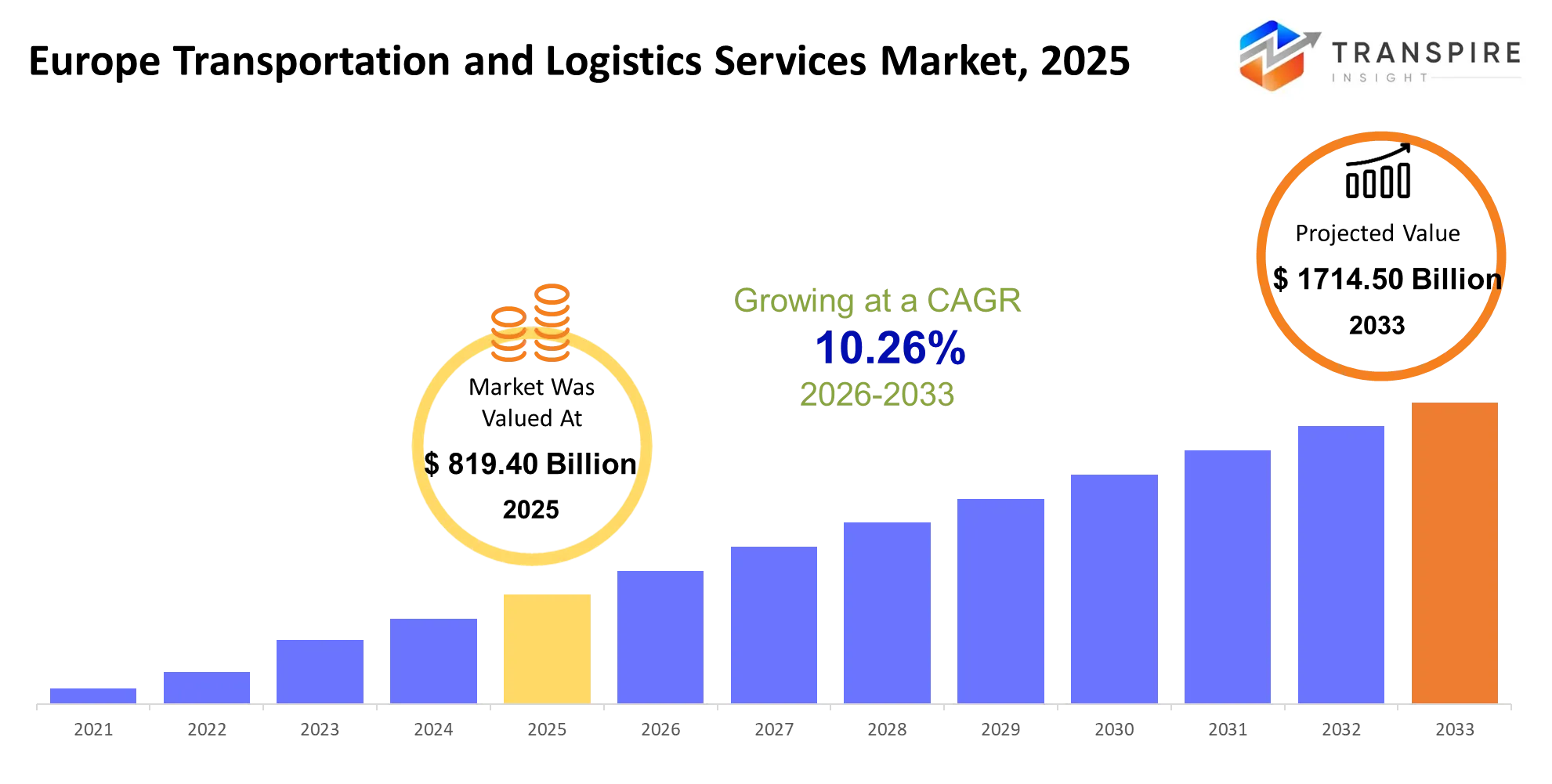
As per Transpire Insight Analysis the Europe Transportation and Logistics Services Market size is estimated at USD 819.40 Billion in 2025 and is anticipated to reach USD 1714.50 Billion by 2033, growing at a CAGR of 10.26% from 2026 to 2033.
Transport and logistics across Europe help keep shipments moving. They connect producers with places that store goods, along with shops, ports, and end buyers. Along the way, people handle schedules, plan routes, manage storage, deal with customs paperwork, and then complete the drop off to the customer.In the past three to five years, many logistics groups have moved off paper. They use more connected transport tools now. Warehouses have also changed, with more automation on the floor. Live shipment checks are used more often. Teams plan using data more frequently than before.
The COVID-19 outbreak exposed weak points in stock control and in freight links. Later, political disruptions made the situation harder. Many companies responded by changing routes. They also carried extra inventory to protect day to day operations. Some firms brought in more suppliers as well.
EU eFTI rules are driving the move toward electronic freight information. The full change is scheduled for July 2027. If this goes through as expected, the sector may save around EUR 1 billion each year. These gains help business results.More savings and smoother systems can raise revenue in related areas. That includes freight forwarding, contract logistics, and warehousing. It also supports demand for better shipment visibility. Work across transport modes, such as road and rail, benefits too.
Europe Transportation and Logistics Services Market Size & Forecast:
- Europe Transportation and Logistics Services Market Size 2025: USD 819.40 Billion
- Expected Market Value 2033: USD 1714.50 Billion
- Forecast CAGR: 10.26%
- Leading region in 2025: Germany
- Fastest Growing region: France
- Key Profile: DHL Supply Chain, Kuehne+Nagel, DSV, DB Schenker, CEVA Logistics, Maersk, UPS, FedEx, GXO Logistics, Dachser, Rhenus Logistics, Geodis, Hellmann Worldwide Logistics, ID Logistics, Wincanton
Key Market Insights
- Germany is still a major logistics hub in Europe. It has solid factories, reliable road links, and cross border routes that stay busy. It also has broad industrial coverage.
- In 2025, Poland handled 381.0 billion tonne kilometers. That was 20.2% of the EU’s road freight. Poland ranked first across the member states.
- Road freight carries most of the goods. In Germany in 2025, road hauling was 71.4% of domestic freight.
- eFTI is making paperwork faster. Certified e freight systems are planned to start in 2026. Full rollout is expected in July 2027.
- More teams are moving from AI trials to actual use. They apply it to map routes. They also use it to spot gear problems sooner. It helps forecast demand too. It can speed up customs steps and improve how warehouses coordinate.
- DHL has launched close to 10,000 projects for automation and digital tools around the world. It has also added more than 8,000 robots for shared tasks. Warehousing is shifting quickly.
- Online shopping is reshaping last mile work. Carriers are leaning into parcel automation. They are using time-flex delivery options. Some are setting up city based fulfillment. They also share live updates on orders.
- DHL expanded its Pepco agreement across five sites in Europe. The update covers 290,000 square meters. Retail shipments can move between countries with less friction.
- DSV wrapped up the Schenker takeover in April 2025. The deal was worth EUR 14.3 billion. It widened DSV’s network and pushed more consolidation across the wider logistics space.
- France is drawing large investment for logistics sites. DHL expects about EUR 160 million for 2026 to 2027. The funds support new capacity, new technology, and operations with lower emissions.
What are the Key Drivers, Restraints, and Opportunities in the Europe Transportation and Logistics Services Market?
Driver: Digital freight handling is turning into a must-have for day to day work, not a nice-to-have add on. The EU plan for eFTI sets one common way to share electronic freight details. It covers road, rail, inland water, and air. Full roll out is planned for July 2027. The European Commission also expects as much as EUR 1 billion per year in savings. These gains come from less paperwork and better sharing of information between parties. Logistics firms should see new income from transport management tools, digital paperwork, shipment tracking tools, customs related software, and combined control centers.
Restraint: Even with the push, the ground reality is still hard. Infrastructure gaps and old IT setups slow things down in a lasting way. Many big logistics groups run warehouses on different platforms. They also use separate customs systems, carrier lists, and different rules in each country.That situation means costs go up and the work takes longer. Data has to be moved. Cyber safety checks need to be put in place. Staff training is required. Old systems still have to be replaced. All of this can push out the time it takes to get automation running. It can also lower the return you get from spending on digital tools.
Opportunity: Central and Eastern Europe may be a strong growth spot. Poland, in particular, draws attention. In 2025, Poland handled 381.0 billion tonne-kilometres of EU road freight. By Q2 2025, warehousing and logistics space reached about 36 million square meters. This was 7.2% higher than the prior year.With that backdrop, logistics firms can put more effort into automated warehouses. They can also pursue cross-border service work, last mile delivery for online orders, and multimodal sites near Poland’s expanding industrial areas.
What Has the Impact of Artificial Intelligence Been on the Europe Transportation and Logistics Services Market?
AI is changing how logistics teams work. Instead of setting plans and waiting, they keep improving routes and timing as conditions change. Systems can read traffic patterns, weather, truck limits, shipment ranks, and delivery rules. They then update schedules on the fly. Other models try to guess when loads will arrive and how much demand will show up. DHL says its shipment forecasts can hit about 90% to 95% certainty for certain site volume ranges. That helps with courier planning and how resources get assigned.
Maintenance has also moved toward early detection. It can use sound, vibration, heat data, and camera signals to spot trouble before a big breakdown. DHL’s pilot for a 2025 sorting system tried audio AI plus IoT sensors. The goal was to catch maintenance issues early and avoid losing time later. AI is used in other parts too. It can help with customs paperwork. It can support picking items in a warehouse, building loads, planning inventory, and handling last-mile drops. DHL’s AI item recognition can create customs-ready item text from shipment photos. That lowers the need for manual typing and may cut the risk of clearance delays.
For sea freight, AI can track exhaust gas cleaning systems. It can also help with automatic scrubber settings and predictive checks. Still, there is a key problem. The results depend on data quality and how well systems connect. Old records that do not match can hurt accuracy. Rolling the setup out across a large logistics network can also cost a lot.
Key Market Trends
- Online shipping is now pulling more money into automated sites. Companies want quicker sorting too. Delivery slots are becoming more flexible. Many also push for better tracking on the final leg.
- In 2025, eFTI rollouts sped up work toward paperless freight forms. This applies to trucks, trains, inland ships, and planes.
- AI is no longer just a test. It helps plan routes, flag likely faults early, and prepare customs files. It also supports demand estimates and sends routine messages to customers.
- DHL added over 8,000 robot units meant to work alongside staff. That move highlights a trend in warehouses. People and machines now share tasks more often.
- In Poland, road freight hit 381.0 billion tonne-kilometres in 2025. The figure backs up the idea that Central Europe is growing in continental distribution.
- In 2025, DSV’s purchase of Schenker sped up the merge of operations. The result is a bigger hub across road, air, sea, and contract logistics.
- More firms now blend forwarding with warehousing. They also add pick and pack support, customs work, and transport control. This helps them win longer customer deals.
- DHL grew Pepco work to five distribution centers across Europe. It points to more uniform multi-country contract logistics plans.
- France is aiming at bigger logistics buildouts. DHL set aside EUR 160 million for 2026 to 2027 capacity and decarbonization efforts.
- Predictive maintenance is reaching warehouse machines and sorting lines. IoT sensors and AI spot breakdown risks before they cause delays.
Europe Transportation and Logistics Services Market Segmentation
By Transportation Mode:
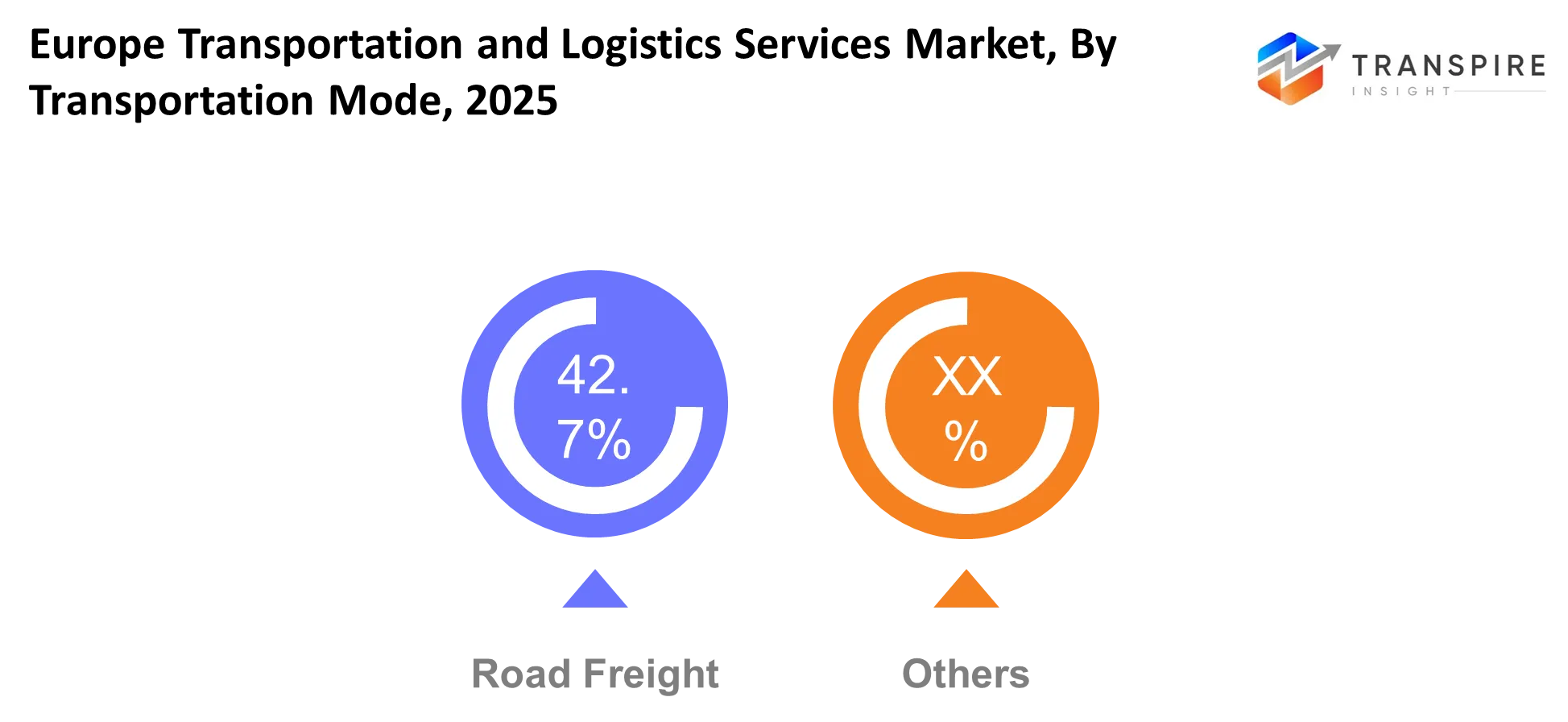
Road freight moves goods between nearby plants and nearby hubs, then out to shops and customers. Rail freight is used for large shipments over long inland routes. Air freight fits urgent, high-value loads that need quick delivery across borders. Sea freight carries big international shipments through major ports in Europe. Inland waterways can shift freight cheaply on rivers and canals. Pipeline transport keeps energy and chemical products moving in a steady flow.
Multimodal transport links several modes with shared plans and paperwork. Last-mile delivery takes goods from local centers to homes, stores, and business sites.In Europe, road freight stays important since highways link manufacturing areas to local demand. Rail freight is better for heavier loads. Air freight is picked for time-critical moves. Sea freight supports trade when volume matters most. Inland waterways, pipelines, multimodal services, and last-mile delivery each cover niche needs in industry, energy, retail, and online shopping routes.
By Service Type:
Freight forwarding handles international shipments. It picks carriers, files the paperwork, manages customs steps, and sets delivery timing.
Warehousing covers storage and day to day tasks. It also does picking and fulfillment work. Distribution moves goods from main sites to nearby areas. Transportation management runs the carrier side. It manages routes, timing, and freight pricing. Customs brokerage takes care of import and export documents. It also supports the clearance process. Inventory management watches what is in stock. It covers movement, restocking, and order availability.
Cold chain logistics protects items that need tight temperatures. It keeps products within set limits in both transit and storage. Reverse logistics deals with items that come back. That includes returns, fixes, recycling, refurbishment, and recovery.Some parts work together for cross border needs. Freight forwarding and transportation management play a big role there. Warehousing and distribution focus more on local orders. Customs brokerage is shifting as electronic systems grow. Many forms and checks are moving online. Inventory management helps keep stock tighter and more accurate. Cold chain logistics fits areas like healthcare and food. Reverse logistics is useful for online return flows and reuse efforts.
By Cargo Type:
General Cargo is for normal boxed items that travel on usual freight routes. Bulk Cargo moves big quantities of raw materials and needs special storage. Perishable Goods must stay in the right conditions and get delivered fast. Pharmaceuticals call for secure supply chains, full records, and temperature control with tight procedures. Automotive Parts rely on on-time drops so factories and repair networks keep running. Consumer Goods follow retail supply lanes. Chemicals need safety steps and the right paperwork. E-Commerce Parcels go through high-throughput sorting, must be tracked, timed for delivery, and handled for returns.
Across Europe, General Cargo and Consumer Goods drive a lot of everyday movement. The other groups need extra care. Perishable Goods and Pharmaceuticals are sensitive to time and temperature. Automotive Parts depend on tight schedules. Chemicals require controls for safety and rules. E-Commerce Parcels need fast repeat processing and strong last-mile delivery. Bulk Cargo uses dedicated transport setups, not standard lanes. E-Commerce Parcels also support frequent orders and quick fulfillment.
By Technology:
Transportation Management Systems help plan routes and match carriers to loads. They also track freight rates, manage timetables, and oversee shipment work. Warehouse Management Systems run day to day tasks inside the facility. They handle where stock sits, how items get picked and packed, and how staff time is used. They also guide the flow of work on the floor. GPS Tracking shares location updates for vehicles and shipments as they move. IoT ties together trucks, containers, warehouses, and sensors. It keeps data coming in so sites can monitor what is happening all the time. AI Analytics looks for trends across transport and inventory records. It supports better forecasts and day to day choices. It can also help with planning.
Robotics takes over repeat warehouse jobs like picking and sorting. It can also help move items around quickly. RFID allows fast product and asset checks without much manual work. Blockchain keeps secure logs for transactions. It also makes the records easy to trace among supply chain partners. Taken together, these tools form the main digital base for smooth operations. GPS Tracking and IoT boost visibility and monitoring of assets. AI Analytics supports planning and predictions. Robotics raises output in the warehouse. RFID improves inventory checks. Blockchain helps keep records reliable for high value or multi party cases.
By End User:
Making goods starts with shipping and logistics. Raw materials and parts need to travel. Work in progress must move too. Finished items also have to reach the right place.Shops depend on delivery routes. These routes keep shelves full. They also help customers find what they need.Online sales depend on fulfillment centers. Orders then go through shipping and packing. Returns have to be handled. Delivery to the door is the final step.Car factories need parts to arrive on schedule. Assembly lines cannot pause. So shipments must line up with the production plan.
Food and beverage companies ship products with care. Many loads require cold or warm control. That helps items stay safe and fresh.Healthcare services have to transport medicines and devices. Some items must stay at strict temperatures. Safety rules matter at every step.Chemical shipments require special handling. There are strict limits and clear procedures. Workers need safe steps for loading, moving, and delivery.Building sites run on timing. Supplies have to show up when crews need them. That includes materials, tools, machines, spare parts, and other site items.Across the board, manufacturing and retail both drive a lot of hauling. They also rely on large storage systems and wide distribution lanes.E-commerce depends on quick order processing. It also needs flexible delivery choices. Those choices can change as demand shifts.
In the automotive sector, parts must move quickly. The pace has to match what the plant needs next.Food and beverage delivery still needs stable conditions. Healthcare delivery also needs steady care.Chemicals and construction both use trained methods for transport. Items must be kept safe. Schedules also have to fit project timelines.
By Region:
Germany backs big transport and logistics activity via factories, links across central Europe, wide road coverage, and large industrial zones. The UK brings strong reach for global logistics with big ports, airports, cargo hubs, and retail supply links. France has good access to nearby continental buyers, key transport lines, and solid logistics sites. Italy supports logistics tied to production in auto, machinery, consumer goods, and retail delivery chains. Spain gives access to southern European markets and major routes for trade.
The Netherlands acts like a main distribution entry for Europe, with Rotterdam and lots of inland links. Belgium also plays a role in cross border logistics, using major ports and access to central Europe. Poland has grown into a key logistics center in central Europe. It has 36.0 million square meters of warehousing and logistics space as of Q2 2025, which is up 7.2% from the prior year. Germany, the UK, France, Italy, Spain, the Netherlands, Belgium, and Poland together support linked European freight, storage, order handling, and cross border distribution.
What are the Key Use Cases Driving the Europe Transportation and Logistics Services Market?
Freight still matters most for making goods and selling them. Factories and retail supply chains need trips that match well with storage, stock moves, packing work, and final delivery. In the EU, road freight is a big part of this. In 2025, EU road freight reached 1,886 billion tonne-kilometres.Other uses are growing too, especially e-commerce and health supply work. Online retail depends on fast picking and sorting in warehouses. It also needs parcel routing, last mile delivery, and returns handling. Healthcare logistics must keep items at the right temperature. It also needs clear trace records and safe handling for medicines and medical goods.
New directions are also showing up. Delivery networks may be managed with AI. Fleet checks can use predictive maintenance. Border steps can be handled more automatically through customs processing. There is also more focus on multimodal plans that work together. From 2027, the eFTI framework is set to help expand electronic freight data sharing. This can open doors for digital freight tools and linked logistics control systems.
|
Report Metrics |
Details |
|
Market size value in 2025 |
USD 819.40 Billion |
|
Market size value in 2026 |
USD 865.60 Billion |
|
Revenue forecast in 2033 |
USD 1714.50 Billion |
|
Growth rate |
CAGR of 10.26% from 2026 to 2033 |
|
Base year |
2025 |
|
Historical data |
2021 - 2024 |
|
Forecast period |
2026 - 2033 |
|
Report coverage |
Revenue forecast, competitive landscape, growth factors, and trends |
|
Regional scope |
Europe (Germany, United Kingdom, France, Italy, Spain and Rest of Europe) |
|
Key company profiled |
DHL Supply Chain, Kuehne+Nagel, DSV, DB Schenker, CEVA Logistics, Maersk, UPS, FedEx, GXO Logistics, Dachser, Rhenus Logistics, Geodis, Hellmann Worldwide Logistics, ID Logistics, Wincanton |
|
Customization scope |
Free report customization (country, regional & segment scope). Avail customized purchase options to meet your exact research needs. |
|
Report Segmentation |
By Transportation Mode (Road Freight, Rail Freight, Air Freight, Sea Freight, Inland Waterways, Pipeline Transport, Multimodal Transport, Last-Mile Delivery); By Service Type (Freight Forwarding, Warehousing, Distribution, Transportation Management, Customs Brokerage, Inventory Management, Cold Chain Logistics, Reverse Logistics); By Cargo Type (General Cargo, Bulk Cargo, Perishable Goods, Pharmaceuticals, Automotive Parts, Consumer Goods, Chemicals, E-Commerce Parcels); By Technology (Transportation Management Systems, Warehouse Management Systems, GPS Tracking, IoT, AI Analytics, Robotics, RFID, Blockchain); By End User (Manufacturing, Retail, E-Commerce, Automotive, Food & Beverage, Healthcare, Chemicals, Construction); By Region (Germany, UK, France, Italy, Spain, Netherlands, Belgium, Poland) |
Which Regions are Driving the Europe Transportation and Logistics Services Market Growth?
Germany is still the biggest regional market. It sits in the middle of key European trade routes, and it has a strong manufacturing sector. Good road and rail links move people and goods between automotive, chemicals, machinery, and consumer-goods sites in nearby countries. Germany also has many inland terminals, large airports, distribution hubs, and long-running freight companies. This means logistics firms can sell services to many kinds of clients. They can earn money through transport, storage, forwarding, and contract logistics, with demand that tends to hold up over time.
The UK is another large player. Its logistics setup is shaped more by outside trade and by global gateways. Air cargo and sea ports matter a lot, along with well-run retail distribution. Ports and airports help connect supply chains across borders. Online shopping also drives steady needs for storage, parcel handling, and returns. The UK has logistics systems that can stay firm even when the economy swings. That is partly because providers work with several sectors, not just one heavy industry. Digital tools for freight planning are now widely used. Warehouse automation is also growing, which helps keep service income more stable.
France is set to grow the quickest through 2033. That growth path looks different from Germany, where manufacturing size leads the market. In France, logistics growth is getting direct help from new infrastructure work. DHL plans to spend EUR 160 million in 2026 to 2027. The money is meant for more logistics capacity, upgrades to sites, and operations that produce fewer emissions.
Who are the Key Players in the Europe Transportation and Logistics Services Market and How Do They Compete?
Big logistics firms are getting larger. They buy other companies, and the rules of freight keep shifting as new tech changes costs and how work is done. What used to matter most, simple transport rates, is now less important. Buyers look more at size, how wide the network reaches, clearer shipment tracking, and skills in contract logistics. They also care about services that link multiple modes, not just trucks or only ocean freight. DSV’s deal for DB Schenker, worth EUR 14.3 billion, closed in April 2025. That move pushed consolidation forward in Europe for freight forwarding and contract logistics. Yet smaller firms are not locked out. Some still win by focusing on defined markets. Examples include healthcare, automotive, cold chain, and e-commerce. In these areas, custom service can matter more than standard pricing.
DHL Supply Chain is also growing. The company is adding more contract logistics sites, bringing in automation, and forming partnerships in regions. One example is a 2026 expansion with Pepco. That plan covers five European distribution centers. Kuehne+Nagel stands out in a different way. It leans on its own digital tools and on AI. The AI is used for things like air freight pricing and customs paperwork. Over time, the plan is to expand automation in wider parts of its work.
DSV is getting more scale by absorbing Schenker. The integration brings together air, sea, road, and contract logistics under one group. CEVA Logistics plays on linked freight forwarding plus contract logistics. GXO puts a lot of weight on automated warehousing and fulfillment. Both can go after clients who want specific operations, not only extra transport capacity.
Company List
- DHL Supply Chain
- Kuehne+Nagel
- DSV
- DB Schenker
- CEVA Logistics
- Maersk
- UPS
- FedEx
- GXO Logistics
- Dachser
- Rhenus Logistics
- Geodis
- Hellmann Worldwide Logistics
- ID Logistics
- Wincanton
Recent Development News
- "In April 2025, DSV completed the acquisition of DB Schenker for approximately EUR 14.3 billion. The transaction expanded DSV's global freight forwarding and contract logistics network and strengthened consolidation across European transportation services.http://dsv.gcs-web.com/news-releases/news-release-details/dsv-1154-dsv-completes-acqusition-schenker (DSV A/S)."
- "In June 2026, DHL Group announced an investment of around EUR 160 million in France during 2026–2027. The investment will expand logistics capacity, upgrade infrastructure, and accelerate lower-emission operations, strengthening France's position as a European logistics hub.http://group.dhl.com/en/media-relations/press-releases/2026/dhl-group-to-invest-around-eur160-million-in-2026-2027-to-strengthen-logistics-infrastructure-and-support-clean-energy-transition-in-france.html (DHL Group)."
What Strategic Insights Define the Future of the Europe Transportation and Logistics Services Market?
The market is shifting toward one connected logistics setup. In that model, freight, storage, stock handling, customs work, and final delivery share the same digital tools. What drives this change is not only more shipping. It is the money gained from seeing everything clearly and replying quickly when plans break. Manufacturers are reshaping their supply chains for stability and for sourcing closer to home. There is also a downside that can be easy to miss. If a few big firms buy many others, the network can get more efficient but less open. Suppliers may have fewer options. Too much trust can build around a small set of large logistics platforms.
Still, there is a chance that stands out. AI systems can act like a control tower. They can bring together shipment updates, warehouse space, customs details, and early disruption signals. Then they can handle exceptions across mixed transport modes in a more automatic way. France looks like a strong place to grow. Infrastructure spending is picking up, and France is working to strengthen its position as a logistics hub in Europe.
For decision makers, the priority should be clear. Choose AI tools and transportation management systems that can work together. Aim to link what is already in use, instead of replacing whole logistics setups.
Europe Transportation and Logistics Services Market Report Segmentation
By Transportation Mode
- Road Freight
- Rail Freight
- Air Freight
- Sea Freight
- Inland Waterways
- Pipeline Transport
- Multimodal Transport
- Last-Mile Delivery
By Service Type
- Freight Forwarding
- Warehousing
- Distribution
- Transportation Management
- Customs Brokerage
- Inventory Management
- Cold Chain Logistics
- Reverse Logistics
By Cargo Type
- General Cargo
- Bulk Cargo
- Perishable Goods
- Pharmaceuticals
- Automotive Parts
- Consumer Goods
- Chemicals
- E-Commerce Parcels
By Technology
- Transportation Management Systems
- Warehouse Management Systems
- GPS Tracking
- IoT
- AI Analytics
- Robotics
- RFID
- Blockchain
By End User
- Manufacturing
- Retail
- E-Commerce
- Automotive
- Food & Beverage
- Healthcare
- Chemicals
- Construction
By Region
- Germany
- UK
- France
- Italy
- Spain
- Netherlands
- Belgium
- Poland
Frequently Asked Questions
Find quick answers to common questions.
The expected Europe Transportation and Logistics Services Market size for the market will be USD 1714.50 Billion in 2033.
Key segments for the Europe Transportation and Logistics Services Market are By Transportation Mode (Road Freight, Rail Freight, Air Freight, Sea Freight, Inland Waterways, Pipeline Transport, Multimodal Transport, Last-Mile Delivery); By Service Type (Freight Forwarding, Warehousing, Distribution, Transportation Management, Customs Brokerage, Inventory Management, Cold Chain Logistics, Reverse Logistics); By Cargo Type (General Cargo, Bulk Cargo, Perishable Goods, Pharmaceuticals, Automotive Parts, Consumer Goods, Chemicals, E-Commerce Parcels); By Technology (Transportation Management Systems, Warehouse Management Systems, GPS Tracking, IoT, AI Analytics, Robotics, RFID, Blockchain); By End User (Manufacturing, Retail, E-Commerce, Automotive, Food & Beverage, Healthcare, Chemicals, Construction); By Region (Germany, UK, France, Italy, Spain, Netherlands, Belgium, Poland).
Major Europe Transportation and Logistics Services Market players are DHL Supply Chain, Kuehne+Nagel, DSV, DB Schenker, CEVA Logistics, Maersk, UPS, FedEx, GXO Logistics, Dachser, Rhenus Logistics, Geodis, Hellmann Worldwide Logistics, ID Logistics, Wincanton.
The Europe Transportation and Logistics Services Market size is USD 819.40 Billion in 2025.
The Europe Transportation and Logistics Services Market CAGR is 10.26% from 2026 to 2033.
- DHL Supply Chain
- Kuehne+Nagel
- DSV
- DB Schenker
- CEVA Logistics
- Maersk
- UPS
- FedEx
- GXO Logistics
- Dachser
- Rhenus Logistics
- Geodis
- Hellmann Worldwide Logistics
- ID Logistics
- Wincanton
About the Authors

Mayur Shinde
I am Mayur Shinde, a Senior Research Analyst at Transpire Insight, specializing in the Automotive & Transportation and Information & Communication Technology (ICT) Industry. My work focuses on analyzing emerging market trends, technological advancements, competitive landscapes, and industry developments to deliver accurate, data-driven insights. I am passionate about transforming complex market information into clear, actionable content that helps businesses, professionals, and decision-makers stay informed and make confident strategic decisions.

Chakradhar Khansole
Chakradhar serves as the Research Director at Transpire Insight, bringing over 8 years of experience in technology, innovation, and strategic market intelligence. He specializes in transforming complex market data into actionable business insights that enable organizations to make informed, growth-oriented decisions. Recognized for his strategic vision and analytical expertise, Chakradhar leads high-impact research initiatives, delivering comprehensive market assessments, competitive intelligence, and forward-looking industry analysis.
Recently Published Reports
-
Apr 2026
ATV & UTV Market
ATV & UTV Market Size, Share & Analysis Report By Type (ATV, and UTV), By Variants (Less Than 400 CC, 400 CC To 800 CC, and More Than 800 CC), and Geography (North America, Europe, Asia-Pacific, Middle East and Africa, South and Central America), 2021 - 2031
-
Apr 2026
Automotive Central Gateway Module Market
Automotive Central Gateway Module Market Size, Share & Analysis Report By Type (Ethernet Central Gateway Module, CAN Central Gateway Module, LIN Central Gateway Module, and FlexRay), By Application (Powertrain Control, Body Control, Infotainment System, Advanced Driver Assistance Systems (ADAS), and Others), By End User (Passenger Vehicles, and Commercial Vehicles), and Geography (North America, Europe, Asia-Pacific, Middle East and Africa, South and Central America), 2021 - 2031
-
Apr 2026
Automotive Engine Oil Filter Market
Automotive Engine Oil Filter Market Size, Share & Analysis Report By Filter Type (Fuel Filter, Engine Oil Filter, Hydraulic Oil Filter, and Others), By Filter Media (Cellulose, Synthetic, and Micro), By Sales Channel (OEMs, and Aftermarket), By Vehicle Type (Passenger Cars, Light Commercial Vehicles, Heavy Duty Trucks, Buses and Coaches, and Off-road Vehicles), and Geography (North America, Europe, Asia-Pacific, Middle East and Africa, South and Central America), 2021 - 2031
-
Apr 2026
Automotive Parts Aluminium Die Casting Market
Automotive Parts Aluminium Die Casting Market Size, Share & Analysis Report By Production Process (Pressure Die Casting, Vacuum Die Casting, Squeeze Die Casting, Gravity Die Casting), By Application (Body Parts, Engine Parts, Transmission Parts, Battery And Related Components, Other Application Types), and Geography (North America, Europe, Asia-Pacific, Middle East and Africa, South and Central America), 2021 - 2031
Our Clients



