
South Korea Membrane Electrode Assembly Market Size & Forecast:
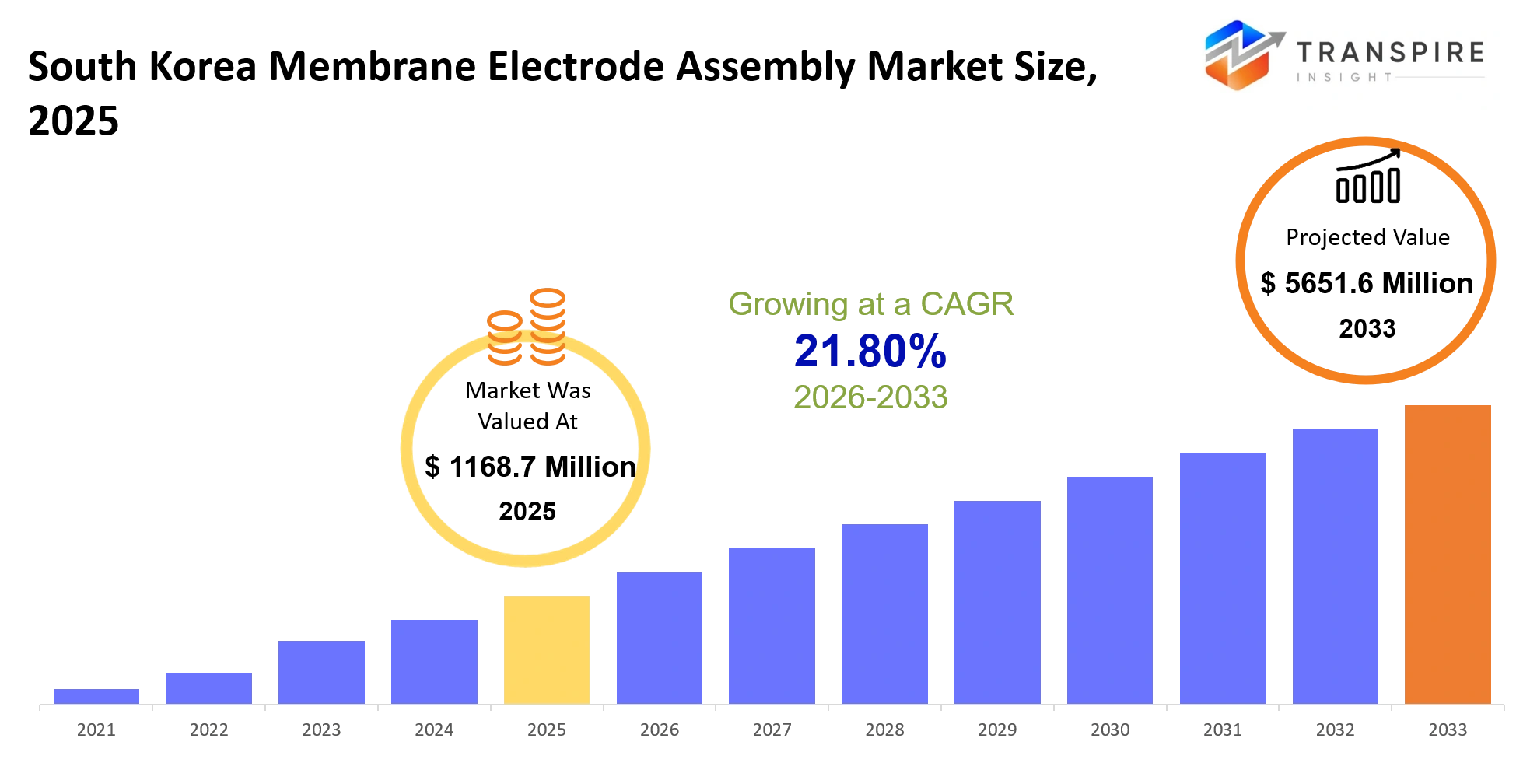
- South Korea Membrane Electrode Assembly Market Size 2025: USD 1168.7 Million
- South Korea Membrane Electrode Assembly Market Size 2033: USD 5651.6 Million
- South Korea Membrane Electrode Assembly Market CAGR: 21.80%
- South Korea Membrane Electrode Assembly Market Segments: By Component (Catalyst Layers, Gas Diffusion Layers, Proton Exchange Membranes, Others); By Application (Fuel Cell Electric Vehicles, Stationary Fuel Cells, Portable Power Systems, Electrolyzers, Others); By Fuel Cell Type (PEM Fuel Cells, Direct Methanol Fuel Cells, Alkaline Fuel Cells, Others); By End User (Automotive Industry, Energy & Utilities, Industrial Sector, Electronics Industry, Others); By Material (Platinum-based Catalysts, Carbon-based Materials, Composite Membranes, Others).
To learn more about this report,  Download Free Sample Report
South Korea Membrane Electrode Assembly Market Summary
The South Korea Membrane Electrode Assembly Market was valued at USD 1168.7 Million in 2025. It is forecast to reach USD 5651.6 Million by 2033. That is a CAGR of 21.80% over the period.
In actuality, membrane electrode assemblies kinda work as the electrochemical core inside hydrogen fuel cells, letting vehicles , stationary power systems, and industrial backup units convert hydrogen into electricity that is only paired with water as a byproduct. In South Korea the adoption story has changed from pilot scale demonstrations toward more integrated deployment across mobility fleets and distributed energy systems, where reliability and energy efficiency really touch operating costs , right in practice.
Over the last five years , the market moved away from imported dependence toward localized stack integration, and it looks like this is pushed by domestic fuel cell manufacturing growth and by more strict hydrogen mobility targets that come with national decarbonization programs. A noticeable structural shift is the move from small scale PEM fuel cell pilots to broader mass deployment in buses and stationary power units. The momentum kind of started when stricter hydrogen economy roadmaps arrived, plus global supply chain disruptions that made the weaknesses obvious in imported catalyst and membrane sourcing. So, manufacturers are scaling domestic MEA production to keep supply continuity stable and to boost cost efficiency, in a more practical way.
Key Market Insights
- South Korea Membrane Electrode Assembly Market is kind of consolidating around hydrogen mobility platforms, and the stationary fuel systems as well, this is pushed by national decarbonization mandates.
- In 2025 the fuel cell vehicle adoption hit more than 30% higher fleet integration , and that is lifting MEA demand across OEM supply chains too.
- The leading region is South Korea , which holds an estimated 70–75% domestic share because fuel cell manufacturing clusters are concentrated there.
- The fastest-growing export-linked segment is expanding through 2026–2033 as global hydrogen infrastructure investments speed up, and basically pull more orders in.
- On the product side PEM-based MEA is still dominant with over 80% share, mostly tied to automotive-grade efficiency and durability requirements.
- The second-largest segment is stationary power systems, and it’s supported by industrial backup energy demand in data centers , as well as utilities.
- For growth rate the fastest-moving slice is heavy-duty transport applications, with hydrogen bus deployments and truck rollouts increasing steadily.
- If we look by application, fuel cell vehicles are the leader, making up more than 60% of installed MEA demand in 2025.
- There is also an emerging application like maritime auxiliary power systems, driven by port decarbonization initiatives , and those are becoming more visible.
What are the Key Drivers, Restraints, and Opportunities in the South Korea Membrane Electrode Assembly Market?
The primary driver of the South Korea Membrane Electrode Assembly Market seems to be the fast commercialization of hydrogen fuel cell mobility , under national energy transition policies, kind of pushing everything forward. Government buying programs for hydrogen buses and logistics fleets have moved demand away from prototype stacks and toward repeatable industrial output. That change has directly bumped MEA consumption because each vehicle , and even each stationary unit, ends up needing several high-performance electrode layers, so you get these recurring replacement rhythms. Then the aftermarket demand follows too, for durability upgrades and so on.
The biggest restraint is still dependence on high cost catalyst materials like platinum group metals which stay exposed to unpredictable global supply chains. Even if some assembly is done locally , raw material import reliance makes it hard to cut costs, plus it adds structural pricing pressure on OEMs. As a result, it slows the path to wide scale price parity with battery electric systems, and it also tends to suppress adoption in cost sensitive commercial settings, where margins are tight.
A noticeable opportunity is starting to show up through localized gigafactory-scale MEA production that is integrated with hydrogen corridors across South Korea , especially around port and logistics zones. Plants connected to Ulsan and Incheon are starting to sync fuel cell output with shipping , trucking , and port equipment electrification. This ecosystem style integration could unlock new demand pools beyond just automotive, including industrial backup power, and maritime auxiliary systems too.
What Has the Impact of Artificial Intelligence Been on the South Korea Membrane Electrode Assembly Market?
Artificial intelligence is getting more and more woven into membrane electrode assembly production and fuel cell system optimization, rather than into the MEA itself. In manufacturing settings, AI vision systems are used to check catalyst coating uniformity and spot membrane defects with micron-level precision, which cuts down on the usual manual inspection missteps and helps keep production yield steadier. When the systems are actually running, fuel cell stack management frameworks rely on machine learning models to tune hydrogen flow, manage humidity equilibrium, and hold thermal conditions in real time, so overall stability improves even when the load swings around.
Predictive analytics is also being pushed to foresee degradation patterns in MEA layers by looking at voltage decay “signatures” plus the history of operational cycling. That supports maintenance planning, so there are fewer surprises and less unplanned downtime in hydrogen buses and for stationary power units. A lot of operators mention clear, directional gains in uptime reliability, plus smoother efficiency curves when demand is not consistent, mainly during fleet operations.
Still, AI uptake is held back by the fact that real-world training data is often constrained, particularly for long-duration maritime and heavy-duty use, where conditions can vary a lot. And in remote fleet environments, connectivity can be limited, so updates for the models can’t happen as quickly, which ends up lowering predictive accuracy once things are out in the field.
Key Market Trends
- MEA manufacturing sort of moved away from import reliance in 2020, then by 2025 it reached well over 60% localized integration in South Korea .
- During 2024 to 2025, hydrogen bus rollout kept growing fast, and that also sped up stack replacement cycles across different fleet operators.
- OEM partnerships got stronger too, like Toyota Industries , plus Korean suppliers, they co-developed tougher MEA stacks for logistics vehicles.
- Then in 2025, catalyst cost volatility showed up, so manufacturers ended up redesigning electrode structures for better lower platinum loading efficiency . On the other side, stationary fuel cell use in data centers rose, because backup power reliability demands got stricter after grid instability incidents.
- For exports, production leaned more outward, through collaborations between Johnson Matthey and Asian fuel cell integrators.
- Meanwhile hydrogen infrastructure in port cities expanded quickly, which nudged MEA demand for auxiliary marine systems and shore power setups .
- Material innovation cycles also seemed to get shorter, as DuPont rolled out more durable membrane layer improvements.
- Overall, competition shifted away from plain cost, toward lifecycle durability , and energy conversion efficiency upgrades .
- Finally, government-led hydrogen corridor projects during 2024 to 2026, kind of re-channeled where demand clustered across industrial areas.
South Korea Membrane Electrode Assembly Market Segmentation
By Component
Catalyst Layers hold a leading position in fuel cell stack design, mostly because they affect electrochemical reactions that decide efficiency and power density, kinda directly. There is also a high dependency on platinum based formulations, so the value has been clustered in this part of the market, particularly for mobility focused use cases. Gas Diffusion Layers keep a strong, yet secondary role, they help with uniform reactant distribution and water management, and that matters for durability in transport systems. Proton Exchange Membranes are more tech sensitive, where performance stability and chemical resistance really shape adoption decisions. The rest of the components stay smaller in share, but they still support system level integration needs across various niche applications.
Catalyst Layers will keep pulling most of the innovation attention, as manufacturers try to cut down precious metal loading without hurting output performance. Gas Diffusion Layers should grow steadily too, tied to the rising need for long-life fuel cell stacks in commercial transport fleets. Proton Exchange Membranes are likely to move faster, since durability requirements in heavy duty and stationary uses are tightening the improvement cycles. Looking ahead, future investment will focus on material engineering breakthroughs that reduce degradation rates, and also raise lifecycle efficiency. Component by component differentiation will increasingly decide how suppliers compete and where they land in the market.
By Application
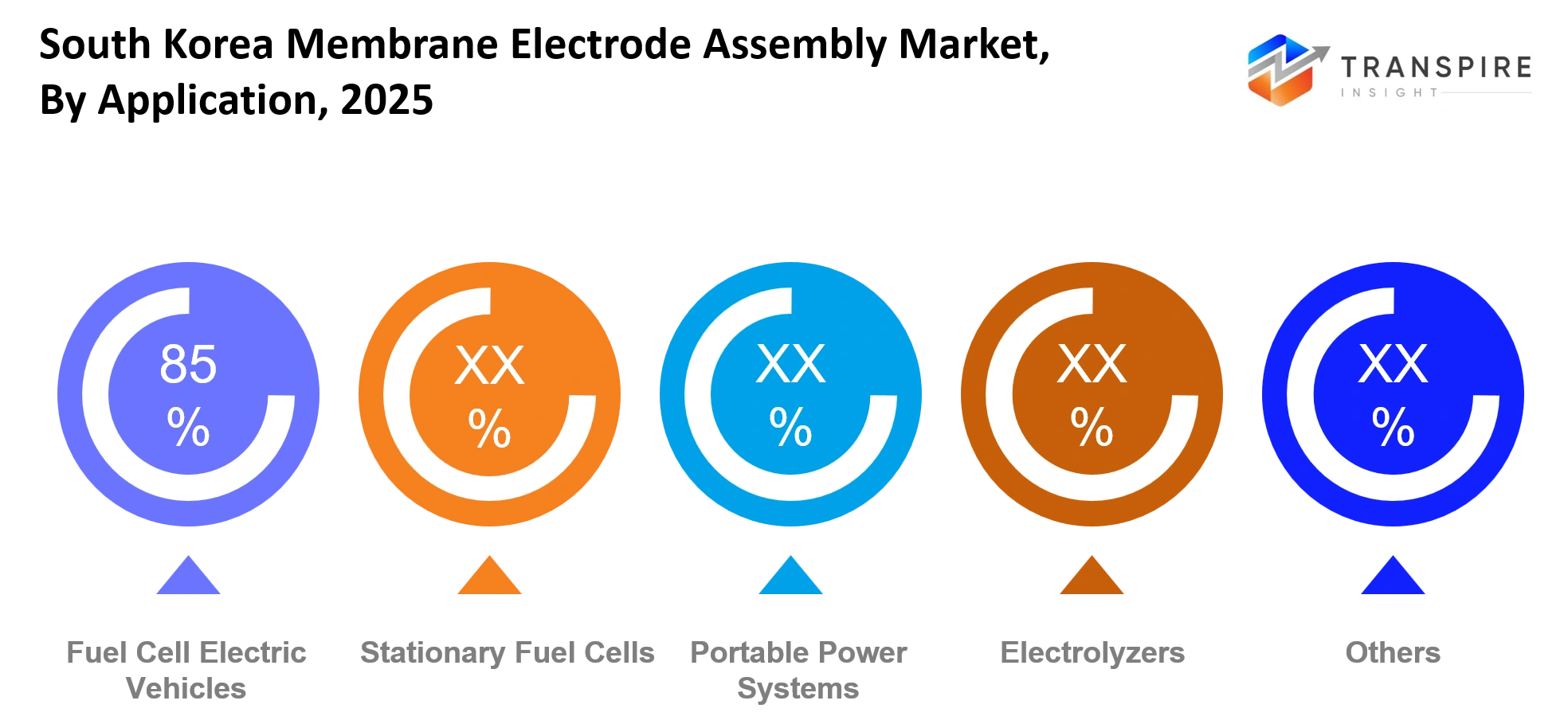
Fuel Cell Electric Vehicles currently keep the lead, as transportation electrification programs start pushing hydrogen bus fleets and other commercial fleets at bigger scale. There’s also, steady procurement momentum from public transport operators, plus logistics providers who want strong high performance stack systems. Meanwhile Stationary Fuel Cells keep a pretty stable foothold, mostly because backup power is still required for data centers, telecom setups and industrial operations. Portable Power Systems are smaller, but still matter—especially where remote power is needed or when emergencies pop up. And then there are Electrolyzers, which are showing up as a key neighboring application, directly tied to expanding hydrogen production infrastructure.
In the near to medium term, Fuel Cell Electric Vehicles should keep anchoring demand as mobility decarbonization programs broaden across city transport routes. Stationary Fuel Cells are likely to move upward at a steady pace too, given the growing worries around grid reliability and wider distributed energy adoption. Electrolyzers are expected to turn into a faster growth area because hydrogen production is being scaled up through national energy strategies. Portable Power Systems will stay relatively niche, but they remain strategically relevant for off grid contexts and defense use cases. Overall, application diversification should help smooth out the dependence on automotive only demand cycles, so the whole market is less sensitive to just one segment.
To learn more about this report, Download Free Sample Report
By Fuel Cell Type
PEM Fuel Cells are kind of taking over the market, not just because of high efficiency but also fast start up capability, and because they fit pretty well for transport plus stationary use when you need quick dynamic load response. Also the strong integration into automotive fuel cell platforms has, in a way, locked in their leading position. Direct Methanol Fuel Cells keep only a restricted share since their energy density is lower, though they still make sense for portable use, especially where hydrogen infrastructure is missing. Alkaline Fuel Cells work well for specialized industrial and aerospace applications, but they hit some roadblocks for wider commercial uptake, largely because the system is more complex and it is quite sensitive to carbon dioxide exposure. The other fuel cell types are mostly experimental, or just in early commercialization, sort of still in the background.
For what comes next PEM Fuel Cells will stay the main growth driver as automotive and distributed energy programs keep scaling up. Direct Methanol Fuel Cells could expand slowly in niche portable and military systems, where fuel flexibility is, well, the point. Alkaline Fuel Cells will likely keep a limited but steady footprint in specialized industrial settings. Looking ahead, future growth will depend on improving PEM durability and reducing catalyst dependency to make the costs more competitive, less painful. Fuel cell diversification will probably remain pretty tight, and PEM technology will keep its structural dominance, more or less.
By End User
The Automotive Industry still feels like the main end-user segment, mostly because hydrogen fuel cell systems get integrated at big scale into buses trucks and passenger cars. There’s also this kind of strong buy-in between OEM plans and national hydrogen mobility policies, which has kept demand steady for a while now. Then Energy & Utilities, that one is a notable segment too, driven by distributed power generation plus backup energy systems that are needed for critical sites. The Industrial Sector is picking up gradually, since factories want low-emission electricity or at least power options that look cleaner, and Electronics Industry is smaller but it stays steady, mainly because it covers backup energy and portable setups.
In the near future, Automotive Industry will still lead overall demand, especially as hydrogen mobility ecosystems spread across commercial transport routes. Energy & Utilities should keep moving upward, not suddenly but consistently, due to more distributed generation and the rising need for grid resilience. Industrial Sector adoption is expected to speed up as emissions rules get stricter and energy diversification becomes more of a requirement. Electronics Industry will likely stay stable, with only incremental take-up for specialized use cases. And overall, when end-users keep expanding across sectors, it should support long-term demand steadiness too.
By Material
Platinum based Catalysts have the dominant position because of their superior electrochemical performance and the fact theyre already used in high efficiency fuel cell systems, in a kinda proven way. Still, supply constraints and cost volatility keeps squeezing manufacturers, so they try to optimize how much they use. Carbon based Materials keep a strong supporting role, especially in gas diffusion structures and for conductivity enhancement things that make the whole system work smoother. Composite Membranes are getting more attention too, mostly due to better durability and resistance to chemical degradation when the operating load gets high. Then there are other materials, which show up in specialized or experimental fuel cell designs depending on what someone is trying to test or improve.
Platinum based Catalysts will remain central, but there will be gradual substitution pressure, driven by reduction strategies and alloy innovation. Carbon based Materials will probably keep steady growth, because structural tuning and conductivity optimization are still needed. Composite Membranes are expected to expand faster as durability becomes a major performance requirement in both mobility and stationary systems. Material innovation will increasingly lean toward cost reduction and lifecycle extension, not just higher output. In the end, future competitiveness will depend more on advanced material engineering rather than pure performance scaling, and that part will matter more over time.
What are the Key Use Cases Driving the South Korea Membrane Electrode Assembly Market?
In South Korea, the main, or dominant, use case for membrane electrode assemblies is fuel cell electric vehicles, especially hydrogen buses and those commercial fleets that run all day. In practice, that’s where the biggest demand comes from, because they need high endurance stacks that can keep cycling without much trouble, even with typical city stop and go patterns. So the MEA performance kind of becomes tied directly to fleet availability, and then to whole operating costs, like it’s all connected.
Besides that, you also see expansion toward stationary backup power systems. Think data centers, telecom setups, and industrial plants. For these buyers, reliability is the real headline, not so much the lowest price. That preference makes MEA-based fuel cells a pretty attractive alternative to diesel generators, even if the upfront discussion gets more serious.
More emerging use cases show up in maritime auxiliary power, plus electrification of port equipment. Here, hydrogen fuel cells are being trialed, partly to meet emissions reduction rules and compliance goals. Also, logistics hubs are checking hydrogen forklifts, and even cold-chain transport units, so the channels are still early-stage, but the momentum is quickly growing.
|
Report Metrics |
Details |
|
Market size value in 2025 |
USD 1168.7 Million |
|
Market size value in 2026 |
USD 1421.1 Million |
|
Revenue forecast in 2033 |
USD 5651.6 Million |
|
Growth rate |
CAGR of 21.80% from 2026 to 2033 |
|
Base year |
2025 |
|
Historical data |
2021 - 2024 |
|
Forecast period |
2026 - 2033 |
|
Report coverage |
Revenue forecast, competitive landscape, growth factors, and trends |
|
Regional scope |
South Korea |
|
Key company profiled |
Hyundai Motor Company, Ballard Power Systems, Plug Power, Johnson Matthey, Gore, DuPont, 3M, Toyota Industries, Umicore, Bosch, Doosan Fuel Cell, Horizon Fuel Cell Technologies, Advent Technologies, AVL List, Nedstack Fuel Cell Technology. |
|
Customization scope |
Free report customization (country, regional & segment scope). Avail customized purchase options to meet your exact research needs. |
|
Report Segmentation |
By Component (Catalyst Layers, Gas Diffusion Layers, Proton Exchange Membranes, Others); By Application (Fuel Cell Electric Vehicles, Stationary Fuel Cells, Portable Power Systems, Electrolyzers, Others); By Fuel Cell Type (PEM Fuel Cells, Direct Methanol Fuel Cells, Alkaline Fuel Cells, Others); By End User (Automotive Industry, Energy & Utilities, Industrial Sector, Electronics Industry, Others); By Material (Platinum-based Catalysts, Carbon-based Materials, Composite Membranes, Others). |
Which Regions are Driving the South Korea Membrane Electrode Assembly Market Growth?
South Korea keeps showing up as the leading region, mainly because its hydrogen policy ecosystem is tightly stitched together , and because the domestic manufacturing base for fuel cells is really solid. In practice, the industrial clusters around Ulsan and Gyeonggi Province help everything line up , with OEMs, material providers, and stack integrators basically operating inside one supply network. On top of that, government buying programs for hydrogen buses and municipal fleets create a stable “floor” of demand , so companies can plan and iterate without too much uncertainty. Because of this whole setup, MEA technologies can move from lab work to scaled commercialization pretty quickly, almost in a straight line.
Japan and parts of Europe work more like a stable secondary benchmark area, not as the primary engine but still important. They contribute indirectly via technology cooperation and component standardization efforts. Compared with South Korea’s deployment-forward approach, these places tend to focus on longer-cycle infrastructure buildup, plus efficiency tuning over time . Their hydrogen demand stays steady, since adoption in both industrial and residential segments is happening gradually. That consistency also helps protect export opportunities for Korean MEA suppliers, since buyers can keep procurement rhythms without sudden reversals.
If we talk about the fastest growth, Southeast Asia looks like the real momentum holder, mostly fueled by newer investments in hydrogen-ready ports and logistics modernization programs . Nations such as Singapore and Indonesia are upgrading maritime infrastructure so it matches decarbonization targets aimed at the 2030s. That change is opening up fresh entry points for Korean MEA exporters who want expansion beyond current domestic limits. Over 2026–2033, this region should become a key diversification market, not just a side option.
Who are the Key Players in the South Korea Membrane Electrode Assembly Market and How Do They Compete?
Competition in the South Korea Membrane Electrode Assembly Market is kinda moderately consolidated, though it still feels like a small set of OEM-tied manufacturers plus a few big global materials science groups keep most of the really high-performance stack knowhow. In practice the main fight is on technological efficiency, especially catalyst usage, endurance during thermal cycling, and ultimately cost per kilowatt output, not so much on raw production scale, if that makes sense.
Hyundai Motor Company leans hard into vertical integration by dropping fuel cell systems right into mobility platforms, so it becomes less dependent on outside MEA suppliers. Ballard Power Systems plays the efficiency angle with stack designs that push performance, and they also use licensing partnerships with Asian OEMs to widen their regional footprint. Johnson Matthey is more about catalyst innovation, and specifically low-platinum formulations, which helps cut long term system costs.
DuPont holds ground through membrane materials that push better chemical steadiness and a longer service life, even when the load cycling gets intense. Plug Power continues expanding via system-level integration, plus investments across the hydrogen ecosystem, with a direct eye on logistics and warehouse use cases. Overall these players are also forming cross-border collaborations more often, co-developing stack parts and then moving into fleet-scale rollouts across Asia, sort of in parallel.
Company List
- Hyundai Motor Company
- Ballard Power Systems
- Plug Power
- Johnson Matthey
- Gore
- DuPont
- 3M
- Toyota Industries
- Umicore
- Bosch
- Doosan Fuel Cell
- Horizon Fuel Cell Technologies
- Advent Technologies
- AVL List
- Nedstack Fuel Cell Technology
Recent Development News
In October 2025, Hyundai Motor Company announced the construction of a hydrogen fuel cell production facility in Ulsan, South Korea. The plant will mass-produce PEM fuel cells and related stack components, strengthening domestic MEA integration and reducing reliance on imported electrode assemblies for mobility applications.
Source: http://www.hyundai.com
In January 2023 (referenced strategic expansion continuing into 2025 deployment cycles), Johnson Matthey entered a long-term strategic partnership with Plug Power. The collaboration focuses on scaling catalyst coated membrane (CCM) and MEA component manufacturing to support large-scale hydrogen fuel cell production, directly influencing MEA supply chains relevant to South Korea’s hydrogen mobility ecosystem.
Source: http://matthey.com
What Strategic Insights Define the Future of the South Korea Membrane Electrode Assembly Market?
The South Korea Membrane Electrode Assembly market is kind of moving, structurally speaking, toward vertically integrated hydrogen ecosystems where vehicle OEMs, material suppliers and energy operators more or less end up converging into one supply chain. The growth now seems less about “just” fuel cell adoption, and more about infrastructure density, particularly across mobility use cases plus industrial backup power, you know, where demand has more depth.
One risk that is easy to miss is catalyst material concentration. Basically if you lean on limited global platinum group metal supply chains, you can get price shocks, and also nasty production bottlenecks, even when demand looks strong on paper. At the same time there is an emerging opportunity that’s maybe not as obvious, maritime hydrogen corridors. In those lanes, port electrification requirements are starting to push fuel cell use beyond land transport, into auxiliary ship systems and even shore power networks.
So market participants should really put weight behind vertical integration moves, meaning secure material supply partnerships first, and then expand into non-automotive applications in parallel. That double-track approach will be the key for staying competitive during the 2026–2033 transition phase, because the shift is gradual but it is relentless.
South Korea Membrane Electrode Assembly Market Report Segmentation
By Component
- Catalyst Layers
- Gas Diffusion Layers
- Proton Exchange Membranes
- Others
By Application
- Fuel Cell Electric Vehicles
- Stationary Fuel Cells
- Portable Power Systems
- Electrolyzers
- Others
By Fuel Cell Type
- PEM Fuel Cells
- Direct Methanol Fuel Cells
- Alkaline Fuel Cells
- Others
By End User
- Automotive Industry
- Energy & Utilities
- Industrial Sector
- Electronics Industry
- Others
By Material
- Platinum-based Catalysts
- Carbon-based Materials
- Composite Membranes
- Others
Frequently Asked Questions
Find quick answers to common questions.
The estimated South Korea Membrane Electrode Assembly Market size for the market will be USD 5651.6 Million in 2033.
Key segments for the South Korea Membrane Electrode Assembly Market are By Component (Catalyst Layers, Gas Diffusion Layers, Proton Exchange Membranes, Others); By Application (Fuel Cell Electric Vehicles, Stationary Fuel Cells, Portable Power Systems, Electrolyzers, Others); By Fuel Cell Type (PEM Fuel Cells, Direct Methanol Fuel Cells, Alkaline Fuel Cells, Others); By End User (Automotive Industry, Energy & Utilities, Industrial Sector, Electronics Industry, Others); By Material (Platinum-based Catalysts, Carbon-based Materials, Composite Membranes, Others).
Major South Korea Membrane Electrode Assembly Market players are Hyundai Motor Company, Ballard Power Systems, Plug Power, Johnson Matthey, Gore, DuPont, 3M, Toyota Industries, Umicore, Bosch, Doosan Fuel Cell, Horizon Fuel Cell Technologies, Advent Technologies, AVL List, Nedstack Fuel Cell Technology.
The South Korea Membrane Electrode Assembly Market size is USD 1168.7 Million in 2025.
The South Korea Membrane Electrode Assembly Market CAGR is 21.80% from 2026 to 2033.
- Hyundai Motor Company
- Ballard Power Systems
- Plug Power
- Johnson Matthey
- Gore
- DuPont
- 3M
- Toyota Industries
- Umicore
- Bosch
- Doosan Fuel Cell
- Horizon Fuel Cell Technologies
- Advent Technologies
- AVL List
- Nedstack Fuel Cell Technology
About the Authors

Avinash Kumar
I’m Avinash Kumar, a Senior Research Analyst at Transpire Insight, with expertise in the Electronics and Semiconductor and Energy & Power industry. My work focuses on analyzing emerging technologies, market trends, industry developments, and innovation across these sectors. I specialize in transforming complex technical and market insights into clear, research-backed content that helps professionals, businesses, and decision-makers stay informed. Through continuous industry research and data-driven analysis, I strive to deliver accurate, reliable, and practical perspectives on the latest advancements shaping the semiconductor and energy landscape.

Chakradhar Khansole
Chakradhar serves as the Research Director at Transpire Insight, bringing over 8 years of experience in technology, innovation, and strategic market intelligence. He specializes in transforming complex market data into actionable business insights that enable organizations to make informed, growth-oriented decisions. Recognized for his strategic vision and analytical expertise, Chakradhar leads high-impact research initiatives, delivering comprehensive market assessments, competitive intelligence, and forward-looking industry analysis.
Recently Published Reports
-
Apr 2026
Active Power Filter Market
Active Power Filter Market Size, Share & Analysis Report By Type (Shunt Active Power Filters, Series Active Power Filter, Hybrid Active Power Filter), By Application (Harmonics Mitigation, Reactive Power Compensation, Voltage Regulation, Power Factor Correction), By Phase (Single Phase, Three Phase), By End-User Industry (Manufacturing, Healthcare, Commercial, Automotive, Oil and Gas, Others), and Geography (North America, Europe, Asia-Pacific, Middle East and Africa, South and Central America), 2021 - 2031
-
Apr 2026
Electrical Transformer Market
Electrical Transformer Market Size, Share & Analysis Report By Core (Closed, Shell, and Berry), By Insulation (Gas, Oil, Solid, Air, and Other), By Phase (Single, and Three), By Rating (100 MVA to 500 MVA, 501 MVA to 800 MVA, and 801 MVA to 1200 MVA), and Geography (North America, Europe, Asia-Pacific, Middle East and Africa, South and Central America), 2021 – 2031
-
Apr 2026
Hydraulic Piston Pumps Market
Hydraulic Piston Pumps Market Size, Share & Analysis Report By Type (Axial Piston Pumps, Radial Piston Pumps), By Operating Pressure (Low Pressure, Medium Pressure, High Pressure), By Application (Construction, Mining, Agriculture, Automotive, Oil & Gas, Industrial Machinery, Others), By End-User (OEMs, Aftermarket), and Geography (North America, Europe, Asia-Pacific, Middle East and Africa, South and Central America), 2021 – 2031
-
Apr 2026
Laboratory Gas Generators Market
Laboratory Gas Generators Market Size, Share & Analysis Report By Product (Nitrogen Gas Generator, Hydrogen Gas Generator, Zero Air Gas Generator, Purge Gas Generator, TOC Gas Generators, Others), By Application (Gas Chromatography, Liquid Chromatography-mass Spectrometry (LC-MS), Gas Analyzers, Others), By End-user (Life Science, Chemical & Petrochemical, Food & Beverage, Others), and Geography (North America, Europe, Asia-Pacific, Middle East and Africa, South and Central America), 2021 – 2031