

South Korea Lathe Machines Market Size & Forecast:
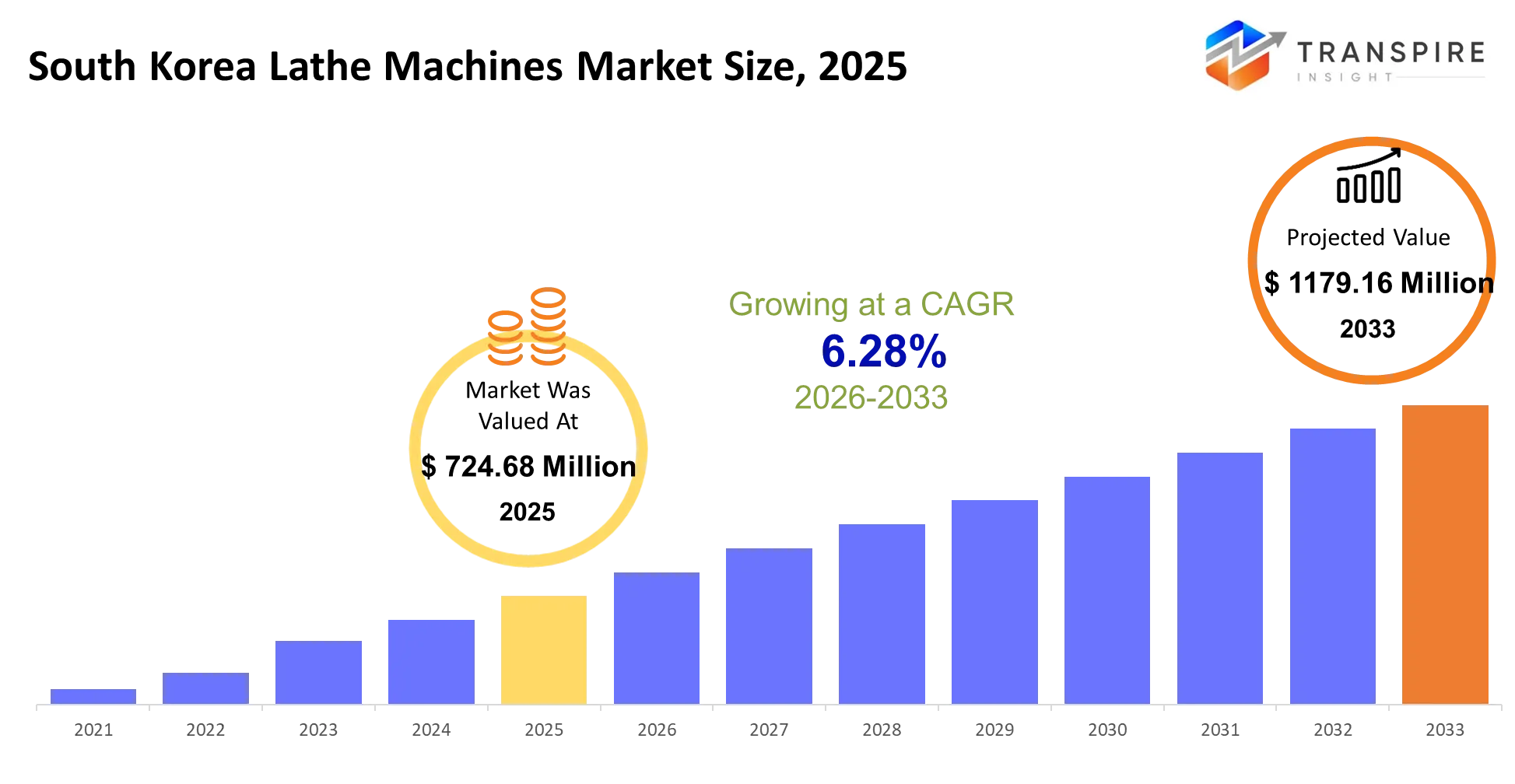
- South Korea Lathe Machines Market Size 2025: USD 724.68 Million
- South Korea Lathe Machines Market Size 2033: USD 1179.16 Million
- South Korea Lathe Machines Market CAGR: 6.28%
- South Korea Lathe Machines Market Segments: By Machine Type (CNC Lathes, Vertical Lathes, Horizontal Lathes, Multi-axis Lathes, Others); By Application (Metal Cutting, Wood Turning, Precision Machining, Automotive Component Manufacturing, Others); By Technology (Conventional Lathes, CNC-controlled Lathes, Automated Lathes, Others); By End User (Automotive Industry, Aerospace Industry, Industrial Manufacturing, Electronics Industry, Others); By Operation Type (Manual Lathes, Semi-automatic Lathes, Fully Automatic Lathes, Others)
To learn more about this report,  Download Free Sample Report
South Korea Lathe Machines Market Summary
The South Korea Lathe Machines Market was valued at USD 724.68 Million in 2025. It is forecast to reach USD 1179.16 Million by 2033. That is a CAGR of 6.28%over the period.
In South Korea, the lathe machines market somehow ends up being a key factor inside the country’s precision manufacturing ecosystem. It supports metal shaping, cutting, threading, plus component finishing, not just in one sector but across automotive, shipbuilding, aerospace, semiconductors, and industrial machinery. With these lathe machines, producers can hold tight tolerances, push production speed up faster, and at the same time cut down on material waste when they run big volume industrial orders.
Over the past five years, things have quietly moved away from conventional, manually operated systems. More factories now prefer CNC-integrated and smart-connected lathe platforms that can run automated production, and also provide real time monitoring. That shift picked up momentum after the COVID-19 period caused global supply chain disruptions, because it revealed weak points in overseas component sourcing. So South Korean manufacturers started localizing precision machining capabilities, more than before.
At the same time, investments in semiconductor equipment and the build out of electric vehicle component manufacturing kept adding pressure, in a good way, on machine tool demand. Now, as factories chase higher throughput with less labor dependency, advanced lathe systems are bringing in more aftermarket revenue too, mostly from software upgrades, predictive servicing, and even automation integration.
Key Market Insights
- South Korea's lathe machines market is moving pretty fast toward CNC based systems, and by 2025 they will be behind nearly 68% of all machine installations, like it is pretty much already standard.
- After 2021, smart factory initiatives tied to South Korea manufacturing modernization pushed adoption of AI enabled and IoT connected precision machining equipment, sort of smoother and faster than before .
- In terms of geography, Gyeonggi Province held the biggest portion, around 34% market share, mainly because there are so many automotive plus semiconductor manufacturing clusters close together.
- Busan then showed up as the quickest growing regional hub, with shipbuilding suppliers upgrading machining capabilities for LNG carriers and offshore equipment, you know, for the more complex builds.
- For product types, horizontal lathe machines kept the top position in share because automotive component manufacturers lean toward high speed repetitive metal cutting jobs.
- Meanwhile multi axis CNC lathes, yeah that extra axis really matters , became the fastest growing segment between 2024 and 2033 as aerospace and semiconductor suppliers started demanding micron level machining accuracy.
- On the application side, automotive manufacturing made up nearly 39% of total demand in 2025, backed by EV drivetrain , plus battery housing component production.
- Semiconductor equipment manufacturing also expanded the most quickly, since South Korean chip fabrication investments increased how much precision tooling they needed.
- Lastly, large industrial manufacturers stayed the main end user group, but small precision engineering workshops started adopting compact CNC machine options more aggressively after 2022.
What are the Key Drivers, Restraints, and Opportunities in the South Korea Lathe Machines Market?
The main thing driving the South Korea lathe machines market is kinda the country’s push toward high precision automated manufacturing . For instance semiconductor fabrication, electric vehicle output, and aerospace component machining need tighter dimensional accuracy and quicker cycle times than conventional machining setups can keep up with . This momentum got stronger after 2020, because supply chain instability plus labor shortages made companies automate production lines more aggressively . CNC lathe systems that include robotics and digital monitoring features now allow almost continuous machining with fewer rejected parts, so the plant gets better throughput, and overall production profitability goes up . And as South Korean makers expand in-country production of semiconductors and EV components , their machine tool procurement budgets keep climbing .
The biggest restraint is still the very high upfront capital investment needed for advanced CNC and multi axis machining systems. The total integration spend doesn’t stop at buying the equipment , manufacturers also have to upgrade software infrastructure, train operators , and adjust production workflows to fit the new setup. Smaller machining workshops sometimes postpone modernization , because financing is tight. That ends up limiting wider market penetration . As a result replacement cycles get slower, and adoption is restrained among medium-sized suppliers that still use older conventional equipment
One standout opportunity is coming from smart factory growth and wider digital manufacturing integration. South Korea’s industrial automation programs are encouraging manufacturers to link machining machinery with cloud analytics, robotics, and AI based process optimization tools , which in turn supports higher efficiency and more predictable output.
What Has the Impact of Artificial Intelligence Been on the South Korea Lathe Machines Market?
Artificial intelligence and other advanced digital tech are, kind of slowly reshaping the South Korea lathe machines market too, by pushing machining precision higher, cutting down on downtime, and tuning production efficiency throughout automated manufacturing sites. AI-enabled CNC setups can now watch cutting conditions live, including spindle vibration, thermal swings, and tool wear, then they make quick micro-adjustments to the machining parameters while the job is still running. Because of this, makers can hold tighter tolerances with fewer mistakes, also it tends to lower the amount of scrapped material and those annoying production interruptions.
In semiconductor and automotive parts manufacturing, machine learning models are increasingly used for predictive maintenance by spotting “wrong” spindle behavior ahead of mechanical failures. That means factories can raise equipment uptime and, in turn, reduce maintenance spending, without waiting for breakdowns.
On top of that, advanced analytics platforms are improving day-to-day output by refining cutting speeds and even tracking energy consumption patterns. A number of smart manufacturing facilities in South Korea have reported clear reductions in unplanned downtime, plus shorter production cycles, after they integrated AI-driven process monitoring into their lathe operations. Digital twin technology also comes in handy: it lets manufacturers run simulations of machining performance before any physical production begins. This can reduce setup errors and makes workflow planning feel a bit smoother.
Still, AI adoption runs into real-world limits. Many small and medium-sized workshops still rely on older, legacy machinery, and it often doesn’t have compatible sensors or the digital infrastructure needed for full AI integration. There are also high implementation costs, ongoing cybersecurity worries, and a shortage of skilled automation engineers, all of which slow the broad rollout of intelligent machining systems across smaller industrial suppliers.
Key Market Trends
- After 2021, CNC lathe adoption kind of sped up, at least that’s what happened when automotive and semiconductor manufacturers started prioritizing automated machining with lower rejection rates and more steady cycle consistency.
- Multi axis machining systems got a noticeably stronger pull in the market from 2023 to 2025 , mainly because aerospace and EV component work demands very tight precision.
- In South Korea , manufacturers have been swapping out standalone units for integrated smart machining cells, which are linked through wider plant industrial IoT networks.
- Semiconductor equipment suppliers also increased their precision machine tool purchases by more than 20% since 2022, to back domestic chip fabrication expansion projects that keep growing.
- Predictive maintenance software is moving fast too, since AI enabled machining setups cut down on unexpected downtime and helped boost spindle utilization efficiency , in a more reliable way.
- Hyundai WIA and DN Solutions expanded their automation centric CNC offerings, focusing on semiconductor as well as aerospace production facilities.
- And energy efficient machining technologies got more attention after factories felt higher electricity , plus operational costs during the post pandemic industrial rebound, so everyone started looking at efficiency harder.
- Even small precision workshops have been taking in compact CNC lathes more often, because financing programs made equipment access easier for mid-sized industrial suppliers .
- Meanwhile, the industrial clusters around Busan and Ulsan supported rising demand for heavy duty lathe systems , especially for shipbuilding and offshore engineering component manufacturing.
- Finally, digital twin simulation technologies came up as a real differentiator, after manufacturers tried to speed up production setup validation and reduce prototyping losses , before things get too expensive.
South Korea Lathe Machines Market Segmentation
By Machine Type
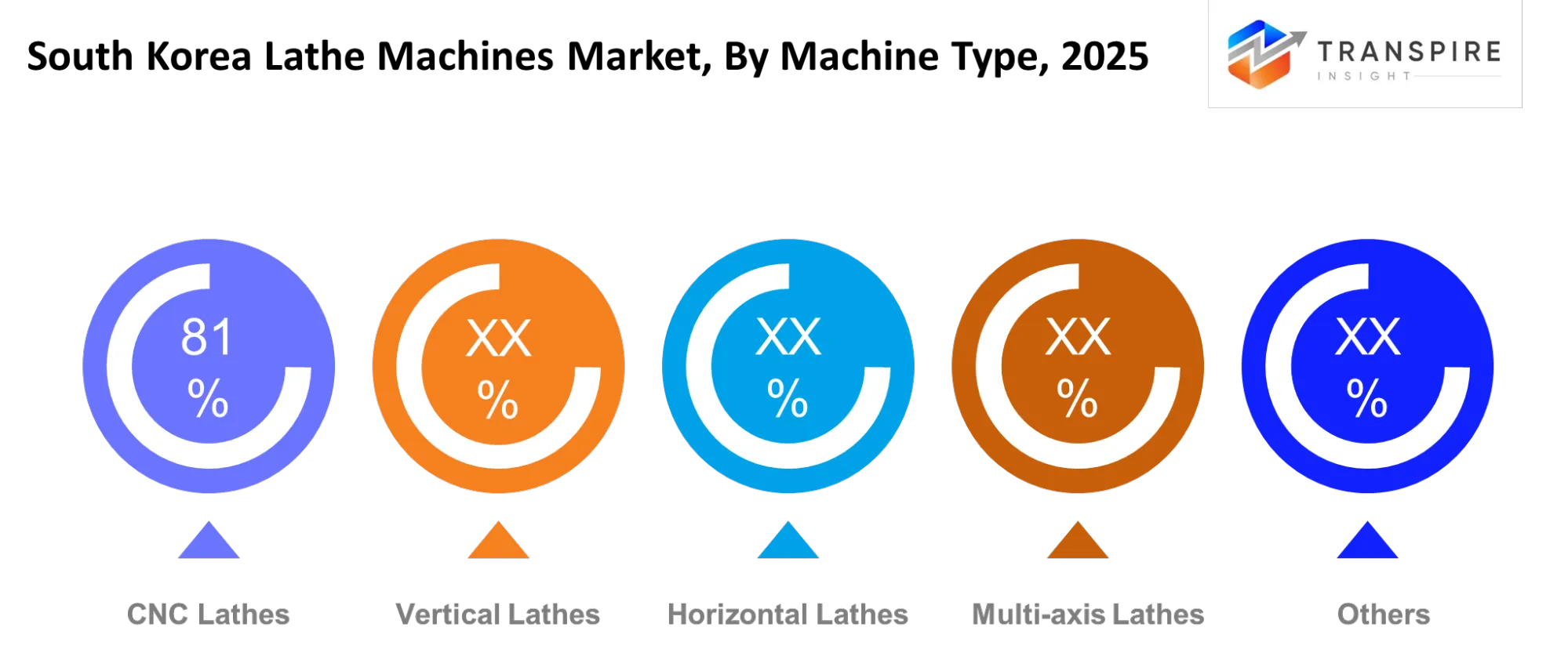
CNC Lathes kinda hold the leading position because they’re used a lot in automotive, semiconductor, and precision engineering places where machining has to stay accurate and production stays automated. They also fit pretty well with robotics, AI-supported monitoring, and smart factory systems so industry folks usually pick them without much hesitation. Plus, the higher machining speed and fewer rejected parts help a lot, specially in high-volume manufacturing, where leadership can’t really be optional.
Horizontal Lathes keep getting chosen for automotive parts and general industrial work since they offer operational flexibility and cost efficiency for repeat cutting tasks. Vertical Lathes still matter for heavy-duty machining, especially for large industrial pieces, turbine housings, and marine equipment. Multi-axis Lathes are growing quickly in aerospace and semiconductor tooling, where complex shapes need advanced precision machining. Other types include specialized hybrid layouts and custom-built machines that are meant for specific industrial needs.
In the forecast window, multi-axis systems, plus CNC-integrated setups, will likely pull even more investment traction. Manufacturers are focusing on automation, micron-level accuracy, and digitally connected production environments, so that momentum should keep building.
To learn more about this report, Download Free Sample Report
By Application
Metal cutting is still in the leading position ,more or less, because on big industrial production lines everything really leans on continuous shaping , drilling , threading, and then finishing of metal parts. This matters a lot inside automotive manufacturing plants and machinery production sites where components have to stay consistent. Also the steady appetite from steel fabrication, industrial equipment making and precision tooling jobs helps lock in the segment’s stability over the long run. With high material throughput plus tight tolerance rules, the machines keep running without weird drops in utilization rates.
Automotive Component Manufacturing also looks like it will expand, mostly because electric vehicle drivetrain systems are being produced at higher rates ,along with battery housings and transmission components that need fast precision machining. Precision Machining is picking up even more momentum for semiconductor equipment and aerospace use, since micron-level exactness directly influences how the final product behaves. Wood Turning stays limited, but it is stable enough for furniture making and decorative manufacturing operations. Others cover custom fabrication and training workshop setups. Through the forecast period, precision machining should record the quickest advancement, mainly as more semiconductor and aerospace investments pull demand toward highly accurate multi stage machining workflows.
By Technology
CNC controlled lathes kinda dominate the technology side, mostly because they bring stronger automation, better machinable precision that’s programmable and they also fit well with the whole digital manufacturing infrastructure. You see strong roll out across automotive, electronics and industrial machinery areas, so that supports long term market leadership, even when things shift. Also, with less operator reliance , and steadier output quality, it gets easier for big production plants to keep adopting them.
Automated lathes are steadily growing too, since manufacturers are adding robotic loading setups more often , plus predictive maintenance software and real time process monitoring inside the machining workflow. Conventional lathes are still around, especially in smaller workshops and maintenance shops, where the lower buying price stays kinda practical. Then there are also other types , like hybrid machining platforms that blend additive manufacturing with digital simulation tools. Through the forecast window, automated and CNC controlled systems should pull in the biggest investment levels, because industrial facilities are prioritizing unmanned operations, energy efficiency, and factory wide production optimization.
By End User
The Automotive Industry kind of holds the largest share, because continuous production needs for engine systems, transmission components, brake assemblies,and electric vehicle parts. Big manufacturing clusters, plus high volume machining operations, help procurement of CNC and automated lathe systems stay strong. And yes the ongoing shift toward EV production, seems to also push equipment modernization across supplier networks, pretty steadily.
Industrial Manufacturing stays broadly adopted too, since machinery production, heavy engineering, and fabrication plants really depend on dependable precision machining, for large scale component output. The Electronics Industry is expanding rapidly, mostly as semiconductor equipment suppliers keep raising demand for ultra precise machining systems that can deal with miniature parts and high tolerance jobs. Aerospace Industry shows growing investment in advanced multi axis machining for lightweight alloy processing, and also for defense related component manufacturing.
Other segments include educational institutions and maintenance workshops. Over the forecast period, electronics and aerospace applications should grow faster, because precision engineering standards are becoming more demanding across those advanced manufacturing areas.
By Operation Type
Fully Automatic Lathes kinda dominate the operation type segment because of heavy adoption across automotive, semiconductor, and industrial production lines, where machining must keep moving at high speed without interruption. With automated tool handling, lower labor reliance , and fairly steady production quality, the long term industrial preference seems pretty strong. Also when they get paired with robotics plus digital production monitoring, that’s when the efficiency edge becomes even more noticeable, for sure.
Semi-automatic Lathes still hold a stable position, mostly in medium-scale workshops and custom build environments, where operational flexibility is still a big deal. Manual Lathes keep showing up in repair facilities, technical training centers, and low-volume fabrication units, where the investment budget just can’t stretch too far. Then there are others, like hybrid operational systems, combining a bit of manual intervention alongside programmable machining support. During the forecast period, fully automatic systems are expected to grow the fastest, as manufacturers chase smart factory transformation plans, and try to curb production variability via digitally controlled machining operations.
What are the Key Use Cases Driving the South Korea Lathe Machines Market?
In South Korea the strongest demand for lathe machines sort of comes from automotive and electric vehicle component making. For precision machining, it’s basically necessary in order to produce drive shafts, transmission housings, brake assemblies, battery casings, plus motor parts, all with tight dimensional tolerances. Automotive suppliers really lean on CNC lathes, because they can run high-speed repetitive work, and that helps cut down rejection rates and material waste, especially when they’re dealing with huge production volumes.
Second tier applications are also growing, kind of quietly, across semiconductor equipment manufacturing and shipbuilding supply chains. Semiconductor machinery producers use more advanced multi-axis lathes to cut precision chambers, valves, and wafer-processing components where micron-level accuracy is required. In Busan and Ulsan, marine engineering suppliers increasingly put heavy-duty lathe systems to work on propeller shafts, turbine pieces, and offshore equipment fabrication that links back to LNG vessel construction.
Newer use cases are starting to show up in aerospace machining and in additive manufacturing integration too. Aerospace suppliers are adopting hybrid machining setups that can manage lightweight alloys for aircraft structures and defense-related components. At the same time, manufacturers are pairing lathe machines with robotic automation and digital twin platforms to enable unmanned smart factory operations, over the whole forecast period.
|
Report Metrics |
Details |
|
Market size value in 2025 |
USD 724.68 Million |
|
Market size value in 2026 |
USD 770.09 Million |
|
Revenue forecast in 2033 |
USD 1179.16 Million |
|
Growth rate |
CAGR of6.28%from 2026 to 2033 |
|
Base year |
2025 |
|
Historical data |
2021 - 2024 |
|
Forecast period |
2026 - 2033 |
|
Report coverage |
Revenue forecast, competitive landscape, growth factors, and trends |
|
Regional scope |
South Korea |
|
Key company profiled |
Doosan Machine Tools, Hyundai WIA, DMG Mori, Mazak Corporation, Haas Automation, Okuma Corporation, Hardinge, Yamazaki Mazak, FANUC, Makino, Hurco Companies, EMAG, Tsugami Corporation, Ace Micromatic, JTEKT Corporation |
|
Customization scope |
Free report customization (country, regional & segment scope). Avail customized purchase options to meet your exact research needs. |
|
Report Segmentation |
By Machine Type (CNC Lathes, Vertical Lathes, Horizontal Lathes, Multi-axis Lathes, Others); By Application (Metal Cutting, Wood Turning, Precision Machining, Automotive Component Manufacturing, Others); By Technology (Conventional Lathes, CNC-controlled Lathes, Automated Lathes, Others); By End User (Automotive Industry, Aerospace Industry, Industrial Manufacturing, Electronics Industry, Others); By Operation Type (Manual Lathes, Semi-automatic Lathes, Fully Automatic Lathes, Others) |
Which Regions are Driving the South Korea Lathe Machines Market Growth?
Gyeonggi Province stays the big name in the South Korea lathe machines market, mostly because it actually holds the largest cluster of automotive, semiconductor and industrial equipment makers. It also has solid, well-worn industrial infrastructure, good logistics connections, and it’s close enough to the big technology pockets around Seoul that suppliers can move faster, not just faster… also more reliably. In the area precision parts firms keep putting money into CNC automation, in order to match the high production requirements from semiconductor fabrication plants and EV makers. And then there’s the way machinery manufacturers, automation software providers, and advanced manufacturing research centers end up working together kind of continuously, which makes the region’s lead position feel a lot more “locked in” than elsewhere.
South Gyeongsang Province works in a more distinct way, more like a dependable industrial manufacturing base, anchored on Changwon’s machine tool ecosystem. Unlike Gyeonggi, its momentum ties itself closely to heavy industries, industrial machinery output, and the long lived manufacturing know-how that’s already there. Firms in this region tend to keep steady investment rhythms, since they provide essential equipment for both local factory lines and export buyers across Asia, and Europe too. Plus, with major machine tool manufacturers and experienced engineering labor, production stability is maintained for longer stretches, even when the world economy is kind of shaky, you know, global uncertainty periods.
Busan and Ulsan, meanwhile, are showing up as the fastest-growing regional markets. That’s happening as shipbuilding modernization accelerates, and offshore engineering spending ramps up. Demand got a noticeable boost after LNG carrier construction expanded quite a bit, especially following global energy supply disruptions, and also with increased liquefied natural gas trade. So, in a way these ports are getting pulled into the market faster than before, not only on paper but in actual orders.
Who are the Key Players in the South Korea Lathe Machines Market and How Do They Compete?
Competition in the South Korea lathe machines market stays somewhat moderately consolidated, in the sense that the bigger global and domestic names still go head to head using technology integration, machining precision, automation ability, and after-sales service reach . Most large incumbents are still trying to defend share by rolling out CNC automation ranges, and on top of that weaving in AI monitoring tools directly into the machining setup . Buyers, for their part, are sounding more focused on operational efficiency, software compatibility, predictive maintenance support, and multi-axis flexibility… not just checking the purchase price like before. So yeah, this change tends to favor manufacturers that can provide an integrated smart production approach, rather than selling machines as if they’re only standalone metal boxes.
Doosan Machine Tools, which is now basically operating under the DN Solutions name, competes with big CNC automation capacity and solid domestic manufacturing ties. They tend to stand out by bundling integrated machining together with additive manufacturing, plus digital production platforms aimed at aerospace and semiconductor needs. And by 2026 DN Solutions further pushed its position by finishing the acquisition of German machine tool maker HELLER, which broadened their access to premium European engineering know how. That’s the general direction they’re taking.
Hyundai WIA, meanwhile, leans heavily into automotive and industrial machining systems, and it does this by leaning on long-standing connections with South Korean vehicle manufacturers, and also with EV supply chains. Their edge comes from high-volume precision machining setups that are tuned for automotive production efficiency, so the output stays consistent without too much downtime, at least that’s what they try to assure.
DMG Mori and Mazak Corporation sit in the same competitive lane, but they push it through advanced multi-axis machining know-how, and smart factory integration features too, rather than only raw machining performance.
Company List
- Doosan Machine Tools
- Hyundai WIA
- DMG Mori
- Mazak Corporation
- Haas Automation
- Okuma Corporation
- Hardinge
- Yamazaki Mazak
- FANUC
- Makino
- Hurco Companies
- EMAG
- Tsugami Corporation
- Ace Micromatic
- JTEKT Corporation
Recent Development News
In January 2026, DN Solutions completed acquisition of German machine tool manufacturer HELLER. The acquisition strengthened DN Solutions’ high-precision machining and CNC automation portfolio while expanding its European manufacturing footprint.http://www.dn-solutions.com
In March 2026, DN Solutions launched its Additive Solutions Center Europe in Gütersloh, Germany. The facility integrates additive manufacturing, CNC machining, and automation technologies to support advanced aerospace, semiconductor, and industrial production applications.http://www.tctmagazine.com
In April 2026, DN Solutions showcased automation-integrated machining technologies at CCMT 2026 in Shanghai. The company presented digitally connected machining systems designed for semiconductor, electric vehicle, and aerospace manufacturing applications, reinforcing its smart factory expansion strategy.http://www.dn-solutions.com
What Strategic Insights Define the Future of the South Korea Lathe Machines Market?
The South Korea lathe machines market is kind of moving fast toward fully integrated smart machining ecosystems where CNC equipment, robotics, AI driven analytics, and predictive maintenance software all work like interconnected production assets instead of separate machines. Semiconductor manufacturing expansion, EV component localization, and those big factory automation investments are pushing this change. In the next five to seven years, the firms that blend machining precision with digital production intelligence should end up capturing better margins, and also those recurring software related service revenues.
There is also this underrecognized risk though, namely the growing dependence on semiconductor and automotive investment cycles. If global chip demand softens , or EV production growth slows down, then machine tool procurement can face sudden capital expenditure delays, especially for mid-sized suppliers. But at the same time, hybrid additive subtractive machining systems are becoming a pretty real opportunity, since aerospace and precision engineering companies want reduced prototyping costs and quicker component customization.
So market participants should really focus on software enabled machining platforms, regional service expansion, and automation partnerships rather than only competing on machine pricing. Vendors that can deliver integrated production ecosystems, plus lifecycle support capabilities, will likely be the ones that land longer term industrial contracts.
South Korea Lathe Machines Market Report Segmentation
By Machine Type
- CNC Lathes
- Vertical Lathes
- Horizontal Lathes
- Multi-axis Lathes
- Others
By Application
- Metal Cutting
- Wood Turning
- Precision Machining
- Automotive Component Manufacturing
- Others
By Technology
- Conventional Lathes
- CNC-controlled Lathes
- Automated Lathes
- Others
By End User
- Automotive Industry
- Aerospace Industry
- Industrial Manufacturing
- Electronics Industry
- Others
By Operation Type
- Manual Lathes
- Semi-automatic Lathes
- Fully Automatic Lathes
- Others
Frequently Asked Questions
Find quick answers to common questions.
The expected South Korea Lathe Machines Market size for the market will be USD 1179.16 Million in 2033.
Key segments for the South Korea Lathe Machines Market are By Machine Type (CNC Lathes, Vertical Lathes, Horizontal Lathes, Multi-axis Lathes, Others); By Application (Metal Cutting, Wood Turning, Precision Machining, Automotive Component Manufacturing, Others); By Technology (Conventional Lathes, CNC-controlled Lathes, Automated Lathes, Others); By End User (Automotive Industry, Aerospace Industry, Industrial Manufacturing, Electronics Industry, Others); By Operation Type (Manual Lathes, Semi-automatic Lathes, Fully Automatic Lathes, Others).
Major South Korea Lathe Machines Market players are Doosan Machine Tools, Hyundai WIA, DMG Mori, Mazak Corporation, Haas Automation, Okuma Corporation, Hardinge, Yamazaki Mazak, FANUC, Makino, Hurco Companies, EMAG, Tsugami Corporation, Ace Micromatic, JTEKT Corporation.
The South Korea Lathe Machines Market size is USD 724.68 Million in 2025.
The South Korea Lathe Machines Market CAGR is 6.28% from 2026 to 2033.
- Doosan Machine Tools
- Hyundai WIA
- DMG Mori
- Mazak Corporation
- Haas Automation
- Okuma Corporation
- Hardinge
- Yamazaki Mazak
- FANUC
- Makino
- Hurco Companies
- EMAG
- Tsugami Corporation
- Ace Micromatic
- JTEKT Corporation
Recently Published Reports
-
Apr 2026
Handling and Lifting Equipment Market
Handling and Lifting Equipment Market Size, Share & Analysis Report By Product (Cranes and Hoists, Forklifts, Conveyor Systems, Aerial Work Platforms, Others), By Application (E-Commerce, Automotive and Railway, Food and Beverages, Aviation, Others), and Geography (North America, Europe, Asia-Pacific, Middle East and Africa, South and Central America), 2021 - 2031
-
Apr 2026
HVAC Equipment Market
HVAC Equipment Market Size, Share & Analysis Report By Heating Equipment Type (Boilers and Furnaces, Heat Pumps, and Unitary Heaters), By Ventilation Equipment (Air Handling Units, Humidifiers and Dehumidifiers, Air Filters, and Fan Coiling Units), By Air Conditioning Equipment (Unitary Air Conditioners, Room Air Conditioners, Packaged Terminal Air Conditioners, and Chillers), By End User (Commercial, Residential, Industrial, and others), and Geography (North America, Europe, Asia-Pacific, Middle East and Africa, South and Central America), 2021 – 2031
-
Apr 2026
Refrigeration Valves Market
Refrigeration Valves Market Size, Share & Analysis Report By Type (Solenoid Valves, Expansion Valves, Check Valves, Service Valves, Others), By Application (Commercial Refrigeration, Industrial Refrigeration, Transport Refrigeration, Residential Refrigeration, Air Conditioning Systems), By End User (Food and Beverage Industry, Pharmaceutical Industry, HVAC Industry, Chemical Industry, Others), and Geography (North America, Europe, Asia-Pacific, Middle East and Africa, South and Central America), 2021 – 2031
-
Apr 2026
E-Commerce Packaging Materials Market
E-Commerce Packaging Materials Market By Material Type (Corrugated Boxes, Paper & Paperboard, Foam & Cushioning Materials, Plastic Packaging, Flexible Packaging, Protective Packaging, Others), By Product(Primary Packaging, Secondary Packaging, Tertiary Packaging), By Packaging Function (Protective Packaging, Branding & Presentation Packaging, Transit & Logistic Packaging, Sustainable Packaging, Tamper Evidence Packaging), By End-User (Retail & Consumer Goods, Electronic Appliances, Food & Beverages, Healthcare & Pharmaceutical, Fashion & Apparel, Home & Furnishing, Others); By Industry Analysis, Size, Share, Growth, Trends, and Forecasts 2021-2033