

United Kingdom Precision Machining Market Size & Forecast:
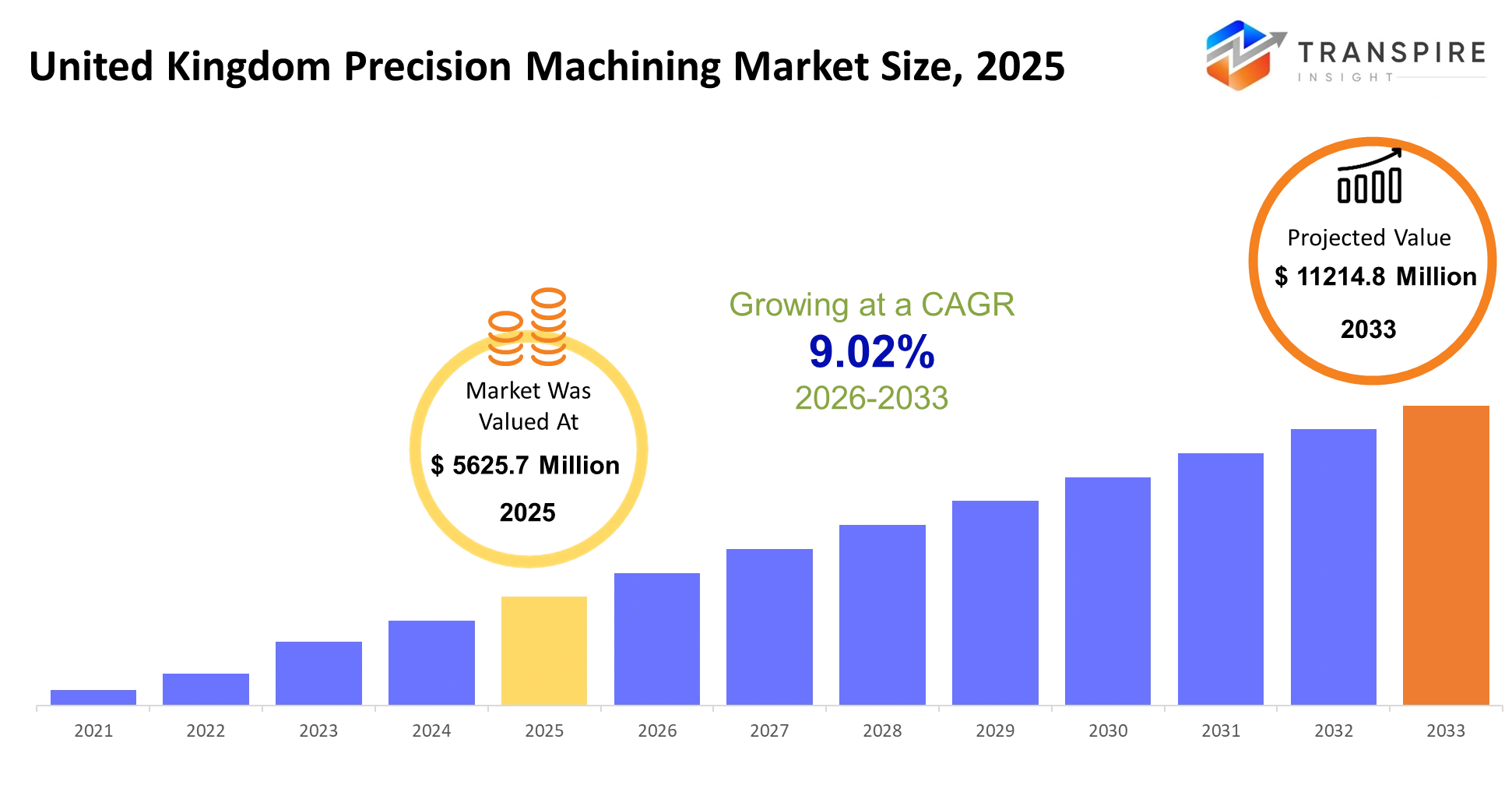
- United Kingdom Precision Machining Market Size 2025: USD 5625.7 Million
- United Kingdom Precision Machining Market Size 2033: USD 11214.8 Million
- United Kingdom Precision Machining Market CAGR: 9.02%
- United Kingdom Precision Machining Market Segments: By Process (Milling, Turning, Grinding, Electrical Discharge Machining), By End-User Industry (Automotive, Aerospace & Defense, Medical Devices, Electronics), By Material (Steel, Aluminum, Titanium).
To learn more about this report,  Download Free Sample Report
United Kingdom Precision Machining Market Summary:
The United Kingdom Precision Machining Market size is estimated at USD 5625.7 Million in 2025 and is anticipated to reach USD 11214.8 Million by 2033, growing at a CAGR of 9.02% from 2026 to 2033. The United Kingdom precision machining market serves as an essential foundation for its advanced manufacturing industry, providing capabilities that meet the stringent requirements of the aerospace, automotive, medical device, and energy industries. The aerospace, automotive, medical device, and energy markets drive demand for these systems which need high-precision and dependable performance. The country's industrial sector needs precision machining technologies more than ever due to rising demand for lightweight materials, smaller components, and intricate product designs.
The market maintains its development because businesses quickly implement CNC machining, automation, and smart manufacturing systems which enhance their operational efficiency and product quality while decreasing their expenses. The increase in electric vehicle production and the growth of healthcare manufacturing and the drive for domestic manufacturing create new business prospects for machining companies. The United Kingdom precision machining market will continue to grow in upcoming years because of persistent investments in cutting-edge technologies and its solid engineering foundation.
Key Market Trends & Insights:
The market is experiencing strong growth as manufacturers increasingly adopt CNC machining, which offers greater precision and operational efficiency. Manufacturing processes achieve continuous operation through automation and robotics together with AI integration, which reduces human errors while decreasing operational costs.
High-value products are necessary for the manufacturing industry to meet its increasing demand. The aerospace, automotive, medical device, and defense sectors create strong demand for precision machining, which produces lightweight complex components that need highly accurate manufacturing methods.
Manufacturers increasingly work with materials that include titanium and composites and high-performance alloys. Manufacturers need precision machining capabilities because the advanced machining techniques required for these materials exceed regular machining methods.
The growth of electric vehicles, together with healthcare advancements leads to new market opportunities. The demand for electric vehicle systems requires manufacturers to develop specialized battery components and lightweight structural materials. The healthcare industry expands through its need for personalized medical devices and surgical equipment for less invasive procedures.
Enterprises increasingly adopt smart manufacturing systems that incorporate artificial intelligence technology. The manufacturing process now undergoes a fundamental shift because of artificial intelligence and machine learning together with real-time data analysis. The technologies enable organizations to achieve better operational results by improving their equipment maintenance schedules and cutting down on resource waste.
United Kingdom Precision Machining Market Segmentation
By Process
Milling: The UK precision machining market uses milling to create precise complex shapes and slots and high-precision surface areas. CNC milling machines with advanced technology support multi-axis operations which aerospace and automotive manufacturers use for their component production. The process provides both prototyping and mass production capabilities which deliver consistent results and high-quality surface finishes.
Turning: Turning serves as a fundamental machining method which produces cylindrical parts including shafts and bolts and fittings. CNC turning technology delivers precise results at fast speeds while maintaining consistent performance. The system performs best in industrial applications which demand identical products with precise specifications.
Grinding: Grinding serves the purpose of achieving outstanding surface quality together with maintaining precise measurement standards. The process is frequently used as a final step after the completion of milling or turning operations. The UK market relies on grinding to support aerospace and healthcare industries which require precise component production with smooth surfaces and optimal performance.
Electrical Discharge Machining: EDM enables the cutting of hard metals and complex shapes which traditional methods cannot produce. The process holds great importance for tool and die production as well as aerospace and electronics applications. EDM enables precise material cutting through non-contact methods which minimize material stress while achieving complex shape designs.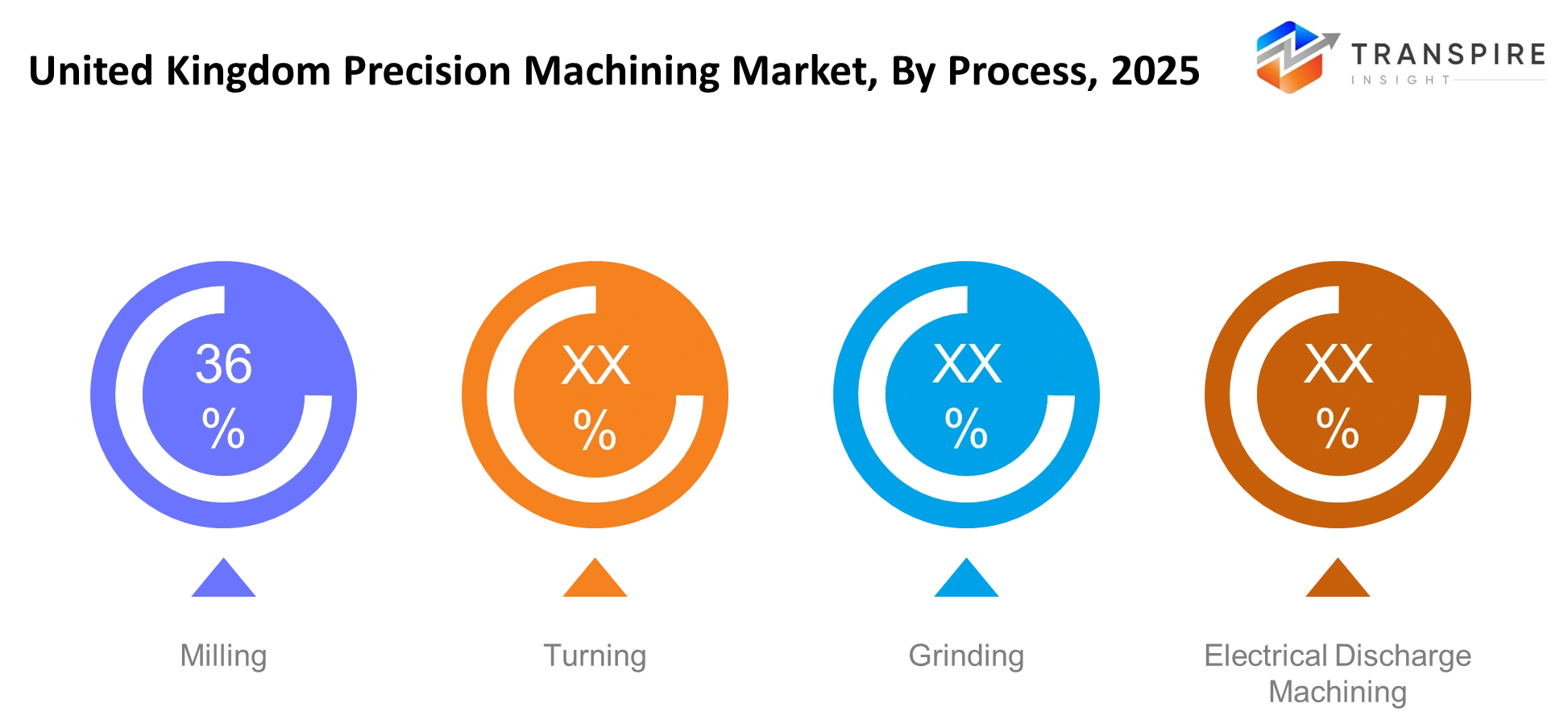
To learn more about this report, Download Free Sample Report
By End-User Industry
Automotive: The UK automotive industry uses precision machining to create high-accuracy engine parts and transmission systems and structural elements. The electric vehicle market expansion drives manufacturers to create more lightweight and complex products which requires them to utilize advanced machining methods that deliver better operational results and precise results.
Aerospace & Defense: The aerospace and defense industries require their work to meet exceptional precision requirements and follow strict quality control protocols. Precision machining produces turbine blades and aircraft structures and defense equipment. The segment uses advanced materials and safety-critical components to create new machining technology which requires increased investment.
Medical Devices: Precision machining enables the medical devices industry to produce their surgical instruments and implants and diagnostic equipment. The process needs high accuracy and customized solutions which follow strict regulatory standards. The demand for high-quality machined components increases because of healthcare needs and technological progress.
Electronics: The electronics sector uses precision machining to create small and complex components which include connectors and housings and semiconductor parts. The consumer electronics market needs high-precision manufacturing processes to create compact devices which provide better performance because of the industrys rapid growth of miniaturized electronic devices.
By Material
Steel: Steel stands as the most popular material used in precision machining because of its strong durability and multiple applications. The material finds common use in making components for automotive systems building construction projects and industrial machining equipment. The material functions as an optimal choice for manufacturing parts which need to endure intense stress while maintaining their operational effectiveness throughout extended usage periods.
Aluminum: Aluminum becomes the most popular choice because of its lightweight properties, resistance to corrosion, and its ability to be easily machined. The material finds extensive applications across the aerospace, automotive, and electronics sectors, which require lightweight components that deliver maximum efficiency. The material enables manufacturers to create complex parts through its machining method which results in faster production timelines and reduced manufacturing costs.
Titanium: People value it for its high strength, its lightweight nature, and its resistance to corrosion, making it suitable for medical use. The material finds extensive application in aerospace and medical fields which include aircraft manufacturing and implant development. The material proves challenging to machines, yet its performance attributes make it necessary for creating parts which require precise dimensions and outstanding operational capabilities.
Country Insights
The United Kingdom maintains its economic growth through its established engineering industry and its historical success in advanced manufacturing, which drives development in the precision machining sector. The country’s robust aerospace, automotive, and defense sectors create consistent demand for high-precision components. The government supports innovation through its funding programs which, together with industrial modernization efforts drive manufacturing plants to implement advanced machining technologies.
The UK today experiences increased funding for smart factories and digital manufacturing technologies which assist businesses in boosting their productivity while sustaining their ability to compete internationally. The market expansion process receives support from the current trend which involves companies bringing their manufacturing operations back to the United States and businesses developing local supply networks. The United Kingdom serves as a central European precision machining centre because it possesses a qualified labor force and experiences ongoing progress in technological development.
Recent Development News
- The 2026 industry update shows positive outcomes for UK manufacturing through increased output and new orders which result in business confidence reaching its highest point in 17 months.
- The MACH 2026 exhibition, which will take place in Birmingham will display new developments in machining, automation and digital manufacturing to demonstrate how the UK prioritizes industrial innovation and manufacturing resilience.
- Sigma Advanced Systems purchased Nasmyth Group, which operates a precision engineering business in the UK, to enhance its capacity for aerospace and defense machining while expanding its worldwide production capabilities.
- UK companies now provide CNC machining services that come with rapid delivery options and inventory management services, which enable manufacturers to shorten their production times and gain better control over their supply chains while maintaining uninterrupted production processes.
|
Report Metrics |
Details |
|
Market size value in 2025 |
USD 5625.7 Million |
|
Market size value in 2026 |
USD 6126.3 Million |
|
Revenue forecast in 2033 |
USD 11214.8 Million |
|
Growth rate |
CAGR of 9.02% from 2026 to 2033 |
|
Base year |
2025 |
|
Historical data |
2021 – 2024 |
|
Forecast period |
2026 – 2033 |
|
Report coverage |
Revenue forecast, competitive landscape, growth factors, and trends |
|
Country scope |
United Kingdom |
|
Key company profiled |
DMG Mori Co. Ltd., Mazak Corporation, Haas Automation Inc., Okuma Corporation, Makino Milling Machine Co. Ltd., GF Machining Solutions, Hurco Companies Inc., Hardinge Inc., FANUC Corporation, Doosan Machine Tools Co. Ltd., Yamazaki Mazak Corporation, Sandvik AB, Kennametal Inc., Mitsubishi Heavy Industries Ltd., JTEKT Corporation. |
|
Customization scope |
Free report customization (country, regional & segment scope). Avail customized purchase options to meet your exact research needs. |
|
Report Segmentation |
By Process (Milling, Turning, Grinding, Electrical Discharge Machining), By End-User Industry (Automotive, Aerospace & Defense, Medical Devices, Electronics), By Material (Steel, Aluminum, Titanium). |
Key United Kingdom Precision Machining Market Company Insights
The precision machining sector in the United Kingdom contains established engineering companies and specialized small and medium-sized enterprises. The companies Astec Precision and Ultra Precision Ltd operate advanced CNC machining systems which use multi-axis technology while maintaining high quality control standards. The companies serve high-demand sectors which include aerospace and automotive, and medical devices because these industries require precise and dependable products.
Addison Precision and Thompson Precision Engineering provide personalized machining services which include both prototyping work and complete production capabilities. Businesses use their financial resources to develop automation systems, digital manufacturing capabilities, and advanced materials-processing technologies to improve operational performance. Through ongoing technological advancements UK companies create new market advantages which help them succeed in both their home territory and international business operations.
Company List
- DMG Mori Co. Ltd.
- Mazak Corporation,
- Haas Automation Inc.
- Okuma Corporation
- Makino Milling Machine Co. Ltd.
- GF Machining Solutions
- Hurco Companies Inc.
- Hardinge Inc.
- FANUC Corporation
- Doosan Machine Tools Co. Ltd.
- Yamazaki Mazak Corporation
- Sandvik AB
- Kennametal Inc.
- Mitsubishi Heavy Industries Ltd.
- JTEKT Corporation.
United Kingdom Precision Machining Market Report Segmentation
By Process
- Milling
- Turning
- Grinding
- Electrical Discharge Machining
By End-User Industry
- Automotive
- Aerospace & Defense
- Medical Devices
- Electronics
By Material
- Steel
- Aluminum
- Titanium
Frequently Asked Questions
Find quick answers to common questions.
The Approximate United Kingdom Precision Machining Market size will be USD 11,214.8 Million in 2033.
Key Segments for the United Kingdom Precision Machining Market are By Process (Milling, Turning, Grinding, Electrical Discharge Machining), By End-User Industry (Automotive, Aerospace & Defense, Medical Devices, Electronics), By Material (Steel, Aluminum, Titanium).
Major United Kingdom Precision Machining Market Players are DMG Mori Co. Ltd., Mazak Corporation, Haas Automation Inc., Okuma Corporation, Makino Milling Machine Co. Ltd., GF Machining Solutions, Hurco Companies Inc., Hardinge Inc., FANUC Corporation, Doosan Machine Tools Co. Ltd., Yamazaki Mazak Corporation, Sandvik AB, Kennametal Inc., Mitsubishi Heavy Industries Ltd., JTEKT Corporation.
The Current United Kingdom Precision Machining Market size is USD 5625.7 Million in 2025.
The United Kingdom Precision Machining Market CAGR is 9.02%.
- DMG Mori Co. Ltd.
- Mazak Corporation,
- Haas Automation Inc.
- Okuma Corporation
- Makino Milling Machine Co. Ltd.
- GF Machining Solutions
- Hurco Companies Inc.
- Hardinge Inc.
- FANUC Corporation
- Doosan Machine Tools Co. Ltd.
- Yamazaki Mazak Corporation
- Sandvik AB
- Kennametal Inc.
- Mitsubishi Heavy Industries Ltd.
- JTEKT Corporation.
Recently Published Reports
-
Apr 2026
Handling and Lifting Equipment Market
Handling and Lifting Equipment Market Size, Share & Analysis Report By Product (Cranes and Hoists, Forklifts, Conveyor Systems, Aerial Work Platforms, Others), By Application (E-Commerce, Automotive and Railway, Food and Beverages, Aviation, Others), and Geography (North America, Europe, Asia-Pacific, Middle East and Africa, South and Central America), 2021 - 2031
-
Apr 2026
HVAC Equipment Market
HVAC Equipment Market Size, Share & Analysis Report By Heating Equipment Type (Boilers and Furnaces, Heat Pumps, and Unitary Heaters), By Ventilation Equipment (Air Handling Units, Humidifiers and Dehumidifiers, Air Filters, and Fan Coiling Units), By Air Conditioning Equipment (Unitary Air Conditioners, Room Air Conditioners, Packaged Terminal Air Conditioners, and Chillers), By End User (Commercial, Residential, Industrial, and others), and Geography (North America, Europe, Asia-Pacific, Middle East and Africa, South and Central America), 2021 – 2031
-
Apr 2026
Refrigeration Valves Market
Refrigeration Valves Market Size, Share & Analysis Report By Type (Solenoid Valves, Expansion Valves, Check Valves, Service Valves, Others), By Application (Commercial Refrigeration, Industrial Refrigeration, Transport Refrigeration, Residential Refrigeration, Air Conditioning Systems), By End User (Food and Beverage Industry, Pharmaceutical Industry, HVAC Industry, Chemical Industry, Others), and Geography (North America, Europe, Asia-Pacific, Middle East and Africa, South and Central America), 2021 – 2031
-
Apr 2026
E-Commerce Packaging Materials Market
E-Commerce Packaging Materials Market By Material Type (Corrugated Boxes, Paper & Paperboard, Foam & Cushioning Materials, Plastic Packaging, Flexible Packaging, Protective Packaging, Others), By Product(Primary Packaging, Secondary Packaging, Tertiary Packaging), By Packaging Function (Protective Packaging, Branding & Presentation Packaging, Transit & Logistic Packaging, Sustainable Packaging, Tamper Evidence Packaging), By End-User (Retail & Consumer Goods, Electronic Appliances, Food & Beverages, Healthcare & Pharmaceutical, Fashion & Apparel, Home & Furnishing, Others); By Industry Analysis, Size, Share, Growth, Trends, and Forecasts 2021-2033