
South Korea Large Scale LNG Terminal Market Size & Forecast:
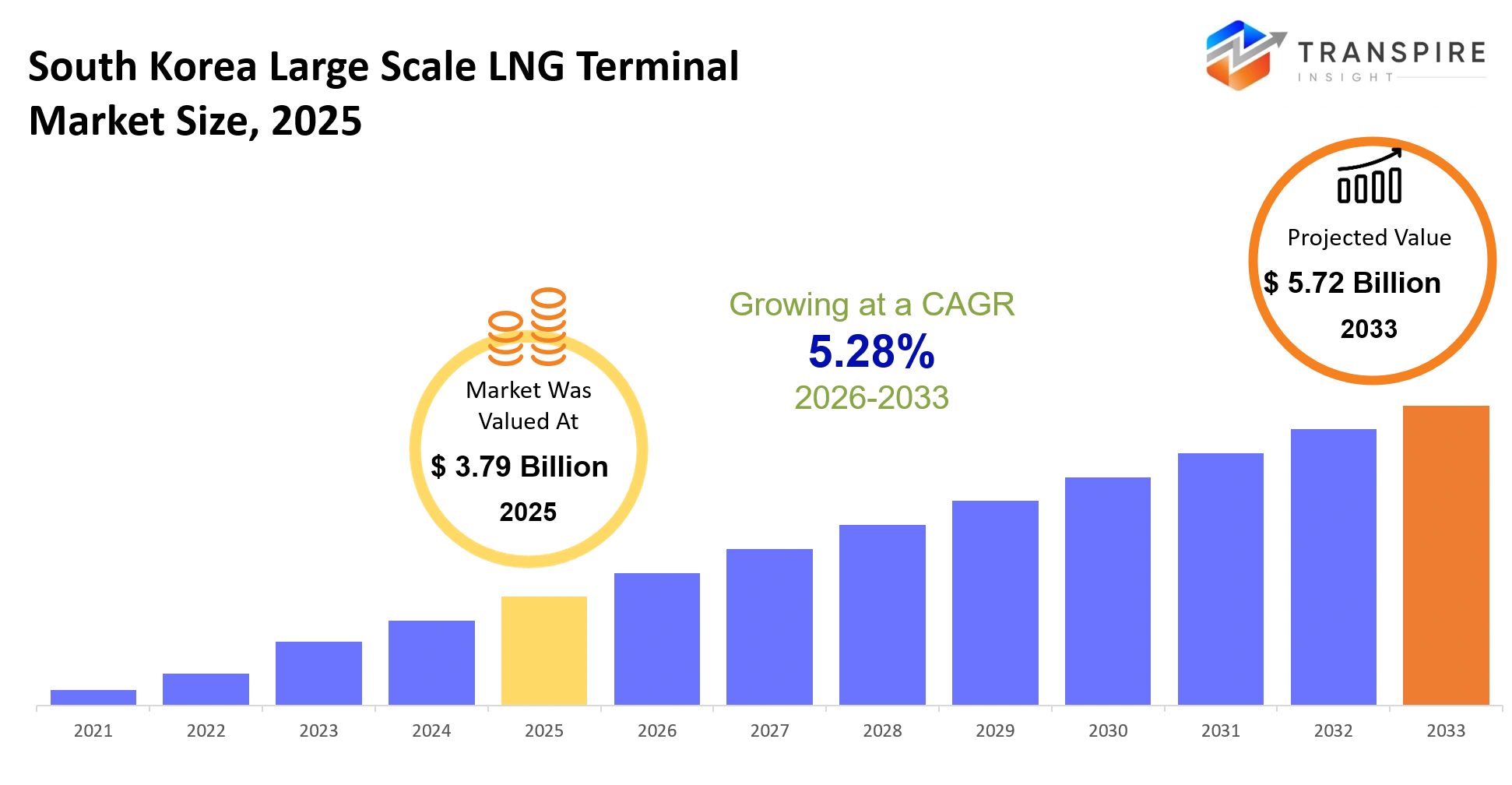
- South Korea Large Scale LNG Terminal Market Size 2025: USD 3.79 Billion
- South Korea Large Scale LNG Terminal Market Size 2033: USD 5.72 Billion
- South Korea Large Scale LNG Terminal Market CAGR: 5.28%
- South Korea Large Scale LNG Terminal Market Segments: By Terminal Type (Import Terminals, Export Terminals, Regasification Terminals, Storage Terminals, Integrated LNG Hubs, Offshore Terminals, Multi-purpose Terminals, Others); By Application (Power Generation, Industrial Feedstock, Gas Distribution, LNG Trading, Marine Fueling, Export Operations, Grid Supply, Others); By Capacity (Below 1 MTPA, 1–5 MTPA, 5–10 MTPA, 10–15 MTPA, Above 15 MTPA, Expansion Projects, Strategic Reserves, Others); By End User (Utilities, Oil & Gas Companies, Industrial Users, Energy Traders, Government Entities, Shipping Companies, Infrastructure Operators, Others)
South Korea Large Scale LNG Terminal Market Summary
The South Korea Large Scale LNG Terminal Market was valued at USD 3.79 Billion in 2025. It is forecast to reach USD 5.72 Billion by 2033. That is a CAGR of 5.28% over the period.
Large-scale LNG terminal markets of South Korea have the function to balance its energy system by receiving and storing the liquefied natural gas imported from overseas and then providing it after re-gasifying it for power plants, industrial fuel, city gas customers. The role and meaning of it in practice is that it supplies stable energy to countries that do not have significant domestic fuel resources and have vulnerable global supply-side situations. South Korea's LNG terminal market had changed from a capacity increase to supply flexibility and energy security-oriented for the last 5 years by installing larger capacity storage tanks, diversifyingLNG sources, and utilizing digital terminal management systems. However, the LNG supply chain shock resulting from Russia and Ukraine's war accelerated this shift because it brought up the vulnerability of reliance on limited supply routes for imports and a significant loss of energy. Thus, as LNG supply and demand will likely become increasingly inelastic and the demand for flexible services will surge, terminal operators and utilities will expand and increase profits from the capacity utilization, trading opportunities, and strategic inventories and even from a wider spectrum of storage services in addition to basic LNG supply operations.
Key Market Insights
- The South Korea Large Scale LNG Terminal Market went away from a focus on import capacity addition after 2021 and moved on to operational flexibility and diversification of supplies.
- The Southeast coastal region leads in the market with nearly 70% in 2025 considering the majority of dense clusters of industries and LNG receiving facilities.
- Eastern Coastal terminals will be the fastest-growing regional category through 2032 as fears of energy security spur investment in storage expansion.
- LNG receiving and regasification services commands the largest share of the market with more than 55%, supported by the stable indigenous natural gas consumption.
- However, LNG storage infrastructure is the second largest segment as operators increased tank capacity over 15% between 2020 and 2025.
- Floating storage and regasification integration is developing quickly with hybrid terminals gaining market share for added supply flexibility through 2030.
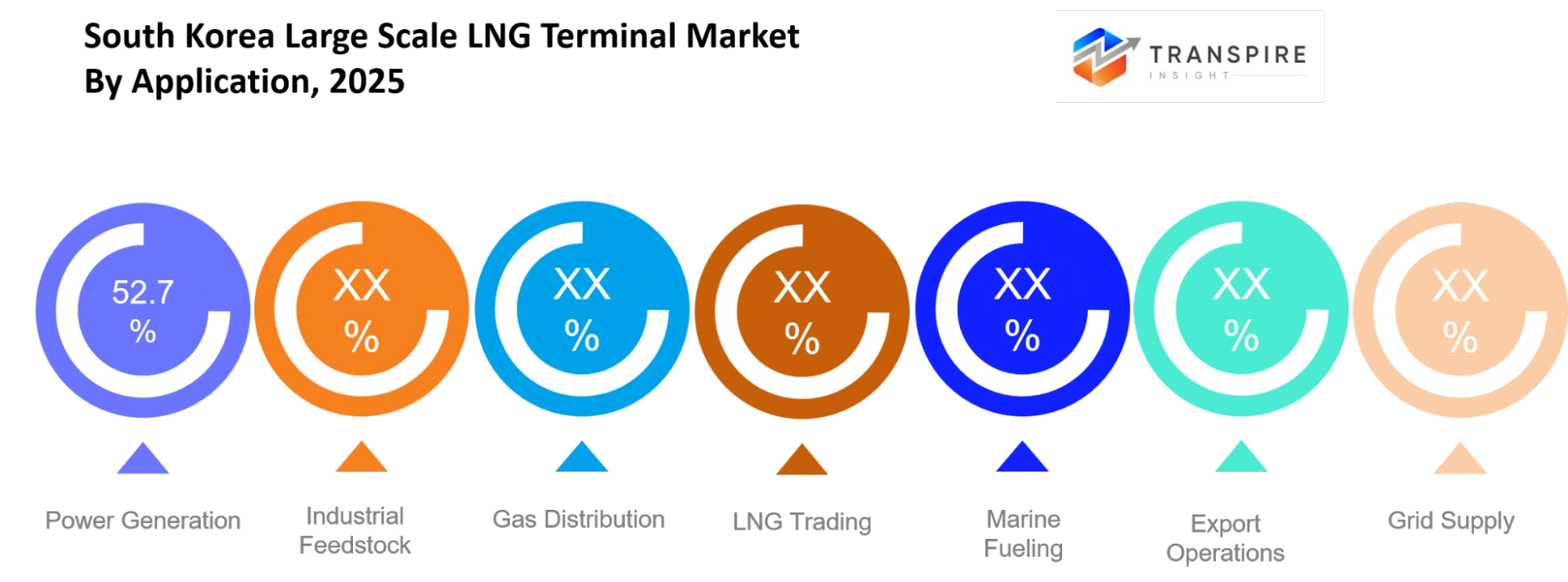
- Among applications Power generation is the main application with around 48% market share. Feedstock use in the industry is, though, the fastest growing use.
- Apart from industrial end-users like petrochemicals and steels gained further appetite for cheaper and cleaner energy, namely, LNG, after 2022 for long term purchase to cover their eventual reliance on coal and related exposure to emissions.
- Operation of digital terminals is a major trend since 2023, AI based predictive maintenance leading to a 20% reduction in unplanned equipment downtime.
What are the Key Drivers, Restraints, and Opportunities in the South Korea Large Scale LNG Terminal Market?
This is the primary source of growth – the long-term energy security policy coupled with scheduled phasing-out of older coal plants. Supply disruptions following 2022 have pushed utilities and industrial players to diversify the sources of natural gas and increase LNG capacity in the country – a move that translated directly into investments in terminals, storage and regasification units. Long-term demand remains solid, with government efforts to minimize coal usage supporting continued demand from terminals.
This is the biggest structural constraint on growth in receiving terminal capacity, with the requirement for massive investment, long lead times (often 5+ years), lengthy permit processes, and constraints on available land in coastal industrial areas all impeding new capacity addition. The result is a slower rate of new capacity coming on line and lower overall market revenue generation.
New investments are being directed at “smart” LNG infrastructure, which incorporates new technologies for greater efficiency and decarbonization. These will include artificial intelligence (AI) to manage terminals and more advanced boil-off gas recovery and carbon capture technology – a trend likely to accelerate as South Korea progresses towards carbon neutrality goals through 2050.
What Has the Impact of Artificial Intelligence Been on the South Korea Large Scale LNG Terminal Market?
AI and Other digital technologies optimize terminal operations in South Korea AI and new digital technologies are now enabling operators to enhance reliability and safety, boost asset utilization and boost overall efficiency of LNG terminal operations in South Korea. Operators have implemented AI-based monitoring systems to automatically control cryogenic storage operations, regulate gasification controls and optimize pressure in pipeline infrastructure. Continuous real-time analysis of sensor readings enables the systems to detect deviations from expected operating conditions in advance and apply real-time changes to operating conditions. ML helps in predictive maintenance ML models are increasingly being used for the predictive maintenance of equipment.
Terminal operators monitor compressor behavior, ambient temperature readings, vibration patterns and other performance indicators, to ensure timely maintenance and predict any potential equipment failure. According to terminal operators, the integration of AI technology has led to a 10-20% decline in unplanned equipment downtime as well as a decrease in maintenance expenses and an increase in asset availability. AI-enabled demand forecasting assists operators in optimizing LNG storage levels and scheduling cargo to further optimize storage utilization.
Advanced analytics solutions can also be applied to monitor emissions from the terminals and to identify opportunities to save energy and fuel consumption through boil-off gas forecasting and by optimizing the fuel usage for operations. Major bottleneck - AI integration High integration cost is a limitation for the rapid expansion of the technology adoption in LNG terminals. Integrating existing legacy infrastructure with the newly deployed modern digital platforms also takes time and requires substantial planning without disturbing the operations of the LNG terminals.
Key Market Trends
- In 2021, buyers began purchasing from multiple countries for the first time since 2012. This decrease reliance on single sources of supply has helped diminish volatile supplies and enhance the flexibility of long-term contracts.
- Since 2023, terminal operators have increasingly relied on AI-based predictive maintenance to help improve equipment availability and reduce unplanned outages across pilot terminal infrastructure.
- Expansion of storage tanks grew rapidly as utilities and others sought to build strategic reserves of larger and larger size. Total capacity accumulated in LNG storage in the country has increased steadily in recent years.
- However, competitive behavior has transitioned from a focus solely on capacity expansion to digitalization, reduction in emissions, and improving operational efficiency.
- In planning for future import infrastructure, the consideration for hydrogen and ammonia acceptance has become widespread, given that South Korea's energy transition plans extend until 2050.
- Regulatory priorities moved to energy resilience in 2022 onwards aiming to set operators more storage redundancy and emergency supplies.
- LNG demand from industrial consumers grew as costs for coal and carbon increased, among steel and petrochemical industries.
- The global supply disruptions led the terminal operators to adopt the approach of flexible cargo scheduling and spot procurement, rather than a fixed sourcing model.
- Utility, engineering firms and technology vendor collaboration increased since 2023 to aid the rollout of smart terminals and modernize infrastructure.
- Operators invested in boil-off gas, emissions measurement and energy conscious regasification technologies making environmental performance a competitive factor.
South Korea Large Scale LNG Terminal Market Segmentation
By Terminal Type :
Import terminals represent most of the infrastructure at large scale LNG facilities, as the LNG demand for power and industry increases. Robust coastal infrastructure provides sufficient capacity to handle continuous operations such as LNG unloading, regasification, loading and regassing operations. As capacities rise, they contribute to the stable supply of energy resources. Upgrades and modernization of the LNG receiving facilities, contributes to an increase in the operational safety and improve the operational efficiency within LNG infrastructure and national distribution networks.
Export terminals are limited because the nation’s energy structure is import dominant, though some facilities strategically cater for the re-export operation when LNG supplies exceed demand. Regasification terminals convert LNG back to pipeline gas before being delivered through the domestic gas distribution networks. Storage facilities serve to ensure an available supply to the market at times when demand exceeds supply. LNG Integrated Hub terminals bring multiple terminal operations together in one location to improve overall efficiency, synergy and long-term sustainability.
Offshore terminals offer the flexibility of dealing with land scarcity and allow deepwater LNG reception and offshore transfer activities. Multi-purpose terminals allow the handling and receiving of LNG in conjunction with storage and other functions. Finally, alternative terminal designs may be developed to address the specific needs of a region or industry to optimize flexibility and resilience of a LNG infrastructure portfolio.
By Application :
LNG Terminals: Application SegmentsLNG as a clean energy source for stable power output, power generation continues to represent the largest segment due to strong preference for clean fuel substitutes in the segment. LNG facilities are crucial as reliable terminal support, guaranteeing efficient gas flow to fuel generation and a well-balanced national electricity network.LNG acts as industrial feedstock used by chemical industry, steel plants and other manufacturing operations to satisfy the constant need of gas.
Gas distribution companies need a steady supply from LNG facilities, since regasified LNG fed into the existing pipelines helps manage fluctuating demand from all users.Price volatility and shifts in international gas supply boost the LNG trading industry activity. LNG supply is gaining acceptance as a marine fueling option with an increase in demand for eco-friendly alternatives in the maritime sector.
Limited yet tactical, exports become necessary in situations of imbalance between global supply and demand.LNG supplies national grid as power output supplement and facilitates balanced regional distribution of electricity via gas pipeline network.LNG is consumed also to supply district heating and other niche industries.
By Capacity :
Infrastructure Facilities Below 1 MTPA-capacity terminals that cater to regional demands and small scale industries, provides convenient supplies for users in localities. Moderate infrastructure ensures ease in dealing with moderate-to-limited demand intensity without compromising steady distribution and efficient delivery.
1-5 MTPA-capacity terminals widely used to fulfill average import and distribution demand 5-10 MTPA terminals to fulfill import and distribution demand for large urban areas and industrial regions 10-15 MTPA terminals for large demand centers; high end distribution with comprehensive storage and regasification infrastructure Above 15 MTPA-capacity terminals for nationally sized importing and importing of energy Additional terminals such as Expansion project provides additional import capacity to existing facilities by expanding the facilities strategically to handle additional supply for growing needs.
Strategic reserves will ensure the availability of supplies during supply disruption or for peaks in demand. Another capacity category consists of hybrid capacity-building to allow facilities to accommodate changes in demand for long-term energy security and efficient operations.
By End User :
A terminal is used to facilitate imports, storage and re-distribution to industries and is crucial for ensuring that a wide range of businesses and public service providers have the necessary fuel they need on hand at any time – and it is of course essential for powering large power stations and city-wide gas distribution networks to support electricity generation.
As the largest end-user group, the utilities sectors’ reliance on LNG terminals to meet power and city-wide gas requirements underpins electricity generation reliability and supports urban energy system continuity. LNG import and regasification at terminals helps maintain consistent energy supply during demand fluctuations and supports national grid resilience. Other key users include the oil and gas sector (for handling, storing, distributing); industrial end-users (for steady fuel supplies in their operations); energy traders; and government bodies (for strategic energy security, planning and policy). Shipping companies are usingLNG terminals to fuel vessels to enhance cleaner transport, while infrastructure operators are responsible for maintaining and operating the facilities and logistics networks to manage the whole process, serving diverse energy access needs across many sectors.
What are the Key Use Cases Driving the South Korea Large Scale LNG Terminal Market?
Main drivers based onLNG usage from power generation in South Korea where the terminals provide regasified fuel to gas turbine facilities due to emissions reduction mandates and national energy security strategy from a domestic system perspective.
Also industrial users from steel/petrochemical/manufacturing companies utilize LNG supplies through the terminals, shipping companies expanding LNG bunkering due to IMO standards, and utility companies boosting gas pipeline networks.
Future demand includes LNG trading hubs from price arbitrage, price reservation from supply shock, and offshore terminal facilities providing coastal flexibility with future low-carbon fuel integration facilities along the coast.
|
Report Metrics |
Details |
|
Market size value in 2025 |
USD 3.79 Billion |
|
Market size value in 2026 |
USD 3.99 Billion |
|
Revenue forecast in 2033 |
USD 5.72 Billion |
|
Growth rate |
CAGR of 5.28% from 2026 to 2033 |
|
Base year |
2025 |
|
Historical data |
2021 - 2024 |
|
Forecast period |
2026 - 2033 |
|
Report coverage |
Revenue forecast, competitive landscape, growth factors, and trends |
|
Country scope |
South Korea |
|
Key company profiled |
KOGAS, SK E&S, GS Caltex, POSCO International, Korea Midland Power, Shell, BP, TotalEnergies, ExxonMobil, Chevron, Cheniere Energy, QatarEnergy, Petronas, Mitsubishi Corp, JERA |
|
Customization scope |
Free report customization (country, regional & segment scope). Avail customized purchase options to meet your exact research needs. |
|
Report Segmentation |
By Terminal Type (Import Terminals, Export Terminals, Regasification Terminals, Storage Terminals, Integrated LNG Hubs, Offshore Terminals, Multi-purpose Terminals, Others); By Application (Power Generation, Industrial Feedstock, Gas Distribution, LNG Trading, Marine Fueling, Export Operations, Grid Supply, Others); By Capacity (Below 1 MTPA, 1–5 MTPA, 5–10 MTPA, 10–15 MTPA, Above 15 MTPA, Expansion Projects, Strategic Reserves, Others); By End User (Utilities, Oil & Gas Companies, Industrial Users, Energy Traders, Government Entities, Shipping Companies, Infrastructure Operators, Others) |
Which Regions are Driving the South Korea Large Scale LNG Terminal Market Growth?
The Incheon-Gyeonggi coastal area dominates South Korean Large Scale LNG Terminal Market owing to its direct link to Seoul metropolitan demand center. The Incheon LNG terminal (Operated by Korea Gas Corporation) is capable of large scale regasification and stable pipeline supply. The excellent port infrastructure permits continuous handling of LNG carriers at the port and the high storage turnover rate. The heavy urban & industrial consumption provides steady rate of terminal capacity utilization throughout the year.
Ulsan-Yeosu industrial belt supports a stable second growth region with significant petrochemical and manufacturing demand. Petrol region receives dedicated long-term LNG supply to support the refinery complex and its cluster of heavy industry. Different from Incheon’s capital linked demand, this region depends more on industrial self sufficiency and export-oriented production. Existing coastal terminals guarantee stable supply for long term industrial contract.
In the Busan and southern coastal corridor, rapid growth momentum can be observed from Bunkering LNG and port modernization programs. The new regulations on the use of maritime fuel encourage shipping operators to switch to LNG fuel supply chain can be implemented at major ports. This provides new entry opportunities for investor in terminal operation and marine energy services.
Who are the Key Players in the South Korea Large Scale LNG Terminal Market and How Do They Compete?
The South Korea Large Scale LNG Terminal market has a moderately concentrated competitive landscape, dominated by a few government-supported and vertically integrated energy majors. Competitions are on building scale, reliability, and securing long-term LNG supply contracts. Entrenched players compete on scale of infrastructure and regulatory compliance to defend their position, instead of solely on price competition. Emerging player competition generally exists in the form of JVs or projects bundled with EPC scopes.
KOGAS is a structural winner on account of ownership of large scale import terminals and nationwide pipeline, which enables efficient logistics and efficient terminal utilization. SK E&S aims to integrateLNG terminals with its downstream power business to support internal consumption of imported LNG to achieve better demand stability. POSCO International strengthens competitive positioning through trading-linked LNG sourcing as well as investment into upstream assets to improve sourcing flexibility and LNG portfolio efficiency. GS Energy's growth strategy is by participating in coastal terminals and forming alliances with existing infrastructure players.
Company List
- KOGAS
- SK E&S
- GS Caltex
- POSCO International
- Korea Midland Power
- Shell
- BP
- TotalEnergies
- ExxonMobil
- Chevron
- Cheniere Energy
- QatarEnergy
- Petronas
- Mitsubishi Corp
- JERA
Recent Development News
In March 2026, Korea Gas Corporation entered into a memorandum of understanding with JERA Co. to enhance cooperation in LNG terminal and shipping operations. The collaboration focuses on cargo swaps and coordinated scheduling across terminals to improve efficiency and energy security in Northeast Asia. Sourcehttps://www.jera.co.jp/
In August 2025, Trafigura signed a long-term LNG supply agreement with Korea Gas Corporation. The deal secures multi-year LNG deliveries through Trafigura’s global portfolio, strengthening upstream-to-terminal supply continuity for South Korea’s regasification infrastructure. Sourcehttps://www.trafigura.com/
What Strategic Insights Define the Future of the South Korea Large Scale LNG Terminal Market?
The South Korea Large Scale LNG Terminal Market is shifting towards an integrated infrastructure and a multi-use approach, which means terminals could be seen as a multi-purpose energy hub rather than only an LNG import point, driven by more fluctuating demands, the strengthening of security policy and the development of communication between power generation companies and industrial gas customers.
Terminal utilisation over the next 5-7 years will depend less on quantity growth and more on optimisation through scheduling and LNG procurement through portfolios. Less obvious but crucial challenges include the trend of increased concentration of supply contracts amongst few players which may have a negative impact on the trading liquidity of LNG and could limit operational throughput during demand shocks.
There is a visible but yet developing opportunity in the expansion of LNG bunkering for southern coastal ports as the emission regulations become tighter, coupled with initiatives targeting ship decarbonisation. Stakeholders should invest in flexible regasification expansions in modules and double-duty storage, to prepare for the power sector as well as the marine fuel segment demand changes.
South Korea Large Scale LNG Terminal Market Report Segmentation
By Terminal Type
- Import Terminals
- Export Terminals
- Regasification Terminals
- Storage Terminals
- Integrated LNG Hubs
- Offshore Terminals
- Multi-purpose Terminals
By Application
- Power Generation
- Industrial Feedstock
- Gas Distribution
- LNG Trading
- Marine Fueling
- Export Operations
- Grid Supply
By Capacity
- Below 1 MTPA
- 1–5 MTPA
- 5–10 MTPA
- 10–15 MTPA
- Above 15 MTPA
- Expansion Projects
- Strategic Reserves
By End User
- Utilities
- Oil & Gas Companies
- Industrial Users
- Energy Traders
- Government Entities
- Shipping Companies
- Infrastructure Operators
Frequently Asked Questions
Find quick answers to common questions.
The South Korea Large Scale LNG Terminal Market size is USD 5.72 Billion in 2033.
Key segments for the South Korea Large Scale LNG Terminal Market are By Terminal Type (Import Terminals, Export Terminals, Regasification Terminals, Storage Terminals, Integrated LNG Hubs, Offshore Terminals, Multi-purpose Terminals, Others); By Application (Power Generation, Industrial Feedstock, Gas Distribution, LNG Trading, Marine Fueling, Export Operations, Grid Supply, Others); By Capacity (Below 1 MTPA, 1–5 MTPA, 5–10 MTPA, 10–15 MTPA, Above 15 MTPA, Expansion Projects, Strategic Reserves, Others); By End User (Utilities, Oil & Gas Companies, Industrial Users, Energy Traders, Government Entities, Shipping Companies, Infrastructure Operators, Others).
Major South Korea Large Scale LNG Terminal Market players are KOGAS, SK E&S, GS Caltex, POSCO International, Korea Midland Power, Shell, BP, TotalEnergies, ExxonMobil, Chevron, Cheniere Energy, QatarEnergy, Petronas, Mitsubishi Corp, JERA.
The South Korea Large Scale LNG Terminal Market size is USD 3.79 Billion in 2025.
The South Korea Large Scale LNG Terminal Market CAGR is 5.28% from 2026 to 2033.
- KOGAS
- SK E&S
- GS Caltex
- POSCO International
- Korea Midland Power
- Shell
- BP
- TotalEnergies
- ExxonMobil
- Chevron
- Cheniere Energy
- QatarEnergy
- Petronas
- Mitsubishi Corp
- JERA
About the Authors

Avinash Kumar
I’m Avinash Kumar, a Senior Research Analyst at Transpire Insight, with expertise in the Electronics and Semiconductor and Energy & Power industry. My work focuses on analyzing emerging technologies, market trends, industry developments, and innovation across these sectors. I specialize in transforming complex technical and market insights into clear, research-backed content that helps professionals, businesses, and decision-makers stay informed. Through continuous industry research and data-driven analysis, I strive to deliver accurate, reliable, and practical perspectives on the latest advancements shaping the semiconductor and energy landscape.

Chakradhar Khansole
Chakradhar serves as the Research Director at Transpire Insight, bringing over 8 years of experience in technology, innovation, and strategic market intelligence. He specializes in transforming complex market data into actionable business insights that enable organizations to make informed, growth-oriented decisions. Recognized for his strategic vision and analytical expertise, Chakradhar leads high-impact research initiatives, delivering comprehensive market assessments, competitive intelligence, and forward-looking industry analysis.
Recently Published Reports
-
Apr 2026
Active Power Filter Market
Active Power Filter Market Size, Share & Analysis Report By Type (Shunt Active Power Filters, Series Active Power Filter, Hybrid Active Power Filter), By Application (Harmonics Mitigation, Reactive Power Compensation, Voltage Regulation, Power Factor Correction), By Phase (Single Phase, Three Phase), By End-User Industry (Manufacturing, Healthcare, Commercial, Automotive, Oil and Gas, Others), and Geography (North America, Europe, Asia-Pacific, Middle East and Africa, South and Central America), 2021 - 2031
-
Apr 2026
Electrical Transformer Market
Electrical Transformer Market Size, Share & Analysis Report By Core (Closed, Shell, and Berry), By Insulation (Gas, Oil, Solid, Air, and Other), By Phase (Single, and Three), By Rating (100 MVA to 500 MVA, 501 MVA to 800 MVA, and 801 MVA to 1200 MVA), and Geography (North America, Europe, Asia-Pacific, Middle East and Africa, South and Central America), 2021 – 2031
-
Apr 2026
Hydraulic Piston Pumps Market
Hydraulic Piston Pumps Market Size, Share & Analysis Report By Type (Axial Piston Pumps, Radial Piston Pumps), By Operating Pressure (Low Pressure, Medium Pressure, High Pressure), By Application (Construction, Mining, Agriculture, Automotive, Oil & Gas, Industrial Machinery, Others), By End-User (OEMs, Aftermarket), and Geography (North America, Europe, Asia-Pacific, Middle East and Africa, South and Central America), 2021 – 2031
-
Apr 2026
Laboratory Gas Generators Market
Laboratory Gas Generators Market Size, Share & Analysis Report By Product (Nitrogen Gas Generator, Hydrogen Gas Generator, Zero Air Gas Generator, Purge Gas Generator, TOC Gas Generators, Others), By Application (Gas Chromatography, Liquid Chromatography-mass Spectrometry (LC-MS), Gas Analyzers, Others), By End-user (Life Science, Chemical & Petrochemical, Food & Beverage, Others), and Geography (North America, Europe, Asia-Pacific, Middle East and Africa, South and Central America), 2021 – 2031