

South Korea Hybrid Electric Aircraft Market Size & Forecast:
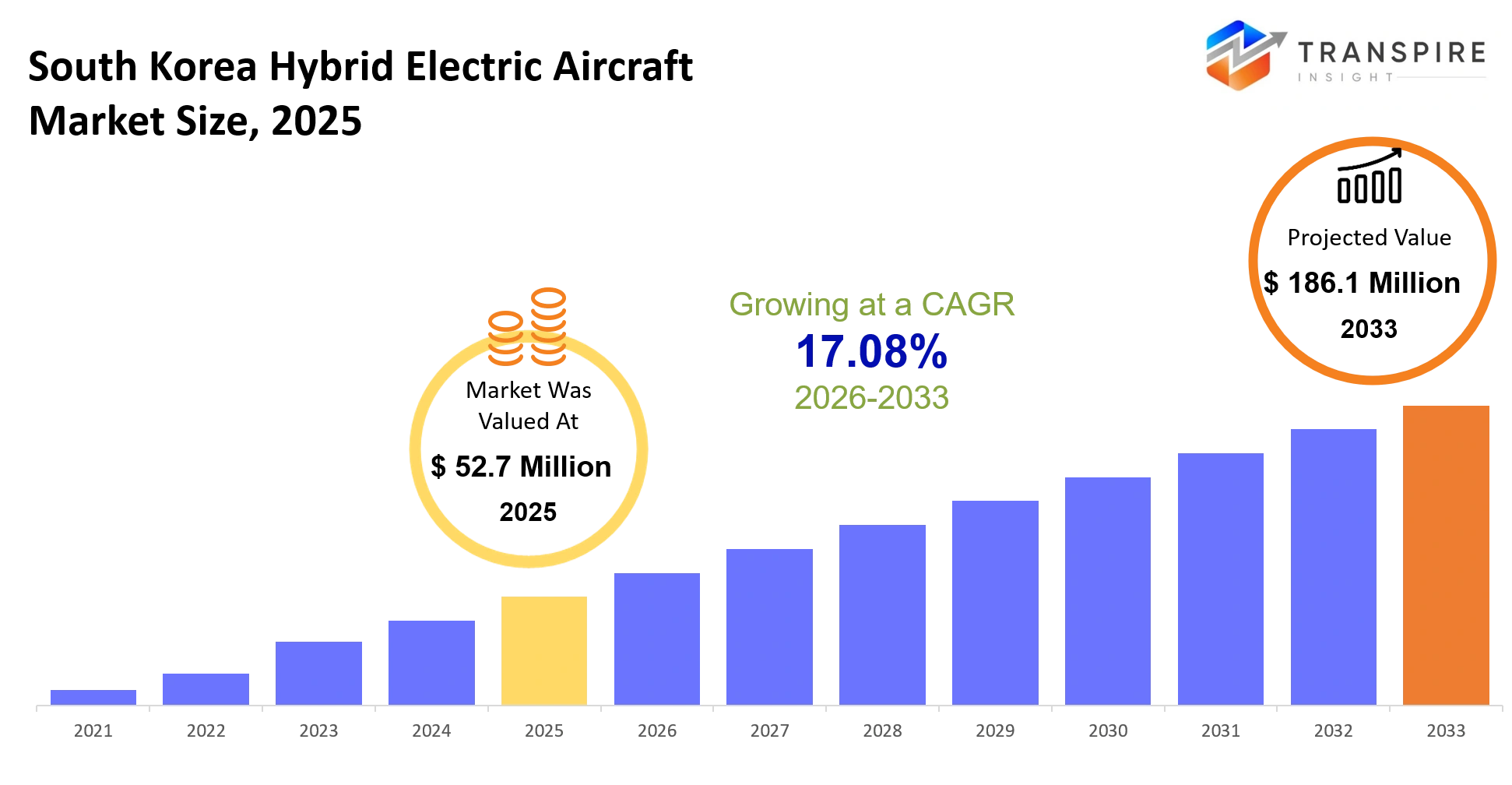
- South Korea Hybrid Electric Aircraft Market Size 2025: USD 52.7 Million
- South Korea Hybrid Electric Aircraft Market Size 2033: USD 186.1 Million
- South Korea Hybrid Electric Aircraft Market CAGR: 17.08%
- South Korea Hybrid Electric Aircraft Market Segments: By Aircraft Type (Regional Aircraft, Business Jets, UAVs, Air Taxis, Commercial Aircraft, Military Aircraft, Others) By Propulsion Type (Parallel Hybrid, Series Hybrid, Turboelectric, Battery Electric Hybrid, Hydrogen Hybrid, Solar Hybrid, Others),By Component (Batteries, Electric Motors, Generators, Power Electronics, Energy Storage Systems, Control Systems, Others),By Application (Commercial Aviation, Defense, Cargo Transport, Urban Air Mobility, Emergency Services, Pilot Training, Others)
South Korea Hybrid Electric Aircraft Market Summary
The South Korea Hybrid Electric Aircraft Market was valued at USD 52.7 Million in 2025. It is forecast to reach USD 186.1 Million by 2033. That is a CAGR of 17.08% over the period.
South Korea’s hybrid electric aircraft market is kinda developing around a very practical challenge, namely cutting fuel burn emissions, and operating costs for regional flying, without giving up range or reliability. Airlines plus aerospace makers and even defense programs are looking at hybrid propulsion so short-haul routes and urban air mobility services stay economically viable, and also so they fit the national decarbonization plans. Over the last five years, the market sort of moved from early research mode to more integrated demonstration programs that stitch together batteries, electric motors, and conventional propulsion in architectures that can actually be scaled. That shift picked up after pandemic era supply chain hiccups, and after fuel price swings made it clearer how risky it is to depend only on the usual aviation setup. Because of that, money has drifted toward energy-efficient aircraft platforms and toward building domestic know-how, not just buying the stuff. The markets growth now mirrors a wider reshaping of aviation economics, where lower lifecycle costs and regulatory fit increasingly decide whether companies adopt this approach, and also where the next revenue possibilities come from.
Key Market Insights
- In 2025 the Seoul metropolitan region will dominate the South Korea Hybrid Electric Aircraft Market , with nearly 45% share, mainly because there is heavy aerospace R&D concentration in the area.
- Meanwhile South Gyeongsang Province shows up as the fastest-growing regional hub all the way through 2033, backed by aircraft manufacturing clusters and these strategic aerospace investments that keep stacking up.
- Between 2021 and 2025 the regional aerospace ecosystems shifted, moving away from defense-focused projects toward dual-use hybrid aviation technologies.
- When it comes to propulsion, parallel hybrid systems are leading , at about 48% market share in 2025, because they somehow manage to balance fuel savings with operational reliability.
- Series hybrid systems take the second-largest slice too, as manufacturers lean toward simpler architectures for regional flights and short-haul aircraft types.
- Turboelectric and distributed propulsion are the fastest-growing technologies through 2033, mainly as battery performance keeps improving steadily.
- On the revenue side, regional transport aircraft make up more than 40% of the South Korea Hybrid Electric Aircraft Market , since operating costs tend to be lower on shorter routes.
- Urban air mobility applications really picked up after 2022, once government initiatives accelerated the electric air taxi ecosystem development.
- Cargo and logistics aircraft are becoming more visible as operators try to cut fuel consumption and also reduce maintenance expenses.
- And commercial aviation operators lead overall with nearly 55% share , driven by fleet modernization programs and strong fuel efficiency targets.
What are the Key Drivers, Restraints, and Opportunities in the South Korea Hybrid Electric Aircraft Market?
The main thing driving the South Korea Hybrid Electric Aircraft Market is the country’s push to decarbonize aviation but still stay competitive in high end aerospace production. After 2021, the government roadmaps came out and they really put emphasis on urban air mobility, electric propulsion, and specific carbon reduction goals. That basically makes a clear stream for research money and small pilot programs too, and it is all connected. Around the same time, jet fuel can swing a lot , so airlines and aircraft makers are looking at propulsion approaches that cut fuel use by roughly 20%–40% on short flights. All of that is helping prototype work move faster, and it’s also creating new income paths across battery systems, electric motors, and aircraft integration services.
The biggest brake though is still the limited energy density of today’s batteries. It feels kinda structural, because improving battery chemistry is not an instant fix , it takes years of work, testing, certification, plus industrial scaling. Right now those limits cap the aircraft range and how much it can carry, so commercial rollouts get postponed. That in turn drags on revenue potential from regional passenger flying and cargo routines.
One standout opportunity is urban air mobility together with regional electric aviation. South Korea is putting money into air mobility corridors, charging networks, and broader smart mobility ecosystems. And as battery performance keeps trending better, and as the certification rules get more settled, hybrid electric aircraft could end up being commercially workable for between city routes and air taxi use. If that lands, it opens a whole new slice of aviation, not just incremental growth.
What Has the Impact of Artificial Intelligence Been on the South Korea Hybrid Electric Aircraft Market?
Artificial intelligence plus advanced digital technologies are getting very much involved, you know, in the hybrid electric aircraft development across South Korea. More and more aircraft makers are putting in AI driven energy management systems, these systems basically shuffle and balance the power flow between batteries, electric motors, and the conventional engines. They keep reading what’s happening during flight, the weather trends, and how much energy is being used, then they aim to squeeze out better fuel efficiency and at the same time stretch the useful life of the battery.
And then there is machine learning too, that part is turning predictive maintenance into something more proactive. When operators look at sensor information coming from propulsion systems, the batteries, and the thermal management units, they can spot early wear and degradation before any real failure shows up. This kind of early warning reduces the number of sudden, unplanned maintenance moments, it boosts aircraft availability, and it also cuts down operating expenses. A number of aerospace firms say digital twin technologies and AI based diagnostics can push maintenance spending down by double digit percentages, while also lifting fleet uptime in practice.
AI also helps with flight route optimization and with forecasting battery health, so operators can sort of maximize overall operational efficiency. Still, the rollout is not fully smooth, because integration costs are high and historical operating data is pretty limited. Since hybrid electric aircraft are still in those early commercialization phases, it is tricky to train sturdy AI models, especially for really rare failure cases, and for long duration flight situations where the data just doesn’t accumulate as fast.
Key Market Trends
- Since 2021, aerospace companies have kinda moved away from isolated battery efforts, toward more integrated hybrid propulsion setups, with higher reliability and longer operating ranges.
- Kinda after 2022, the whole urban air mobility push went fast, and that made manufacturers try to build compact hybrid aircraft, not just for intercity, but also for metropolitan service.
- Meanwhile, aircraft developers are leaning harder into distributed electric propulsion systems, which helps with aerodynamic efficiency and makes it easier to pull off more flexible airframe layouts.
- At the same time, government funding for advanced aviation tech went up a lot from 2021 to 2025, so demo work and certification activities picked up real speed.
- Manufacturers are also getting more collaborative with battery suppliers, plus semiconductor firms, aiming to boost energy density and sharpen onboard power management features.
- After the pandemic disruptions, supply chain strategies changed too, with firms localizing battery production and finding key aerospace components more domestically, sometimes via nearshoring plans.
- Hybrid aircraft designs are now more often using lightweight composite materials, which cuts structural weight, and that then improves fuel efficiency across regional operations.
- Airlines are shifting their purchasing emphasis toward lower lifecycle operating costs, not only the initial aircraft acquisition price up front.
South Korea Hybrid Electric Aircraft Market Segmentation
Aircraft Type:
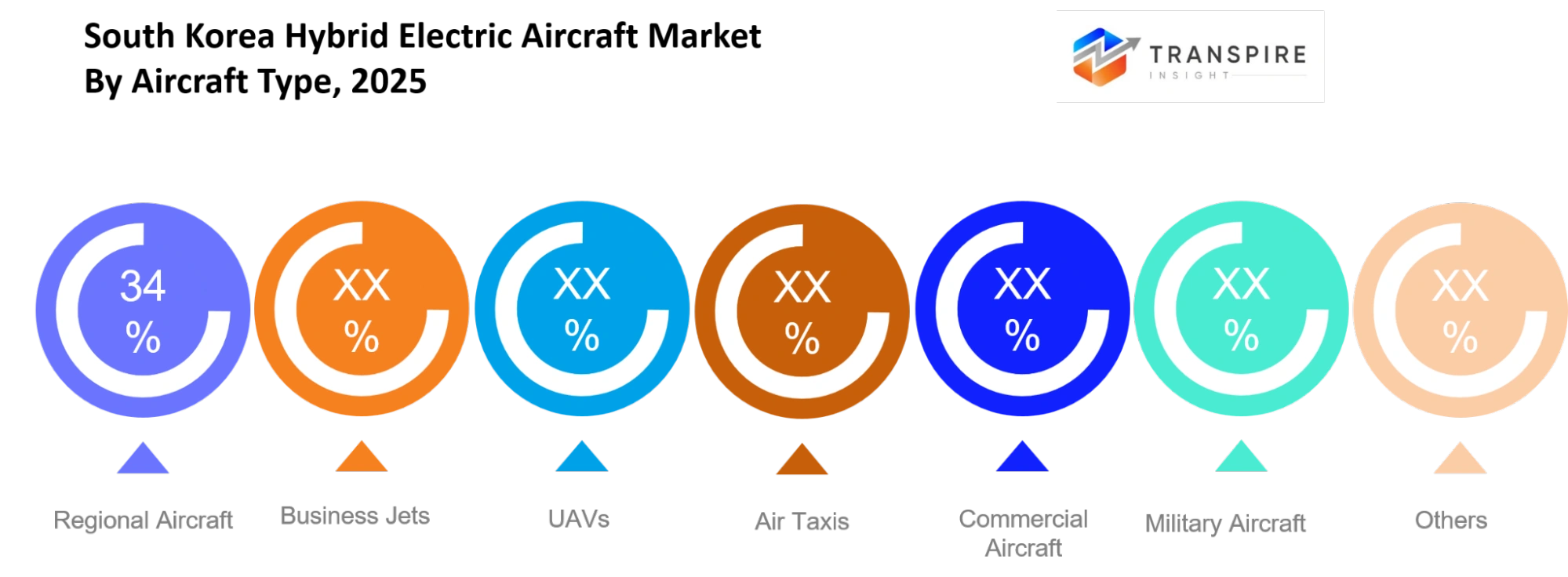
Regional Aircraft are made for short to medium distance routes and kinda help boost fuel efficiency, while also easing emissions. Business Jets are more for private and corporate travel, and they often come with advanced hybrid systems that lower the day to day operating expenses. UAVs, meanwhile , do surveillance, inspection, and defense tasks, with longer endurance and a quieter kind of performance that stands out.
Air Taxis are compact aircraft aimed at city movement, and people expect they will reshape short-haul travel in big metropolitan areas. Commercial Aircraft are for hauling passengers across longer routes, and Military Aircraft are built around defense missions, with better efficiency too. Others cover experimental and specialized planes, created for research, plus odd niche operations.
Propulsion Type:
Parallel Hybrid means a conventional engine teams up with electric motors, and both can basically work together during flight. That setup improves fuel savings and gives more operational flexibility, which is pretty important. Series Hybrid is different: it relies on electric motors for propulsion while the engine acts more like an electricity generator, so the energy use stays more efficient.
Turboelectric systems use gas turbines tied to electric power units , to enable advanced designs in aircraft. Battery Electric Hybrid, Hydrogen Hybrid, and Solar Hybrid are getting more attention lately because cleaner energy sources can reduce fuel dependence. Other concepts are still emerging propulsion technologies in development, aimed at future aviation needs, even if they’re not mainstream yet.
Component:
Batteries are, well, some of the most important bits here because they hold the electrical energy that’s needed for electric flight operations. Electric Motors turn that stored energy into mechanical power, but Generators then dish out electricity so the whole system stays stable across different flight situations.
Power Electronics step in to steer how the electricity moves, boosting efficiency over all those aircraft subsystems. Energy Storage Systems also keep a calm, steady reserve of power, while Control Systems keep an eye on the process and regulate everything so the operation stays safe and predictable. There are other supporting parts too—sensors, wiring arrangements, plus thermal management equipment, which keeps aircraft functionality in check.
Application:
Commercial Aviation is still a big deal because airlines want aircraft that cut fuel consumption and lower operating expenses. Defense missions usually lean toward surveillance, pilot training, and tactical tasks, where hybrid setups can stretch endurance and reduce maintenance overhead. Cargo Transport is also growing, since logistics providers are looking for more effective aircraft for regional deliveries.
Urban Air Mobility covers short distance passenger transport in dense cities, and then Emergency Services along with Pilot Training use hybrid aircraft for more specialized roles. Other areas include tourism, research, and government aviation activities, though those vary quite a bit from program to program.
What are the Key Use Cases Driving the South Korea Hybrid Electric Aircraft Market?
Regional passenger transportation still seems like the big reason people are picking hybrid electric aircraft in South Korea. Airlines and aircraft makers are really steering attention toward short haul routes, where the fuel bill takes up a pretty big part of day to day expenses. With hybrid propulsion you get better energy efficiency along with reduced emissions, so regional aviation becomes this kind of sensible place for early commercial roll out.
Also, urban air mobility and defense work are starting to pick up steam as secondary reasons. Mobility companies are trialing hybrid air taxis, kind of to help with travel between cities, while defense groups are looking at these aircraft for things like surveillance and training jobs, missions that want longer endurance and less maintenance over time.
Then there are the newer angles too, emergency medical transport and regional cargo services. Medical teams are exploring hybrid aircraft for quicker reach to remote areas . Logistics operators meanwhile think these same platforms could support low emission freight movements. As batteries keep improving, along with smarter energy management systems, those ideas should drift closer to actual commercial use during the forecast period.
|
Report Metrics |
Details |
|
Market size value in 2025 |
USD 52.7 Million |
|
Market size value in 2026 |
USD 61.7 Million |
|
Revenue forecast in 2033 |
USD 186.1 Million |
|
Growth rate |
CAGR of 17.08% from 2026 to 2033 |
|
Base year |
2025 |
|
Historical data |
2021 - 2024 |
|
Forecast period |
2026 - 2033 |
|
Report coverage |
Revenue forecast, competitive landscape, growth factors, and trends |
|
Country scope |
South Korea |
|
Key company profiled |
Airbus, Boeing, Embraer, RTX, Rolls-Royce, Safran, Honeywell, GE Aerospace, magniX, Ampaire, Heart Aerospace, Eviation, Hyundai Aerospace, Korean Air Aerospace, Hanwha Aerospace |
|
Customization scope |
Free report customization (country, regional & segment scope). Avail customized purchase options to meet your exact research needs. |
|
Report Segmentation |
Aircraft Type (Regional Aircraft, Business Jets, UAVs, Air Taxis, Commercial Aircraft, Military Aircraft, Others) | Propulsion Type (Parallel Hybrid, Series Hybrid, Turboelectric, Battery Electric Hybrid, Hydrogen Hybrid, Solar Hybrid, Others) | Component (Batteries, Electric Motors, Generators, Power Electronics, Energy Storage Systems, Control Systems, Others) | Application (Commercial Aviation, Defense, Cargo Transport, Urban Air Mobility, Emergency Services, Pilot Training, Others) |
Which Regions are Driving the South Korea Hybrid Electric Aircraft Market Growth?
Seoul Capital Area is still the main area in the South Korea Hybrid Electric Aircraft Market, mostly because it gathers a lot of the national aerospace know how , like manufacturing capacity, research institutes, and those aviation policy rules. There are also government-backed innovation schemes, plus solid university research channels , and being close to major airports. All of that forms a kind of ecosystem that helps aircraft testing move faster, and components get worked on quicker. On top of that, the region basically hosts a wide mix of domestic aerospace suppliers, battery developers, and software firms—so they can all support hybrid propulsion work together. Because everything is connected like that, companies can shorten their development timelines and land collaborations more efficiently than in other regions.\
Then there is the southeastern region around Busan and Sacheon, which looks like the second-largest market, but it grows in a bit of a different way. Instead of leaning too much on research institutes, this place leans more on its industrial manufacturing foundation, steady defense spending, and ongoing investments in aerospace production facilities. Aircraft component vendors, together with precision engineering businesses, build a steady supply chain , so long-term commercialization of hybrid electric aircraft stays more durable. Its industrial mix is fairly balanced and the public-private funding stays consistent, which makes the region a dependable contributor to national market revenue even when the economy feels shaky for a while.
Jeolla Province and the nearby southwestern areas are starting to grow faster than a lot of other regions, partly because local governments are putting more and more money into green aviation infrastructure and regional air mobility projects, you know. A bunch of recent moves pushing low-carbon transportation—plus the creation of drone , and advanced air mobility testing zones—have opened up fresh doors for hybrid electric aircraft developers. Some firms are now looking at regional air routes and trial demonstration projects that, honestly , would have been harder to justify just a few years ago, since both infrastructure and policy support were kind of limited. Going into the 2026–2033 window, this whole momentum is expected to offer solid early exposure opportunities for investors who want to get in first on next-generation aviation technologies and regional mobility services.
Who are the Key Players in the South Korea Hybrid Electric Aircraft Market and How Do They Compete?
Competition in the South Korea Hybrid Electric Aircraft Market is still kind of moderately concentrated, so there are established aerospace manufacturers right next to newer electric aviation specialists plus propulsion technology firms. For pretty much everyone, technology innovation is the main thing, especially around battery integration , hybrid propulsion efficiency, lighter materials, and the ability to pass aircraft certification. The older aerospace players keep trying to hold their ground with research alliances and government-supported programs. Meanwhile, the newer entrants tend to aim at smaller, more specific aircraft categories and different propulsion layouts, basically to stand out in a less direct way.
When looking at who’s most active, Korea Aerospace Industries is pushing technology integration and building a domestic ecosystem. They lean on their aircraft manufacturing background and defense program experience, then move into next-generation propulsion systems as well as urban air mobility platforms. Hanwha Aerospace is more centered on propulsion technologies and energy systems. They use their know-how in engines and power solutions to strengthen hybrid aircraft capabilities, and their investments in upcoming aviation technologies seem like a direct road to diversify beyond the classic aerospace lanes.
International players also add pressure by bringing specialized tech and forming strategic partnerships. Ampaire, for example, differentiates with retrofit hybrid propulsion systems for regional aircraft, so operators can cut emissions without having to buy whole new fleets. Rolls-Royce competes via electric propulsion research plus strong system integration skills. It grows its presence through collaborations with aircraft manufacturers and battery technology suppliers. Taken together, these contrasting approaches are moving the market forward, or at least pushing it, in a direction that keeps competition intense
Company List
- Airbus
- Boeing
- Embraer
- RTX
- Rolls-Royce
- Safran
- Honeywell
- GE Aerospace
- magniX
- Ampaire
- Heart Aerospace
- Eviation
- Hyundai Aerospace
- Korean Air Aerospace
- Hanwha Aerospace
Recent Development News
In October 2025, Archer Aviation entered a strategic partnership with Korean Air to commercialize electric vertical take-off and landing (eVTOL) aircraft in South Korea. The agreement includes the potential purchase of up to 100 aircraft and is expected to accelerate the country's advanced air mobility ecosystem and low-emission aviation capabilities.
Source https://www.reuters.com/
In June 2026, Hanwha Group announced plans to increase its combined stake in Korea Aerospace Industries (KAI) to more than 12% by the end of 2026 through an additional investment commitment. The move is intended to deepen aerospace collaboration and strengthen South Korea's competitiveness in next-generation aviation and advanced aircraft technologies, including sustainable propulsion systems. Source https://www.reuters.com/
What Strategic Insights Define the Future of the South Korea Hybrid Electric Aircraft Market?
The South Korea Hybrid Electric Aircraft market is shifting , not overnight but steady, from those demo projects to a more specialized regional aviation ecosystem focused on urban air mobility, island linkages, and low-emission short haul transport during the next 5–7 years. In practice this move is less about aircraft sales numbers and more about government backed infrastructure spending, improvements in battery tech, and making advanced air mobility part of national transport blueprints. There’s also a quieter kind of risk , supply chain concentration for high-energy batteries and power electronics, where relying on a relatively small cluster of suppliers could pull manufacturers into cost swings and production delays , even if the demand is growing.
At the same time, an opportunity is starting to show up: hybrid-electric aircraft tuned for regional plus maritime routes that connect South Korea’s islands and coastal zones, an area still somewhat untouched by standard airline offerings. Market players should push for collaborations spanning batteries, avionics, and vertiport infrastructure, so the ecosystem edge is locked in before commercialization really scales up.
South Korea Hybrid Electric Aircraft Market Report Segmentation
By Aircraft Type
- Regional Aircraft
- Business Jets
- UAVs
- Air Taxis
- Commercial Aircraft
- Military Aircraft
By Propulsion Type
- Parallel Hybrid
- Series Hybrid
- Turboelectric
- Battery Electric Hybrid
- Hydrogen Hybrid
- Solar Hybrid
By Component
- Batteries
- Electric Motors
- Generators
- Power Electronics
- Energy Storage Systems
- Control Systems
By Application
- Commercial Aviation
- Defense
- Cargo Transport
- Urban Air Mobility
- Emergency Services
- Pilot Training
Frequently Asked Questions
Find quick answers to common questions.
The South Korea Hybrid Electric Aircraft Market size is USD 186.1 Million in 2033.
Key segments for the South Korea Hybrid Electric Aircraft Market are Aircraft Type (Regional Aircraft, Business Jets, UAVs, Air Taxis, Commercial Aircraft, Military Aircraft, Others) | Propulsion Type (Parallel Hybrid, Series Hybrid, Turboelectric, Battery Electric Hybrid, Hydrogen Hybrid, Solar Hybrid, Others) | Component (Batteries, Electric Motors, Generators, Power Electronics, Energy Storage Systems, Control Systems, Others) | Application (Commercial Aviation, Defense, Cargo Transport, Urban Air Mobility, Emergency Services, Pilot Training, Others).
Major South Korea Hybrid Electric Aircraft Market players are Airbus, Boeing, Embraer, RTX, Rolls-Royce, Safran, Honeywell, GE Aerospace, magniX, Ampaire, Heart Aerospace, Eviation, Hyundai Aerospace, Korean Air Aerospace, Hanwha Aerospace.
The South Korea Hybrid Electric Aircraft Market size is USD 52.7 Million in 2025.
The South Korea Hybrid Electric Aircraft Market CAGR is 17.08% from 2026 to 2033.
- Airbus
- Boeing
- Embraer
- RTX
- Rolls-Royce
- Safran
- Honeywell
- GE Aerospace
- magniX
- Ampaire
- Heart Aerospace
- Eviation
- Hyundai Aerospace
- Korean Air Aerospace
- Hanwha Aerospace
About the Authors

Mayur Shinde
I am Mayur Shinde, a Senior Research Analyst at Transpire Insight, specializing in the Automotive & Transportation and Information & Communication Technology (ICT) Industry. My work focuses on analyzing emerging market trends, technological advancements, competitive landscapes, and industry developments to deliver accurate, data-driven insights. I am passionate about transforming complex market information into clear, actionable content that helps businesses, professionals, and decision-makers stay informed and make confident strategic decisions.

Chakradhar Khansole
Chakradhar serves as the Research Director at Transpire Insight, bringing over 8 years of experience in technology, innovation, and strategic market intelligence. He specializes in transforming complex market data into actionable business insights that enable organizations to make informed, growth-oriented decisions. Recognized for his strategic vision and analytical expertise, Chakradhar leads high-impact research initiatives, delivering comprehensive market assessments, competitive intelligence, and forward-looking industry analysis.
Recently Published Reports
-
Apr 2026
ATV & UTV Market
ATV & UTV Market Size, Share & Analysis Report By Type (ATV, and UTV), By Variants (Less Than 400 CC, 400 CC To 800 CC, and More Than 800 CC), and Geography (North America, Europe, Asia-Pacific, Middle East and Africa, South and Central America), 2021 - 2031
-
Apr 2026
Automotive Central Gateway Module Market
Automotive Central Gateway Module Market Size, Share & Analysis Report By Type (Ethernet Central Gateway Module, CAN Central Gateway Module, LIN Central Gateway Module, and FlexRay), By Application (Powertrain Control, Body Control, Infotainment System, Advanced Driver Assistance Systems (ADAS), and Others), By End User (Passenger Vehicles, and Commercial Vehicles), and Geography (North America, Europe, Asia-Pacific, Middle East and Africa, South and Central America), 2021 - 2031
-
Apr 2026
Automotive Engine Oil Filter Market
Automotive Engine Oil Filter Market Size, Share & Analysis Report By Filter Type (Fuel Filter, Engine Oil Filter, Hydraulic Oil Filter, and Others), By Filter Media (Cellulose, Synthetic, and Micro), By Sales Channel (OEMs, and Aftermarket), By Vehicle Type (Passenger Cars, Light Commercial Vehicles, Heavy Duty Trucks, Buses and Coaches, and Off-road Vehicles), and Geography (North America, Europe, Asia-Pacific, Middle East and Africa, South and Central America), 2021 - 2031
-
Apr 2026
Automotive Parts Aluminium Die Casting Market
Automotive Parts Aluminium Die Casting Market Size, Share & Analysis Report By Production Process (Pressure Die Casting, Vacuum Die Casting, Squeeze Die Casting, Gravity Die Casting), By Application (Body Parts, Engine Parts, Transmission Parts, Battery And Related Components, Other Application Types), and Geography (North America, Europe, Asia-Pacific, Middle East and Africa, South and Central America), 2021 - 2031
Our Clients



