
South Korea Humanoid Robot Market Size & Forecast:
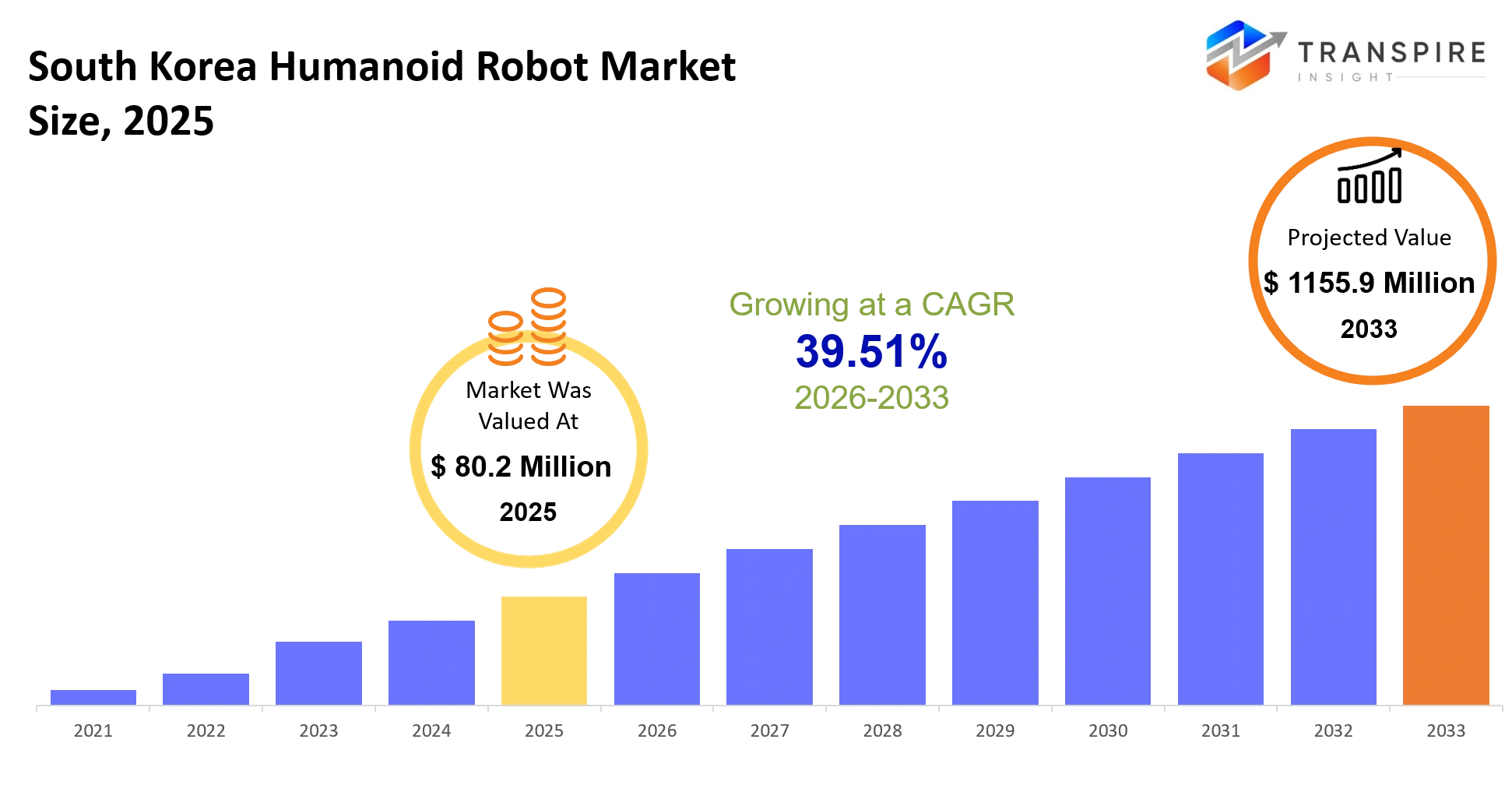
- South Korea Humanoid Robot Market Size 2025: USD 80.2 Million
- South Korea Humanoid Robot Market Size 2033: USD 1155.9 Million
- South Korea Humanoid Robot Market CAGR: 39.51%
- South Korea Humanoid Robot Market Segments: By Component (Hardware, Software, Services, Others); By Application (Industrial, Healthcare, Education, Hospitality, Others); By Motion Type (Bipedal, Wheeled, Hybrid, Others)
South Korea Humanoid Robot Market Summary
The South Korea Humanoid Robot Market was valued at USD 80.2 Million in 2025. It is forecast to reach USD 1155.9 Million by 2033. That is a CAGR of 39.51% over the period.
South Korea's humanoid robotics market is driven by the implementation of human-like machines on the shop floor in areas where existing automation is unable to accommodate variation, and where high intensity, repetitive, and precision tasks are needed in factories, shipyards, logistics centers and inspection. Essentially, the market is working towards decreased use of labor which is becoming a scarcer commodity, in turn, safety and throughput improvements. Over the past 3-5 years, the market has transitioned from hardware based prototypes toward AI embodied robotic systems capable of intelligent, perceptive decision making and dexterous manipulation.
One major catalyst has been Korea's fast and escalating labor deficit due to the high population aging rate coupled with post-Pandemic supply chain reconfiguration which brought manufacturing offshore and then brought it home and the need to secure a stable manufacturing process. Consequently, shipyards and the advanced manufacturing operators have ramped up pilot operations that turned robotics into operational assets rather than prototype demonstrations, and this has changed the procurement agenda for the market and driven commercialization for value-based industrial segments.
Key Market Insights
- South Korea Humanoid Robot Market share by region 2025.
- Seoul Capital Region represents approximately 40 percent market share in South Korea Humanoid Robot Market 2025 as most industrial and research and development ecosystems are present in this region.
- Ulsan-Busan corridor fastest-growing region driven by implementation of robotic automation for shipbuilding and usage of heavy engineering robots.
- Regional concentration aids faster commercialization of the South Korea Humanoid Robot Market with on-site testing facilities for robots and pilot production facilities are being developed.
- South Korea Humanoid Robot Market segments by component type 2025. Hardware-based robotic systems held market share over 50 percent due to availability of industrial-grade humanoid robots.
- Software and AI based control systems occupy the second largest market share enabling improved perception and motion intelligence of the robotic system.
- AI-enabled robotic intelligence platforms are the fastest-growing segment through 2030 with rising commercial viability of robot autonomy.
- South Korea Humanoid Robot Market share by application 2025. Manufacturing automation occupies around 45 percent of South Korea Humanoid Robot Market as it is primarily implemented in electronics and automobile manufacturing assembly.
- Logistics and warehouse operation is the fastest-growing application due to scalability demands of e-commerce and to substitute workforce in warehouses.
- Inspection and hazardous environment operations are becoming high-value applications driven by demand for increased industrial safety.
- South Korea Humanoid Robot Market share by end user 2025. The leading segment being industrial manufacturers with more than 50 percent share driven by the need of production optimization.
What are the Key Drivers, Restraints, and Opportunities in the South Korea Humanoid Robot Market?
South Korea Humanoid Robot Market has a strong driver in critical labor shortage as a result of demographic change, like rapid population aging and contraction of the working-age population. Manufacturers are under pressure to substitute labor tasks with humanoid robots in sectors, such as automobiles, electronics, shipbuilding etc. This means capital investment cycles are short. In return, companies will increase the usage of robots to maintain production levels and overcome limitations in available labor.
Significant barriers to the market include complex integration infrastructure with existing systems, like factories and production lines. The integration challenges include major modification of existing production flow, safety systems and the digital architecture, which cause long waiting for returns. SMEs with small budgets are reluctant to commit significant capitals for robot automation due to integration cost, thus making it barrier for their penetration into the market.
AI-native humanoid robots embedded in smart factories coupled with 5G industrial networks pose the most compelling opportunity. Due to strong investment in smart manufacturing hubs in Gyeonggi, Ulsan and others, pilot tests will be conducted in mass scale which is foreseen to unleash full deployment of the next-generation humanoid robotics on manufacturing for precision production and dangerous industrial jobs.
What Has the Impact of Artificial Intelligence Been on the South Korea Humanoid Robot Market?
By integrating smart technology and learning capabilities, artificial intelligence is bringing a significant change in the South Korea Humanoid Robot Market by making robots shift from a pre-programmed automation approach to adaptable, context aware decision-making systems. Industrial areas such as assembly of automotive parts and manufacturing of electronics use AI based vision systems, they are used for automated inspection of quality, correction of assembly, modification of motion at real time thus requiring lesser attention.
Machine learning models used for predictive maintenance allows the humanoid robots to assess wear on actuator, stress on joint, operational load to predict the failures that occur in a component, hence it can save down time for manufacturers and costs related to unexpected maintenance. These types of systems optimize motion efficiency, increasing the time to execute a task while at the same time reducing energy consumption during routine manufacturing processes.
Manufacturers have also stated benefits in operation such as uptime and more consistent production due to self learning robots that eventually learn to increase precision. The main constraint though is the significant cost of integrating the AI systems into the varied industrial machinery, and also, noise and variability in the real world environments drastically reduce the accuracy of models and speed up deployment.
Key Market Trends
- Seoul Capital Region, moving from piloting the robotics center to taking hold 40% market share, established industrial clusters by 2025.
- South Korea humanoid robots, were moving from the hardware-focused prototypes prior to 2022 towards AI-enabled autonomous systems and combined vision with reinforcement learning techniques.
- The Busan-Ulsan shipbuilding corridor was transforming from manual welding tasks toward human-robot assistance post-2023, driven by shortages in manual welders.
- Post-2020 population aging led to higher adoption rates in industrial robots as manufacturers were seeking to compensate for labor shortages in the form of humanoid robots.
- Post-2023, Hyundai Motor Group doubled its investments on humanoids via Boston Dynamics incorporation and robot deployment across their factories around the country.
- Samsung Electronics and LG Electronics were transforming their businesses from providing robot parts toward building complete AI robotics platforms post-2022.
- Doosan Robotics' businesses shifted from providing only the cobot to Humanoid compatible solutions as market demand moved towards the task versatility in industrial application.
- Rainbow Robotics scaled up from the research prototypes in 2021 to establish partnerships for commercialization and expansion for logistics and industrial inspection sectors.
- Post-2024, the focus was set on smart factory safety standards that lead to more and more adoption of humanoid robots in manufacturing plants due to safety compliance issues.
South Korea Humanoid Robot Market Segmentation
By Component :
The South Korea Humanoid Robot Market comprises hardware used in robotic frameworks, sensors, actuators and control units, which are critical for tasks in industrial automation and high-precision industries. After 2022, manufacturers moved from simple mechanical systems to complex integrated robotic solutions in factories to fulfill industrial applications, thus driving demand. In the market, hardware deployment continues to cater to operational consistency and reduce reliance on human laborers in environments subjected to high loads.
After 2023, the demand for software and services increased substantially with higher adoption of AI control systems and predictive maintenance applications in industries. Software enables advanced motion control, vision capabilities, and adaptive learning for improved robot precision, while the services segment expands the installation, integration and maintenance required for operational deployment in a demanding industrial setting.
By Application :
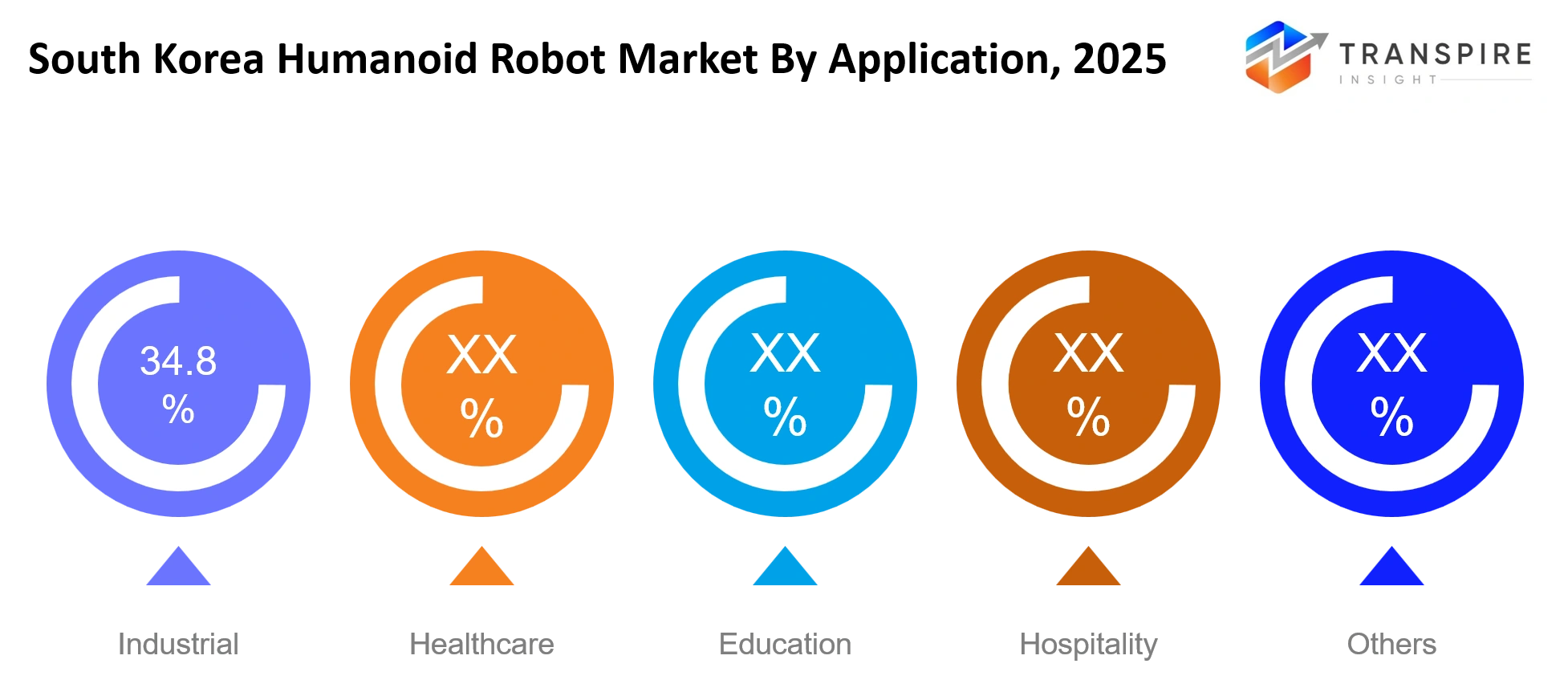
The industrial application continues to dominate the South Korea Humanoid Robot Market, with the integration of humanoid robots in manufacturing processes for assembly, inspection, and routine production activities. This rise followed the growing shortage of labor in major manufacturing sectors. This is driven by manufacturing plants moving from pilot stages to full-scale operations, to increase consistency and efficiency.
Post-2021, the healthcare applications expanded due to increased adoption in patient support, rehabilitation, and hospital logistics. Applications in the education sector witnessed an increase with robotics learning platforms in educational institutions, while a growing number of hospitality and service sector applications gained traction with the increase in its use for customer assistance and maintenance services.
By Motion Type :
In the South Korea Humanoid Robot Market, bipedal humanoid robots are considered an important motion type because it enables humanoids to operate in human designed environments like the factory floor or service sectors. The demand of this type has risen after 2022 since industries had shifted towards more flexible motion capability and task performance in the complicated layouts.
The system using wheels obtained much attention from manufacturing industries in the sectors of logistics and stable working areas, like indoors where motion performance mainly depends on the system’s velocity and stability more than being human-like. Hybrid motion types were more available in 2023. Walking and wheels are combined to maximize the task efficiency and working scopes. Other unique experimental motion types were less researched and mostly applicable in industry tests.
What are the Key Use Cases Driving the South Korea Humanoid Robot Market?
The main use case in South Korea's Humanoid Robot Market is production. Factories deploy humanoids for assembly, quality control and monotonic tasks in manufacturing processes. The demand is increasing due to aging of the labor force and requirement of steady output by companies.
Logistics and healthcare are new areas of widespread acceptance for warehouse automation, hospital conveyance and assisted living activities. Electronics companies and hospital organizations use humanoid robots for the speed of operations, lower staffing levels and to keep operations running efficiently 24/7 in crowded urban facilities.
New areas of application such as aid for elder care and inspection of unsafe facilities on restricted industrial sites are increasingly being considered. With standards becoming more rigorous and an aging population rising, the motivation to discover adjustable humanoid applications beyond conventional machining and transporting industries is increasing.
|
Report Metrics |
Details |
|
Market size value in 2025 |
USD 80.2 Million |
|
Market size value in 2026 |
USD 112.4 Million |
|
Revenue forecast in 2033 |
USD 1155.9 Million |
|
Growth rate |
CAGR of 39.51% from 2026 to 2033 |
|
Base year |
2025 |
|
Historical data |
2021 - 2024 |
|
Forecast period |
2026 - 2033 |
|
Report coverage |
Revenue forecast, competitive landscape, growth factors, and trends |
|
Country scope |
South Korea |
|
Key company profiled |
Boston Dynamics, Tesla, Figure AI, Agility Robotics, Hyundai Robotics, Samsung Electronics, UBTECH, SoftBank Robotics, Honda, Toyota, PAL Robotics, Engineered Arts, Hanson Robotics, Fourier Intelligence, Sanctuary AI |
|
Customization scope |
Free report customization (country, regional & segment scope). Avail customized purchase options to meet your exact research needs. |
|
Report Segmentation |
By Component (Hardware, Software, Services, Others); By Application (Industrial, Healthcare, Education, Hospitality, Others); By Motion Type (Bipedal, Wheeled, Hybrid, Others) |
Which Regions are Driving the South Korea Humanoid Robot Market Growth?
As the major center for innovation and decision making, the Seoul Capital Region is at the forefront of the South Korea Humanoid Robot Market. Concentrated AI research centers, robotics startups and semiconductor suppliers ensure technology advancement through ongoing development. Smart factory and industrial automation subsidies backed by government funding programs are speeding up implementation of pilot tests at sophisticated manufacturing sites. The number of leading universities and funding networks has created a constant source of robotics talent and productization.
The Ulsan-Busan industrial zone is a slow and steady second with strong reliance on demand from the Heavy Industry sector and shipbuilding industry. Unlike Seoul, which focuses on innovation and new development, this zone relies on large and ongoing industrial orders and export-based production rhythms. Shipyards and automotive parts factories have started integrating humanoid systems for improved accuracy in welding, inspection accuracy, and workplace safety. Large industrial groups consistently contribute to the gradual but stable adoption at manufacturing plants.
The Gyeonggi and Incheon logistics sector is the most rapidly growing segment fueled by swift warehouse automation and smart port projects. Growth of the e-commerce fulfillment industry has led to increasing demand for humanoid systems in sorting and warehouse management. Upgrade of infrastructure, which took place between 2024 and 2026, has sped up implementation of the robotics at smart logistics centers. This indicates a promising opportunity for automation vendors looking for massive implementation projects at distribution facilities with high throughput.
Who are the Key Players in the South Korea Humanoid Robot Market and How Do They Compete?
The Humanoid Robot Market in South Korea has a moderate level of industry consolidation; large industrial conglomerates and robot specialization companies compete on technology complexity rather than price.Competition focuses on AI integration capability, advanced control systems, and real-world performance in factories and logistics contexts.Hardware-software integration challenges and lengthy industrial validation periods are still significant barriers to entry. Hyundai Motor Group leads advanced humanoid system initiatives focused on factory automation pilotsandrobotics integrationthrough global partnerships; Samsung Electronics builds capability with itsAI chipset,perception systems, robotics software to enable advanced automation solutions; LG Electronics continues expansion into service robotics through combined AI interaction technologies for service environments and consumers. Hanwha Robotics builds on its industrial manufacturing and defense-connected automation expertise to grow.Rainbow Robotics is pursuing commercialization initiatives by shifting from research prototypes to industrial partners while Doosan Robotics focuses on scalable deployment of collaborative robots for high-precision industrial applications.
Company List
- Boston Dynamics
- Tesla
- Figure AI
- Agility Robotics
- Hyundai Robotics
- Samsung Electronics
- UBTECH
- SoftBank Robotics
- Honda
- Toyota
- PAL Robotics
- Engineered Arts
- Hanson Robotics
- Fourier Intelligence
- Sanctuary AI
Recent Development News
In January 2026, Hyundai Motor Group announced expanded humanoid robot deployment plans with its Boston Dynamics Atlas platform. The company confirmed integration of humanoids into U.S. manufacturing plants by 2028 to automate assembly and high-risk industrial tasks.
Source https://www.reuters.com/
In April 2025, South Korea Ministry of Trade, Industry and Energy launched the K-Humanoid Alliance. The initiative brought together major robotics firms, universities, and semiconductor companies to accelerate domestic humanoid robot development and standardize core AI and hardware technologies for commercialization. Sourcehttps://en.wikipedia.org/
What Strategic Insights Define the Future of the South Korea Humanoid Robot Market?
The South Korea Humanoid Robot Market will structurally trend towards AI-native industrial automation where a humanoid acts as an integrated execution layer in the factory as opposed to an autonomous unit. Driven by the enduring labor deficit,reshoring sophisticated manufacturing processes, and transition to agile production facilities requiring minimum line overhaul to change line configuration, it is expected that market penetration over the next 5-7 years will occur in premium high value manufacturing zones where the benefits achieved would rationalize substantial integration costs.
An undiscerned risk arises as technology is consolidated by the major few platform players; slowing down ecosystem proliferation and increasing dependency on their closed AI stacks, placing manufacturers at the risk of price hikes and supply bottlenecks for key robotics components.
An unexploited market opportunity is humanoid operations at 5G smart logistics hubs linking to smart port infrastructure (Incheon and Busan specifically), where ample opportunities for scale testing outside of factory walls exist. Both interoperable AI stacks and on-the-ground industrial partnership is critical to decreasing integration barriers and fast-tracking market deployment.
South Korea Humanoid Robot Market Report Segmentation
By Component
- Hardware
- Software
- Services
By Application
- Industrial
- Healthcare
- Education
- Hospitality
By Motion Type
- Bipedal
- Wheeled
- Hybrid
Frequently Asked Questions
Find quick answers to common questions.
The South Korea Humanoid Robot Market size is USD 1155.9 Million in 2033.
Key segments for the South Korea Humanoid Robot Market are By Component (Hardware, Software, Services, Others); By Application (Industrial, Healthcare, Education, Hospitality, Others); By Motion Type (Bipedal, Wheeled, Hybrid, Others).
Major South Korea Humanoid Robot Market players are Boston Dynamics, Tesla, Figure AI, Agility Robotics, Hyundai Robotics, Samsung Electronics, UBTECH, SoftBank Robotics, Honda, Toyota, PAL Robotics, Engineered Arts, Hanson Robotics, Fourier Intelligence, Sanctuary AI.
The South Korea Humanoid Robot Market size is USD 80.2 Million in 2025.
The South Korea Humanoid Robot Market CAGR is 39.51% from 2026 to 2033.
- Boston Dynamics
- Tesla
- Figure AI
- Agility Robotics
- Hyundai Robotics
- Samsung Electronics
- UBTECH
- SoftBank Robotics
- Honda
- Toyota
- PAL Robotics
- Engineered Arts
- Hanson Robotics
- Fourier Intelligence
- Sanctuary AI
About the Authors

Mayur Shinde
I am Mayur Shinde, a Senior Research Analyst at Transpire Insight, specializing in the Automotive & Transportation and Information & Communication Technology (ICT) Industry. My work focuses on analyzing emerging market trends, technological advancements, competitive landscapes, and industry developments to deliver accurate, data-driven insights. I am passionate about transforming complex market information into clear, actionable content that helps businesses, professionals, and decision-makers stay informed and make confident strategic decisions.

Chakradhar Khansole
Chakradhar serves as the Research Director at Transpire Insight, bringing over 8 years of experience in technology, innovation, and strategic market intelligence. He specializes in transforming complex market data into actionable business insights that enable organizations to make informed, growth-oriented decisions. Recognized for his strategic vision and analytical expertise, Chakradhar leads high-impact research initiatives, delivering comprehensive market assessments, competitive intelligence, and forward-looking industry analysis.
Recently Published Reports
-
Apr 2026
3D Optical Profiler Market
3D Optical Profiler Market Size, Share & Analysis Report By Type (Desktop 3D Optical Profiler, and Portable 3D Optical Profiler), By Technology (Confocal Technology, and White Light Interference), By End-Use Industry (Manufacturing, Research Institutions, Automotive, Aerospace and Defense, Medical Devices, and Other), and Geography (North America, Europe, Asia-Pacific, Middle East and Africa, South and Central America), 2021 - 2031
-
Apr 2026
Depth Sensor Market
Depth Sensor Market Size, Share & Analysis Report By Type (Infrared Depth Sensors, Time-of-Flight (ToF) Sensors, Stereo Vision Sensors, Structured Light Sensors, Ultrasonic Depth Sensors), By Application (Automotive, Robotics, Gaming, Consumer Electronics, Industrial Automation, Healthcare, Security & Surveillance, Others), By End Users (Automotive Manufacturers, Consumer Electronics Companies, Healthcare Providers, Industrial Companies, Security Agencies, Gaming Companies, Robotics Companies, Others), and Geography (North America, Europe, Asia-Pacific, Middle East and Africa, South and Central America), 2021 – 2031
-
Apr 2026
Digital Manufacturing Market
Digital Manufacturing Market Size, Share & Analysis Report By Component (Hardware, Software, and Services), By Technology (Robotics, 3D Printing, Internet of Things (IoT), and Others), By Application (Automotive and Transportation, Aerospace and Defense, Consumer Electronics, Industrial Machinery, and Others), By Process Type (Computer-Based Designing, Computer-Based Simulation, Computer 3D Visualization, Analytics, and Others), and Geography (North America, Europe, Asia-Pacific, Middle East and Africa, South and Central America), 2021 – 2031
-
Apr 2026
Digital Visa Services Market
Digital Visa Services Market Size, Share & Analysis Report By Type (Individual Travelers, Group Travelers), By Application (Tourism, Business Travel, Others), and Geography (North America, Europe, Asia-Pacific, Middle East and Africa, South and Central America), 2021 – 2031