
South Korea High-Pressure Processing Foods Market Size & Forecast:
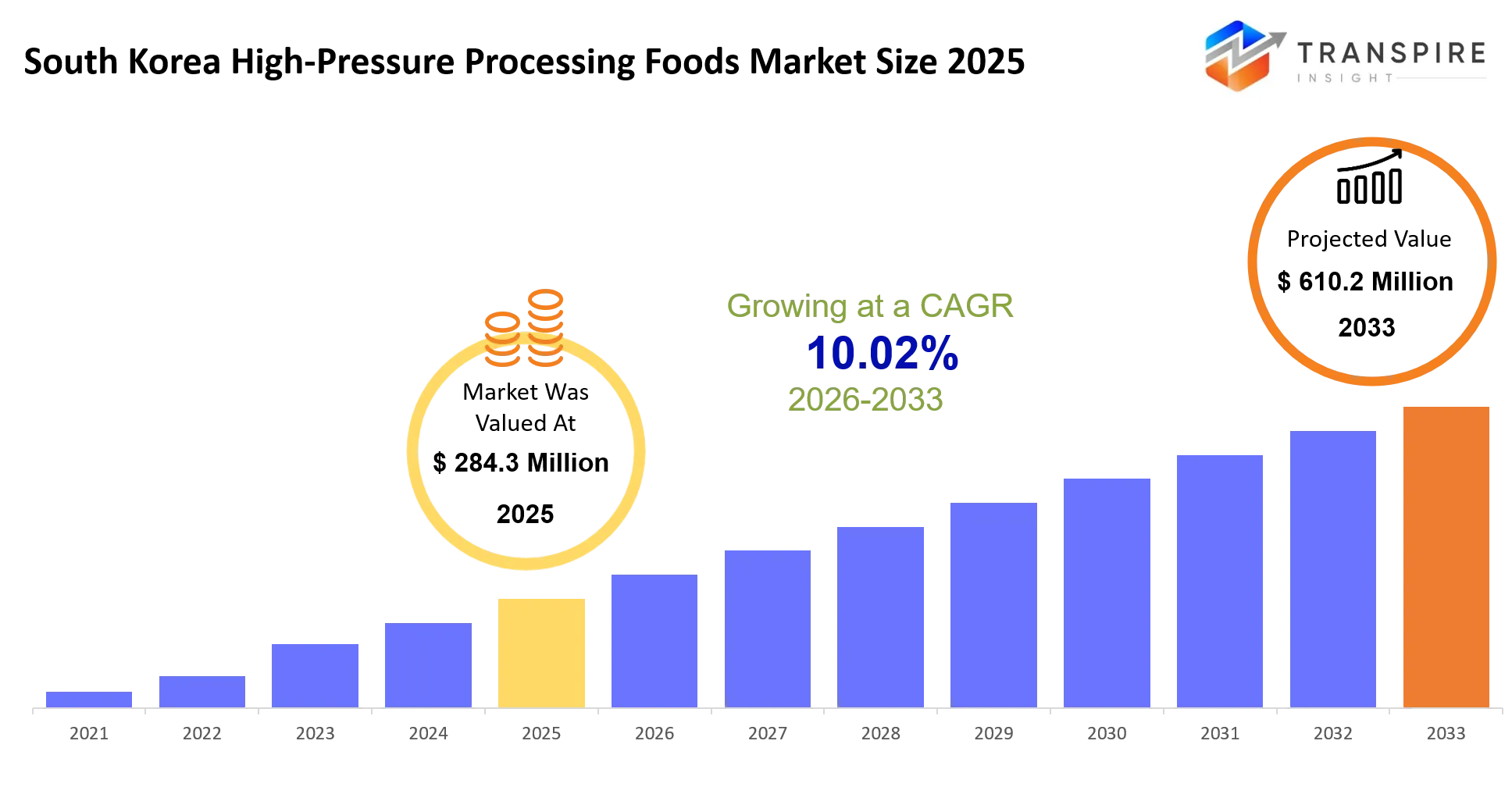
- South Korea High-Pressure Processing Foods Market Size 2025: USD 284.3 Million
- South Korea High-Pressure Processing Foods Market Size 2033: USD 610.2 Million
- South Korea High-Pressure Processing Foods Market CAGR: 10.02%
- South Korea High-Pressure Processing Foods Market Segments: By Product Type (Meat Products, Seafood, Juices, Dairy Products, Ready Meals, Fruits & Vegetables, Baby Food, Others); By Application (Food Safety, Shelf Life Extension, Premium Foods, Organic Foods, Convenience Foods, Export Foods, Functional Foods, Others); By Distribution Channel (Supermarkets, Convenience Stores, Online Retail, Foodservice, Hypermarkets, Specialty Stores, Export Channels, Others)
South Korea High-Pressure Processing Foods Market Summary
The South Korea High-Pressure Processing Foods Market was valued at USD 284.3 Million in 2025. It is forecast to reach USD 610.2 Million by 2033. That is a CAGR of 10.02% over the period.
South Korea High-Pressure Processing Foods Market High-Pressure Processing (HPP) relies on extremely high hydrostatic pressure to naturally extend shelf life and achieve microbial safety of packaged food products without heat. Manufacturers are using HPP to maintain nutrients and texture for a wide array of packaged products that can’t be processed using heat, such as convenient ready-to-eat meals, ready-to-drink juices, pre-prepared seafood, dips, and deli items sold via retail and food services. HPP adoption for mainstream convenient foods and food production for export has expanded substantially in the past five years as manufacturers move the technology into highly automated, HPP integrated cold chain production solutions and seek to meet the “clean label” movement by eliminating preservatives.
Demand for foods that last longer and offer hygienic handling, particularly during pandemic-driven supply chain interruptions, accelerated adoption in retail and e-commerce channels where food retailers continue to give preference to HPP certified products in the cold chain segments.
Given the trend of increased scrutiny by food safety officials and development of more robust chilled distribution networks across South Korea, this industry is expected to continue its growth, with new investments in HPP facilities focused on delivering a value-added product and achieving greater market share.
Key Market Insights
- South Korea High-Pressure Processing Foods Market rapidly evolving from niche premium juices to mass-market chilled RTE meals since 2022
- Clean-label consciousness translates into 35%+ adoption in non-thermal preservation for packaged seafood and meat producers
- Automation of HPP systems slashes batch processing variability by almost 20% at industrial food facilities in 2024
- South Korea High-Pressure Processing Foods Market sees export-driven companies leveraging HPP for longer shelf-life
- Urban cold-chain growth bolsters HPP-treated product availability in convenient store spaces throughout SK
- Seoul-Gyeonggi province commands approximately 45% market share in 2025 owing to strong Food Processing & Distribution Centers
- Southeastern corridor poised as the fastest expanding region until 2030 from a surge in seafood processing industries
- Packaged beverages account for the majority (~32%) attributed to juices and health drink preferences
- RTE foods, the second-leading product type, gain traction through urban lifestyle and demands for convenient snacking
- Seafood processing will exhibit robust growth up to 2030 amid the emphasis on exported product safety standards
What are the Key Drivers, Restraints, and Opportunities in the South Korea High-Pressure Processing Foods Market?
Leading cause for South Korea's high pressure processing foods market is the shift of the processed food industry towards clean label and conventional processed products amid tougher food safety regulations imposed by government and major retailers post-2022. This transition leads to substitution of chemical preservatives by clean non-thermal HPP systems and drives capital investment in high pressure processing lines, boosting the overall value of per-unit chilled processed food production. High initial capital cost is a major impediment.
Costs associated with setting up HPP facilities can be several times more expensive than thermal processed systems with more specialized infrastructure for equipment maintenance, thus slowing down HPP adoption at medium processors and restraining sales growth mainly limited to export-oriented and premium products in the South Korea high pressure processing foods market.
The future potential in the South Korea high pressure processing foods market includes the export standardization of Korean seafood products in accordance with stricter guidelines of the EU and North America on microbial contamination. Adoption of containerized HPP facilities that enable integration of HPP within the export and fishing areas like in Busan will stimulate export growth and extend its application to packaged food producers outside metropolitan areas
What Has the Impact of Artificial Intelligence Been on the South Korea High-Pressure Processing Foods Market?
AI is starting to create a disruption in the South Korea High-Pressure Processing Foods Market with the ongoing improvements it is bringing in system-level efficiencies like equipment monitoring, process controls and even predictive maintenance of machinery. The sensors that are embedded on HPP machines are now aided with AI capabilities, thereby tracking pressure cycles, vessel health, cycle efficiency in real-time and are minimizing unexpected downtimes & enhancing consistency of throughput especially for large-scale manufacturers in the South Korea High-Pressure Processing Foods Market. The Machine Learning models are increasingly being used by manufacturers to analyze the pattern of equipment wearing off over time as well as the duration of pressure cycles according to food product which enhances the uptime by around 10 to 15% in technologically adept food production plants.
Moreover, in Food Production Lines AI is facilitating a paradigm shift towards energy efficient practices by optimally modulating compression cycles, which reduces consumption of electricity during heavy energy demand times.
Although the High-Pressure Processing Foods Market in South Korea has begun witnessing an uptake in AI enabled technology it is facing hurdles from high complexity of integration and the retrofit requirements for older machines as they do not have access to real time data for analysis. Multiple, disparate operational data sets are also creating impediments for models to predict process efficiency for several food products accurately.
Key Market Trends
- South Korean HPP Food market transitions from niche juice to readily available chilled ready-to-eat offerings in retail stores post-2022
- HPP system installations jump by almost 40% from 2021-2025 following a tough microbial control on packaged products.
- South Korea’s CJ CheilJedang added non-thermal production lines in 2024 to meet its growing need to export ultra-premium convenient food products across the APAC region.
- The retailers have decreased their stock of chemicals preserved SKU by more than 25% since 2023.
- Improvements in batch reliability of HPP plants have slashed cycle variations down by 18% as new-age HPP facilities integrate Automation features
- 26% of Busan-based food exporters embraced HPP after the stricter EU implementation in 2023 to remain viable, the pace is continuing to grow even post-2023
- Smaller food manufacturers are investing more into Modular HPP plants as it makes it more efficient and cost-effective due to minimized installation space requirements.
- More South Korean beverage brands have opted for HPP-treated and functional ready drinks to meet soaring consumer demand for foods devoid of chemicals.
South Korea High-Pressure Processing Foods Market Segmentation
By Product Type :
Usage by Food Product Sector is Dominantly High Pressure Processed Chilled and Packaged Foods and this product in the South Korea high-pressure processed food market includes usage in fresh juices, fruit and vegetables puree, dairy products, meat and seafood products, infant nutrition products and ready meals and snack products are significantly a driver for this high-pressure product market.
With evolving and rapid consumption styles changing over time, meat and seafood products that require a higher level of shelf life without exposure to high thermal energy that affect the taste and quality will find more of this high-pressure processing technology adoption. Products like baby food require a very high level of safety standard to be adhered to during their manufacturing process that favors their wide adoption of this process. Juice, dairy products, ready to eat food and vegetables are high demand driven, with greater demand towards preserved yet fresh-like taste food.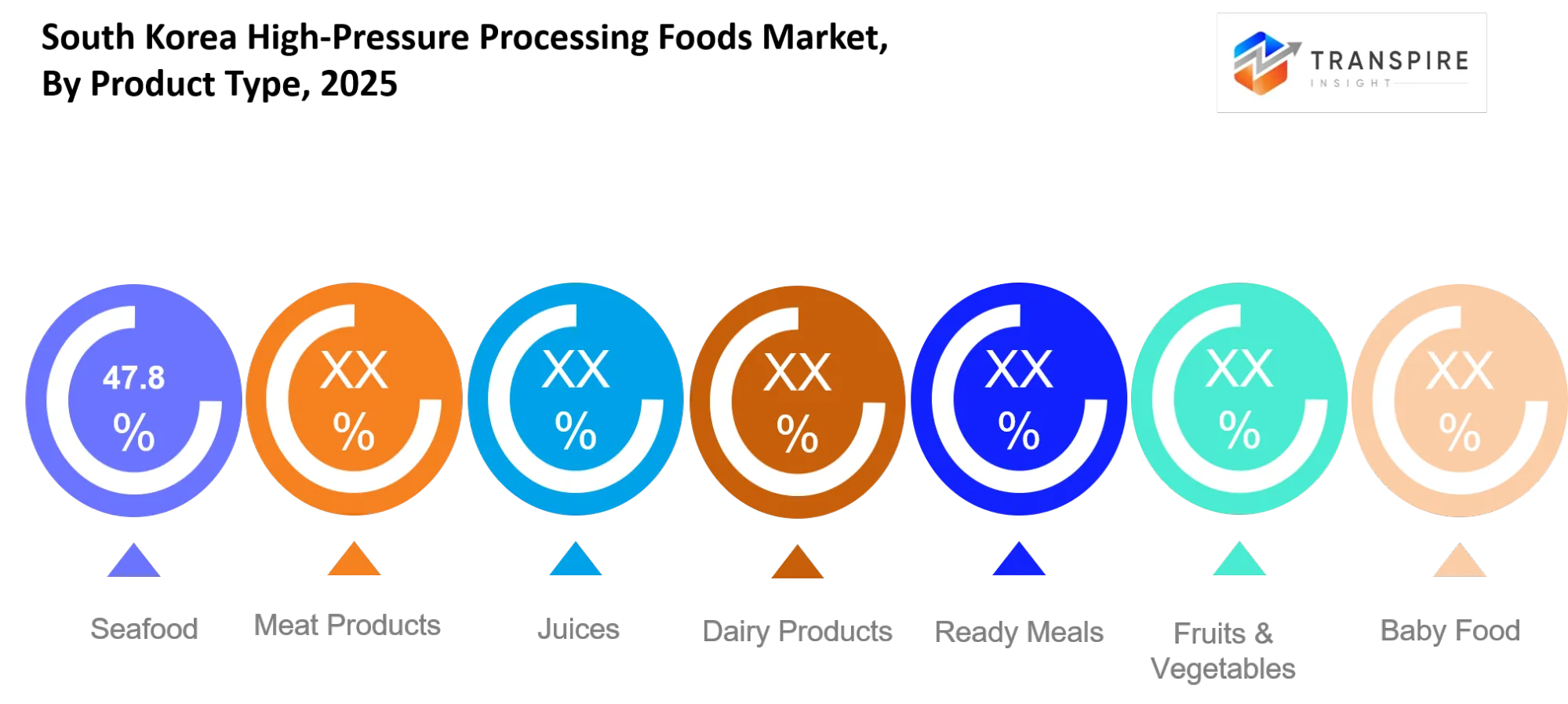
By Application :
Food safety is still the leading application of the High-Pressure Processing Foods Market of South Korea because manufacturers are using this technique for minimizing the microbial load in the packaged foods without any chemical additives. The shelf- life improvement ensures for the efficient distribution of chilled foods that need a stable and quality standard while transport and storage.
Convenient foods The application is gaining market Share as the urban lifestyle and eating habits are changing with the growing demand of convenience and ready- to- consume foods which will keep fresh with time.
Exports Food the method of high-pressure processing for the export of food products to meet stringent international regulations for food quality and spoilage due to time lapse. Functional food The high-pressure processing technology preserves the essential nutrients in Functional food products. Organic foods Preserving the quality and standards, in absence of preservatives, allows the organic foods market to get the benefit from the HPP technology for meeting the clean-label demand in all the retail outlets.
By Distribution Channel :
Supermarkets & Convenience Stores dominate the high-pressure processing (HPP) foods market in South Korea as they facilitate the high frequency of chilled and packed products that are suitable for HPP applications. HPP foods such as packaged ready-to-eat meals, and juices are widely distributed via supermarkets, which cater to diverse consumer demands. Meanwhile, convenience stores mostly deal with single-serving packs of food products that are required for rapid consumption in city areas.
Foodservice sector utilizes HPP processed foods by catering to restaurant outlets and institutional cafeterias, thereby ensuring consistent quality standards in the ready-meals. Hypermarkets help customers to do their wholesale purchase in larger quantities. Small retail outlets such as specialty stores aim at customers who are seeking high-quality food products. HPP foods are also being exported to foreign markets in these export channels that ensure rigorous safety and quality standards.
What are the Key Use Cases Driving the South Korea High-Pressure Processing Foods Market?
Food safety in chilled ready-to-eat and packaged meal production is the most dominant demand in South Korea High-Pressure Processing Foods Market. High-pressure processing technology enables food manufacturers to suppress microbial hazards from products without relying on heat, especially among meat products-based meals and seafood-based packaged foods. This method helps maintain the required hygiene regulations and also enables suppliers to sustain the quality of food products throughout storage as well as supply chain processes.
Shelf life extension and fresh juice-based premium products are the second-largest and also growing applications. The growing use cases within South Korea’s High-Pressure Processing Foods Market cater mostly to beverage producers and major supermarket supply chains, as these firms are opting for the technology to maintain the food items in their packaged and ready-to-eat condition for a longer period. Moreover, seafood export processors are also deploying this technology to adhere to the international food standards and prevent spoilage of seafood products during long-haul transit of sea-based food products across the globe. Big players in the Food & Beverage Industry, contract manufacturers, and other large-scale food organizations are major adoption agents in these segments of food business due to stringent regulations imposed by both global as well as local authorities towards consumer well-being.
Functional nutritious food & clean-labeled organic packaged foods. As consumer focus on natural products and healthy living standards increases, the demand for food products with clean labels has proliferated in the South Korea High-Pressure Processing Foods Market. Consequently, several food & beverage organizations in South Korea, including various dairy and infant formula manufacturers, are experimenting with HPP processes for their new lines of innovative products such as probiotic rich dairy products, nutrients enhanced baby food, as well as other food items that are being categorized under the functional food and clean-label product segment. This use case area, though currently smaller than conventional use cases, shows significant promise to become a major demand area in the future.
|
Report Metrics |
Details |
|
Market size value in 2025 |
USD 284.3 Million |
|
Market size value in 2026 |
USD 312.8 Million |
|
Revenue forecast in 2033 |
USD 610.2 Million |
|
Growth rate |
CAGR of 10.02% from 2026 to 2033 |
|
Base year |
2025 |
|
Historical data |
2021 - 2024 |
|
Forecast period |
2026 - 2033 |
|
Report coverage |
Revenue forecast, competitive landscape, growth factors, and trends |
|
Country scope |
South Korea |
|
Key company profiled |
Hiperbaric, JBT, Avure Technologies, Thyssenkrupp Uhde, Kobe Steel, Hormel Foods, Fresh Del Monte, Suja Life, Universal Pasteurization, Espuna, Campofrio, LG Household, CJ CheilJedang, Dongwon, Pulmuone |
|
Customization scope |
Free report customization (country, regional & segment scope). Avail customized purchase options to meet your exact research needs. |
|
Report Segmentation |
By Product Type (Meat Products, Seafood, Juices, Dairy Products, Ready Meals, Fruits & Vegetables, Baby Food, Others); By Application (Food Safety, Shelf Life Extension, Premium Foods, Organic Foods, Convenience Foods, Export Foods, Functional Foods, Others); By Distribution Channel (Supermarkets, Convenience Stores, Online Retail, Foodservice, Hypermarkets, Specialty Stores, Export Channels, Others) |
Which Regions are Driving the South Korea High-Pressure Processing Foods Market Growth?
Seoul Capital Area to spur South Korea’s high pressure processed foods market, in a way that’s kind of expected if you look at what’s already here. This region has the highest potential for the high pressure processed food market because there are a lot of food production facilities, plus the retail store HQ, cold chain distribution center and many food distribution business HQs. And with the rising requirement for food safety regulation, especially with ready-to-eat products and chilled processed food that comes in packages, the high pressure processed food systems have been pushed to develop in this area too. Also, since big market stores and convenience stores are spread across the region, there is a strong demand for ready-to-eat and refrigerated packaged foods so people keep getting fresh product availability. Strong distribution facilities there can provide quicker access to HPP food products from plants to food lovers, without needing to go outside the region too much.
Busan, Southeast Coastal Region A consistent contribution will likely keep coming from the Busan region and continue along the Southeast coast, because there’s a solid seafood production base, and especially for export focused food manufacturers that are located in the area. Compared with the capital area, the contribution here is more often shaped by exports related product needs and by the standard food safety practices demanded by importing countries. Seafood processing plants will end up as an ideal user of HPP technology, mainly because it can handle spoilage issues linked to long transit and shipping times to international markets (for example Japan, United States, Europe). Finally, a healthy situation for foreign and domestic investments into exported food manufacturing will help guarantee steady income for food production from Busan, more or less.
The Chungcheong and Jeolla regions seem to be showing the fastest growth as food processing clusters and industrial parks expand further inland, a bit more than before. There are new mid scale food manufacturing facilities coming in, plus government supported agro processing zones, and these have kinda improved access to HPP technology. In practice the regions get lower operating costs, and also there’s a rising trend of production moving away from overly saturated urban centers. Then between 2026 and 2033, this whole relocation pattern should pull in fresh entrants who want scalable production capacity, and lower infrastructure barriers, overall.
Who are the Key Players in the South Korea High-Pressure Processing Foods Market and How Do They Compete?
The South Korea High-Pressure Processing Foods Market has a sort of moderately consolidated competitive field , where global equipment manufacturers still lead in technology supply, while local food processors kinda push adoption, you could say. What really matters in the fight is processing efficiency, system scalability and how well the setup integrates with cold-chain production lines , not so much price. The established companies keep a lead via proprietary pressure vessel approaches, plus after-sales service networks. New entrants tend to aim for compact arrangements, especially for mid-sized food producers .
Hiperbaric shows up with high-capacity industrial systems meant for big food manufacturers, and it leans hard on throughput performance and modular growth potential. Its distinct point seems to be engineering dependability and the option to support continuous production conditions, even when the schedule is tight. The way it expands is also related to partnerships with Asian food processors that are ramping up chilled export products.
JBT Corporation leans into integrated food processing lines , where high-pressure units are paired with automation and packaging solutions. That blend helps manufacturers cut down operational tangle, which makes it appealing for large packaged food producers. Its expansion is backed by acquisitions and cross-platform industrial food technology offerings , so they can reuse know-how across different setups.
Bühler Group competes with energy-conscious processing systems and heavy engineering tailoring for premium food uses. What sets it apart is precision control , meant to hold product consistency in sensitive categories like dairy, and also functional foods. It grows through regional service centers and cooperative ties with Asian food innovation hubs , where experiments and development are happening faster than usual.
Company List
- Hiperbaric
- JBT
- Avure Technologies
- Thyssenkrupp Uhde
- Kobe Steel
- Hormel Foods
- Fresh Del Monte
- Suja Life
- Universal Pasteurization
- Espuna
- Campofrio
- LG Household
- CJ CheilJedang
- Dongwon
- Pulmuone
Recent Development News
In 2025, the South Korea High-Pressure Processing Foods Market saw verified strategic expansion as food safety and chilled food demand accelerated equipment adoption. In May 2025, JBT Corporation announced a strategic partnership with Asian food manufacturers to expand high-pressure processing system deployment across chilled ready-meal facilities, strengthening automated food safety compliance and reducing microbial risk in export-grade production lines. Sourcehttps://www.jbtc.com
In February 2026, Bühler Group entered a regional collaboration agreement with Asia-Pacific food tech integrators to enhance energy-efficient high-pressure processing solutions for premium dairy and functional food applications, improving scalability for mid-sized Korean manufacturers. Sourcehttps://www.buhlergroup.com
What Strategic Insights Define the Future of the South Korea High-Pressure Processing Foods Market?
The South Korea High-Pressure Processing Foods Market is, sort of, structurally moving toward integrated automated cold chain production systems where HPP becomes a standard step in chilled food manufacturing, not really a premium extra. This shift is being pushed by tighter food safety expectations, higher desire for preservative-free packaged foods ,and the practical need for extended shelf stability, especially across export oriented supply chains. Over the next 5 to 7 years adoption is likely to cluster among big food manufacturers and contract processors that can actually stomach the high capex because scale will make it work.
There is also a less visible risk, namely, the growing concentration of technology ownership among only a few global equipment suppliers. That pattern could reduce pricing flexibility and make localized innovation slower inside South Korean production ecosystems. And because of that dependence, processors might face supply chain delays for crucial system components, even when demand stays steady.
At the same time, an emerging opportunity is showing up in modular HPP systems built for mid-sized regional food clusters, particularly around inland industrial parks where new food manufacturing capacity is being developed. These setups can help widen uptake beyond only the major urban producers.
Market participants should focus on flexible scalable equipment layouts plus service driven maintenance contracts, so entry barriers soften for mid tier manufacturers.
South Korea High-Pressure Processing Foods Market Report Segmentation
By Product Type
- Meat Products
- Seafood
- Juices
- Dairy Products
- Ready Meals
- Fruits & Vegetables
- Baby Food
By Application
- Food Safety
- Shelf Life Extension
- Premium Foods
- Organic Foods
- Convenience Foods
- Export Foods
- Functional Foods
By Distribution Channel
- Supermarkets
- Convenience Stores
- Online Retail
- Foodservice
- Hypermarkets
- Specialty Stores
- Export Channels
Frequently Asked Questions
Find quick answers to common questions.
The South Korea High-Pressure Processing Foods Market size is USD 610.2 Million in 2033.
Key Segments for the South Korea High-Pressure Processing Foods Market are By Product Type (Meat Products, Seafood, Juices, Dairy Products, Ready Meals, Fruits & Vegetables, Baby Food, Others); By Application (Food Safety, Shelf Life Extension, Premium Foods, Organic Foods, Convenience Foods, Export Foods, Functional Foods, Others); By Distribution Channel (Supermarkets, Convenience Stores, Online Retail, Foodservice, Hypermarkets, Specialty Stores, Export Channels, Others).
Major South Korea High-Pressure Processing Foods Market Players are Hiperbaric, JBT, Avure Technologies, Thyssenkrupp Uhde, Kobe Steel, Hormel Foods, Fresh Del Monte, Suja Life, Universal Pasteurization, Espuna, Campofrio, LG Household, CJ CheilJedang, Dongwon, Pulmuone.
The Current South Korea High-Pressure Processing Foods Market size is USD 284.3 Million in 2025.
The South Korea High-Pressure Processing Foods Market CAGR is 10.02% from 2026 to 2033.
- Hiperbaric
- JBT
- Avure Technologies
- Thyssenkrupp Uhde
- Kobe Steel
- Hormel Foods
- Fresh Del Monte
- Suja Life
- Universal Pasteurization
- Espuna
- Campofrio
- LG Household
- CJ CheilJedang
- Dongwon
- Pulmuone
About the Authors

Chetan Dhatrak
I’m Chetan Dhatrak, a Senior Research Analyst at Transpire Insight, specializing in the Consumer Goods, Foods and Beverages industry. I focus on analyzing market trends, consumer behavior, competitive landscapes, and industry developments to deliver accurate, data-driven insights. My research at Transpire Insight is built on credible sources and in-depth analysis, helping businesses and readers better understand market dynamics, emerging opportunities, and evolving consumer preferences. I’m committed to creating reliable, well-researched content that supports informed decision-making and reflects the latest developments in the consumer goods and food & beverage sectors.

Chakradhar Khansole
Chakradhar serves as the Research Director at Transpire Insight, bringing over 8 years of experience in technology, innovation, and strategic market intelligence. He specializes in transforming complex market data into actionable business insights that enable organizations to make informed, growth-oriented decisions. Recognized for his strategic vision and analytical expertise, Chakradhar leads high-impact research initiatives, delivering comprehensive market assessments, competitive intelligence, and forward-looking industry analysis.
Recently Published Reports
-
Apr 2026
Baby Infant Formula Market
Baby Infant Formula Market Size, Share & Analysis Report By ype (Infant Milk, Follow On Milk, Specialty Baby Milk, Growing-Up Milk), By Ingredient (Carbohydrate, Fat, Protein, Minerals, Vitamins, and Others), By Product Form (Powder, Liquid, and Ready-to-feed), By Distribution Channels (Supermarket/Hypermarket, Specialty Store, Pharmacies, Online Retail, and Others), and Geography (North America, Europe, Asia-Pacific, Middle East and Africa, South and Central America), 2021 - 2031
-
Apr 2026
Edible Insects for Animal Feed Market
Edible Insects for Animal Feed Market Size, Share & Analysis Report By Type (Insect Powder, Insect Meal, Insect Bar, Insect Paste, Insect Oil, and Others), By Insect Type (Beetles, Cricket, Caterpillar, Hymenoptera, Orthoptera, Tree Bugs, and Others), By Application (Livestock, Pet Food, and Aquaculture), By Livestock Type (Poultry, Swine, and Others), and Geography (North America, Europe, Asia-Pacific, Middle East and Africa, South and Central America), 2021 - 2031
-
Apr 2026
Food Industry Disinfection and Bacterial Control Market
Food Industry Disinfection and Bacterial Control Market Size, Share & Analysis Report By Type (Chemical Disinfectants, Physical Disinfectants, and Biocides and Antimicrobials), By Application (Food Processing Equipment Surface Disinfection, Food Preparation Areas Surface Disinfection, Storage Areas Surface Disinfection, Anti-microbial Coatings Food Preservation, and Preservative Solutions Food Preservation), By End User (Meat and Poultry Processing, Dairy Processing, Seafood Processing, Bakery and Confectionery, Restaurants and Commercial Kitchens, and Food Service Providers), By Sales Channel (Online, Offline), and Geography (North America, Europe, Asia-Pacific, Middle East and Africa, South and Central America), 2021 - 2031
-
May 2026
Freeze Dried Food Market
Freeze Dried Food Market Size, Share & Analysis Report By Product Type (Fruits, Vegetables, Freeze-Dried Dairy Products, Freeze-Dried Meat and Seafood, Freeze-Dried Pet Food, and Prepared Meal), By Nature (Organic, and Conventional), By Form (Powdered, Granules, and Diced), By End Use (Breakfast Cereals, Dairy Products, Bakery & Confectionery, Nutritional Bars & Supplements, Powdered Beverages, Snacks, and Retail (Household)), and Geography (North America, Europe, Asia-Pacific, Middle East and Africa, South and Central America), 2021 - 2031