
South Korea Gallium Nitride Market Size & Forecast:
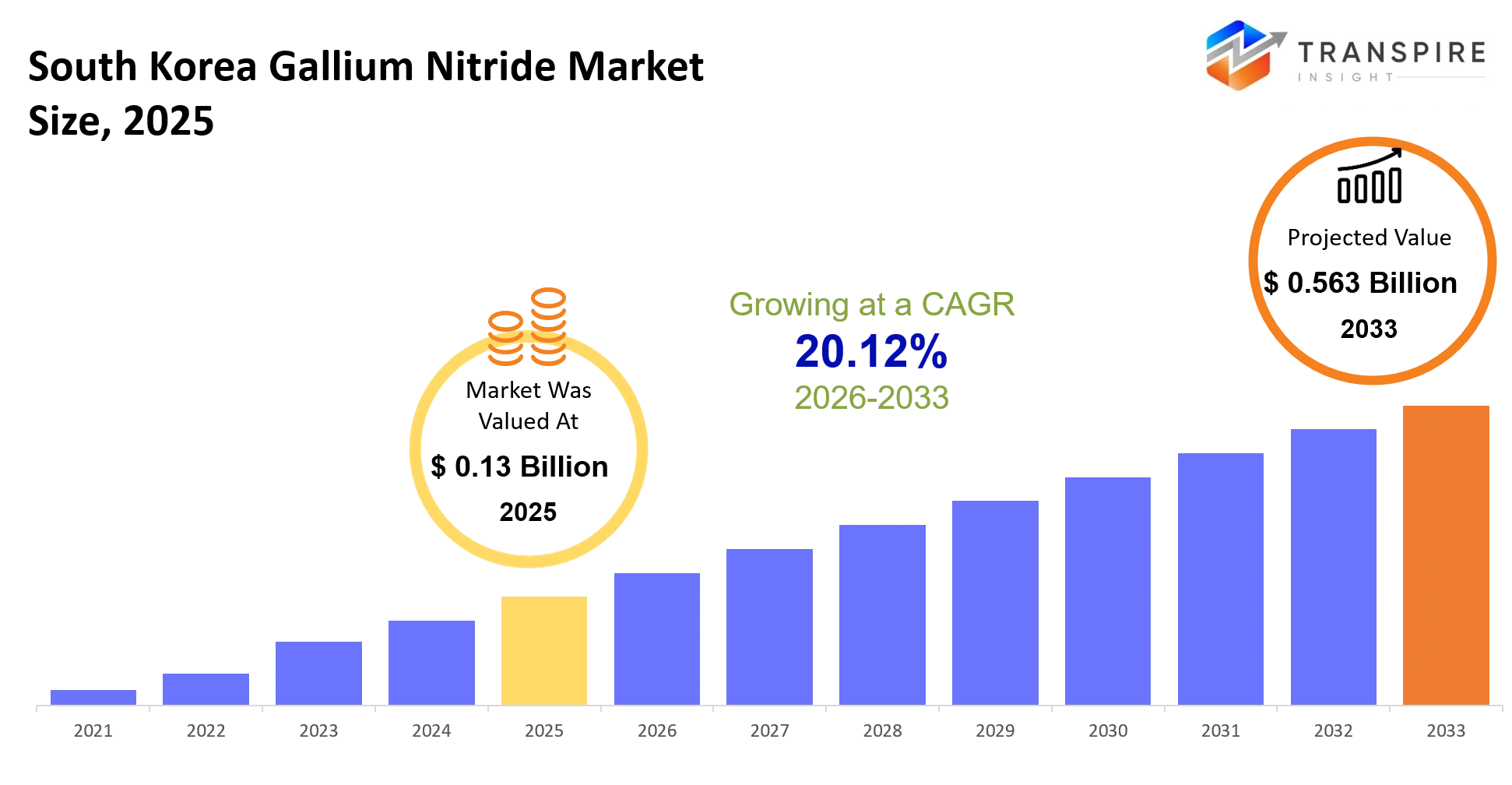
- South Korea Gallium Nitride Market Size 2025: USD 0.13 billion
- South Korea Gallium Nitride Market Size 2033: USD 0.563 billion
- South Korea Gallium Nitride Market CAGR: 20.12%
- South Korea Gallium Nitride Market Segments: By Device Type (Power Devices, RF Devices, Optoelectronic Devices, Others); By Application (Consumer Electronics, Automotive, Telecom, Defense, Others)
To learn more about this report,  Download Free Sample Report
South Korea Gallium Nitride Market Summary
The South Korea Gallium Nitride Market was valued at USD 0.13 billion in 2025. It is forecast to reach USD 0.563 billion by 2033. That is a CAGR of 20.12% over the period.
In South Korea, the Gallium Nitride market mostly shows up where power electronics have to stay efficient, cool, and fast under real stress, like in shipboard converters, grid-connected inverters, and industrial drives. It helps firms solve the heat and switching-loss problem, so equipment can run with tighter performance targets. Over the last 3–5 years, there’s been a structural shift: manufacturers moved from older silicon designs toward wide bandgap layouts, especially for high-frequency power stages and compact traction or charging units. A key trigger was stricter emissions and energy-efficiency pressure, tied to maritime compliance and local industrial upgrades, plus periodic supply chain strain that pushed buyers to qualify “next-best” components sooner. The cause-and-effect is pretty direct: better thermal behavior lowers system size and operating cost, which then speeds pilot projects into repeat orders, improves forecast certainty, and supports broader revenue capture. Local partnerships with device makers also sped up qualification timelines, even when parts lead times were messy.
Key Market Insights
- The South Korea Gallium Nitride market is actually doing pretty well, more and more people are moving toward Gallium Nitride semiconductors, especially for vehicles and sort of 5G infrastructure as well. There’s also a big push in power electronics, because they help conserve energy and well, that matters a lot.
- The South Korea Gallium Nitride Market is expected to keep growing until 2030, somehow. This is mainly because people want high performance semiconductor devices and also better communication technologies, such as Gallium Nitride, over all. In a word, there’s a growing push toward advanced electronics and more reliable wireless links.
- The Seoul Capital Area is sort of part of the South Korea Gallium Nitride Market. In 2025 it made up 45 percent of the industry’s revenue, more or less. There are also semiconductor manufacturing sites in this area , and that helps the South Korea Gallium Nitride Market keep moving.
- Gyeonggi Province also has a part in the South Korea Gallium Nitride Market, you know. There are many electronics companies there, and people are still pouring effort into producing chips such as Gallium Nitride chips, kinda. Investments keep happening because there’s this ongoing push toward semiconductor manufacturing and all that.
- From 2025 to 2030 the Chungcheong region will grow the fastest, or so it seems. Companies are already expanding their semiconductor production and research activities in this area which, honestly is good for the South Korea Gallium Nitride Market. In particular, Gallium Nitride demand is getting a boost, and that momentum should keep going.
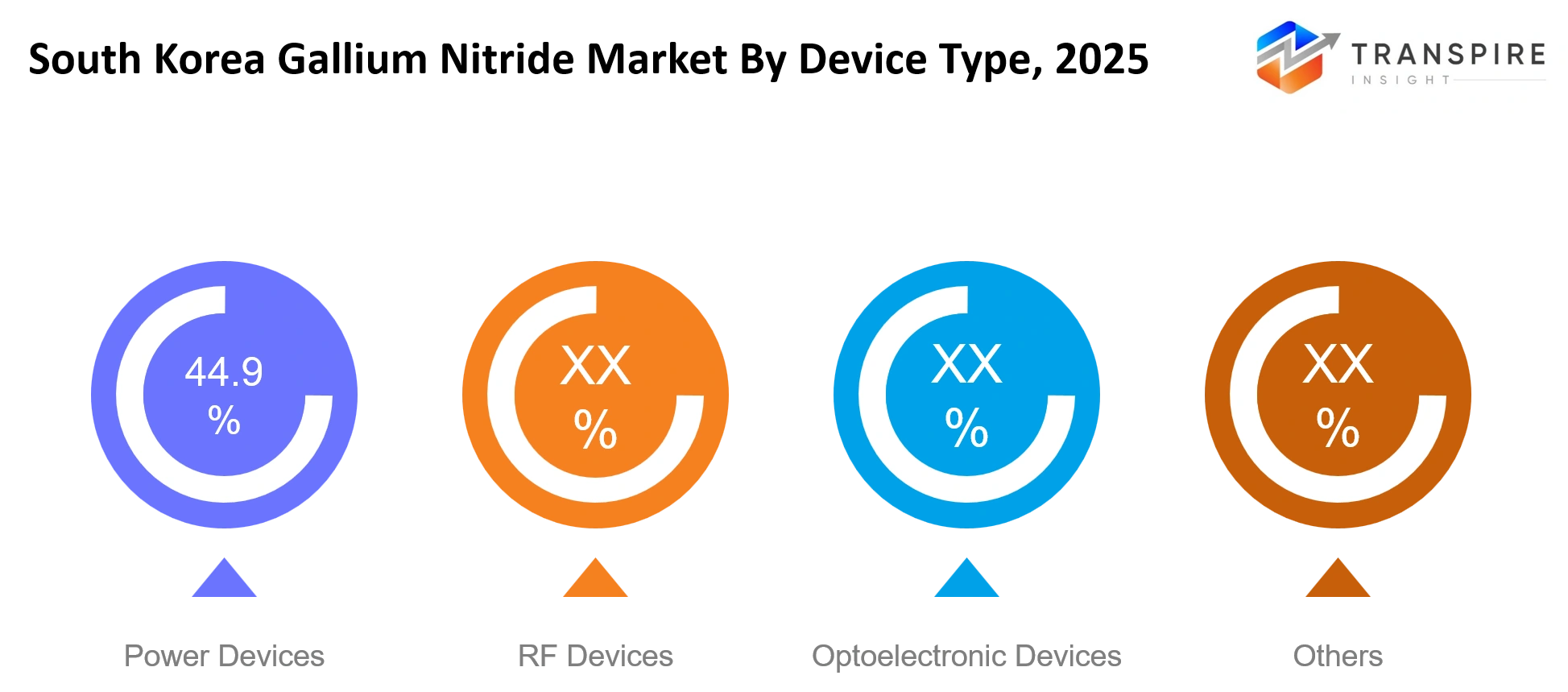
- Power Devices make up 40 percent of the South Korea Gallium Nitride Market in 2025, kinda. They get used in cars and renewable energy systems, plus in industrial applications, too. All of that is really pushing demand for Gallium Nitride overall, you know.
- RF Devices are the segment that seems to be riding the money being spent on 5G infrastructure, and high frequency communication gear, which often uses Gallium Nitride.
- Optoelectronic devices are likely growin the fastest up to 2030, like, people really want sensing plus photonics technologies. In practice these can lean on Gallium Nitride, because it’s… more capable in the real world than other simple options.
- Consumer Electronics is bringing in something like 35 percent of the South Korea Gallium Nitride Markets revenue for 2025. And yeah, plenty of people are already using gallium nitride chargers , plus those compact power adaptors, everywhere.
- Telecom is also a piece of the South Korea Gallium Nitride Market, and in practice it kind of blends with the rest. Gallium Nitride components are now used in 5G base stations, along with network equipment , where the signal handling matters. The South Korea Gallium Nitride Market is very important for these use cases, especially for 5G and for power electronics that are built using Gallium Nitride.
What are the Key Drivers, Restraints, and Opportunities in the South Korea Gallium Nitride Market?
The main force pushing the South Korea Gallium Nitride Market forward is this fast transition toward higher-efficiency power electronics, seen in electric vehicles, fast-charging systems, and even 5G infrastructure. It really seemed to come from the pressure to cut energy losses and get better power density more than what regular silicon based semiconductors can manage. GaN devices kinda switch at higher frequencies, and they can also handle higher temperatures too. That lets power systems become smaller, lighter, and more efficient in practice. And when South Korean makers are expanding their investments in EV production, as well as advanced consumer electronics, the need for GaN power devices keeps climbing. So overall, this is directly feeding higher semiconductor revenues and wider commercial use.
The biggest hurdle, though, is the fairly complex capital-heavy manufacturing web needed for GaN device production, like… getting strong GaN wafers while also making sure yields stay consistent. that really depends on specialized fabrication routines, advanced machinery, and a lot of hands on technical know how. And yeah, this issue feels kinda structural, because building manufacturing capacity and keeping the supply chain dependable takes years of investment, plus repeated process tuning and adjustment, again and again. So the production cost is still higher than with standard silicon alternatives, which ends up restricting adoption in price sensitive uses, and it can slow revenue growth across some end use categories.
A big growth chance is in basically putting GaN technology into the next-gen electric vehicle powertrain setups. In South Korea the EV scene keeps getting bigger, and with battery making leadership already there, it’s kinda easier for GaN to show up more often in onboard chargers, DC-DC converters, and also in the fast charging stations. If investment in advanced mobility tech continues, it could open up real long term market expansion and at the same time, help boost domestic semiconductor competitiveness.
What Has the Impact of Artificial Intelligence Been on the South Korea Gallium Nitride Market?
Artificial intelligence , and advanced digital technologies are getting more involved in the South Korea Gallium Nitride Market , sorta reshaping everything, mainly by upgrading semiconductor design, manufacturing efficiency , and device reliability. Big chip makers are rolling out AI driven process control systems, to keep an eye on wafer fabrication parameters in real time , then they tweak temperature, deposition rates , and even the defect inspection routines. Somehow this kind of automation helps lower production inconsistency , and it pushes higher yield results for those high performance GaN parts.
On top of that, machine learning models are being used for predictive maintenance across semiconductor fabrication sites. By reading equipment vibration, pressure, and operational signals, these systems can spot likely tool failures before they actually interrupt production. Companies then rely on predictive analytics to fine tune equipment usage, cut the nasty unplanned downtime, and raise overall fab productivity. Also AI powered simulation platforms speed up GaN device development by estimating electrical and thermal behavior before any physical prototyping happens , so the product development timeline becomes shorter, more agile, and honestly a lot less chaotic.
These technologies seem to help with higher plant uptime, reduced day to day operating expenses, better quality control, and a quicker path to market for advanced power plus RF devices. In certain fabrication setups , AI monitoring has cut down the time it takes to spot defects, also boosting output efficiency, mainly due to nonstop process fine-tuning.
Still, there’s a big catch that stays there, the integration expense. The cost to hook AI platforms into existing semiconductor manufacturing infrastructure can be quite high . On top of that, building reliable models needs big volumes of high quality production data, and for newer GaN manufacturing routes, gathering that data can feel hard, or at least not straightforward.
Key Market Trends
- Since 2022 the companies that make electronics in South Korea have started using GaN-based chargers more and more. They are replacing the silicon designs with these new ones to make the chargers smaller and to make them charge faster.
- The people who make equipment for telecom have started investing more in GaN RF technologies from 2023 to 2025. They are doing this to support the growing needs of the 5G network.
- The companies that make cars have started looking into GaN power devices more and more after 2023. They want to use these devices to make the electric vehicles more efficient and to reduce energy losses.
- The companies that make semiconductors have started working with universities and technology institutes to research new materials. They are focusing on the generation wide-bandgap materials.
- The companies that make devices have started moving from using separate GaN components. Instead they are using power solutions. This makes the system design simpler. It helps with thermal performance.
- Some companies like Infineon, Wolfspeed and STMicroelectronics have started investing more in making GaN products. They want to make sure they have a supply of these products.
- The people who buy these components have started caring more about how efficient they're. They do not care much about the cost of the components anymore. This is especially true for things like high-performance consumer electronics and industrial power applications.
- The companies that make these products have started using wafer formats and they have improved the way they make the products. This helps reduce the cost of making these products compared to how it was
- The competition in this field is not about how well the products perform. It is also about how reliable they're how long they last. The companies are also trying to make products that're specific to certain applications, especially, for cars and industrial customers.
- Since 2024 the companies that make semiconductors have started using tools that are assisted by intelligence. These tools help them design the semiconductors faster. They help them predict how well the devices will perform.
South Korea Gallium Nitride Market Segmentation
By Device Type:
Power Devices:
Power devices kinda hold a big role in semiconductor applications, due to their strong efficiency , fast switching speed, and lower energy losses. Lately the growing use in electric vehicles, charging systems, industrial gear, and renewable energy infrastructure has really pushed demand up. At the same time, manufacturers keep putting money into more advanced power management solutions , so they can get compact designs while also nudging thermal performance a bit better .
Also, ongoing tweaks in the device architecture have improved reliability and operating efficiency across different industries. The spread of electric mobility projects, along with high-performance consumer electronics, has created more opportunities for power device adoption. In the long run, the industry focus stays mostly on reducing energy consumption, but without giving up higher output performance .
RF Devices:
RF devices sort of play a key role in wireless communication networks and advanced connectivity systems, you know. The deployment of 5G infrastructure has made it more necessary for components that can work at higher frequencies while still holding up the signal quality. Telecom equipment manufacturers are also gravitating toward technologies that enable efficient power amplification and better overall network performance, even when conditions are demanding.
Because data traffic keeps rising and the network capacity requirements keep expanding, adoption is continuing across a bunch of communication applications. There are also more investments going into next-generation network infrastructure, and that has, in turn, pushed more development of modern RF solutions. Market participants are moreover trying to improve reliability and, at the same time, lower operational losses in high-frequency environments where everything can get touchy.
Optoelectronic Devices:
Optoelectronic devices have been getting a lot more attention lately for sensing, imaging, and communication uses, where top performance is really demanded. Over time, progress in photonics plus optical technologies has kinda pushed adoption in industrial and commercial areas. At the same time demand keeps rising too, because manufacturers are hunting for approaches that let data move quicker, and also improve day to day operational accuracy.
Meanwhile, research work and technology development programs keep backing up new ideas in this field. Even more use of advanced sensors and optical communication systems, has helped the growth picture stay strong. Looking ahead, more chances should show up as automation expands, monitoring systems get smarter, and smart technologies keep spreading around.
Others:
The others category covers specialized devices made for niche, and what basically seems like emerging applications. Ongoing technological progress has kind of nudged people to explore fresh use cases , that still need better efficiency and stronger performance traits. Overall demand still feels sustained by research projects, pilot deployments, and those industry specific requirements that don’t really go away.
A few manufacturers keep looking around for chances outside the mainstream kind of set up , so they can diversify their product lineup. Their development work aims at tackling performance limits, while also raising commercial viability. If they move into new end-use industries, it might open up more growth possibilities in the next years.
To learn more about this report, Download Free Sample Report
By Application:
Consumer Electronics:
Consumer electronics are a pretty big application area, mostly because people keep asking for smaller devices that use less power. Things like fast chargers , laptops, gaming systems, and more advanced mobile devices are needing parts that can handle higher performance. At the same time, manufacturers keep trying to shrink the overall size, but also boost charging speed , and make power use more efficient.
Tech progress has also pushed wider adoption, not only in premium gadgets, but in mainstream ones too. And yeah, consumer preferences , especially for quicker charging and better battery behavior, seem to shape how products get planned and built. With that said, ongoing innovation should help keep demand moving along in this whole segment.
Automotive:
The auto industry has kinda turned into a real major growth area, because vehicle manufacturers keep investing in electrification and in more advanced power management systems, you know. For electric vehicles to actually work well they also need efficient power conversion technologies, so the driving range improves and the full system runs more smoothly. At the same time industry spending on next generation mobility solutions keeps going, and that keeps market expansion moving along, even if it feels kinda slow sometimes or just a bit delayed.
On the supplier side, automotive companies are focusing on boosting efficiency, reducing energy losses ,and making thermal management a lot more capable than before. Since the production of electric plus hybrid vehicles is rising, the need for advanced semiconductor technologies has gotten stronger. Also, future developments in charging infrastructure are expected to help wider adoption too, yeah.
Telecom:
Telecom applications keep expanding as network operators put more money into faster, and more dependable communication infrastructure. Lately, the rollout of 5G networks has pushed the need for high-frequency plus high efficiency semiconductor solutions. Communication equipment makers are looking for ways that can back up higher bandwidth requirements, basically in a sustained manner.
At the same time, network modernization projects have sped up adoption across base stations along with the rest of the supporting infrastructure. And the steady rise in data consumption, kind of keeps reinforcing investment into advanced communication technologies. There is also strong demand for connectivity solutions, which will keep shaping how this segment develops.
Defense:
Defense apps need pretty reliable, durable technologies that can work in tough conditions. Advanced communication systems , radar platforms and surveillance gear keep fueling demand here. In the end, performance reliability and day to day operational efficiency stay as the big purchasing points.
On top of that, government spending on modernization programs has backed up the rollout of new tech across defense projects . Research and development work still zeroes in on making systems better in terms of capabilities and real world effectiveness. Overall, demand should stay pretty stable, mainly because security requirements are becoming more advanced, more stringent, if you will .
Others:
The others category also includes things like industrial , medical, aerospace , and specialized commercial applications where high performance semiconductor solutions matter a lot. As automation initiatives keep expanding and smart technologies get adopted more widely , demand growth is happening across multiple industries . Organizations are still looking at advanced components , mainly to boost operational efficiency and overall system reliability.
Meanwhile, technology development plus application-specific innovation stays a pretty big part of what enables future opportunities. More people are getting interested in high efficiency electronic systems , so exploration of newer use cases has been going wider too. With ongoing diversification across end use industries , the long term market potential should get stronger , even if it’s a gradual kind of change.
What are the Key Use Cases Driving the South Korea Gallium Nitride Market?
Most of the demand basically shows up in power conversion systems for electric vehicles, fast charging infrastructure, and also in high-performance consumer electronics. A lot of manufacturers are leaning toward gallium nitride tech, sort of because it can deliver higher efficiency, less power losses, and smaller system layouts. These benefits, help speed up charging, cut overall energy usage, and boost how well devices behave, so yeah this ends up being the most commercially significant application area.
Then beyond the usual power work, the uptake is spreading into 5G telecommunications infrastructure and newer industrial equipment. Telecom operators use gallium nitride components to make signal transmission more efficient , and to expand network capacity, while industrial manufacturers fold the same tech into power management systems so operations can run better. And the steady rise in investment for digital infrastructure keeps feeding that momentum.
Looking ahead, new openings are forming around aerospace systems, advanced radar platforms, and next generation data centers. There is also growing interest in high frequency communication technologies, plus energy efficient computing infrastructure , which is opening up fresh use cases. Adoption is still kind of early, but with ongoing research funding and performance upgrades, wider commercial deployment should become more likely across the forecast period.
|
Report Metrics |
Details |
|
Market size value in 2025 |
USD 0.13 Billion |
|
Market size value in 2026 |
USD 0.156 Billion |
|
Revenue forecast in 2033 |
USD 0.563 Billion |
|
Growth rate |
CAGR of 20.12% from 2026 to 2033 |
|
Base year |
2025 |
|
Historical data |
2021 - 2024 |
|
Forecast period |
2026 - 2033 |
|
Report coverage |
Revenue forecast, competitive landscape, growth factors, and trends |
|
Regional scope |
South Korea |
|
Key company profiled |
Infineon, Wolfspeed, Qorvo, NXP, Texas Instruments, Navitas, EPC, ROHM, Toshiba, STMicroelectronics, Mitsubishi Electric, Sumitomo Electric, MACOM, Samsung, Fujitsu |
|
Customization scope |
Free report customization (country, regional & segment scope). Avail customized purchase options to meet your exact research needs. |
|
Report Segmentation |
By Device Type (Power Devices, RF Devices, Optoelectronic Devices, Others); By Application (Consumer Electronics, Automotive, Telecom, Defense, Others) |
Which Regions are Driving the South Korea Gallium Nitride Market Growth?
The Seoul Capital Area still kind of stays as the main region in the South Korea Gallium Nitride Market , mostly because it has a big cluster of semiconductor companies, research institutions, and these advanced manufacturing facilities. Also the government keeps giving support for semiconductor competitiveness and the continued investment in next-generation chip technologies, well that has doubled down on why this area stays on top. Big tech firms usually keep research centers there too, and they also run production operations in the same place , so you get a pretty integrated innovation ecosystem. And then there is close collaboration between industry, academia , and public agencies, which keeps backing product development and commercialization work.
Gyeonggi Province sits as the second most meaningful regional market , but the growth story feels a bit different. It is not just headquarter activity or research labs doing most of the heavy lifting, instead the region leans on a broad manufacturing base and well-established supplier networks. Semiconductor producers keep making consistent capital investments, so the production capacity stays steady and operational efficiency holds up. With this kind of balanced industrial structure, Gyeonggi ends up being a dependable contributor to national semiconductor output , and to market revenue as well.
Chungcheong region is kinda emerging as the fastest growing space, thanks to more investment in semiconductor fabrication facilities and advanced industrial infrastructure . A few manufacturers have been stretching their production footprint in recent years , not only to lock in extra capacity ,but also to back up long term growth strategies . Meanwhile regional authorities have really leaned into helping with technology development, plus more industrial expansion, so the investment environment is getting better , overall. Looking ahead, between 2026 and 2033, this momentum should turn into solid opportunities for equipment suppliers, material providers, and even investors who want some exposure to the expanding semiconductor manufacturing activity.
Who are the Key Players in the South Korea Gallium Nitride Market and How Do They Compete?
Competition in the South Korea Gallium Nitride Market is still fairly concentrated, sort of, with a set of big international semiconductor companies holding most of the advanced tech and the real production capacity. For the most part, people compete on technological performance not on cost, because customers usually put power efficiency first, then switching speed, reliability, and those thermal management needs, too. More established semiconductor players tend to guard their share by putting money into R&D and keeping strong manufacturing scale. At the same time, GaN-focused specialists push back against the older suppliers, using more innovative product architectures. The whole market vibe is also influenced by who can lock in long-term supply ties with automotive players, telecom providers, and electronics customers.
Infineon Technologies leans into technology integration and tries to cover a wide range of use cases across automotive, industrial, and even consumer electronics. They stand out due to a deep power semiconductor background, and also because they can pair gallium nitride devices with broader system level solutions. Wolfspeed on the other hand leans hard into advanced materials and wafer technology, which gives it a decent footing in high-performance applications, where superior efficiency and reliability really matter. Their growth efforts are mostly about expanding manufacturing capacity and reinforcing supply chain strength so they can keep up with the rising demand.
Navitas Semiconductor kind of pursues a strategy that focuses on highly integrated GaN power solutions, they do this to reduce the whole system size and also improve energy efficiency. That approach has apparently helped it get adoption in fast charging and more typical consumer electronics use cases, even when timelines are tight. Meanwhile STMicroelectronics leans on power management know how and has solid relationships in the automotive sector, which supports broader deployment in electric mobility contexts. Then Qorvo stands out by leaning into high frequency RF technologies that are used within advanced communication infrastructure, and they keep on expanding with product development that lines up with 5G and whatever comes after, like next generation wireless network needs.
Company List
- Infineon Technologies AG
- Wolfspeed, Inc.
- Qorvo, Inc.
- NXP Semiconductors N.V.
- Texas Instruments Incorporated
- Navitas Semiconductor Corporation
- Efficient Power Conversion (EPC) Corporation
- ROHM Co., Ltd.
- Toshiba Corporation
- STMicroelectronics N.V.
- Mitsubishi Electric Corporation
- Sumitomo Electric Industries, Ltd.
- MACOM Technology Solutions Holdings, Inc.
- Samsung Electronics Co., Ltd.
- Fujitsu Limited
Recent Development News
In February 2026, Infineon Technologies released its “GaN Insights 2026” technology update. The company highlighted new high-voltage gallium nitride bidirectional switch technology and expanded applications in AI, robotics, and advanced power electronics, reinforcing innovation across the GaN semiconductor ecosystem. [https://www.infineon.com
In July 2025, Navitas Semiconductor announced plans for 200mm GaN production with Powerchip Semiconductor Manufacturing Corporation (PSMC). The manufacturing expansion is intended to support growing demand for GaN devices in AI data centers, electric vehicles, and 48V infrastructure applications while improving production scalability. [https://navitassemi.com
In November 2025, Navitas Semiconductor announced a private placement of common stock that generated approximately $100 billion in gross proceeds. The funding supports the company’s strategic expansion into higher-power GaN and SiC markets, strengthening its capacity to address growing demand from industrial, energy, and AI infrastructure sectors. [https://navitassemi.com
What Strategic Insights Define the Future of the South Korea Gallium Nitride Market?
Over the next five to seven years, the South Korean gallium nitride market is expected to move beyond its current concentration in consumer electronics , and telecom applications , toward deeper integration inside electric mobility, AI infrastructure, and advanced industrial power systems. The force pushing this change is mostly the growing need for higher energy efficiency and power density. In other words , industries are running into more performance expectations along with tougher power consumption issues, so the value shifts toward devices that can do more with less. As semiconductor customers start focusing on system-level efficiency more than just component-level cost, gallium nitride adoption will get more tightly woven into next-generation electronic architectures, if that makes sense.
There is also a less obvious risk tucked underneath all this, namely supply chain concentration across critical materials and advanced manufacturing capacity. If demand keeps ramping up fast, it could reveal bottlenecks in wafer production, and also fabrication resources. That might swing pricing stability , and at the same time make product availability harder to predict. Meanwhile, the continuing progress in silicon carbide technologies could make competition sharper in certain high-power segments , where some buyers might hedge their bets.
On the opportunity side, there’s the use of gallium nitride in AI-focused data center power systems. In those setups, efficiency improvements can translate into real reductions in energy consumption, not just small gains on paper. Market players should, on one hand, strengthen partnerships across the semiconductor value chain, and on the other hand invest early in manufacturing scale. Longer term, competitive advantage will likely depend less on broad marketing, and more on production capacity , supply security and application-specific know-how.
South Korea Gallium Nitride Market Report Segmentation
By Device Type
- Power Devices
- RF Devices
- Optoelectronic Devices
- Others
By Application
- Consumer Electronics
- Automotive
- Telecom
- Defense
- Others
.
Frequently Asked Questions
Find quick answers to common questions.
The expected South Korea Gallium Nitride Market size for the market will be USD 0.563 Billion in 2033.
Key segments for the South Korea Gallium Nitride Market are By Device Type (Power Devices, RF Devices, Optoelectronic Devices, Others); By Application (Consumer Electronics, Automotive, Telecom, Defense, Others)
Major South Korea Gallium Nitride Market players are Infineon, Wolfspeed, Qorvo, NXP, Texas Instruments, Navitas, EPC, ROHM, Toshiba, STMicroelectronics, Mitsubishi Electric, Sumitomo Electric, MACOM, Samsung, Fujitsu
The South Korea Gallium Nitride Market size is USD 0.13 billion in 2025.
The South Korea Gallium Nitride Market CAGR is 20.12% from 2026 to 2033.
- Infineon Technologies AG
- Wolfspeed, Inc.
- Qorvo, Inc.
- NXP Semiconductors N.V.
- Texas Instruments Incorporated
- Navitas Semiconductor Corporation
- Efficient Power Conversion (EPC) Corporation
- ROHM Co., Ltd.
- Toshiba Corporation
- STMicroelectronics N.V.
- Mitsubishi Electric Corporation
- Sumitomo Electric Industries, Ltd.
- MACOM Technology Solutions Holdings, Inc.
- Samsung Electronics Co., Ltd.
- Fujitsu Limited
About the Authors

Avinash Kumar
I’m Avinash Kumar, a Senior Research Analyst at Transpire Insight, with expertise in the Electronics and Semiconductor and Energy & Power industry. My work focuses on analyzing emerging technologies, market trends, industry developments, and innovation across these sectors. I specialize in transforming complex technical and market insights into clear, research-backed content that helps professionals, businesses, and decision-makers stay informed. Through continuous industry research and data-driven analysis, I strive to deliver accurate, reliable, and practical perspectives on the latest advancements shaping the semiconductor and energy landscape.

Chakradhar Khansole
Chakradhar serves as the Research Director at Transpire Insight, bringing over 8 years of experience in technology, innovation, and strategic market intelligence. He specializes in transforming complex market data into actionable business insights that enable organizations to make informed, growth-oriented decisions. Recognized for his strategic vision and analytical expertise, Chakradhar leads high-impact research initiatives, delivering comprehensive market assessments, competitive intelligence, and forward-looking industry analysis.
Recently Published Reports
-
Apr 2026
Fiber Optic Faceplates Market
Fiber Optic Faceplates Market Size, Share & Analysis Report By Type (< 300 mm2, 300-350 mm2, and > 350 mm2, By Application (Night Vision, Holographic Imaging, Medical, and Others), and Geography (North America, Europe, Asia-Pacific, Middle East and Africa, South and Central America), 2021 - 2031
-
Apr 2026
High Temperature Superconductors Market
High Temperature Superconductors Market Size, Share & Analysis Report By Type (1G HTS, and 2G HTS), By Application (Power Cable, Fault Current Limiter, and Transformer), and Geography (North America, Europe, Asia-Pacific, Middle East and Africa, South and Central America), 2021 - 2031
-
Apr 2026
Industrial Plugs and Socket Market
Industrial Plugs and Socket Market Size, Share & Analysis Report By Type (Industrial Plugs, Industrial Sockets), By Current (Up to 32 A, 32 to 125 A, Above 125 A), By Protection (Dustproof and Splash Proof, Waterproof, Explosion Proof), By End User (Heavy Industries, Oil and Gas, Chemicals and Pharmaceuticals, Power Generation, Others), and Geography (North America, Europe, Asia-Pacific, Middle East and Africa, South and Central America), 2021 - 2031
-
Apr 2026
InGaAs Avalanche Photodiodes Market
InGaAs Avalanche Photodiodes Market Size, Share & Analysis Report By Type (1100 - 1700 nm, and 1000 - 1600 nm), By Application (Missile Warning System, Muzzle Flash Detection, Wafer Defect Inspection, Laser Rangefinders, and Others), and Geography (North America, Europe, Asia-Pacific, Middle East and Africa, South and Central America), 2021 - 2031