
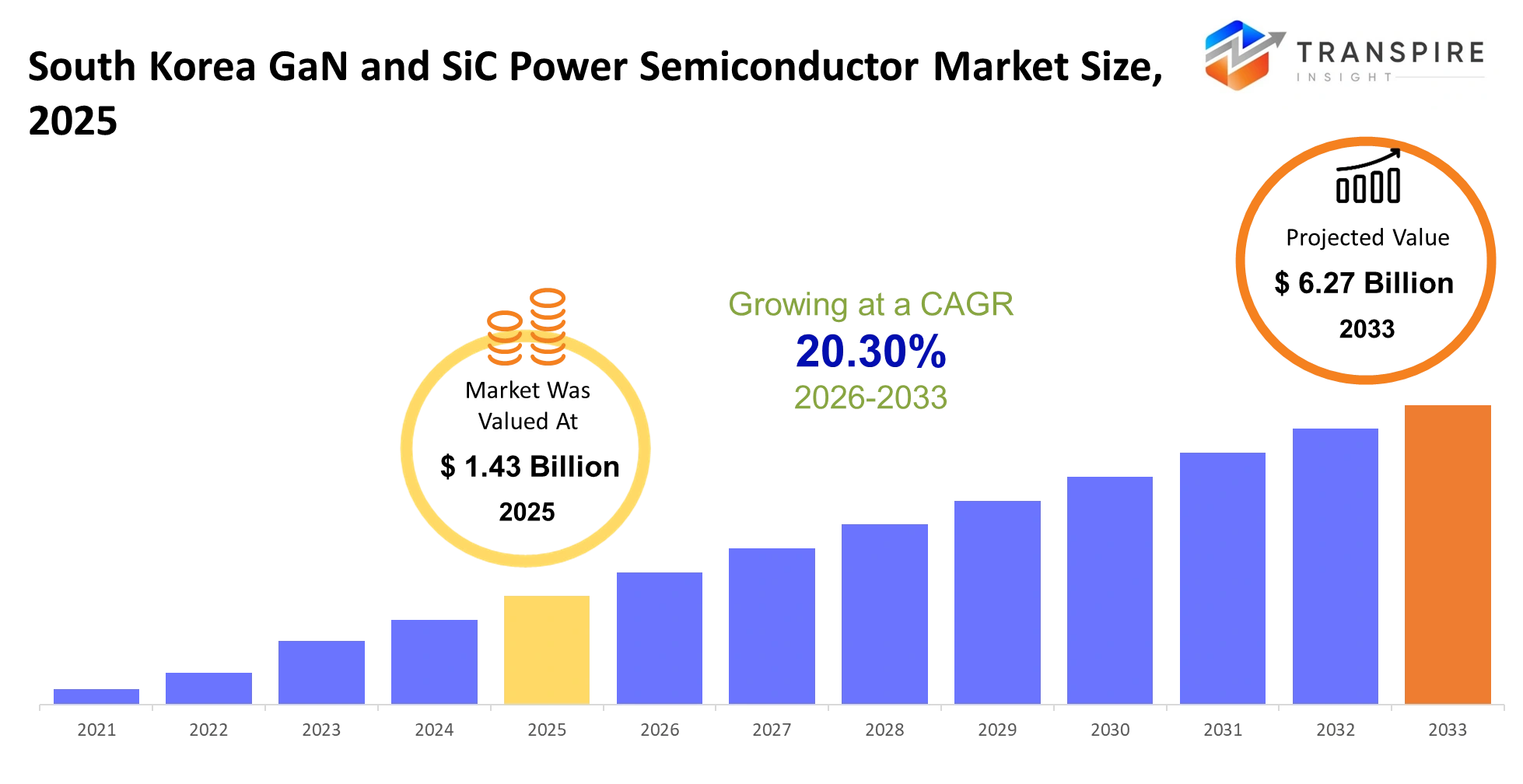
South Korea GaN and SiC Power Semiconductor Market Size & Forecast:
- South Korea GaN and SiC Power Semiconductor Market Size 2025: USD 1.43 Billion
- South Korea GaN and SiC Power Semiconductor Market Size 2033: USD 6.27 Billion
- South Korea GaN and SiC Power Semiconductor Market CAGR: 20.30%
- South Korea GaN and SiC Power Semiconductor Market Segments: By Material Type (Gallium Nitride Semiconductors, Silicon Carbide Semiconductors, Hybrid Power Semiconductors, Others); By Device Type (Power ICs, MOSFETs, Diodes, Rectifiers, Others); By Application (Electric Vehicles, Consumer Electronics, Renewable Energy Systems, Industrial Automation, Others); By Wafer Size (4-inch Wafers, 6-inch Wafers, 8-inch Wafers, Others); By End User (Automotive OEMs, Electronics Manufacturers, Energy Companies, Others).
To learn more about this report,  Download Free Sample Report
South Korea GaN and SiC Power Semiconductor Market Summary
The South Korea GaN and SiC Power Semiconductor Market was valued at USD 1.43 Billion in 2025. It is forecast to reach USD 6.27 Billion by 2033. That is a CAGR of 20.30% over the period.
In practice, GaN and SiC power semiconductors in South Korea sort of act like the hidden efficiency layer inside high-load electrical systems, where they regulate and stabilize power. It shows up in EV drivetrains, fast chargers, industrial automation lines and advanced grid infrastructure too. These materials replace standard silicon components to cut energy loss , improve thermal behavior and allow smaller, quicker power conversion setups used in next-gen mobility and smart manufacturing environments. Over the last 3–5 years, the market has shifted in a more structural way, moving away from silicon-dominant designs toward wide-bandgap adoption as EV production and renewable grid integration ramped up sharply. One big trigger was the global semiconductor supply chain disruption during COVID-19, which basically pushed South Korean manufacturers to localize , and redesign their power electronics for resilience, and higher efficiency. Meanwhile, tighter carbon neutrality commitments also made the demand for higher-efficiency conversion systems rise faster. That directly increases adoption across automotive OEM platforms and industrial power modules and it has strengthened revenue visibility across the whole ecosystem.
Key Market Insights
- South Korea's GaN and SiC power semiconductor market is moving away from plain silicon power parts , toward wide-bandgap semiconductor setups across EV and industrial systems.
- And, honestly it feels like the shift is accelerating pretty quickly, especially where efficiency matters.
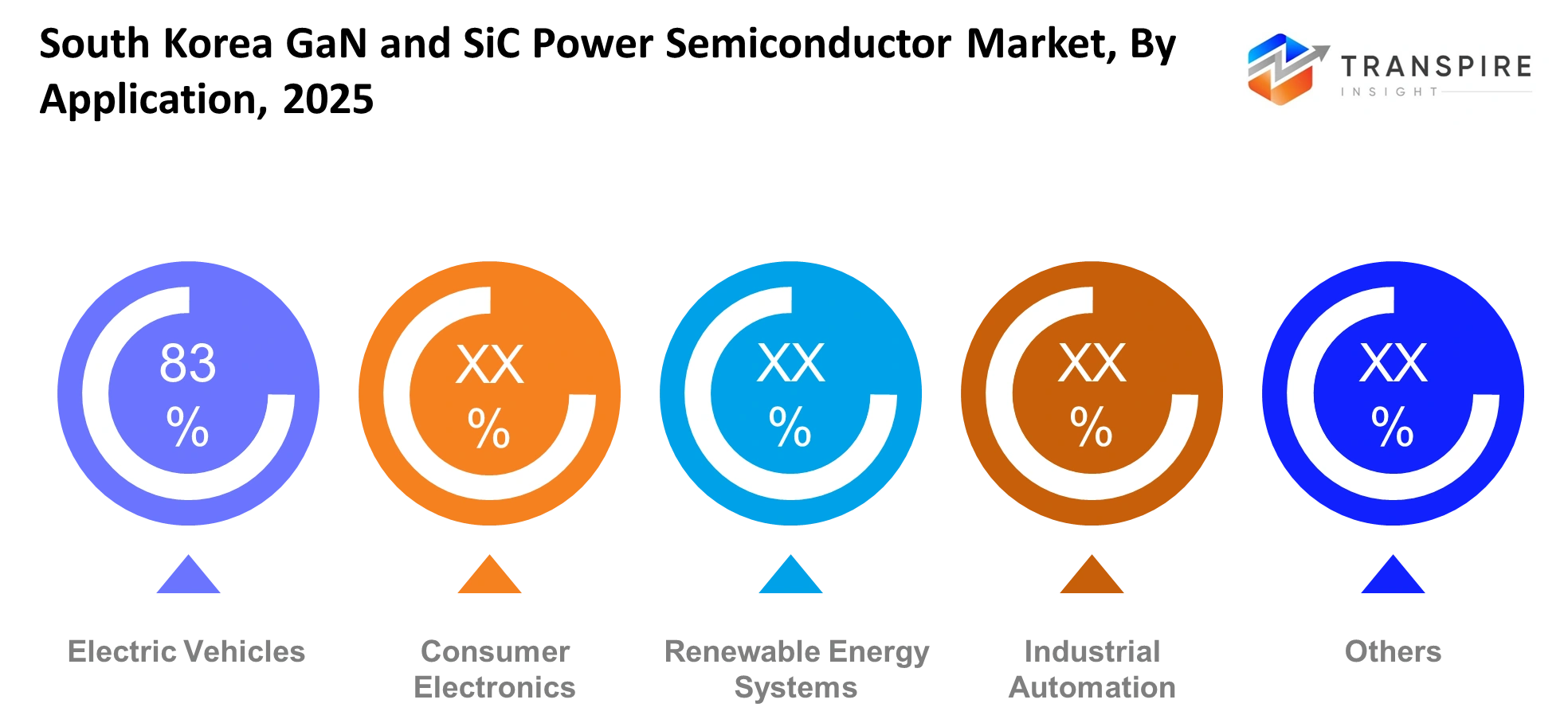
- In 2025, EV manufacturing integration will take the lead at around 40–45% share because traction inverters plus onboard charging systems are getting deployed at scale.
- Then the industrial power electronics slice stays as the second biggest share, mainly helped by robotics, smart factories, and high-efficiency motor control solutions. You can see it in how they’re building for tighter performance.
- Renewable energy integration is, uh, also the fastest-growing application, with forecasts pointing to a fairly sharp ramp through 2033 mostly glued to grid stabilization needs.
- If you look at geography, the Seoul–Gyeonggi area is taking the lead, at above 55% share, and it’s backed up by semiconductor fabs, EV OEM clusters, plus strong R and D attention.
- At the same time, the Southeastern industrial corridor is seeing the quickest regional expansion, mainly driven by automotive electrification and also shipbuilding electrification pushes.
- From the end-user angle, automotive still leads demand, but renewable energy utilities are showing up as the fastest-growing end-user category, which is kinda worth tracking.
- A lot of companies are also scaling GaN/SiC output via vertical integration, wafer fabrication investments, and by releasing automotive-qualified products.
- And lastly, strategic collaborations with EV OEMs and power module suppliers are helping firms tighten their competitive footing across Asia-Pacific supply chains even when the schedules get tight ,and you have little slack.
What are the Key Drivers, Restraints, and Opportunities in the South Korea GaN and SiC Power Semiconductor Market?
So the main driver of the South Korea GaN and SiC power semiconductor market is really the quick electrification of mobility and industrial systems, like EV platforms, and that kind of thing where higher switching efficiency matters, plus fewer thermal losses in smaller inverter layouts. This whole movement seems to have been pushed by performance barriers in silicon based devices, which can get stressed under high voltage and high frequency loads. Then automakers and OEM suppliers start moving toward wide bandgap alternatives, because it just works better. And as a result, revenue is getting more and more tied up in the higher value automotive modules and the fast charging infrastructure side, where those efficiency gains turn into longer range, and also lower total system costs.
Still, a big restraint stays in place: the manufacturing complexity and the wafer cost structure connected with SiC substrates and GaN epitaxy. Those production barriers feel kind of structural, because they rely on limited crystal growth yields and on capital intensive fabrication processes that do not scale fast. That slows price normalization too, and it can delay mass adoption in the mid tier industrial uses. So even when demand signals look strong, broader volume growth gets held back.
At the same time, there is an opportunity forming, especially in grid scale power conversion for renewable energy integration. This is mainly tied to South Korea’s offshore wind push and smart grid projects. These setups need very efficient bidirectional converters, to keep things stable when energy inputs are fluctuating. Firms that are betting on local SiC wafer supply chains and localized packaging technologies should be in a good position to win longer term infrastructure contracts, over time.
What Has the Impact of Artificial Intelligence Been on the South Korea GaN and SiC Power Semiconductor Market?
Artificial intelligence is, kind of, reshaping the optimization of power electronics in South Korea by getting better at how GaN and SiC based systems handle load balancing, thermal behavior, and real time efficiency tuning in EVs and industrial setups. In the automotive manufacturing side, AI controlled systems can tweak inverter switching patterns on the fly, based on driving behavior, battery condition , and terrain signals, this tends to boost energy usage while lowering conversion losses in high voltage architectures. For industrial spaces, machine learning is being used more often to watch power modules across robotics lines and semiconductor fabs, so it can spot early stage wear patterns and support predictive maintenance before something fails, like before the failure even really starts.
Also, predictive analytics backs grid connected renewable systems where AI estimates how the load will swing and then improves the power conversion efficiency in solar inverters along with energy storage systems. As a result, uptime has gone up, and there are fewer surprise maintenance cycles in high density power infrastructure. Still though, one major issue is the shortage of high quality real world operational data, especially in extreme thermal conditions and high frequency switching settings, which makes the models less accurate and slows deployment when the application is mission critical.
Key Market Trends
- After 2022 GaN and SiC adoption kind of jumped, like EV inverter designs swapped out silicon-based power modules across several major OEM platforms, all at once maybe.
- Automotive suppliers also leaned heavier into SiC deployment in 800V EV architectures. That helped charging speeds move faster and it made thermal efficiency better, compared with those older legacy setups.
- For industrial automation firms, the shift away from silicon dependence began to take hold after 2023. Mostly it was energy loss constraints during high-frequency robotics operations, so yeah less room for older choices.
- On the domestic side, semiconductor firms expanded packaging innovation in 2024. They focused on improving heat dissipation performance, especially for compact power modules that have to behave under tight constraints.
- Renewable integration, in turn, boosted SiC inverter adoption in 2025. It was especially noticeable in solar and wind grid stabilization efforts where reliability matters.
- At the same time, supply chain localization trends got stronger after global chip shortages messed with the availability of imported power devices. So companies just tried to control the pathway a bit more.
- EV fast-charging infrastructure meanwhile expanded GaN usage for compact, high-frequency power conversion modules that keep switching at speed.
- There were also strategic collaborations between automotive OEMs and power semiconductor vendors. Those turned into more technology co-development agreements, and it felt pretty coordinated.
- High-voltage industrial equipment manufacturers picked up SiC solutions too, mainly for better operational lifetime and fewer maintenance cycles over time.
- Competition got louder, as global players expanded South Korea specific R&D investment and automotive qualification programs.
South Korea GaN and SiC Power Semiconductor Market Segmentation
By Material Type
Silicon Carbide semiconductors still seem to hold the leading position in material segmentation, mostly because they are widely deployed in high-voltage electric vehicle drivetrains, fast-charging infrastructure, and industrial power conversion systems. Their thermal conductivity is high, and the switching efficiency stays strong even when voltage gets extreme. That’s why Silicon Carbide ends up as the go-to material for traction inverters and grid-connected energy systems. In addition, auto electrification programs, plus the shift toward 800V architecture, drive usage even further across premium mobility platforms, and big industrial automation setups quietly reinforce volume demand.
Gallium Nitride semiconductors are seeing faster take-up in compact, high-frequency uses like onboard chargers, consumer fast chargers, and data center power supplies. Meanwhile, hybrid power semiconductors are still in early-stage deployment, combining Silicon Carbide toughness with Gallium Nitride switching speed for selected niche high-performance systems. The “Others” category is broader and includes experimental wide-bandgap materials that are still under pilot testing. Throughout the forecast period, Gallium Nitride adoption is expected to accelerate in compact electronics and mobility charging ecosystems. Silicon Carbide, on the other hand, keeps its edge in high-power automotive applications and grid infrastructure, so overall you get a kind of split growth pattern across efficiency-focused and power-density-focused segments.
By Device Type
MOSFETs are pretty much the leading device category because they’re integrated everywhere, especially in electric vehicle powertrains, industrial motor drives, and renewable energy inverters , so yeah… it adds up. Silicon Carbide MOSFETs take over in high-voltage use cases where energy loss reduction and thermal stability largely determine how well the whole system performs. You also see strong adoption in traction inverter architectures, and in DC-DC conversion modules, which sort of keeps MOSFETs in a dominant position across automotive OEM platforms and energy infrastructure deployments.
Power ICs are gaining quick momentum in smaller, compact system designs where the control and power stages get merged together, and that helps efficiency plus it shrinks the overall component footprint, particularly in fast charging setups and in consumer electronics. Diodes continue to hold steady demand for rectification and protection circuits across industrial plus energy systems. Rectifiers still support legacy conversion setups and grid stabilization equipment, while Others includes emerging wide-bandgap hybrid switching devices. During the forecast period, Power IC integration is likely to expand even faster due to miniaturization trends in the overall system, whereas MOSFETs should keep their edge in high-power applications, pushed by automotive electrification and the ongoing growth of renewable energy.
By Application
Electric Vehicles basically keep the lead because there’s huge buy-in of Silicon Carbide and Gallium Nitride devices in traction systems, plus onboard chargers, and even the high-voltage battery management setup. The rapid spread of 800V platforms, along with drivetrain designs focused on efficiency, really boosts semiconductor usage across both premium and mass-market EV lines. Also, strong OEM spending on electrification ecosystems keeps the high-volume appetite for power conversion modules going.
Consumer Electronics are also showing steady pickup, mostly in fast-charging adapters, compact power supplies, and energy-saving device chargers that use Gallium Nitride tech. Renewable Energy Systems are growing fast too, since grid modernization and solar-plus-storage deployments need high-efficiency inversion and conversion equipment. Industrial Automation stays relatively stable, with robotics, precision manufacturing machinery, and motor control systems all pulling consistent demand. Others includes aerospace and defense-grade power systems where reliability is the main concern, so high-reliability components matter. Over the forecast timeframe, renewable energy use-cases tend to accelerate the quickest, driven by national decarbonization goals, while electric vehicles remain the main demand anchor for wide-bandgap semiconductors, in general.
To learn more about this report, Download Free Sample Report
By Wafer Size
Six-inch wafers kinda hold the dominant position in production, mostly because the manufacturing infrastructure is already in place, the cost efficiency stays balanced, and they are widely used for Silicon Carbide and Gallium Nitride device fabrication. Also, the automotive and industrial demand at high volume keeps the utilization going strong for six-inch wafer platforms, especially inside MOSFET and power module production lines, so it feels pretty locked in. The mature process integration, plus yield optimization, really reinforces this kind of industrial preference.
Four-inch wafers still stick around for legacy production and some specialized low-volume applications where cost constraints and design limitations keep people from moving up. Eight-inch wafers, on the other hand, represent the fastest-growing category, driven by more and more investment in advanced Silicon Carbide scaling and next-generation high efficiency device manufacturing. With bigger wafer sizes you can get higher output per wafer and a better overall cost structure, so they become critical for future capacity expansion. There are also other options such as experimental wafer substrates being worked on at pilot scale. Over the forecast period, eight-inch wafer adoption starts to accelerate, since manufacturers prioritize economies of scale and the higher power density integration that works well for automotive and grid applications.
By End User
Automotive OEMs kind of dominate end-user segmentation because they do direct integration of wide-bandgap semiconductors into electric vehicle platforms, charging infrastructure and also battery management systems. There are strong electrification roadmaps, plus a gradual shift toward high-voltage architectures which keeps demand steady for Silicon Carbide-based power modules in both premium and mass-market vehicles. Also the efficiency requirements are just really tight in mobility systems , so OEM-driven procurement stays front and center.
Electronics manufacturers add a more constant kind of demand through consumer devices fast-charging systems and power adapters, all while using Gallium Nitride technology for smaller , cleaner efficiency wins. Energy companies are the fastest-growing end-user group too, mainly because renewable energy integration is expanding , smart grids are getting pushed , and large-scale storage systems keep needing high-efficiency conversion. Other players include industrial automation operators and infrastructure developers deploying power electronics in robotics and heavy machinery systems. Over the forecast period, energy companies are expanding purchasing faster than the traditional segments because of grid modernization programs, while automotive OEMs keep their structural dominance since electrification keeps spreading across global mobility platforms.
What are the Key Use Cases Driving the South Korea GaN and SiC Power Semiconductor Market?
The main use case is for electric vehicle powertrains , where GaN and SiC devices help boost inverter efficiency, somehow extend the driving range, and lower thermal losses in high-voltage layouts. This is where demand tends to be the strongest , because large scale EV manufacturing in South Korea’s automotive scene is growing a lot.
Another category of use is industrial robotics and semiconductor fabrication equipment, where dependable, high frequency power management matters for precision moves and better energy optimization. These products usually end up in smart factory setups, and more advanced manufacturing environments.
Newer use cases are fast EV charging networks and renewable energy storage systems, in those cases compact and high efficiency power conversion is kind of a must, to manage changing loads and keep the grid steady across the forecast period.
|
Report Metrics |
Details |
|
Market size value in 2025 |
USD 1.43 Billion |
|
Market size value in 2026 |
USD 1.72 Billion |
|
Revenue forecast in 2033 |
USD 6.27 Billion |
|
Growth rate |
CAGR of 20.30% from 2026 to 2033 |
|
Base year |
2025 |
|
Historical data |
2021 - 2024 |
|
Forecast period |
2026 - 2033 |
|
Report coverage |
Revenue forecast, competitive landscape, growth factors, and trends |
|
Regional scope |
South Korea |
|
Key company profiled |
Samsung Electronics, SK hynix, Infineon Technologies, Wolfspeed, STMicroelectronics, ON Semiconductor, Rohm Semiconductor, Mitsubishi Electric, Toshiba, Fuji Electric, NXP Semiconductors, Texas Instruments, Navitas Semiconductor, GeneSiC Semiconductor, Microchip Technology. |
|
Customization scope |
Free report customization (country, regional & segment scope). Avail customized purchase options to meet your exact research needs. |
|
Report Segmentation |
By Material Type (Gallium Nitride Semiconductors, Silicon Carbide Semiconductors, Hybrid Power Semiconductors, Others); By Device Type (Power ICs, MOSFETs, Diodes, Rectifiers, Others); By Application (Electric Vehicles, Consumer Electronics, Renewable Energy Systems, Industrial Automation, Others); By Wafer Size (4-inch Wafers, 6-inch Wafers, 8-inch Wafers, Others); By End User (Automotive OEMs, Electronics Manufacturers, Energy Companies, Others). |
Which Regions are Driving the South Korea GaN and SiC Power Semiconductor Market Growth?
Seoul–Gyeonggi stays kind of the main show, because it has so many semiconductor fabrication hubs, EV powertrain developers and also advanced electronics R&D clusters packed together. The area also leans on policy alignment with Korea’s carbon-neutral mobility roadmap which basically speeds up the deployment of SiC-based inverters and GaN-based fast-charging systems. Big automotive suppliers plus Tier-1 vendors along this corridor tend to slip wide-bandgap components straight into EV platforms, aided by nearby testing facilities and materials research institutes. And honestly the high capital intensity here helps lock in long-term leadership, since the design-to-production loops are shorter, and the whole setup is fairly vertically integrated. So yeah, Seoul–Gyeonggi works as both the innovation core and the commercialization gateway for high-efficiency power semiconductor adoption
Meanwhile the southeastern industrial belt, including Busan, Ulsan, and the Gyeongsang regions, plays a steadier but structurally different part in market expansion. Unlike the capital region, which feels very R&D-heavy, this side is anchored in shipbuilding, heavy machinery, and petrochemical industries, that need consistent high-power conversion hardware. Shipbuilders and industrial operators usually value long-lifecycle reliability over rapid technology refreshes, so SiC adoption continues in propulsion drives and auxiliary power systems. Investment behavior there is more conservative too, it’s driven by long-term contracts and incremental electrification upgrades rather than quick prototype cycles. That’s why the region turns into a predictable revenue base for semiconductor suppliers aiming at industrial-grade deployments, even if the pace isn’t as hectic as the north corridor
Who are the Key Players in the South Korea GaN and SiC Power Semiconductor Market and How Do They Compete?
So, competition in the South Korea GaN and SiC power semiconductor market is kinda moderately consolidated at the technology leadership level but, at the same time it feels fragmented across application-specific supply chains. Like globally the bigger incumbents still pull a lot of weight in high-performance device design, while regional players plus fab partners end up competing more on packaging, integration, and that system-level customization thing. And honestly the main competitive axis is not only price, it’s more about process technology leadership for wafer scaling, thermal efficiency and even automotive qualification standards. Also, control over 200mm and the emerging 300mm SiC platforms has basically become a big differentiator, especially now when EV and AI data center applications are chasing higher power density plus reliability under extreme load conditions, which is not always easy.
Infineon Technologies plays it more vertically integrated, with large scale SiC capacity expansion too, and it tends to focus on high-volume automotive-qualified modules. It also does aggressive scaling across Asian manufacturing hubs. Its advantage is pretty tied to controlling the substrate-to-module supply chains, because that reduces cost volatility and improves allocation control, especially for EV OEM contracts, where timing matters.
Wolfspeed, meanwhile, differentiates through advanced SiC material leadership, and specifically its 300mm wafer development, aimed at the next generation AI and high-voltage infrastructure systems. The company is pushing forward by expanding through ecosystem partnerships with foundries and system architects, trying to lock in design wins for grid and data center power architectures. It’s like they’re not just selling wafers, they’re trying to sit closer to how systems get designed in the first place.
STMicroelectronics leans harder into automotive and industrial certification depth, and it leverages strong OEM relationships in Europe and Asia. For expansion, the strategy emphasizes co-development programs with EV manufacturers and adding capacity in SiC wafer manufacturing. So rather than only scaling, they’re trying to grow alongside the customer roadmap, even if it means slower steps at first.
Company List
- Samsung Electronics
- SK hynix
- Infineon Technologies
- Wolfspeed
- STMicroelectronics
- ON Semiconductor
- Rohm Semiconductor
- Mitsubishi Electric
- Toshiba
- Fuji Electric
- NXP Semiconductors
- Texas Instruments
- Navitas Semiconductor
- GeneSiC Semiconductor
- Microchip Technology
Recent Development News
"In March 2026, Wolfspeed announced advancement of its 300mm silicon carbide platform for AI data center and high-performance computing applications. The development enhances scalability for next-generation power architectures and improves thermal management efficiency in high-density systems.
Source: https://www.wolfspeed.com
"In May 2026, onsemi expanded its GaN power device collaboration with GlobalFoundries to develop 650V-class next-generation power semiconductors. The partnership targets AI data center and EV power systems by improving efficiency and reducing system-level power losses.
Source: https://www.beyondspx.com
"In May 2026, Navitas Semiconductor through its technology partnership with Cyient enabled the launch of a GaN power IC family aimed at AI infrastructure and e-mobility applications. The collaboration strengthens localized GaN supply chains and accelerates adoption in high-efficiency power conversion systems.
Source: https://www.semiconductor-today.com
What Strategic Insights Define the Future of the South Korea GaN and SiC Power Semiconductor Market?
South Korea’s GaN and SiC power semiconductor market is kind of, structurally, drifting toward more system level integration where power efficiency gets sort of baked into EV platforms, AI data center infrastructure, and renewable energy grids rather than being marketed as standalone components. This direction is being pushed by the coming together of 800V architectures, grid decentralization, and those high density computing loads that run into thermal and energy efficiency ceilings, so wide-bandgap semiconductors have to show up. There’s also a hidden risk that feels easy to overlook, it’s the supply concentration of SiC substrates, where the wafer capacity is limited and the manufacturing process is pretty complex, so scaling could get stuck even while demand keeps accelerating. On the other hand, an emerging opportunity is the way SiC can be integrated into AI power delivery networks for data centers, because demand is moving away from the usual silicon based power stages. A key strategic recommendation would be, for companies to lock in long term wafer supply partnerships while at the same time investing in application specific power modules for EV and grid systems, so they stay resilient across those cyclical demand phases.
South Korea GaN and SiC Power Semiconductor Market Report Segmentation
By Material Type
- Gallium Nitride (GaN) Semiconductors
- Silicon Carbide (SiC) Semiconductors
- Hybrid Power Semiconductors
- Others
By Device Type
- Power ICs
- MOSFETs
- Diodes
- Rectifiers
- Others
By Application
- Electric Vehicles
- Consumer Electronics
- Renewable Energy Systems
- Industrial Automation
- Others
By Wafer Size
- 4-inch Wafers
- 6-inch Wafers
- 8-inch Wafers
- Others
By End User
- Automotive OEMs
- Electronics Manufacturers
- Energy Companies
- Others
Frequently Asked Questions
Find quick answers to common questions.
The estimated South Korea GaN and SiC Power Semiconductor Market size for the market will be USD 6.27 Billion in 2033.
Key segments for the South Korea GaN and SiC Power Semiconductor Market are By Material Type (Gallium Nitride Semiconductors, Silicon Carbide Semiconductors, Hybrid Power Semiconductors, Others); By Device Type (Power ICs, MOSFETs, Diodes, Rectifiers, Others); By Application (Electric Vehicles, Consumer Electronics, Renewable Energy Systems, Industrial Automation, Others); By Wafer Size (4-inch Wafers, 6-inch Wafers, 8-inch Wafers, Others); By End User (Automotive OEMs, Electronics Manufacturers, Energy Companies, Others).
Major South Korea GaN and SiC Power Semiconductor Market players are Samsung Electronics, SK hynix, Infineon Technologies, Wolfspeed, STMicroelectronics, ON Semiconductor, Rohm Semiconductor, Mitsubishi Electric, Toshiba, Fuji Electric, NXP Semiconductors, Texas Instruments, Navitas Semiconductor, GeneSiC Semiconductor, Microchip Technology.
The South Korea GaN and SiC Power Semiconductor Market size is USD 1.43 Billion in 2025.
The South Korea GaN and SiC Power Semiconductor Market CAGR is 20.30% from 2026 to 2033.
- Samsung Electronics
- SK hynix
- Infineon Technologies
- Wolfspeed
- STMicroelectronics
- ON Semiconductor
- Rohm Semiconductor
- Mitsubishi Electric
- Toshiba
- Fuji Electric
- NXP Semiconductors
- Texas Instruments
- Navitas Semiconductor
- GeneSiC Semiconductor
- Microchip Technology
Recently Published Reports
-
Apr 2026
Fiber Optic Faceplates Market
Fiber Optic Faceplates Market Size, Share & Analysis Report By Type (< 300 mm2, 300-350 mm2, and > 350 mm2, By Application (Night Vision, Holographic Imaging, Medical, and Others), and Geography (North America, Europe, Asia-Pacific, Middle East and Africa, South and Central America), 2021 - 2031
-
Apr 2026
High Temperature Superconductors Market
High Temperature Superconductors Market Size, Share & Analysis Report By Type (1G HTS, and 2G HTS), By Application (Power Cable, Fault Current Limiter, and Transformer), and Geography (North America, Europe, Asia-Pacific, Middle East and Africa, South and Central America), 2021 - 2031
-
Apr 2026
Industrial Plugs and Socket Market
Industrial Plugs and Socket Market Size, Share & Analysis Report By Type (Industrial Plugs, Industrial Sockets), By Current (Up to 32 A, 32 to 125 A, Above 125 A), By Protection (Dustproof and Splash Proof, Waterproof, Explosion Proof), By End User (Heavy Industries, Oil and Gas, Chemicals and Pharmaceuticals, Power Generation, Others), and Geography (North America, Europe, Asia-Pacific, Middle East and Africa, South and Central America), 2021 - 2031
-
Apr 2026
InGaAs Avalanche Photodiodes Market
InGaAs Avalanche Photodiodes Market Size, Share & Analysis Report By Type (1100 - 1700 nm, and 1000 - 1600 nm), By Application (Missile Warning System, Muzzle Flash Detection, Wafer Defect Inspection, Laser Rangefinders, and Others), and Geography (North America, Europe, Asia-Pacific, Middle East and Africa, South and Central America), 2021 - 2031