

South Korea AMHS for Semiconductor Market Size & Forecast:
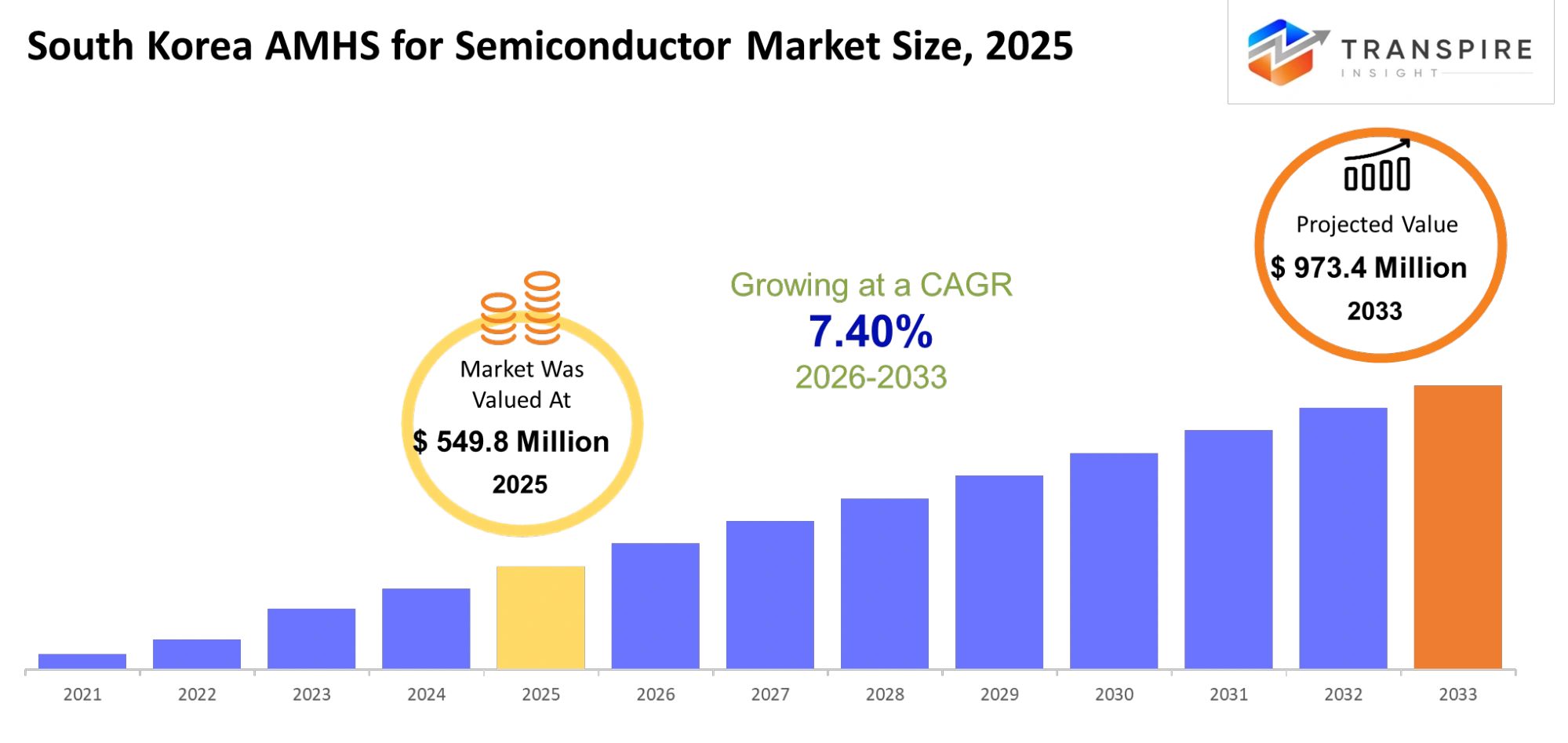
- South Korea AMHS for Semiconductor Market Size 2025: USD 549.8 Million
- South Korea AMHS for Semiconductor Market Size 2033: USD 973.4 Million
- South Korea AMHS for Semiconductor Market CAGR: 7.40%
- South Korea AMHS for Semiconductor Market Segments: By Type (OHT, AGV, Stockers, Conveyor Systems), By Component (Hardware, Software, Control Systems, Services), By Application (Wafer Handling, Fab Automation, Packaging, Testing), By End-User (Semiconductor Fabs, Foundries, OEMs), By Automation Level (Semi-automated, Fully Automated, Smart Systems, AI-driven)
To learn more about this report,  Download Free Sample Report
South Korea AMHS for Semiconductor Market Summary:
The South Korea AMHS for Semiconductor Market size is estimated at USD 549.8 Million in 2025 and is anticipated to reach USD 973.4 Million by 2033, growing at a CAGR of 7.40% from 2026 to 2033.
South Korea AMHS for semiconductor market within the semiconductor manufacturing industry will represent a highly specialized segment which handles automated material transport operations within advanced manufacturing facilities. The market will develop through increasing requirements for precise operations and contamination prevention and continuous manufacturing processes.
System design requires ongoing technological progress because smart automation together with AI-based monitoring systems and real-time tracking has become expected standard features. Flexibility in production systems will become essential because customer needs now require companies to handle multiple production capacities and develop intricate chip designs. System upgrades will continue to follow safety regulations while cleanroom operations and safety regulations establish compliance standards.
What Has the Impact of Artificial Intelligence Been on the South Korea AMHS for Semiconductor Market?
The artificial intelligence technology transforms the operations of South Korea's automated material handling systems which support semiconductor manufacturing because it changes their existing automated processes. South Korean automated material handling systems which support semiconductor production now use artificial intelligence to perform advanced data analysis which enables companies to handle extensive production data with improved precision.
The production efficiency of South Korea's automated material handling systems for semiconductor production receives substantial enhancement from artificial intelligence which operates through intelligent automation solutions. The AI-based system analyzes data to create optimal wafer transport routes while it tracks equipment status and uses predictive technology to identify potential system failures.
AI implementation in South Korea's automated material handling systems for semiconductor production enables companies to reach new levels of operational effectiveness and discover new business opportunities. Businesses that implement smart automation technology gain the ability to create customized solutions which allow them to scale their operations and meet different requirements across multiple fabrication facilities.
Key Market Trends & Insights:
- South Korea maintains 85% market share in 2025 because advanced semiconductor hubs in Suwon and Icheon support its operations.
- Overhead Hoist Transport (OHT) systems control the market with their 40% share because they enable efficient movement of wafers at high speeds.
- Stockers function as the second-largest segment because they maintain organized wafer storage and they help improve cleanroom space utilization.
- From 2026 to 2030 AI-driven AMHS solutions become the fastest-growing segment because they enable predictive maintenance and real-time optimization.
- Wafer handling leads the market in 2025 with its 50% share because precise transport methods continue to be essential for creating semiconductor products.
- Fab automation stands as the most rapidly developing application because companies now demand complete automated systems for their intelligent manufacturing processes.
- Semiconductor fabs control about 65% of the market because they require equipment for their extensive production needs.
- Foundries emerge as the fastest developing user segment because they increase their production capabilities to satisfy worldwide chip requirements while attracting new clients.
- The semiconductor manufacturers' strategic partnerships enable them to create personalized AMHS solutions which allow them to enter new markets at a quicker pace.
- The company achieves growth advantages through its smart factory investments which enhance its competitive abilities in existing markets.
South Korea AMHS for Semiconductor Market Segmentation
By Type:
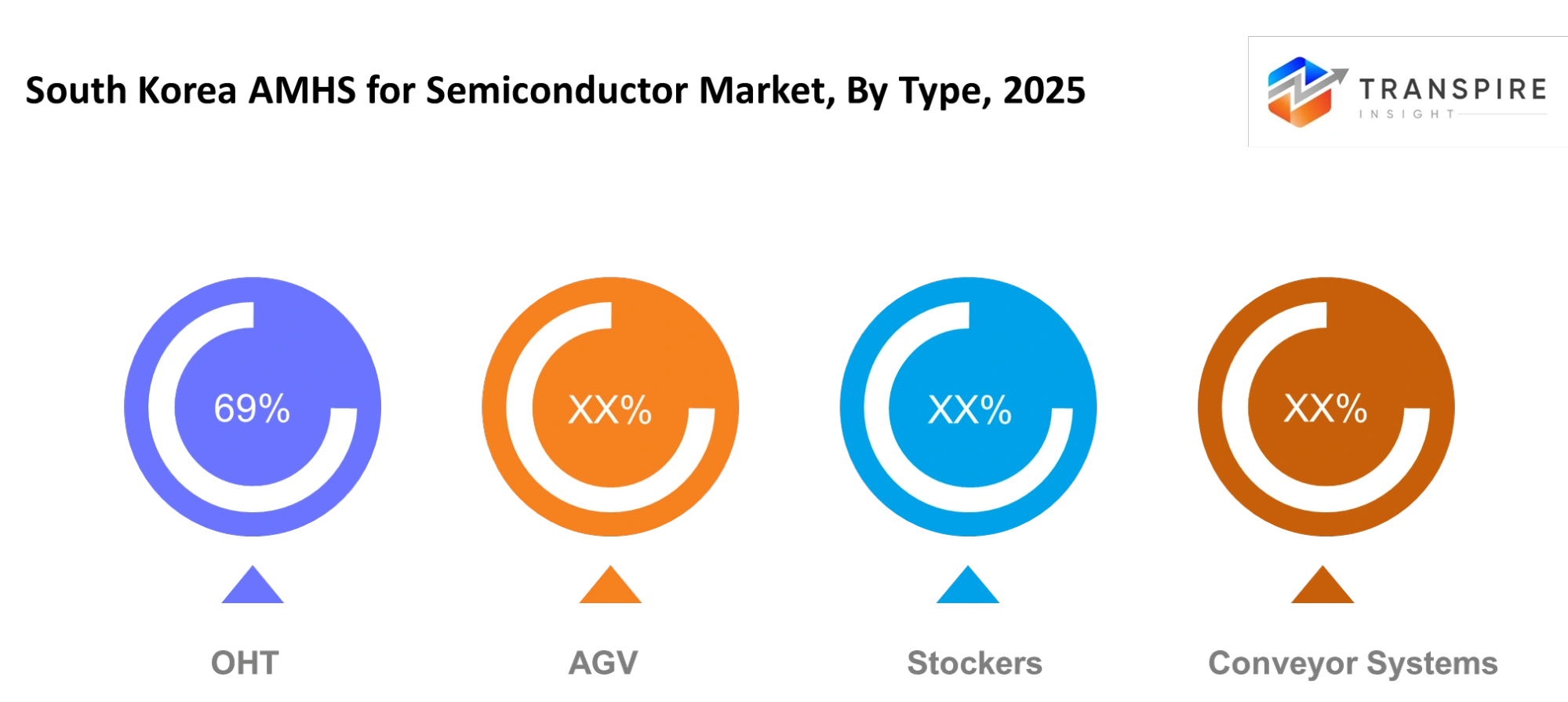
Analysis shows that OHT systems will become the leading overhead transport solution for fabs because of their fast operation and minimal space requirements. The production floor AGVs will enable workers to move flexibly throughout the facility. Stockers will provide organized storage for wafers, while conveyor systems will handle continuous transfer. The production line requires different types of equipment to fulfill its specific operational requirements found in fabrication environments.
To learn more about this report, Download Free Sample Report
By Component:
Analysis shows that hardware will consist of robotic arms and sensors and transport units which will enable physical material movement. The software system will handle both scheduling and data management functions. The control systems will synchronize all operations while maintaining precise system performance. The services will provide system maintenance and updates plus control system integration which will assure system performance and reliability throughout its operational lifetime.
By Application:
Analysis demonstrates that wafer handling will remain an essential application which needs both extreme accuracy and effective contamination management. The Fab automation system will enhance all production processes through automated systems. Automated systems will speed up operational efficiency at both packaging and testing stages while minimizing product defects. The combination of all applications will lead to better operational performance and enhanced product value.
By End-User:
Semiconductor fabs will act as the main user base because they operate at high production levels. Foundries need adaptable systems which can manage different customer requirements. The OEMs will incorporate AMHS into their equipment solutions which will enable complete manufacturing operations while maintaining consistent performance throughout all production sites.
By Automation Level:
The system operates at three different levels of automation which include semi-automated systems, fully automated systems, smart systems and AI-driven systems. The semi-automated systems will provide partial assistance to users who need to complete their tasks. The fully automated systems will manage all aspects of operations without requiring human support. Smart systems will use connected technologies for better monitoring, while AI-driven solutions will enable predictive control and improved decision-making.
What are the Main Challenges for the South Korea AMHS for Semiconductor Market Growth?
The south korean automated material handling systems face technical and operational challenges because precision and reliability remain essential for the semiconductor market. Automated material handling systems must operate in ultra-clean environments which means that any system failure will interrupt complete manufacturing operations. The system becomes more complicated because it needs to integrate with existing systems while maintaining real-time data updates. The ongoing supply chain problems which affect specialized components act as obstacles that prevent business growth.
The south korean automated material handling systems market for semiconductor manufacturing faces two major obstacles which prevent its growth. The high costs related to development and deployment create competitive disadvantages for small businesses, while the industry requires strict compliance with regulatory standards and product quality requirements, which delays product launches. The different semiconductor fabs between semiconductor fabs require their own customization which results in extended production times, thereby creating commercial delays that prevent new companies from expanding their operations.
The adoption process presents multiple problems for the south korean automated material handling systems market which demands skilled workers who can operate advanced automated machinery. The adoption process in mid-sized manufacturing companies experiences delays because companies find it hard to find trained workers who can operate advanced automated systems while facing the challenge of covering expensive initial system costs. The implementation of the technology faces limitations because organizations lack the essential infrastructure needed to run AI-powered analytics and smart factory systems.
Regional Insights
The South Korean semiconductor sector will experience ongoing growth because semiconductor producers need to increase their production facilities while they develop automated systems. The market will expand because the industry requires effective material handling systems to manage more complex wafers and meet higher cleanroom requirements. The companies entering this industry must develop exceptional technical skills while keeping their expenses low and their operational systems dependable to achieve their demanding production goals.
The semiconductor industry in South Korea operates at a high level because major semiconductor manufacturers like Samsung Electronics and SK Hynix continue to establish their production facilities. The adoption of automation technology will be driven by three factors which include government support and the existence of skilled workers and advanced technological infrastructure. The development of urban industrial clusters will enable businesses to use automated material handling systems more quickly which will help them work better and keep their worldwide market edge.
The South Korean AMHS market for semiconductor manufacturing shows continuous development because the country invests heavily in both semiconductor production and intelligent factory technologies. The growth of the market will proceed because companies need to decrease their need for manual work while they raise their production output and sustain their cleanroom environment. Businesses will concentrate on developing automation solutions which include both robotic transportation systems and systems that track operations in real time. New companies will establish trust with clients by forming strategic agreements with domestic manufacturers which will also assist them in reaching their target market.
The semiconductor hubs in South Korea will continue their role as main centers for technological development and manufacturing operations which they display through their two primary locations in Suwon and Icheon. The ongoing infrastructure development projects will improve supply chain systems and operational capacity of these areas. Technology providers and chip manufacturers will work together to build a system that drives continuous productivity improvements while keeping automated systems running at their regular pace.
Recent Development News
In March 2026, Semits announced a merger with NH Special Purpose Acquisition Company to facilitate its KOSDAQ listing, aiming to strengthen its advanced semiconductor logistics automation (AMHS-related) capabilities.https://view.asiae.co.kr
In April 2026, Semits scheduled a shareholder meeting (April 17, 2026) to approve its merger with NH SPAC, advancing consolidation in semiconductor automation systems supporting fab material handling infrastructure.https://view.asiae.co.kr
|
Report Metrics |
Details |
|
Market size value in 2025 |
USD 549.8 Million |
|
Market size value in 2026 |
USD 590.5 Million |
|
Revenue forecast in 2033 |
USD 973.4 Million |
|
Growth rate |
CAGR of 7.40% from 2026 to 2033 |
|
Base year |
2025 |
|
Historical data |
2021 - 2024 |
|
Forecast period |
2026 - 2033 |
|
Report coverage |
Revenue forecast, competitive landscape, growth factors, and trends |
|
Regional scope |
South Korea |
|
Key company profiled |
Daifuku, Murata Machinery, SSI Schaefer, Dematic, KION Group, Toyota Industries, Honeywell, Siemens, ABB, Samsung SDS, SK Materials, CJ Logistics, Vanderlande, TGW Logistics, BEUMER Group |
|
Customization scope |
Free report customization (country, regional & segment scope). Avail customized purchase options to meet your exact research needs. |
|
Report Segmentation |
By Type (OHT, AGV, Stockers, Conveyor Systems), By Component (Hardware, Software, Control Systems, Services), By Application (Wafer Handling, Fab Automation, Packaging, Testing), By End-User (Semiconductor Fabs, Foundries, OEMs), By Automation Level (Semi-automated, Fully Automated, Smart Systems, AI-driven) |
How Can New Companies Establish a Strong Foothold in the South Korea AMHS for Semiconductor Market?
New entrants who want to enter the South Korean AMHS semiconductor market must identify specific market segments which match existing industry deficiencies. Companies should choose to compete in specific markets which exist between wafer handling automation and cleanroom robotics and AI material tracking technologies. This method enables new companies to tackle semiconductor manufacturing problems which include yield improvement and contamination management. The use of local market expansion statistics together with current industry developments will enable better establishment of market position and faster product acceptance.
The Korean AMHS semiconductor market relies on innovation to create unique business identities. Organizations need to allocate resources toward emerging technologies which include autonomous mobile robots and predictive maintenance systems and IoT-enabled logistics solutions. The startups involved in SEMIBOTICS (this example) create AI-based AMHS systems which operate through continuous data evaluation to minimize operational interruptions. The innovative methods create better productivity results while they solve important manufacturing difficulties which include production delays and workforce reliance.
The South Korean AMHS semiconductor market requires companies to create strategic partnerships which enable their business expansion. Established semiconductor manufacturers and equipment suppliers and smart factory integrators make up the strategic partners who will enhance business credibility while reducing market entry time.
The combination of technology uniqueness and comprehensive market understanding serves as the foundation for achieving success. Companies that align innovation strategies with industry-specific demands—while continuously adapting to market growth and evolving customer needs—can establish a strong and sustainable foothold.
Key South Korea AMHS for Semiconductor Market Company Insights
The automated material handling systems in South Korea semiconductor manufacturing facilities enable precise wafer transportation between tools which enables factories to operate at high production levels. The method will decrease manual operations which will result in decreased contamination risks while producing better results. The manufacturing process will run continuously which enables faster production times while improving efficiency throughout all manufacturing sites.
Domestic companies invest in system reliability while developing advanced manufacturing node integration solutions which they consider essential for success.
The AMHS system will combine with smart factory systems to provide factories with real-time monitoring capabilities which help predict equipment maintenance needs while managing their operations through data-driven planning. The semiconductor industry will implement these solutions to minimize operational interruptions while improving their supply chain management. The strong connection between the company and Industry 4.0 objectives will lead to more funding for the development of intelligent automation systems.Through their AI-powered platforms and software-based optimization solutions companies will establish their competitive advantage in the market.
The automotive and electronics sectors to which electric vehicles and ADAS systems and consumer electronics belong will demand semiconductor products which require effective material handling systems for their operations. The automated material handling system will provide two essential functions which enable flexible system operations while delivering rapid production output that satisfies semiconductor factory requirements for precise and scalable manufacturing operations.
Market participants will establish partnerships with automotive chip suppliers and electronics manufacturers as their main business strategy. The development of robotic systems together with modular building designs and digital simulation technology will advance both system scalability and cost-effective operations. These developments will enable organizations to expand their facilities at a faster rate while their systems will gain better capacity to handle operational changes. The industry will develop toward automation systems which will function as essential elements in upcoming semiconductor manufacturing methods.Global and regional firms will invest in R&D to strengthen technological differentiation.
Company List
- Daifuku
- Murata Machinery
- SSI Schaefer
- Dematic
- KION Group
- Toyota Industries
- Honeywell
- Siemens
- ABB
- Samsung SDS
- SK Materials
- CJ Logistics
- Vanderlande
- TGW Logistics
- BEUMER Group
What are the Key Use-Cases Driving the Growth of the South Korea AMHS for Semiconductor Market?
The automated material handling systems (AMHS) system runs through its complete operational process because it serves essential needs in semiconductor production. South Korean semiconductor manufacturers depend on AMHS systems which decrease human contact while safeguarding production from contamination and enhancing operational efficiency during advanced node manufacturing processes. The systems operate continuously throughout the day which leads to improvements in fabrication efficiency and production output.
The south korea AMHS for semiconductor market experiences another significant growth driver from its usage in smart manufacturing systems and Industry 4.0 production environments. Fabs implement AMHS solutions which now come with AI-powered scheduling and actual tracking and predictive maintenance features to achieve better operational efficiency and decrease equipment downtime. South Korea dominates global memory chip manufacturing which requires accurate operational execution of production processes.
The south korea AMHS for semiconductor market experiences increased demand from both automotive and consumer electronics industries because electric vehicles and ADAS systems and smartphones and IoT devices require rising chip production volumes which compel manufacturing facilities to increase their output. The automated material handling system (AMHS) guarantees rapid processing times through its ability to route materials flexibly which enables manufacturers to meet their various chip production requirements throughout different business sectors.
The South Korea AMHS for the semiconductor market will experience growth through developments in robotics technology and digital twin systems and modular fabrication technology. These developments will improve scalability while decreasing operational expenses and enabling future semiconductor manufacturing processes which will drive continuous expansion of the market.
South Korea AMHS for Semiconductor Market Report Segmentation
By Type
- OHT
- AGV
- Stockers
- Conveyor Systems
By Component
- Hardware
- Software
- Control Systems
- Services
By Application
- Wafer Handling
- Fab Automation
- Packaging
- Testing
By End-User
- Semiconductor Fabs
- Foundries
- OEMs
By Automation Level
- Semi-automated
- Fully Automated
- Smart Systems
- AI-driven
Frequently Asked Questions
Find quick answers to common questions.
The approximate South Korea AMHS for Semiconductor Market size for the market will be USD 973.4 Million in 2033.
Key segments for the South Korea AMHS for Semiconductor Market are By Type (OHT, AGV, Stockers, Conveyor Systems), By Component (Hardware, Software, Control Systems, Services), By Application (Wafer Handling, Fab Automation, Packaging, Testing), By End-User (Semiconductor Fabs, Foundries, OEMs), By Automation Level (Semi-automated, Fully Automated, Smart Systems, AI-driven).
Major South Korea AMHS for Semiconductor Market players are Daifuku, Murata Machinery, SSI Schaefer, Dematic, KION Group, Toyota Industries, Honeywell, Siemens, ABB, Samsung SDS, SK Materials, CJ Logistics, Vanderlande, TGW Logistics, BEUMER Group.
The South Korea AMHS for the semiconductor market size is USD 549.8 Million in 2025.
The South Korea AMHS for Semiconductor Market CAGR is 7.40%.
- Daifuku
- Murata Machinery
- SSI Schaefer
- Dematic
- KION Group
- Toyota Industries
- Honeywell
- Siemens
- ABB
- Samsung SDS
- SK Materials
- CJ Logistics
- Vanderlande
- TGW Logistics
- BEUMER Group
Recently Published Reports
-
Dec 2024
Fiber Optic Faceplates Market
Fiber Optic Faceplates Market Size, Share & Analysis Report By Type (< 300 mm2, 300-350 mm2, and > 350 mm2, By Application (Night Vision, Holographic Imaging, Medical, and Others), and Geography (North America, Europe, Asia-Pacific, Middle East and Africa, South and Central America), 2021 - 2031
-
Jan 2025
High Temperature Superconductors Market
High Temperature Superconductors Market Size, Share & Analysis Report By Type (1G HTS, and 2G HTS), By Application (Power Cable, Fault Current Limiter, and Transformer), and Geography (North America, Europe, Asia-Pacific, Middle East and Africa, South and Central America), 2021 - 2031
-
Jan 2025
Industrial Plugs and Socket Market
Industrial Plugs and Socket Market Size, Share & Analysis Report By Type (Industrial Plugs, Industrial Sockets), By Current (Up to 32 A, 32 to 125 A, Above 125 A), By Protection (Dustproof and Splash Proof, Waterproof, Explosion Proof), By End User (Heavy Industries, Oil and Gas, Chemicals and Pharmaceuticals, Power Generation, Others), and Geography (North America, Europe, Asia-Pacific, Middle East and Africa, South and Central America), 2021 - 2031
-
Jan 2025
InGaAs Avalanche Photodiodes Market
InGaAs Avalanche Photodiodes Market Size, Share & Analysis Report By Type (1100 - 1700 nm, and 1000 - 1600 nm), By Application (Missile Warning System, Muzzle Flash Detection, Wafer Defect Inspection, Laser Rangefinders, and Others), and Geography (North America, Europe, Asia-Pacific, Middle East and Africa, South and Central America), 2021 - 2031