

South Korea Fly Ash Market Summary:
According to Transpire Insights, a detailed research report on the market reflects that the fly ash segment dominates the South Korea Fly Ash Market, accounting for approximately 50.46% of the total share within the South Korea Supplementary Cementitious Materials Market in 2025. SAMPYO / SP S&A leads the market with approximately 2.1 million tons of annual fly ash production capacity and an estimated around 30% market share, making it the leading contributor to South Korea Fly Ash Market development, innovation, advanced fly ash processing, expanding manufacturing capabilities, sustainable cementitious material production, circular-economy initiatives, and overall market growth dynamics.
Market Snapshot
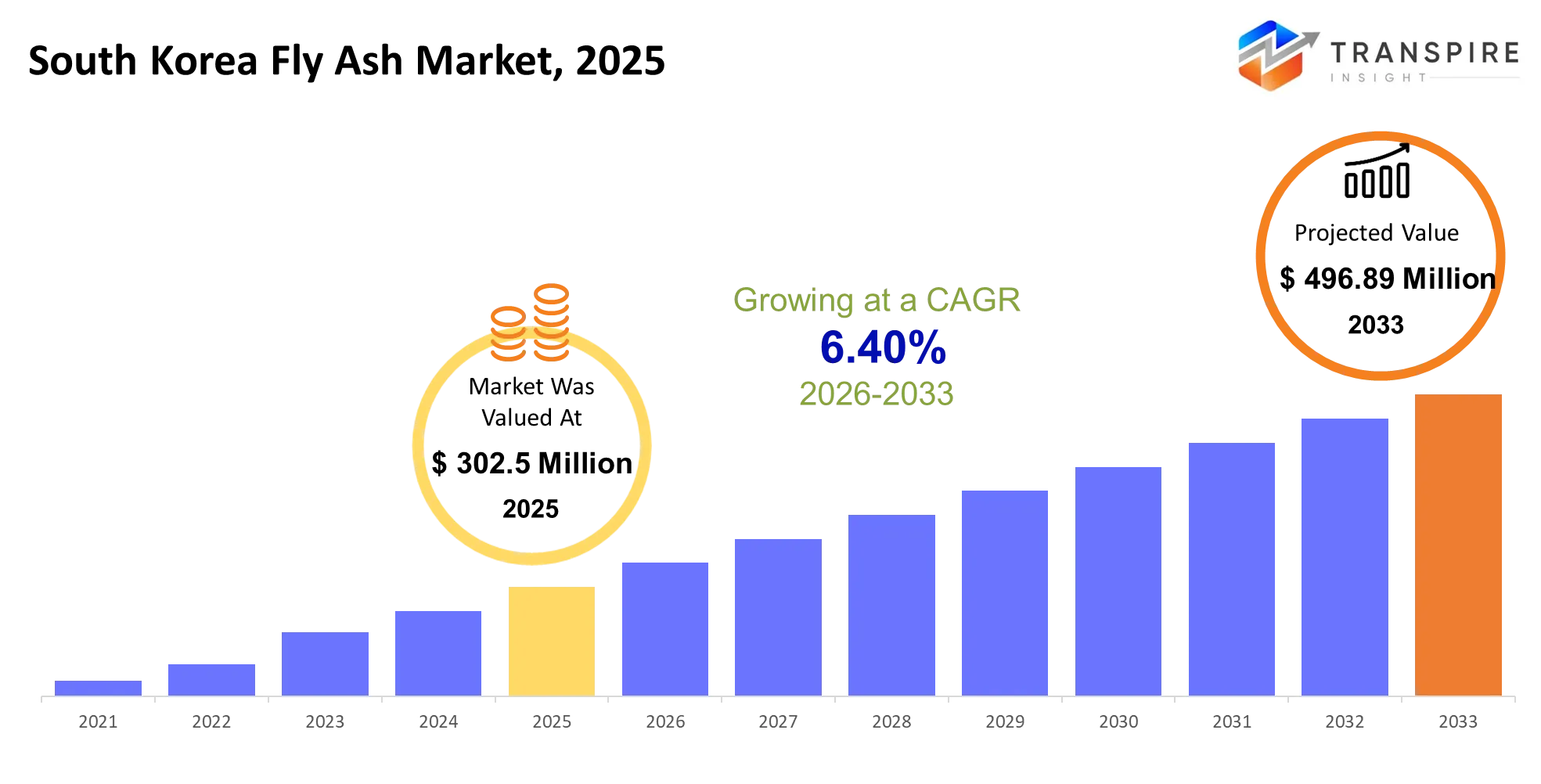
- Market Value (2025): USD 302.5 Million.
- Expected Market Value (2026): USD 321.86 Million.
- Estimated Market Value (2033): USD 496.89 Million.
- Forecast CAGR (2026–2033): 6.40%.
Introduction
South Korea Fly Ash Market refers to processes relating to the generation, management, marketing, and usage of fly ash produced mainly through coal-burning thermal power plants. The fly ash is finely divided particulate matter with silica, alumina, calcium, and iron oxide content and is extensively used as a Supplementary Cementitious Material (SCM) in concrete and cement manufacturing processes. The use of the material enhances workability, durability, and strength of concrete along with minimizing reliance on clinker-based cement. In South Korea, the need for fly ash can be attributed to infrastructure growth, sustainability in construction practices, efforts towards circular economy, and lowering of carbon in construction materials due to the growing significance of construction industry.
Key Market Highlights: -
- By Type, the Class F fly ash dominated the market and holds approximately 62% share in 2025 and is projected to grow at a substantial CAGR during the forecast period.
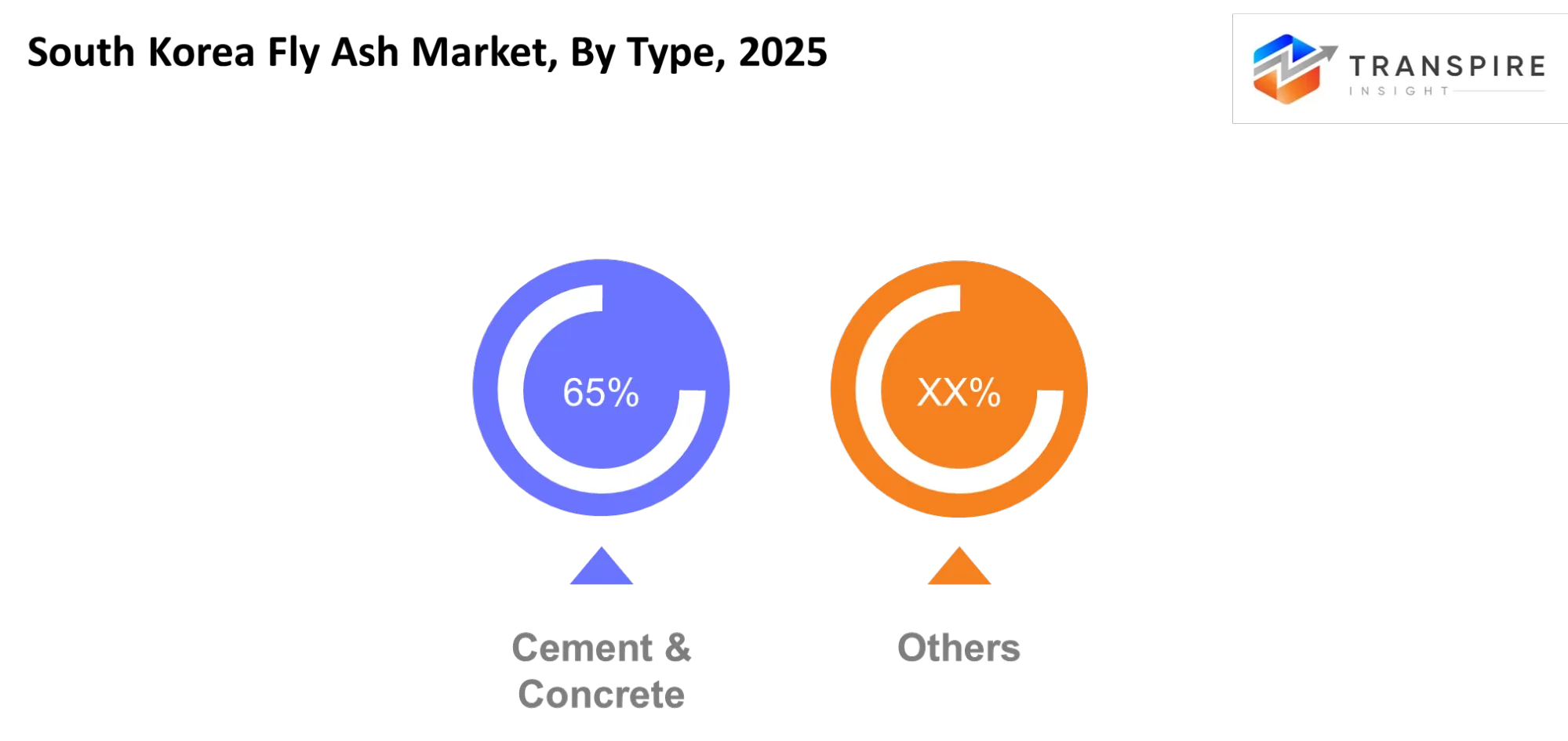
- By Application, the Cement & Concrete dominated the market and holds approximately 45% share in 2025 and is projected to grow at a substantial CAGR during the forecast period.
- By Source, the Coal-Fired Power Plants Manufacturers segment dominated the market and holds approximately 44% share in 2025 and is projected to grow at a substantial CAGR during the forecast period.
- The trends that characterize South Korea’s fly ash market include coal ash recycling, KS quality standards, use of low carbon cement, resource utilization, and processing technologies for sustainable construction.
How is Technology Driving Growth in the South Korea Fly Ash Market?
Technology is contributing to growth in the South Korea Fly Ash Market by means of advanced beneficiation, grinding, classification, quality control, and automation of material handling processes. Modern processing techniques result in improved fineness, uniformity, reactivity, and performance as supplementary cementing material in cement and concrete. Automated quality control systems ensure reliable chemical and physical properties, while the optimized blending technology will allow for higher content of fly ash in low carbon cements. Digital process monitoring also increases operational efficiency and resource management at recycling plants. This trend contributes to clinker savings, better material properties, and more efficient circular economy approach by cement producers.
Market Drivers
The factors that drive the South Korea Fly Ash Market include the increasing demand for sustainable construction materials, infrastructure development, economically viable cementitious materials, and stringent resource recycling regulations. The efforts taken to adopt low carbon construction practices help increase the use of fly ash as a supplementary cementitious material, decreasing the need for clinker while helping to achieve emissions reduction targets. Development activities in infrastructure and urban construction ensure that the demand for fly ash concrete remains high in transportation and commercial as well as industrial construction applications. Moreover, increasing environmental awareness and efforts toward the circular economy promote the recycling and beneficial use of coal combustion products.
Restrain
Market Growth Restraints of South Korea Fly Ash Market
A reduction in the production of electricity by coal-fired power plants can decrease the amount of fly ash available and lead to uncertainty in supply. The quality of the ash can vary. Processing needs heavy investments in the form of beneficiation, grinding, and classification. Moreover, strict compliance with environmental regulations and competition from other supplementary cementitious materials like slag will restrict market growth. The adoption of geopolymer technology and high-volume fly ash is limited in South Korea.
|
Driver |
Relative Impact on Growth (%) |
Geographic Relevance |
Impact Timeline |
Demand Strength |
Growth Mechanism |
Key Beneficiaries |
Major Constraint |
|
Driver 1: Cement Decarbonization and Higher SCM Utilization |
30% |
Nationwide; Seoul Capital Area, Gyeonggi, Chungcheong, and major cement-producing regions |
Short-term |
High |
Higher fly ash substitution reduces clinker consumption and cement emissions |
Cement producers, fly ash processors, ready-mix concrete suppliers |
SCM quality consistency and strength-performance requirements constrain adoption |
|
Driver 2: Circular-Economy Policies and Industrial By-product Recycling |
24% |
Nationwide; industrial and power-generation clusters |
Short-term |
High |
Regulatory recycling priorities increase demand for qualified industrial by-products |
Ash recyclers, waste processors, construction-material manufacturers, utilities |
Strict recognition and permitted-use requirements limit applications |
|
Driver 3: Low-Carbon Concrete and Cementless Binder Technology |
20% |
Nationwide; technology-intensive construction and infrastructure projects |
Medium-term |
High |
Advanced activation and processing expand fly ash into higher-value binders |
Technology vendors, binder manufacturers, concrete producers, infrastructure contractors |
Scale-up costs and long-term durability validation remain barriers |
|
Driver 4: Sustainable Infrastructure and Green Construction Demand |
15% |
Seoul metropolitan region, Busan, Incheon, Gyeonggi, major infrastructure corridors |
Medium-term |
Medium |
Green construction specifications encourage low-carbon cementitious materials |
Construction firms, ready-mix producers, infrastructure developers, fly ash suppliers |
Project specifications and procurement standards may favor established materials |
|
Driver 5: Advanced Fly Ash Processing and Quality Optimization |
11% |
Chungcheong, Gyeongbuk, Gyeongnam, and major industrial clusters |
Long-term |
Medium |
Grinding, classification, beneficiation improve reactivity and application suitability |
Processing-equipment vendors, ash processors, cement manufacturers, material innovators |
Processing investment can raise costs versus conventional cement materials |
Analysis of Prices and Consumer Behaviour
The South Korea Fly Ash Market is characterized by high-quality processed fly ash (constituting 68% of the entire market; mainly due to the consumption by the cement, ready-mixed concrete, infrastructure and sustainable construction industries). High-quality fly ash will have a price 35% higher compared to that of any other product in the market since the product is subjected to advanced beneficiation, grinding and classification processes. In addition, the product is guaranteed and it consists of the same chemical composition and pozzolanic properties. Powdered fly ash is estimated to account for 45% of the total unit sales of fly ash. Powdered fly ash can be used efficiently in different types of cement and concrete application and can be stored easily. The cement, concrete and infrastructure industries account for 70% of the consumption by these end-use industries. The customer's purchase behavior indicates that 55% of customers give the highest preference to fly ash quality, purity, consistent performance and standardized chemical properties. Another 33% of buyers prefer purchasing their products through bulk purchase agreements or long-term contract arrangements since they would like to reduce their procurement cost and have a consistent supply for their customers.
|
Company |
Est. Revenue Share Range |
Key Offerings |
Strategic Positioning |
Geographic Strength |
Technology Focus |
|
SAMPYO / SP S&A |
18–24% |
Processed fly ash; SCMs; low-CO₂ cementitious materials; industrial by-product recycling |
Scale leadership with integrated nationwide supply |
South Korea; particularly Chungcheong, Honam, Gangwon |
Fly-ash processing; low-heat binders; resource recycling |
|
SSANGYONG C&E |
11–16% |
Fly-ash-utilizing cement; blended cement; recycled-resource cement; low-heat cement |
Integrated cement and circular-resource leadership |
Gangwon; nationwide; export-linked coastal network |
Alternative raw materials; kiln recycling; low-carbon cement |
|
Hanil Cement |
9–13% |
Fly-ash blended cement; low-heat blended cement; cementitious materials; RMC |
Premium performance and diversified cement solutions |
Nationwide; Chungcheong, Gangwon, 수도권 |
Multi-component binders; low-heat cement; durability optimization |
|
Asia Cement |
7–11% |
Fly-ash-derived alternative raw materials; Portland cement; specialty cement; RMC |
Regional scale with sustainability-driven diversification |
Chungcheong; 수도권; nationwide through Halla network |
Alternative materials; kiln efficiency; specialty binders |
|
SUNGSHIN CEMENT |
6–9% |
Portland cement; blended cement; RMC; fly-ash-based cementitious systems |
Regional cement scale with application expertise |
Chungcheong; 수도권; central Korea |
SCM formulation; concrete performance; low-carbon materials |
|
Maxcon Materials |
5–8% |
Class-F fly ash; GGBFS; construction materials; binder materials |
Specialty SCM and materials technology positioning |
South Korea; Busan and central industrial markets |
SCM characterization; automated processing; alkali activation |
|
Korea Midland Power (KOMIPO) |
3–5% |
Fly ash; bottom ash; recycled coal-ash materials; cement raw materials |
Utility-linked feedstock and resource-recycling supplier |
Boryeong; Chungcheong; western Korea |
Coal-ash separation; recycling; resource utilization |
|
Korea Southern Power (KOSPO) |
3–5% |
Class-F fly ash; recycled coal ash; construction-material feedstock |
Power-generation-linked ash supply specialization |
Hadong; southeastern Korea |
Ash recovery; classification; construction-material recycling |
|
Korea Western Power (KOWEPO) |
2–4% |
Fly ash; coal-ash recycling; cement raw-material feedstock; construction applications |
Utility-backed regional recycling and supply |
Taean; Chungcheong; western coastal Korea |
Ash beneficiation; recycling; material utilization |
|
Hadong Mineral Fiber |
1–3% |
Recycled fly ash; mineral-based materials; ash-derived construction inputs |
Niche specialty recycling and material valorization |
Hadong; southeastern Korea |
Fly-ash recycling; mineral-material processing; value recovery |
Who are the Key Players in the South Korea Fly Ash Market and how do they compete?
The competitiveness of South Korea Fly Ash Market is associated with the involvement of organizations that provide expertise in the area of advanced fly ash processing technologies, specialized solutions in the cement and construction industries, as well as the development of distribution networks on the global level. Competing not only with prices, but with high-quality fly ash, advanced technology of fly ash processing, sustainable material solutions, and integration with the cement and concrete production systems, such a competition strategy results in the constant development of products, as well as helps organizations optimize their material use and become more efficient.
Thus, the company Korea South-East Power improves its position in the market by developing advanced fly ash processing technologies, sustainable recycling solutions, quality optimization, and sustainable cementitious materials. The company Korea Midland Power gains competitive advantage over its rivals by developing high-quality fly ash that can be used for the production of cement, concrete, and other construction materials. Korea Western Power improves its market position by providing integrated solutions in the field of fly ash recycling, resource use, material processing, and sustainable construction applications.
Top Companies in the South Korea Fly Ash Market
- Korea South-East Power
- Korea Midland Power
- Korea Western Power
- Korea Southern Power
- Korea East-West Power
- KEPCO
- POSCO
- Hyundai Cement
- Ssangyong C&E
- Hanil Cement
- Asia Cement
- Sampyo Cement
- Lotte Fine Chemical
- Heidelberg Materials
- CEMEX
South Korea Fly Ash Market Segmentation
The South Korea Fly Ash Market share is divided into five categories: By Type, By Application, By Source, By Form, By End User.
The Class F fly ash dominated the market, accounting for nearly 62% in 2025 and is expected to rise at a significant CAGR during the forecast period.
The South Korea Fly Ash Market is segmented by type into class f, class c, high-calcium fly ash, low-calcium fly ash, ultrafine fly ash, processed fly ash, unprocessed fly ash. Among these, the Class F fly ash segment dominated the market, accounting for nearly 62% in 2025 and expected to increase at a significant CAGR during the forecast period. Market share of Class F fly ash was significant, contributing to nearly 62% in 2025, owing to extensive applications in cement production, excellent pozzolanic properties, enhanced durability, and demand for low carbon constructions.
The Cement & Concrete dominated the market, accounting for nearly 45% in 2025, and is expected to rise at a significant CAGR during the forecast period.
The South Korea Fly Ash Market is segmented by application into cement & concrete, bricks & blocks, road construction, soil stabilization, mining, oil & gas, waste management. Among these, the Cement & Concrete dominated the market, accounting for nearly 45% in 2025 and expected to increase at a significant CAGR during the forecast period. Market share of Cement & Concrete applications was dominant, contributing to nearly 45% in 2025, owing to increasing infrastructural development, usage in place of clinker, improved durability, and low carbon construction demand.
The Coal-Fired Power Plants dominated the market, accounting for nearly 44% in 2025 and is expected to rise at a significant CAGR during the forecast period.
The South Korea Fly Ash Market is segmentedby source into coal-fired power plants, biomass power plants, co-firing plants, utility plants, industrial boilers, cogeneration plants, other combustion sources. Among these, the Coal-Fired Power Plants dominated the market, accounting for nearly 44% in 2025 and expected to increase at a significant CAGR during the forecast period. Market share of Coal-fired Power Plants applications was dominant, contributing to nearly 44% in 2025, owing to existing ash production infrastructure, continuous power generation, and demand for recycling.
Future Market Trends for the South Korea Fly Ash Market: -
Adoption of Low-Carbon Cement: Higher levels of decarbonization will promote the use of fly ash in blended cements and concretes, which will limit the use of clinker and aid sustainable construction practices.
Recovery of Stored Fly Ash: The shift to coal power by South Korea will lead to greater efforts toward recovery, beneficiation, and utilization of fly ash that is stored.
Processing of Fly Ash: Advanced technology in sorting, grinding, beneficiation, and quality control will improve the quality of fly ash and its performance in construction projects.
Recent Development
In March 2026 - Regulatory Enforcement Initiative: South Korea implemented stronger carbon-reduction regulations which encouraged investment in more advanced fly ash processing and low-carbon cement production processes.
In May 2026 - Sustainable Building Initiative: South Korea implemented an improved resource-efficient initiative which supported standardization of the quality of fly ash and its use in sustainable cement production.
In August 2026 - Feedstock Optimization Initiative: The cement industry began implementing a more efficient mixed cement process involving the use of fly ash and slag.
Market Segmentation
This study forecasts revenue at Japan, regional and country levels from 2020 to 2033. Transpire Insights has segmented the South Korea Fly Ash Market based on the below-mentioned segments:
South Korea Fly Ash Market, By Type:
- Class F
- Class C
- High-Calcium Fly Ash
- Low-Calcium Fly Ash
- Ultrafine Fly Ash
- Processed Fly Ash
- Unprocessed Fly Ash
South Korea Fly Ash Market, By Application
- Cement & Concrete
- Bricks & Blocks
- Road Construction
- Soil Stabilization
- Mining
- Oil & Gas
- Waste Management
South Korea Fly Ash Market, By Source
- Coal-Fired Power Plants
- Biomass Power Plants
- Co-Firing Plants
- Utility Plants
- Industrial Boilers
- Cogeneration Plants
- Other Combustion Sources
South Korea Fly Ash Market, By Form
- Dry Fly Ash
- Wet Fly Ash
- Ponded Fly Ash
- Bottom-Ash Blended
- Powder
- Granulated
- Processed
South Korea Fly Ash Market, By End User
- Construction
- Cement Manufacturers
- Ready-Mix Concrete
- Infrastructure
- Mining, Agriculture
- Oil & Gas
Frequently Asked Questions
Find quick answers to common questions.
Growing low-carbon construction, cement decarbonization, infrastructure development, circular-economy initiatives, and increasing demand for sustainable supplementary cementitious materials are driving growth.
Class F fly ash dominates with approximately 62% share in 2025, supported by strong pozzolanic performance and extensive cement applications.
Cement and concrete lead with approximately 45% share in 2025, driven by clinker substitution, durability requirements, infrastructure development, and sustainable construction.
Declining coal-fired power generation may reduce domestic fly ash availability, creating supply uncertainty and increasing dependence on processing and recovery.
Advanced grinding, classification, beneficiation, quality monitoring, and automated processing improve fly ash consistency, reactivity, performance, and suitability for low-carbon construction.
- Korea South-East Power
- Korea Midland Power
- Korea Western Power
- Korea Southern Power
- Korea East-West Power
- KEPCO
- POSCO
- Hyundai Cement
- Ssangyong C&E
- Hanil Cement
- Asia Cement
- Sampyo Cement
- Lotte Fine Chemical
- Heidelberg Materials
- CEMEX
About the Authors

Pankaj Ghogare Patil
I am Pankaj Ghogare Patil, a Senior Research Analyst at Transpire Insight, specializing in the Pharmaceutical, Chemicals & Materials, Healthcare IT, and Biotechnology industry. My expertise lies in conducting comprehensive market research, analyzing industry trends, evaluating competitive landscapes, and translating complex data into actionable insights. At Transpire Insight, I closely follow emerging technologies, regulatory developments, and market innovations to create accurate, well-researched, and informative content that helps businesses and professionals make informed decisions. I am committed to producing credible, evidence-based articles that reflect industry best practices while making technical topics accessible and valuable for a broad audience.

Chakradhar Khansole
Chakradhar serves as the Research Director at Transpire Insight, bringing over 8 years of experience in technology, innovation, and strategic market intelligence. He specializes in transforming complex market data into actionable business insights that enable organizations to make informed, growth-oriented decisions. Recognized for his strategic vision and analytical expertise, Chakradhar leads high-impact research initiatives, delivering comprehensive market assessments, competitive intelligence, and forward-looking industry analysis.
Recently Published Reports
-
May 2026
Healthcare Polymer Packaging Market
Healthcare Polymer Packaging Market Size, Share & Analysis Report By Packaging Type (Syringes, IV Bottles and Pouches, Clamshells, Blisters, Bottles & Jars, Containers, Tubes, IV Parental Packaging, Others), By Type (Regulated, Non-regulated), By Polymer Type (LDPE (Low-Density Polyethylene), HDPE (High-Density Polyethylene), Homo-polymer (Homo), Random Copolymer (Random), Block Copolymer (Block), PET, Polystyrene, Polyvinyl Chloride, Polyamide/EVOH, Others), and Geography (North America, Europe, Asia-Pacific, Middle East and Africa, South and Central America), 2021 - 2031
-
Apr 2026
Hydrophilic Tape (Waterstop) Market
Hydrophilic Tape (Waterstop) Market Size, Share & Analysis Report By Type (Bentonite-Based Hydrophilic Tape, Rubber-Based Hydrophilic Tape), By Application (Residential Buildings, Commercial Buildings, Infrastructure Projects), and Geography (North America, Europe, Asia-Pacific, Middle East and Africa, South and Central America), 2021 - 2031
-
Apr 2026
Metalens Market
Metalens Market Size, Share & Analysis Report By Type (Visible Light Metalens, and Infrared Metalens), By Application (Consumer Electronics, Automotive Electronics, Industrial, Medical, and Others), and Geography (North America, Europe, Asia-Pacific, Middle East and Africa, South and Central America), 2021 - 2031
-
Apr 2026
PBT Resin Market
PBT Resin Market Size, Share & Analysis Report By Type (Reinforced PBT Resin, Unreinforced PBT Resin), By Processing Method (Injection Molding, Extrusion, Blow Molding, Others), By End-User (Automotive, Electrical & Electronics, Consumer Appliances, Industrial Machinery, Medical Devices, Packaging, Others), and Geography (North America, Europe, Asia-Pacific, Middle East and Africa, South and Central America), 2021 - 2031