

South Korea Cement Fly Ash Market Size & Forecast:
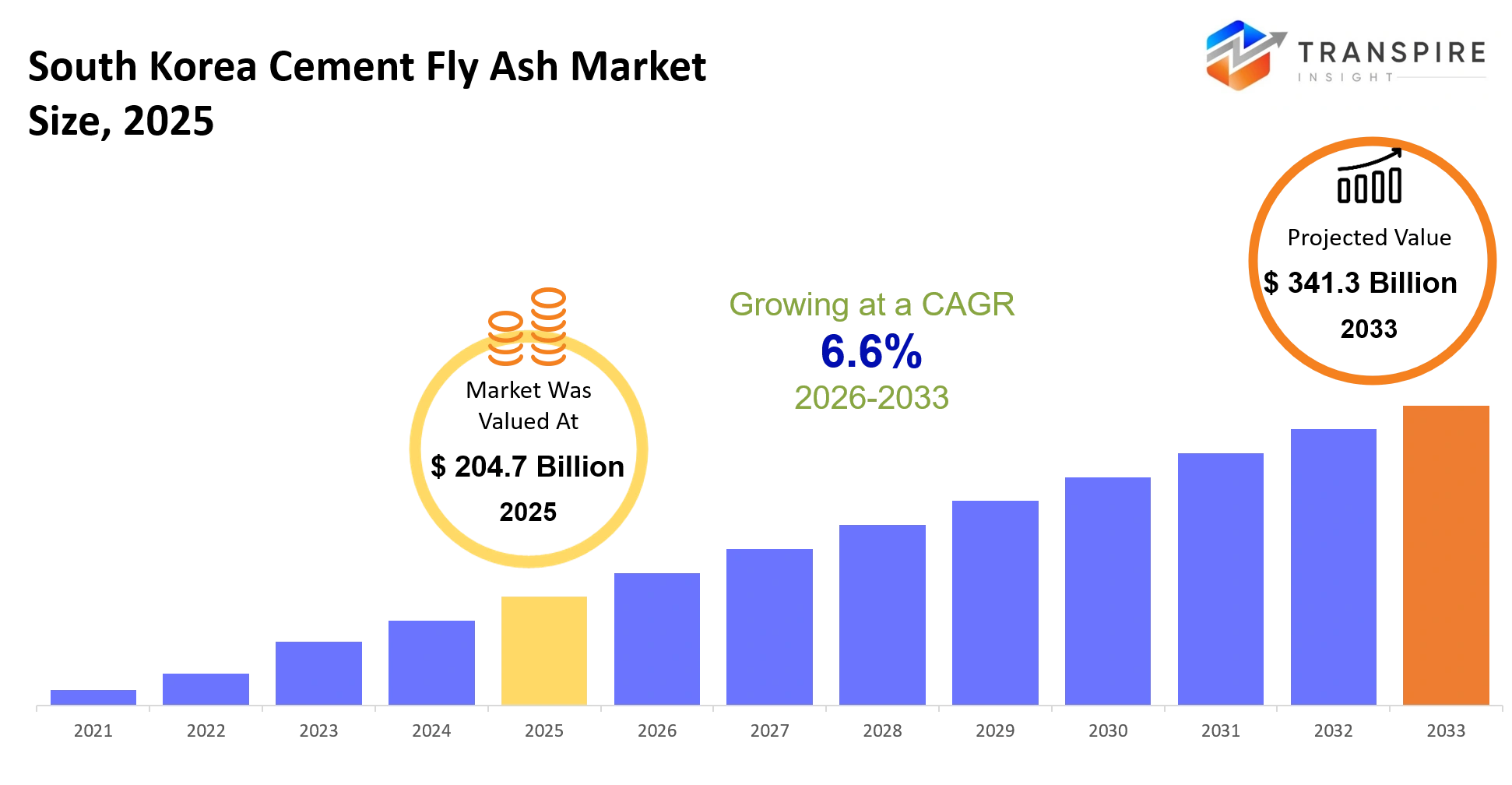
- South Korea Cement Fly Ash Market Size 2025: USD 204.7 billlion
- South Korea Cement Fly Ash Market Size 2033: USD 341.3 billlion
- South Korea Cement Fly Ash Market CAGR: 6.6%
- South Korea Cement Fly Ash Market Segments: By Type (Class F Fly Ash, Class C Fly Ash, Others); By Application (Concrete Production, Road Construction, Bricks & Blocks, Mining, Others)
To learn more about this report,  Download Free Sample Report
South Korea Cement Fly Ash Market Summary
The South Korea Cement Fly Ash Market was valued at USD 204.7 billion in 2025. It is forecast to reach USD 341.3 billion by 2033. That is a 6.6% CAGR over the period.
The South Korea Cement Fly Ash Market actually plays this kind of practical role in helping cement and concrete producers cut down clinker use, while also making the product more durable, stronger, and generally better over the long run for construction work. It lets builders reduce material costs and meet tighter environmental targets without significantly compromising structural quality. In the end it becomes an important input across infrastructure projects, commercial builds, and a lot of industrial developments too.
Over the last 3–5 years, you can see the market kind of shifting its structure toward low carbon construction materials, mostly because decarbonization policies from the government and green building standards have reshaped who buys what, and why. One big reason, or trigger, was the tightening of carbon-reduction commitments across construction and manufacturing, which pushed cement producers to incorporate supplementary cementitious materials, including fly ash, directly into their production processes. So now there is this clearer connection between sustainability goals and the way materials get selected. And since infrastructure modernization keeps moving forward, contractors are looking for reduced emission concrete options—fly ash adoption is growing not just for cost advantages. It is turning into more of a strategic requirement, and that supports stronger market revenues, plus wider commercial use overall.
Key Market Insights
- The Seoul Capital Area is really big in the market it has around 35 to 40 percent of the market in 2025. This is because there is a lot of construction and redevelopment going on in this area.
- The southeastern part of the country, which includes Busan and Ulsan is growing fast. This area will keep growing until 2030 because of infrastructure and industrial investments.
- There are big urban renewal projects that help increase the demand for fly ash-based concrete and cement products in different regions.
- Class F Fly Ash is the popular it has more than 60 percent of the market in 2025. This is because it is very durable and resistant to sulfate and it helps concrete longer.
- Class C Fly Ash is the most popular it is used in applications where self-cementing properties and faster strength development are needed.
- The Others segment is growing rapidly and will continue to expand through 2030. This is because it is used in construction and blended material applications.
- Making concrete is the use of fly ash, which accounts for around 50 percent of total demand in 2025. This is because of all the infrastructure and commercial construction projects going on.
- Building roads is the biggest use of fly ash. This is because there are always roads being built and old ones being upgraded.
- Bricks and blocks are becoming really popular they are the growing application. This is because people want to use building materials more efficiently and reduce resource use.
- The Construction and Infrastructure sector is the biggest it has, than 65 percent of the market in 2025. This is because fly ash is widely used in concrete and in projects in the Construction and infrastructure sectors.
What are the Key Drivers, Restraints, and Opportunities in the South Korea Cement Fly Ash Market?
The main driver of the South Korea Cement Fly Ash Market is the construction sector's shift toward low-clinker cement and concrete mix designs to meet national carbon reduction targets. In South Korea, decarbonization rules plus an emissions oversight structure, have put more weight on cement makers to lower the carbon intensity during production. Fly ash works well as a practical solution because it can partially replace clinker, the most carbon-intensive component in cement. Because of this, cement producers, ready-mix concrete suppliers, and infrastructure contractors seem more willing to incorporate higher percentages of fly ash into construction materials. As use continues to grow across public works and commercial builds, suppliers often see higher sales and more dependable long-term purchasing agreements.
On the other hand, the biggest obstacle is the way the system still leans on coal-fired power generation, as the primary origin for fly ash. South Korea is slowly swapping to cleaner energy sources, and that gradually reduces the amount of fly ash that will be accessible later, so long-term supply starts to feel uncertain. Also, this difficulty isn’t something you can fix right away, since other supplementary cementitious materials require additional processing capacity, new certification steps, and additional investments across the supply chain. When feedstock availability stays tight, procurement can get pricier and that can limit broader market growth, so the adoption rate slows down on major scale construction projects.
There is a major opportunity in working on more advanced processed fly ash, and also in blended supplementary cementitious materials. If investments go into beneficiation technologies, those that can improve ash quality and overall consistency, then its use can be expanded into higher-performance concrete. Meanwhile, infrastructure modernization projects are keep growing, especially across metropolitan and industrial regions, which sets up a rather favorable environment for these higher value products. In this way suppliers can move past pure volume driven growth and, kinda at the same time, capture better margins via specialized construction solutions, not just the usual stuff.
What Has the Impact of Artificial Intelligence Been on the South Korea Cement Fly Ash Market?
Artificial intelligence and advanced digital technologies are getting better and better at improving efficiency across South Korea’s cement fly ash value chain, specially when it comes to material processing, quality control, and day to day plant operations. Cement manufacturers and fly ash processors are increasingly rolling out AI enabled control setups that help automate ash classification, keep an eye on particle fineness, and fine tune blending ratios in real time. This sort of approach helps operators maintain steadier product quality while also reducing manual effort and production variability.
Also, machine learning models are being applied to predictive maintenance for grinding equipment, pneumatic conveying systems, and storage infrastructure. They look at vibration, temperature, and other operating data, and can flag likely equipment failures before anything actually breaks. As a result, there’s less unplanned downtime, and overall asset utilization tends to improve. In several industrial sites, these predictive maintenance efforts have helped lift equipment availability and reduce maintenance costs compared with more traditional scheduled servicing routines.
Advanced analytics platforms can help with all kinds of performance stuff, like predicting fly ash availability, keeping an eye on inventory positions, and also sharpening logistics plans between power sites and cement plants. In practice, this tends to cut down on transport hitches, and it can make the whole supply chain more dependable too.
Still, AI adoption has a big snag that is kinda hard to dodge. Bringing AI platforms together with older industrial systems needs major capital outlay, plus real access to lots of high quality operational data. A lot of facilities still run on fragmented information setups, so the model doesn’t always behave as well, and the full operational gains come in slower than expected.
Key Market Trends
- Since 2021 the people who make cement have been trying to replace some of the clinker with things to make the cement better for the environment and to meet the goals for reducing emissions that the country has set.
- The way that companies buy things changed after 2022 because the people who make cement wanted to make sure they had a supply of fly ash, which is a type of ash that comes from coal plants and they were worried that these plants might close down soon.
- Between 2023 and 2025 companies invested money in making the ash better and in processing it which made the material more consistent and better for making high-performance concrete.
- The people who build things started to ask for cement that was mixed with things in their construction projects and this became a requirement for getting the job not just something that was nice to have.
- The companies that make ready-mix concrete started to use computer systems to check the quality of the concrete and make sure it was consistent.
- Now companies are competing with each other to sell the cement, not just the most cement and they are emphasizing how good their cement is and the services they offer to help customers use it.
- Since 2022 big cement companies like Holcim and Heidelberg Materials have been working hard to develop products that are better for the environment and this has changed the way that cement is made and sold in different parts of the world.
- The people who buy cement for projects are now looking at how much carbon is used to make the cement, not just how much it costs and this has changed the way that they buy cement compared to how they used to buy it before 2020.
- After 2023 companies started to use data and computers to plan how they would make and transport the cement, which has helped them to be more efficient.
- Over the five years the government has been paying closer attention to the emissions that come from construction projects, which has encouraged more companies to use materials that are better for the environment, in their buildings.
South Korea Cement Fly Ash Market Segmentation
By Type:
So yeah, the market kind of gets shaped by the presence of Class F Fly Ash, Class C Fly Ash, and Others, with each group doing its own thing for different construction and industrial needs, even if it feels kinda overlapping at first. Over the last few years, demand patterns have shifted, mainly because cement manufacturers are trying to cut clinker consumption and, at the same time, boost the environmental performance of construction materials. Also processing technologies have advanced, which has helped a lot with product consistency, so it’s easier to use fly ash across infrastructure, commercial, and industrial projects. And because people are still investing in low-carbon construction practices, adoption is expected to keep expanding across the whole set of product categories.
On top of that, the growing focus on sustainable building materials has nudged companies toward more fly ash integration in cement and concrete production. Manufacturers are getting better at tuning material blends to satisfy performance specs, while also matching regulatory expectations. The competitive approach now leans more toward quality improvement, dependable supply, and value-added offerings, not just basic availability. In the end, these changes keep reinforcing the role of fly ash within South Korea’s construction materials industry, pretty steadily.
By Application:
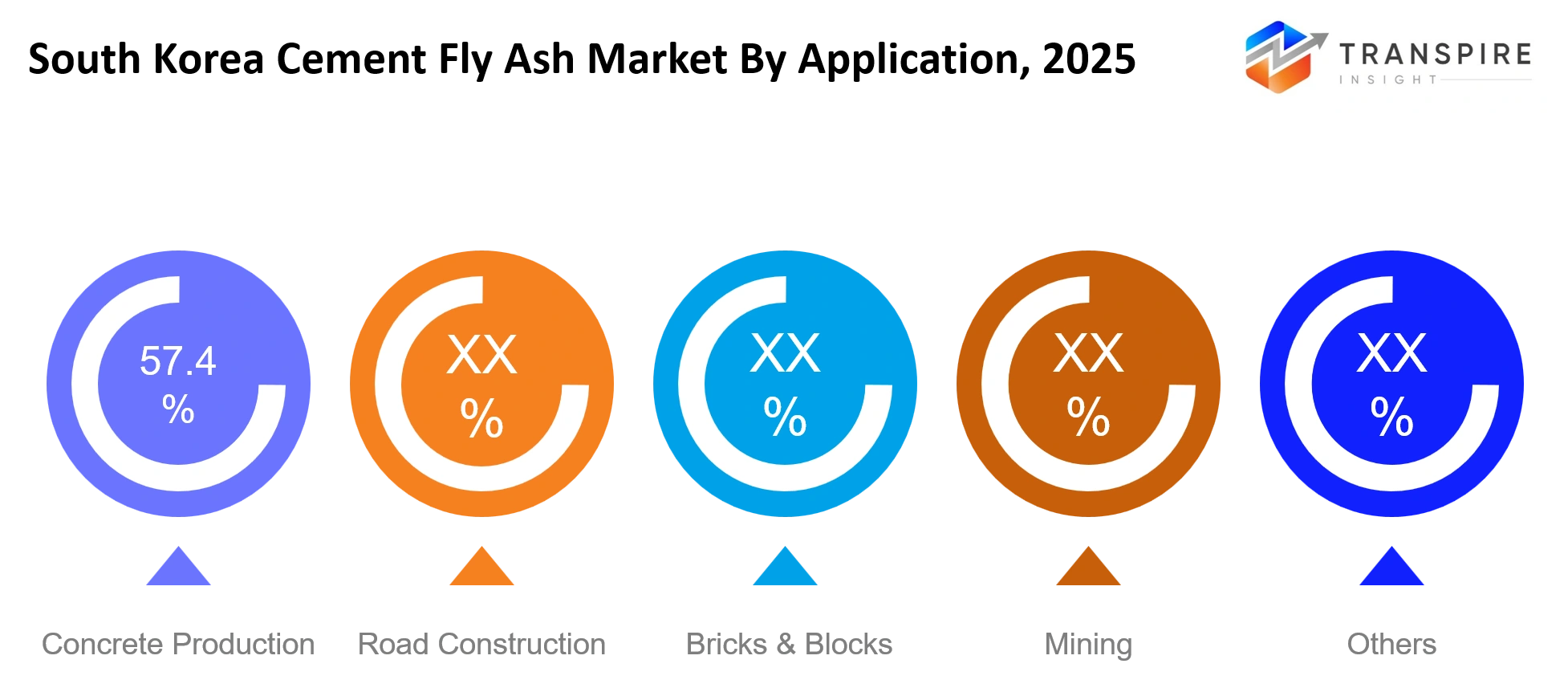
Applications across Concrete Production, Road Construction, Bricks & Blocks, Mining, and Other segments kinda all move together and keep the market flowing, and yes they also shape purchasing choices all the way through the value chain. Concrete Production still shows up as a big utilization zone, mostly because there are ongoing infrastructure and urban development projects. At the same time Road Construction feels the boost from transportation modernization programs. For Bricks & Blocks, things have grown a bit, since producers look for more efficient substitutes, using advanced methods instead of the older conventional raw materials. Mining, plus other specialized use cases, keeps opening further commercial pathways for utilization, even when demand shifts.
Meanwhile, construction sector decarbonization pushes broader adoption across a lot of these application areas. Material performance, lifecycle cost advantages, and environmental concerns are starting to matter more in procurement, not just in theory but in real buying decisions too. Technological improvements in processing, and logistics too, have helped products stay available, and the quality consistency has improved. And as infrastructure spending keeps rising, along with sustainable construction practices becoming more common, this mix of applications is expected to stay an important driver for long-term market development.
To learn more about this report, Download Free Sample Report
What are the Key Use Cases Driving the South Korea Cement Fly Ash Market?
Concrete manufacturing is still kind of the main reason people are adopting this across South Korea construction sector, you know, it keeps coming up again and again. Big infrastructure projects, commercial developments, bridges tunnels, and public facilities are all leaning on fly ash-enhanced concrete, mostly to boost durability, lower clinker use, and also to satisfy those tighter carbon reduction rules. In practice this one tends to create the highest demand, because it matches both the performance side and the environmental side, at the same time. Road infrastructure is showing up as a notable secondary use case too. Transportation authorities and civil engineering contractors are now more often adding fly ash into road bases, embankments, and pavement materials, aiming for better stability and long-term behavior. At the same time, demand keeps growing inside the building materials industry, where producers drop fly ash into bricks and blocks, so they can improve production efficiency and also reduce how much they depend on raw materials.
Sever al emerging applications show pretty strong long-term potential, in a way that’s hard to ignore. For instance, Mine reclamation and backfilling projects are looking at fly ash, as a more cost-effective material for site rehabilitation and land management, kind of like a practical choice that sticks. At the same time, Advanced low-carbon construction solutions— especially high-performance blended cement systems meant for major urban redevelopment projects— are opening new avenues. These might, over the forecast period help enable broader commercial adoption, even if the path is a bit nuanced.
|
Report Metrics |
Details |
|
Market size value in 2025 |
USD 204.7 Billion |
|
Market size value in 2026 |
USD 82.1 Billion |
|
Revenue forecast in 2033 |
USD 341.3 Billion |
|
Growth rate |
CAGR of 6.6% from 2026 to 2033 |
|
Base year |
2025 |
|
Historical data |
2021 - 2024 |
|
Forecast period |
2026 - 2033 |
|
Report coverage |
Revenue forecast, competitive landscape, growth factors, and trends |
|
Regional scope |
United States; Canada; Mexico; United Kingdom; Germany; France; Italy; Spain; Denmark; Sweden; Norway; China; Japan; India; Australia; South Korea; Thailand; Brazil; Argentina; South Africa; Saudi Arabia; United Arab Emirates |
|
Key company profiled |
Boral, Charah Solutions, Ashtech, SEFA Group, Titan America, Holcim, Heidelberg Materials, CEMEX, Lafarge, Salt River Materials, Eco Material, Ash Grove, CRH, UltraTech Cement, Adani Cement |
|
Customization scope |
Free report customization (country, regional & segment scope). Avail customized purchase options to meet your exact research needs. |
|
Report Segmentation |
By Type (Class F Fly Ash, Class C Fly Ash, Others); By Application (Concrete Production, Road Construction, Bricks & Blocks, Mining, Others) |
Which Regions are Driving the South Korea Cement Fly Ash Market Growth?
Seoul Capital Area basically leads the South Korea Cement Fly Ash Market because a lot of big scale construction keeps piling up there, plus commercial developments, and also public infrastructure stuff. In and around Seoul, Incheon, and nearby cities there are major redevelopment plans running, so the need for blended cement, and concrete materials stays pretty steady. With strong transportation routes, and distribution channels that are already in place, it becomes easier to move fly ash and cement products across the whole region. There’s also this well-built network of cement producers, ready-mix suppliers, contractors, and engineering firms that keeps the regional position strong and not just temporary.
Then the southeastern region, Busan, Ulsan, and the Gyeongsang provinces, sits as the second largest market. It’s a bit different from the capital area because its base is more industrial. Here demand is driven by manufacturing facilities, logistics hubs, industrial complexes, and port-related construction, rather than only the urban redevelopment cycle. Ongoing industrial investment acts like a cushion, so even when residential construction slows down, consumption doesn’t drop too hard. That blend of industrial demand and infrastructure work makes it a dependable part of market revenue.
Meanwhile the central region, especially Chungcheong Province, looks like the fastest growing spot. There’s been recent growth in industrial parks, logistics sites, and transportation infrastructure, and that has pushed the need for cement and concrete mixes that include fly ash. Regional development programs backed by government, have kind of sped up construction activities, and more private investment has followed along. If that keeps continuing, the 2026–2033 period should bring solid openings for suppliers, processors, and investors, across the board.
Who are the Key Players in the South Korea Cement Fly Ash Market and How Do They Compete?
In the South Korea Cement Fly Ash Market, competition is kind of moderately consolidated, like not totally fragmented, but also not only a few players. Bigger cement producers, fly ash processors, and suppliers of construction materials are competing on supply reliability, consistent product quality, and low-carbon material know-how. They are not just chasing the lowest cost because contractors and infrastructure developers are asking for consistent output and want compliance with environmental requirements all the time. So, in practice, processing methods, quality checks, and longer-term supply arrangements start to matter more than you might expect. Newcomers can struggle with getting stable feedstock and meeting certification conditions too, so the more established names can keep a stronger grip.
Holcim is placing weight on low carbon cement pathways, plus blended material approaches that let construction customers cut down project emissions. Heidelberg Materials, meanwhile, stands out with more sophisticated cement mixes and technical knowhow in supplementary cementitious materials, which makes it easier to use fly ash in applications that care a lot about performance. Both firms keep pushing forward with investments in sustainable building solutions, and with partnerships that back decarbonization targets across the wider building sector, even when regulations change.
CEMEX really leans into digital construction services, and it uses material optimization tools so that customers see better operational efficiency in practice. CRH on the other side, leans on a diversified portfolio of construction materials plus solid supply chain management capabilities to help reinforce market access and keep service reliability steady. UltraTech Cement keeps putting money into lower-carbon cement products and improvements in production efficiency, so it can catch more opportunities as environmental requirements get stricter, and as construction standards keep evolving . What this all comes down to is that these firms compete by focusing on value creation, not just chasing volume, like it is some kind of only goal.
Company List
- Boral
- Charah Solutions
- Ashtech
- SEFA Group
- Titan America
- Holcim
- Heidelberg Materials
- CEMEX
- Lafarge
- Salt River Materials
- Eco Material
- Ash Grove
- CRH
- UltraTech Cement
- Adani Cement
Recent Development News
In July 2025, CRH announced acquisition of Eco Material Technologies for approximately USD 2.1 billion. The acquisition expanded CRH’s access to supplementary cementitious materials, including fly ash, and strengthened long-term supply capabilities for low-carbon cement and concrete production. [https://www.reuters.com
In January 2026, Holcim highlighted the advancement of multiple sustainable construction technologies and low-carbon building solutions as part of its 2026 innovation strategy. The initiative reinforced Holcim’s focus on expanding supplementary cementitious material usage and accelerating adoption of lower-carbon construction products across global markets. [https://www.holcim.com
In October 2025, Cemex Ventures expanded investment activity aligned with Cemex’s “Future in Action” decarbonization strategy. The initiative supported technologies aimed at reducing cement-related emissions and increasing the use of alternative supplementary cementitious materials, creating long-term opportunities for fly ash and related low-carbon construction solutions. [https://www.cemexventures.com
What Strategic Insights Define the Future of the South Korea Cement Fly Ash Market?
Over the next five to seven years, the South Korea Cement Fly Ash Market is likely to drift away from a volume driven setup toward something more like resource efficiency and material security, sort of. The core reason behind that shift, is the increasing need to lower construction-sector emissions, while still keeping dependable access to supplementary cementitious materials . So as decarbonization efforts keep moving, factors like material quality, processing know-how, and supply assurance will start mattering more than raw production capacity alone.
There’s also a risk that’s not as obvious, the slow decline of fly ash availability as coal fired power generation drops off. Even though sustainability policies support fly ash use right now, the longer-term reduction of primary feedstock sources might end up squeezing supply, and that can push procurement costs upward. Honestly, this kind of constraint could show up sooner than most market participants are expecting.
On the flip side, there’s a real opportunity in building advanced beneficiation technologies, that upgrade lower quality ash into high performance construction materials. This space is still, relatively underpenetrated, but it could become more meaningful as conditions tighten. Market players should think about investing early in processing infrastructure, plus strengthening alternative supplementary cementitious material capabilities. That way they can lock in future supply flexibility, and stay more resilient against changing regulatory rules and the energy-sector shifts.
South Korea Cement Fly Ash Market Report Segmentation
By Type
- Class F Fly Ash
- Class C Fly Ash
- Others
By Application
- Concrete Production
- Road Construction
- Bricks & Blocks
- Mining
- Others
Frequently Asked Questions
Find quick answers to common questions.
The expected South Korea Cement Fly Ash Market size for the market will be USD 341.3 Billion in 2033.
Key segments for the South Korea Cement Fly Ash Market are By Type (Class F Fly Ash, Class C Fly Ash, Others); By Application (Concrete Production, Road Construction, Bricks & Blocks, Mining, Others)
Major South Korea Cement Fly Ash Market players are Boral, Charah Solutions, Ashtech, SEFA Group, Titan America, Holcim, Heidelberg Materials, CEMEX, Lafarge, Salt River Materials, Eco Material, Ash Grove, CRH, UltraTech Cement, Adani Cement
The South Korea Cement Fly Ash Market size is USD 204.7 billlion in 2025.
The South Korea Cement Fly Ash Market CAGR is 6.6% from 2026 to 2033.
- Boral
- Charah Solutions
- Ashtech
- SEFA Group
- Titan America
- Holcim
- Heidelberg Materials
- CEMEX
- Lafarge
- Salt River Materials
- Eco Material
- Ash Grove
- CRH
- UltraTech Cement
- Adani Cement
About the Authors

Pankaj Ghogare Patil
I am Pankaj Ghogare Patil, a Senior Research Analyst at Transpire Insight, specializing in the Pharmaceutical, Chemicals & Materials, Healthcare IT, and Biotechnology industry. My expertise lies in conducting comprehensive market research, analyzing industry trends, evaluating competitive landscapes, and translating complex data into actionable insights. At Transpire Insight, I closely follow emerging technologies, regulatory developments, and market innovations to create accurate, well-researched, and informative content that helps businesses and professionals make informed decisions. I am committed to producing credible, evidence-based articles that reflect industry best practices while making technical topics accessible and valuable for a broad audience.

Chakradhar Khansole
Chakradhar serves as the Research Director at Transpire Insight, bringing over 8 years of experience in technology, innovation, and strategic market intelligence. He specializes in transforming complex market data into actionable business insights that enable organizations to make informed, growth-oriented decisions. Recognized for his strategic vision and analytical expertise, Chakradhar leads high-impact research initiatives, delivering comprehensive market assessments, competitive intelligence, and forward-looking industry analysis.
Recently Published Reports
-
May 2026
Healthcare Polymer Packaging Market
Healthcare Polymer Packaging Market Size, Share & Analysis Report By Packaging Type (Syringes, IV Bottles and Pouches, Clamshells, Blisters, Bottles & Jars, Containers, Tubes, IV Parental Packaging, Others), By Type (Regulated, Non-regulated), By Polymer Type (LDPE (Low-Density Polyethylene), HDPE (High-Density Polyethylene), Homo-polymer (Homo), Random Copolymer (Random), Block Copolymer (Block), PET, Polystyrene, Polyvinyl Chloride, Polyamide/EVOH, Others), and Geography (North America, Europe, Asia-Pacific, Middle East and Africa, South and Central America), 2021 - 2031
-
Apr 2026
Hydrophilic Tape (Waterstop) Market
Hydrophilic Tape (Waterstop) Market Size, Share & Analysis Report By Type (Bentonite-Based Hydrophilic Tape, Rubber-Based Hydrophilic Tape), By Application (Residential Buildings, Commercial Buildings, Infrastructure Projects), and Geography (North America, Europe, Asia-Pacific, Middle East and Africa, South and Central America), 2021 - 2031
-
Apr 2026
Metalens Market
Metalens Market Size, Share & Analysis Report By Type (Visible Light Metalens, and Infrared Metalens), By Application (Consumer Electronics, Automotive Electronics, Industrial, Medical, and Others), and Geography (North America, Europe, Asia-Pacific, Middle East and Africa, South and Central America), 2021 - 2031
-
Apr 2026
PBT Resin Market
PBT Resin Market Size, Share & Analysis Report By Type (Reinforced PBT Resin, Unreinforced PBT Resin), By Processing Method (Injection Molding, Extrusion, Blow Molding, Others), By End-User (Automotive, Electrical & Electronics, Consumer Appliances, Industrial Machinery, Medical Devices, Packaging, Others), and Geography (North America, Europe, Asia-Pacific, Middle East and Africa, South and Central America), 2021 - 2031