

Europe Bricks Market Size & Forecast:
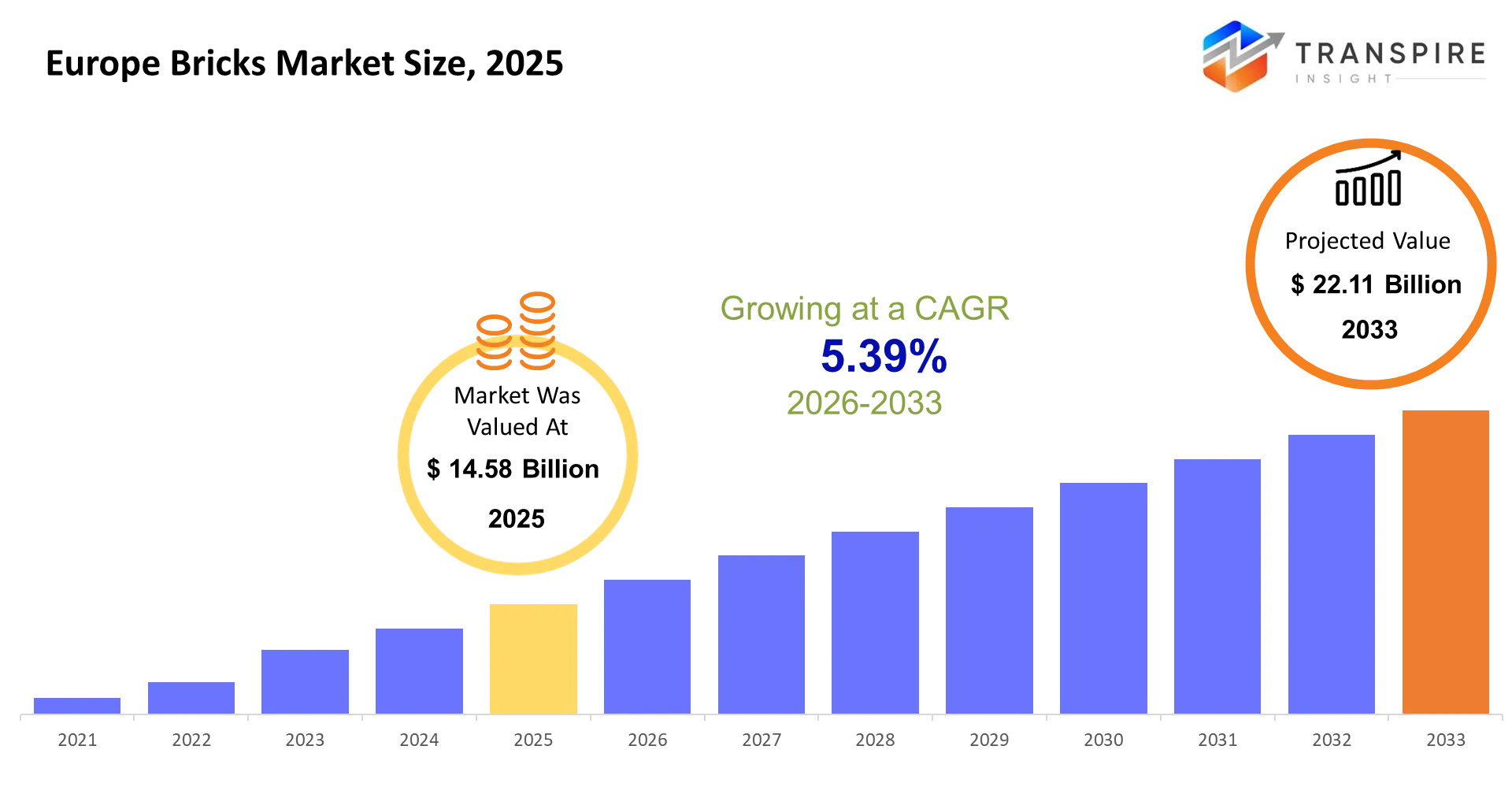
- Europe Bricks Market Size 2025: USD 14.58 Billion
- Europe Bricks Market Size 2033: USD 22.11 Billion
- Europe Bricks Market CAGR: 5.39%
- Europe Bricks Market Segments: By Type (Clay Bricks, Concrete Bricks, Fly Ash Bricks, Engineering Bricks, Refractory Bricks, Others); By Application (Residential Construction, Commercial Construction, Infrastructure, Renovation, Industrial Construction, Others); By End-User (Builders, Contractors, Government, Real Estate Developers, Others); By Distribution (Direct Sales, Distributors, Retail, Online, Others)
To learn more about this report,  Download Free Sample Report
Europe Bricks Market Summary
The Europe Bricks Market was valued at USD 14.58 Billion in 2025. It is forecast to reach USD 22.11 Billion by 2033. That is a CAGR of 5.39% over the period.
The Europe Bricks Market supplies essential structural and facing materials which support construction activities in housing and commercial buildings and infrastructure corridors and renovation work throughout European cities. Engineers must select building materials because brick systems determine a structure's durability and thermal performance and its ability to meet emerging energy standards.
The market has transitioned during the last three to five years from using energy-intensive clay production methods to adopting low-emission production systems that include fly ash and recycled-content bricks. The European Union carbon reduction requirements together with rising energy costs after the 2021-2022 supply disruption which resulted from the Russia-Ukraine conflict created a structural change in the market. The kiln disruption raised fuel expenses for manufacturing operations, which compelled manufacturers to expedite their adoption of automated systems and energy-saving combustion methods. The current production methods focus on three main areas which include managing emissions and optimizing digital kiln operations and achieving material recycling.
Manufacturers who operate compliant energy-efficient production systems receive direct financial benefits which create revenue shifts, while aging plants face increased operational challenges. Sustainable brick solutions have become essential for Europe Bricks Market demand because renovation-driven markets implement strict regulatory control measures.
Key Market Insights
- Western Europe holds nearly 38% share of the Europe Bricks Market in 2025 because of its strict carbon regulations and its implementation of advanced manufacturing systems.
- The fastest growing area in Eastern Europe will experience growth between 2024 and 2032 because of kiln updates and infrastructure improvements which will occur throughout Poland and Romania.
- The Europe Bricks Market experiences its main growth through fly ash bricks which increase their market share because they help businesses meet emission standards and their production costs stay low.
- The second largest market segment remains clay bricks which will lose market share because of regulations against energy demanding firing methods and increasing fuel expenses.
- The residential construction sector creates about 45% of total demand because urban European cities continue their housing renovation projects.
- The infrastructure sector develops as the fastest expanding market segment because EU-funding supports transportation improvements and public construction projects which will continue until 2030.
- Builders and contractors represent the leading end-user group, holding the largest procurement share due to centralized bulk purchasing contracts.
- Real estate developers show rising influence, especially in mixed-use urban redevelopment projects across Germany, France, and the Netherlands.
- The Europe Bricks Market remains under the control of Wienerberger, CRH plc, Xella Group, Forterra plc, and La Paloma Cerámicas because these companies expand their production capacity while developing new products.
- Companies enhance their competitive position through AI-based kiln control systems and recycled material recycling systems and regional business acquisitions that help them achieve cost savings and regulatory compliance.
What are the Key Drivers, Restraints, and Opportunities in the Europe Bricks Market?
The European Union's enhanced carbon and energy efficiency standards create permanent changes in European brick production operations. The EU Green Deal industrial decarbonization requirements together with increasing carbon pricing create higher production costs for high-temperature firing operations which compel manufacturers to update their kilns and use environmentally friendly materials like fly ash and recycled aggregates. The need for compliance drives businesses to invest in automated firing systems and advanced combustion technologies which results in better operational performance and consistent revenue growth for certified manufacturers while non-compliant smaller facilities shut down.
Market growth suffers from two factors which include high energy costs and reliance on old kiln equipment. The majority of brick production facilities throughout Central and Eastern Europe continue to use traditional tunnel kilns which consume large amounts of fuel and lack modern environmental protection technologies. The process of retrofitting these facilities requires both major financial investments and extensive operational downtime, which impacts both the execution of modernization plans and the first stage of production expansion. The existing operational system prevents quick implementation of environmentally friendly production methods because regulations require immediate action which results in different implementation speeds throughout different geographical areas.
Smart manufacturing technology and industrial automation systems offer manufacturing companies an attractive opportunity for expansion. The implementation of AI-driven kiln optimization together with electrified firing systems in Germany and the Netherlands establishes a direct link between energy usage reduction and emissions intensity decrease. Manufacturers achieve production simulation through the combination of sensor-based process control and digital twin technology which helps them to optimize yield results while reducing defect occurrences.The digital transformation enables plants that use digital technology to obtain higher value contracts which their business infrastructure and renovation work require certified low-carbon materials.
What Has the Impact of Artificial Intelligence Been on the Europe Bricks Market?
The development of artificial intelligence together with improved digital systems now creates new operational methods for brick production and supply chain management throughout Europe because these technologies enhance process management and pollution control and equipment operational dependability. AI-powered control systems now manage kiln operations by controlling temperature and airflow and fuel feeding systems which results in lower thermal losses and consistent product quality throughout clay and fly ash and concrete brick production. The exhaust gas cleaning system combines sensor-based monitoring with automated scrubber systems which adjust filtration operations according to particulate levels and combustion patterns thus helping organizations meet stricter EU emission regulations.
Machine learning models use vibration data and motor load and kiln rotation patterns to forecast equipment breakdowns through their predictive maintenance capabilities. The method has resulted in increased operational times for automated facilities while it has cut down unscheduled plant closures and decreased maintenance expenses through its planned maintenance work. Emissions forecasting tools further help operators optimize fuel usage and carbon output which supports gradual efficiency gains in energy-intensive firing processes. Facilities which use adaptive kiln optimization together with real-time process monitoring technologies achieve measurable energy savings during production.
The high expenses which come with new technology implementation together with the existence of outdated systems throughout traditional brick production facilities create obstacles to AI technology implementation. The deployment of sensors across different locations leads to data shortages which result in lower model performance during actual production testing thus impeding the growth of operation.
Key Market Trends
- After 2020, European countries started using fly ash bricks because new carbon regulations made traditional clay firing kilns less viable.
- The installation of automated brick manufacturing lines brought about better production results in Germany and Poland because it eliminated the need for manual molding work which operators had to do since 2021.
- European construction companies started developing direct supplier contracts because this approach enabled them to buy materials in larger quantities while decreasing their dependence on distributors throughout their urban development projects.
- The percentage of recycled aggregate used in brick production facilities increased after 2019 because waste diversion policies and circular economy targets needed to be met.
- The adoption of energy-efficient kiln technologies began to replace coal-fired systems throughout Western Europe which resulted in decreased emissions intensity for brick manufacturing operations since 2020.
- The restoration of urban spaces created a higher need for bricks which resulted in decreased brick usage for building new homes and increased brick usage for renovation work.
- After 2022, contractors started using digital procurement platforms because these platforms helped them find better prices while they completed their construction material acquisitions.
- Industrial decarbonization projects became the main driver of refractory brick demand because steel and cement plants upgraded their thermal processing systems.
Europe Bricks Market Segmentation
By Type:
The market maintains its primary position because clay bricks have established production networks which architects use for building low-rise residential buildings. The concrete bricks which provide precise measurements and need less time to set up work in urban environments hold the second strongest market position. The market share of fly ash bricks keeps rising because construction standards become stricter and builders choose cost-effective solutions for all building levels.
Engineering bricks together with refractory bricks serve particular needs in construction projects which demand high-performance building materials that provide strength and thermal resistance and durability. The market for fly ash and concrete products experiences growth because companies need to meet sustainability targets while adopting automated construction methods. The Europe Bricks Market forecast shows that urban areas will replace traditional clay materials with modern bricks while companies invest in technologies that reduce emissions through advanced manufacturing processes.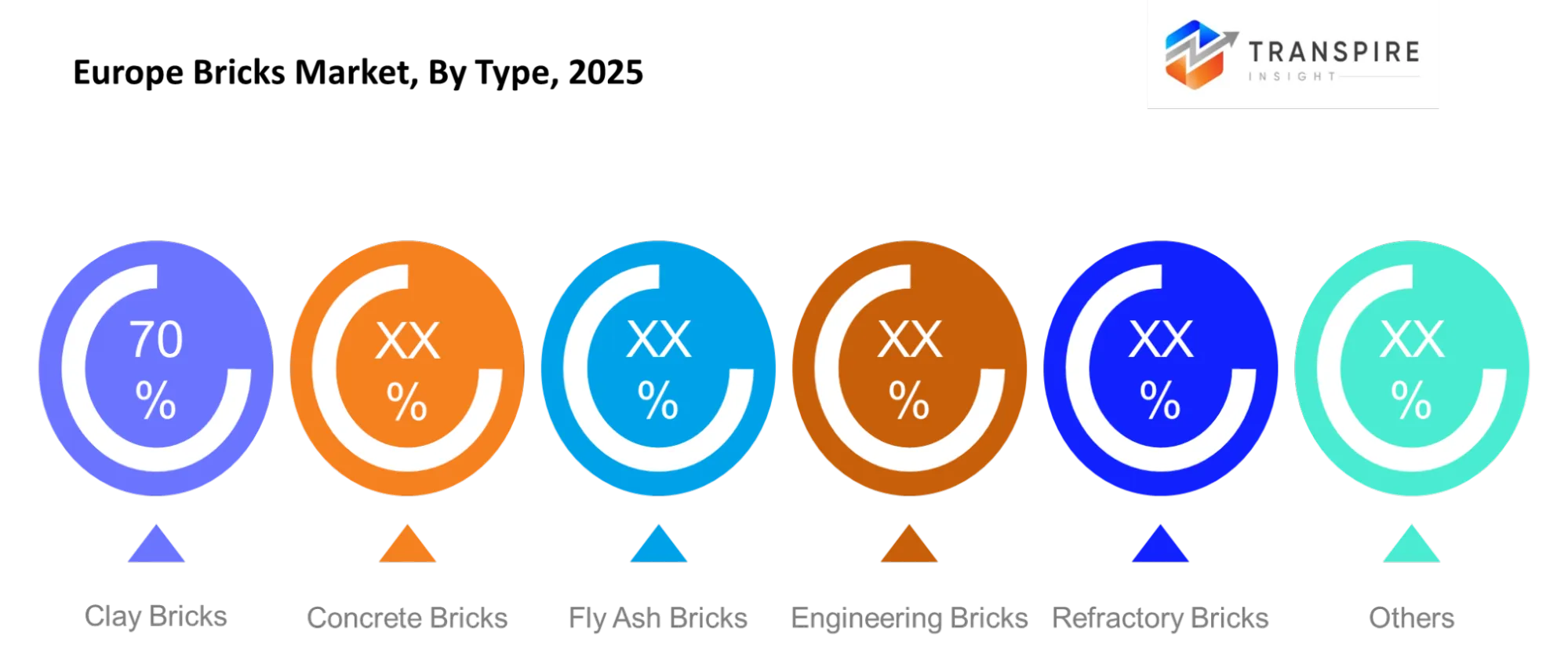
To learn more about this report, Download Free Sample Report
By Application:
Residential construction maintains its top market position because of ongoing housing demands and urban growth and the constant need for building improvements in both developed and developing countries. The commercial construction sector has stable growth because office buildings and retail spaces and hospitality venues continue to develop. Public works projects which include roads and bridges and civic utility systems drive ongoing demand for infrastructure applications.
The industrial construction and renovation sectors show separate growth patterns because of manufacturing expansion and the need to upgrade old building materials. Urban density increases together with public housing projects and energy efficiency rules that affect material selection processes create a demand for construction materials. The European Bricks Market will focus more on building renovation projects and infrastructure development work than on new residential development projects in established markets which will create a constant requirement for long-lasting brick products.
By End-User:
The end-user distribution includes five categories which are Builders, Contractors, Government, Real Estate Developers, and Others. Builders and contractors represent the dominant consumption base because they require materials for projects that include residential buildings and commercial structures and infrastructure development. Real estate developers control the market because their large housing and mixed-use projects require them to purchase materials in bulk according to established industry standards. Government procurement establishes continuous market requirements through its public housing initiatives and public works construction projects.
Regional construction markets experience consistent demand patterns from smaller end-user groups which create demand that spreads throughout construction markets. The construction services market experiences consolidation which results in procurement systems that establish permanent contracts with suppliers. The European Bricks Market will benefit large contractors and developers who have better negotiation power because they will use integrated supply contracts and procurement methods that focus on project efficiency.
By Distribution:
The construction industry relies heavily on direct sales channels because large construction companies purchase products through bulk transactions from manufacturers. Distributors maintain relevance by bridging supply gaps across regional and small-scale construction demand. Retail channels support localized procurement needs, particularly for renovation and minor residential projects which require customers to place orders throughout the day.
The online distribution system operates at an early development stage yet it establishes gradual progress through digital procurement platforms and catalog-based sourcing models. The construction industry experiences growth because supply chain transparency enables price comparison while procurement processes undergo digital transformation across all construction sectors. The European Bricks Market will develop a hybrid distribution system which combines direct manufacturer relationships with distributor networks and digital distribution channels to enhance product accessibility and procurement processes.
What are the Key Use Cases Driving the Europe Bricks Market?
The bricks market in Europe exists because residential construction acts as its primary usage while sustained housing需求 and extensive building renovation projects drive the market forward. The European Union energy efficiency requirements force developers to implement high-performance brick systems which enhance insulation properties and decrease operational emissions according to building requirements
The field of commercial construction alongside public infrastructure development has emerged as a new operational sector which especially applies to educational institutions, medical facilities, and municipal construction projects. Institutional developers together with government-funded urban redevelopment programs depend on masonry systems which provide fire protection and require minimal upkeep.
The practice of energy retrofitting has emerged as a new application because carbon dioxide reduction laws have become stricter. The demand for modern brick systems has grown because of facade replacement and thermal envelope enhancements and the conversion of industrial facilities into new uses. The use of circular construction methods which use recycled clay materials will create new niche markets that will develop in the future.
|
Report Metrics |
Details |
|
Market size value in 2025 |
USD 14.58 Billion |
|
Market size value in 2026 |
USD 20.98 Billion |
|
Revenue forecast in 2033 |
USD 22.11 Billion |
|
Growth rate |
CAGR of 5.39% from 2026 to 2033 |
|
Base year |
2025 |
|
Historical data |
2021 - 2024 |
|
Forecast period |
2026 - 2033 |
|
Report coverage |
Revenue forecast, competitive landscape, growth factors, and trends |
|
Regional scope |
Europe (Germany, United Kingdom, France, Italy, Spain, Rest of Europe) |
|
Key company profiled |
Wienerberger, CRH, Heidelberg Materials, Boral, Forterra, Ibstock, Acme Brick, General Shale, Hanson, Summit Materials, Wienerberger AG, LafargeHolcim, Cemex, Brickworks, Midland Brick |
|
Customization scope |
Free report customization (country, regional & segment scope). Avail customized purchase options to meet your exact research needs. |
|
Report Segmentation |
By Type (Clay Bricks, Concrete Bricks, Fly Ash Bricks, Engineering Bricks, Refractory Bricks, Others); By Application (Residential Construction, Commercial Construction, Infrastructure, Renovation, Industrial Construction, Others); By End-User (Builders, Contractors, Government, Real Estate Developers, Others); By Distribution (Direct Sales, Distributors, Retail, Online, Others) |
Which Regions are Driving the Europe Bricks Market Growth?
The bricks market in Western Europe operates as the main market for Europe because both strict carbon regulations and low-emission construction standards have been implemented earlier in the region. The demand for building materials in Germany, the UK, and France is supported by their renovation programs which require compliance with building envelope standards. The industry maintains its dominant position because it operates a complete manufacturing system which includes advanced kiln systems and dependable clay material sources and complete distribution systems that optimize their transportation operations. This area establishes a strong contractor network which selects certified energy-saving masonry products instead of choosing less expensive materials.
Southern Europe establishes itself as a reliable market which maintains permanent market presence at all times because Italian and Spanish markets demonstrate stable demand patterns. The region develops its market strength through two main drivers which include the restoration of its outdated residential buildings and the environmental demands for retrofitting in its warm climate areas. The construction industry experiences stable demand because public funding supports seismic upgrades and restoration projects for urban heritage sites. The industrial cycle establishes a basic brick consumption level which remains stable because public funding needs to continue for its operation.
Eastern Europe represents the region with highest growth rate because it experiences both increasing housing development and industrial developments which create industrial parks in less expensive EU member nations. The production of kilns in Poland, Romania, and the Czech Republic is increasing because manufacturing facilities are establishing their operations near new transportation routes. The modern brick production facilities in the area have advanced their operations because of recent EU funding for economic development and the manufacturing industry has shifted its operations to areas outside Western Europe.The current shift provides investors and new market entrants with an opportunity to expand their operations while establishing themselves as cost-efficient competitors in the European supply market which will be active until 2033.
Who are the Key Players in the Europe Bricks Market and How Do They Compete?
The European bricks market exhibits moderate consolidation which results in cross-border market fragmentation. The competition between companies depends on three factors which include energy efficiency and carbon compliance and logistics optimization for their heavy low-value products.
Large companies maintain their market share by modernizing their kilns and securing access to their essential raw materials. The industry receives mounting pressure from low-carbon construction systems and prefabricated solutions which compete with traditional building methods instead of facing competition from new market entrants.
Wienerberger develops low-carbon clay brick products and creates integrated wall systems which meet the needs of energy-efficient renovation projects. CRH uses its extensive European building materials operations together with its complete supply chain management system to obtain major contractor agreements which enable the company to maintain stable prices throughout economic fluctuations. Heidelberg Materials focuses on energy efficiency upgrades through their UK brick operations under Hanson while working to decrease emissions because of increasing regulatory costs.
Ibstock develops its market position through its specialized brick products which meet the design requirements of UK planning authorities. Forterra builds its business operations through its domestic UK production capabilities and distribution systems while working on kiln improvements which will decrease energy consumption and maintain its profit margins. The two companies grow their operations through three methods which include increasing their operational efficiency and gradually expanding their production capacity and creating products for specific markets.
Company List
- Wienerberger
- CRH
- Heidelberg Materials
- Boral
- Forterra
- Ibstock
- Acme Brick
- General Shale
- Hanson
- Summit Materials
- Wienerberger AG
- LafargeHolcim
- Cemex
- Brickworks
- Midland Brick
Recent Development News
“In February 2026, Wienerberger announced acquisition of Italcer Group. The deal expands Wienerberger’s exposure to premium ceramic surfaces and strengthens its renovation-focused building envelope strategy across Europe, supporting long-term demand shift away from new-build cyclicality toward refurbishment-led growth.https://www.wienerberger.com
What Strategic Insights Define the Future of the Europe Bricks Market?
The European bricks market will transition from its current volume-driven conventional masonry methods during the next 5 to 7 years because EU emissions regulations will become more stringent and building supply chains will shift toward electrification. Demand growth will increasingly decouple from conventional residential construction cycles as retrofit and energy-efficiency upgrades become dominant end-use drivers. The more subtle danger exists because feedstock and energy price swings create a hazardous situation which continues to affect natural gas costs and limit clay extraction capacities that would lead to profit losses throughout developing markets. The Northern European construction market currently presents an emerging yet non-mainstream business opportunity through the use of carbon-captured bricks which contain recycled materials and according to new carbon tax rules and circular building standards. The market participants should create low-carbon kiln technologies through their production facilities which should be spread across multiple regions to achieve two goals: less regulatory risk and permanent supply agreements with environmentally certified construction partners.
Europe Bricks Market Report Segmentation
By Type
- Clay Bricks
- Concrete Bricks
- Fly Ash Bricks
- Engineering Bricks
- Refractory Bricks
- Others
By Application
- Residential Construction
- Commercial Construction
- Infrastructure
- Renovation
- Industrial Construction
- Others
By End-User
- Builders
- Contractors
- Government
- Real Estate Developers
- Others
By Distribution
- Direct Sales
- Distributors
- Retail
- Online
- Others
Frequently Asked Questions
Find quick answers to common questions.
The Europe Bricks Market size is USD 22.11 Billion in 2033.
Key segments for the Europe Bricks Market are By Type (Clay Bricks, Concrete Bricks, Fly Ash Bricks, Engineering Bricks, Refractory Bricks, Others); By Application (Residential Construction, Commercial Construction, Infrastructure, Renovation, Industrial Construction, Others); By End-User (Builders, Contractors, Government, Real Estate Developers, Others); By Distribution (Direct Sales, Distributors, Retail, Online, Others)
Major Europe Bricks Market players are Wienerberger, CRH, Heidelberg Materials, Boral, Forterra, Ibstock, Acme Brick, General Shale, Hanson, Summit Materials, Wienerberger AG, LafargeHolcim, Cemex, Brickworks, Midland Brick.
The Current Europe Bricks Market size is USD 14.58 Billion in 2025.
The Europe Bricks Market CAGR is 5.39% from 2026 to 2033.
- Wienerberger
- CRH
- Heidelberg Materials
- Boral
- Forterra
- Ibstock
- Acme Brick
- General Shale
- Hanson
- Summit Materials
- Wienerberger AG
- LafargeHolcim
- Cemex
- Brickworks
- Midland Brick
Recently Published Reports
-
Apr 2026
Handling and Lifting Equipment Market
Handling and Lifting Equipment Market Size, Share & Analysis Report By Product (Cranes and Hoists, Forklifts, Conveyor Systems, Aerial Work Platforms, Others), By Application (E-Commerce, Automotive and Railway, Food and Beverages, Aviation, Others), and Geography (North America, Europe, Asia-Pacific, Middle East and Africa, South and Central America), 2021 - 2031
-
Apr 2026
HVAC Equipment Market
HVAC Equipment Market Size, Share & Analysis Report By Heating Equipment Type (Boilers and Furnaces, Heat Pumps, and Unitary Heaters), By Ventilation Equipment (Air Handling Units, Humidifiers and Dehumidifiers, Air Filters, and Fan Coiling Units), By Air Conditioning Equipment (Unitary Air Conditioners, Room Air Conditioners, Packaged Terminal Air Conditioners, and Chillers), By End User (Commercial, Residential, Industrial, and others), and Geography (North America, Europe, Asia-Pacific, Middle East and Africa, South and Central America), 2021 – 2031
-
Apr 2026
Refrigeration Valves Market
Refrigeration Valves Market Size, Share & Analysis Report By Type (Solenoid Valves, Expansion Valves, Check Valves, Service Valves, Others), By Application (Commercial Refrigeration, Industrial Refrigeration, Transport Refrigeration, Residential Refrigeration, Air Conditioning Systems), By End User (Food and Beverage Industry, Pharmaceutical Industry, HVAC Industry, Chemical Industry, Others), and Geography (North America, Europe, Asia-Pacific, Middle East and Africa, South and Central America), 2021 – 2031
-
Apr 2026
E-Commerce Packaging Materials Market
E-Commerce Packaging Materials Market By Material Type (Corrugated Boxes, Paper & Paperboard, Foam & Cushioning Materials, Plastic Packaging, Flexible Packaging, Protective Packaging, Others), By Product(Primary Packaging, Secondary Packaging, Tertiary Packaging), By Packaging Function (Protective Packaging, Branding & Presentation Packaging, Transit & Logistic Packaging, Sustainable Packaging, Tamper Evidence Packaging), By End-User (Retail & Consumer Goods, Electronic Appliances, Food & Beverages, Healthcare & Pharmaceutical, Fashion & Apparel, Home & Furnishing, Others); By Industry Analysis, Size, Share, Growth, Trends, and Forecasts 2021-2033