
Oil & Gas Automation Market Summary:
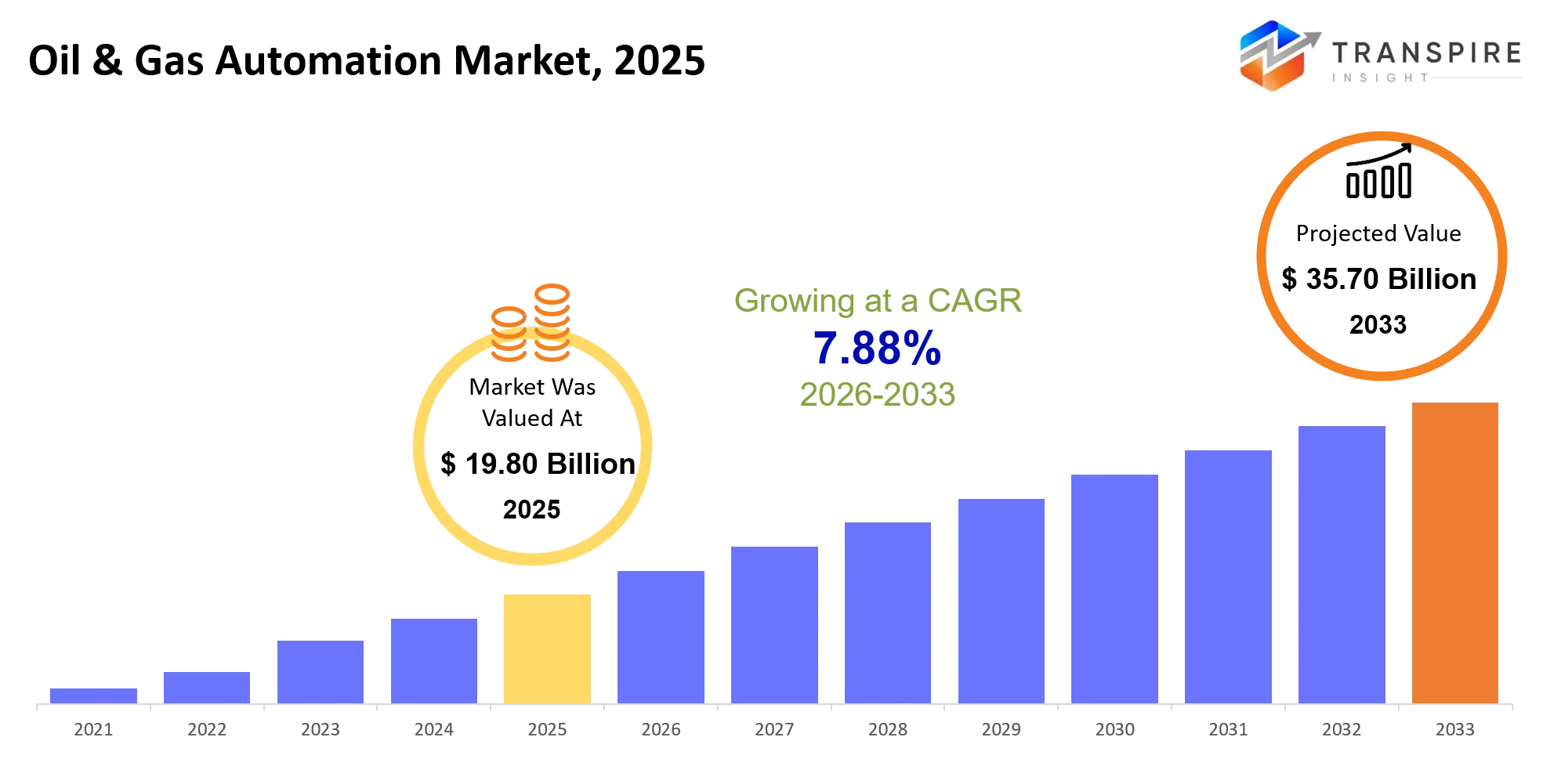
As per Transpire Insight Analysis, the Oil & Gas Automation Market size is estimated at USD 19.80 billion in 2025 and is anticipated to reach USD 35.70 billion by 2033, growing at a CAGR of 7.88% from 2026 to 2033.
The oil and gas automation market provides operators, pipeline operators, refineries, LNG plants, and petrochemical plants to manage their assets with greater control, faster decision-making, and less manual labour. Over the past three to five years, the oil and gas automation market has transformed from simple control systems to connected automation, which includes industrial software, sensors, cloud computing, edge computing, and analytics. The cooperation of IT and OT, which enables the transfer of data about the field and plants into the optimisation process, is one of the latest trends in the oil and gas automation market. The unstable energy markets, safety regulations, and the need to lower costs are the main drivers of upgrading control systems. Such a trend has been shown recently by ABB, Emerson, and Honeywell, where automation is combined with real-time monitoring, predictive maintenance, and decision-making via AI. As the amount of data produced by assets increases, the oil and gas automation market is moving from control systems to optimisation and semi-autonomy.
Oil & Gas Automation Market Size & Forecast:
- Market Size 2025: USD 19.80 Billion
- Expected Market Value (2033): USD 35.70 Billion
- Forecast CAGR (2026–2033): 7.88%
- Leading Region in 2025: Middle East & Africa
- Fastest Growing Region: Asia Pacific
- Key Company Profiles: Siemens, ABB, Emerson, Honeywell, Schneider Electric, Rockwell Automation, Yokogawa Electric, Baker Hughes, SLB, Halliburton, Mitsubishi Electric, Honeywell Process Solutions, GE Vernova, Emerson Automation Solutions, Rockwell
Key Market Insights:
The market trend involves a move to integrated automation, where control systems, industrial data, artificial intelligence, and asset management software function in unison as opposed to being independent technologies. There has been an increasing trend of the most lucrative business opportunity being the one that entails modernisation.
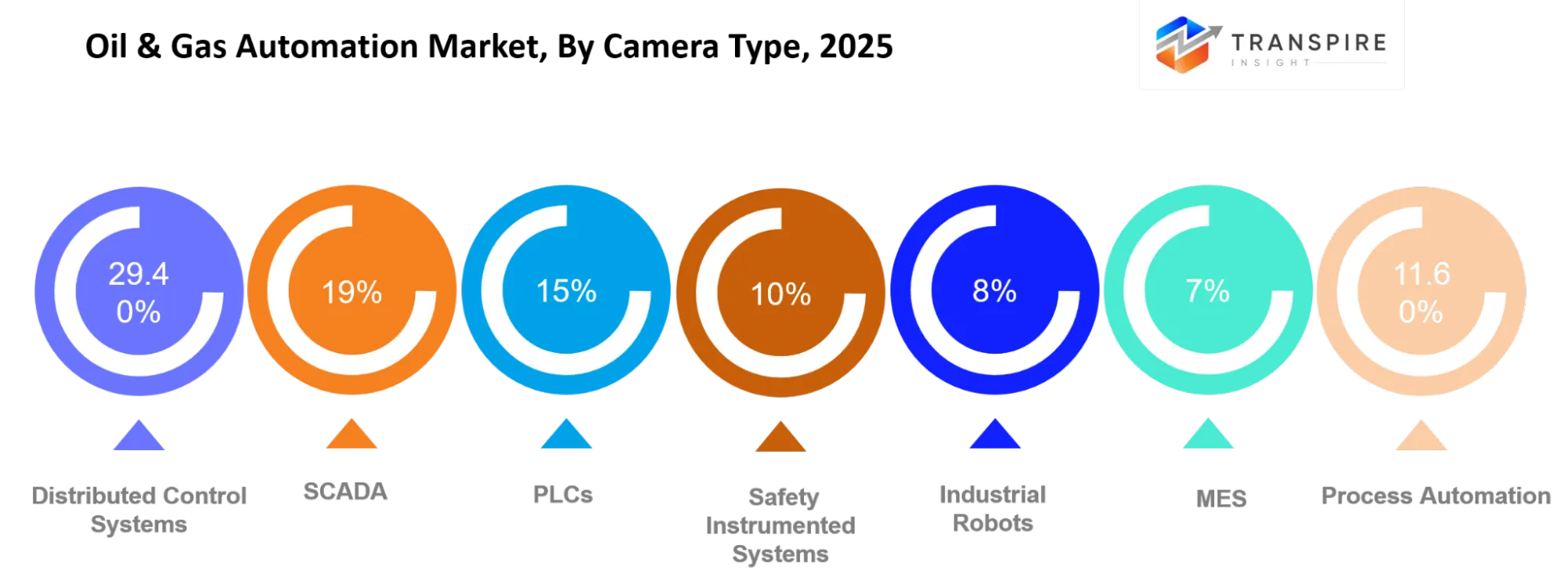
- The Distributed Control Systems segment accounted for 29.40% of the automation-type segment, owing to its proven capability in managing the continuous and complicated oil and gas processes.
- SCADA comprised 19.00%, driven by the need for centralised monitoring and control of processes in the pipelines and geographically distributed energy infrastructure.
- PLCs made up 15.00%, still relevant for controlling equipment and automated processes, in which fast and precise machine response is required.
- Safety Instrumented Systems contributed to 10.00% as more and more operators are turning to automated protection systems due to increasing significance in process safety and risk management.
- Industrial Robots made up 8.00% due to a gradual move towards automation for inspection, manipulation, maintenance, and dangerous operations.
- Manufacturing Execution Systems comprised 7.00% allowing better link between plant floor operations and manufacturing information and management decisions.
- Process Automation was 6.00% as operators tend to incorporate process control and optimization together with automation instead of automation regulation only.
- Industrial IoT comprised 5.60%, yet 9.70% CAGR makes it the fastest-growing segment.
What are the Key Drivers, Restraints, and Opportunities in the Oil & Gas Automation Market?
Drivers
Growth has been fueled by the demand for the modernisation of the ageing oil and gas infrastructure, but not through complete replacement of the current control systems. There have been investments made in sensors, SCADA, DCS, industrial networking, and analytics, which will provide enhanced visibility into equipment status and process performance. This results in an immediate adoption benefit because it prevents shutdowns and provides more efficiency and consistency through automated process control. Digital operations and their expansion also catalyze because some companies need remote monitoring of their operations over wide areas.
Restraints
The complexity of integrating any form of automation with old equipment. There are many cases where there are control systems that have been put in place for many years, and there may be a need to change or connect such systems. This challenge exists since operators cannot easily interrupt critical production simply to introduce new technology.
Opportunities
The opportunity would be in leveraging the integration of the industrial internet of things, edge computing, AI, and digital twin with the current DCS and SCADA setups. It will be possible to leverage the many modernisation efforts being done on some major pipeline networks to establish a base for centralised monitoring, predictive maintenance, and cybersecurity.
What Has the Impact of Artificial Intelligence on the Oil & Gas Automation Market?
AI is revolutionising oil and gas automation through its move from monitoring to prediction, optimisation, and assisted decision-making. The AI model will examine the significant amount of data gathered through sensors and production to be able to detect any abnormal equipment operation, predict maintenance needs, point out process limitations and recommend operational modifications. In upstream operations, AI will correlate well, facility, and production data to be able to assist engineers in detecting problems and optimising production. In downstream operations, an AI-supported control room will integrate operating data and predictions in order to allow operators to respond quickly to deviations.AI is making drilling and well site operations more automated. Examples of current applications show how AI, automation, and real-time data can be combined to achieve consistency and reduce human intervention. However, there are certain issues that need to be considered to implement AI successfully. These are related to data quality, legacy systems integration, cyber security, reliability of models and cost of digital infrastructure implementation. Thus, AI implementation should be considered as solution to certain operational issue and not only purchase of technology.
Instance
In August 2026, ADNOC and SLB created an AI-driven Real-Time Operations Centre on over 120 drilling rigs by using real-time data analysis and AI-driven insights to optimise drilling operations and decrease operational risks.
Key Market Trends
The market is moving towards process control to automation, where equipment information, analysis, and decision-making are becoming more connected. This is altering how technology is bought and also the asset management practices of oil and gas firms.
- Automation efforts have concentrated on process control, whereas currently there is a growing tendency to integrate DCS and SCADA into Industrial IoT and analysis.
- Remotely operated systems evolved from a specialised function into a means of remote supervisory control of wells, pipelines, and other facilities spread across geographic locations.
- Predictive maintenance is slowly substituting some calendar-driven maintenance based on machine data, which identifies developing issues early.
- Cloud computing is becoming more relevant for analysis and enterprise processes, while edge computing ensures that timely decision-making occurs closer to equipment.
- Cybersecurity has taken up a bigger part in automation strategy due to higher connectivity between IT and OT systems that need protection.
- Automation vendors offer AI assistance and more autonomous systems instead of restricting themselves to dashboards and alarm management only.
Oil & Gas Automation Market Segmentation
By Automation Types
Distributed Control Systems represent the largest supplied share with 29.40% supply, followed by SCADA with 19.00% supply and Programmable Logic Controllers with 15.00% supply. Safety Instrumented Systems have a 10.00% share, Industrial Robots have 8.00%, Manufacturing Execution Systems have 7.00%, Process Automation 6.00%, and Industrial Internet of Things 5.60%. The relevance of DCS is due to continuous monitoring and control of oil and gas processing plants, while the relevance of IIoT lies in increasing connectivity and analysis. According to the supplied data, Industrial IoT is the fastest-growing area with a 9.70% CAGR.
By Operation
the market includes Upstream, Midstream, Downstream, Refining, Petrochemical, LNG, and Oilfield Services. The Upstream operation needs to have automation for drilling, production, well management, and remote field management. For Midstream operations, there is much dependence on monitoring and control for pipelines and transport networks. For downstream operations, refineries, and petrochemical plants, there is much need for process control since the slightest changes can influence production efficiency, safety, and product quality. There are opportunities with the construction of LNG plants that incorporate process automation, safety system, electrical control, and digital monitoring.
By Component
The Market Is Formed by Sensors, Controllers, Actuators, Valves, HMIs, Industrial Networks, Robotics, and Software. The sensors are used to provide the operating data needed in condition monitoring and predictive applications. The controllers and actuators translate the decisions made into actions, while industrial networks and HMIs improve the communication between operators and equipment, and robotics perform automation for repetitive and hazardous jobs. Software is gaining significance in the market since the operators require more from their software which includes analytics, asset monitoring, cybersecurity and optimisation.
By Application
the market segments include Drilling, Production, Pipeline Monitoring, Refining, Storage, Transportation, Process Optimisation, and Safety. Applications such as drilling and production are being increasingly automated and integrated with real-time decision support based on collected data. In addition, pipeline monitoring requires continuous visibility of geographically dispersed assets. At the same time, refining and process optimisation are still important due to automation which can help to keep operating conditions constant and detect any deviations.
By Technology
AI, IoT, Cloud Computing, Digital Twins, Machine Learning, Robotics, Edge Computing, and Predictive Analytics expand the capabilities of automation. The Internet of Things is used for connecting devices and producing a constant stream of data, while edge computing allows for conducting an analysis in a timely manner near the device. Cloud computing offers the opportunity for big data analysis and collaboration, while digital twins assist in evaluating the behavior of the device or scenario. AI and machine learning become more and more popular in making predictions and decisions. In this case, oil and gas companies are the most likely to choose architecture that combines all these technologies with the control system.
By End User
Oil and Gas Producers, Pipeline Operators, Refineries, Petrochemicals, LNG Operations, and Oil Services are the key players when it comes to automation. The oil and gas producer needs automation for effective tracking and optimisation of production and equipment performance, while the pipeline operator requires efficient monitoring over long distances. The refiner and the petrochemical company demand process control along with safety control in an integrated manner. LNG companies are now automating their processes to enable large-scale processing.
What are the Key Use Cases Driving the Oil & Gas Automation Market?
The use cases in the market are that Distributed Control Systems are still integral to industry applications involving extensive production. The automation of monitoring and control of production, processing, and petrochemical processes is one of the key application areas. SCADA and industrial networks help extend the reach to pipelines and geographically spread-out installations, whereas sensors and controllers gather the operational data that allows for intervention. Other growing applications include predictive maintenance, pipeline condition monitoring, production optimisation, automated safety measures, remote monitoring of assets, and inventory control. These applications integrate the automation hardware and software as opposed to the isolation of the automation control equipment. Growing applications revolve around AI-enabled control rooms, digital twins, edge intelligence, unmanned drilling, and closed-loop wellsite operations. These applications may streamline the process of intervention in complicated and challenging environments of offshore, LNG, and oilfield services.
|
Report Metrics |
Details |
|
Market size value in 2025 |
USD 19.80 Billion |
|
Market size value in 2026 |
USD 21 Billion |
|
Revenue forecast in 2033 |
USD 35.70 Billion |
|
Growth rate |
CAGR of 7.88% from 2026 to 2033 |
|
Base year |
2025 |
|
Historical data |
2021 - 2024 |
|
Forecast period |
2026 - 2033 |
|
Report coverage |
Revenue forecast, competitive landscape, growth factors, and trends |
|
Regional scope |
United States; Canada; Mexico; United Kingdom; Germany; France; Italy; Spain; Denmark; Sweden; Norway; China; Japan; India; Australia; South Korea; Thailand; Brazil; Argentina; South Africa; Saudi Arabia; United Arab Emirates |
|
Key company profiled |
Siemens, ABB, Emerson, Honeywell, Schneider Electric, Rockwell Automation, Yokogawa Electric, Baker Hughes, SLB, Halliburton, Mitsubishi Electric, Honeywell Process Solutions, GE Vernova, Emerson Automation Solutions, Rockwell |
|
Customization scope |
Free report customization (country, regional & segment scope). Avail customized purchase options to meet your exact research needs. |
|
Report Segmentation |
Automation Type (Distributed Control Systems, Supervisory Control & Data Acquisition, Programmable Logic Controllers, Safety Instrumented Systems, Industrial Robots, Manufacturing Execution Systems, Process Automation, Industrial IoT); Operation (Upstream, Midstream, Downstream, Refining, Petrochemicals, LNG, Oilfield Services); Component (Sensors, Controllers, Actuators, Valves, HMIs, Industrial Networks, Robotics, Software); Application (Drilling, Production, Pipeline Monitoring, Refining, Storage, Transportation, Process Optimization, Safety); Technology (AI, IoT, Cloud Computing, Digital Twins, Machine Learning, Robotics, Edge Computing, Predictive Analytics); End User (Oil Producers, Gas Producers, Refineries, Pipeline Operators, LNG Operators, Petrochemical Companies, Oilfield Service Providers) |
Which Regions are Driving the Oil & Gas Automation Market Growth?
North America
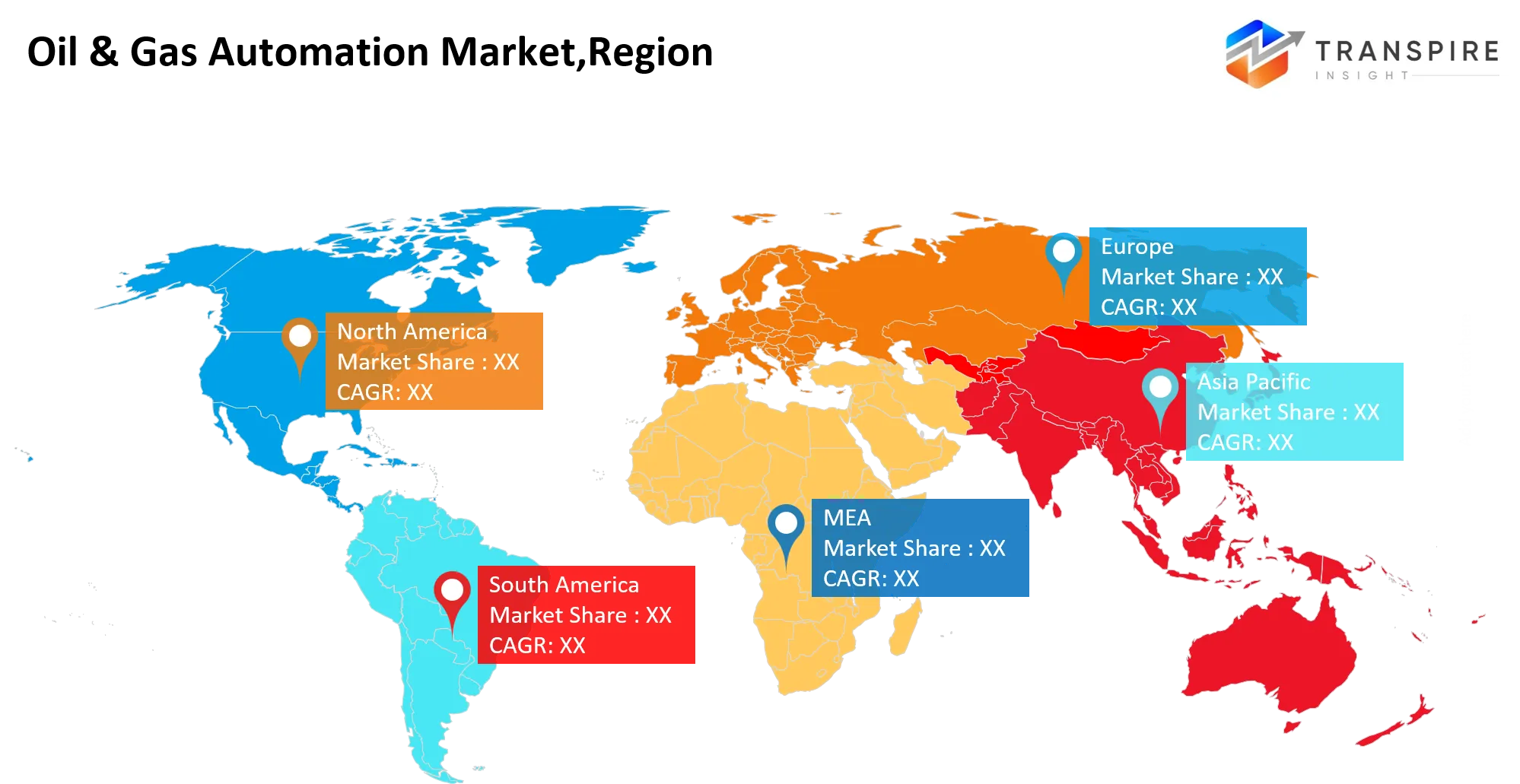
The North American market constitutes 27.00% of the market share for the oil and gas automation market. The market in this region has a stronghold in terms of its technologies and service offerings due to the presence of experienced oil field operators, developed digital infrastructure, and the use of AI, cloud, cybersecurity, and remote monitoring technologies. Investments in shale, refining, LNG, and automation are quite active in the region.
In August 2026, ExxonMobil has shown how advanced data and automation technology can be used in its Permian Basin drilling to increase drilling safety and efficiency. The company has been employing automation and digitalisation in its oilfield operations to enhance the adoption of automation in the upstream sector in North America.
Europe
The European market holds 20.00% of the market share and has a growth base that is different from that of North America and includes factors such as asset modernisation, efficiency, safety, and emissions management. The presence of mature offshore and refining assets guarantees the continuous need for the upgrading of control systems, lifecycle services, and digital monitoring. Operators in Europe have more focus on autonomy and energy efficiency.
In June 2026, TotalEnergies has increased the use of data and artificial intelligence in monitoring industrial equipment to detect any early warning signs of failure. It was noted that almost 3,000 pieces of equipment have been under monitoring, while the company plans to expand its AI monitoring to tens of thousands more. This shows the growing adoption of digital automation in Europe's oil and gas operations.
Asia-Pacific
The Asia-Pacific region accounts for 17.00% of the market and represents the fastest-growing regional segment with a 7.80% CAGR. Growth in new LNG, refining, petrochemical, pipeline, and upstream infrastructure projects is creating opportunities for automation in the form of both new build and retrofit. Recent projects in India and other Asian countries demonstrate the increasing adoption of centralised monitoring, cloud-based automation, and digital control systems.
In January 2026, Woodside Energy introduced Maint Intel, an AI-based maintenance technology at its North West Shelf Project in Australia. This technology uses the equipment's data and past performance to suggest maintenance schedules.
Who are the Key Players in the Oil & Gas Automation Market and how do they compete?
Competition in the oil and gas automation market includes the depth of control systems, digitisation, cybersecurity, lifecycle services, and connectivity of legacy assets with analytics. Companies compete not only on hardware but also on their measurable operating results. Siemens continues its AI-driven approach to industrial automation and develops AI agents for automation of industrial processes. Honeywell provides its customers with a combination of process control, asset performance management, cybersecurity, and AI technologies, which gives it a competitive edge where a unified operating environment is required for all plant assets. The ABB company competes through integrated automation, electrification, digital services, and modernisation programs. The projects implemented by ABB with pipeline operators prove its strategy, which includes the improvement of existing infrastructure and the continuity of operations. The SLB and Halliburton companies expand their digital capabilities into drilling, production optimisation, remote operations, and automated wellsite execution. This expansion strategy is highly connected with the oilfield workflows, which allows selling technology as part of operational services.
Oil & Gas Automation Market companies
- Siemens
- ABB
- Emerson
- Honeywell
- Schneider ElectricBaker
- Rockwell Automation
- Yokogawa Electric
- aker Hughes
- SLB
- Halliburton
- Mitsubishi Electric
- Honeywell Process Solutions
- GE Vernova
- Emerson Automation Solutions
- Rockwell
Recent Development News
In November 2025, the ADNOC AI-based Production System Optimisation was launched by SLB and Cognite, starting with eight fields. This technology utilizes real-time data, AI, and machine learning to help with production optimisation and better decision-making.
https://www.slb.com/newsroom/updates/2025/2025-adnoc-slb-aipso-update
July 2026, Halliburton announced the completion of the deployment of LOGIX automation and remote operations on a deepwater exploration well for Eni in Indonesia. This project involved automated drilling, downhole hydraulics, managed pressure drilling, and connected execution. It was a major milestone in automated offshore operations in the Asia-Pacific region.
What Strategic Insights Define the Future of the Oil & Gas Automation Market?
The future oil and gas automation market will be driven by connectivity and autonomy instead of standalone control upgrades. There will still be roles for DCS and SCADA; however, their usefulness will become increasingly determined by how effectively they interact with Industrial IoT, artificial intelligence, edge computing, digital twins, and enterprise software. The latent danger will be increased exposure from faster connectivity and a higher negative impact from bad operational data because of faster connectivity. Another potential threat will be the lack of engineers familiar with the legacy control environment as well as with digital technology. The emerging opportunity will be the upgrading of legacy equipment in iterations by installing sensors, edge processing, predictive analytics, and AI without a full-scale replacement of the system. In the vendor's strategy, this means putting priority on interoperable systems, maintenance and production results measurability, robust cybersecurity and life cycle. The companies will find success in proving their value through incremental implementation followed by scalability across the entire chain of exploration, pipelines, refineries and LNG.
Automation Type
- Distributed Control Systems
- Supervisory Control & Data Acquisition
- Programmable Logic Controllers
- Safety Instrumented Systems
- Industrial Robots
- Manufacturing Execution Systems
- Process Automation
- Industrial IoT
Operation
- Upstream
- Midstream
- Downstream
- Refining
- Petrochemicals
- LNG
- Oilfield Services
Component
- Sensors
- Controllers
- Actuators
- Valves
- HMIs
- Industrial Networks
- Robotics
- Software
Application
- Drilling
- Production
- Pipeline Monitoring
- Refining
- Storage
- Transportation
- Process Optimization
- Safety
Technology
- AI
- IoT
- Cloud Computing
- Digital Twins
- Machine Learning
- Robotics
- Edge Computing
- Predictive Analytics
End User
- Oil Producers
- Gas Producers
- Refineries
- Pipeline Operators
- LNG Operators
- Petrochemical Companies
- Oilfield Service Providers
Frequently Asked Questions
Find quick answers to common questions.
The oil & gas automation market size was valued at USD 19.80 billion in 2025 and is poised to reach USD 35.70 billion by 2033, expanding at a 7.88% CAGR.
Key segments for the oil & gas automation market are Automation Type (Distributed Control Systems, Supervisory Control & Data Acquisition, Programmable Logic Controllers, Safety Instrumented Systems, Industrial Robots, Manufacturing Execution Systems, Process Automation, Industrial IoT); Operation (Upstream, Midstream, Downstream, Refining, Petrochemicals, LNG, Oilfield Services); Component (Sensors, Controllers, Actuators, Valves, HMIs, Industrial Networks, Robotics, Software); Application (Drilling, Production, Pipeline Monitoring, Refining, Storage, Transportation, Process Optimization, Safety); Technology (AI, IoT, Cloud Computing, Digital Twins, Machine Learning, Robotics, Edge Computing, Predictive Analytics); End User (Oil Producers, Gas Producers, Refineries, Pipeline Operators, LNG Operators, Petrochemical Companies, Oilfield Service Providers)
Growth is primarily driven by the increasing use of AI and IoT technologies, the need to increase the efficiency and safety of operations, investments in digital oil fields, and predictive maintenance solutions.
The market is led by major manufacturers including Siemens, ABB, Emerson, Honeywell, Schneider Electric, Rockwell Automation, Yokogawa Electric, Baker Hughes, SLB, Halliburton, Mitsubishi Electric, Honeywell Process Solutions, GE Vernova, Emerson Automation Solutions, Rockwell
The Middle East & Africa impact on the oil & gas automation market is seen through the regional market share which accounts for 31.50%. The strong position of this region is due to oil and gas production, digital oil fields, automation in exploration and refining processes, and modernizing aging energy infrastructure.
Opportunities in the international oil and gas automation market sector involve digital oilfield creation, AI-enabled predictive maintenance, adoption of industrial IoT, automation of drilling & production operations, and modernization of old oil & gas assets.
- Siemens
- ABB
- Emerson
- Honeywell
- Schneider ElectricBaker
- Rockwell Automation
- Yokogawa Electric
- aker Hughes
- SLB
- Halliburton
- Mitsubishi Electric
- Honeywell Process Solutions
- GE Vernova
- Emerson Automation Solutions
- Rockwell
About the Authors

Avinash Kumar
I’m Avinash Kumar, a Senior Research Analyst at Transpire Insight, with expertise in the Electronics and Semiconductor and Energy & Power industry. My work focuses on analyzing emerging technologies, market trends, industry developments, and innovation across these sectors. I specialize in transforming complex technical and market insights into clear, research-backed content that helps professionals, businesses, and decision-makers stay informed. Through continuous industry research and data-driven analysis, I strive to deliver accurate, reliable, and practical perspectives on the latest advancements shaping the semiconductor and energy landscape.

Chakradhar Khansole
Chakradhar serves as the Research Director at Transpire Insight, bringing over 8 years of experience in technology, innovation, and strategic market intelligence. He specializes in transforming complex market data into actionable business insights that enable organizations to make informed, growth-oriented decisions. Recognized for his strategic vision and analytical expertise, Chakradhar leads high-impact research initiatives, delivering comprehensive market assessments, competitive intelligence, and forward-looking industry analysis.
Recently Published Reports
-
Apr 2026
Active Power Filter Market
Active Power Filter Market Size, Share & Analysis Report By Type (Shunt Active Power Filters, Series Active Power Filter, Hybrid Active Power Filter), By Application (Harmonics Mitigation, Reactive Power Compensation, Voltage Regulation, Power Factor Correction), By Phase (Single Phase, Three Phase), By End-User Industry (Manufacturing, Healthcare, Commercial, Automotive, Oil and Gas, Others), and Geography (North America, Europe, Asia-Pacific, Middle East and Africa, South and Central America), 2021 - 2031
-
Apr 2026
Electrical Transformer Market
Electrical Transformer Market Size, Share & Analysis Report By Core (Closed, Shell, and Berry), By Insulation (Gas, Oil, Solid, Air, and Other), By Phase (Single, and Three), By Rating (100 MVA to 500 MVA, 501 MVA to 800 MVA, and 801 MVA to 1200 MVA), and Geography (North America, Europe, Asia-Pacific, Middle East and Africa, South and Central America), 2021 – 2031
-
Apr 2026
Hydraulic Piston Pumps Market
Hydraulic Piston Pumps Market Size, Share & Analysis Report By Type (Axial Piston Pumps, Radial Piston Pumps), By Operating Pressure (Low Pressure, Medium Pressure, High Pressure), By Application (Construction, Mining, Agriculture, Automotive, Oil & Gas, Industrial Machinery, Others), By End-User (OEMs, Aftermarket), and Geography (North America, Europe, Asia-Pacific, Middle East and Africa, South and Central America), 2021 – 2031
-
Apr 2026
Laboratory Gas Generators Market
Laboratory Gas Generators Market Size, Share & Analysis Report By Product (Nitrogen Gas Generator, Hydrogen Gas Generator, Zero Air Gas Generator, Purge Gas Generator, TOC Gas Generators, Others), By Application (Gas Chromatography, Liquid Chromatography-mass Spectrometry (LC-MS), Gas Analyzers, Others), By End-user (Life Science, Chemical & Petrochemical, Food & Beverage, Others), and Geography (North America, Europe, Asia-Pacific, Middle East and Africa, South and Central America), 2021 – 2031