
South Korea Automotive Wheel Market Summary:
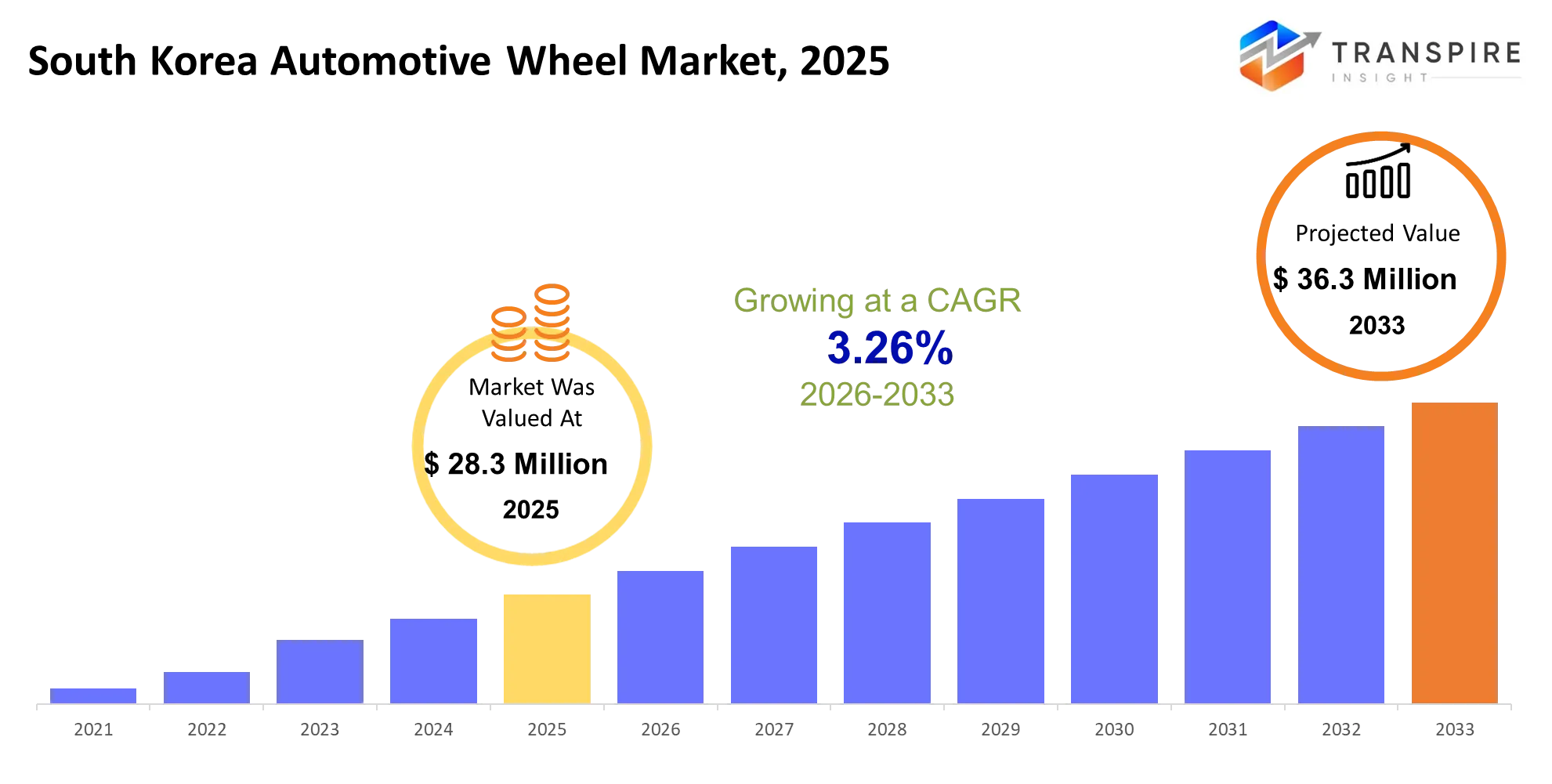
According to Transpire Insight, a detailed research report on the market reflects that the South Korea Automotive Wheel Market was valued at approximately USD 28.3 Million in 2025 and is expected to reach USD 29.0 Million in 2026, with the market projected to grow to USD 36.3 Million by 2033, registering a CAGR of 3.26% during the 2026–2033 forecast period. This growth reflects the evolving dynamics of Japan’s household refrigerator industry, supported by technological innovation, advancements in energy-efficient refrigeration technologies, expanding manufacturing capabilities, and increasing demand for modern household refrigeration solutions, contributing to the continued development and growth of the South Korea Automotive Wheel Market.
Market Snapshot
- Market Value (2025): USD 28.3 Million.
- Expected Market Value (2026): USD 29.0 Million.
- Estimated Market Value (2033): USD 36.3 Million.
- Forecast CAGR (2026–2033): 3.26%.
Introduction
Definition of the South Korea Automotive Wheel Market
The South Korea Automotive Wheel Market consists of designing, producing and selling wheels of steel, aluminum alloy, and advanced composite material for use in passenger cars, commercial vehicles and electric vehicles. Wheels are crucial in any vehicle, in that they help in load bearing, tires fitting and ensure safety and efficiency of movement. The South Korea Automotive Wheel Market is developing in light of the growing demands for lightweight wheels, alloy materials, aerodynamic wheels and high-end manufacturing processes. There is close cooperation with top local car manufacturers like Hyundai and Kia which helps develop complex OEM supply chain systems and innovations. There is also an increasing need for advanced lightweight wheels due to the growing number of electric vehicles in use.
Key Market Highlights: -
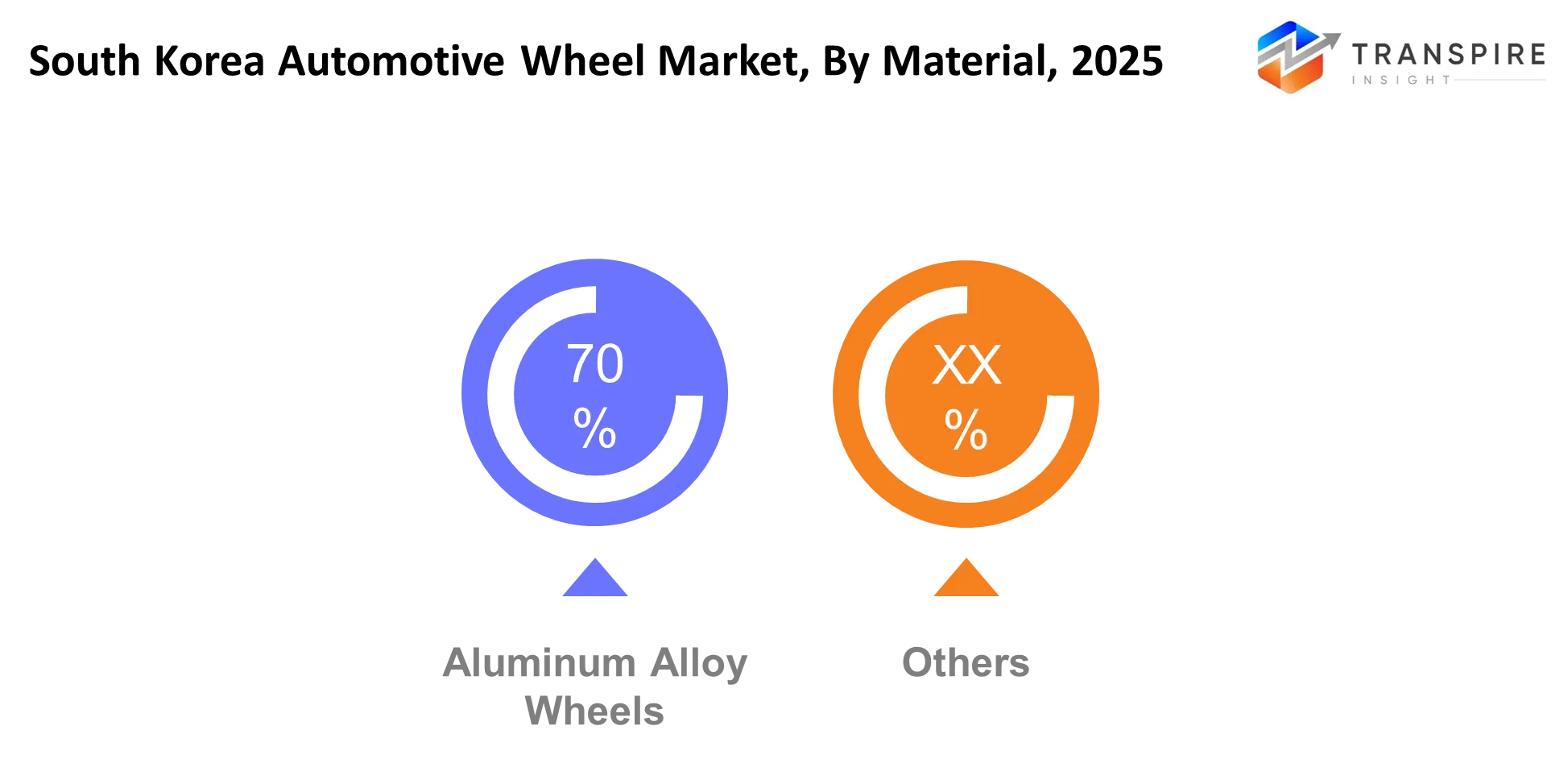
- By Material, the Aluminum Alloy Refrigerator dominated the market and holds approximately 64.99% share in 2025 and is projected to grow at a substantial CAGR during the forecast period.
- By Vehicle, the Passenger Cars dominated the market and holds approximately 72.45% share in 2025 and is projected to grow at a substantial CAGR during the forecast period.
- By Wheel Size, the Direct-Cool technology Manufacturers segment dominated the market and holds approximately 77.52% share in 2025 and is projected to grow at a substantial CAGR during the forecast period.
- The South Korean automotive wheel industry is progressing through the adoption of electric vehicles, lightweight aluminum wheels, manufacturing technology, and transformation of the automotive supply chain by the South Korean government.
How is Technology Driving Growth in the South Korea Automotive Wheel Market?
The South Korea Automotive Wheel Market’s expansion is being driven by technological developments through lightweight materials, manufacturing process innovations, wheel engineering, and design tailored for electric vehicles. Aluminum alloys and high-strength materials assist in reducing the weight of unsprung components that play an important role in increasing fuel efficiency and handling of vehicles along with EV range. The aerodynamic designs of wheels are increasingly being used on EVs to increase efficiency. Casting, forging, machining, balancing, and vision-based inspection process increases precision and efficiency in the manufacturing process. Digital quality control systems minimize defects and wastage in production.
Market Drivers
The factors that influence the South Korea Automotive Wheel Market include the electric vehicle trend, the need for lightweight wheels, production advancement, commercial fleets, and wheel customizations. The rising popularity of the EVs is leading to the rising demand for lightweight aluminum alloy wheels, aerodynamic designs, and optimized wheel structures to increase the efficiency of the vehicles and driving range. Strict environmental and performance standards of the vehicles have pushed the companies to develop wheels using material efficiency, recyclability, durability, and corrosion resistance. Automation in various stages of production, such as casting, forming, machining, balancing, and inspection, is making the process precise and cost-effective.
Restrain
Constraints on the South Korea Automotive Wheel Market include the high cost of production and research and development for lightweight wheels and aluminum alloy wheels. High fluctuations in aluminum and alloy costs can squeeze profit margins. The vehicle market being relatively mature might be a barrier to growth through increased volumes of sales. Furthermore, the pricing pressures from local manufacturers and imported wheels push suppliers to continuously innovate.
|
Driver |
Relative Impact on Growth (%) |
Geographic Relevance |
Impact Timeline |
Demand Strength |
Growth Mechanism |
Key Beneficiaries |
Major Constraint |
|
Driver 1: Rapid EV and Hybrid Vehicle Adoption |
30% |
South Korea — Seoul Capital Area, Gyeonggi, Ulsan, Busan |
Short-term |
High |
Rising EV volumes increase demand for specialized lightweight wheel designs. |
Wheel manufacturers, EV OEMs, alloy suppliers, coating providers |
Higher EV wheel engineering and validation costs |
|
Driver 2: Lightweight Aluminum and Advanced Alloy Wheel Demand |
24% |
Nationwide, particularly major OEM manufacturing clusters |
Medium-term |
High |
Weight reduction improves vehicle efficiency, range, handling, and energy consumption. |
Aluminum wheel makers, alloy producers, EV manufacturers, casting technology vendors |
Aluminum prices and advanced manufacturing costs |
|
Driver 3: Expansion of Domestic Automotive Production and OEM Investment |
20% |
Ulsan, Gyeonggi, Incheon, Chungcheong, Gwangju |
Short-term |
High |
Higher vehicle production expands OEM wheel procurement and replacement requirements. |
OEM suppliers, wheel manufacturers, forging/casting companies, logistics providers |
Production volatility and global trade uncertainty |
|
Driver 4: Premium, Aerodynamic and Customized Wheel Designs |
15% |
Seoul, Gyeonggi and premium-vehicle markets nationwide |
Medium-term |
Medium |
Premium EVs and SUVs increase demand for distinctive, aerodynamic, larger-diameter wheels. |
Premium OEMs, wheel designers, aftermarket suppliers, finishing companies |
Premium wheels carry higher consumer prices |
|
Driver 5: Stricter Safety, Performance and Sustainability Requirements |
11% |
Nationwide |
Long-term |
Medium |
Safety standards and sustainability targets encourage certified, efficient wheel technologies. |
Certified wheel manufacturers, testing providers, recycled-material suppliers |
Compliance testing and certification expenses |
Analysis of Prices and Consumer Behaviour
Alloy wheels of high quality make up 68% of the total South Korean market share of automotive wheels, owing to the growing demand from electric vehicles, passenger vehicles and high-end automotive applications. A wheel made from lightweight alloy is expected to be 35% higher in cost compared to other wheel types since the manufacturing processes will be highly advanced. Aluminum alloy wheels account for nearly 45% of total wheel units sold in South Korea. This is driven by the fact that the wheels are lightweight, durable and flexible in terms of design and can work well in the modern automotive industry. The electric and passenger vehicle sectors together take up about 70% of the applications' market. The buying pattern of automotive wheel OEMs and customers shows that 55% give most priority to the durability, lightweight and quality of manufacturing of the wheels. Some 33% buy products through bulk or contract purchases to reduce their costs and ensure a constant supply of wheels for vehicle production programs both in South Korea and overseas.
|
Company |
Est. Revenue Share Range |
Key Offerings |
Strategic Positioning |
Geographic Strength |
Technology Focus |
|
HANDS Corporation |
18–24% |
Aluminum alloy wheels; OEM wheel assemblies; lightweight wheels; customized wheel designs |
Domestic scale with OEM-focused aluminum-wheel specialization |
South Korea, Europe, North America |
Lightweight alloys, advanced casting, wheel material development |
|
Hyundai Sungwoo Casting |
12–17% |
Aluminum alloy wheels; cast wheels; OEM wheel components; lightweight wheel solutions |
Integrated Korean OEM supplier with high-volume casting capability |
South Korea, Asia, North America |
Aluminum casting, lightweighting, automated production, precision machining |
|
Seojin Industrial |
8–12% |
Steel wheels; commercial-vehicle wheels; passenger-vehicle steel wheels; TPMS valve assemblies |
Cost-efficient steel-wheel specialist serving Hyundai-Kia platforms |
South Korea, Asia |
Automated welding, painting, TPMS integration, IATF manufacturing |
|
Korea Wheel |
6–10% |
Steel wheels; automotive rims; OEM steel-wheel assemblies; replacement wheels |
Domestic steel-wheel specialization with export-oriented manufacturing |
South Korea, North America, Asia |
Steel forming, automated production, durability testing, corrosion protection |
|
Hihowheel |
5–8% |
Aluminum alloy wheels; OEM wheels; lightweight wheels; customized aluminum designs |
Premium aluminum-wheel manufacturer with export diversification |
South Korea, North America, Europe, Japan |
Aluminum casting, lightweight design, integrated manufacturing, quality testing |
|
Samwoo |
3–6% |
Commercial-vehicle steel wheels; truck wheels; bus wheels; specialty wheels |
Korean commercial-wheel specialist emphasizing durability and reliability |
South Korea, Asia, international export markets |
Heavy-duty steel forming, durability testing, advanced wheel specifications |
|
Iochpe-Maxion / Maxion Wheels |
2–5% |
Steel wheels; aluminum wheels; commercial wheels; specialty wheels |
Global scale supplier leveraging multinational OEM relationships and engineering |
Asia Pacific, Europe, Americas |
Lightweighting, sustainable wheels, advanced engineering, low-carbon manufacturing |
|
Topy Industries |
1–3% |
Steel wheels; automotive wheels; wheel components; undercarriage components |
Vertically integrated metal-processing and automotive-wheel supplier |
Japan, Asia Pacific, North America |
Steel processing, integrated manufacturing, material recycling, automation |
|
Enkei Corporation |
1–3% |
Aluminum wheels; forged wheels; aftermarket wheels; motorsport wheels |
Technology-led lightweight alloy and performance-wheel specialist |
Asia Pacific, North America, Europe |
Advanced casting, forging, lightweight alloys, motorsport engineering |
|
Kosei Aluminum |
1–3% |
OEM aluminum wheels; aftermarket wheels; lightweight wheels; aluminum components |
Global aluminum-wheel specialist competing through manufacturing technology |
Japan, Asia Pacific, North America, India |
CAE design, Super Forming, Max Cooling, friction-based manufacturing |
Who are the Key Players in the South Korea Automotive Wheel Market and how do they compete?
The international market of South Korea Automotive Wheel Market is highly competitive because of the presence of companies, which are capable of making technological innovation, solution in regard to the application in automobiles and development of distribution networks in a global perspective. Not only competing by prices but also using their durable wheels, advanced lightweight materials, smart manufacturing solutions and integration with modern vehicles platform, this kind of competition makes the company develop new products and at the same time make its organization more effective and efficient in regard to the vehicle performance, safety, manufacturing and so on.
Hyundai Mobis improves its position on the market through developing advanced automotive wheels, lightweight alloys, engineering and wheel technologies. Hyundai WIA improves its position in comparison with its competitors through development of high-performance automotive wheel solutions for passenger, electric vehicles, commercial vehicles and other kinds of automobiles. HL Mando increases its position by using integrated solutions in automotive components, lightweight wheel technologies, advanced manufacturing and vehicle safety systems.
Top Companies in the South Korea Automotive Wheel Market
- Hyundai Mobis
- Hyundai WIA
- HL Mando
- Alcoa Wheels
- Ronal Group
- Borbet
- Superior Industries
- Maxion Wheels
- CITIC Dicastal
- Enkei
- Topy Industries
- Iochpe-Maxion
- Uniwheels
- Kosei
- Hands Corporation
South Korea Automotive Wheel Market Segmentation
The South Korea Automotive Wheel Market share is divided into five categories: By Material, By Vehicle, By Wheel Size, By Manufacturing, By Distribution
The Aluminum Alloy Refrigerator dominated the market, accounting for nearly 64.99% in 2025 and is expected to rise at a significant CAGR during the forecast period.
The South Korea Automotive Wheel Market is segmented by material into aluminum alloy, steel, carbon fiber, magnesium alloy, forged aluminum, cast aluminum, composite. Among these, the Aluminum Alloy Refrigerator segment dominated the market, accounting for nearly 64.99% in 2025 and expected to increase at a significant CAGR during the forecast period. The Aluminum Alloy Refrigerator captured a significant share of the market, contributing nearly 64.99% in 2025 due to factors such as high durability, corrosion resistance, light-weight, energy saving, and consumer preference for more sophisticated refrigerators.
The Passenger Cars dominated the market, accounting for nearly 72.45% in 2025, and is expected to rise at a significant CAGR during the forecast period.
The South Korea Automotive Wheel Market is segmented by vehicle into passenger cars, light commercial vehicles, heavy commercial vehicles, electric vehicles, hybrid vehicles, sports cars, luxury vehicles. Among these, the Passenger Cars dominated the market, accounting for nearly 72.45% in 2025 and expected to increase at a significant CAGR during the forecast period. The Passenger Cars captured a significant share of the market, contributing nearly 72.45% in 2025 owing to increasing vehicle ownership, need for urban mobility, increased adoption of electric vehicles, and increasing consumer preference for personal mobility.
The Direct-Cool technology dominated the market, accounting for nearly 77.52% in 2025 and is expected to rise at a significant CAGR during the forecast period.
The South Korea Automotive Wheel Market is segmentedby wheel size into below 15 inches, 15–17 inches, 18–20 inches, 21–22 inches, above 22 inches, compact, large-diameter. Among these, the Direct-Cool technology dominated the market, accounting for nearly 77.52% in 2025 and expected to increase at a significant CAGR during the forecast period. The Direct-Cool Technology captured a significant share of the market, contributing nearly 77.52% in 2025 owing to low energy consumption, easy maintenance, affordability, efficient cooling, and high consumer demand.
Future Market Trends for the South Korea Automotive Wheel Market: -
- Lightweighting and Aerodynamics of EVs: The increased adoption of EVs will increase the need for lightweight aluminum wheels with well-designed spokes and aerodynamic wheel structures.
- Sustainable Manufacturing of Wheels: The increasing emphasis on the environment will result in the use of recycled aluminum, sustainable manufacturing processes, and effective coating techniques throughout South Korea’s wheel manufacturing supply chain.
- Smart and Automated Wheel Manufacturing: CAD/CAM design, automation in casting, machining, inspection, and quality control systems will help ensure consistency, customization, efficient production, and scalability of wheel manufacturing.
Recent Development
- In February 2026 – Development of EV Aluminum Wheels: South Korean auto component suppliers sped up the process of developing lightweight aluminum wheels, aiding in the efficiency of EVs and range optimization of batteries.
- In April 2026 – Advanced Casting Automation Introduction: Local wheel makers upgraded the technology for automated casting and intelligent manufacturing to enhance the precision and defect-free manufacturing of aerodynamically designed wheels.
- In June 2026 – Development of In-Wheel Motors: South Korean mobility companies advanced with in-wheel motors to develop an electric and autonomous vehicle platform that integrates the electric drivetrain components inside wheel hubs.
- In August 2026 – Aftermarket Wheels Market Growth: The altered dynamics of importing vehicles opened up more possibilities for aftermarket wheels and rim providers in South Korea.
Market Segmentation
This study forecasts revenue at Japan, regional and country levels from 2020 to 2033. Transpire Insight has segmented the South Korea Automotive Wheel Market based on the below-mentioned segments:
South Korea Automotive Wheel Market, By Material
- Aluminum Alloy
- Steel
- Carbon Fiber
- Magnesium Alloy
- Forged Aluminum
- Cast Aluminum
- Composite
South Korea Automotive Wheel Market, By Vehicle
- Passenger Cars
- Light Commercial Vehicles
- Heavy Commercial Vehicles
- Electric Vehicles
- Hybrid Vehicles
- Sports Cars
- Luxury Vehicles
South Korea Automotive Wheel Market, By Wheel Size
- Below 15 Inches
- 15–17 Inches
- 18–20 Inches
- 21–22 Inches
- Above 22 Inches
- Compact
- Large-Diameter
South Korea Automotive Wheel Market, By Manufacturing
- Casting
- Forging
- Flow Forming
- Spinning
- Machining
- Additive Manufacturing
- Hybrid Manufacturing
South Korea Automotive Wheel Market, By Distribution
- OEM
- Aftermarket
- Online Retail
- Tire Dealers
- Automotive Service Centers
- Specialty Wheel Shops
- Direct Sales
Frequently Asked Questions
Find quick answers to common questions.
EV adoption, lightweighting, advanced manufacturing, aerodynamic designs, sustainability initiatives, and increasing demand for efficient automotive wheel technologies.
Lightweight aluminum wheels reduce unsprung mass, improve vehicle efficiency, enhance handling, and support driving-range optimization for electric vehicles.
CAD/CAM, automated casting, precision machining, advanced inspection, digital quality control, and smart manufacturing systems are transforming wheel production.
EV adoption is accelerating demand for lightweight, aerodynamic aluminum wheels designed to improve energy efficiency and optimize battery-supported driving range.
Key trends include EV lightweighting, aerodynamic wheel designs, recycled aluminum, sustainable production, automation, digital quality control, and advanced manufacturing technologies.
- Hyundai Mobis
- Hyundai WIA
- HL Mando
- Alcoa Wheels
- Ronal Group
- Borbet
- Superior Industries
- Maxion Wheels
- CITIC Dicastal
- Enkei
- Topy Industries
- Iochpe-Maxion
- Uniwheels
- Kosei
- Hands Corporation
About the Authors

Chetan Dhatrak
I’m Chetan Dhatrak, a Senior Research Analyst at Transpire Insight, specializing in the Consumer Goods, Foods and Beverages industry. I focus on analyzing market trends, consumer behavior, competitive landscapes, and industry developments to deliver accurate, data-driven insights. My research at Transpire Insight is built on credible sources and in-depth analysis, helping businesses and readers better understand market dynamics, emerging opportunities, and evolving consumer preferences. I’m committed to creating reliable, well-researched content that supports informed decision-making and reflects the latest developments in the consumer goods and food & beverage sectors.

Chakradhar Khansole
Chakradhar serves as the Research Director at Transpire Insight, bringing over 8 years of experience in technology, innovation, and strategic market intelligence. He specializes in transforming complex market data into actionable business insights that enable organizations to make informed, growth-oriented decisions. Recognized for his strategic vision and analytical expertise, Chakradhar leads high-impact research initiatives, delivering comprehensive market assessments, competitive intelligence, and forward-looking industry analysis.
Recently Published Reports
-
Apr 2026
Bottled Water Market
Bottled Water Market Size, Share & Analysis Report By Product Type (Still Bottled Water, Carbonated Bottled Water, Functional Bottled Water, and Others), By Packaging (PET, Cans, and Others), By Sales Channel (Supermarkets/Hypermarkets, Convenience Stores/Drug Stores, Grocery Stores/Club Stores, Foodservice, and Others) and Geography (North America, Europe, Asia-Pacific, Middle East and Africa, South and Central America), 2021 - 2032
-
Apr 2026
Color Cosmetic Packaging Market
Color Cosmetic Packaging Market Size, Share & Analysis Report By Application (Mascara Packaging, Liquid Packaging, and Liquid Face), By Type (Tubes & Bottles, Pens & Markers, Compacts & Containers, and Droppers & Pumps), and Geography (North America, Europe, Asia-Pacific, Middle East and Africa, South and Central America), 2021 - 2031
-
Apr 2026
External Microphone For Camera Market
External Microphone For Camera Market Size, Share & Analysis Report By Type (Shotgun Microphone, Lavalier Microphone, and Others), By Application (Digital Camera, Professional Video Camera, and Others), and Geography (North America, Europe, Asia-Pacific, Middle East and Africa, South and Central America), 2021 - 2031
-
Apr 2026
Foot Orthotic Insoles Market
Foot Orthotic Insoles Market Size, Share & Analysis Report By Type (Pre-fabricated, and Custom-made), By Material (Thermoplastic, Composite Carbon Fiber, and Others), By Distribution Channel (Drug Stores, Hospitals & Clinics, and Others), and Geography (North America, Europe, Asia-Pacific, Middle East and Africa, South and Central America), 2021 - 2031