
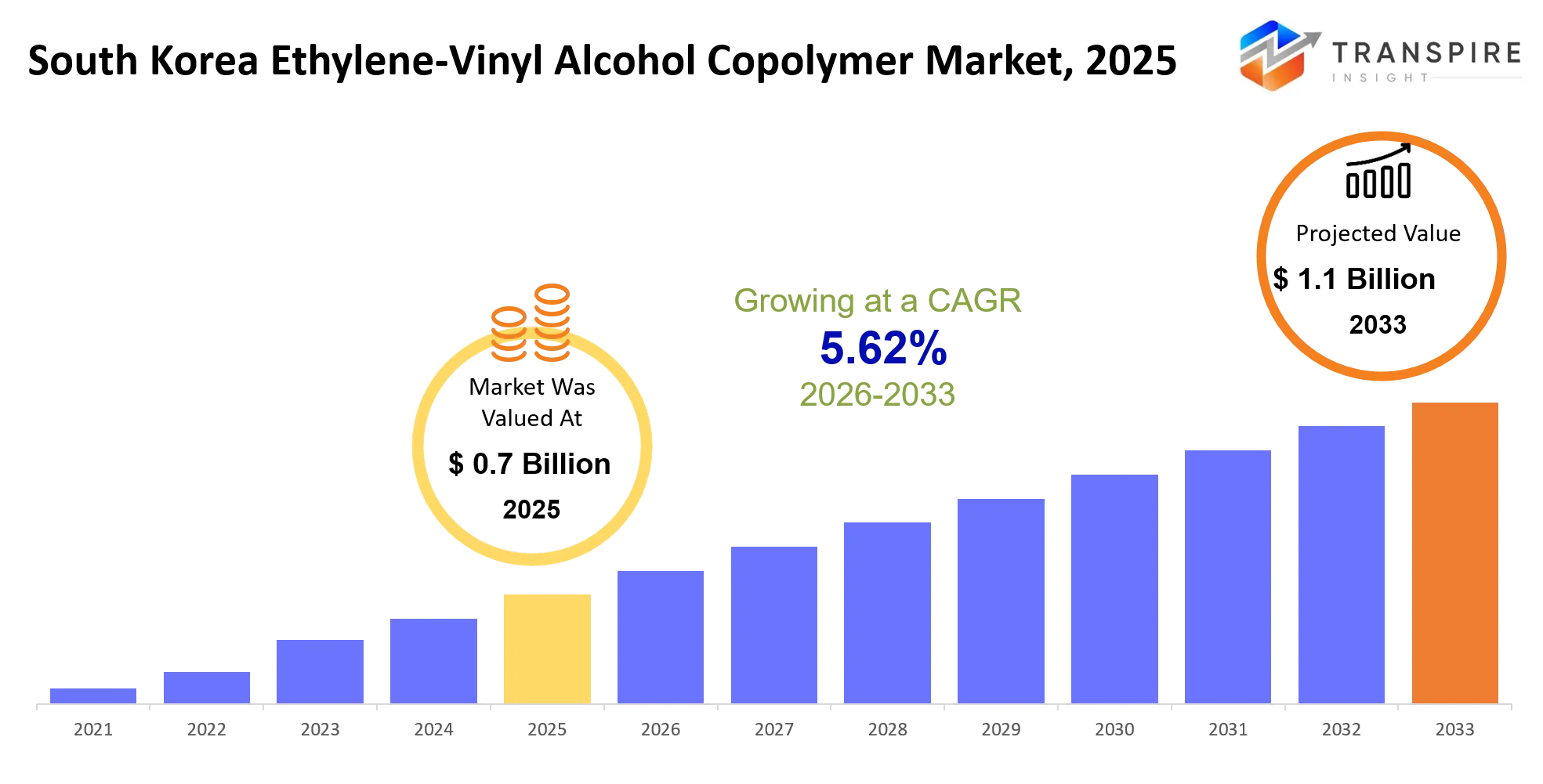
South Korea Ethylene-Vinyl Alcohol Copolymer Market Summary:
According to Transpire Insights, a detailed research report on the market reflects that the packaging application segment dominates the South Korea Ethylene-Vinyl Alcohol Copolymer Market, supported by strong demand for high-barrier materials that extend shelf life and protect packaged products. Kuraray Co., Ltd. leads the global EVOH market with an estimated 29.8% market share in 2025, making it a leading contributor to EVOH market development, innovation, advanced barrier-resin production, expanding manufacturing capabilities, and growth dynamics.
Market Snapshot
- Market Value (2025): USD 0.7 Billion.
- Expected Market Value (2026): USD 0.75 Billion.
- Estimated Market Value (2033): USD 1.1 Billion.
- Forecast CAGR (2026–2033): 5.62%
Introduction
Ethylene,viny alcohol (EVOH) is a flexible and transparent thermoplastic copolymer obtained from polymerizing ethylene and vinyl alcohol monomers. The EVA copolymer industry is a niche within the broad polymer and advanced material industry and is known for its gas barrier properties to protect items that can spoil and keep products fresher longer. The merits of the material's advanced functional and barrier properties benefit the Ethylene-Vinyl Alcohol Copolymer (EVOH) Market of South Korea. Its outstanding gas-barrier quality provides good abilities to resist nitrogen, carbon dioxide, and oxygen, ensuring longer shelf life for food and drugs. Retention of flavors and aromas ensures product quality in relation to odor migration. Resistance to solvents and chemicals allows for use in automotive fuel systems and industrial liners. Clarity and gloss of EVOH help improve the appearance of retail packaging. Furthermore, its chlorine-free composition contributes to sustainability goals and the emergence of new recycling-compatible solutions, which further drives its usage in food, pharmaceutical, automotive, and industrial applications in South Korea.
Key Market Highlights: -
- By product form, the Pellets segment dominated the market and holds nearly 70 % share in 2025 and is projected to grow at a substantial CAGR during the forecast period.
- By application, the Food Packaging segment dominated the market and holds nearly 33 % share in 2025 and is projected to grow at a substantial CAGR during the forecast period.
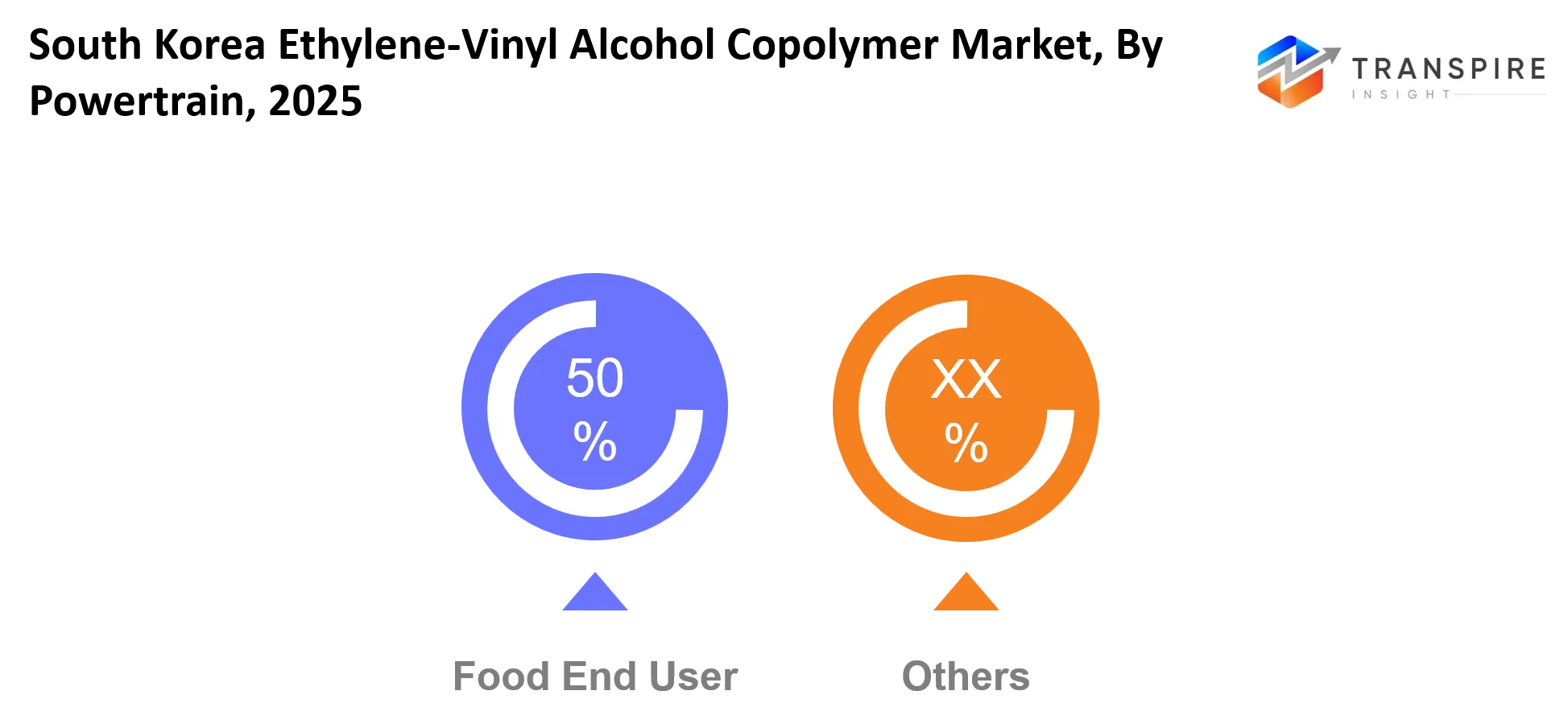
- By end user, the Food & Beverage segment dominated the market and holds nearly 28 % share in 2025 and is projected to grow at a substantial CAGR during the forecast period.
- High-Barrier Packaging & Circular Economy Incentives: The packaging sustainability measures adopted in South Korea have resulted in waste minimization, better recycling, and greater use of resources, thus increasing the demand for high-barrier materials, including EVOH. This leads to the use of high-performance packaging products designed for food, pharmaceutical, cosmetic, and industrial applications due to their high barrier properties.
How is Technology Driving Growth in the South Korea Ethylene-Vinyl Alcohol Copolymer Market?
The South Korea Ethylene-Vinyl Alcohol Copolymer (EVOH) Market is being influenced by advancements in technology, resulting in significant improvements relating to barrier performance, material efficiency, sustainability, and precision. The use of multilayer co-extrusion technology has made it possible to produce thinner EVOH films which offer high oxygen and aroma barriers while helping to lower material usage and transport costs. Advanced molding technology provides users with numerous benefits but most of all effectively solves fuel-permeation issues in various automotive fuel system applications and meeting the demanding requirements associated with emissions. Recyclability, circular economy innovations, and other related technological developments help improve compatibility technologies as well as fulfill the eco-friendly formulation needs of multilayer packages. Digital manufacturing optimization processes incorporate various traditional techniques and technologies like real-time process control, automated quality inspections, and advanced polymers synthesis, which help improve the production process efficiency. All those technologies contribute to the growing popularity of EVOH among consumers from South Korea and their use in various industries including food packaging and healthcare, automotive, and others.
Market Drivers
The increasing need for high-performance barrier materials in automotive and packaging applications drives the demand for ethylene-vinyl alcohol (EVOH) in South Korea. The need for EVOH is also increased by the advancement of global food exports as this material has exceptional properties in the area of preventing oxygen and moisture penetration. The automotive industry creates demand for fuel permeation resistant fuel tanks and co-extruded barrier structures, which contribute to lower emissions. The trend towards sustainability and lightweighting encourages the use of recyclable multilayer packaging and resource-efficient solutions in the automotive manufacturing sector. Furthermore, advancements in multilayer co-extrusion technology, compatibility, and advanced processing facilitate better productivity and barrier performance as well as enhanced utilization of materials and wider application of EVOH in South Korea’s packaging, automotive, healthcare, and industrial sectors. The South Korea Ethylene-Vinyl Alcohol Copolymer (EVOH) market benefits from the superior functional and processing characteristics of this material. Its superior gas barrier properties enable extreme resistance to air, gases, and odors, extending the shelf life of perishables like food products and sensitive applications. Its solvent-resistant properties enable its use in oils, hydrocarbons, and organic solvents; therefore, EVOH can be used in packaging as well as automotive fuel systems. Its chlorine-free composition helps maintain sustainability in packaging solutions and allows for recycling programs. Its optical clarity brings in transparency and aesthetics in packaging. Furthermore, excellent processability of EVOH allows it to be co-extruded along with polyethylene and polypropylene, leading to effective production of multilayered materials. Hence, this has expanded the scope of EVOH applications in flexible packaging and industries such as food, healthcare, automotive, and various others in South Korea.
Restrain
The South Korea Ethylene-Vinyl Alcohol Copolymer (EVOH) market is faced with important restraints which are the high humidity sensitivity that causes the oxygen barrier efficiency to decline and protective multilayer structures to be introduced as a result. The cost sensitivity caused by the high production costs and the volatility of the petrochemical feedstock can limit adoption as well. Moreover, recycling and processing difficulties related to multilayer packaging create economic, technical, as well as regulatory hurdles on the road to sustainable packaging development.
|
Driver |
Relative Impact on Growth (%) |
Geographic Relevance |
Impact Timeline |
Demand Strength |
Growth Mechanism |
Key Beneficiaries |
Major Constraint |
|
Driver 1: Rising Demand for High-Barrier Food Packaging |
28% |
South Korea; Seoul, Gyeonggi, Chungcheong |
Short-term |
High |
Extends shelf life through superior oxygen barriers |
EVOH producers, packaging converters, food manufacturers |
Higher material costs versus conventional packaging polymers |
|
Driver 2: Sustainable & Recycling-Compatible Packaging Development |
24% |
Nationwide; major packaging manufacturing clusters |
Medium-term |
High |
Enables thinner recyclable multilayer packaging structures |
Resin producers, converters, brand owners, recyclers |
Multilayer recycling complexity can restrict adoption |
|
Driver 3: Advanced Co-Extrusion & Multilayer Processing |
20% |
Gyeonggi, Incheon, Chungcheong, Busan |
Short-term |
High |
Improves barrier performance while reducing material usage |
EVOH manufacturers, extrusion equipment suppliers, converters |
Processing complexity requires specialized production capabilities |
|
Driver 4: Automotive Fuel-Permeation & Lightweighting Applications |
15% |
Ulsan, Gyeongnam, Seoul metropolitan region |
Medium-term |
Medium |
Reduces fuel permeation and supports lightweight components |
Automotive OEMs, component suppliers, polymer manufacturers |
EV transition reduces long-term fuel-system demand |
|
Driver 5: Petrochemical Restructuring & Higher-Value Polymer Investment |
13% |
Yeosu, Daesan, Ulsan |
Long-term |
Medium |
Encourages higher-value specialty polymer production investments |
Petrochemical firms, specialty polymer producers, technology providers |
Feedstock restructuring may increase supply-chain volatility |
Analysis of Prices and Consumer Behaviour
The high barrier applications segment has dominated the ethylene-vinyl alcohol copolymer market since its share was expected to reach roughly 25.83 % in 2024 thanks to the rising demand from food, medical and high-quality packaging sectors. The market for barrier resins in Korea was estimated at around USD 387.6 million in 2024 while the total worth of EVOH films used for packaging was thought to amount to USD 5.86 million in 2025. The use of EVOH films in food packaging sectors in Korea made up roughly 86 % of the total volume of EVOH films employed in 2025 due to the necessity to provide good oxygen barrier properties, long shelf life and safeguard the product. The market is influenced by implementation of multilayer EVOH films for the purpose of achieving optimal barrier properties and material efficiency. The purchasing trends among the market participants are oriented toward the necessity of providing high barrier effect, quality of resin and consistency of processing. The purchasing practices of converters and packaging companies imply bulk purchase and long-term contracts in order to ensure stable supply.
Who are the Key Players in the South Korea Ethylene-Vinyl Alcohol Copolymer Market and how do they compete?
The competition in the South Korean Ethylene-Vinyl Alcohol Copolymer Market is influenced by firms that focus on high-barrier plastic technology, the provision of solutions tailored for particular applications, modern operating manufacturing methods, and a robust distribution system in the area. The competition is fostered by the performance of barriers, compatibility with multilayer packaging, sustainable development, material efficiency, as well as processing technology, leading to ongoing development of products by the companies that make it possible for them to enhance shelf life, resistance to packaging, and resource effectiveness.
Kuraray Co., Ltd. solidifies its position with the help of its EVAL™ EVOH technology by developing high-barrier EVOH polymers and multilayer packaging solutions that find usage in food, healthcare, automotive, and industrial applications. Nippon Gohsei Co., Ltd. competes with the help of Soarnol™ EVOH polymers that focus on high gas-barrier performance, processability, and packaging usages. Chang Chun Petrochemical Co., Ltd. is fortifying competition in the region by utilizing progress in polymer materials and incorporating manufacturing technology to implement high-quality packaging solutions.
Top Companies in the South Korea Ethylene-Vinyl Alcohol Copolymer Market
- Kuraray
- Nippon Synthetic Chemical
- Chang Chun Petrochemical
- Mitsubishi Chemical
- SKC
- LG Chem
- LyondellBasell
- Dow
- DuPont
- Mitsui Chemicals
- Sumitomo Chemical
- Asahi Kasei
- Toray Industries
- Toyobo
- KCC
|
Company |
Est. Revenue Share Range |
Key Offerings |
Strategic Positioning |
Geographic Strength |
Technology Focus |
|
Kuraray Co., Ltd. |
20–25% |
EVAL™ EVOH resin; EVAL™ films; high-barrier grades; recyclable packaging solutions |
Global EVOH leadership through premium barrier performance |
Asia Pacific, Europe, North America |
High-barrier EVOH and recyclable multilayer packaging technology |
|
Mitsubishi Chemical Group |
14–18% |
SoarnoL™ EVOH; Soaresin™ compatibilizers; specialty grades; barrier coatings |
Technology-led differentiation and integrated barrier solutions |
Asia Pacific, Europe, North America |
EVOH recycling compatibility and advanced barrier formulations |
|
Chang Chun Petrochemical |
6–9% |
EVOH resins; specialty polymers; barrier materials |
Regional supply scale and polymer portfolio diversification |
Asia Pacific, Southeast Asia |
Polymer synthesis and high-barrier resin manufacturing capabilities |
|
Toray Industries |
4–7% |
EVOH-containing films; multilayer films; high-barrier packaging materials |
Advanced film engineering and packaging diversification |
Asia Pacific, North America, Europe |
Multilayer film engineering and precision barrier processing |
|
Amcor plc |
4–6% |
PP/EVOH/PP structures; barrier trays; high-barrier films |
Integrated packaging solutions with sustainability differentiation |
Asia Pacific, Europe, North America |
Co-extrusion, recyclable structures and barrier packaging |
|
Sealed Air Corporation |
3–5% |
CRYOVAC® EVOH films; recycle-ready laminates; barrier packaging |
Application-led food packaging and barrier specialization |
Asia Pacific, North America, Europe |
EVOH barrier films and recycle-ready packaging architectures |
|
Mondi Group |
2–4% |
Barrier films; flexible packaging; multilayer structures |
Sustainable flexible packaging and material efficiency |
Europe, Asia Pacific, North America |
Lightweight multilayer films and recyclable packaging structures |
|
Berry Global |
2–4% |
Barrier films; flexible packaging; EVOH-based structures |
Large-scale packaging conversion and product diversification |
North America, Europe, Asia Pacific |
Advanced film extrusion and multilayer barrier structures |
|
Winpak Ltd. |
1–3% |
EVOH high-barrier films; vacuum pouches; shrink bags |
Specialized high-barrier food packaging solutions |
North America, Asia Pacific |
Thermoforming, co-extrusion and EVOH barrier packaging |
|
Toppan Holdings / Toppan |
1–3% |
High-barrier films; multilayer packaging; functional barrier materials |
Premium packaging technology and regional customer integration |
Asia Pacific, Europe, North America |
Functional films and high-performance barrier packaging technologies |
South Korea Ethylene-Vinyl Alcohol Copolymer Market Segmentation
The South Korea Ethylene-Vinyl Alcohol Copolymer Market share is divided into five categories: By ethylene content, product form, application, end user and processing.
The Pellets dominated the market, accounting for nearly 70% in 2025 and is expected to rise at a significant CAGR during the forecast period.
The South Korea Ethylene-Vinyl Alcohol Copolymer Market is segmented by product form into Pellets, Films, Sheets, Bottles, Tubes, Coatings, Multilayer Structures. Among these, the Pellets segment dominated the market, accounting for nearly 70% in 2025 and expected to increase at a significant CAGR during the forecast period. In 2025, the pellets segment occupied the largest share of the South Korea Ethylene-Vinyl Alcohol Copolymer (EVOH) Market, contributing approximately 70% due to the ease of use, effective storage, consistent processing and compatibility with traditional polymer production machinery. EVOH pellets are useful in film multi-layering and co-extrusion processes, and the increasing demand for high-barrier packaging and special-purpose polymers boosts the segment.
The Food Packaging dominated the market, accounting for nearly 33% in 2025, and is expected to rise at a significant CAGR during the forecast period.
The South Korea Ethylene-Vinyl Alcohol Copolymer Market is segmented by application into Food Packaging, Pharmaceutical Packaging, Barrier Films, Bottles, Automotive, Medical Devices, Industrial Packaging. Among these, the Food Packaging segment dominated the market, accounting for nearly 33% in 2025 and expected to increase at a significant CAGR during the forecast period. The South Korea Ethylene-Vinyl Alcohol Copolymer (EVOH) Market was led by the food packaging segment in 2025, with about 33% market share on account of the rising need for high-barrier packaging that keeps food from oxygen, moisture, and aroma migration. EVOH plays a role in improving the shelf life of products and makes packaging efficient, while rising demand for processed food and multilayer packaging technology boosts the demand for this segment.
The Food & Beverage dominated the market, accounting for nearly 28% in 2025 and is expected to rise at a significant CAGR during the forecast period.
The South Korea Ethylene-Vinyl Alcohol Copolymer Market is segmented by end user into nutraceutical companies, food manufacturers, beverage companies, cosmetic companies, pharmaceutical companies, ingredient suppliers, contract manufacturers, others. Among these, the Food & Beverage segment dominated the market, accounting for nearly 28% in 2025 and expected to increase at a significant CAGR during the forecast period. In the year 2025, the South Korea Ethylene-Vinyl Alcohol Copolymer (EVOH) market was led by the Food & Beverage Industry, which held close to 28% share due to the rising demand for high-barrier packaging. It is noted that the performance of EVOH as a barrier against oxygen and aroma helps in ensuring longer shelf life of products. The growth in the demand for packaged food and improved multilayer packaging techniques have further contributed in boosting the demand in the Food & Beverage segment.
Future Market Trends for the South Korea Ethylene-Vinyl Alcohol Copolymer Market: -
- Sustainable and Level Packing: The change in consumer behavior towards solid, responsible packing is encouraging the use of EVOH over other packing types.
- Technology developments: New techniques in the co-extrusion of multilayer films are permitting thinner films that provide a better oxygen and gas barrier than other methods.
- Automotive and Industry: The rising local demand for light-weight car parts and the need to prevent vapor formation in the case of plastic fuel tanks makes the production of EVOH and adhesive in South Korea very appealing.
- Prices of raw material: The prices in the region are affected by the fluctuations of the cost of ethylene and naphtha as well as the process of producing crackers in the Asia-Pacific region.
Recent Development
- In September 2026: The merger of HD Hyundai Chemical and Lotte Daesan Petrochemical, H&L Advanced, officially started its operations. The company is aiming to decrease the Daesan NCC production capacity by 1.1 million tons in a period of time of three years and improve the production process of high-end, environmentally-friendly chemicals, which can have an effect on the feedstock for the petrochemical sector and downstream market of modern polymer and copolymer materials in South Korea, among others in terms of EVOH production applications.
- In July 2026: Government officials in South Korea passed a restructuring plan for a petrochemical facility at Yeosu, aiming to reduce an average of 1.39 million tonnes of ethylene production per year while ensuring that a more valuable and eco-friendly range of chemicals would be produced. The implementation of this measure might bring about fertilizer feedstock availability, logistics convenience, and advance the polymer field of applications and EVOH production.
Market Segment
This study forecasts revenue at South Korea, regional and country levels from 2020 to 2033. Transpire Insights has segmented the South Korea Ethylene-Vinyl Alcohol Copolymer Market based on the below-mentioned segments:
South Korea Ethylene-Vinyl Alcohol Copolymer Market, By Ethylene Content
- Below 29%
- 29–35%
- 35–38%
- 38–44%
- Above 44%
- Low Ethylene
- High Ethylene
South Korea Ethylene-Vinyl Alcohol Copolymer Market, By Product Form
- Pellets
- Films
- Sheets
- Bottles
- Tubes
- Coatings
- Multilayer Structures
South Korea Ethylene-Vinyl Alcohol Copolymer Market, By Application
- Food Packaging
- Pharmaceutical Packaging
- Barrier Films
- Bottles
- Automotive
- Medical Devices
- Industrial Packaging
South Korea Ethylene-Vinyl Alcohol Copolymer Market, By End User
- Food & Beverage
- Pharmaceutical
- Household
- Personal Care & Cosmetics
- Industrial
- Automotive
- Electronics
South Korea Ethylene-Vinyl Alcohol Copolymer Market, By Processing
- Extrusion
- Co-Extrusion
- Injection Molding
- Blow Molding
- Thermoforming
- Lamination, Coating
Frequently Asked Questions
Find quick answers to common questions.
High-barrier packaging demand, food exports, shelf-life requirements, automotive applications, sustainability initiatives, and advanced multilayer technologies drive market growth.
Pellets dominate with nearly 70% share in 2025, supported by efficient handling, storage, consistent processing, and manufacturing compatibility.
Food Packaging leads with nearly 33% share in 2025, driven by strong oxygen, aroma, and gas-barrier requirements.
Key players include Kuraray, Nippon Synthetic Chemical, Chang Chun Petrochemical, Mitsubishi Chemical, SKC, LG Chem, Dow, and Mitsui Chemicals.
Sustainable packaging, multilayer co-extrusion, lightweight automotive applications, recycling-compatible structures, digital manufacturing, and raw-material price fluctuations shape market development
- Kuraray
- Nippon Synthetic Chemical
- Chang Chun Petrochemical
- Mitsubishi Chemical
- SKC
- LG Chem
- LyondellBasell
- Dow
- DuPont
- Mitsui Chemicals
- Sumitomo Chemical
- Asahi Kasei
- Toray Industries
- Toyobo
- KCC
About the Authors

Pankaj Ghogare Patil
I am Pankaj Ghogare Patil, a Senior Research Analyst at Transpire Insight, specializing in the Pharmaceutical, Chemicals & Materials, Healthcare IT, and Biotechnology industry. My expertise lies in conducting comprehensive market research, analyzing industry trends, evaluating competitive landscapes, and translating complex data into actionable insights. At Transpire Insight, I closely follow emerging technologies, regulatory developments, and market innovations to create accurate, well-researched, and informative content that helps businesses and professionals make informed decisions. I am committed to producing credible, evidence-based articles that reflect industry best practices while making technical topics accessible and valuable for a broad audience.

Chakradhar Khansole
Chakradhar serves as the Research Director at Transpire Insight, bringing over 8 years of experience in technology, innovation, and strategic market intelligence. He specializes in transforming complex market data into actionable business insights that enable organizations to make informed, growth-oriented decisions. Recognized for his strategic vision and analytical expertise, Chakradhar leads high-impact research initiatives, delivering comprehensive market assessments, competitive intelligence, and forward-looking industry analysis.
Recently Published Reports
-
May 2026
Healthcare Polymer Packaging Market
Healthcare Polymer Packaging Market Size, Share & Analysis Report By Packaging Type (Syringes, IV Bottles and Pouches, Clamshells, Blisters, Bottles & Jars, Containers, Tubes, IV Parental Packaging, Others), By Type (Regulated, Non-regulated), By Polymer Type (LDPE (Low-Density Polyethylene), HDPE (High-Density Polyethylene), Homo-polymer (Homo), Random Copolymer (Random), Block Copolymer (Block), PET, Polystyrene, Polyvinyl Chloride, Polyamide/EVOH, Others), and Geography (North America, Europe, Asia-Pacific, Middle East and Africa, South and Central America), 2021 - 2031
-
Apr 2026
Hydrophilic Tape (Waterstop) Market
Hydrophilic Tape (Waterstop) Market Size, Share & Analysis Report By Type (Bentonite-Based Hydrophilic Tape, Rubber-Based Hydrophilic Tape), By Application (Residential Buildings, Commercial Buildings, Infrastructure Projects), and Geography (North America, Europe, Asia-Pacific, Middle East and Africa, South and Central America), 2021 - 2031
-
Apr 2026
Metalens Market
Metalens Market Size, Share & Analysis Report By Type (Visible Light Metalens, and Infrared Metalens), By Application (Consumer Electronics, Automotive Electronics, Industrial, Medical, and Others), and Geography (North America, Europe, Asia-Pacific, Middle East and Africa, South and Central America), 2021 - 2031
-
Apr 2026
PBT Resin Market
PBT Resin Market Size, Share & Analysis Report By Type (Reinforced PBT Resin, Unreinforced PBT Resin), By Processing Method (Injection Molding, Extrusion, Blow Molding, Others), By End-User (Automotive, Electrical & Electronics, Consumer Appliances, Industrial Machinery, Medical Devices, Packaging, Others), and Geography (North America, Europe, Asia-Pacific, Middle East and Africa, South and Central America), 2021 - 2031