
Frozen Food Packaging Market Summary:
According to Transpire Insights, a detailed research report on the market reflects that the Modified Atmosphere Packaging application segment dominates the Frozen Food Packaging Market, accounting for approximately 48% of the total share worldwide. Amcor plc leads the market with approximately (around USD 15.6 billion) in annual revenue and an estimated 12–16% global market share, making it a leading contributor to global market development, innovation, advanced frozen food packaging production, expanding manufacturing capabilities, and growth dynamics.
Market Snapshot
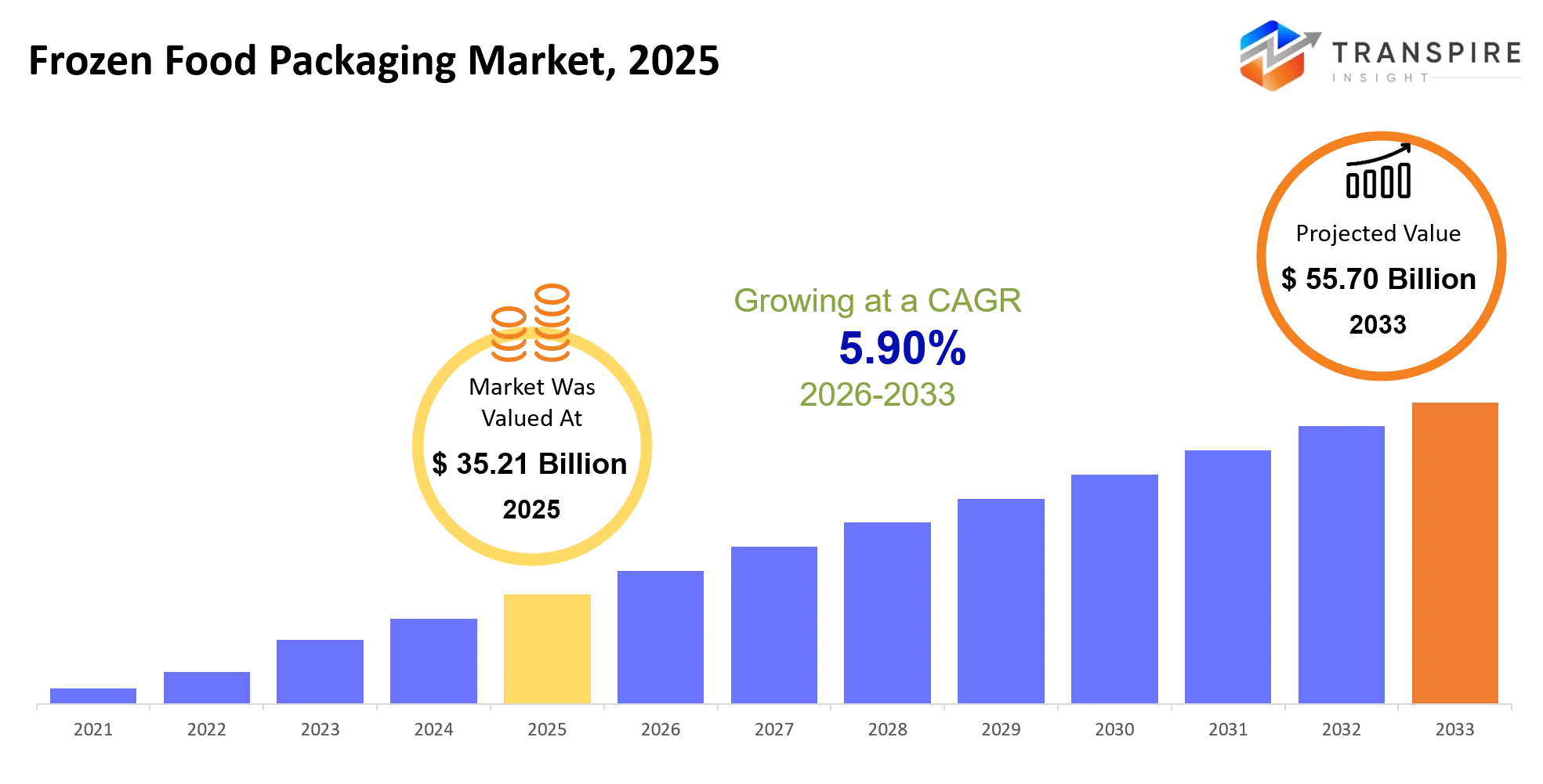
- Global Market Value (2025): USD 35.21 Billion.
- Expected Market Value (2026): USD 37.29 Billion.
- Estimated Market Value (2033): USD 55.70 Billion.
- Forecast CAGR (2026–2033): 5.90%
- Leading Region in 2025: Europe
- Second-largest Region: North America
- Fastest Growing Region: Asia Pacific
Introduction
The term Frozen Food packaging refers to the sector in the whole packaging industry that is responsible for producing specialized packages, films and wraps that are able to resist freezing temperature and preserve food items stored in these packages. Frozen Food Packaging refers to the specialized material systems used for packaging food items. Frozen food packaging plays a vital role in providing effective performance within the cold-chain system. It helps reduce the negative effects of freezer burn since it limits moisture loss and ice-crystal formation resulting in the retention of product quality. The use of innovative packaging materials results in effective barriers against biological, chemical, and environmental contaminants which is crucial for ensuring food safety. In addition, high-performance packaging allows for extending shelf life due to the retention of quality features of the product including tastes, nutrients, and overall freshness while decreasing food waste. Packaging technologies undergo a lot of advancements as packaging keeps performing well during the whole process of storing, handling, and getting rid of products at temperature below zero. Finally, new technologies that support the trend towards sustainability are gaining popularity as many companies turn to the usage of recycled products for frozen food packaging samples.
For instance:-The Frozen Food Packaging Market in North America invests mainly in environmentally friendly biodegradable materials and flexible packaging. This trend is attributed to stringent regulations and plastic bans, as well as the increasing demand for easy-to-eat frozen food by consumers.
Market Highlights: -
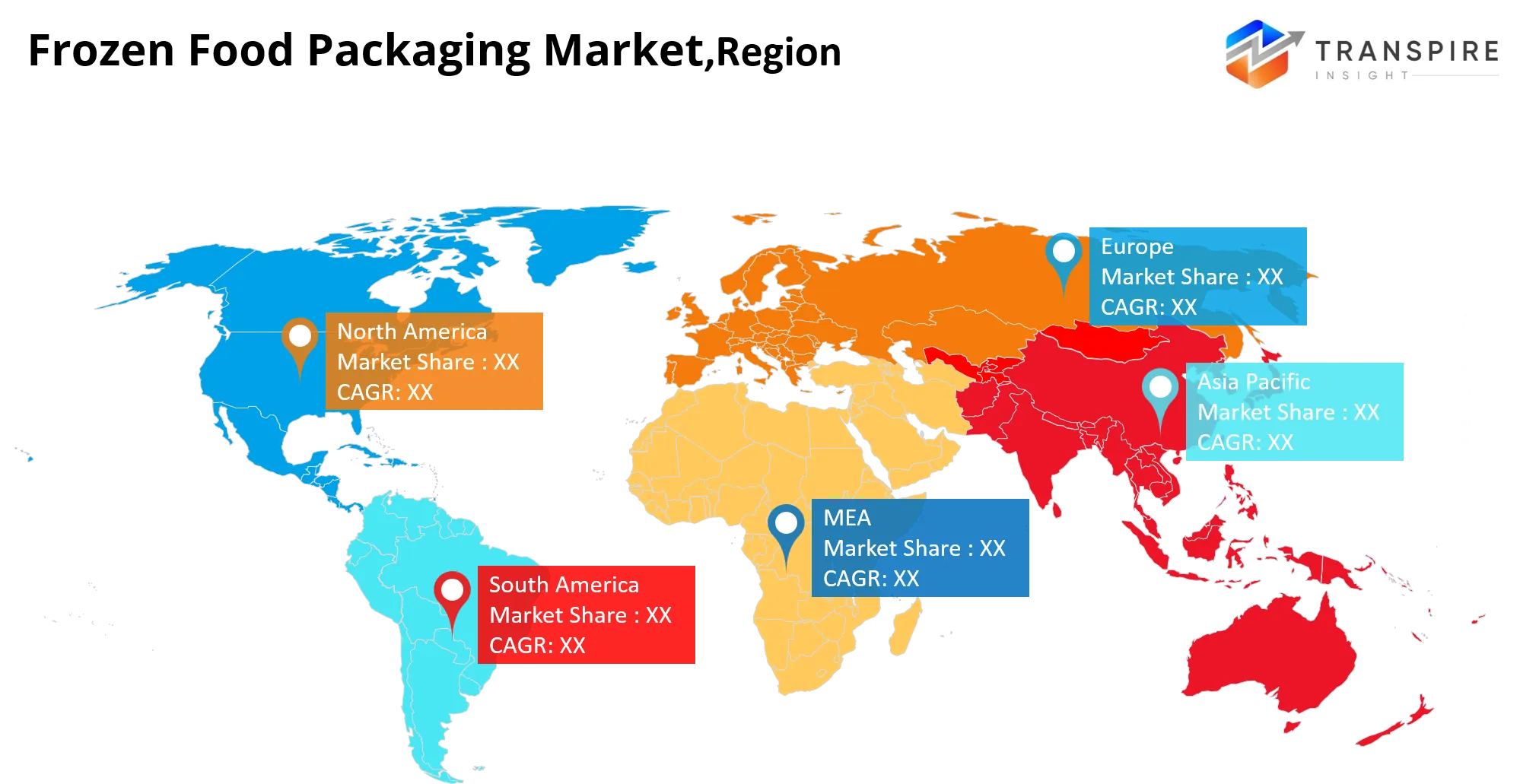
- Europe is anticipated to hold almost 37% share of the Frozen Food Packaging Market over the predicted timeframe.
- North America is expected to grow at a rapid CAGR in the Frozen Food Packaging Market by holding almost35% of the share during the forecast period.
- Asia Pacific is anticipated to hold almost20% share of the Frozen Food Packaging Market over the predicted timeframe.
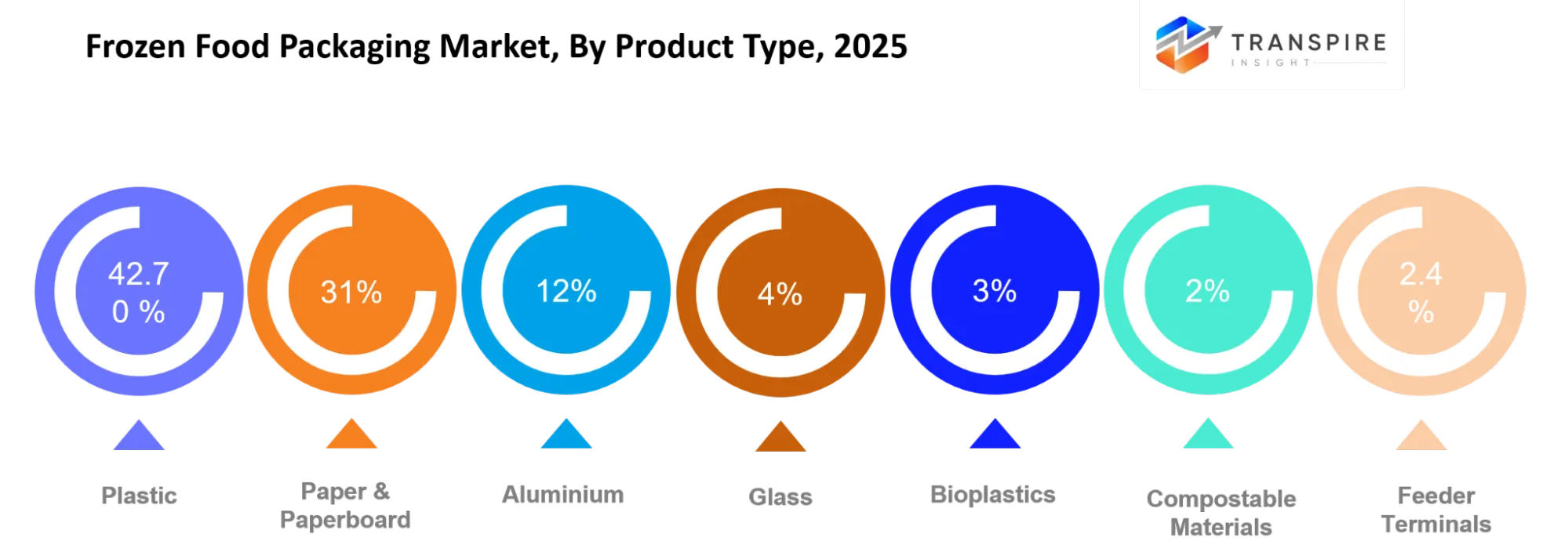
- By material, the Plastic segment dominated the market and holds nearly 41% share in 2025 and is projected to grow at a substantial CAGR during the forecast period.
- By end user, the Retailers segment dominated the market and holds nearly 55% share in 2025 and is projected to grow at a substantial CAGR during the forecast period.
- By technology, the Modified Atmosphere Packaging segment dominated the market and holds nearly 48% share in 2025 and is projected to grow at a substantial CAGR during the forecast period.
- The Pradhan Mantri Kisan SAMPADA Yojana (PMKSY) assists the frozen food packaging industry in India by making cold chain and value addition facilities stronger. Financial support reaches up to ₹10 crores for each project for cold storage and packing, freezing, and refrigerated transport, thus helping preserve frozen foods and enhancing distribution efficiency of frozen food, as well as providing help in eliminating post-harvest losses.
How is Technology Driving Growth in the Frozen Food Packaging Market?
The Frozen Food Packaging Market is seeing advancements in technology that lead to greater preservation of food, ease of use, automation of operations, and better sustainability practices. For example, advanced technologies such as high-barrier laminates, Modified Atmosphere Packaging (MAP), and active scavenging films minimize the loss of moisture, oxidation, freezer burn, and waste of food. Besides, microwave-safe and oven-ready packaging types and resealable closures make it easier for consumers to use such products in portions. Automation technologies, including multi-head weighers and IoT-enabled sensors, improve the accuracy of the packaging process and allow controlling the temperature in the cold chain in real time. Moreover, integration with quick commerce offers an efficient delivery of frozen food. Innovations focused on sustainability, such as recyclable mono-materials, paper-based solutions, and biodegradable films, are continuing to develop as manufacturers are getting to comply with the regulations in the field of environmental protection, decrease the amount of packaging waste, and meet the needs of customers in the eco-friendly solutions for frozen food packages.
|
Report Metrics |
Details |
|
Market size value in 2025 |
USD 35.21 Billion |
|
Market size value in 2026 |
USD 37.29 Billion |
|
Revenue forecast in 2033 |
USD 55.70 Billion |
|
Growth rate |
CAGR of 5.90% from 2026 to 2033 |
|
Base year |
2025 |
|
Historical data |
2021 - 2024 |
|
Forecast period |
2026 - 2033 |
|
Report coverage |
Revenue forecast, competitive landscape, growth factors, and trends |
|
Regional scope |
United States; Canada; Mexico; United Kingdom; Germany; France; Italy; Spain; Denmark; Sweden; Norway; China; Japan; India; Australia; South Korea; Thailand; Brazil; Argentina; South Africa; Saudi Arabia; United Arab Emirates |
|
Key company profiled |
Amcor, Mondi, Sealed Air, Sonoco Products, Huhtamaki, International Paper, WestRock, Berry Global, Winpak, Coveris, UFlex, Pactiv Evergreen, Graphic Packaging, DS Smith, Smurfit Westrock |
|
Customization scope |
Free report customization (country, regional & segment scope). Avail customized purchase options to meet your exact research needs. |
|
Report Segmentation |
By Material (Plastic, Paper & Paperboard, Aluminium, Glass, Bioplastics, Compostable Materials, Foil, Others); By Packaging Type (Rigid, Flexible, Pouches, Bags, Trays, Boxes & Cartons, Containers, Others); By Food Type (Fruits & Vegetables, Ready-to-eat Products, Dairy Products, Meat, Poultry & Seafood, Bakery & Confectionery, Frozen Desserts, Others); By Plastic Type (PE, PET, PP, PS, PVC, EVOH, Bioplastics, Others); By Packaging Format (Wraps, Films, Pouches, Bags, Trays, Cartons, Tubs & Cups, Others); By End User (Food Manufacturers, Retailers, Foodservice, Restaurants, Supermarkets, Convenience Stores, E-commerce, Others); By Technology (Modified Atmosphere Packaging, Vacuum Packaging, Active Packaging, Intelligent Packaging, Retort Packaging, Thermoforming, Sealing, Others) |
Market Drivers
The growth of the Frozen Food Packaging Market is fueled by urbanization and hectic lifestyles, which have led to an increased interest in buying convenient and quick meals. The quick-commerce industry and development of cold-chain technologies have resulted in delivering goods more efficiently. Different packaging technologies help keep the food fresh for a longer time, minimize wastage, and prevent any bacteria spoilage and freezer burn. Also, trends related to sustainable development are triggering the use of recyclable single-materials, eco-friendly fiber packaging, and light packaging solutions. In addition, advancements in the use of technologies such as Modified Atmosphere Packaging (MAP) are making it possible to keep food fresh without using chemical preservatives. Frozen food packaging is vital, as it aids in ensuring product preservation, safety, and improving supply chain operations. It extends shelf-life by controlling moisture loss, freezer burn, oxidation, and deterioration of quality. Properly designed packaging creates protective barriers against all types of pollution, helping with compliance with food safety requirements. Moreover, advanced packaging materials preserve nutritional quality while eliminating the need to use chemical preservatives. Flexible pouches reduce packaging weight and volume, thus providing logistics improvements too. In addition, advanced packaging technologies make use of indicators and monitoring solutions that allow tracing condition of products.
For Instance: - The growth of the Russian frozen food packaging sector has been spurred on by the expanded call for ready-made food products, convenience foods and domestically produced products. In spite of disruptions caused by national conflicts, technology is being heavily invested in the use of modern packaging solutions, cold chain solutions with multiple temperature zones and recyclable flexible polymers.
The South African frozen foods packaging market is being driven by the increasing demand for convenience meals as well as improvements in the cold chain. The emphasis of strategic investments is on sustainable mono-material films and advanced packaging to abide by the law as well as extend shelf life.
Restrain
The Frozen Food Packaging Market is troubled by high prices for materials, especially for modern barrier technologies, and fluctuations in the price of raw materials. Stringent environmental laws aimed at plastic waste and polystyrene increase pressure to comply with regulations. Consumers tend to believe fresh food is better than frozen, which slows down the adoption of frozen food. Furthermore, the absence of a proper cold chain increases the risks of freezer burn, spoilage, and product degradation, which impedes market growth.
|
Driver |
Relative Impact on Growth (%) |
Geographic Relevance |
Impact Timeline |
Demand Strength |
Growth Mechanism |
Key Beneficiaries |
Major Constraint |
|
Driver 1: Rising Demand for Convenient Frozen Foods |
30% |
North America, Europe, Asia-Pacific |
Short-term |
High |
Expands packaged frozen-food consumption across retail channels. |
Frozen-food brands, packaging converters, retailers, consumers |
Consumer preference shifts toward fresh alternatives. |
|
Driver 2: Growth of Flexible and High-Barrier Packaging |
25% |
North America, Europe, Asia-Pacific |
Medium-term |
High |
Lightweight formats improve protection, logistics, and freezer efficiency. |
Flexible converters, film producers, food manufacturers, retailers |
Resin price volatility increases packaging production costs. |
|
Driver 3: Cold-Chain, E-Commerce and Quick-Commerce Expansion |
20% |
Asia-Pacific, North America, Europe |
Short-term |
High |
Requires durable packaging throughout temperature-controlled distribution networks. |
Cold-chain operators, packaging suppliers, online grocers, brands |
Inadequate cold-chain infrastructure limits market penetration. |
|
Driver 4: Sustainability Regulations and Recyclable Packaging Adoption |
15% |
Europe, North America, Asia-Pacific |
Medium-term |
High |
Regulatory pressure accelerates recyclable mono-material and fiber solutions. |
Sustainable-material suppliers, converters, food brands, recyclers |
Sustainable alternatives often carry higher production costs. |
|
Driver 5: Advanced Packaging Technologies and Automation |
10% |
North America, Europe, Asia-Pacific |
Long-term |
Medium |
MAP, smart sensors, automation improve shelf-life and efficiency. |
Technology vendors, automated-packaging firms, processors, retailers |
High capital requirements slow technology adoption rates. |
Analysis of Prices and Consumer Behaviour
At present time, it is evident that plastic packaging is leading the market for frozen foods (accounting for 47.14% of the total market in the year 2026; due to the characteristics such as strength, lightness, cost efficiency and protection from external elements). The high price of packaging proved to have better barrier performance than the conventional one because it requires innovative design features and construction to be made from the new materials and technologies aimed at meeting the consumers' needs in moisture, oxygen and temperature resistance. In 2026 about 65.97% of the market will be encompassed by flexible packaging. Flexible formats such as bags and pouches promote the sales as they provide great flexibility in terms of frozen food applications and their usage in storage and transportation. At the same time, about 34.98% of money of flexible frozen food packaging comes from bags and pouches sold in 2025. Consumer purchase facts indicate that 55% of consumers always consider the importance of product packaging being strong, protected and made from quality materials. 33% of consumers conclude that bulk purchasing is the best idea to avoid problems with purchasing frozen foods that need to be sold timely and regularly in different countries.
|
Investment Factor |
Why It Matters to Investors |
Opportunity |
Investment Implication |
|
Flexible & High-Barrier Packaging Expansion |
Improves product protection while reducing packaging weight. |
Invest in films, pouches, lidding and barrier structures. |
Supports scalable manufacturing and recurring B2B demand. |
|
Sustainable Packaging Transition |
Regulations and customer requirements are accelerating material substitution. |
Develop recyclable mono-materials, fiber formats and reduced-plastic solutions. |
Creates differentiation and premium product opportunities. |
|
Cold-Chain & E-Commerce Development |
Frozen-food distribution requires packaging resilient to temperature and handling stresses. |
Supply packaging optimized for delivery, retail and cold-chain logistics. |
Expands addressable customers across emerging distribution networks. |
|
MAP, Vacuum & Active Packaging |
Preservation technologies can extend shelf life and reduce food losses. |
Develop MAP films, vacuum formats and active packaging systems. |
Creates higher-value technology-driven packaging opportunities. |
|
Automation & Production Efficiency |
Automated packaging reduces labor dependency and improves throughput consistency. |
Invest in automated filling, sealing, thermoforming and inspection solutions. |
Enables operational scalability and manufacturing-cost optimization. |
|
Asia-Pacific Market Expansion |
Rising frozen-food consumption and developing cold chains support packaging demand. |
Target India, China, Japan, South Korea and Southeast Asian markets. |
Provides medium- and long-term geographic expansion potential. |
Who are the Key Players in the Frozen Food Packaging Market and how do they compete?
Dynamic competition within the global Frozen Food Packaging Market hinges on businesses that apply innovative sustainable packaging, advanced barrier technologies, proper cold-chain conditions, and globally extensive distribution network. The competition exists based on not only cost but also on recyclable products, freezer-proof designs, Modified Atmosphere Packaging (MAP), flexible pouches, fiber-based packaging products, and packaging solutions to prolong the shelf life of food, thus ensuring food safety, convenience, and efficiency of the supply chain. These principles of productivity help the companies develop their products systematically.
The development of recyclable flexible packaging, high-barrier films, and advanced packaging technologies gives Amcor a competitive edge in the market. Sealed Air uses CRYOVAC branded food packaging solutions as well as recyclable pouches and technologies to ensure food protection and effective packaging, thus being different on the market. Mondi creates a baseline for building competitive capacity with the help of recyclable paper-based packaging solutions for frozen food products.
Top Companies in the Frozen Food Packaging Market
- Amcor
- Mondi
- Sealed Air
- Sonoco Products
- Huhtamaki
- International Paper
- WestRock
- Berry Global
- Winpak
- Coveris
- UFlex
- Pactiv Evergreen
- Graphic Packaging
- DS Smith
- Smurfit Westrock
|
Company |
Est. Revenue Share Range |
Key Offerings |
Strategic Positioning |
Geographic Strength |
Technology Focus |
|
Amcor plc |
5–7% |
Frozen films, laminates, pouches, trays, containers, lidding |
Global scale with integrated packaging portfolio |
North America, Europe, Asia-Pacific |
Advanced films, barrier structures, recyclable materials |
|
Sealed Air Corporation |
4–6% |
CRYOVAC® films, vacuum packaging, food pouches, shrink solutions |
Food-protection and automation-led differentiation |
North America, Europe, Asia-Pacific |
Vacuum skin, barrier films, automation, material efficiency |
|
Sonoco Products Company |
4–5% |
Paperboard cartons, rigid containers, trays, flexible packaging |
Diversified packaging with sustainable solutions |
North America, Europe, Asia-Pacific |
Barrier packaging, rigid formats, automation |
|
Mondi plc |
3–5% |
Frozen-food cartons, bags, films, paper-based packaging |
Integrated paper-to-packaging sustainability strategy |
Europe, North America, Asia-Pacific |
Recyclable mono-materials, barrier paper, lightweighting |
|
Huhtamaki Oyj |
3–4% |
Flexible films, paperboard packaging, trays, food containers |
Sustainable food-packaging diversification |
Europe, North America, Asia-Pacific |
Mono-materials, fiber packaging, flexible structures |
|
Smurfit Westrock |
2–4% |
Frozen-food cartons, pizza packaging, corrugated boxes, trays |
Fiber-based substitution and supply-chain efficiency |
North America, Europe, Latin America |
Moisture-resistant paperboard, automation, fiber engineering |
|
Graphic Packaging Holding Company |
2–3% |
Folding cartons, paperboard packaging, frozen-food cartons, multipacks |
Paperboard specialization and branded-food solutions |
North America, Europe, Asia-Pacific |
Barrier coatings, high-resolution printing, microwave performance |
|
ProAmpac |
2–3% |
Frozen-food rollstock, pouches, recyclable films, lidding |
Flexible packaging and sustainability specialization |
North America, Europe, Asia-Pacific |
Recyclable PE films, extrusion, laminations, venting |
|
Winpak Ltd. |
1–2% |
Flexible films, lidding, trays, vacuum packaging |
Food-focused specialty packaging provider |
North America, Europe |
Barrier films, thermoforming, lidding, vacuum packaging |
|
SÜDPACK |
1–2% |
High-barrier films, pouches, vacuum packaging, recyclable films |
Premium high-performance flexible packaging |
Europe, North America, Asia-Pacific |
High-barrier films, recyclable structures, vacuum technology |
Market Segmentation
The Frozen Food Packaging Market share is divided into seven categories: By material, packaging, food, plastic, packaging format, end user and technology.
The Plastic dominated the market, accounting for nearly 41% in 2025 and is expected to rise at a significant CAGR during the forecast period.
The Frozen Food Packaging Market is segmented by material into Plastic, Paper & Paperboard, Aluminium, Glass, Bioplastics, Compostable Materials, Foil, Others. Among these, the Plastic segment dominated the market, accounting for nearly 41% in 2025 and expected to increase at a significant CAGR during the forecast period. In 2025, plastic held the largest market share of almost 41%, thanks to its lightweight, durable, and inexpensive material, which is used in many applications including automotive industry, packaging, construction, and consumer goods. An increase in demand for environmentally-friendly and recyclable plastic solutions and breakthroughs in technology enabling improved manipulation of the material are among the factors that contribute to this trend in the coming years.
The Retailers dominated the market, accounting for nearly 55% in 2025, and is expected to rise at a significant CAGR during the forecast period.
The Frozen Food Packaging Market is segmented by end user into Food Manufacturers, Retailers, Foodservice, Restaurants, Supermarkets, Convenience Stores, E-commerce, Others. Among these, the Retailers segment dominated the market, accounting for nearly 55% in 2025 and expected to increase at a significant CAGR during the forecast period. Retailers were the major players in the market, holding almost 55% in 2025 as they benefitted from their extensive reach to customers, excellent distribution networks, ease of access to products, and preference for retailers from consumers. The growing usage of digital retailing, omnichannel approaches, personalized shopping experiences, and development of retail infrastructure is also facilitating the growth in the market and increasing the presence of retailers in the concerned period.
The Modified Atmosphere Packaging dominated the market, accounting for nearly 48% in 2025 and is expected to rise at a significant CAGR during the forecast period.
The Frozen Food Packaging Market is segmented by technology into Modified Atmosphere Packaging, Vacuum Packaging, Active Packaging, Intelligent Packaging, Retort Packaging, Thermoforming, Sealing, Others. Among these, the Modified Atmosphere Packaging segment dominated the market, accounting for nearly 48% in 2025 and expected to increase at a significant CAGR during the forecast period. The market was led by Modified Atmosphere Packaging, representing about 48% in 2025, due to its ability to prolong shelf life, protect product quality, decrease oxidation, and control microbial growth. The growth in demand for fresh and minimally-processed food products along with the rise in strict food safety requirements, and increase in packaged food consumption are contributing towards the growth in adoption of such solutions in the food sector.
Regional Segment Analysis of the Frozen Food Packaging Market:
- North America (U.S., Canada, Mexico)
- Europe (Germany, France, U.K., Italy, Spain, Rest of Europe)
- Asia-Pacific (China, Japan, India, Rest of APAC)
- South America (Brazil and the Rest of South America)
- The Middle East and Africa (UAE, South Africa, Rest of MEA)
Europe is expected to grow at a rapid CAGR in theFrozen Food Packaging Market, holding almost 37% of the share during the forecast period.
Europe is expected to grow at a rapid CAGR in the Frozen Food Packaging Market holding almost 37% share during the forecast period. During the forecast period, Europe is expected to show high CAGR growth in the Frozen Food Packaging Market, with a share of nearly 37%, owing to rising frozen food consumption, new retail and e-commerce channels, improved number of cold chain operations, and increased interest in quick packaging solutions. The companies in the frozen food packaging industry will create more recyclable materials and will develop sustainable practices to ensure more environmentally-friendly operations.
North America is the fastest-growing region in the Frozen Food Packaging Market during the period, holding almost 35% share.
North America is expected to grow at a rapid CAGR in the Frozen Food Packaging Market holding almost 35% share during the forecast period. The Frozen Food Packaging Market is rapidly growing in North America, which has nearly one third share in terms of revenue generated by frozen food consumption and retail and foodservice sectors that are developing with advanced cold-chain technologies and rising demand of consumers for convenience. Introduction of eco-friendly, recyclable, high quality packaging technologies adds to the revenues of this regional segment as the growth of the frozen food packaging market continues in the near future.
Asia Pacific is the fastest-growing region in the Frozen Food Packaging Market during the period, holding almost 20% share.
Asia Pacific is the fastest-growing region in the Frozen Food Packaging Market during the forecast period, holding almost 20% share during the forecast period. The Asia Pacific region has become the fastest growing region in the frozen food packaging market with a share of nearly 20%. This growth is the result of increasing urbanization, improvement in disposable income, greater retail infrastructure, and increase in demand for easy to consume frozen food. Increasing investment in cold chain logistics, food processing, and sustainable packaging technologies is also driving the growth of the market in emerging economies.
Strategies for Market Growth in Non-Leading Regions:
The growth of non-leading markets through efficient and flexible frozen food packaging technologies would help small to medium-sized food packaging companies. Local sourcing of materials for packaging and the establishment of cold food packaging production sites would reduce reliance on imports and cut production costs. Partnerships with regional food producers, suppliers of frozen foods, fmcg firms, and distributors would increase the access of suppliers of frozen food packaging solutions to the market. Workshops and courses aimed at educating people on the frozen food packaging technology, materials selection, cold chain, quality assurance, and eco-friendly packaging will be necessary to increase the knowledge base on these issues. Additionally, flexible financing patterns, long-term contracts for supply, and manufacturing agreements could make the production of frozen food packaging cheaper and facilitate its uptake. Cooperative initiatives with governments and specialists from food processing companies would improve the availability of frozen food products and promote sustainable growth of the international market.
Future Market Trends for the Frozen Food Packaging Market: -
- Eco-Friendly Materials: The growing regulatory pressures are hastening the transition towards biodegradable, compostable, recyclable, and mono-material packaging.
- Dominance of Flexible Packaging: Bags and pouches have gained the upper hand in the market as they have lightweight designs, are cheap, and minimize freezer space.
- Active and Intelligent Packaging: Technologies like modified atmosphere packaging (MAP) and high barrier films are helping prolong shelf life and prevent freezer burn.
- Growth of E-Commerce and Quick Commerce: Fast urban delivery systems need strong rigid trays and containers that can withstand stringent temperature ranges during transportation.
- Meat and Seafood Domination: Packaging that decreases drip loss and combats microorganisms in perishable protein represents the largest food product category.
Recent Development
- In January 2026: Mordor Intelligence enhanced its review of the Flexible Frozen Food Packaging Market, concentrating on techniques like Modified Atmosphere Packaging (MAP) and the microwave-vapor vent method. These modern methods improve the availability of food over a considerable timeframe, preserving its freshness and making packaging more effective, aiding the development of other Frozen Food Packages as well.
- In July 2026: The widespread acceptance of paper board and fiber-based packaging solutions promotes innovation in the US Frozen Food Packaging Industry. Rising requirements for sustainability, initiatives for recycling, and consumer preferences for eco-friendly packaging solutions spur manufacturers into creating lightweight, strong, and effective packaging formats for their products that provide a high degree of protection while reducing ecological damage during transportation.
This study forecasts revenue at global, regional and country levels from 2020 to 2033. Transpire Insights has segmented the Frozen Food Packaging Market based on the below-mentioned segments:
Frozen Food Packaging Market, By Material
- Plastic
- Paper & Paperboard
- Aluminium
- Glass
- Bioplastics
- Compostable Materials
- Foil
- Others
Frozen Food Packaging Market, By Packaging Type
- Rigid
- Flexible
- Pouches
- Bags
- Trays
- Boxes & Cartons
- Containers
- Others
Frozen Food Packaging Market, By Food Type
- Fruits & Vegetables
- Ready-to-eat Products
- Dairy Products
- Meat
- Poultry & Seafood
- Bakery & Confectionery
- Frozen Desserts
- Others
Frozen Food Packaging Market, By Plastic Type
- PE
- PET
- PP
- PS
- PVC
- EVOH
- Bioplastics
- Others
Frozen Food Packaging Market, By Packaging Format
- Wraps
- Films
- Pouches
- Bags
- Trays
- Cartons
- Tubs & Cups
- Others
Frozen Food Packaging Market, End User
- Food Manufacturers
- Retailers
- Foodservice
- Restaurants
- Supermarkets
- Convenience Stores
- E-commerce
- Others
Frozen Food Packaging Market, By Technology
- Modified Atmosphere Packaging
- Vacuum Packaging
- Active Packaging
- Intelligent Packaging
- Retort Packaging
- Thermoforming
- Sealing
- Others
Frozen Food Packaging Market, By Regional Analysis
North America
- US
- Canada
- Mexico
Europe
- Germany
- UK
- France
- Italy
- Spain
- Russia
- Rest of Europe
Asia Pacific
- China
- Japan
- India
- South Korea
- Australia
- Rest of Asia Pacific
South America
- Brazil
- Argentina
- Rest of South America
Middle East & Africa
- UAE
- Saudi Arabia
- Qatar
- South Africa
- Rest of the Middle East & Africa
Frequently Asked Questions
Find quick answers to common questions.
The market is projected to reach USD 55.70 billion by 2033, expanding at a 5.90% CAGR from 2026 to 2033.
Plastic dominates with nearly 41% share in 2025, supported by its lightweight, durable, cost-effective, and protective properties.
Modified Atmosphere Packaging (MAP) leads with nearly 48% share in 2025, driven by extended shelf life and improved food quality.
Europe is expected to hold nearly 37% share, supported by frozen food consumption, advanced cold-chain infrastructure, and sustainable packaging adoption.
Key trends include eco-friendly materials, flexible packaging, MAP, intelligent packaging, and expanding e-commerce and quick-commerce distribution channels.
- Amcor
- Mondi
- Sealed Air
- Sonoco Products
- Huhtamaki
- International Paper
- WestRock
- Berry Global
- Winpak
- Coveris
- UFlex
- Pactiv Evergreen
- Graphic Packaging
- DS Smith
- Smurfit Westrock
About the Authors

Kartik bhong
I am Kartik Bhong, a Senior Research Analyst at Transpire Insight, specializing in the Packaging, Manufacturing, and Construction industry. My work focuses on analyzing market trends, emerging technologies, industry regulations, and competitive landscapes to deliver accurate, data-driven insights. I am passionate about transforming complex industry information into clear, practical content that helps businesses, professionals, and decision-makers stay informed and make confident strategic decisions. Through continuous research and a strong commitment to accuracy, I strive to create reliable, well-researched content that reflects the latest developments across these dynamic industries and supports the vision of Transpire Insight in delivering valuable market intelligence.

Chakradhar Khansole
Chakradhar serves as the Research Director at Transpire Insight, bringing over 8 years of experience in technology, innovation, and strategic market intelligence. He specializes in transforming complex market data into actionable business insights that enable organizations to make informed, growth-oriented decisions. Recognized for his strategic vision and analytical expertise, Chakradhar leads high-impact research initiatives, delivering comprehensive market assessments, competitive intelligence, and forward-looking industry analysis.
Recently Published Reports
-
Apr 2026
Pharmaceutical Cold Chain Packaging Market
Pharmaceutical Cold Chain Packaging Market By Material (Plastic,(Polyethylene (PE), Polypropylene (PP), Polyethylene Terephthalate (PET), Expanded Polystyrene (EPS), Polyurethane (PU),Others), Paper, Metal, Others), By Product (Small Boxes, Pallets, Large Sized Pallet Containers, Others), By End Use (Biopharmaceutical Companies, Clinical Research Organizations, Hospitals, Research Institutes, Logistics and Distribution Companies, Others)”, By Industry Analysis, Size, Share, Growth, Trends, and Forecasts 2026-2033
-
Apr 2026
Active & Intelligent Packaging Market
Active & Intelligent Packaging Market By Type (Active Packaging, Smart Packaging), By Material (Polymer-Based, Paper & Board-Based, Metal-Based, Glass-Based), By Technology (Time-Temperature Indicators, Freshness Indicators, RFID, Antimicrobial Packaging, Modified Atmosphere Packaging), By Application (Food & Beverages, Pharmaceutical, Cosmetics & Personal Care, Electronics & Consumer Goods, Others), By Industry Analysis, Size, Share, Growth, Trends, and Forecasts 2026-2033
-
Apr 2026
Biodegradable Cut Flower Packaging Market
Biodegradable Cut Flower Packaging Market By Material Type (Paper & Paperboard, Biodegradable Plastics, Natural Fibers, Molded Pulp, Others), By Product Type (Sleeves, Wraps, Boxes & Cartons, Bags & Pouches, Inserts & Holders), By Application (Roses, Carnations, Tulips, Chrysanthemums, Mixed Flowers, Others) and By Distribution Channel (Direct Sales, Distributors & Wholesalers, Online Channels), By Industry Analysis, Size, Share, Growth, Trends, and Forecasts 2026-2033
-
May 2026
Pharmaceutical Packaging Market
Pharmaceutical Packaging Market By Material Type (Plastic, Glass, Metal, Paper & Paperboard, Others), By Packaging Type (Bottles, Blister Packs, Vials, Ampoules, Pouches & Sachets, Others) and By End User (Hospitals & Clinics, Retail Pharmacies, Online Pharmacies, Pharmaceutical Manufacturers), By Industry Analysis, Size, Share, Growth, Trends, and Forecasts 2026-2033