

Japan Glass Fiber-reinforced Plastics (GFRP) Market Summary:
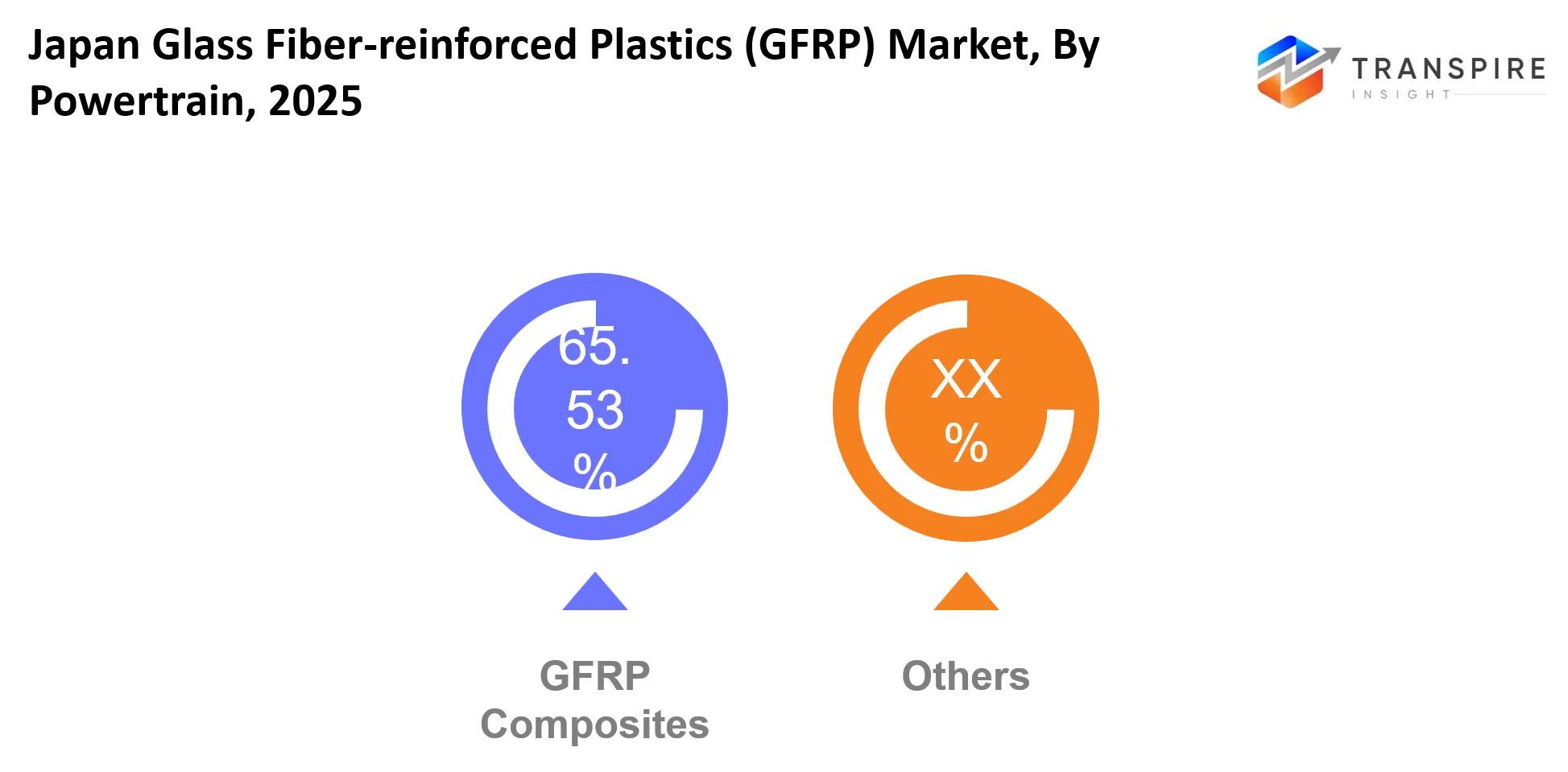
According to Transpire Insights, a detailed research report on the market reflects that the Glass Fiber-reinforced Plastics (GFRP) segment dominates the Japan Fiber-reinforced Plastics Market, accounting for approximately 65.53% of the total market revenue in 2025. Toray Industries, Inc. is among the major Japanese composite-material companies, supported by extensive materials manufacturing capabilities and a strong domestic presence, contributing to Japan’s GFRP market development, advanced composite-material innovation, lightweighting solutions, manufacturing capabilities, and overall market growth dynamics.
Market Snapshot
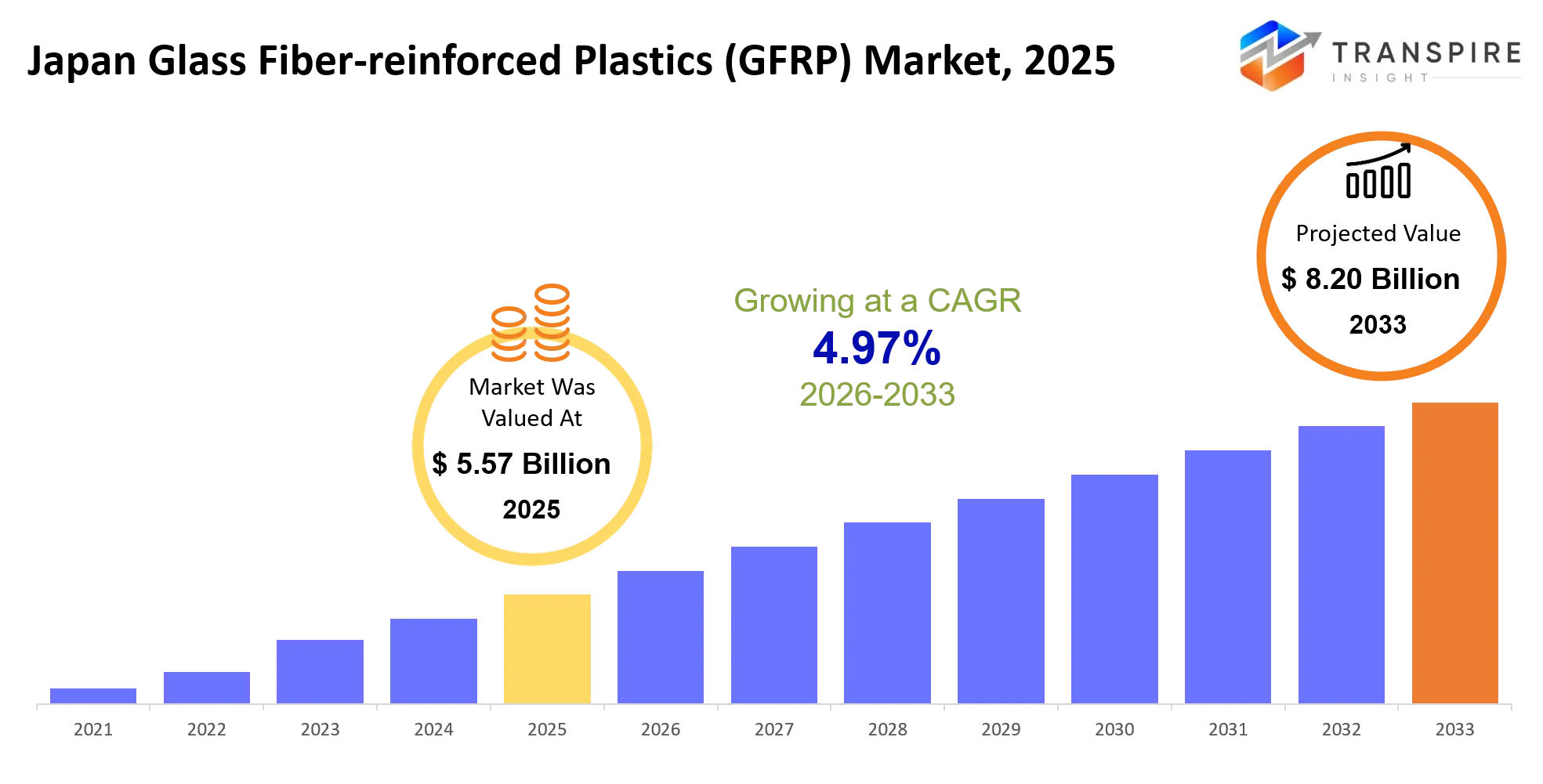
- Market Value (2025): USD 5.57 Billion.
- Expected Market Value (2026): USD 5.84 Billion.
- Estimated Market Value (2033): USD 8.20 Billion.
- Forecast CAGR (2026–2033): 4.97%
Introduction
GFRP materials consist of glass filaments reinforced with polymer resin that give the resultant material an excellent strength-to-weight ratio, corrosion, and heat resistance, along with durability and ability to be formed into intricate shapes. The GFRP (Glass Fiber-Reinforced Plastic) is a composite, which is a basic chemical structure consisting of a polymer resin there are also any other materials, like fiberglass, in it. The GFRP industry in Japan benefits from its various performance attributes that facilitate its use in infrastructure, vehicles, marine activities, and intelligent technologies. The technology has a very high strength-to-weight ratio, providing exceptional structural efficiency while significantly lowering weight when compared to conventional metals such as iron and steel. The technology has impressive resistance to corrosion, preventing degradation of the material and its rusting caused by moisture, salt, and chemicals, making it ideal for use in marine and coastal structures. Furthermore, GFRP is a cost-effective solution in comparison to more expensive modern composites like CFRP, making it commercially appealing. GFRP offers good insulating properties, as well as radio-wave transparency, making it effective in smart technologies, communication systems, and modern building activities.
Key Market Highlights: -
- By end user, the Transportation segment dominated the market and holds nearly 25% share in 2025 and is projected to grow at a substantial CAGR during the forecast period.
- By product type, the GFRP Composites segment dominated the market and holds nearly 91% share in 2025 and is projected to grow at a substantial CAGR during the forecast period.
- By application, the Construction segment dominated the market and holds nearly 20% share in 2025 and is projected to grow at a substantial CAGR during the forecast period.
- The Green Innovation Fund & Decarbonization program has been instituted by Japan's METI that supports decarbonization efforts, such as resource circulation and advanced material innovations. These initiatives promote recyclable compositions, lighter materials, and energy-efficient manufacturing methods that also support the development of the Japan GFRP market. The emergence of circular economy and carbon-neutrality initiatives is expected to create more GFRP applications in sectors, such as infrastructure, transportation, and heavy industries.
How is Technology Driving Growth in the Japan Glass Fiber-reinforced Plastics (GFRP) Market?
The GFRP Market in Japan is increasingly bolstered by technological advancements in thermoplastic manufacturing automation and material science. Technologies such as robotics and automated molding as well as digital manufacturing technologies improve manufacturing accuracy, efficiency, and customization. The smart factory technologies that include IoT and digital twin technologies allow for prediction and maintenance of operations. AI-powered quality control enables detection of any defect in the process of manufacturing in real time, while machine learning technology can be used to optimize the use of materials during manufacturing and minimize the wastage. At the same time, innovations in material sciences have made it possible to create more efficient glass fiber that will provide improved mechanical and thermal properties.
Market Drivers
The growth of the GFRP Composites Market in Japan can be attributed to the modernization of infrastructures, advances in automotive light-weighting technologies, and renewable energy usage. As old bridges, tunnels, and waterworks deteriorate, the demand for a strong, corrosion-resistant material becomes evident. In the automotive industry, the GFRP materials contribute to reducing vehicle weight and fuel consumption and lowering emissions. The growing use of renewable energy sources, particularly wind energy, also favors the use of weather resistance composite materials. Furthermore, Japan’s environmental policies encourage the use of energy-efficient and sustainable materials. The GFRP market in Japan gains momentum due to its considerable benefits that boost its usage in various fields such as construction, automotive, marine related practices, and others. The material has outstanding resilience to corrosion enabling its use in field conditions like coastal infrastructures, and cold water treatment facilities, and where chemicals are used. This feature combined with high strength-to-weight ratio makes this material a favorable choice where sturdy performance is expected while using less weight than steel and its alloys. The lack of substantial weight of GFRP components boosts transportation processes and simplifies maneuvers with the material during the construction process. In addition, the high durability quality prevents the necessity of frequent repair operations and provides the infrastructure with a longer polyurethane life cycle thus saving resources during its use.
Restrain
The GFRP market in Japan encounters obstacles such as the significant expense of production and installation due to specialized manufacturing processes and technology. The process of recycling thermosets is also complicated, presenting challenges for waste management and regulatory compliance. Glass fiber and resin price fluctuations can affect profitability, while technical limitations in large-scale production, complexity of processing, and costs of production continue to inhibit expansion within the GFRP market.
Analysis of Prices and Consumer Behaviour
The Japan Glass Fiber-reinforced Plastics (GFRP) Market is led by the transportation sector (making up about 25.4% of the overall market in 2025; owing to high demand for durable and lightweight material in the transportation industry). Construction and Infrastructure contributed almost24.2% of the Japan GFRP market in 2025 on account of growing demand for corrosion-resistant and long-lasting composites. The Japan GFRP Composites Market is expected to be worth USD5,571.3 million in 2025 and further grow to USD 7,043.1 million in 2030 registering a 4.8% CAGR. Thus, Transportation and Construction & Infrastructure Industries are the two major end-use segments with respective revenue contributions of USD 1,415.3 million and USD 1,349.4million in 2025. In the larger Japan fiber reinforced plastic market, the share of GFRP in terms of revenue was at around 65.53% in 2025. In addition, mechanical strength, corrosion resistance, lightweight properties, durability and lifecycle cost are the factors driving buying decisions of industrial buyers.
Top Companies in the Japan Glass Fiber-reinforced Plastics (GFRP) Market
- Nippon Electric Glass
- Nitto Boseki
- Owens Corning
- AGY
- Saint-Gobain
- Jushi Group
- Taishan Fiberglass
- Johns Manville
- Toray Industries
- Teijin
- Mitsubishi Chemical
- Sumitomo Bakelite
- Asahi Kasei
- Denka
- Panasonic
Japan Glass Fiber-reinforced Plastics (GFRP) Market Segmentation
The Japan Glass Fiber-reinforced Plastics (GFRP) Market share is divided into six categories: By resin type, end user, manufacturing process, form, product and application.
The Transportation dominated the market, accounting for nearly 25% in 2025 and is expected to rise at a significant CAGR during the forecast period.
The Japan Glass Fiber-reinforced Plastics (GFRP) Market is segmented by end user into Wind Energy, Electrical & Electronics, Transportation, Pipes & Tanks, Construction & Infrastructure, Marine, Aerospace & Defense, Other Industries. Among these, the Transportation segment dominated the market, accounting for nearly 25% in 2025 and expected to increase at a significant CAGR during the forecast period. The Transportation industry leads due to the heightened demand for composite materials that are lightweight, long-lasting, and resistant to corrosion in automotive, rail, aerospace, and infrastructure applications. The factors driving the adoption of GFRP include the growing production of vehicles, electrification of fleets, increases in the demand for fuel-efficient technology, and the need for modernization of infrastructure. These trends lead to higher performance and lower maintenance costs in the transportation sector.
The GFRP Composites dominated the market, accounting for nearly 91% in 2025, and is expected to rise at a significant CAGR during the forecast period.
The Japan Glass Fiber-reinforced Plastics (GFRP) Market is segmented by product type intoGFRP Composites, GFRP Sheets, GFRP Pipes, GFRP Rebar, GFRP Panels, GFRP Profiles, GFRP Tanks, GFRP Structural Components. Among these, the GFRP Composites segment dominated the market, accounting for nearly 91% in 2025 and expected to increase at a significant CAGR during the forecast period. The GFRP Composites segment leads the market because of excellent strength-to-weight ratio, resistance to corrosion, high durability, wide design options, and rapid deployment in constructions, automotive industries, infrastructure, wind energy, and transportation. The need for lightweight durable materials supported by innovation in composite manufacturing technologies fuels the growth of the GFRP composite market.
The Construction dominated the market, accounting for nearly 20% in 2025 and is expected to rise at a significant CAGR during the forecast period.
The Japan Glass Fiber-reinforced Plastics (GFRP) Market is segmented by application into, Automotive, Construction, Electrical, Wind Turbines, Marine, Aerospace, Industrial Equipment, Consumer Products. Among these, the Construction segment dominated the market, accounting for nearly 20% in 2025 and expected to increase at a significant CAGR during the forecast period. In 2025, the Construction sector was the most significant unit in the market, aided by the need for strong, light, and cheap building materials and the steady growth of infrastructure development and urbanization. Increasing investment in residential, commercial, and transport infrastructures along with construction projects implemented by the government is promoting material usage.
Future Market Trends for the Japan Glass Fiber-reinforced Plastics (GFRP) Market: -
- Automotive Lightweighting: Growing need for fuel efficiency and longer EV range results in composites becoming more prevalent.
- Structural Renewal: Older buildings and bridges need to be renovated using rust-resistant rebar and polymer coating.
- Smart Manufacturing (Industry 4.0): The use of AI, digital twins, Internet of Things and cloud robotics makes manufacturing more flexible.
- Eco-Friendly Sustainability: Regulations encourage the use of biological resins and advanced recycling methods.
Recent Development
- In June 2026: Teijin Limited introduced a recyclable version of the thermosetting CFRP having a heat-activated self-healing feature. While the emphasis is on carbon-fiber composite instead of GFRP, this innovation will help support the larger transition towards sustainable composite materials in Japan. The stress on recyclability, durability, and increased service life might help indirectly boost the future development of the Japan GFRP Market through circular economy-related improvements and developments in advanced materials.
- In March 2026: THERMOFIL XP glass-filled polypropylene range of Sumika Polymer Compounds was introduced into the market. This product contributes to the Japanese market for GFRP as it allows for manufacturing lightweight and high-performing composites, improved production efficiency, faster cycle times, and increased productivity.
- In August 2026: Growing usage of GFRP rebar in marine, coastal, bridge, and tunnel construction projects in Japan was pointed out by MarketsandMarkets. The growth in modernization of infrastructure, corrosion-resistant properties of GFRP, and construction that is able to withstand changes in climate contribute to rising demand for GFRP reinforcement systems.
Market Segment
This study forecasts revenue at Japan, regional and country levels from 2020 to 2033. Transpire Insights has segmented the Japan Glass Fiber-reinforced Plastics (GFRP) Market based on the below-mentioned segments:
Japan Glass Fiber-reinforced Plastics (GFRP) Market, By Resin Type
- Polyester
- Vinyl Ester
- Epoxy
- Polyurethane
- Thermoplastic
- Phenolic
- Acrylic
- Other Resins
Japan Glass Fiber-reinforced Plastics (GFRP) Market, By End User
- Wind Energy
- Electrical & Electronics
- Transportation
- Pipes & Tanks
- Construction & Infrastructure
- Marine
- Aerospace & Defense
- Other Industries
Japan Glass Fiber-reinforced Plastics (GFRP) Market, By Manufacturing Process
- Compression Molding
- Injection Molding
- Lay-Up
- Filament Winding
- Pultrusion
- Resin Transfer Molding
- Extrusion
- Other Processes
Japan Glass Fiber-reinforced Plastics (GFRP) Market, By Form
- Rebar
- Powder
- Sheet
- Panel
- Rolls
- Rods
- Profiles
- Other Forms
Japan Glass Fiber-reinforced Plastics (GFRP) Market, By Product Type
- GFRP Composites
- GFRP Sheets
- GFRP Pipes
- GFRP Rebar
- GFRP Panels
- GFRP Profiles
- GFRP Tanks
- GFRP Structural Components
Japan Glass Fiber-reinforced Plastics (GFRP) Market, By Application
- Automotive
- Construction
- Electrical
- Wind Turbines
- Marine
- Aerospace
- Industrial Equipment
- Consumer Products
Frequently Asked Questions
Find quick answers to common questions.
The Japan GFRP Market is projected to grow at a 4.97% CAGR from 2026 to 2033, driven by expanding composite applications.
The Transportation segment dominates the Japan GFRP Market, accounting for nearly 25% share in 2025, supported by lightweighting and durability requirements.
GFRP offers high strength, lightweight performance, corrosion resistance, durability, and reduced maintenance requirements, supporting adoption across Japan’s construction infrastructure.
Infrastructure modernization, automotive lightweighting, renewable energy expansion, advanced manufacturing, and demand for sustainable composites are driving Japan’s GFRP Market growth.
Major Companies include Nippon Electric Glass, Nitto Boseki, Toray Industries, Teijin, Mitsubishi Chemical, Saint-Gobain, and Owens Corning
- Nippon Electric Glass
- Nitto Boseki
- Owens Corning
- AGY
- Saint-Gobain
- Jushi Group
- Taishan Fiberglass
- Johns Manville
- Toray Industries
- Teijin
- Mitsubishi Chemical
- Sumitomo Bakelite
- Asahi Kasei
- Denka
- Panasonic
About the Authors

Pankaj Ghogare Patil
I am Pankaj Ghogare Patil, a Senior Research Analyst at Transpire Insight, specializing in the Pharmaceutical, Chemicals & Materials, Healthcare IT, and Biotechnology industry. My expertise lies in conducting comprehensive market research, analyzing industry trends, evaluating competitive landscapes, and translating complex data into actionable insights. At Transpire Insight, I closely follow emerging technologies, regulatory developments, and market innovations to create accurate, well-researched, and informative content that helps businesses and professionals make informed decisions. I am committed to producing credible, evidence-based articles that reflect industry best practices while making technical topics accessible and valuable for a broad audience.

Chakradhar Khansole
Chakradhar serves as the Research Director at Transpire Insight, bringing over 8 years of experience in technology, innovation, and strategic market intelligence. He specializes in transforming complex market data into actionable business insights that enable organizations to make informed, growth-oriented decisions. Recognized for his strategic vision and analytical expertise, Chakradhar leads high-impact research initiatives, delivering comprehensive market assessments, competitive intelligence, and forward-looking industry analysis.
Recently Published Reports
-
May 2026
Healthcare Polymer Packaging Market
Healthcare Polymer Packaging Market Size, Share & Analysis Report By Packaging Type (Syringes, IV Bottles and Pouches, Clamshells, Blisters, Bottles & Jars, Containers, Tubes, IV Parental Packaging, Others), By Type (Regulated, Non-regulated), By Polymer Type (LDPE (Low-Density Polyethylene), HDPE (High-Density Polyethylene), Homo-polymer (Homo), Random Copolymer (Random), Block Copolymer (Block), PET, Polystyrene, Polyvinyl Chloride, Polyamide/EVOH, Others), and Geography (North America, Europe, Asia-Pacific, Middle East and Africa, South and Central America), 2021 - 2031
-
Apr 2026
Hydrophilic Tape (Waterstop) Market
Hydrophilic Tape (Waterstop) Market Size, Share & Analysis Report By Type (Bentonite-Based Hydrophilic Tape, Rubber-Based Hydrophilic Tape), By Application (Residential Buildings, Commercial Buildings, Infrastructure Projects), and Geography (North America, Europe, Asia-Pacific, Middle East and Africa, South and Central America), 2021 - 2031
-
Apr 2026
Metalens Market
Metalens Market Size, Share & Analysis Report By Type (Visible Light Metalens, and Infrared Metalens), By Application (Consumer Electronics, Automotive Electronics, Industrial, Medical, and Others), and Geography (North America, Europe, Asia-Pacific, Middle East and Africa, South and Central America), 2021 - 2031
-
Apr 2026
PBT Resin Market
PBT Resin Market Size, Share & Analysis Report By Type (Reinforced PBT Resin, Unreinforced PBT Resin), By Processing Method (Injection Molding, Extrusion, Blow Molding, Others), By End-User (Automotive, Electrical & Electronics, Consumer Appliances, Industrial Machinery, Medical Devices, Packaging, Others), and Geography (North America, Europe, Asia-Pacific, Middle East and Africa, South and Central America), 2021 - 2031