
Asia Pacific Primary Pharmaceutical Packaging Market Summary
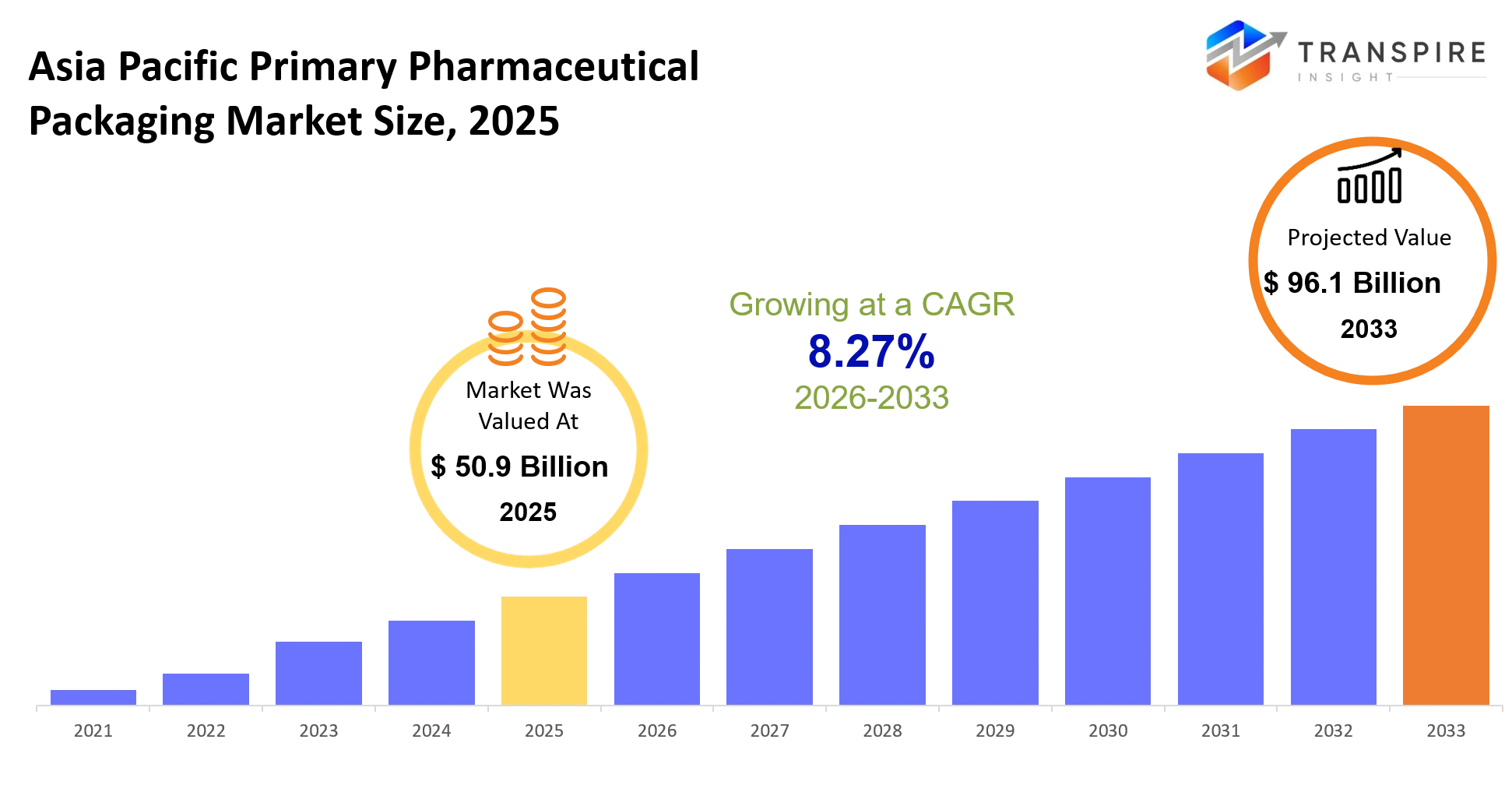
As per Transpire Insight Analysis the Asia Pacific Primary Pharmaceutical Packaging Market size is estimated at USD 50.9 Billion in 2025 and is anticipated to reach USD 96.1 Billion by 2033, growing at a CAGR of 8.27% from 2026 to 2033.
In the Asia Pacific Primary Pharmaceutical Packaging Market there’s a big emphasis on actually shielding medicines from contamination, moisture, oxygen, and random physical harm, while also trying to keep everything stable across manufacturing, shipping, storage, and of course patient handling. Most pharma makers end up sort of leaning on primary packaging, like vials, bottles, blister packs, ampoules, and also prefilled syringes, so the drug stays in good condition. regulators are satisfied, and patient safety gets improved in hospitals, retail pharmacies and all kinds of healthcare settings.
Over the last five years, things have been moving more toward high value packaging forms that are suited for biologics, vaccines, and injectable treatments. This is closely tied to tighter pharmaceutical quality rules across China, India, Japan, and South Korea. And yeah, the COVID-19 period sort of sped everything up, with more spending on sterile packaging capacity, vaccine logistics, plus domestic pharmaceutical production, which then changed regional supply chains in a more or less permanent way. Because of that shift, manufacturers have pushed harder on advanced glass containers, polymer based packaging materials, and tamper evident types of solutions, all aimed at reducing risk and raising performance.
As more specialty drugs and biologics get launched, and governments strengthen healthcare manufacturing capability, packaging suppliers keep landing higher value deals, and that helps revenue grow steadily across the wider regional pharma network, even when the market is not uniform everywhere
Asia Pacific Primary Pharmaceutical Packaging Market Size & Forecast:
- Asia Pacific Primary Pharmaceutical Packaging Market Size 2025: USD 50.9 Billion
- Expected Market Value 2033: USD 96.1 Billion
- Forecast CAGR: 8.27%
- Leading region in 2025:
- Fastest Growing region:
- Key Profile: Gerresheimer, Schott AG, AptarGroup, West Pharmaceutical Services, Amcor, Berry Global, SGD Pharma, Nipro Corporation, Stevanato Group, Bormioli Pharma, WestRock, SGD Pharma, O-I Glass, DWK Life Sciences, UFlex
Key Market Insights
- China basically just leads the Asia Pacific Primary Pharmaceutical Packaging Market with an estimated 34–36% market share in 2025, backed by big pharmaceutical production and export capability, so it stays hard to beat.
- India is also the one getting momentum fast, it’s expected to grow the quickest through 2033, mainly because of pharmaceutical exports and contract manufacturing expansion , plus those government production linked incentive programs that keep pushing output.
- When it comes to the product side, plastic bottles are still the top choice , around 28% market share. They’re used a lot for high volume oral solid dosage manufacturing across various regional pharmaceutical firms.
- Next up are blister packs, they land as the second largest segment with close to 22% share, largely because they offer stronger medication protection and match the patient compliance rules more neatly.
- Prefilled syringes are projected to grow the quickest through 2033, supported by biologics, biosimilars, and specialty injectable therapies , which keeps demand rising.
- Solid dosage formulations take nearly 40% of packaging demand , while injectable drugs keep climbing as vaccine and biologic production ramps up across the region.
- For end users , pharmaceutical manufacturers remain dominant at about 65% market share, but CDMOs and biologics manufacturers are the ones seeing the fastest expansion , almost like the growth engine.
- On the company front, Gerresheimer, Schott AG, Amcor, AptarGroup, West Pharmaceutical Services, and Stevanato Group keep putting money into sterile packaging, advanced polymer materials, and production automation, because the requirements are getting stricter, and well… that’s how it goes.
- Also, more manufacturing facilities are being set up in India and Southeast Asia, for regional supply resilience, to shorten delivery timelines , and to cut down import dependence.
- Since 2021, digital inspection systems, serialization tech, and track and trace solutions have become more standard investments , helping improve regulatory compliance and also lowering packaging defects.
What are the Key Drivers, Restraints, and Opportunities in the Asia Pacific Primary Pharmaceutical Packaging Market?
The strongest growth driver seems to be the fast expansion of biologics, vaccines, and injectable drugs across Asia Pacific. In China , India, South Korea , and Singapore , governments have actually pushed more money into pharmaceutical manufacturing via production incentives, healthcare modernization, and policies that lean export oriented. This basically nudges drug makers to use more premium packaging methods like prefilled syringes, high-performance glass vials, and upgraded polymer containers that fit with quality rules that are becoming stricter , all the time. The outcome is more revenue potential for packaging suppliers, because pharma production is moving toward complex therapies that need better containment systems.
The biggest structural headache still is the high expense of regulatory compliance along with sterile manufacturing infrastructure. Packaging manufacturers in pharma have to keep funding cleanroom spaces, validation systems , newer inspection tech, and material qualification, while also meeting different regulatory expectations across various countries in Asia Pacific. Those steps take serious capital and long certification periods, which can reduce market entry for smaller suppliers, and it also tends to slow down production expansion. Because of that, extra capacity often does not keep up with the rate of pharmaceutical manufacturing growth, so revenue upside can get squeezed.
Another major future opportunity comes from smart pharmaceutical packaging, the kind that blends serialization, RFID capabilities, and digital traceability platforms. Regulators keep tightening anti-counterfeiting mandates , while pharmaceutical companies want full supply chain visibility end to end.
What Has the Impact of Artificial Intelligence Been on the Asia Pacific Primary Pharmaceutical Packaging Market?
Artificial intelligence, plus advanced digital technologies, are slowly but surely changing how pharmaceutical packaging gets made, mainly because manufacturing precision goes up, quality checks get more consistent, and regulatory compliance becomes a lot easier to manage. With AI powered vision inspection systems the lines can flag cosmetic defects, weird size differences, seal integrity problems, and even contamination risks, all while running at speeds that basically beat the slower conventional manual inspection methods. On top of that, manufacturers use machine learning models to tune filling operations, cut down material waste, and squeeze better production scheduling across those high volume packaging plants.
Then there is predictive analytics, which helps with preventive maintenance of molding equipment, glass forming lines, filling systems, and the packaging machinery itself. It does this by watching vibration patterns, spotting temperature swings and then catching those early signs of equipment wear before anything actually breaks, or jams, or just straight up stops the line. So, unplanned downtime drops, production utilization improves, and overall equipment effectiveness feels more dependable, which also supports that consistent product quality thing. Meanwhile, AI enabled digital twins allow engineers to mimic real manufacturing conditions, so parameters can be tuned before anything goes live, ending up shaving validation time , and reducing operational costs, in practice.
Finally, advanced serialization platforms combined with AI can strengthen counterfeit detection, automate the regulatory paperwork, and improve pharmaceutical traceability across regional supply chains. Though wider adoption is kind of stuck because integration expenses stay high, older manufacturing infrastructure is often hard to modify, production environments may feel fragmented, and standardized operational data isn’t always easily available across facilities.Smaller manufacturers in particular sometimes have trouble convincing themselves to spend on a big digital transformation, even if the long term productivity improvements and compliance benefits are pretty clear.
Key Market Trends
- Since 2020 , pharmaceutical manufacturers have started putting much more money into sterile vial and syringe production, mostly after regional vaccine manufacturing got bigger.
- The adoption of prefilled syringes has grown by over 30% across biologics manufacturing programs, which helps lower dosing mistakes and it also makes patient use feel more seamless.
- China and India keep pushing ahead with pharmaceutical manufacturing capacity , and they now represent more than half of the regional packaging investments that were announced since 2021.
- Smart serialization , plus digital track- and-trace systems, has pretty much turned into a standard practice for export driven pharmaceutical facilities, to help them meet regulatory requirements more reliably.
- Pharmaceutical firms are increasingly swapping conventional packaging materials with cyclic olefin polymers and high-performance pharmaceutical glass, especially for specialty medicines.
- Gerresheimer, Schott AG, Stevanato Group, and Amcor continue to expand their local production footprints, in line with these pharmaceutical localization plans.
- Automated visual inspection systems now check millions of containers every single day , and that cuts packaging defects a lot while also reducing the amount of manual quality control that teams have to do.
- Also, supply chain diversification has moved a larger share of manufacturing investment toward Southeast Asia, because companies try not to rely on just one country sourcing model.
- Packaging suppliers are also working more often with contract development and manufacturing organizations, to build customized packaging solutions for biologics.
- On sustainability, the focus has shifted from lightweight packaging alone, toward recyclable materials, energy efficient manufacturing , and lower-carbon production approaches, all without losing the drug protection part .
Asia Pacific Primary Pharmaceutical Packaging Market Segmentation
By Packaging Type
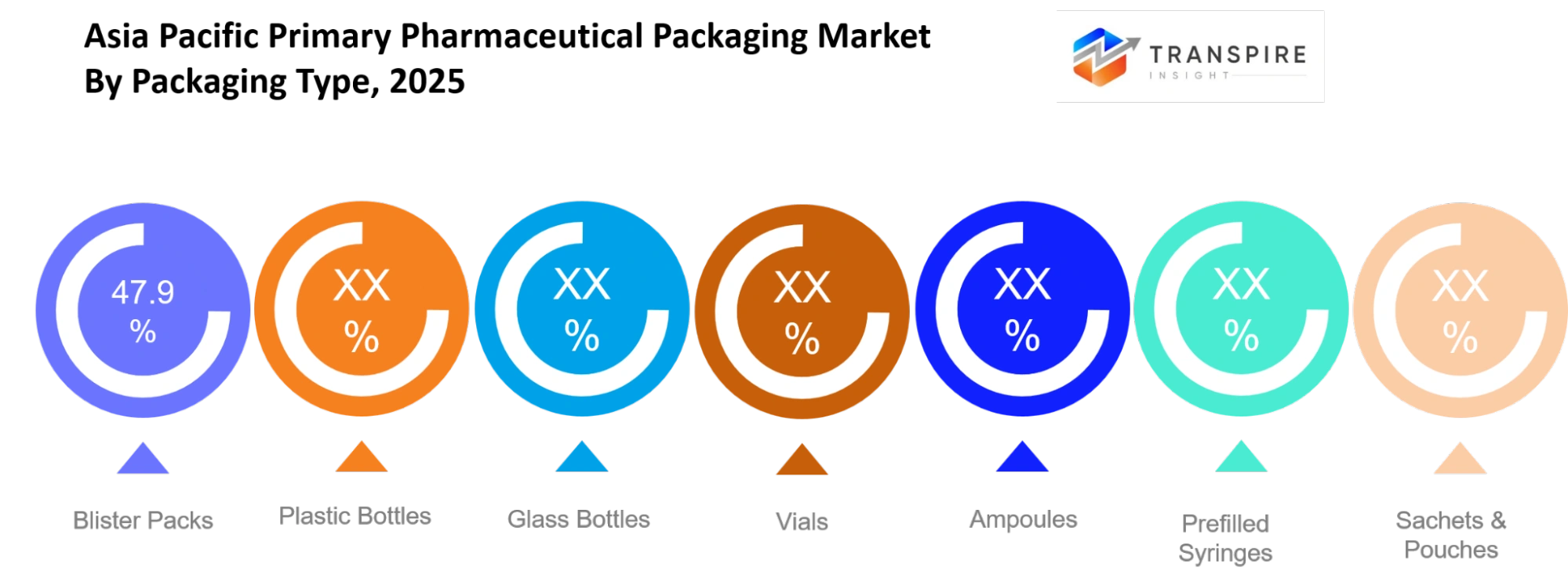
Plastic Bottles still hold a big, almost undeniable place because oral medicines need something lightweight, durable , and also cost effective enough for huge manufacturing runs. Glass Bottles also stay in the picture, mainly for those formulations that need high chemical steadiness and real strong shielding against moisture plus contamination issues. Blister Packs kind of do two jobs at once , they help with unit-dose packaging, make life easier for patients, and they can extend shelf life by keeping tablets and capsules away from the outside environment. Vials are for injectable medicines, biologics, and lab products, where sterile storage matters a lot and filling during production has to be precise.
Ampoules work as secure single-use packaging for touchy injectable formulations where contamination control stays, basically, the whole point. Prefilled Syringes keep getting chosen, since ready to use delivery means less preparation time and fewer dosing mistakes in healthcare facilities. Sachets & Pouches are used for powders, granules, and single-dose liquid products, offering convenient transport and typically lower material consumption too. Then there are others like cartridges, tubes, inhaler containers, plus specialty packaging built for niche pharmaceutical products and advanced drug delivery systems, you know the usual.
By Material
Glass is still the preferred material for injectable medicines, because it offers strong chemical resistance and good barrier qualities, that really help keep drug stability during storage. Plastic supports high-volume pharmaceutical packaging thanks to its light weight construction, flexible design options, and lower manufacturing costs, kind of a straightforward advantage. Aluminum, on the other hand, guards moisture-sensitive medicines with excellent barrier performance, especially in blister packs, tubes, and those specialized pharmaceutical containers. Paper and Paperboard mostly back secondary protection parts and some selected packaging formats, where labeling and day-to-day handling efficiency matters.
Rubber matters in closures, stoppers, and seals too, because it helps preserve sterility and avoids leakage in pharmaceutical containers. Laminates work by combining different materials, so you get better moisture resistance, stronger oxygen protection, and improved product durability for specialized packaging needs. Composite Materials also bring extra strength and performance, for advanced packaging solutions that need multiple protective characteristics, all at once. Others still include specialty polymers and engineered materials, created for high-value biologics, personalized medicines, and next-generation pharmaceutical products.
By Drug Type
Solid dosage forms take up a pretty big portion of the market since tablets and capsules basically need dependable shielding during storage as well as transit and handover . Liquid dosage forms lean on bottles vials and more specialized containers, those help keep the formulation quality intact while also reducing contamination risk and in general it’s all about keeping things clean. Injectable drugs call for sterile packaging like vials, ampoules , and prefilled syringes so the product’s integrity stays protected all the way across the supply chain, from the start to the very end . Topical formulations use tubes jars pumps and similar containers, they help with controlled dispensing and they also guard creams, gels, and ointments against outside interference, like direct environmental contact.
Ophthalmic products are a bit different because they need highly sterile packaging systems for safe administration, and they must also preserve product quality up to the moment it’s used. Biologics require packaging materials with stronger barrier performance, since temperature sensitivity and molecular stability are still the key points for real therapeutic effectiveness. Vaccines depend on secure sterile containers that can support cold chain distribution and keep regulatory expectations aligned across healthcare systems. “Others” covers inhalation therapies, transdermal products, diagnostic pharmaceuticals, and specialized formulations, all of which often need customized primary packaging solutions that fit their specific needs.
By End User
Pharmaceutical Manufacturers count as the biggest end-user group, mostly because big scale medicine manufacturing needs steady supplies of bottles, blister packs, vials and all those primary packaging kinds that satisfy tight quality requirements, without much wobble. Biotechnology Companies lean on advanced packaging for biologics, biosimilars and specialty therapies, which really ask for strong barrier protection plus careful sterile handling during the whole manufacturing run. Contract Packaging Organizations essentially provide packaging services for pharma brands, so brands can gain manufacturing flexibility and also cut day to day operating expenses, at least in theory, and usually in practice too. Hospitals, on the other hand, use sterile packaging for injectable medicines, emergency drugs, and specialized treatments, where secure storage is critical before administration and that part cannot be guessed wrong.
Retail Pharmacies depend on primary packaging that stays reliable so the medicine quality is preserved during storage and then during dispensing, while also keeping patient safety in view. Research Institutes need packaging for clinical research materials, experimental formulations, and that lab scale production too, where samples can be picky. Vaccine Manufacturers rely on sterile containers, ampoules and vials that keep product stability intact during the cold chain journey, even when the logistics gets chaotic. Others still include animal healthcare companies, government healthcare agencies, and specialty pharmaceutical firms, who use customized packaging solutions for niche therapeutic products and often require a very specific setup.
By Application
Prescription Medicines are kind of the biggest one for application because regulated pharma items need protective packing, secure wrapping really, that keeps the product quality stable, also supports labeling compliance, and keeps drug stability during distribution. Over-the-Counter Medicines usually depend on bottles, blister packs, sachets, and pouches, which makes everyday use easier for consumers, but still shields the products while they sit in retail storage. Biopharmaceuticals need high-performance packaging materials, sort of a more capable class, that can preserve complex molecular structures with controlled conditions, not just “okay” protection. Clinical Trial Packaging supports research programs with secure, traceable, and accurately labeled packaging, made for environments where the study is controlled and monitored, end to end.
Nutraceuticals rely on primary packaging that guards tablets, capsules, powders, and liquid supplements, while also helping stretch the product’s shelf life. Veterinary Medicines call for durable containers that fit multiple dosage forms, used across livestock and companion animal healthcare. Generic Drugs create major packaging volume because high-volume production needs cost-efficient solutions, without cutting corners on product protection or regulatory compliance. Others includes orphan drugs, personalized therapies, herbal medicines, and specialty pharmaceutical products, all of which need customized primary packaging formats, some of them are pretty niche.
What are the Key Use Cases Driving the Asia Pacific Primary Pharmaceutical Packaging Market?
Prescription medicine packaging still feels like the biggest use case, because pharmaceutical manufacturers need that dependable primary wrap to keep product quality intact from the moment it’s made right through patient use. Strict regulatory rules around product safety, tamper evidence, and contamination control keep driving continued demand for bottles, blister packs, and sterile containers in mainstream commercial pharmaceutical manufacturing, really.
Biopharmaceutical production and vaccine manufacturing are also still rising, mostly as biotech companies and vaccine makers roll out complex therapies that call for more advanced, sterile packaging. Clinical trial packaging, meanwhile, keeps seeing steady adoption since research organizations want traceable, validated, and compliant packaging for investigational medicines that get sent across lots of healthcare locations.
Personalized medicines plus cell and gene therapies are becoming more visible, with real long term potential. Better primary packaging—more or less designed for temperature sensitive formulations, small batch production, and precision dosing—should open up fresh opportunities as specialty pharmaceutical development grows across Asia Pacific.
|
Report Metrics |
Details |
|
Market size value in 2025 |
USD 50.9 Billion |
|
Market size value in 2026 |
USD 55.1 Billion |
|
Revenue forecast in 2033 |
USD 96.1 Billion |
|
Growth rate |
CAGR of 8.27% from 2026 to 2033 |
|
Base year |
2025 |
|
Historical data |
2021 - 2024 |
|
Forecast period |
2026 - 2033 |
|
Report coverage |
Revenue forecast, competitive landscape, growth factors, and trends |
|
Regional scope |
Asia Pacific (India, China, Japan, Australia, South Korea, Rest of Asia Pacific) |
|
Key company profiled |
Gerresheimer, Schott AG, AptarGroup, West Pharmaceutical Services, Amcor, Berry Global, SGD Pharma, Nipro Corporation, Stevanato Group, Bormioli Pharma, WestRock, SGD Pharma, O-I Glass, DWK Life Sciences, UFlex |
|
Customization scope |
Free report customization (country, regional & segment scope). Avail customized purchase options to meet your exact research needs. |
|
Report Segmentation |
By Packaging Type (Plastic Bottles, Glass Bottles, Blister Packs, Vials, Ampoules, Prefilled Syringes, Sachets & Pouches, Others); By Material (Glass, Plastic, Aluminum, Paper & Paperboard, Rubber, Laminates, Composite Materials, Others); By Drug Type (Solid Dosage Forms, Liquid Dosage Forms, Injectable Drugs, Topical Formulations, Ophthalmic Products, Biologics, Vaccines, Others); By End User (Pharmaceutical Manufacturers, Biotechnology Companies, Contract Packaging Organizations, Hospitals, Retail Pharmacies, Research Institutes, Vaccine Manufacturers, Others); By Application (Prescription Medicines, Over-the-Counter Medicines, Biopharmaceuticals, Clinical Trial Packaging, Nutraceuticals, Veterinary Medicines, Generic Drugs, Others) |
Which Regions are Driving the Asia Pacific Primary Pharmaceutical Packaging Market Growth?
China sits at the front of the regional market, mainly because it has strong pharmaceutical manufacturing capability plus supportive industrial policies, and also strict drug quality rules that keep demand steady for advanced primary packaging. National pushes for pharmaceutical self-reliance and export driven output have already nudged packaging firms to expand their own lines, like glass vials , blister packs, and polymer containers. Add in fairly solid logistics infrastructure, modern industrial clusters, and the kind of linked pharmaceutical supply chains that cut delays, and you end up with better production efficiency. There is also close day to day collaboration across drug makers, packaging suppliers, materials producers, and research institutions, which keeps China in that dominant spot.
Japan, meanwhile, is the second biggest regional contributor with a somewhat different growth approach. It leans more on premium pharmaceutical manufacturing and steady regulatory adherence, not so much on raw production volume. Because the quality thresholds are tight, manufacturers keep shifting toward high-performance glass packaging, prefilled syringes , and precision drug delivery containers for newer therapies. Over time, long term spending on advanced manufacturing automation, plus pharmaceutical research, helps keep packaging demand consistent even if population growth is slower. This calmer operating setting makes Japan a dependable revenue base for global packaging companies that focus on high value pharmaceutical products.
India is projected to show the quickest growth out to 2033, as pharmaceutical exports, contract manufacturing, and government production linked incentive initiatives speed up capacity scaling.
Who are the Key Players in the Asia Pacific Primary Pharmaceutical Packaging Market and How Do They Compete?
Competition is still kinda moderately consolidated, with global packaging specialists going up against each other via technology strengths, regulatory compliance, manufacturing quality, and regional production networks not just price, you know. Most firms keep putting money into more advanced materials, sterile manufacturing setups, and customized drug containment systems, to back biologics, injectable medicines, and specialty pharmaceuticals. A lot of their growth playbook now leans toward beefing up manufacturing capacity across Asia, plus making supply chains more resilient for multinational pharmaceutical buyers.
Gerresheimer stands out with integrated drug containment systems that bring together glass packaging, polymer packaging, and drug delivery devices for pharma and biotech customers. They say the acquisition of Bormioli Pharma really added molded glass muscle, while partnerships aimed at advanced HDPE packaging technologies—those help widen product performance. Schott AG focuses on high-performance pharmaceutical glass and specialty materials that are meant to protect sensitive injectable medicines, and the ongoing investment in ready-to-use containment systems really reinforces its stance in sterile pharmaceutical packaging. Then Stevanato Group leans into precision-engineered vials, syringes, cartridges, and integrated manufacturing solutions that make pharmaceutical filling operations feel easier.
Amcor competes by mixing flexible packaging know how with recyclable, plus high-barrier pharmaceutical materials, which is supposed to improve product protection and also operational efficiency across regional manufacturing locations. West Pharmaceutical Services is more centered on containment and closure systems for injectable treatments, delivering elastomer components and integrated packaging solutions that support those complex biologics
Company List
• Gerresheimer
• Schott AG
• AptarGroup
• West Pharmaceutical Services
• Amcor
• Berry Global
• SGD Pharma
• Nipro Corporation
• Stevanato Group
• Bormioli Pharma
• WestRock
• SGD Pharma
• O-I Glass
• DWK Life Sciences
• UFlex
Recent Development News
In April 2026, Gerresheimer entered a partnership with Milliken & Company to commercialize LeneX™ UltraGuard® technology for HDPE pharmaceutical packaging. The collaboration improves moisture barrier performance by up to 40%, supporting higher-quality pharmaceutical packaging applications.https://www.gerresheimer.com
In March 2026, Gerresheimer launched Gx InMonit, a digital patient support solution for autoinjector-based home therapies. The platform expands the company's connected drug delivery portfolio and strengthens value-added pharmaceutical packaging services.https://www.gerresheimer.com
What Strategic Insights Define the Future of the Asia Pacific Primary Pharmaceutical Packaging Market?
The market is likely to keep drifting toward higher value containment solutions for biologics, injectable medicines, personalized therapies, and also those connected drug delivery systems. This growth won’t be pushed as much by pure packaging volume, but rather by higher value products that need advanced materials , sterile manufacturing that is tighter, and digital traceability. There’s also a less obvious risk, kind of quiet, tied to relying on specialty glass, medical grade polymers, and pharmaceutical elastomers, where shortages in raw material or too much supply concentration can slow things down and push manufacturing costs up.
At the same time, an emerging chance is intelligent packaging—like when it mixes serialization, RFID, temperature monitoring, and digital authentication, especially for biologics moving around in Asia. Firms trying to get in should probably focus on local sterile manufacturing capacity , build strategic partnerships with pharmaceutical manufacturers, and invest in smart packaging technologies that can meet evolving regulatory demands while still supporting those premium pharmaceutical products.
Asia Pacific Primary Pharmaceutical Packaging Market Report Segmentation
By Packaging Type
• Plastic Bottles
• Glass Bottles
• Blister Packs
• Vials
• Ampoules
• Prefilled Syringes
• Sachets & Pouches
• Others
By Material
• Glass
• Plastic
• Aluminum
• Paper & Paperboard
• Rubber
• Laminates
• Composite Materials
• Others
By Drug Type
• Solid Dosage Forms
• Liquid Dosage Forms
• Injectable Drugs
• Topical Formulations
• Ophthalmic Products
• Biologics
• Vaccines
• Others
By End User
• Pharmaceutical Manufacturers
• Biotechnology Companies
• Contract Packaging Organizations
• Hospitals
• Retail Pharmacies
• Research Institutes
• Vaccine Manufacturers
• Others
By Application
• Prescription Medicines
• Over-the-Counter Medicines
• Biopharmaceuticals
• Clinical Trial Packaging
• Nutraceuticals
• Veterinary Medicines
• Generic Drugs
• Others
Frequently Asked Questions
Find quick answers to common questions.
The expected Asia Pacific Primary Pharmaceutical Packaging Market size for the market will be USD 96.1 Billion in 2033.
Key segments for the Asia Pacific Primary Pharmaceutical Packaging Market are By Packaging Type (Plastic Bottles, Glass Bottles, Blister Packs, Vials, Ampoules, Prefilled Syringes, Sachets & Pouches, Others); By Material (Glass, Plastic, Aluminum, Paper & Paperboard, Rubber, Laminates, Composite Materials, Others); By Drug Type (Solid Dosage Forms, Liquid Dosage Forms, Injectable Drugs, Topical Formulations, Ophthalmic Products, Biologics, Vaccines, Others); By End User (Pharmaceutical Manufacturers, Biotechnology Companies, Contract Packaging Organizations, Hospitals, Retail Pharmacies, Research Institutes, Vaccine Manufacturers, Others); By Application (Prescription Medicines, Over-the-Counter Medicines, Biopharmaceuticals, Clinical Trial Packaging, Nutraceuticals, Veterinary Medicines, Generic Drugs, Others).
Major Asia Pacific Primary Pharmaceutical Packaging Market players are Gerresheimer, Schott AG, AptarGroup, West Pharmaceutical Services, Amcor, Berry Global, SGD Pharma, Nipro Corporation, Stevanato Group, Bormioli Pharma, WestRock, SGD Pharma, O-I Glass, DWK Life Sciences, UFlex.
The Asia Pacific Primary Pharmaceutical Packaging Market size is USD 50.9 Billion in 2025.
The Asia Pacific Primary Pharmaceutical Packaging Market CAGR is 8.27% from 2026 to 2033.
• Gerresheimer
• Schott AG
• AptarGroup
• West Pharmaceutical Services
• Amcor
• Berry Global
• SGD Pharma
• Nipro Corporation
• Stevanato Group
• Bormioli Pharma
• WestRock
• SGD Pharma
• O-I Glass
• DWK Life Sciences
• UFlex
About the Authors

Kartik bhong
I am Kartik Bhong, a Senior Research Analyst at Transpire Insight, specializing in the Packaging, Manufacturing, and Construction industry. My work focuses on analyzing market trends, emerging technologies, industry regulations, and competitive landscapes to deliver accurate, data-driven insights. I am passionate about transforming complex industry information into clear, practical content that helps businesses, professionals, and decision-makers stay informed and make confident strategic decisions. Through continuous research and a strong commitment to accuracy, I strive to create reliable, well-researched content that reflects the latest developments across these dynamic industries and supports the vision of Transpire Insight in delivering valuable market intelligence.

Chakradhar Khansole
Chakradhar serves as the Research Director at Transpire Insight, bringing over 8 years of experience in technology, innovation, and strategic market intelligence. He specializes in transforming complex market data into actionable business insights that enable organizations to make informed, growth-oriented decisions. Recognized for his strategic vision and analytical expertise, Chakradhar leads high-impact research initiatives, delivering comprehensive market assessments, competitive intelligence, and forward-looking industry analysis.
Recently Published Reports
-
Apr 2026
Pharmaceutical Cold Chain Packaging Market
Pharmaceutical Cold Chain Packaging Market By Material (Plastic,(Polyethylene (PE), Polypropylene (PP), Polyethylene Terephthalate (PET), Expanded Polystyrene (EPS), Polyurethane (PU),Others), Paper, Metal, Others), By Product (Small Boxes, Pallets, Large Sized Pallet Containers, Others), By End Use (Biopharmaceutical Companies, Clinical Research Organizations, Hospitals, Research Institutes, Logistics and Distribution Companies, Others)”, By Industry Analysis, Size, Share, Growth, Trends, and Forecasts 2026-2033
-
Apr 2026
Active & Intelligent Packaging Market
Active & Intelligent Packaging Market By Type (Active Packaging, Smart Packaging), By Material (Polymer-Based, Paper & Board-Based, Metal-Based, Glass-Based), By Technology (Time-Temperature Indicators, Freshness Indicators, RFID, Antimicrobial Packaging, Modified Atmosphere Packaging), By Application (Food & Beverages, Pharmaceutical, Cosmetics & Personal Care, Electronics & Consumer Goods, Others), By Industry Analysis, Size, Share, Growth, Trends, and Forecasts 2026-2033
-
Apr 2026
Biodegradable Cut Flower Packaging Market
Biodegradable Cut Flower Packaging Market By Material Type (Paper & Paperboard, Biodegradable Plastics, Natural Fibers, Molded Pulp, Others), By Product Type (Sleeves, Wraps, Boxes & Cartons, Bags & Pouches, Inserts & Holders), By Application (Roses, Carnations, Tulips, Chrysanthemums, Mixed Flowers, Others) and By Distribution Channel (Direct Sales, Distributors & Wholesalers, Online Channels), By Industry Analysis, Size, Share, Growth, Trends, and Forecasts 2026-2033
-
May 2026
Pharmaceutical Packaging Market
Pharmaceutical Packaging Market By Material Type (Plastic, Glass, Metal, Paper & Paperboard, Others), By Packaging Type (Bottles, Blister Packs, Vials, Ampoules, Pouches & Sachets, Others) and By End User (Hospitals & Clinics, Retail Pharmacies, Online Pharmacies, Pharmaceutical Manufacturers), By Industry Analysis, Size, Share, Growth, Trends, and Forecasts 2026-2033