

South Korea Ethylene Oxide Market Summary
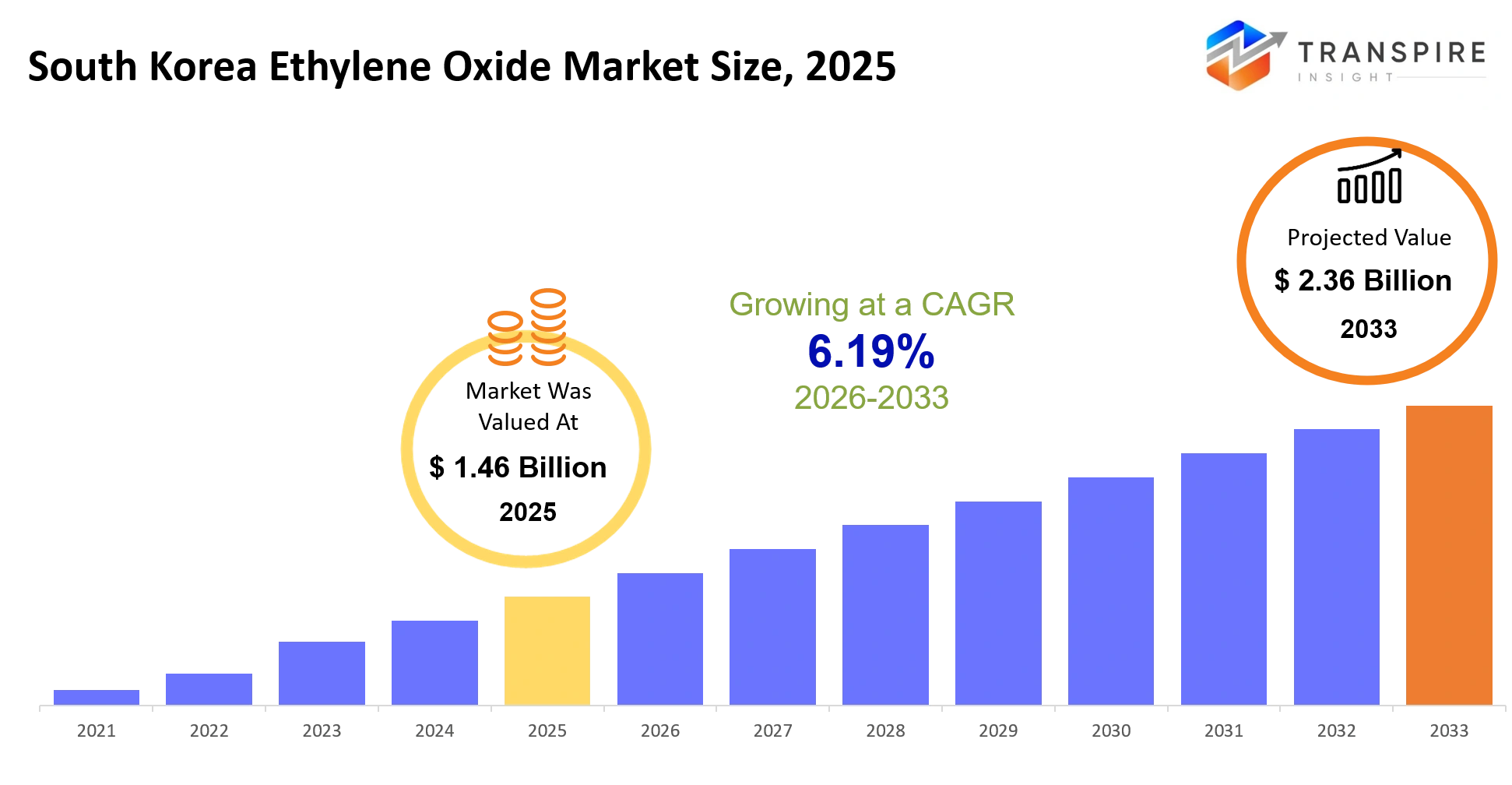
As per Transpire Insight Analysis the South Korea Ethylene Oxide Market size is estimated at USD 1.46 Billion in 2025 and is anticipated to reach USD 2.36 Billion by 2033, growing at a CAGR of 6.19% from 2026 to 2033.
South Korea's Ethylene Oxide Market holds together an extensive line of downstream chemicals really touching our daily lives - from polyester fibres in our clothes to surfactants in household cleaners. Ethylene oxide stays rather discreetly hidden within lots of products we use all the time without even thinking about it. Producers heavily depend on it for manufacturing ethylene glycols, ethoxylates, and glycol ethers - and they, in turn, supply textile mills, medical sterilisation facilities, and car coolant production lines. For several years now, the country has focused much more intensely on producing higher-value by-products, shifting away from basic commodity output due to intense regional competition from China reducing profit margins significantly. Meanwhile, government-led reorganisations of the naphtha cracking industry have driven companies like Lotte Chemical and LG Chem to modernise their outdated equipment and direct investments towards speciality ethylene oxide compounds instead. This change, combined with constant demand in textiles and healthcare, keeps the market growing steadily yet reliably over the forecast period.
South Korea Ethylene Oxide Market Size & Forecast:
- South Korea Ethylene Oxide Market Size 2025: USD 1.46 Billion
- Expected Market Value 2033: USD 2.36 Billion
- Forecast CAGR: 6.19%
- Leading cluster in 2025: Yeosu Petrochemical Complex
- Fastest Growing cluster: Daesan Petrochemical Complex
- Key Profile: SABIC, BASF, Dow, Shell Chemicals, Reliance Industries, Indian Oil Corporation, Formosa Plastics, Nippon Shokubai, Mitsubishi Chemical, Huntsman Corporation, Ineos Oxide, Sinopec, Lotte Chemical, LG Chem, Sasol.
Key Market Insights
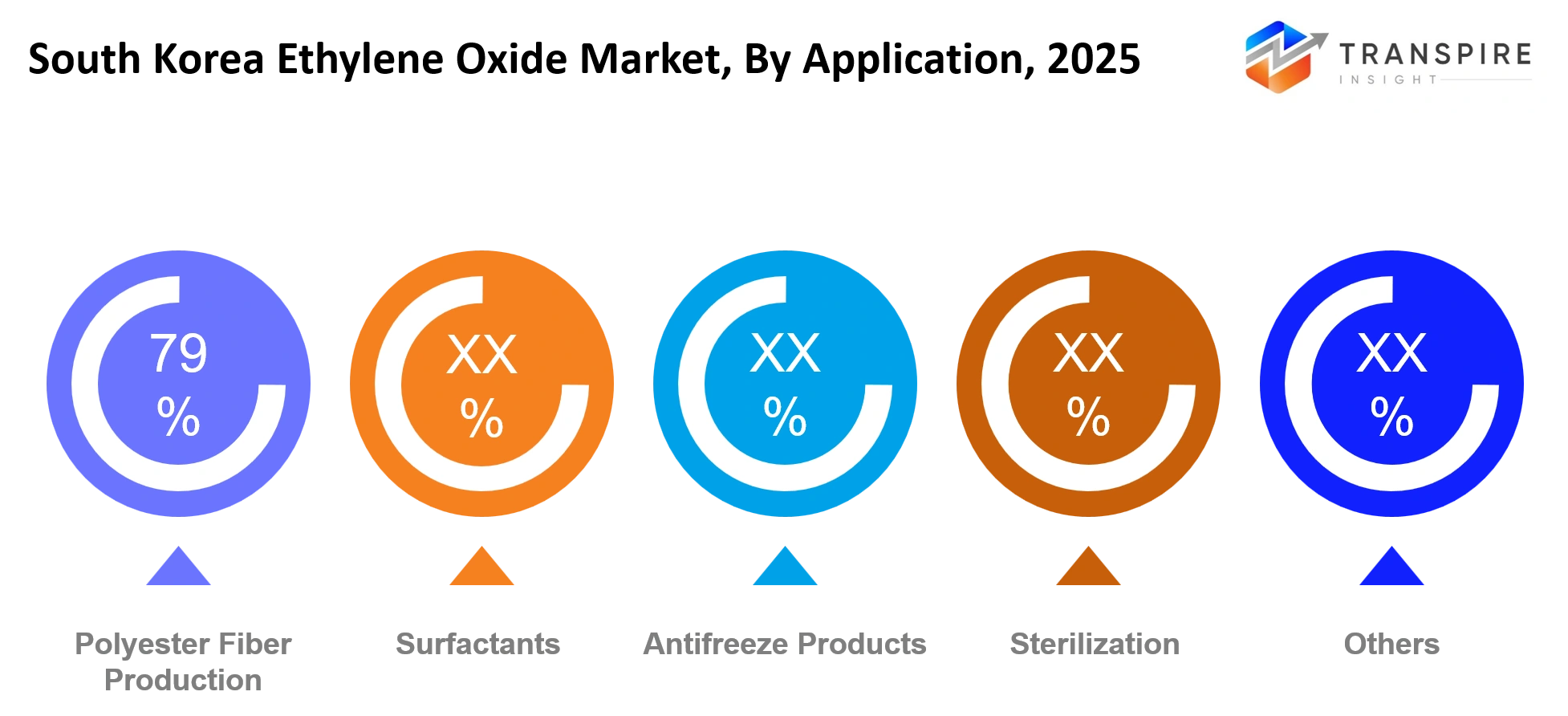
- Polyester fiber manufacture drives application demand - holding around 79% market share by 2025, as textile mills throughout South Korea continue relying heavily on ethylene glycol as their primary raw material.
- Ethylene glycols really dominate the derivative category - mostly because PET and polyester supply chains form a huge portion of our country's domestic chemical production base.
- Glycol ethers are picking up speed somewhat faster than other derivatives, primarily because of growing coatings, paint, and electronic cleaning solution formulations.
- The chemical industry holds its position as the largest consumer, considering ethylene oxide feeds straight into many intermediate chemical processes itself.
- Healthcare demand is also rising fairly steadily, as sterilisation applications become more popular in hospitals and among medical device manufacturers needing reliable, validated gas sterilisers.
- Direct oxidation remains the preferred method of production, because it provides better yield control and really matches up well with the big-scale crackers already set up in Yeosu and Daesan.
- Liquid ethylene oxide continues to drive most of the trade volume - mainly because downstream glycol and ethoxylate plants are designed to handle it in liquid form itself.
- Automotive demand for antifreeze-grade glycols is predicted to grow somewhat as vehicle production in this area remains relatively stable.
What are the Key Drivers, Restraints, and Opportunities in the South Korea Ethylene Oxide Market?
Demand for ethylene oxide is being constantly pushed forward by the country's very large textile and polyester production facilities. Local mills transform ethylene glycol into fibres and PET resin on a massive scale - which keeps ethylene oxide plants operating at nearly maximum capacity for quite some time each year. Increasingly necessary healthcare sterilisation requirements add yet another element of consistent demand, because ethylene oxide gas really is among the few alternatives left for sterilising heat-sensitive medical equipment. Together, these end-uses provide manufacturers with a relatively stable source of income - even when wider petrochemical markets become softer.
Yet, the market still holds some very real structural pressure. South Korea's naphtha cracking industry has been dealing with years of losses because of Chinese overcapacity, forcing companies such as Lotte Chemical and LG Chem into government-backed capacity cuts and plant mergers. Feedstock price fluctuations, outdated cracker infrastructure, and more stringent emissions regulations only add more stress - and these factors can significantly reduce new investment in ethylene oxide capacity - even where downstream demand appears quite strong.
Looking ahead, there are opportunities emerging around higher-value derivatives rather than basic output. Companies are moving their capital towards ethylene oxide adducts, speciality glycol ethers, and sterilisation-grade products that have far better profit margins. As reorganisation eliminates older, less efficient assets, the remaining producers will be much better set up to seize demand from textiles, healthcare, and electronics - whilst regional integration around Yeosu and Daesan keeps our supply chains very short and quite efficient indeed.
What Has the Impact of Artificial Intelligence Been on the South Korea Ethylene Oxide Market?
Artificial intelligence is really changing things around how South Korean chemical plants manage their ethylene oxide units. Predictive maintenance tools are now pointing out early warning signs of reactor wear - which greatly helps operators schedule downtime before a failure causes an unexpected shutdown. Process control software also makes use of machine learning to perfect oxidation conditions, allowing plants to achieve even tighter yield margins even when feedstock quality changes from batch to batch.
Across the broader petrochemical industry, manufacturers use AI-driven demand forecasting to create plans for glycol and ethoxylate production based on patterns of orders in textiles and healthcare, which significantly reduces inventory costs and minimizes waste. Supply chain platforms also assist logistics teams in setting safer routes for shipping liquid ethylene oxide - given its highly flammable properties and special handling needs.
Adoption still develops quite slowly in many areas though. Lots of plants rely on old control systems that weren't set up with today's data connections in mind - and replacing them takes lots of time and funds. Safety rules for handling ethylene oxide also call for very thorough testing and validation before new automated systems can be brought online, so companies often introduce AI tools very gradually and incrementally instead of all at once.
Key Market Trends
- Government led restructuring of naphtha cracking capacity gathered pace through 2025 and into 2026, pushing producers to consolidate aging plants and focus on higher value output.
- Lotte Chemical expanded its ethylene oxide adduct production lines at Daesan and Yeosu, adding capacity aimed at construction and specialty chemical uses.
- Regional overcapacity from Chinese producers kept pricing pressure on commodity grade ethylene glycol through much of 2025.
- Healthcare sterilization demand grew steadily as medical device manufacturing expanded, supporting a shift toward higher purity ethylene oxide grades.
- Merger activity between Hyundai Chemical and Lotte Chemical's Daesan operations reflected broader industry consolidation aimed at restoring profitability.
- Producers increased focus on glycol ethers and ethoxylates for coatings, electronics, and personal care formulations, moving away from pure commodity glycol output.
South Korea Ethylene Oxide Market Segmentation
By Derivative Type:
Ethylene glycols hold the largest share of the derivative mix, since they feed directly into PET resin and polyester fiber production that anchors much of the domestic textile industry. Ethoxylates come next, valued for their role in surfactants and household cleaning formulations. Ethanolamines keep a steady niche in gas treatment and personal care products, while glycol ethers are gaining ground quickly thanks to demand from coatings, electronics cleaning, and industrial solvents. Other derivatives, including specialty intermediates, continue to open smaller but growing commercial pathways as chemical companies diversify beyond bulk glycol output.
By Application:
Polyester fiber production leads by a wide margin, accounting for close to 79% of application demand in 2025, driven by South Korea's large textile and PET packaging base. Surfactants form the next largest use, supporting detergents and personal care goods. Antifreeze products hold a smaller but stable slice tied to automotive and industrial cooling needs. Sterilization applications are growing the fastest, as hospitals and device makers lean on ethylene oxide gas to treat equipment that cannot handle heat or moisture based methods. Other niche applications continue to add incremental demand across specialty chemical processes.
By End User:
The chemical industry remains the dominant end user, since ethylene oxide acts as a building block across countless intermediate processes. The textile industry follows closely, given its heavy reliance on ethylene glycol for fiber and resin manufacturing. Healthcare demand keeps climbing as sterilization needs expand across hospitals, clinics, and device producers. The automotive industry uses ethylene oxide derivatives mainly for antifreeze and coolant products, and this stays fairly stable year to year. Other end users, spanning construction and electronics, continue to add smaller but meaningful pockets of demand.
By Production Process:
Direct oxidation remains the preferred production route across South Korea, offering better yield efficiency and fitting naturally with the large scale crackers already operating in Yeosu, Daesan, and Ulsan. Catalytic oxidation processes still hold relevance for certain specialty grade outputs where tighter purity control matters more than raw throughput. Other emerging process technologies are being explored in smaller pilot scale settings, mostly aimed at improving energy efficiency and cutting emissions as environmental rules tighten across the domestic petrochemical sector.
By Form:
Liquid ethylene oxide carries the bulk of trade and internal transfer volume, since most downstream glycol, ethoxylate, and ethanolamine plants are built around liquid feed handling. Gas ethylene oxide holds a smaller but important niche, used mainly in medical and industrial sterilization where direct gas exposure is needed. Other specialized forms, including diluted gas mixtures for safer handling, continue to see limited but steady uptake in select sterilization and laboratory settings.
|
Market size value in 2025 |
USD 1.46 Billion |
|
Market size value in 2026 |
USD 1.55 Billion |
|
Revenue forecast in 2033 |
USD 2.36 Billion |
|
Growth rate |
CAGR of 6.19% from 2026 to 2033 |
|
Base year |
2025 |
|
Historical data |
2021 - 2024 |
|
Forecast period |
2026 - 2033 |
|
Report coverage |
Revenue forecast, competitive landscape, growth factors, and trends |
|
Regional scope |
South Korea (Yeosu, Daesan, Ulsan and other industrial clusters) |
|
Key company profiled |
SABIC, BASF, Dow, Shell Chemicals, Reliance Industries, Indian Oil Corporation, Formosa Plastics, Nippon Shokubai, Mitsubishi Chemical, Huntsman Corporation, Ineos Oxide, Sinopec, Lotte Chemical, LG Chem, Sasol. |
|
Customization scope |
Free report customization (country, regional & segment scope). Avail customized purchase options to meet your exact research needs. |
|
Report Segmentation |
By Derivative Type (Ethylene Glycols, Ethoxylates, Ethanolamines, Glycol Ethers, Others); By Application (Polyester Fiber Production, Surfactants, Antifreeze Products, Sterilization, Others); By End User (Textile Industry, Chemical Industry, Healthcare Industry, Automotive Industry, Others); By Production Process (Direct Oxidation Process, Catalytic Oxidation Process, Others); By Form (Liquid Ethylene Oxide, Gas Ethylene Oxide, Others). |
Which Clusters are Driving the South Korea Ethylene Oxide Market Growth?
Yeosu stands as the dominant production hub, hosting some of the country's largest integrated petrochemical complexes and a long running base of ethylene oxide and glycol capacity. Lotte Chemical and other major producers keep expanding adduct lines here, and the cluster benefits from deep port access that supports both feedstock imports and product exports. Stable naphtha supply contracts and established logistics infrastructure help keep the region's output competitive even as broader industry margins stay under pressure.
Daesan is emerging as the fastest growing cluster through the 2026 to 2033 window, largely because recent restructuring, including the Lotte Chemical and Hyundai Chemical integration, is concentrating fresh investment there. New adduct and high purity ethylene oxide lines are coming online in the area, and government backed rationalization plans are steering capital toward this cluster as older, less efficient assets elsewhere get phased out.
Ulsan continues to play a supporting role, with several major producers running complementary petrochemical operations there. As national restructuring plans finalize through 2026, capacity allocation across Yeosu, Daesan, and Ulsan is expected to shift further toward higher value, better integrated production sites.
Who are the Key Players in the South Korea Ethylene Oxide Market and How Do They Compete?
Competition in the South Korea Ethylene Oxide Market stays fairly concentrated, with domestic petrochemical giants Lotte Chemical and LG Chem holding a meaningful share of national output, while global players including SABIC, BASF, Dow, and Shell Chemicals maintain trading and technology partnerships across the region. Competitive position depends less on price alone and more on production efficiency, product purity, and the ability to pivot toward specialty derivatives as commodity margins stay thin.
Lotte Chemical keeps expanding its ethylene oxide adduct capacity across Yeosu and Daesan, positioning itself around higher value construction and specialty chemical uses. LG Chem continues to invest in derivative diversification alongside its broader ethylene portfolio. International names such as SABIC and Sinopec bring scale and feedstock flexibility through cross border supply arrangements, while Mitsubishi Chemical and Nippon Shokubai contribute specialty process technology that supports quality upgrades across the regional supply chain.
Ongoing government led restructuring is reshaping this competitive picture. As naphtha cracking capacity gets rationalized, remaining producers are likely to consolidate market share, and companies that move fastest toward specialty ethylene oxide derivatives should gain the strongest long term footing.
Company List
- SABIC
- BASF
- Dow
- Shell Chemicals
- Reliance Industries
- Indian Oil Corporation
- Formosa Plastics
- Nippon Shokubai
- Mitsubishi Chemical
- Huntsman Corporation
- Ineos Oxide
- Sinopec
- Lotte Chemical
- LG Chem
- Sasol
Recent Development News
In February 2026, South Korea's trade ministry approved a restructuring plan merging Lotte Chemical's Daesan petrochemical plant with Hyundai Chemical, integrating naphtha cracking and downstream units under a jointly funded investment package. The move marks the first approved project under the government's wider rationalization drive across the Yeosu, Daesan, and Ulsan complexes, and is expected to sharpen capacity allocation for ethylene oxide and related derivatives at the Daesan site.
Source: https://www.argusmedia.com
In prior expansion activity, Lotte Chemical invested roughly 250 billion won to expand its ethylene oxide adduct production line at Daesan, lifting EOA capacity by 150,000 tons annually and raising high purity ethylene oxide output to 250,000 tons, following an earlier 120 billion won expansion at its Yeosu facility.
Source: https://www.indianchemicalnews.com
What Strategic Insights Define the Future of the South Korea Ethylene Oxide Market?
Over the next five to seven years, the South Korea Ethylene Oxide Market should lean further into specialty derivatives, supported by government backed restructuring that is trimming older naphtha cracking capacity and steering fresh capital toward integrated, higher value production sites. This shift should help stabilize margins that have been under pressure from regional overcapacity.
A less visible risk sits with continued Chinese competition on commodity grade glycol, which could keep pricing pressure alive even as restructuring proceeds. Feedstock cost volatility and slow moving regulatory approvals for new capacity add further uncertainty to the pace of recovery.
At the same time, real opportunity is forming around healthcare sterilization grade ethylene oxide and construction focused adducts, where demand keeps climbing independent of broader petrochemical cycles. Companies that invest early in these specialty lines, while keeping supply chains concentrated around Yeosu and Daesan, should be best placed to capture long term commercial value across the forecast period.
South Korea Ethylene Oxide Market Report Segmentation
By Derivative Type
- Ethylene Glycols
- Ethoxylates
- Ethanolamines
- Glycol Ethers
By Application
- Polyester Fiber Production
- Surfactants
- Antifreeze Products
- Sterilization
By End User
- Textile Industry
- Chemical Industry
- Healthcare Industry
- Automotive Industry
By Production Process
- Direct Oxidation Process
- Catalytic Oxidation Process
By Form
- Liquid Ethylene Oxide
- Gas Ethylene Oxide
Frequently Asked Questions
Find quick answers to common questions.
The expected South Korea Ethylene Oxide Market size for the market will be USD 2.36 Billion in 2033.
Key segments for the South Korea Ethylene Oxide Market are By Derivative Type (Ethylene Glycols, Ethoxylates, Ethanolamines, Glycol Ethers, Others); By Application (Polyester Fiber Production, Surfactants, Antifreeze Products, Sterilization, Others); By End User (Textile Industry, Chemical Industry, Healthcare Industry, Automotive Industry, Others); By Production Process (Direct Oxidation Process, Catalytic Oxidation Process, Others); By Form (Liquid Ethylene Oxide, Gas Ethylene Oxide, Others).
Major South Korea Ethylene Oxide Market players are SABIC, BASF, Dow, Shell Chemicals, Reliance Industries, Indian Oil Corporation, Formosa Plastics, Nippon Shokubai, Mitsubishi Chemical, Huntsman Corporation, Ineos Oxide, Sinopec, Lotte Chemical, LG Chem, Sasol.
The South Korea Ethylene Oxide Market size is USD 1.46 Billion in 2025.
The South Korea Ethylene Oxide Market CAGR is 6.19% from 2026 to 2033.
- SABIC
- BASF
- Dow
- Shell Chemicals
- Reliance Industries
- Indian Oil Corporation
- Formosa Plastics
- Nippon Shokubai
- Mitsubishi Chemical
- Huntsman Corporation
- Ineos Oxide
- Sinopec
- Lotte Chemical
- LG Chem
- Sasol
About the Authors

Pankaj Ghogare Patil
I am Pankaj Ghogare Patil, a Senior Research Analyst at Transpire Insight, specializing in the Pharmaceutical, Chemicals & Materials, Healthcare IT, and Biotechnology industry. My expertise lies in conducting comprehensive market research, analyzing industry trends, evaluating competitive landscapes, and translating complex data into actionable insights. At Transpire Insight, I closely follow emerging technologies, regulatory developments, and market innovations to create accurate, well-researched, and informative content that helps businesses and professionals make informed decisions. I am committed to producing credible, evidence-based articles that reflect industry best practices while making technical topics accessible and valuable for a broad audience.

Chakradhar Khansole
Chakradhar serves as the Research Director at Transpire Insight, bringing over 8 years of experience in technology, innovation, and strategic market intelligence. He specializes in transforming complex market data into actionable business insights that enable organizations to make informed, growth-oriented decisions. Recognized for his strategic vision and analytical expertise, Chakradhar leads high-impact research initiatives, delivering comprehensive market assessments, competitive intelligence, and forward-looking industry analysis.
Recently Published Reports
-
May 2026
Healthcare Polymer Packaging Market
Healthcare Polymer Packaging Market Size, Share & Analysis Report By Packaging Type (Syringes, IV Bottles and Pouches, Clamshells, Blisters, Bottles & Jars, Containers, Tubes, IV Parental Packaging, Others), By Type (Regulated, Non-regulated), By Polymer Type (LDPE (Low-Density Polyethylene), HDPE (High-Density Polyethylene), Homo-polymer (Homo), Random Copolymer (Random), Block Copolymer (Block), PET, Polystyrene, Polyvinyl Chloride, Polyamide/EVOH, Others), and Geography (North America, Europe, Asia-Pacific, Middle East and Africa, South and Central America), 2021 - 2031
-
Apr 2026
Hydrophilic Tape (Waterstop) Market
Hydrophilic Tape (Waterstop) Market Size, Share & Analysis Report By Type (Bentonite-Based Hydrophilic Tape, Rubber-Based Hydrophilic Tape), By Application (Residential Buildings, Commercial Buildings, Infrastructure Projects), and Geography (North America, Europe, Asia-Pacific, Middle East and Africa, South and Central America), 2021 - 2031
-
Apr 2026
Metalens Market
Metalens Market Size, Share & Analysis Report By Type (Visible Light Metalens, and Infrared Metalens), By Application (Consumer Electronics, Automotive Electronics, Industrial, Medical, and Others), and Geography (North America, Europe, Asia-Pacific, Middle East and Africa, South and Central America), 2021 - 2031
-
Apr 2026
PBT Resin Market
PBT Resin Market Size, Share & Analysis Report By Type (Reinforced PBT Resin, Unreinforced PBT Resin), By Processing Method (Injection Molding, Extrusion, Blow Molding, Others), By End-User (Automotive, Electrical & Electronics, Consumer Appliances, Industrial Machinery, Medical Devices, Packaging, Others), and Geography (North America, Europe, Asia-Pacific, Middle East and Africa, South and Central America), 2021 - 2031