
North America Sterilization Consumables Market Size & Forecast:
- North America Sterilization Consumables Market Size 2025: USD 3.51 Billion
- North America Sterilization Consumables Market Size 2033: USD 5.51 Billion
- North America Sterilization Consumables Market CAGR: 5.81%
- North America Sterilization Consumables Market Segments: By Product Type (Sterilization Wraps, Sterilization Indicators, Biological Indicators, Chemical Indicators, Sterilization Pouches, Sterilization Containers, Disinfectants, Others); By Sterilization Method (Steam Sterilization, Ethylene Oxide Sterilization, Hydrogen Peroxide Sterilization, Radiation Sterilization, Dry Heat Sterilization, Ozone Sterilization, Plasma Sterilization, Others); By End User (Hospitals, Clinics, Pharmaceutical Companies, Medical Device Manufacturers, Laboratories, Research Institutes, Ambulatory Centers, Others); By Distribution Channel (Direct Sales, Medical Distributors, Hospital Procurement, Retail Suppliers, Online Sales, Group Purchasing Organizations, Specialty Suppliers, Others); By Material (Paper-Based Materials, Plastic-Based Materials, Metal Containers, Synthetic Fabrics, Composite Materials, Biodegradable Materials, Sterile Materials, Others).
North America Sterilization Consumables Market Summary
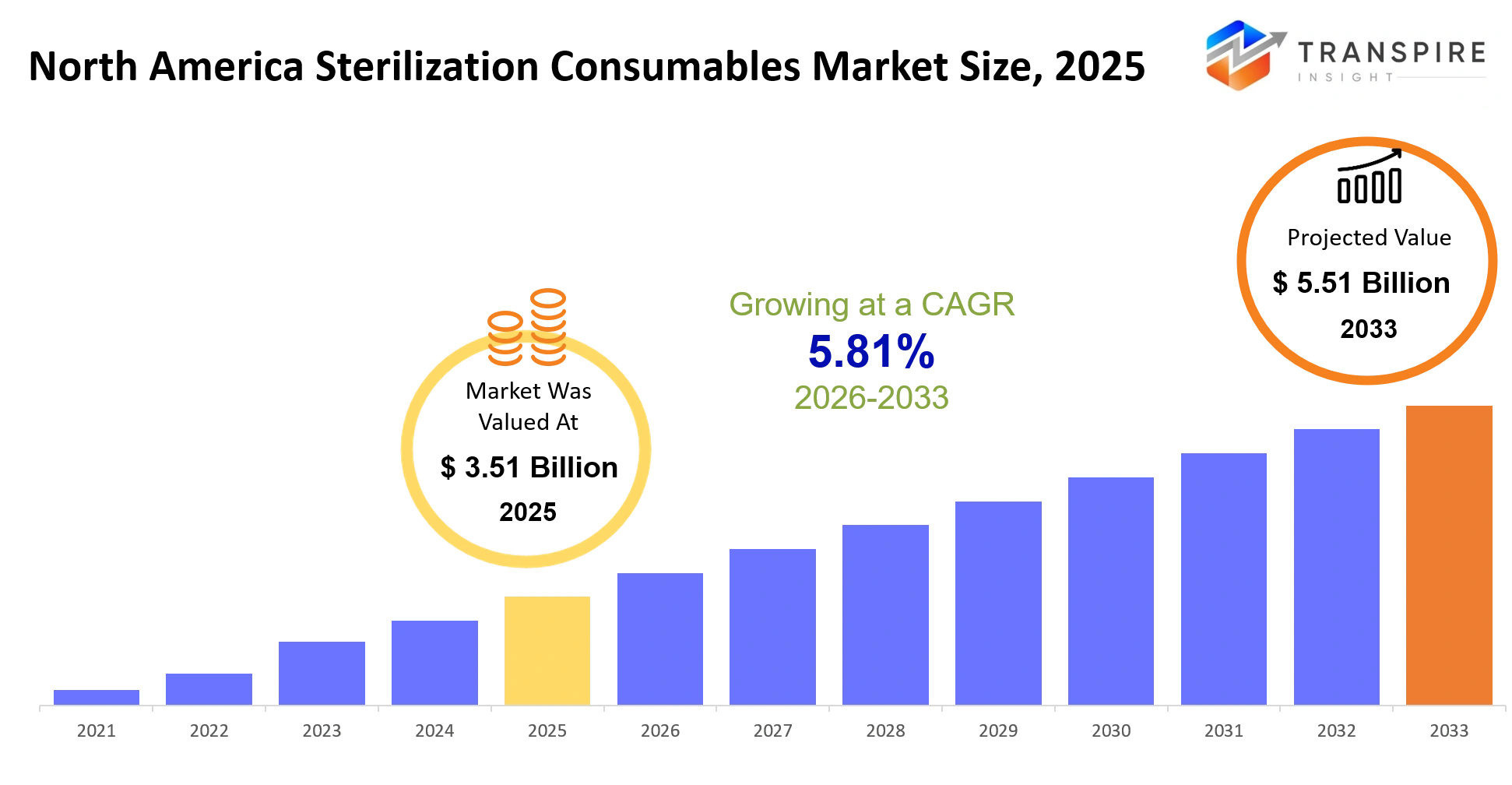
The North America Sterilization Consumables Market was valued at USD 3.51 Billion in 2025. It is forecast to reach USD 5.51 Billion by 2033. That is a CAGR of 5.81% over the period.
In North America, sterilization consumables do this critical work of keeping hospitals, pharmaceutical plants, and diagnostic labs safe, by making sure each surgical instrument device and even production surface is clean, free from contamination, before it’s actually used. These things basically sit inside continuous infection control workflows, so if there’s downtime or something fails, it doesn’t just “slow down” operations, it can directly affect patient safety and also regulatory compliance. Over the last five years, the market has moved in a more structural way, away from the older indicator focused monitoring and toward more integrated systems that are traceable, so they match digital hospital workflows and stricter quality documentation needs.
One big trigger that helped push this change, was the post-pandemic tightening of infection prevention protocols, mixed with supply chain disruptions that revealed how much everyone was depending on single-use sterile packaging and standalone indicators. So, in practice, healthcare systems plus manufacturers started diversifying procurement, they also began adopting standardized consumables, to cut down operational risk. This overall has become stronger recurring demand cycles, especially in high-throughput surgical settings and pharmaceutical production environments, where compliance pressure keeps getting more intense.
Key Market Insights
- North America Sterilization Consumables Market is getting more and more driven by standardized infection control protocols across hospitals and ambulatory surgical centers, you know how it goes.
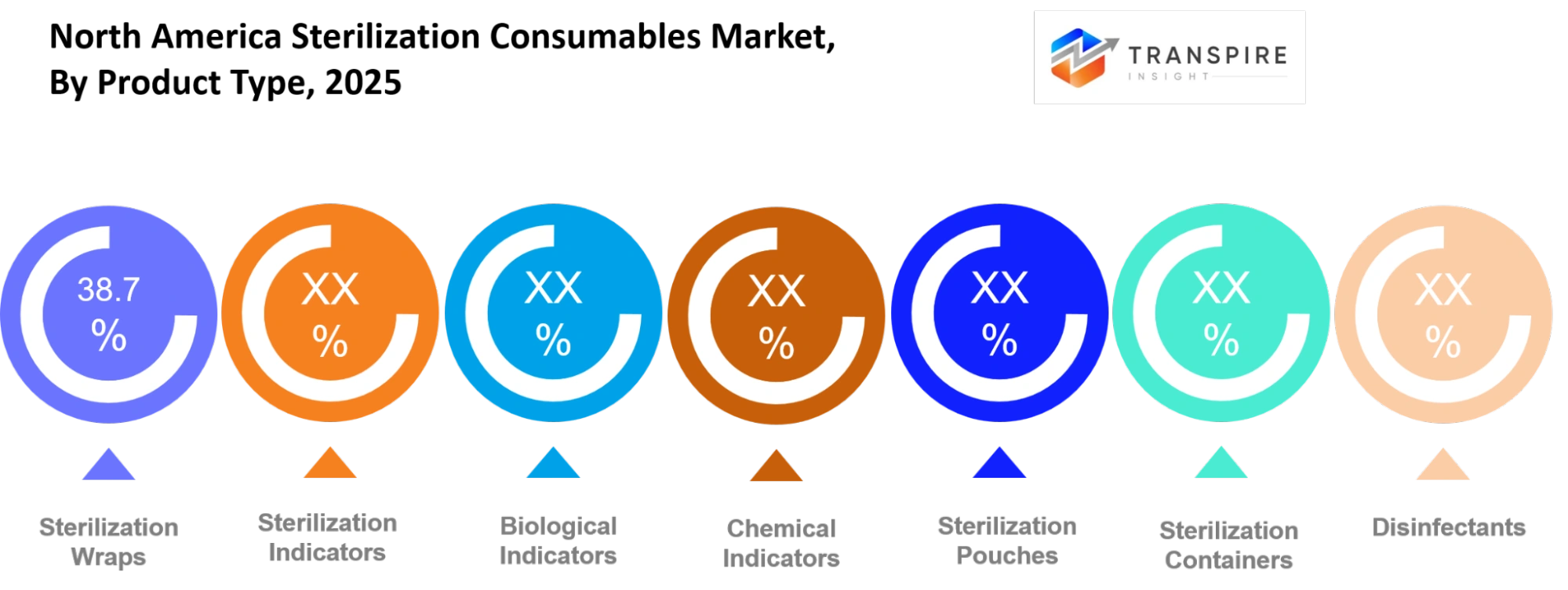
- Sterilization indicators are basically the main thing people pick first , they hold around 28–32% share because regulatory documentation needs keep piling up by 2025.
- Sterilization pouches look like the fastest-moving segment, since outpatient surgeries and minimally invasive procedures keep expanding across the region in a pretty steady way.
- For end users, hospitals are still leading the charge, contributing over 55% share in the North America Sterilization Consumables Market, mainly due to high surgical throughput and the constant demand cycle.
- On the adoption side, pharmaceutical manufacturing is seeing rapid growth, pushed by stricter GMP compliance and the need for batch-level sterility validation. Steam sterilization compatibility consumables still remain dominant too , supported by cost efficiency plus the fact that hospital infrastructure is widely already in place.
- Chemical indicators are also gaining ground, especially in decentralized diagnostic labs where faster turnaround validation workflows matter a lot, like more speed less delays. In terms of geography, the United States holds the top regional share at roughly 75–80%, largely because healthcare infrastructure is more advanced and enforcement is tighter.
- Canada is expected to be the fastest-growing submarket, backed by more hospital investments and ongoing infection control modernization programs. The competitive scene is shaped by strategic expansion and product innovation from 3M, STERIS, Medline Industries, Cardinal Health, Getinge, and Johnson & Johnson. These firms are improving their portfolios through advanced indicator systems, supply chain localization, and sterile packaging innovation, kinda focusing on upgrades that stick.
What are the Key Drivers, Restraints, and Opportunities in the North America Sterilization Consumables Market?
The main driver behind the North America Sterilization Consumables Market is this kinda tightening enforcement of hospital-acquired infection prevention standards across surgical and clinical settings. Regulatory bodies, and accreditation schemes now ask for documented sterilization validation for each and every procedure cycle . Because of that, hospitals and labs are leaning more and more toward frequent use of indicators , pouches and wraps. And yeah, this shift has pushed up recurring procurement volumes quite noticeably, especially in facilities with heavy surgical loads, where these consumables are handled like critical operational inputs, not something “optional” you can skip.
On the other side, a big restraint is the ongoing cost pressure inside healthcare purchasing systems, most visible in public hospitals and mid-level diagnostic centers. Sterilization consumables need continuous replenishment , but reimbursement models don’t always grow in step with compliance expenses. So budget constraints end up slowing the uptake of premium or more advanced, traceability-enabled consumables. Buyers then have to juggle compliance requirements with cost optimization, which can feel like a constant tradeoff. And since this is tied to the structure of healthcare funding models, it doesn’t really get fixed in the near term, not easily.
An opportunity that is starting to take shape involves digitally traceable sterilization consumables, supporting end to end compliance tracking through surgical workflows. Hospitals are increasingly paying attention to smart tracking systems that link sterilization cycles with patient records, allowing audit-ready documentation. Manufacturers that match their consumables to digital hospital infrastructure and automated compliance platforms, are more likely to secure higher-value agreements, plus longer term supply commitments.
What Has the Impact of Artificial Intelligence Been on the North America Sterilization Consumables Market?
Artificial intelligence is kind of gradually reshaping the operational workflows in the North America Sterilization Consumables Market, by boosting how efficient sterilization cycles are, improving monitoring clarity, and handling compliance tracking in a more steady way. In big hospital networks, AI-enabled systems are being used to take over sterilizer monitoring tasks, so that temperature , pressure and exposure time parameters stay inside the validated boundaries , without anyone having to manually babysit the process. That cuts down on human error a bit, and it helps keep results more consistent across high-volume surgical centers.
Also, machine learning models are getting stitched into predictive maintenance frameworks for sterilization equipment. This helps healthcare facilities anticipate equipment wear sooner, and arrange servicing on a more practical timetable. In certain advanced hospital setups predictive analytics have boosted equipment uptime by 10–15% and lowered unexpected cycle failures, and that directly trims consumable wastage plus reduces operational delays . These tools further support performance optimization by reviewing historical sterilization data , and then using it to refine cycle efficiency.
Still , there is a clear snag with AI adoption. It’s largely driven by fragmented data environments, and by inconsistent digitization across smaller healthcare facilities. Lots of sterilization workflows still lean on partially manual records, which then restricts model precision, and also limits how far predictive solutions can scale. On top of that, connectivity gaps between sterilization units and centralized hospital data platforms make the full-scale AI roll out slower , especially in older infrastructure settings where everything is a bit less integrated.
Key Market Trends
- Hospitals are kinda moving away from manual sterilization logbooks, to RFID and barcode tracking, which sorta ups compliance documentation accuracy since 2021.
- Back between 2022 and 2025, 3M and STERIS also expanded their smart indicator line, and it seems to have boosted adoption of automated sterilization validation in a real-world way.
- Demand for sterilization pouches jumped hard after 2020, mostly because outpatient surgical volumes kept rising and minimally invasive procedures became more common across North America.
- In pharmaceutical plants, biological indicator adoption went up by almost 18% from 2021 to 2025. This happened alongside tighter GMP validation obligations, which everyone was suddenly treating as non-negotiable.
- Steam sterilization consumables stayed the main thing, but hydrogen peroxide compatible options started gaining traction as low temperature sterilization spread across hospitals.
- After the disruptions that hit in 2021, supply chain diversification also accelerated. So hospitals began using multi-vendor purchasing tactics for sterilization supplies, like more than one source at a time.
- Chemical indicator use grew in ambulatory surgical centers. This tracks with more same day discharge workflows increasing across the bigger urban health networks.
- Meanwhile, medical device manufacturers started weaving sterilization-ready packaging systems into production itself, rather than relying on the usual after-the-fact validation steps.
- Also, government supported infection prevention audits got more intense after COVID-19 , and that increased how often some consumables were used across accredited facilities.
- Finally, group purchasing organizations reinforced bulk procurement agreements, so pricing power started leaning away from smaller regional suppliers and toward the larger manufacturers.
North America Sterilization Consumables Market Segmentation
By Product Type
Sterilization Wraps and Sterilization Indicators are seeing pretty strong adoption in hospital operating rooms, helps keep infection control more consistent across different surgical workflows. Since around 2021, surgical volumes keep going up, so consumption of barrier based wrapping systems and validation indicators has stayed steady. Lately, hospitals are also leaning into standardized packaging formats… not just for convenience but to cut down contamination risks, plus to make audits easier, quicker, you know.
Sterilization Pouches and Biological Indicators have been gaining more pull in pharmaceutical and medical device manufacturing settings. From 2022 and on, regulatory scrutiny feels a bit more intense so manufacturers are shifting toward batch level sterility verification systems. Meanwhile, Chemical Indicators and Sterilization Containers keep expanding in ambulatory centers where rapid turnover procedures need fast validation and reusable containment setups.
By Sterilization Method
Steam Sterilization still feels like the default choice, mostly because it fits hospital infrastructure, and also because it tends to be cost efficient across North America. The uptake seemed to rise again after 2020 as healthcare systems sorta standardized high volume sterilization procedures. And those sterilization consumables that are meant for steam processes keep showing up in procurement cycles, basically staying on top.
Hydrogen Peroxide with Plasma Sterilization has expanded really quickly in recent years, largely because the push for low temperature sterilization is not slowing down. Medical device manufacturers, more and more, moved toward Ethylene Oxide alternatives after the rules tightened around emissions. Then Radiation Sterilization, and also ozone based systems, are still more niche, but they are slowly gaining ground in specialized pharma, plus lab use.
By End User
Hospitals show up as the dominant end-user segment, mostly because the surgical activity never really stops and there are strict infection prevention standards in place. The use of sterilization consumables jumped quite a lot after 2020, likely because hospital acquired infection control demands got more intense. So procurement systems now tend to lean toward bulk purchasing, while also focusing on compliance certified consumables , which seems to be the safe way to go.
Pharmaceutical firms and medical device manufacturers have also increased their consumption, partly tied to stricter regulatory validation obligations that started since 2021. Meanwhile laboratories and research institutes are also adopting more, for controlled testing surroundings, plus better biosafety alignment. On top of that, ambulatory centers are turning into a fast growing segment, due to the steady rise in outpatient surgical procedures happening across urban healthcare networks.
By Distribution Channel
Group Purchasing Organizations and hospital procurement channels sorta lead the way, mostly because centralized purchasing setups work across big healthcare systems. After 2021, when supply chain disruptions got worse, the move toward bulk contracts picked up, and that helped with tighter pricing control and steadier inventory, overall. Even so, direct sales still matter a lot for large institutional buyers, since they often need bespoke supply agreements, tailored to their workflows or requirements.
Medical distributors plus specialty suppliers also expanded in a major way, largely because healthcare demand is kinda fragmented across North America. Online sales, meanwhile, grew pretty steadily starting 2022, and especially for small clinics, and diagnostic labs. Retail suppliers are still somewhat limited , but they’re useful when procurement can’t wait in decentralized healthcare facilities, you know, for urgent cases.
By Material
Paper based and plastic based materials kind of dominate, mostly because they re widely used in sterilization wraps and pouches across hospitals. After 2020 demand ramped up, since single use consumables were treated as standard for infection prevention. Synthetic fabrics are also commonly used in reusable surgical wrap and gown systems, at least in many wards.
Composite and metal containers have gained real traction, especially in high value instrument sterilization systems inside hospitals and device manufacturing units. Biodegradable materials are slowly emerging, more because of the sustainability initiatives that came in after 2022. Meanwhile sterile pre packed materials are being adopted more often in ambulatory and outpatient surgical centers, for efficiency and for compliance assurance too.
What are the Key Use Cases Driving the North America Sterilization Consumables Market?
Hospitals and surgical centers are basically the main use case for sterilization consumables, pushed along by high surgery volume and very strict infection-control rules in operating rooms, you know the kind where everything is timed. There are ongoing sterilization cycles for surgical instruments, instrument trays, and implantable devices so the demand stays steady across healthcare systems, especially after the post-2020 regulatory tightening, which kinda forced more consistent routines.
Pharmaceutical manufacturing and medical device production are also growing fast as use cases, because sterilization consumables help with batch validation, packaging integrity, and the whole GMP compliance side that has to be proven. Laboratories and diagnostic facilities meanwhile use indicators and wraps so biosafety standards remain in place during testing workflows, even when the process feels a bit chaotic sometimes.
More emerging use cases show up in outpatient ambulatory surgical centers and decentralized diagnostic clinics adopting rapid sterilization validation systems. And then growth in home healthcare support services plus mobile surgical units is opening new demand pathways for portable and simplified sterilization consumable solutions, which is pretty different from the classic large facility setup.
|
Report Metrics |
Details |
|
Market size value in 2025 |
USD 3.51 Billion |
|
Market size value in 2026 |
USD 3.71 Billion |
|
Revenue forecast in 2033 |
USD 5.51 Billion |
|
Growth rate |
CAGR of 5.81% from 2026 to 2033 |
|
Base year |
2025 |
|
Historical data |
2021 - 2024 |
|
Forecast period |
2026 - 2033 |
|
Report coverage |
Revenue forecast, competitive landscape, growth factors, and trends |
|
Regional scope |
United States; Canada; Mexico; United Kingdom; Germany; France; Italy; Spain; Denmark; Sweden; Norway; China; Japan; India; Australia; South Korea; Thailand; Brazil; Argentina; South Africa; Saudi Arabia; United Arab Emirates |
|
Key company profiled |
3M, Steris, Getinge, Cantel Medical, Cardinal Health, Ecolab, ASP, Crosstex, HuFriedyGroup, Medline, Stryker, Belimed, Tuttnauer, MMM Group, Propper Manufacturing. |
|
Customization scope |
Free report customization (country, regional & segment scope). Avail customized purchase options to meet your exact research needs. |
|
Report Segmentation |
By Product Type (Sterilization Wraps, Sterilization Indicators, Biological Indicators, Chemical Indicators, Sterilization Pouches, Sterilization Containers, Disinfectants, Others); By Sterilization Method (Steam Sterilization, Ethylene Oxide Sterilization, Hydrogen Peroxide Sterilization, Radiation Sterilization, Dry Heat Sterilization, Ozone Sterilization, Plasma Sterilization, Others); By End User (Hospitals, Clinics, Pharmaceutical Companies, Medical Device Manufacturers, Laboratories, Research Institutes, Ambulatory Centers, Others); By Distribution Channel (Direct Sales, Medical Distributors, Hospital Procurement, Retail Suppliers, Online Sales, Group Purchasing Organizations, Specialty Suppliers, Others); By Material (Paper-Based Materials, Plastic-Based Materials, Metal Containers, Synthetic Fabrics, Composite Materials, Biodegradable Materials, Sterile Materials, Others). |
Which Regions are Driving the North America Sterilization Consumables Market Growth?
The United States still pretty much stays the main region in the North America Sterilization Consumables Market, because it has a dense hospital network, strict FDA infection control enforcement, and lots of surgical case volume. Big integrated healthcare systems, plus outpatient surgery centers , keep buying rhythm going for indicators, wraps and pouches, and this is reinforced by standardized compliance audits. Also there’s a strong base of advanced life sciences manufacturing clusters, which kinda locks in demand for validated sterilization workflows and traceable consumables. All of this together helps keep consumption consistent across both public and private healthcare infrastructure, even when things shift a little.
Canada adds a steady share, and it’s growing in a careful way, in the North America Sterilization Consumables Market. The drivers are universal healthcare coverage, and more structured hospital procurement frameworks. Compared with the U.S., the momentum here is less about raw volume and more about efficiency, with provinces pushing standardized sterilization protocols and centralized purchasing setups. Hospitals gradually upgrade their infrastructure, and minimally invasive procedures are getting adopted more often , so steady demand for sterilization consumables continues. So Canada ends up being a predictable, policy-aligned contributor that supports regional market revenue stability.
Mexico is showing up as the fastest-growing region, supported by expanding medical device manufacturing clusters and more investment into healthcare infrastructure. In particular, recent industrial expansion in medical export zones and the rising uptake of international sterilization standards have sped up consumables demand across hospitals, as well as production facilities.
Who are the Key Players in the North America Sterilization Consumables Market and How Do They Compete?
The North America Sterilization Consumables Market is kind of moderately consolidated, not totally fragmented, but still with enough noise. There’s a fairly strong top tier of multinational healthcare and infection control players, and they fight on technology integration, regulatory compliance, and supply reliability. Lately the whole contest is moving, away from just shipping a product, toward full cycle sterilization solutions that come with consumables monitoring systems and validation services. Older companies defend their footprint via long term hospital contracts, while newer players tend to push cost efficient consumables, plus a few niche uses in outpatient care and diagnostics, you know, the smaller but faster moving segments.
Companies like 3M, go hard with material science breakthroughs especially with chemical indicators and sterilization monitoring systems meant for quicker readout accuracy and cleaner compliance documentation. STERIS keeps tightening its grip by pairing consumables with low temperature sterilization platforms and also expanding through acquisitions across infection prevention portfolios. Getinge leans into an end to end sterile processing ecosystem approach, where equipment and consumables are aligned for hospital central sterile departments, so it feels more integrated rather than just “parts”.
Medline Industries and Cardinal Health lean on large scale distribution networks, plus group purchasing agreements, to gain pricing advantage across hospital groups. Ecolab differentiates through infection control service integration, bundling consumables with hygiene compliance programs for healthcare facilities, so the sale becomes more like a program. Across the market, competitive advantage is being shaped more and more by portfolio width, regulatory certifications, and the ability to secure recurring institutional contracts rather than relying on standalone product sales.
Company List
- 3M
- STERIS
- Getinge
- Cantel Medical
- Cardinal Health
- Ecolab
- ASP (Advanced Sterilization Products)
- Crosstex
- HuFriedyGroup
- Medline
- Stryker
- Belimed
- Tuttnauer
- MMM Group
- Propper Manufacturing
Recent Development News
In April 2026, STERIS launched the VHP™ LTS60 Low Temperature Sterilizer in North America, expanding its vaporized hydrogen peroxide sterilization portfolio for heat-sensitive medical materials and improving validated sterilization workflows in hospitals.
Source: https://www.sterislifesciences.com
In fiscal 2026, STERIS expanded its infection prevention portfolio through targeted acquisitions totaling over $20 million, strengthening its consumables and sterile processing service capabilities across North American healthcare facilities.
Source: https://www.companiesmarketcap.com
What Strategic Insights Define the Future of the North America Sterilization Consumables Market?
The North America Sterilization Consumables Market is kind of structurally moving toward integrated, digitally traceable sterilization ecosystems, where consumables, equipment and compliance software kinda work as one unified system. The growth piece will be less about standalone product supply, and more about how well manufacturers align with hospital automation, surgical throughput expansion, and the pharmaceutical validation needs that are always coming up.
There’s also a less obvious risk , and it comes from rising market concentration where a small circle of large suppliers controls procurement channels through bundled contracts. This tends to limit pricing flexibility for newer entrants. On top of that, if everyone leans too hard on centralized hospital purchasing systems, demand can wobble when procurement policies shift, sometimes quickly.
Still, there is an emerging opportunity in smart sterilization consumables, with digital tracking, plus real-time validation capabilities. This matters a lot for outpatient surgical centers and for decentralized diagnostics. Companies that connect consumables to hospital IT systems and compliance dashboards will likely build stronger contract stickiness. A pragmatic strategic move for players is to invest in interoperable product ecosystems that tie consumables to sterilization equipment data streams, so you get long-term institutional adoption and more stable recurring revenue.
North America Sterilization Consumables Market Report Segmentation
By Product Type
- Sterilization Wraps
- Sterilization Indicators
- Biological Indicators
- Chemical Indicators
- Sterilization Pouches
- Sterilization Containers
- Disinfectants
- Others
By Sterilization Method
- Steam Sterilization
- Ethylene Oxide Sterilization
- Hydrogen Peroxide Sterilization
- Radiation Sterilization
- Dry Heat Sterilization
- Ozone Sterilization
- Plasma Sterilization
- Others
By End User
- Hospitals
- Clinics
- Pharmaceutical Companies
- Medical Device Manufacturers
- Laboratories
- Research Institutes
- Ambulatory Centers
- Others
By Distribution Channel
- Direct Sales
- Medical Distributors
- Hospital Procurement
- Retail Suppliers
- Online Sales
- Group Purchasing Organizations
- Specialty Suppliers
- Others
By Material
- Paper-Based Materials
- Plastic-Based Materials
- Metal Containers
- Synthetic Fabrics
- Composite Materials
- Biodegradable Materials
- Sterile Materials
- Others
Frequently Asked Questions
Find quick answers to common questions.
The expected North America Sterilization Consumables Market size for the market will be USD 5.51 Billion in 2033.
Key segments for the North America Sterilization Consumables Market are By Product Type (Sterilization Wraps, Sterilization Indicators, Biological Indicators, Chemical Indicators, Sterilization Pouches, Sterilization Containers, Disinfectants, Others); By Sterilization Method (Steam Sterilization, Ethylene Oxide Sterilization, Hydrogen Peroxide Sterilization, Radiation Sterilization, Dry Heat Sterilization, Ozone Sterilization, Plasma Sterilization, Others); By End User (Hospitals, Clinics, Pharmaceutical Companies, Medical Device Manufacturers, Laboratories, Research Institutes, Ambulatory Centers, Others); By Distribution Channel (Direct Sales, Medical Distributors, Hospital Procurement, Retail Suppliers, Online Sales, Group Purchasing Organizations, Specialty Suppliers, Others); By Material (Paper-Based Materials, Plastic-Based Materials, Metal Containers, Synthetic Fabrics, Composite Materials, Biodegradable Materials, Sterile Materials, Others).
Major North America Sterilization Consumables Market players are 3M, Steris, Getinge, Cantel Medical, Cardinal Health, Ecolab, ASP, Crosstex, HuFriedyGroup, Medline, Stryker, Belimed, Tuttnauer, MMM Group, Propper Manufacturing.
The North America Sterilization Consumables Market size is USD 3.51 Billion in 2025.
The North America Sterilization Consumables Market CAGR is 5.81% from 2026 to 2033.
- 3M
- STERIS
- Getinge
- Cantel Medical
- Cardinal Health
- Ecolab
- ASP (Advanced Sterilization Products)
- Crosstex
- HuFriedyGroup
- Medline
- Stryker
- Belimed
- Tuttnauer
- MMM Group
- Propper Manufacturing
About the Authors

Pankaj Ghogare Patil
I am Pankaj Ghogare Patil, a Senior Research Analyst at Transpire Insight, specializing in the Pharmaceutical, Chemicals & Materials, Healthcare IT, and Biotechnology industry. My expertise lies in conducting comprehensive market research, analyzing industry trends, evaluating competitive landscapes, and translating complex data into actionable insights. At Transpire Insight, I closely follow emerging technologies, regulatory developments, and market innovations to create accurate, well-researched, and informative content that helps businesses and professionals make informed decisions. I am committed to producing credible, evidence-based articles that reflect industry best practices while making technical topics accessible and valuable for a broad audience.

Chakradhar Khansole
Chakradhar serves as the Research Director at Transpire Insight, bringing over 8 years of experience in technology, innovation, and strategic market intelligence. He specializes in transforming complex market data into actionable business insights that enable organizations to make informed, growth-oriented decisions. Recognized for his strategic vision and analytical expertise, Chakradhar leads high-impact research initiatives, delivering comprehensive market assessments, competitive intelligence, and forward-looking industry analysis.
Recently Published Reports
-
Apr 2026
AI in Diabetic Retinopathy Market
AI in Diabetic Retinopathy Market Size, Share & Analysis Report By Type (Screening AI Systems, Diagnostic AI Systems, and Predictive AI Models), By Application Segment (Hospitals, Ophthalmology Clinics, Diagnostic Centers, and Research and Development), and Geography (North America, Europe, Asia-Pacific, Middle East and Africa, South and Central America), 2021 - 2031
-
Apr 2026
Psychometric Tests Market
Psychometric Tests Market Size, Share & Analysis Report By Type (Personality Tests, Ability/Aptitude Tests, Skill/Knowledge Tests, and Others), By Application (Talent Acquisition and Talent Management), and Geography (North America, Europe, Asia-Pacific, Middle East and Africa, South and Central America), 2021 – 2031
-
Apr 2026
Rare Biological Sample Collection Market
Rare Biological Sample Collection Market Size, Share & Analysis Report By Type (Isolation Kits & Reagent, Blood Collection Tubes, and Others), By Application (Oncology, Transcriptomics, Pharmacogenomics, and Others), and Geography (North America, Europe, Asia-Pacific, Middle East and Africa, South and Central America), 2021 – 2031
-
Jul 2026
Diabetic Retinopathy Market
Diabetic Retinopathy Market Size, Share & Analysis Report By Type (Proliferative Diabetic Retinopathy, and Diabetic Macular Edema (DME)), By Treatment Type (Anti VEGF Drug, Steroid Implants, Laser Surgeries, and Vitrectomy), and Geography (North America, Europe, Asia-Pacific, Middle East and Africa, South and Central America), 2021 – 2031
Our Clients







