

North America Chemical Indicators Market Size & Forecast:
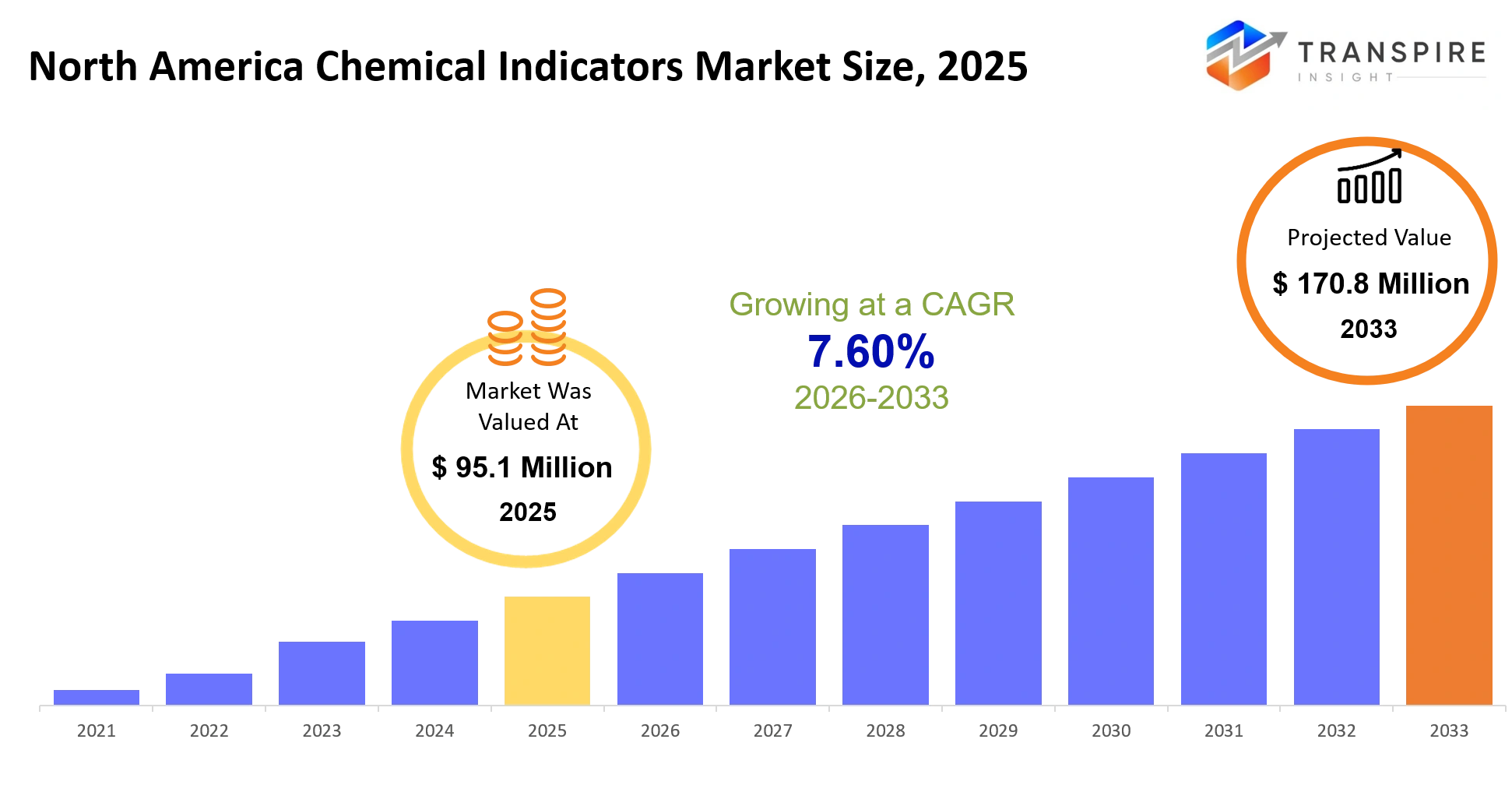
- North America Chemical Indicators Market Size 2025: USD 95.1 Million
- North America Chemical Indicators Market Size 2033: USD 170.8 Million
- North America Chemical Indicators Market CAGR: 7.60%
- North America Chemical Indicators Market Segments: By Product Type (Class 1 Indicators, Class 2 Indicators, Class 3 Indicators, Class 4 Indicators, Others), By Application (Steam Sterilization, Ethylene Oxide Sterilization, Hydrogen Peroxide Sterilization, Others), By End User (Hospitals, Pharmaceutical Companies, Laboratories, Others), By Form (Indicator Strips, Indicator Tapes, Indicator Labels, Others).
To learn more about this report,  Download Free Sample Report
North America Chemical Indicators Market Summary:
The North America Chemical Indicators Market size is estimated at USD 95.1 Million in 2025 and is anticipated to reach USD 170.8 Million by 2033, growing at a CAGR of 7.60% from 2026 to 2033.The North America Chemical Indicators Market, plays a critical part in checking sterilization and decontamination workflows across hospitals, pharmaceutical plants , medical device production sites and laboratories. These indicators act as a kind of “visible proof” that sterilization conditions like temperature, pressure, and exposure duration have actually been reached. In turn, organizations can reduce compliance risk , and also lower the chance of contamination related breakdowns, which is kinda the main concern.
In the last five years, the market moved away from plain process validation toward broader quality assurance systems that include digital records and tighter audit expectations. Regulators have been watching infection control methods more closely, and that extends into sterile manufacturing spaces too. The COVID-19 pandemic was a big catalyst , it highlighted weaknesses in sterilization workflows. So providers and life sciences firms strengthened validation protocols and now deploy higher-value indicator products across more sterilization cycles, driving repeat buying and steady revenue for suppliers focused on traceability, compliance, and reliable operation.
Key Market Insights
- The United States sort of dominates the North America Chemical Indicators Market, with 2025 showing over 80% market share because it has a big and deep healthcare infrastructure.
- Canada ends up being the second-largest regional market, it is supported by continued spending on infection prevention and quality assurance programs, which is basically always ongoing.
- Mexico is the fastest-growing regional market through the forecast, largely pushed by healthcare modernization plus the expanding pharmaceutical manufacturing activities.
- Class 4 plus Class 5 chemical indicators take the lead, together exceeding 35% in 2025 thanks to strong precision and compliance related advantages.
- Process indicators stay as the second-largest segment, and they benefit from broad usage in routine sterilization verification procedures.
- Integrating indicators are projected to grow the quickest up to 2030, due to growing needs for improved sterilization validation and better documentation, more than before.
- On the application side, healthcare and hospital sterilization is still the main area, about 55% of the North America Chemical Indicators Market in 2025.
- Pharmaceutical manufacturing is the fastest-moving application segment too, driven by tougher regulatory requirements and more biologics production.
- Medical device sterilization keeps gaining meaningful share, because manufacturers tighten product safety and quality control protocols.
- Hospitals and healthcare facilities lead the market, taking nearly 50% of revenue share, mainly because sterilization cycle volumes are high and steady.
- Pharmaceutical and biotechnology companies are the second-largest end-user segment across the regional chemical indicators industry.
What are the Key Drivers, Restraints, and Opportunities in the North America Chemical Indicators Market?
The strongest growth driver in the North America Chemical Indicators Market is basically the tighter sterilization validation rules across healthcare, pharmaceutical, and medical device production sites. In practice, regulatory agencies, and also accreditation bodies, have been applying more attention to sterilization processes after stronger worries around infection control and general product safety. This change has pushed hospitals, contract sterilization providers, as well as drug manufacturers to lean toward higher-performance chemical indicators that do a more dependable job of process verification. And when companies start expanding their sterilization monitoring routines, plus bumping up how often they test, suppliers end up benefiting from repeat material use, which supports a steady , scalable revenue stream.
A key issue though is the pretty entrenched procurement structure inside healthcare systems and regulated manufacturing environments. Sterilization workflows are tied to validated procedures, staff learning programs and compliance paperwork in a way that’s hard to detach. So swapping out the current indicator systems is not just a purchase decision, it often means requalification, extra process validation, and operational retraining. That makes the adoption timeline quite long, and also expensive. Because of that structural barrier, advanced indicator technologies don’t move in as fast as they should, and manufacturers introducing newer products can see delayed revenue takeoff.
The next growth opportunity sits in basically folding chemical indicators together with digital traceability and compliance management platforms. Healthcare providers, and pharmaceutical manufacturers are increasingly asking for automated documentation, so it can simplify audits and cut down on all that manual recordkeeping. In a sense, smart sterilization monitoring ecosystems that pair chemical indicators with digital tracking technologies can boost workflow efficiency while also helping with regulatory compliance, and that whole setup tends to open up new value-added revenue streams across North America.
What Has the Impact of Artificial Intelligence Been on the North America Chemical Indicators Market?
The prompt talks about scrubbers and marine emission systems, but for the North America Chemical Indicators Market, this version sort of lines up AI and digital tools with sterilization monitoring, plus how chemical indicators get used in real workflows, day to day.
Artificial intelligence along with advanced digital technologies are starting to change the North America Chemical Indicators Market. The big shift is in sterilization monitoring, compliance management, and quality assurance processes that feel more connected. In healthcare settings , pharmaceutical producers, and medical device organizations, teams are increasingly pairing chemical indicator readings with digital sterilization tracking platforms. These platforms can quietly log cycle parameters, highlight deviations, and then produce audit ready documentation. And because of that, the amount of manual paperwork shrinks a lot, which helps facilities keep their compliance steadier with regulatory expectations.
At the same time, machine learning models are also being introduced to sift through past sterilization cycle data, plus equipment performance patterns. They can forecast when sterilizer upkeep might be needed, spot process variations before they turn into full failures, and help tune the cycle schedule. So operators can limit unexpected downtime, use equipment more efficiently, and reduce the risk of failed sterilization loads that force expensive reprocessing. Digital monitoring also boosts traceability, linking indicator results to particular batches. This makes investigations quicker and helps corrective actions happen sooner, instead of lingering around for too long.
One of the key limitations with current AI adoption is kind of integration difficulty, not just the model side. A lot of healthcare and lab sites still run legacy sterilization equipment that doesn’t really have standardized data connectivity, so the whole pipeline gets messy. Then there’s the cost of replacing infrastructure and also the challenge of creating enough operational data that’s truly high quality … that can slow everything down, and during those first deployment phases it can also reduce how accurate the predictive models end up being.
Key Market Trends
- Since 2020, hospitals have sort of moved away from plain process metrics, and more toward Class 4 and Class 5 indicators in order to bolster sterilization validation, audit readiness , and yeah the whole verification vibe.
- Between 2021 and 2025, regulatory inspections started zeroing in on documented sterilization performance, so facilities ended up adopting more advanced indicator systems, a lot more than before.
- At the same time pharmaceutical manufacturers started leaning harder into chemical indicator usage as biologics, and sterile injectable output capacity, grew across North America after 2020.
- Digital sterilization tracking platforms also gained traction, with more sites tying indicator results to automated compliance documentation systems, so the paperwork is not only “later” it’s kinda linked earlier.
- During the 2020–2022 supply chain disruptions, many healthcare providers chose to diversify suppliers rather than stick to a single-source procurement setup.
- Big names such as 3M, STERIS, Getinge, and Mesa Laboratories, have increased investment since 2021 in integrated monitoring and traceability technologies, and you can feel it in the direction they’re taking.
- Meanwhile contract sterilization service providers expanded capacity, which translated into higher recurring usage of chemical indicators across outsourced sterilization networks.
- Buyers are increasingly prioritizing indicators that play nicely with electronic recordkeeping, reflecting this wider move toward data-driven quality management, rather than just manual review.
- Medical device manufacturers also strengthened sterilization verification protocols after regulatory agencies intensified attention on contamination, plus product safety risks.
- Overall, competitive differentiation seems to have drifted away from just product availability, and toward validation support, digital integration strengths, and broader compliance-first service offerings, kind of end-to-end.
North America Chemical Indicators Market Segmentation
By Product Type
By product type, Class 4 and Class 5 indicators seem to keep the stronger position, mainly because healthcare providers and pharmaceutical manufacturers now want multi parameter verification, it gives more confidence about what happens during sterilization. Class 1 indicators still get a lot of use, mostly for the low cost angle and because routine process monitoring is pretty standard, though. Meanwhile Class 2 and Class 3 indicators are used in a more specialized way for validation scenarios. The other indicator categories support smaller, more niche applications, where certain sterilization parameters call for extra monitoring, kind of like a targeted check rather than a broad one.
Demand is also trending toward higher performance products, since regulatory expectations and audit requirements have started to feel more strict over time. A lot of facilities are moving past just basic exposure confirmation, they’re leaning more into process accuracy, plus the supporting documentation. That kind of shift can open up premium pricing opportunities for suppliers and it also nudges ongoing product innovation.
Looking ahead, growth should favor the more advanced indicator classes, especially those that integrate better with quality management systems. That should create room for manufacturers who can deliver both dependable performance and regulatory compliance support, in one package, kind of.
By Application
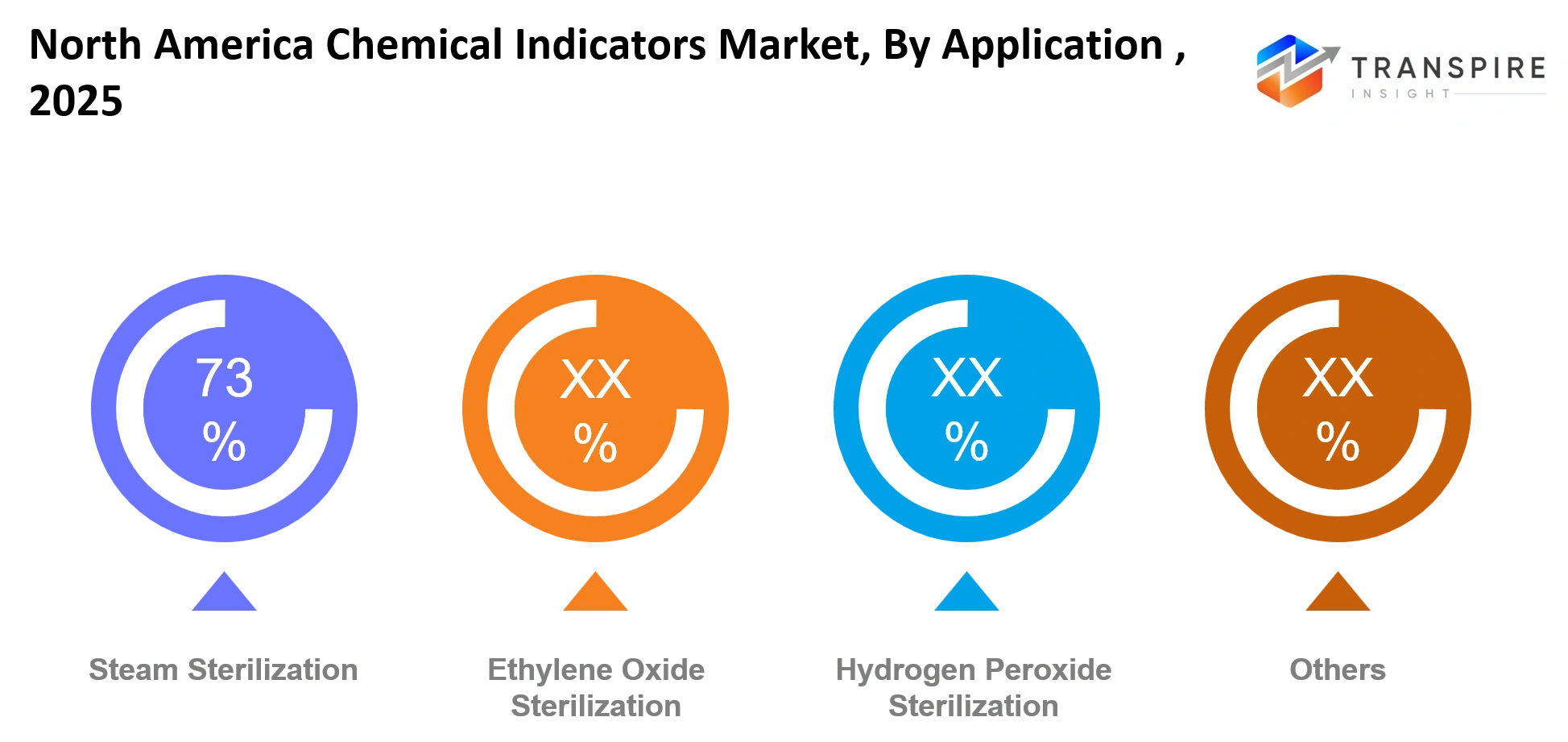
In terms of application, steam sterilization still kind of dominates, largely because hospitals , surgical centers, and medical device processing units lean on steam based methods for what they see as routine sterilization steps. There’s already established infrastructure, the effectiveness is well proven , and regulators generally stay on board so market leadership keeps getting reinforced again and again. Next, ethylene oxide sterilization comes in as the second-largest application , mainly since it works well for heat sensitive medical devices and more complex instruments. Hydrogen peroxide sterilization has also started gaining real momentum, as healthcare organizations want quicker turnaround times and they prefer less process complexity overall.
The other sterilization methods remain smaller but they still matter, especially in specialized settings where they can be useful. Each application category is shaped by its own demand signals , like steam sterilization that benefits from high volume use, while hydrogen peroxide systems are more about workflow efficiency, day to day. Looking ahead, investment should probably concentrate on applications that can support faster validation cycles, stronger traceability, and better compatibility with sterilization technologies that are getting more and more sophisticated.
To learn more about this report, Download Free Sample Report
By End-User
For end user , hospitals take up the largest share, not just because surgical procedures happen often, but also because infection prevention protocols, and, continuous sterilization work create a steady stream of chemical indicator consumption that keeps showing up, again and again. Big healthcare networks meanwhile have strict compliance duties that push them to keep doing process verification, reliably, all the time. Pharmaceutical companies are another key segment, since sterile drug manufacturing standards are becoming more demanding every year. Laboratories still bring stable demand too, especially for research, testing and controlled production settings where contamination control stays critical.
Other end users also show up, like contract sterilization providers and specialized healthcare centers. Demand patterns are not the same across all of them, hospitals usually stress operational consistency, while pharmaceutical manufacturers care more about validation precision and regulatory paperwork. What happens next in the market will be shaped by expanding pharmaceutical production capacity, along with higher investment in healthcare quality systems. Suppliers that adjust their offerings for different compliance needs should be able to seize added value across multiple end user categories too.
By Form
By form, indicator strips sort of dominate the market, mostly because they fit across lots of sterilization processes, they’re easy to handle, and the results are straightforward to read. Indicator tapes keep a solid position too, thanks to heavy use in packaging, plus instrument identification tasks that people already rely on. Indicator labels are still climbing in importance as healthcare organizations tighten traceability rules, and they want more detailed documentation along the sterilization workflow , not just a quick checkbox. Other formats hang around for niche operational needs, where the usual products don’t quite cover the required functionality.
When it comes to buying choices, facilities are increasingly looking at workflow efficiency, recordkeeping demands and how well everything matches digital quality management systems. In general they want formats that simplify compliance steps, while also trimming down the manual documentation burden, because who has time for all that. This momentum is nudging manufacturers toward products with enhanced usability and better integration features. Looking ahead, growth is expected to tilt toward advanced labeling and tracking options that can feed electronic documentation, which should create long-term opportunities for innovation across the chemical indicator value chain.
What are the Key Use Cases Driving the North America Chemical Indicators Market?
The main, the primary use case for chemical indicators kind a stays around sterilization verification especially in hospitals and surgical centers. Each sterilization cycle that touches surgical instruments , trays, and medical equipment needs documented process confirmation, so this is really the biggest source of ongoing product consumption and revenue generation.
Past healthcare, the uptake is moving too, into pharmaceutical manufacturing and medical device production. In those industries chemical indicators get used to validate sterile processing environments, help with regulatory inspections, and keep product quality standards steady. Also contract sterilization providers are leaning into this more and more as outsourcing activity ramps up across North America.
On the newer side, emerging applications are showing up in advanced biologics manufacturing, cell and gene therapy production, and specialized laboratory environments. Those areas run with tight contamination-control requirements and they increasingly want better traceability. With regulatory oversight getting stricter, and production volumes going up, the demand for higher performance indicators that are integrated with digital quality systems is expected to accelerate through the forecast period.
|
Report Metrics |
Details |
|
Market size value in 2025 |
USD 95.1 Million |
|
Market size value in 2026 |
USD 102.3 Million |
|
Revenue forecast in 2033 |
USD 170.8 Million |
|
Growth rate |
CAGR of 7.60% from 2026 to 2033 |
|
Base year |
2025 |
|
Historical data |
2021 - 2024 |
|
Forecast period |
2026 - 2033 |
|
Report coverage |
Revenue forecast, competitive landscape, growth factors, and trends |
|
Country scope |
North America (Canada, The United States, and Mexico) |
|
Key company profiled |
3M, Steris, Getinge, Crosstex International, Mesa Laboratories, Propper Manufacturing, Hu-Friedy, Terragene, Tuttnauer, Matachana Group, Andersen Products, Cardinal Health, Ecolab, GKE GmbH, ASP. |
|
Customization scope |
Free report customization (country, regional & segment scope). Avail customized purchase options to meet your exact research needs. |
|
Report Segmentation |
By Product Type (Class 1 Indicators, Class 2 Indicators, Class 3 Indicators, Class 4 Indicators, Others), By Application (Steam Sterilization, Ethylene Oxide Sterilization, Hydrogen Peroxide Sterilization, Others), By End User (Hospitals, Pharmaceutical Companies, Laboratories, Others), By Form (Indicator Strips, Indicator Tapes, Indicator Labels, Others). |
Which Regions are Driving the North America Chemical Indicators Market Growth?
The United States is still basically the dominant market in North America because of its huge healthcare infrastructure, its strong pharmaceutical manufacturing base, and the pretty strict sterilization compliance rules that are followed there. Oversight at the federal level, through things like the FDA plus accreditation requirements applied across healthcare facilities, keeps demand for chemical indicators fairly steady. Also, the country has a well matured network of hospitals, contract sterilization providers, medical device manufacturers, and life sciences firms, all of them depending on sterilization processes that are validated. Put together, this related ecosystem helps sustain ongoing product consumption and it keeps the U.S. in that leadership role for regional market revenue.
Canada sits as the second-largest regional market, yet the way it grows is not exactly the same as the United States. In Canada, it’s less about raw market size, and more about stable healthcare spending, solid infection prevention programs, and a consistent way regulations get implemented across provinces. Healthcare providers and pharmaceutical companies keep making long term investments in quality assurance, and in sterilization monitoring systems too. That kind of steadiness leads to more predictable buying behavior, so Canada becomes a dependable contributor to regional market results.
Mexico is coming up as the fastest-growing market, as pharmaceutical production, medical device manufacturing, and healthcare infrastructure investments continue to expand. In the recent push, export-oriented manufacturing facilities are growing, and with that there is a bigger need for sterilization processes that are validated and, basically, compliant with international regulatory requirements. Foreign investment in life sciences production along with the modernization of healthcare facilities has also made the appetite stronger for advanced sterilization monitoring products. For market entrants, and investors too, Mexico looks like a very suitable opening through 2026–2033 as industrial expansion keeps going and healthcare modernization accelerates, adoption rates.
Who are the Key Players in the North America Chemical Indicators Market and How Do They Compete?
The competitive landscape for the North America Chemical Indicators Market is kind of moderately consolidated, not totally, with just a handful of global companies in sterilization and infection prevention taking up a notable share of the industry revenue. In general, the rivalry doesn’t really lean on price, it’s more about product reliability, regulatory compliance support, validation performance, and also the way everything fits into sterilization quality systems. Larger established suppliers usually have long standing relationships with hospitals, pharmaceutical manufacturers and medical device companies, while the smaller players tend to go after narrower needs using specialized products and more directed customer support. And as the regulatory expectations keep getting tighter, buyers seem to prefer vendors that can offer technical know-how, help with documentation, and keep product results consistent across multiple sterilization methods, like in practice not just on paper.
3M stands out because it has a wide range of sterilization assurance products that blend chemical indicators, biological indicators and compliance monitoring solutions into one sort of suite. That portfolio strategy lets healthcare organizations standardize purchasing across several product groups. STERIS takes a slightly different route by pairing chemical indicators with sterilization equipment, workflow consulting, and infection prevention services, so it turns into a broader service approach that tends to increase repeat business. Getinge, meanwhile, leans on its strong sterilization equipment presence to provide validation oriented solutions that match well with hospital and life sciences operational needs.
Mesa Laboratories puts a lot of focus on precision testing , sterilization monitoring , and quality control technologies, which seem to fit pretty well in highly regulated pharmaceutical and laboratory settings. The company keeps pushing its market footprint via targeted acquisitions, and investments that are aimed at compliance oriented product development, not just “more stuff”. Propper Manufacturing meanwhile stands out with specialized sterilization consumables and a kind of flexible customer support for healthcare facilities that want cost effective monitoring solutions.
Across the industry, many firms are still trying to bolster their competitive position with digital traceability tools, more validation services expanded over time, and partnerships that help with changing regulatory and quality assurance expectations. It all feels like everyone is leaning on similar themes, but with small different twists.
Company List
- 3M
- Steris
- Getinge
- Crosstex International
- Mesa Laboratories
- Propper Manufacturing
- Hu-Friedy
- Terragene
- Tuttnauer
- Matachana Group
- Andersen Products
- Cardinal Health
- Ecolab
- GKE GmbH
- ASP
Recent Development News
In May 2026, Mesa Labs Announced Fourth Quarter and Fiscal Year 2026 Results: Mesa Laboratories, a key supplier of sterilization monitoring solutions and indicators, announced its fourth-quarter and full-year fiscal 2026 results. The company reported revenue growth, improved operating income, and debt reduction, reflecting continued demand across its Sterilization and Disinfection Control business. This segment serves healthcare and life-science customers that utilize chemical and biological indicators for sterilization validation.
Source: https://investors.mesalabs.com
In April 2026, Mesa Labs CEO Gary Owens to Step Down, Siddhartha Kadia to Succeed: Mesa Labs disclosed a significant leadership change, with longtime CEO Gary Owens stepping down and Siddhartha Kadia taking over leadership. Executive transitions at major sterilization-monitoring suppliers are important because they often influence product strategy, operational priorities, and future investment in indicator technologies and infection-prevention solutions.
Source: https://stockanalysis.com
What Strategic Insights Define the Future of the North America Chemical Indicators Market?
The North America Chemical Indicators Market is kinda moving, toward a more integrated sterilization assurance model where chemical indicators work as part of broader digital quality and compliance ecosystems, not really as standalone consumables. I mean the real push behind this change is the growing need for traceable, audit-ready sterilization records across healthcare, pharmaceutical manufacturing, and even advanced biologics production. Over the next five to seven years, value creation will probably drift from pure product volume toward data integration, validation support, and workflow optimization services.
There’s also a more subtle risk, not everyone sees it right away, and it shows up in market concentration among a smaller group of big healthcare systems and major life sciences manufacturers. When procurement keeps getting more centralized, pricing pressure may grow stronger even while compliance requirements become more complex. Still, there’s an emerging chance in cell and gene therapy manufacturing, where contamination-control expectations are extremely strict and sterilization verification requirements keep getting updated. Market participants should start investing in digitally enabled indicator solutions that connect with electronic quality management systems, because that feature is likely to turn into a key differentiator in future buying decisions and the long-term contract wins.
North America Chemical Indicators Market Report Segmentation
By Product Type
- Class 1 Indicators
- Class 2 Indicators
- Class 3 Indicators
- Class 4 Indicators
- Others
By Application
- Steam Sterilization
- Ethylene Oxide Sterilization
- Hydrogen Peroxide Sterilization
- Others
By End User
- Hospitals
- Pharmaceutical Companies
- Laboratories
- Others
By Form
- Indicator Strips
- Indicator Tapes
- Indicator Labels
- Others
Frequently Asked Questions
Find quick answers to common questions.
The approximate North America Chemical Indicators Market size for the market will be USD 170.8 Million in 2033.
The key segments of the North America Chemical Indicators Market are By Product Type (Class 1 Indicators, Class 2 Indicators, Class 3 Indicators, Class 4 Indicators, Others), By Application (Steam Sterilization, Ethylene Oxide Sterilization, Hydrogen Peroxide Sterilization, Others), By End User (Hospitals, Pharmaceutical Companies, Laboratories, Others), By Form (Indicator Strips, Indicator Tapes, Indicator Labels, Others).
Major players in the North America Chemical Indicators Market are 3M, Steris, Getinge, Crosstex International, Mesa Laboratories, Propper Manufacturing, Hu-Friedy, Terragene, Tuttnauer, Matachana Group, Andersen Products, Cardinal Health, Ecolab, GKE GmbH, ASP.
The current market size of the North America Chemical Indicators Market is USD 95.1 Million in 2025.
The North America Chemical Indicators Market CAGR is 7.60%.
- 3M
- Steris
- Getinge
- Crosstex International
- Mesa Laboratories
- Propper Manufacturing
- Hu-Friedy
- Terragene
- Tuttnauer
- Matachana Group
- Andersen Products
- Cardinal Health
- Ecolab
- GKE GmbH
- ASP
About the Authors

Pankaj Ghogare Patil
I am Pankaj Ghogare Patil, a Senior Research Analyst at Transpire Insight, specializing in the Pharmaceutical, Chemicals & Materials, Healthcare IT, and Biotechnology industry. My expertise lies in conducting comprehensive market research, analyzing industry trends, evaluating competitive landscapes, and translating complex data into actionable insights. At Transpire Insight, I closely follow emerging technologies, regulatory developments, and market innovations to create accurate, well-researched, and informative content that helps businesses and professionals make informed decisions. I am committed to producing credible, evidence-based articles that reflect industry best practices while making technical topics accessible and valuable for a broad audience.

Chakradhar Khansole
Chakradhar serves as the Research Director at Transpire Insight, bringing over 8 years of experience in technology, innovation, and strategic market intelligence. He specializes in transforming complex market data into actionable business insights that enable organizations to make informed, growth-oriented decisions. Recognized for his strategic vision and analytical expertise, Chakradhar leads high-impact research initiatives, delivering comprehensive market assessments, competitive intelligence, and forward-looking industry analysis.
Recently Published Reports
-
Apr 2026
AI in Diabetic Retinopathy Market
AI in Diabetic Retinopathy Market Size, Share & Analysis Report By Type (Screening AI Systems, Diagnostic AI Systems, and Predictive AI Models), By Application Segment (Hospitals, Ophthalmology Clinics, Diagnostic Centers, and Research and Development), and Geography (North America, Europe, Asia-Pacific, Middle East and Africa, South and Central America), 2021 - 2031
-
Apr 2026
Psychometric Tests Market
Psychometric Tests Market Size, Share & Analysis Report By Type (Personality Tests, Ability/Aptitude Tests, Skill/Knowledge Tests, and Others), By Application (Talent Acquisition and Talent Management), and Geography (North America, Europe, Asia-Pacific, Middle East and Africa, South and Central America), 2021 – 2031
-
Apr 2026
Rare Biological Sample Collection Market
Rare Biological Sample Collection Market Size, Share & Analysis Report By Type (Isolation Kits & Reagent, Blood Collection Tubes, and Others), By Application (Oncology, Transcriptomics, Pharmacogenomics, and Others), and Geography (North America, Europe, Asia-Pacific, Middle East and Africa, South and Central America), 2021 – 2031
-
Jul 2026
Diabetic Retinopathy Market
Diabetic Retinopathy Market Size, Share & Analysis Report By Type (Proliferative Diabetic Retinopathy, and Diabetic Macular Edema (DME)), By Treatment Type (Anti VEGF Drug, Steroid Implants, Laser Surgeries, and Vitrectomy), and Geography (North America, Europe, Asia-Pacific, Middle East and Africa, South and Central America), 2021 – 2031
Our Clients







