

Asia Pacific Pharmaceutical Serialization Services Market Size & Forecast:
- Asia Pacific Pharmaceutical Serialization Services Market Size 2025: USD 0.794 Billion
- Asia Pacific Pharmaceutical Serialization Services Market Size 2033: USD 1.997 Billion
- Asia Pacific Pharmaceutical Serialization Services Market CAGR: 12.22%
- Asia Pacific Pharmaceutical Serialization Services Market Segments: By Service Type (Serialization, Aggregation, Compliance Management, Data Management, Consulting Services, Validation Services, Reporting Services, Others); By Application (Drug Traceability, Anti-Counterfeiting, Supply Chain Visibility, Regulatory Compliance, Recall Management, Inventory Tracking, Product Authentication, Others); By Deployment (Cloud, On-Premise, Hybrid, SaaS Platforms, Private Cloud, Public Cloud, Multi-Tenant Systems, Others); By End User (Pharmaceutical Manufacturers, CMOs, Distributors, Healthcare Providers, Wholesalers, Contract Packagers, Retail Pharmacies, Others)
Asia Pacific Pharmaceutical Serialization Services Market Summary
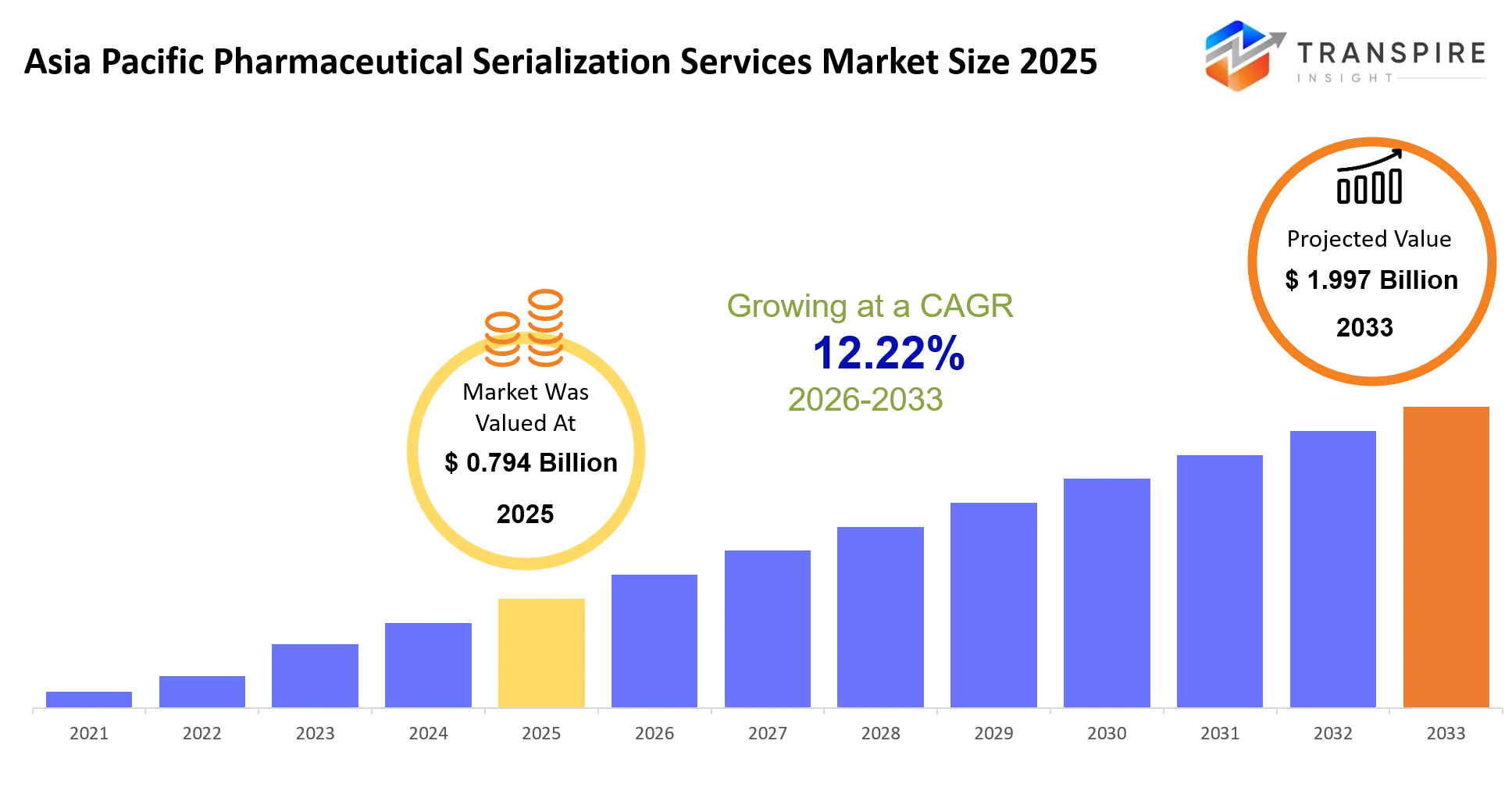
The Asia Pacific Pharmaceutical Serialization Services Market was valued at USD 0.794 Billion in 2025. It is forecast to reach USD 1.997 Billion by 2033. That is a CAGR of 12.22% over the period.
Pharmaceutical serialization in the Asia Pacific provides both manufacturers and distributors with the means to assign a unique ID to every medicine pack, and as a result, achieve full end-to-end traceability throughout the highly fractured supply chain. This helps both brands and regulatory bodies prevent counterfeiting, diversions and inefficient recalls of products and ensures seamless connection between the production line, the logistics partner, and ultimately the pharmacy-creating a traceable web of data.
In the past 3 to 5 years, a structural change has occurred, shifting from an isolated barcode compliance solution to an open, cloud based track and trace system. In reality, a significant trigger for this shift was the pandemic. It was not only a wake-up call to the deficiencies of the pharmaceutical distribution chain but a simultaneous rise in fake medicines across borders also meant that China and India stepped up their tracing legislation, propelling the digital adoption of compliance mandates. Manufacturers thus turned to outsourced serialization and as a result there has been growth in recurring platform-based revenue streams, along with expedited deployment times across their Asia Pacific supply chains.
Key Market Insights
- The Asia Pacific Pharmaceutical Serialization Services market is dominated by the regulatory-driven cloud serialization platforms that hold an estimated market share of nearly 48% by 2025.
- The China and India market together hold almost 55% regional market share in 2025 because of the high volume of pharmaceutical manufacturing and exportations.
- The market in Southeast Asia will grow at the quickest rate till 2030 owing to the implementation of increasingly harmonized regulations on anti-counterfeiting.
- Software serialization solutions hold the leading service segment market share; the integration and validation services hold the second largest market share across the world.
- Real-time track-and-trace implementation will be the fastest growing segment on the back of the growing implementation of interconnected supply chain visibility solutions.
- Hospital distribution is the largest segment in terms of application holding almost 40% market share by 2025 owing to the implementation of strict authenticated prescription tracking and tracing methods.
- The retail pharmacy traceability application will be the fastest growing segment, owing to the robust implementation of counter-counterfeiting schemes.
- Pharmaceutical Manufacturers holds the largest market share in end-users with over 60% in 2025, although it is the Logistics providers that hold the fastest growing market share.
What are the Key Drivers, Restraints, and Opportunities in the Asia Pacific Pharmaceutical Serialization Services Market?
Increasing enforcement of drug traceability regulation across major economies, including China, India and South Korea are the key market drivers for the Asia Pacific Pharmaceutical Serialization Services market. The mandatory serialization rule introduced by the governments to tackle the issue of counterfeit drugs is the direct cause of the expenditure increased by enterprises to buy the compliance software, the integration services and the validation facilities. In this new regulatory scenario serialization is no longer a choice IT investment but a mandatory operational layer, expediting the revenue generation from recurrence in the form of service models to service vendors.
High integration complexity with existing pharmaceutical manufacturing systems and fragmented supply chain facilities are the key market restraints to Asia Pacific Pharmaceutical Serialization Services market across the developing Asia Pacific regions. Manufacturers of small and medium sizes lack standardized ERP systems, hence delaying the execution of system implementation and increasing the initial deployment expenses. The market constraint leads to a slow pace for the realization of the full-scale adoption of the services and suppresses the nearer term revenue.
Convergence of serialization service with real time supply chain intelligence platform in South East Asia would serve as an emerging opportunity to the market. Countries such as Indonesia and Vietnam are investing in building digital health infrastructure which would give rise to the cloud native serialization ecosystem. Vendors offering integration of serialization and real time analytics along with verification service from the blockchain would stand a good chance to gain a stronghold on building up scaled, cross border pharma traceability services.
What Has the Impact of Artificial Intelligence Been on the Asia Pacific Pharmaceutical Serialization Services Market?
The Asia Pacific Pharmaceutical Serialization Services Market has been revolutionized by AI through the development of more precise, quicker, and scalable serialization systems. For a fragmented market like pharmaceutical supply chains, automation based on AI algorithms has been deployed and is being used in the tracking of serialization data streams, detecting abnormalities within batch codes, and optimizing validation procedures throughout production and distribution systems. This directly cuts back on manual reconciliation and increases the reliability of compliance processes over a number of countries.
Machine learning models are now being implemented for tracing trends within serialization data sets to anticipate regulatory compliance risks, and for flagging anomalies in batch codes and miscalculations before regulatory submission. The machine learning systems help identify routes for the optimization of supply chains using shipment and distribution history, making logistic partners' operations more efficient.
On the operational side, the utilization of AI has led to greater accuracy within data sets and has significantly shortened batch validation timelines, resulting in quicker product recall rates and reduced compliance costs. One of the primary challenges for AI adoption, though, is the lack of standardization across various manufacturing systems in the region. Several plants are still operating under fragmented data and have limited connections, making AI model training difficult.
Key Market Trends
- Asia Pacific Pharmaceutical Serialization Services Market - Evolution beyond the year 2021 witnessed a transition from standalone barcode compliance solutions to integrated, cloud-native, and manufacturing-wide traceability solutions.
- China’s regulatory expansion between the years 2019 and 2024 drove the trend towards a consolidated serialization database that substituted individual batch-level tracking solutions.
- India’s drug track and trace framework continued to evolve, thereby boosting the adoption of an enterprise serialization system among exporters who were catering to the US and EU regulated markets.
- During the span between 2020 and 2025, the pharmaceutical industry was witnessed outsourcing the serialization solutions from companies like SAP and TraceLink so as to minimize the compliance complexity and the duration of system deployment.
- Increase in incidents of fake drug proliferation across the Southeast Asian market after the year 2022 accelerated investments in end-to-end visibility into the serialization supply chain among the wholesale distributors.
- Oracle and Siemens strengthened their cloud-based serialization services post 2023.This development is mainly because of the escalating need for a SaaS based compliance infrastructure across the regulated markets.
- Post the year 2021, logistics providers escalated from simple passive data carriers to dynamic compliance nodes within the system, facilitating a series of integrated, real time scanning and validation functions.
- Since the year 2022, efforts towards regulatory convergence among ASEAN nations enhanced interoperability standards that allowed for cross border serialization data exchange systems to come up.
- Artificial intelligence aided serialization monitoring gained ground, thereby phasing out rule based validation engines post the year 2023.
- Interoperable APIs instead of legacy ERP integration gained importance among stakeholders across the Asia Pacific Pharmaceutical Serialization Services Market on account of increasing global compliance regulations.
Asia Pacific Pharmaceutical Serialization Services Market Segmentation
By Service Type:
Serialization services allocate unique codes to all drug packages for tracking them in real time from manufacture to final delivery. Aggregation relates packages into larger, easier-to-manage, cases or pallets. Compliance management ensures companies comply with varying, strict country-specific regulations. Data management services organize, store and utilize enormous traceability data for accurate reporting and audit readiness.
Consulting and validation services assist firms during the process of implementing serialization systems and achieving regulatory authorization. Consulting services assist firms with country-specific regulations and the design of the system; validation services ensure the serialization system functions as specified during a live production environment. Reporting services provide consolidated compliance documents for the regulators, and maintain a higher level of transparency. These service categories will continue to grow as both regulatory pressures and international trade requirements increase throughout the Asian Pacific market.
By Application:
Drug traceability guarantees the ability to track drugs from manufacture to end sale and thus eliminate the threats posed by falsified or diverted medicines. Anti-counterfeiting applications provide the ability to detect falsified drugs with use of the unique product identifiers. Supply chain visibility provides information on coordinating suppliers, logistics and pharmacies which will result in fewer delays and losses. Regulatory compliance applications will enable compliance with country-specific serialization laws in all Asian Pacific nations.
Recall management systems enable a more rapid identification and removal of defective batches, mitigating the public health risks and financial losses to the pharmaceutical company. Inventory tracking provides greater stock visibility within warehouses, distribution centers, and retail facilities. Product authentication systems help identify and distinguish a genuine drug product from an illegitimate one at the point of sale. These application categories will evolve as drug manufacturers implement improved safety processes, and governments demand stricter surveillance over the distribution of medicines in and out of their respective countries.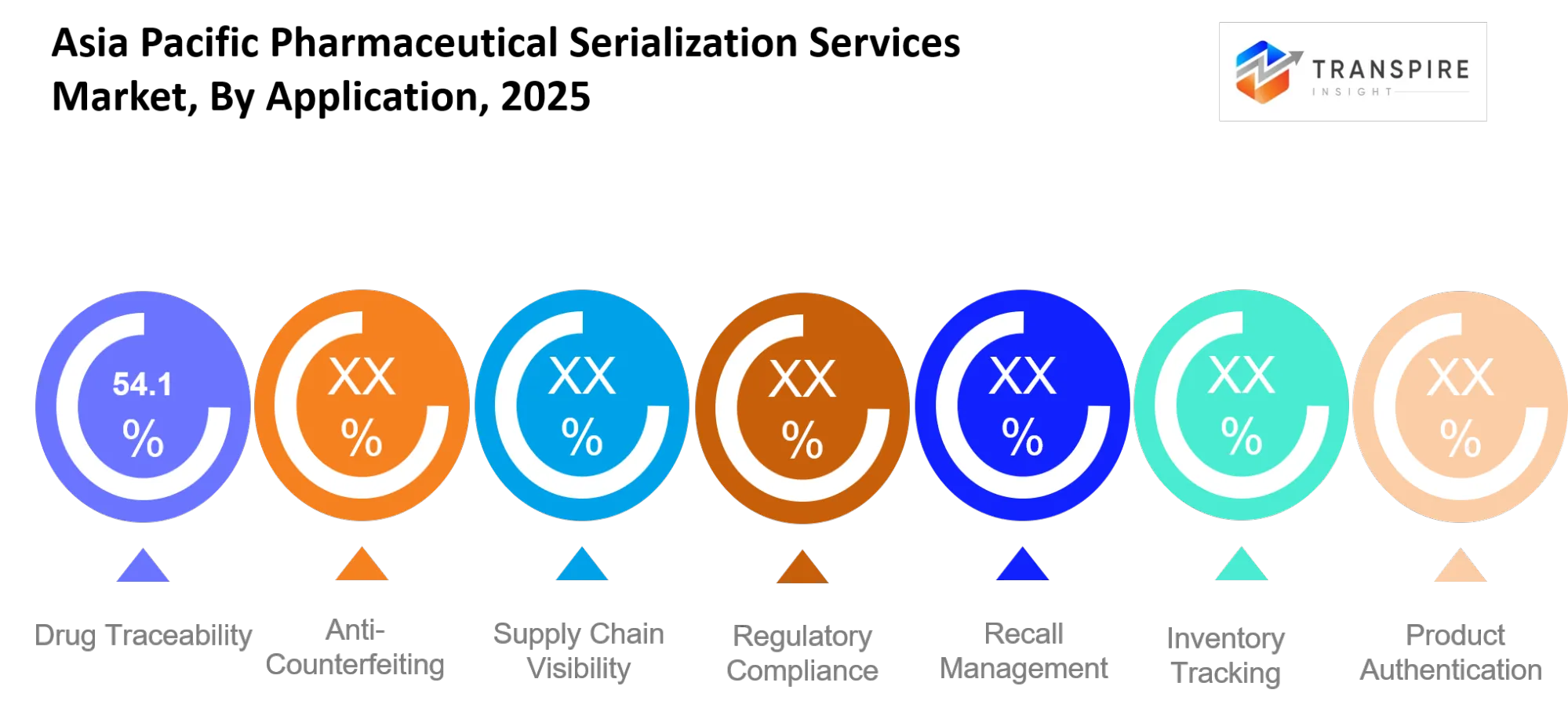
By Deployment:
Cloud-based serialization systems store and manage traceability data on remote servers which means that this data can be accessed by various locations in real-time. On-premise systems store the data within a company's own infrastructure where more control over confidential information can be exerted. A hybrid approach allows the use of both cloud and on-premise systems to combine the benefits of the two approaches. SaaS allows serialization systems to be provided via the internet on a subscription basis, reducing high initial capital expenditure requirements from manufacturers.
Private cloud systems can be supplied to large pharmaceutical companies that have strong data security concerns, whereas a public cloud system can supply scalability and lower costs for small companies starting to operate within the compliance system. A multi-tenant system can provide the shared infrastructure for several companies whilst keeping the data from each separated. This different approach to systems provision will continue to evolve as the need grows for rapid integration, cost reduction and increased scalability over the various regional supply chains.
By End User:
Pharmaceutical manufacturers use serialization systems to comply with government regulations and to identify genuine products through to the point of consumption and into the supply chain. CMOs utilize the systems on behalf of numerous clients to facilitate large-scale manufacturing outsourcing trends. Distributors use the systems for tracking product shipments and identifying any instances of diversion within the supply chain. Healthcare providers use the systems for identifying and confirming genuine products before administering the appropriate treatment to patients.
Wholesalers utilize the systems for bulk inventory management and tracking, complying with all regulations at this stage. Contract packagers are the last stage in the manufacturing supply chain where the systems can be used for checking compliance prior to product dispatch. Retail pharmacies use serialization systems for identification of authentic products at the point of sale to reduce cases of counterfeiting. These end-users will need increased integration with digital systems as government regulations become more stringent in the region.
What are the Key Use Cases Driving the Asia Pacific Pharmaceutical Serialization Services Market?
While the need to implement serialization to track products in the supply chain continues to be the most important driver of the Asia Pacific Pharmaceutical Serialization Services Market, regulatory authorities in China and India are insisting on serialization of the products at product level from the point of manufacturing till to the retail pharmacy. The need to protect products from being counterfeited, coupled with compliance issues on exports to regulated markets like the USA and Europe, makes implementation services and validation support the primary demand drivers in the market.
With growing acceptance, supply chain visibility and recall management are becoming essential for the distribution and wholesaler market and for CMOs with multi-brand production. These end users install serialization systems to have an in-depth overview of the stock's movement and reduce shrinkage; these systems enable quick recall of a batch with manufacturing or quality related defects. The application at the point of dispensing by the retail pharmacies is another area where adoption rates are expected to increase, to allow authentication and enhance the trust at high volume urban centers.
Emerging applications of the Serialization service market include integration with AI-based anomaly detection as well as cross border data exchange between the various regulatory systems in the ASEAN region. Logistic providers and contract packagers are developing an interest in predictive serialization analytics so that they can predict future compliance failures and reduce human reporting errors in the long run.
|
Report Metrics |
Details |
|
Market size value in 2025 |
USD 0.794 Billion |
|
Market size value in 2026 |
USD 0.891 Billion |
|
Revenue forecast in 2033 |
USD 1.997 Billion |
|
Growth rate |
CAGR of 12.22% from 2026 to 2033 |
|
Base year |
2025 |
|
Historical data |
2021 - 2024 |
|
Forecast period |
2026 - 2033 |
|
Report coverage |
Revenue forecast, competitive landscape, growth factors, and trends |
|
Regional scope |
Asia Pacific (India, China, Japan, Australia, South Korea, Rest of Asia Pacific) |
|
Key company profiled |
TraceLink, SAP, Antares Vision, OPTEL, Systech, IBM, Siemens, Oracle, WIPOTEC, SEA Vision, Domino Printing, Markem-Imaje, Körber, Adents, Arvato |
|
Customization scope |
Free report customization (country, regional & segment scope). Avail customized purchase options to meet your exact research needs. |
|
Report Segmentation |
By Service Type (Serialization, Aggregation, Compliance Management, Data Management, Consulting Services, Validation Services, Reporting Services, Others); By Application (Drug Traceability, Anti-Counterfeiting, Supply Chain Visibility, Regulatory Compliance, Recall Management, Inventory Tracking, Product Authentication, Others); By Deployment (Cloud, On-Premise, Hybrid, SaaS Platforms, Private Cloud, Public Cloud, Multi-Tenant Systems, Others); By End User (Pharmaceutical Manufacturers, CMOs, Distributors, Healthcare Providers, Wholesalers, Contract Packagers, Retail Pharmacies, Others) |
Which Regions are Driving the Asia Pacific Pharmaceutical Serialization Services Market Growth?
China is currently at the top of the Asia Pacific Pharmaceutical Serialization Services market, owing to highly stringent traceability regulations at national level and monolithic regulatory supervision in manufacturing & distribution. Robust government sponsored tracking mechanisms necessitate manufacturers implement serialization at batch & unit level aided with state-of-the-art digital infrastructure across major manufacturing provinces. Enhanced export logistics combined with high output rates further solidify its status as the most dominant regional hub.
India emerges as a steady but balanced contributor in terms of serialization mandates solely on account of its role as the leading global exporter of generics, not by solely emphasizing the intensity of centrally controlled enforcement. Serialization adoption is spurred by export needs, specifically shipments of medicines to regulated markets like the US and EU, as well as increasing drug safety regulations at the national level. Strong domestic market coupled with an extensively scattered network of contract manufacturers and packaging service providers fuel steady system implementations across various manufacturing clusters.
Southeast Asia is anticipated to be the fastest growing regional segment with increasing regulatory pressures to implement sequential serialization mandates triggered by national anti-counterfeit programs; countries such as Vietnam, Indonesia, and Thailand are already working on this. A rise in digital customs systems and modernization efforts across port operations will facilitate cross-border traceability in the long run. This evolving landscape signals favorable entry opportunities for solution providers in the 2026-2033 period.
Who are the Key Players in the Asia Pacific Pharmaceutical Serialization Services Market and How Do They Compete?
The Asia Pacific Pharmaceutical Serialization Services market is a moderately consolidated one with a mix of large global software solution vendors, dedicated track and trace technology providers and regional system integrators operating within it. Existing large enterprises tend to maintain client loyalty through extended compliance contracts, while emerging ones focus on plug-and-play cloud based deployments. The core competitive advantages are rooted in system interoperability, ease of regulatory validation and seamless integration across diversified manufacturing environments.
SAP leads by embedding its enterprise-level serializations within comprehensive supply chain management applications, thus enjoying a stronghold among the majority of large pharmaceutical companies with end-to-end integration across their ERP systems. Oracle competes by offering cloud based architecture designed to cater scalable compliance reporting and quicker deployments across multiple countries and primarily for the export driven manufacturing zones. TraceLink strengthens its position by establishing a life sciences network that creates a collective data exchange platform for manufacturers, distributors and regulators alike.
Siemens and Kerber are leveraging the presence of manufacturing execution systems and packaging line integration in many plants which allows them to ensure high accuracy on production site, thereby facilitating seamless Serialization. Antares Vision, on the other hand, is focused on high accuracy vision-based inspections and coding systems which has its applications across high integrity packaging solutions that require advanced tracking features at unit-level for authentication of drug products. Both companies have invested significantly in strategic alliances and partnerships with local system integrators in China and India, facilitating rapid regulatory adoption.
Company List
- TraceLink
- SAP
- Antares Vision
- OPTEL
- Systech
- IBM
- Siemens
- Oracle
- WIPOTEC
- SEA Vision
- Domino Printing
- Markem-Imaje
- Körber
- Adents
- Arvato
Recent Development News
In February 2026, TraceLink announced expansion of its global Life Sciences Cloud Network with enhanced agentic orchestration capabilities across serialization workflows. The update strengthened integration with SAP and Oracle systems, improving end-to-end data exchange for pharmaceutical serialization and compliance operations across Asia Pacific manufacturing hubs. Sourcehttps://www.prnewswire.com/
In January 2026, OPTEL Group expanded its VerifyBrand serialization platform with enhanced EPCIS-based interoperability features for pharmaceutical manufacturers operating in multi-country compliance environments. The upgrade improved real-time validation of serialized data across packaging lines and strengthened integration with existing ERP systems in India and Southeast Asia. Sourcehttps://www.optelgroup.com/
What Strategic Insights Define the Future of the Asia Pacific Pharmaceutical Serialization Services Market?
The Asia Pacific Pharmaceutical Serialization Services market is inherently moving toward fully integrated, data-driven compliance ecosystems, where serialization is becoming part of end-to-end pharmaceutical supply chain intelligence as opposed to a discrete regulatory layer. Cross-border traceability requirements and expanded adoption of cloud platform technologies by both manufacturing and distribution networks (as exporting entities move closer to EU/US regulations) will drive the market for the next 5 to 7 years.
Less obviously, a significant risk will be platform consolidation and reduced vendor flexibility as only a handful of global providers gain control ofSerialization infrastructure across the region and mid-tier companies are unable to adapt without further dependence and greater switching costs in the longer term.
A growing opportunity lies in interoperable regional tracing frameworks in ASEAN, as authorities digitize customs and build on shared compliance data repositories. Firms building adaptable, API-enabled serialization platforms will be poised to succeed in such emerging compliance environments. Ultimately, market players should focus on adaptive, cloud-native serialization architectures capable of multiple jurisdictional compliance requirements while decreasing integration costs in disparate manufacturing networks.
Asia Pacific Pharmaceutical Serialization Services Market Report Segmentation
By Service Type
- Serialization
- Aggregation
- Compliance Management
- Data Management
- Consulting Services
- Validation Services
- Reporting Services
By Application
- Drug Traceability
- Anti-Counterfeiting
- Supply Chain Visibility
- Regulatory Compliance
- Recall Management
- Inventory Tracking
- Product Authentication
By Deployment
- Cloud
- On-Premise
- Hybrid
- SaaS Platforms
- Private Cloud
- Public Cloud
- Multi-Tenant Systems
By End User
- Pharmaceutical Manufacturers
- CMOs
- Distributors
- Healthcare Providers
- Wholesalers
- Contract Packagers
- Retail Pharmacies
Frequently Asked Questions
Find quick answers to common questions.
The Asia Pacific Pharmaceutical Serialization Services Market size is USD 1.997 Billion in 2033.
Key Segments for the Asia Pacific Pharmaceutical Serialization Services Market are By Service Type (Serialization, Aggregation, Compliance Management, Data Management, Consulting Services, Validation Services, Reporting Services, Others); By Application (Drug Traceability, Anti-Counterfeiting, Supply Chain Visibility, Regulatory Compliance, Recall Management, Inventory Tracking, Product Authentication, Others); By Deployment (Cloud, On-Premise, Hybrid, SaaS Platforms, Private Cloud, Public Cloud, Multi-Tenant Systems, Others); By End User (Pharmaceutical Manufacturers, CMOs, Distributors, Healthcare Providers, Wholesalers, Contract Packagers, Retail Pharmacies, Others).
Major Asia Pacific Pharmaceutical Serialization Services Market Pare TraceLink, SAP, Antares Vision, OPTEL, Systech, IBM, Siemens, Oracle, WIPOTEC, SEA Vision, Domino Printing, Markem-Imaje, Körber, Adents, Arvato.
The Current Asia Pacific Pharmaceutical Serialization Services Market size is USD 0.794 Billion in 2025.
The Asia Pacific Pharmaceutical Serialization Services Market CAGR is 12.22% from 2026 to 2033.
- TraceLink
- SAP
- Antares Vision
- OPTEL
- Systech
- IBM
- Siemens
- Oracle
- WIPOTEC
- SEA Vision
- Domino Printing
- Markem-Imaje
- Körber
- Adents
- Arvato
About the Authors

Mayur Shinde
I am Mayur Shinde, a Senior Research Analyst at Transpire Insight, specializing in the Automotive & Transportation and Information & Communication Technology (ICT) Industry. My work focuses on analyzing emerging market trends, technological advancements, competitive landscapes, and industry developments to deliver accurate, data-driven insights. I am passionate about transforming complex market information into clear, actionable content that helps businesses, professionals, and decision-makers stay informed and make confident strategic decisions.

Chakradhar Khansole
Chakradhar serves as the Research Director at Transpire Insight, bringing over 8 years of experience in technology, innovation, and strategic market intelligence. He specializes in transforming complex market data into actionable business insights that enable organizations to make informed, growth-oriented decisions. Recognized for his strategic vision and analytical expertise, Chakradhar leads high-impact research initiatives, delivering comprehensive market assessments, competitive intelligence, and forward-looking industry analysis.
Recently Published Reports
-
Apr 2026
3D Optical Profiler Market
3D Optical Profiler Market Size, Share & Analysis Report By Type (Desktop 3D Optical Profiler, and Portable 3D Optical Profiler), By Technology (Confocal Technology, and White Light Interference), By End-Use Industry (Manufacturing, Research Institutions, Automotive, Aerospace and Defense, Medical Devices, and Other), and Geography (North America, Europe, Asia-Pacific, Middle East and Africa, South and Central America), 2021 - 2031
-
Apr 2026
Depth Sensor Market
Depth Sensor Market Size, Share & Analysis Report By Type (Infrared Depth Sensors, Time-of-Flight (ToF) Sensors, Stereo Vision Sensors, Structured Light Sensors, Ultrasonic Depth Sensors), By Application (Automotive, Robotics, Gaming, Consumer Electronics, Industrial Automation, Healthcare, Security & Surveillance, Others), By End Users (Automotive Manufacturers, Consumer Electronics Companies, Healthcare Providers, Industrial Companies, Security Agencies, Gaming Companies, Robotics Companies, Others), and Geography (North America, Europe, Asia-Pacific, Middle East and Africa, South and Central America), 2021 – 2031
-
Apr 2026
Digital Manufacturing Market
Digital Manufacturing Market Size, Share & Analysis Report By Component (Hardware, Software, and Services), By Technology (Robotics, 3D Printing, Internet of Things (IoT), and Others), By Application (Automotive and Transportation, Aerospace and Defense, Consumer Electronics, Industrial Machinery, and Others), By Process Type (Computer-Based Designing, Computer-Based Simulation, Computer 3D Visualization, Analytics, and Others), and Geography (North America, Europe, Asia-Pacific, Middle East and Africa, South and Central America), 2021 – 2031
-
Apr 2026
Digital Visa Services Market
Digital Visa Services Market Size, Share & Analysis Report By Type (Individual Travelers, Group Travelers), By Application (Tourism, Business Travel, Others), and Geography (North America, Europe, Asia-Pacific, Middle East and Africa, South and Central America), 2021 – 2031