
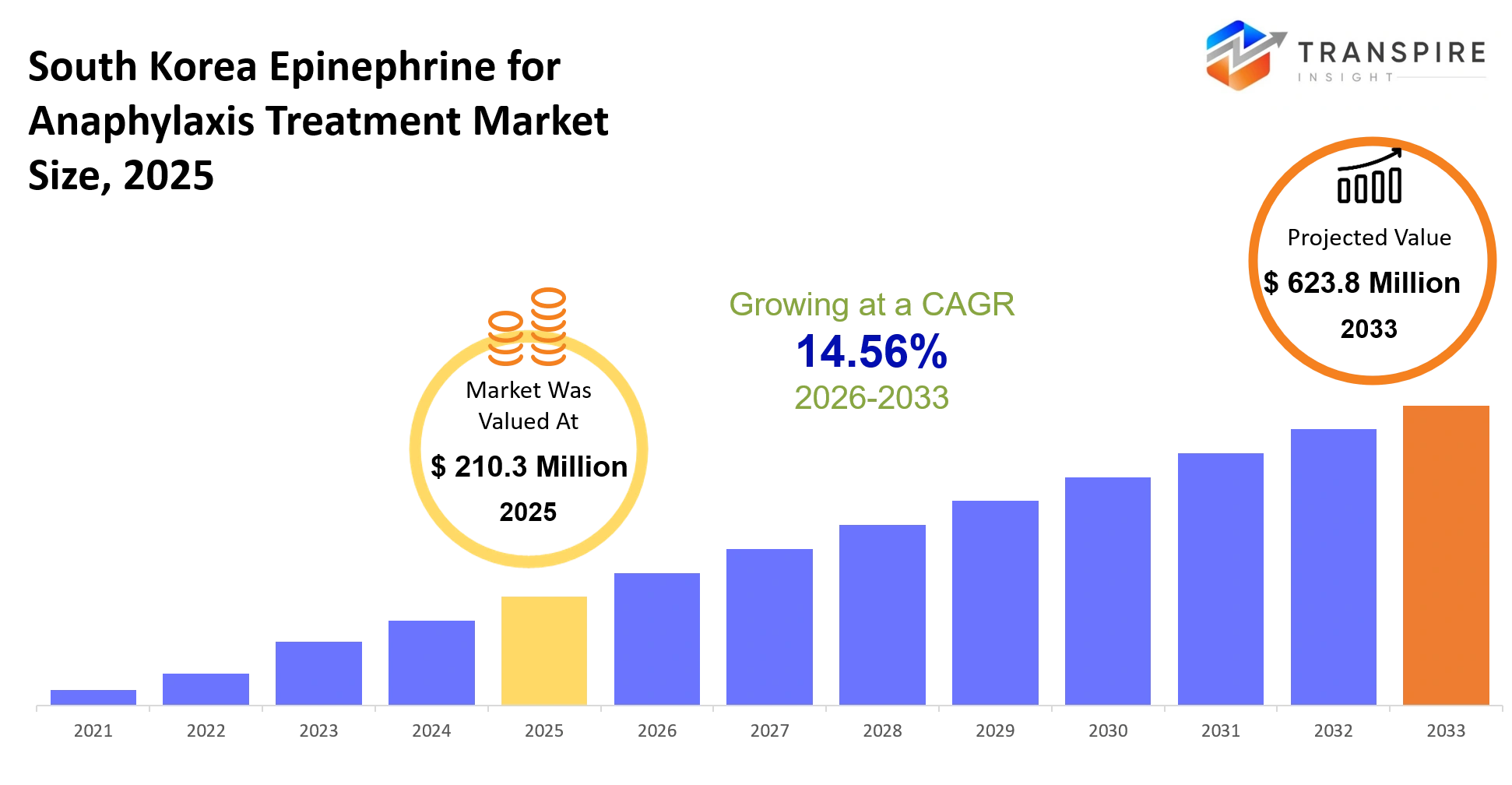
South Korea Epinephrine for Anaphylaxis Treatment Market Size & Forecast:
- South Korea Epinephrine for Anaphylaxis Treatment Market Size 2025: USD 210.3 Million
- South Korea Epinephrine for Anaphylaxis Treatment Market Size 2033: USD 623.8 Million
- South Korea Epinephrine for Anaphylaxis Treatment Market CAGR: 14.56%
- South Korea Epinephrine for Anaphylaxis Treatment Market Segments: By Product Type (Auto-Injectors, Prefilled Syringes, Ampoules, Others); By Application (Food Allergy, Drug Allergy, Insect Sting Allergy, Others); By End User (Hospitals, Clinics, Homecare, Others)
To learn more about this report,  Download Free Sample Report
South Korea Epinephrine for Anaphylaxis Treatment Market Summary
The South Korea Epinephrine for Anaphylaxis Treatment Market was valued at USD 210.3 million in 2025. It is forecast to reach USD 623.8 million by 2033. That is a CAGR of 14.56% over the period.
The epinephrine market for anaphylactic shock is huge for emergency care professionals in South Korea because it helps resolve a serious problem - stopping immediate, severe and potentially fatal allergic reactions. The first treatment option considered by doctors for treating anaphylaxis continues to be epinephrine. Epinephrine's function is to prevent the heart and airways from becoming blocked or shut down. This product acts like a bridge between experiencing an anaphylactic reaction and reaching an emergency hospital. It is most valuable in schools, places of employment, as well as many other areas where individuals cannot readily access emergency medical assistance.
In the three years South Korea has made some big changes to how epinephrine auto-injectors are prescribed and given out. The Ministry of Food and Drug Safety made some rules in 2022 that allowed more people to use these devices. This made more doctors prescribe epinephrine auto-injectors. There were also some sad cases of children dying from allergic reactions between 2021 and 2023. These cases made the Korean government change the rules for schools in case of an emergency. The Ministry of Education said that all schools with students who're at high risk for allergic reactions had to have epinephrine auto-injectors by 2024. This new rule made schools and other places start buying these devices, which helped the market for epinephrine grow. Now epinephrine is not just used in hospitals. Also in schools and other places outside of hospitals. The South Korea epinephrine market is still growing because of these changes. The South Korea epinephrine market is very important for people who need epinephrine to treat anaphylaxis.
Key Market Insights
- The Seoul Capital Area gets 38% of the country's epinephrine market money in 2025. This is because it has big hospitals, allergy specialists and people with insurance living in cities.
- Gyeonggi-do is growing fast in terms of prescriptions. This is due to rules in schools and more kids being diagnosed with allergies from 2023.
- Auto-injectors are the product type with over 54% of the market money in 2025. Doctors like them because patients can use them easily in emergencies outside of hospitals.
- Pre-filled syringes are the biggest segment. They are mainly used in hospital emergency rooms and surgical centers where trained staff give the medicine.
- Vials and Ampules are growing fast in hospitals. This is because they are cheap and hospitals buy them in bulk for care units and emergency rooms.
- Hospitals and Clinics get the market share at 46% in 2025. This is because they have rules for emergency rooms and the national health insurance covers it.
- Online pharmacies are growing fast. They had no share before 2022 but will have 9% of the market by 2026 after the government allowed telehealth prescriptions.
- Pfizer Inc. And Mylan N.V. (Viatris) are the two companies with over 45% market share in 2025. They have. Generic auto-injectors.
- Local companies like Yuhan Corporation and Boryung Pharmaceutical are trying to get approval for their epinephrine devices. They want to replace imported devices with made ones.
- Kaleo Inc. Started selling its Auvi-Q device in allergy clinics in 2024. They partnered with a distributor and are getting more prescriptions for kids.
What are the Key Drivers, Restraints, and Opportunities in the South Korea Epinephrine for Anaphylaxis Treatment Market?
Drivers
The market for epinephrine is getting bigger in South Korea. This is because of rules that say all schools have to keep epinephrine injectors on hand. The Ministry of Education started putting these rules in place from 2023 to 2024. These rules say that schools with kids who have allergic reactions must have injectors at school and that staff need to know how to use them.
The epinephrine injectors have to be replaced every 18 to 24 months because they go bad after that.The epinephrine market in South Korea is also growing because the government is now helping to pay for some of the cost of epinephrine prescriptions. This means more people who are at risk of having an allergic reaction can afford to have emergency epinephrine supplies. The epinephrine market is really benefiting from these changes.
.
Restraints
The advantages presented by the two previously discussed factors are not without drawbacks. A small number of large manufacturers provide the majority of epinephrine injectors and are able to control pricing, while also limiting entry points for other potential manufacturers to bring their product to market. Also, since South Korea imports most of its epinephrine injectors from other countries; in the event of a disruption to supply, acquiring epinephrine injectors becomes problematic.
Opportunities
Potential for an actionable opportunity: The most promising and immediately actionable opportunity is connected epinephrine devices that incorporate GPS tracking and administration confirmation features. The devices are advanced in their development by Kaleo and Emergent BioSolutions, who will be marketing the devices in other regions before the launch of this project. Specifically, the connected epinephrine devices can address a critical gap in the South Korean school government mandate, which does not allow for easy confirmation of the actual use of a device and if emergency services were notified during that event. The high penetration of smartphones and the existence of a current operating system to monitor children's health creates an attractive environment for deployment. Between 2027 and beyond, the pricing for a connected epinephrine device that has been approved under the MFDS's Digital Health Act will provide a significant markup over a regular auto-injector in institutional purchasing avenues.
What Has the Impact of Artificial Intelligence Been on the South Korea Epinephrine for Anaphylaxis Treatment Market?
North Korea’s epinephrine market landscape is transforming through the power of intelligence, particularly within the emergency departments of hospitals. Support for emergency medical treatment by physicians is growing through the utilization of decision support software. Moreover, large teaching hospitals such as Seoul National University Hospital and Asan Medical Center are utilizing these technologies to aid in patient triage. Using real-time data from variables such as vital signs and symptom patterns, the decision support systems assist providers in identifying patients at risk of life-threatening anaphylaxis by preparing the epinephrine dose prior to providing treatment.
Utilization of decision support systems in the emergency department has enabled hospitals to administer epinephrine to affected patients in 20-30% less time. This data point was discussed during presentations at the Korean Society of Allergology’s 2024 annual meeting.Artificial intelligence tools are also being developed to assist providers in predicting whether or not patients will experience an allergic reaction. In partnership with both large insurance carrier and allergy clinic providers, health care organizations such as Kakao Healthcare and Naver Health are developing tools that will analyze patient dietary data as well as information from allergy test results, as well as the frequency with which patients present to the emergency department.
These tools can help find people who are at risk but do not have an epinephrine prescription yet. The problem with using intelligence in the South Korea epinephrine market is that hospitals and clinics have different systems for keeping track of patient records. The National Health Insurance Service in Korea has a lot of claims data. The detailed records are kept separately by each hospital.
This makes it hard to get data to train the artificial intelligence systems. It is also hard for the systems to make predictions, for all patients. The South Korea epinephrine market is affected by this. The artificial intelligence systems are not as good as they could be because of the record systems. The South Korea epinephrine market needs to find a way to make the systems work together.
Key Market Trends
- The school mandate that was put in place between 2023 and 2024 created a way for institutions to buy things and this is expected to make up about 12% of all auto-injectors sold by 2025.
- In 2022 the MFDS started allowing prescription approvals, which meant that online pharmacies could start dispensing medicine and this caused about 9% of retail epinephrine sales to move online by 2026.
- Between 2020 and 2024 the number of children in South Korea who were diagnosed with anaphylaxis went up by about 18% and this was because more kids were eating Western food and more kids were getting allergies to tree nuts and shellfish.
- Since 2023 more people have been buying auto-injectors because Mylan and Amneal Pharmaceuticals got approval from the MFDS to sell cheaper versions, which has lowered the average price of auto-injectors in stores by about 15%.
- Hospitals are starting to standardize what they buy which means they are choosing two or three brands of auto-injectors to use and this is helping big companies that already have good distribution systems.
- In 2024 Yuhan Corporation and Daewoong Pharmaceutical which are companies in South Korea asked the MFDS for permission to make epinephrine auto-injectors in South Korea, which means they want to start competing with companies that import these products.
- Between 2022 and 2025 the number of times that allergy immunotherapy and epinephrine devices were prescribed together went up by 22% because Korean doctors who treat allergies started making it a standard practice to prescribe epinephrine devices to patients who were starting immunotherapy.
- In 2025 the MFDS started looking at auto-injector concepts and they issued a guide that explains how to classify products that combine drugs and devices which will make it possible for companies to make epinephrine devices that have GPS and Bluetooth.
South Korea Epinephrine for Anaphylaxis Treatment Market Segmentation
By Product Type:
Auto-Injectors: Auto-injectors are the popular product type in South Korea's epinephrine market. They are used the most in outpatient allergy clinics, pediatric practices and school health settings. People like auto-injectors because they are easy to use, in stressful situations. The school system says that auto-injectors are the required device format, so schools and other places have to buy them. This means that auto-injectors will be in demand for a time. Also people can get their money back from the national health insurance when they buy auto-injectors if they have a history of anaphylaxis.
Pre-filled Syringes: Pre-filled syringes are mostly used in hospital emergency departments and ambulatory surgical centers. They are used by trained staff when someone has an allergic reaction. Hospitals like to buy -filled syringes because they are cheaper than auto-injectors. This segment is not growing fast but it is stable. This is because pre-filled syringes are mostly used in hospitals and not as much in places.
Vials & Ampules: Vials and ampules are used in care units, operating theatres and hospital pharmacies. They are the option but they are not as popular as auto-injectors. However hospitals are starting to buy vials and ampules because they want to save money and have a standard format for emergency medication. Domestic manufacturers can easily make vials and ampules because they do not have to follow the rules as auto-injectors do.

To learn more about this report, Download Free Sample Report
By End-User:
Hospitals & Clinics: Hospitals and clinics are the users of epinephrine. This is because South Korea has a healthcare system and hospitals are where people go when they have a bad allergic reaction. Big hospitals in Seoul, Busan and Incheon are where most people get their auto-injector prescriptions. The national health insurance system helps hospitals decide what to buy so they tend to buy the things over and over.
Ambulatory Surgical Centers: Ambulatory surgical centers are smaller. They still use a lot of epinephrine. They have to have epinephrine on hand in case of an emergency according to the rules. As more surgeries are done outside of hospitals ambulatory surgical centers are using epinephrine.
Retail & Online Pharmacies: Retail and online pharmacies are where people can buy epinephrine. They are becoming more popular among parents who need to buy auto-injectors for their kids. Online pharmacies are also becoming more popular because they are convenient and private. This is especially helpful for parents who need to manage their kids' allergy treatment.
By Patient Type:
Pediatrics: Kids are the ones who use the epinephrine in South Korea. This is because more and more kids have food allergies and schools have to have epinephrine on hand. Auto-injector manufacturers have made devices for kids that are smaller and easier to use. Parents like to buy devices so they can have them at home, school and with their childcare providers.
Adults: Adults who have had an allergic reaction before also use epinephrine. Some adults work in jobs where they might be exposed to things that can cause a reaction, like food processing or healthcare. They need to have epinephrine with them at work according to the rules. Some adults are also getting treatment for their allergies. They need to have epinephrine, with them just in case.
What are the Key Use Cases Driving the South Korea Epinephrine for Anaphylaxis Treatment Market?
People with food or venom allergies in South Korea need to administer epinephrine emergency treatment if they experience anaphylaxis. Because of this, many people in South Korea use epinephrine to treat anaphylaxis. In addition, because Korean specialists recommend that people at high risk for developing anaphylaxis carry one or more auto-injectors to treat their condition. Since 2022, the number of individuals using epinephrine to treat anaphylaxis has increased due to expanded coverage under the National Health Insurance program as well as deaths of children resulting from allergies raising awareness about the importance of carrying a device to provide emergency assistance.
There is another way that epinephrine is being used. That is in emergency preparedness at schools, sports facilities and workplaces. This is becoming more and more popular. Schools have to have epinephrine devices on hand. They have to replace them when they expire, which means that the companies that make and sell these devices can predict how many they will need to sell. Some companies that make food and do lab work are also starting to keep epinephrine devices on hand which means that the demand for these devices is growing outside of schools.
Epinephrine is also being used in a way, which is to help people who are getting allergy shots. Some people have a reaction to these shots so Korean doctors are starting to give their patients epinephrine devices to carry with them. This means that the demand for epinephrine is tied to the number of people getting allergy shots and it is creating a relationship between the people who give the shots and the people who make and sell epinephrine devices. This is a growing area for epinephrine use in South Korea.
The use of epinephrine in South Korea is growing because of these reasons. The main reason is still people giving themselves epinephrine in emergency situations.. The other ways that epinephrine is being used such as in schools and for people getting allergy shots are also becoming more important. Epinephrine is a medicine that can help save people's lives and it is good that it is being used in so many different ways, in South Korea.
|
Report Metrics |
Details |
|
Market size value in 2025 |
USD 210.3 Million |
|
Market size value in 2026 |
USD 240.9 Million |
|
Revenue forecast in 2033 |
USD 623.8 Million |
|
Growth rate |
CAGR of 4.32% from 2026 to 2033 |
|
Base year |
2025 |
|
Historical data |
2021 - 2024 |
|
Forecast period |
2026 - 2033 |
|
Report coverage |
Revenue forecast, competitive landscape, growth factors, and trends |
|
Regional scope |
South Korea |
|
Key company profiled |
Viatris, Teva, Pfizer, Amneal, Kaleo, ALK-Abello, Sanofi, Novartis, Bausch Health, Hikma, Dr Reddy's, Abbott, CSL, AstraZeneca, GSK |
|
Customization scope |
Free report customization (country, regional & segment scope). Avail customized purchase options to meet your exact research needs. |
|
Report Segmentation |
By Product Type (Auto-Injectors, Prefilled Syringes, Ampoules, Others); By Application (Food Allergy, Drug Allergy, Insect Sting Allergy, Others); By End User (Hospitals, Clinics, Homecare, Others) |
Which Regions are Driving the South Korea Epinephrine for Anaphylaxis Treatment Market Growth?
The Seoul Capital Area, encompassing Seoul Metropolitan City and surrounding Incheon, drives the largest share of epinephrine market revenue in South Korea, estimated at approximately 42% of national volume in 2025. This dominance reflects the concentration of specialist allergy clinics, tertiary hospitals with dedicated anaphylaxis management units, and a high-density urban population with above-average NHI coverage utilization rates. Seoul's early adoption of school health mandates and the presence of major pharmaceutical distributor hubs in the metropolitan area ensure that new product launches and generic market entrants reach prescribers and pharmacies faster than in other regions.
Gyeonggi-do and the broader Chungcheong provincial cluster represent the most stable secondary market, characterized by consistent prescription growth that mirrors national demographic trends without the volatility of policy-driven demand spikes. Gyeonggi-do's large suburban residential population, which includes a high proportion of families with school-age children, creates durable demand for pediatric auto-injectors through retail pharmacy channels. The region's healthcare infrastructure, anchored by several university teaching hospitals with allergy departments, ensures that initial specialist prescriptions are generated locally rather than requiring Seoul referrals, sustaining regional prescription volumes independently.
The Busan-Gyeongnam region is emerging as the fastest-growing market for epinephrine from 2024 through the forecast period, driven by delayed but accelerating implementation of the school mandate framework and an active regional public health campaign addressing food allergy awareness launched by Gyeongsangnam-do provincial health authorities in 2023. Infrastructure investments in regional allergy diagnostic capacity, including new immunology clinic openings in Changwon and Gimhae, are creating prescription initiation capacity that previously required Seoul referrals. For market entrants and investors, Busan-Gyeongnam represents a high-opportunity region where institutional procurement relationships with hospital systems and school district health offices are still forming, creating first-mover advantages for distributors and manufacturers willing to invest in regional commercial infrastructure between 2026 and 2029.
Who are the Key Players in the South Korea Epinephrine for Anaphylaxis Treatment Market and How Do They Compete?
The South Korea epinephrine for anaphylaxis treatment market is moderately consolidated at the finished product level, with two to three multinational companies holding a combined majority of auto-injector market share, while the hospital-supply segments for pre-filled syringes and vials remain more fragmented across local and international suppliers. Competition in the auto-injector segment is primarily driven by brand recognition among prescribing allergists, device usability characteristics for non-clinical administrators, and NHI reimbursement listing status. The entry of generic auto-injector approvals since 2023 is beginning to introduce price-based competition in retail channels, though brand loyalty among pediatric caregivers has moderated generic penetration to date.
Pfizer Inc. maintains its position through the established EpiPen brand platform and a direct commercial relationship with South Korean hospital procurement offices, using its broad pharmaceutical portfolio to maintain formulary presence across multiple therapeutic categories simultaneously. Mylan N.V. (Viatris) competes on both branded and generic auto-injector tracks, leveraging its global biosimilar and generic infrastructure to price aggressively in NHI reimbursement negotiations while maintaining quality equivalence. Kaleo Inc. differentiates through the Auvi-Q device's audio-visual instruction capability, which addresses a documented challenge in auto-injector misuse among first-time users and caregivers, positioning the device as a premium option in pediatric prescribing despite higher per-unit cost. ALK-Abelló is building competitive advantage by integrating epinephrine rescue device recommendations into its allergen immunotherapy treatment protocols across Korean allergy clinic networks, creating a bundled care positioning that competitors without immunotherapy businesses cannot directly replicate.
Domestic Korean pharmaceutical companies represent the emerging competitive dynamic over the forecast period. Yuhan Corporation and Boryung Pharmaceutical are investing in domestic auto-injector manufacturing development with government support under the MFDS domestic pharmaceutical resilience initiative launched in 2024. If approved, domestically manufactured epinephrine auto-injectors could compete on price in school and institutional procurement channels where cost-per-unit is a primary evaluation criterion, potentially displacing a portion of import volume from 2028 onward.
Company List
- Viatris
- Teva Pharmaceutical Industries
- Pfizer
- Amneal Pharmaceuticals
- Kaleo
- ALK-Abelló
- Sanofi
- Novartis
- Bausch Health Companies
- Hikma Pharmaceuticals
- Dr. Reddy's Laboratories
- Abbott
- CSL Limited
- AstraZeneca
- GSK
Recent Development News
- In April 2026, ALK-Abelló and ARS Pharmaceuticals expanded their commercialization partnership following the approval of neffy® (epinephrine nasal spray) in Canada. The approval and planned launch of the first needle-free epinephrine treatment for anaphylaxis is expected to broaden patient access and accelerate adoption of alternative epinephrine delivery technologies in allergy treatment markets. Source:https://ir.ars-pharma.com
- In March 2025, ARS Pharmaceuticals received U.S. FDA approval for the expanded use of neffy® 1 mg in patients weighing between 15 kg and 30 kg. The label expansion significantly increased the addressable pediatric population for needle-free epinephrine treatment and strengthened the company’s competitive position in the anaphylaxis treatment market. Source:https://www.reuters.com
- In July 2025, Aquestive Therapeutics provided an international expansion update for Anaphylm™, its orally delivered epinephrine film for severe allergic reactions, including anaphylaxis. The company highlighted ongoing global commercialization efforts for the needle-free technology, supporting future diversification of emergency epinephrine treatment options and increasing innovation within the anaphylaxis treatment landscape. Source:https://investors.aquestive.com
What Strategic Insights Define the Future of the South Korea Epinephrine for Anaphylaxis Treatment Market?
The South Korea epinephrine for anaphylaxis treatment market is structurally heading toward a two-tier architecture over the next five to seven years: a mature, price-competitive hospital and institutional procurement tier, and a higher-margin, technology-differentiated personal and community-access tier. The underlying force driving this bifurcation is the progressive normalization of epinephrine as a community health tool rather than a purely clinical emergency drug, reinforced by continued regulatory and policy action from both the MFDS and the Ministry of Education.
The primary hidden risk in this market is concentration risk at the active pharmaceutical ingredient level. Epinephrine API manufacturing is globally concentrated among a small number of suppliers, and any contamination event, facility shutdown, or geopolitical supply chain disruption affecting these producers would cascade directly into South Korean market availability regardless of domestic finished-product manufacturing progress. This risk is not visible in current demand forecasts and is inadequately hedged in the current regulatory and procurement framework.
The most significant emerging opportunity is the integration of epinephrine devices into South Korea's school digital health monitoring infrastructure. As schools adopt health management platforms from companies including Kakao Healthcare, the technical foundation for smart auto-injector connectivity with school nurse systems and parental alert applications is being established. Manufacturers that invest in connected device development and Korean regulatory approval under the updated drug-device combination guidance between 2025 and 2027 will be positioned to capture institutional procurement premiums in a market where institutional buyers are actively seeking accountability and administration confirmation features. The strategic recommendation for market participants is to prioritize MFDS digital health product classification submissions in 2026 to establish first-mover positioning in the connected auto-injector segment before the competitive field intensifies in 2028.
South Korea Epinephrine for Anaphylaxis Treatment Market Report Segmentation
By Product Type
- Auto-Injectors
- Prefilled Syringes
- Ampoules
- Others
By Application
- Food Allergy
- Drug Allergy
- Insect Sting Allergy
- Others
By End User
- Hospitals
- Clinics
- Homecare
- Others
Frequently Asked Questions
Find quick answers to common questions.
The expected South Korea Epinephrine for Anaphylaxis Treatment Market size for the market will be USD 623.8 Million in 2033.
Key segments for the South Korea Epinephrine for Anaphylaxis Treatment Market are By Product Type (Auto-Injectors, Prefilled Syringes, Ampoules, Others); By Application (Food Allergy, Drug Allergy, Insect Sting Allergy, Others); By End User (Hospitals, Clinics, Homecare, Others)
Major South Korea Epinephrine for Anaphylaxis Treatment Market players are Viatris, Teva, Pfizer, Amneal, Kaleo, ALK-Abello, Sanofi, Novartis, Bausch Health, Hikma, Dr Reddy's, Abbott, CSL, AstraZeneca, GSK.
The South Korea Epinephrine for Anaphylaxis Treatment Market size is USD 210.3 Million in 2025.
The South Korea Epinephrine for Anaphylaxis Treatment Market CAGR is 14.56% from 2026 to 2033.
- Viatris
- Teva Pharmaceutical Industries
- Pfizer
- Amneal Pharmaceuticals
- Kaleo
- ALK-Abelló
- Sanofi
- Novartis
- Bausch Health Companies
- Hikma Pharmaceuticals
- Dr. Reddy's Laboratories
- Abbott
- CSL Limited
- AstraZeneca
- GSK
About the Authors

Pankaj Ghogare Patil
I am Pankaj Ghogare Patil, a Senior Research Analyst at Transpire Insight, specializing in the Pharmaceutical, Chemicals & Materials, Healthcare IT, and Biotechnology industry. My expertise lies in conducting comprehensive market research, analyzing industry trends, evaluating competitive landscapes, and translating complex data into actionable insights. At Transpire Insight, I closely follow emerging technologies, regulatory developments, and market innovations to create accurate, well-researched, and informative content that helps businesses and professionals make informed decisions. I am committed to producing credible, evidence-based articles that reflect industry best practices while making technical topics accessible and valuable for a broad audience.

Chakradhar Khansole
Chakradhar serves as the Research Director at Transpire Insight, bringing over 8 years of experience in technology, innovation, and strategic market intelligence. He specializes in transforming complex market data into actionable business insights that enable organizations to make informed, growth-oriented decisions. Recognized for his strategic vision and analytical expertise, Chakradhar leads high-impact research initiatives, delivering comprehensive market assessments, competitive intelligence, and forward-looking industry analysis.
Recently Published Reports
-
Apr 2026
AI in Diabetic Retinopathy Market
AI in Diabetic Retinopathy Market Size, Share & Analysis Report By Type (Screening AI Systems, Diagnostic AI Systems, and Predictive AI Models), By Application Segment (Hospitals, Ophthalmology Clinics, Diagnostic Centers, and Research and Development), and Geography (North America, Europe, Asia-Pacific, Middle East and Africa, South and Central America), 2021 - 2031
-
Apr 2026
Psychometric Tests Market
Psychometric Tests Market Size, Share & Analysis Report By Type (Personality Tests, Ability/Aptitude Tests, Skill/Knowledge Tests, and Others), By Application (Talent Acquisition and Talent Management), and Geography (North America, Europe, Asia-Pacific, Middle East and Africa, South and Central America), 2021 – 2031
-
Apr 2026
Rare Biological Sample Collection Market
Rare Biological Sample Collection Market Size, Share & Analysis Report By Type (Isolation Kits & Reagent, Blood Collection Tubes, and Others), By Application (Oncology, Transcriptomics, Pharmacogenomics, and Others), and Geography (North America, Europe, Asia-Pacific, Middle East and Africa, South and Central America), 2021 – 2031
-
Jul 2026
Diabetic Retinopathy Market
Diabetic Retinopathy Market Size, Share & Analysis Report By Type (Proliferative Diabetic Retinopathy, and Diabetic Macular Edema (DME)), By Treatment Type (Anti VEGF Drug, Steroid Implants, Laser Surgeries, and Vitrectomy), and Geography (North America, Europe, Asia-Pacific, Middle East and Africa, South and Central America), 2021 – 2031
Our Clients







