

South Korea Enterprise WLAN Market Size & Forecast:
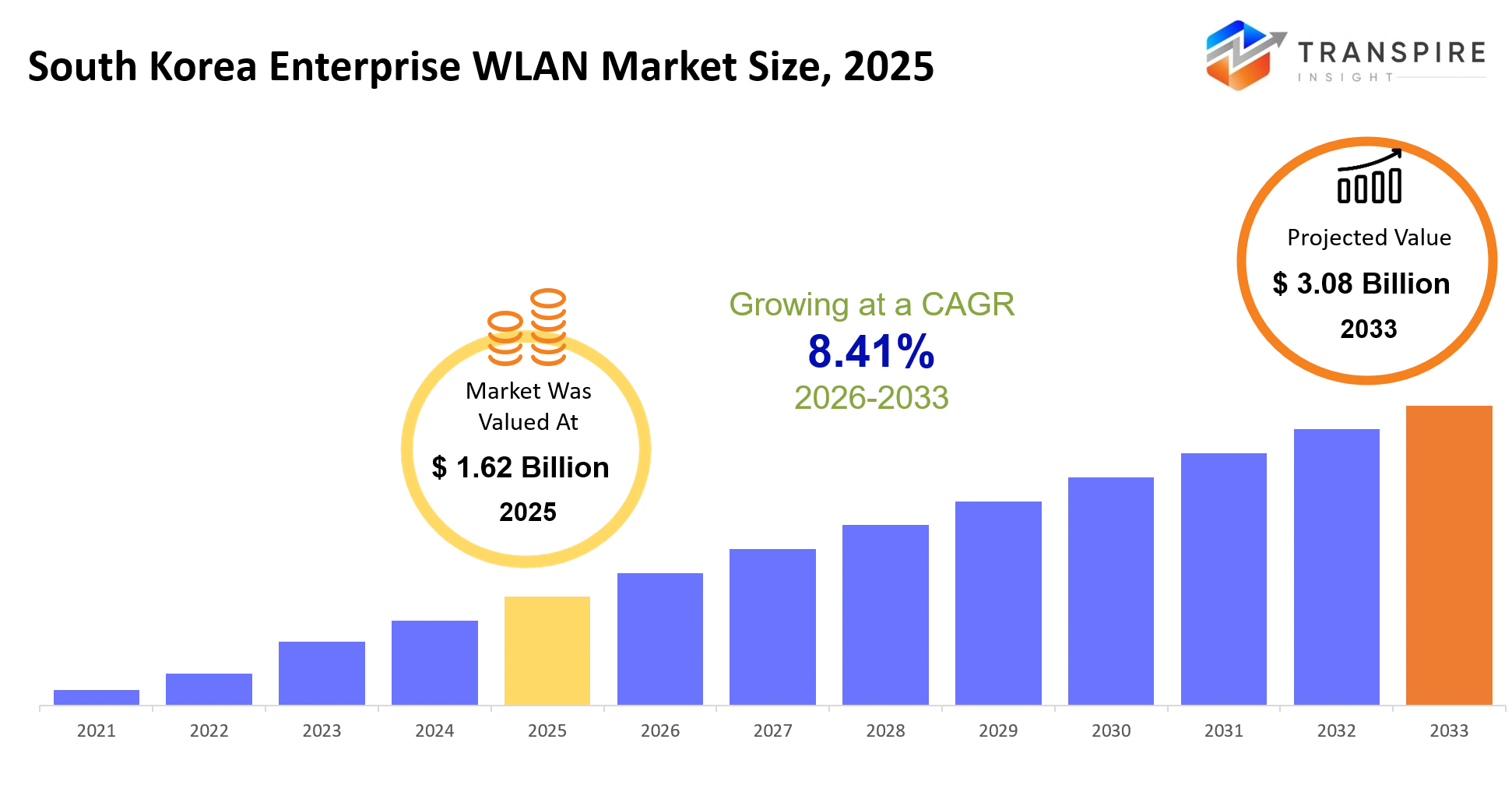
- South Korea Enterprise WLAN Market Size 2025: USD 1.62 Billion
- South Korea Enterprise WLAN Market Size 2033: USD 3.08 Billion
- South Korea Enterprise WLAN Market CAGR: 8.41%
- South Korea Enterprise WLAN Market Segments: By Component (Hardware, Software, Services, Others); By Deployment (Cloud Managed, On-Premise, Hybrid, Others); By End User (IT & Telecom, BFSI, Healthcare, Education, Others).
South Korea Enterprise WLAN Market Summary
The South Korea Enterprise WLAN Market was valued at USD 1.62 Billion in 2025. It is forecast to reach USD 3.08 Billion by 2033. That is a CAGR of 8.41% over the period.
In South Korea enterprise WLAN offers secure, high density wireless networks at factories, ports, logistics facilities, and enterprise campuses, so machinery, sensors and personnel can be connected wirelessly without need of cables. It enables real time control systems for smart manufacturing lines, automated warehouses or marine applications where downtime can have a critical impact to throughput and shipping schedules. In the last 3-5 years the market is transitioning from legacy Wi-Fi implementations to Wi-Fi 6 and cloud-managed WLAN architectures with no on-premise controllers. Pandemic showed the missing connectivity in industrial environments and drove investment into robust wireless networks, while supply chain risks prompted manufacturers to push automation and digitize their operation and implement IoT-driven tracking solutions. All this triggered the need for high capacity, low latency networks supporting automation, edge computing, and always on production
Key Market Insights
- Enterprise WLAN market in Korea has the strongest penetration in the Seoul-Gyeonggi manufacturing & digital enterprises, which hold an estimated concentration of >40% infrastructure by 2025.
- The fast growing deployment in the Southern Industrial complexes like Busan, Ulsan by 2030 as the port digitalization and smart logistics expansion takes traction.
- Secondary enterprises WLAN demand is gaining traction in the region innovation clusters backed up by the government smart factory subsidies.
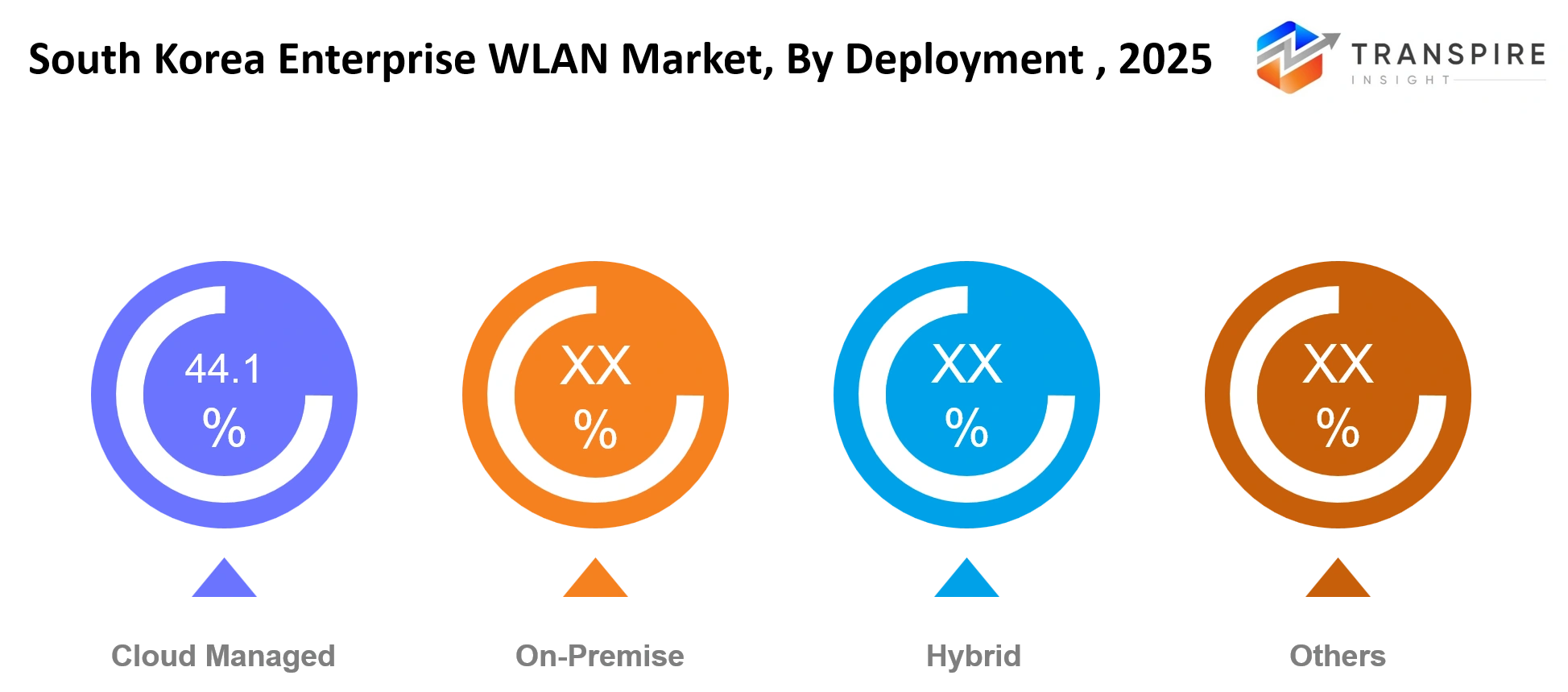
- Cloud managed enterprise WLAN solutions is dominant in South Korea's enterprise WLAN market with an estimated 45% of share by 2025, based on advantages in scalability.
- The hardware-based access point solutions will remain the second dominant category due to the legacy industrial installations and the hybrid networks.
- Wi-Fi 6 and Wi-Fi 6E enabled systems will be the fastest growing segment in 2024-2030 driven by enterprises to upgrade from legacy to achieve low latency automation, which contributes near 45% demand.
- Manufacturing automation and industrial IoT connectivity will dominate the usage accounting for near 50% enterprise WLAN traffic demands by 2030, while the second biggest growth application segment will be the smart warehouse & logistics tracking based on the demands for real-time assets visibility.
- Manufacturing enterprises have occupied the largest market share in the South Korea enterprise WLAN market due to its high density of automation on the production lines.
- Logistics & Maritime operators will have the largest end-user category growth by 2030, boosted by port digitization and supply chain synchronization needs.
What are the Key Drivers, Restraints, and Opportunities in the South Korea Enterprise WLAN Market?
The main driver for the South Korea Enterprise WLAN Market is mass industrial digitalization in the manufacturing and logistics industries. Due to smart factory initiatives in South Korea, enterprises have shifted from wired networking solutions to high density wireless systems supporting IoT sensors, robots, and real time production analysis-thereby driving WLAN equipment deployment and recurrent cloud network management revenues.
The main constraint is complex legacy industrial infrastructure integration. While many factory automation systems are mixed-generation and already legacy-built, it is expensive to reconfigure their network and downtime during the wireless upgrade-this structural impediment slows the full scale deployment, as enterprises tend to avoid abrupt changes in their infrastructure, postponing vendor revenues.
A major opportunity is derived from the hybridization of private 5G and Wi-Fi within the smart port and industrial zones, like Busan. Korean logistics providers have allocated significant investments toward real time cargo tracking and autonomous cargo handling systems, and the integration of hybrid wireless network infrastructure will spawn new revenue cycles from the enterprise WLAN solutions.
What Has the Impact of Artificial Intelligence Been on the South Korea Enterprise WLAN Market?
The role of AI in the South Korea Enterprise WLAN Market is helping shape self-optimizing wireless networks, managing bandwidth allocation, identifying interference sources, and minimizing latency for dense industrial workplaces. For smart factory operations, AI enabled network controllers monitor traffic patterns of robotics, and IoT devices and establish reliable wireless links to maintain high system availability and continuous production cycles, and will result in a predicted 10%-20% in uptime in advanced digitally automated manufacturing environments.
Predictive analytics models will be deployed to accurately forecast network congestion levels and reprogram APs prior to any performance degradation issues occurring. In port and maritime logistics, AI assists in optimizing wireless tracking devices in ship management and container tracking, resulting in increased performance for connected port environments.
While the AI deployment for the South Korea Enterprise WLAN Market is lagging, there's an issue with available real world data. Harsh electromagnetic environments, tightly packed machinery layouts, and unstable connectivity result in lower model accuracy with machine learning based optimization applications.
Key Market Trends
- Enterprises across the South Korea Enterprise WLAN Market transitioned from controller-based Wi-Fi to cloud-managed architectures for improved scalability and centralized management from 2022-2026.
- Adoption of Wi-Fi 6 rapidly grew post-2023 due to the upgrading of factories for supporting robotics, drastically increasing the data density at real-time frequencies.
- Post-2024, smart factory projects in Gyeonggi and Ulsan forced upgrades of the WLAN systems to replace aging wired systems in order to minimize downtime.
- Logistics firms boosted WLAN usage with the global supply chain constraints experienced post-pandemic enabling quicker adoption in favor of more responsive real-time tracking and robotics.
- In 2025 AI driven tools from Cisco Systems were increasingly integrated into the enterprise WLAN management system for reducing network congestion and latency.
- The use of enterprise WLAN grew exponentially within maritime and port operators in Busan to support automated cargo and automated tracking from 2023 to 2026.
- Security concerns escalated post-2024 due to numerous cyber-attacks pushing a zero-trust WLAN framework for industrial and financial enterprises.
- Companies began to shift their competitive strategies towards offering subscription-based WLAN services instead of just selling hardware fromHewlett Packard Enterprise and Juniper Networks respectively by 2024.
- Demand for Wi-Fi 6E capable WLAN hardware grew through 2026 for ultra-low latency IoT and edge computing industrial tasks.
South Korea Enterprise WLAN Market Segmentation
By Component :
The South Korea Enterprise WLAN market's hardware components range from access points to routers and controllers and form the building blocks of wireless networks for offices, factories and logistics centers. Hardware will experience continued replacement of legacy equipment by enterprise upgrades of Wi-Fi 6 and Wi-Fi 6E access points and hardware to cope with increasing data traffic. The market's software component is composed of network management software and tools that allow monitoring, control of network security and performance optimization from a central location and across locations.
With the trends moving towards an automated and AI supported network operation such tools will be more significant. Services offered encompass installation, consultation, maintenance and managed network services. Service demand will grow with companies wishing to outsource complex WLAN deployment and management life cycles to reduce the internal IT workload. Security tools and integrated solutions that enable interoperability between WLAN, IoT and cloud platforms further boost overall performance and usability across business sectors.
By Deployment :
In South Korea Enterprise WLAN Market, cloud-managed deployment refers to the centralized management of wireless networks via cloud services where access points can be configured and monitored remotely from the cloud. This market will likely increase as enterprise adoption of adaptable and scalable network infrastructure to enable distributed operations progresses. On-premise deployment refers to a locally controlled WLAN deployment in which enterprise organizations establish, and control WLAN systems locally within the enterprise premises; this option is prevalent among sectors where Data security controls are stringent.
The segment will likely decrease due to increasing maintenance costs and inherent scalability limitations. Hybrid deployment model is a solution where cloud and on-premise systems are integrated, enabling enterprises to attain a blend of security and agility; this option will witness increasing adoption in sectors such as manufacturing and finance which need tight security controls while retaining a certain level of agility. Other deployment types are edge-integrated deployment models which facilitate local data processing in close proximity to the real world operations.
By End User :
Within the South Korea Enterprise WLAN Market, enterprises in IT and telecom use WLANs for high-speed data transfers, cloud-enabled operations and internal digital services, demand will be higher with higher traffic volumes and with service providers scaling infrastructure capacities. The BFSI segment heavily depends on secured WLAN for digital banking services, customer services platforms and connectivity across branches, the importance of cybersecurity upgrades for this segment is of very high priority.
The healthcare sector uses WLANs to monitor patients' conditions and provide connected medical devices, also they make use of WLANs in digital records. With the expansion of connected classrooms, digital learning, students in educational institutions depend heavily on WLANs for connectivity within the campus. Other end-use segments include retail, logistics and public services for automation, tracking and coordination among multiple units of enterprises.
What are the Key Use Cases Driving the South Korea Enterprise WLAN Market?
The core adoption is led by a smart manufacturing environment where the connectivity of the production line depends on constant and consistent wireless connectivity. The production environment can utilize the WLAN technology to connect all robots, sensors and controllers, so as to monitor the process on the line and quickly respond to the variations of the manufacturing environment. This use case accounts for the greatest demand since even brief disconnections of connectivity could have a direct and significant impact on the product output and quality control.
Emerging use cases are expanding into the logistics automation and BFSI branch connectivity. In logistics automation, enterprises utilize the WLAN technology to implement the warehouse tracking, automated sorting mechanism and real-time cargo visibility, specifically those logistics supply chains associated with ports. In the BFSI sector, secure wireless solutions will be applied to various digital banking services, and the connectivity on the branches will allow institutions to move away from reliance on wired infrastructure, in addition to enabling high-speed services and synchronized data transmission.
Other use cases are expected to include the integration of healthcare IoT, and campus-wide digital learning environments. The hospitals are starting to implement the connectivity of the devices used to monitor the patient and mobile diagnostic equipment. Similarly, higher education and K-12 institutions also will increasingly adapt wireless networks to achieve real-time accessing the online learning content and the collaboration features.
|
Report Metrics |
Details |
|
Market size value in 2025 |
USD 1.62 Billion |
|
Market size value in 2026 |
USD 1.75 Billion |
|
Revenue forecast in 2033 |
USD 3.08 Billion |
|
Growth rate |
CAGR of 8.41% from 2026 to 2033 |
|
Base year |
2025 |
|
Historical data |
2021 - 2024 |
|
Forecast period |
2026 - 2033 |
|
Report coverage |
Revenue forecast, competitive landscape, growth factors, and trends |
|
Country scope |
South Korea |
|
Key company profiled |
Cisco, HPE Aruba, Juniper Networks, Huawei, Extreme Networks, Ubiquiti, Fortinet, CommScope, Dell Technologies, NEC, Samsung Electronics, ZTE, Alcatel-Lucent Enterprise, TP-Link, D-Link. |
|
Customization scope |
Free report customization (country, regional & segment scope). Avail customized purchase options to meet your exact research needs. |
|
Report Segmentation |
By Component (Hardware, Software, Services, Others); By Deployment (Cloud Managed, On-Premise, Hybrid, Others); By End User (IT & Telecom, BFSI, Healthcare, Education, Others). |
Which Regions are Driving the South Korea Enterprise WLAN Market Growth?
Enterprise WLAN deployment is led by the Seoul Capital Region (SCR), which contains the bulk of corporate HQs, data centers, and advanced manufacturing in South Korea. An aggressive government digital policy focus and early deployment of WLAN standards such as Wi-Fi 6 in the smart factory initiatives solidify this position, with continuous upgrade needs driven by finance, IT services and large campus environments. High demands driven by Cloud and AI management strengthen the performance needs and drive upgrades faster in the SCR than other parts of the country.
The Southeast industrial belt (Busan, Ulsan and Gyeongnam) comprise the second major part of the South Korea Enterprise WLAN Market. Ship building, petro chemistry and exports, in particular, lead to a sustained, long cycle demand for wireless. Instead of quick adoption of the latest technology standards, the businesses here are driven more by reliability and durability of operation. Many large industrial enterprises continue a strong and steady upgrade plan in order to ensure more automation and coordination among multiple facilities in these areas.
Busan-driven coastal logistics corridors are growing the quickest as part of smart port development. Recent spending on automated cargo handling systems, real-time tracking, and smart port infrastructure have led to a robust need for WLAN throughout port operations and private logistics companies involved with maritime trade. The smart port policy will spur substantial spending by private logistics corporations through 2033, fueling great opportunities in the maritime logistics domain.
Who are the Key Players in the South Korea Enterprise WLAN Market and How Do They Compete?
The South Korea enterprise WLAN market is moderately consolidated where global networking vendors still have a robust enterprise contract portfolio, competing through upgrades in technology and managed services models. The current competitive factors revolve around Wi-Fi 6/6E performance, cloud-native management platforms, embedded cyber security, and subscription pricing instead of purely on the basis of hardware. Incumbents are defensive in nature to retain existing installed bases while disruption occurs with cloud-first solutions, allowing reduction in on-premise equipment.
Cisco Systems secures its share with an intent-based networking solution driven by AI and cloud-managed WLAN platforms simplifying the enterprises WLAN network management. Hewlett Packard Enterprise leverages its Aruba offering against the existing campus WLAN market and subscription services in GreenLake platform. Huawei Technologies maintains its strong presence with cost-effective hardware and unified WLAN network solution catering to a massive scale. Juniper Networks leverages itsMist AI for optimization of the network performance and auto troubleshooting. Samsung Electronics seeks an advantage by leveraging an on-premise ecosystem across a smart factory andExtreme Networks focuses on cloud-managed niche solutions targeting a distributed enterprise environment.
Company List
- Cisco
- HPE Aruba
- Juniper Networks
- Huawei
- Extreme Networks
- Ubiquiti
- Fortinet
- CommScope
- Dell Technologies
- NEC
- Samsung Electronics
- ZTE
- Alcatel-Lucent Enterprise
- TP-Link
- D-Link
Recent Development News
In April 2025, Hewlett Packard Enterprise completed the strategic integration progress of Aruba Networking within its hybrid cloud portfolio expansion.
The development strengthened HPE’s enterprise WLAN offering by aligning wireless LAN management with GreenLake cloud services, improving scalability for smart factory and enterprise deployments in advanced manufacturing economies such as South Korea.
Source: https://community.hpe.com/
In March 2026, Cisco Systems announced recognition as the overall leader in the ABI Research Enterprise WLAN ranking.
The recognition reinforces its position in AI-driven enterprise WLAN infrastructure and strengthens its competitiveness in cloud-managed and intent-based networking deployments across Asia-Pacific markets, including South Korea.
Source: https://blogs.cisco.com/
What Strategic Insights Define the Future of the South Korea Enterprise WLAN Market?
The South Korea Enterprise WLAN Market is at the cusp of transitioning toward a totally cloud-orchestrated, AI-driven wireless architecture and the enablement of dense automation in manufacturing, logistics, and enterprise campuses. The key drivers of growth over the next 5-7 years will be the evolution from connection-centric deployment to intelligent systems that optimize the network autonomously on the fly according to latency, load balancing, and security requirements. The acceleration will be fueled by the broader uptake of industrial IoT (IIoT) and high availability operations for smart factories and digital port ecosystems.
A less visible threat includes increasing vendor concentration-as the number of players managing core WLAN infrastructure and cloud orchestration layers dwindles down to the few leading global networking vendors. The result is high dependency risks for enterprises and lack of room for flexible pricing for both customers and vendors.
A growing opportunity exists in the consolidation of private wireless networking within the digital ports and industrial districts in Busan as a case-in-point of integration of WLAN and edge computing toward automated logistics operations. Instead of hardware-centric strategies, interested market players need to focus on building an AI-native WLAN solution that embeds security, analytics, and edge coordination capability, because value generation will be increasingly about the software-defined network intelligence.
South Korea Enterprise WLAN Market Report Segmentation
By Component
- Hardware
- Software
- Services
By Deployment
- Cloud Managed
- On-Premise
- Hybrid
By End User
- IT & Telecom
- BFSI
- Healthcare
- Education
Frequently Asked Questions
Find quick answers to common questions.
The South Korea Enterprise WLAN Market size is USD 3.08 Billion in 2033.
Key segments for the South Korea Enterprise WLAN Market are By Component (Hardware, Software, Services, Others); By Deployment (Cloud Managed, On-Premise, Hybrid, Others); By End User (IT & Telecom, BFSI, Healthcare, Education, Others).
Major South Korea Enterprise WLAN Market players are Cisco, HPE Aruba, Juniper Networks, Huawei, Extreme Networks, Ubiquiti, Fortinet, CommScope, Dell Technologies, NEC, Samsung Electronics, ZTE, Alcatel-Lucent Enterprise, TP-Link, D-Link.
The South Korea Enterprise WLAN Market size is USD 1.62 Billion in 2025.
The South Korea Enterprise WLAN Market CAGR is 8.41% from 2026 to 2033.
- Cisco
- HPE Aruba
- Juniper Networks
- Huawei
- Extreme Networks
- Ubiquiti
- Fortinet
- CommScope
- Dell Technologies
- NEC
- Samsung Electronics
- ZTE
- Alcatel-Lucent Enterprise
- TP-Link
- D-Link
About the Authors

Mayur Shinde
I am Mayur Shinde, a Senior Research Analyst at Transpire Insight, specializing in the Automotive & Transportation and Information & Communication Technology (ICT) Industry. My work focuses on analyzing emerging market trends, technological advancements, competitive landscapes, and industry developments to deliver accurate, data-driven insights. I am passionate about transforming complex market information into clear, actionable content that helps businesses, professionals, and decision-makers stay informed and make confident strategic decisions.

Chakradhar Khansole
Chakradhar serves as the Research Director at Transpire Insight, bringing over 8 years of experience in technology, innovation, and strategic market intelligence. He specializes in transforming complex market data into actionable business insights that enable organizations to make informed, growth-oriented decisions. Recognized for his strategic vision and analytical expertise, Chakradhar leads high-impact research initiatives, delivering comprehensive market assessments, competitive intelligence, and forward-looking industry analysis.
Recently Published Reports
-
Apr 2026
3D Optical Profiler Market
3D Optical Profiler Market Size, Share & Analysis Report By Type (Desktop 3D Optical Profiler, and Portable 3D Optical Profiler), By Technology (Confocal Technology, and White Light Interference), By End-Use Industry (Manufacturing, Research Institutions, Automotive, Aerospace and Defense, Medical Devices, and Other), and Geography (North America, Europe, Asia-Pacific, Middle East and Africa, South and Central America), 2021 - 2031
-
Apr 2026
Depth Sensor Market
Depth Sensor Market Size, Share & Analysis Report By Type (Infrared Depth Sensors, Time-of-Flight (ToF) Sensors, Stereo Vision Sensors, Structured Light Sensors, Ultrasonic Depth Sensors), By Application (Automotive, Robotics, Gaming, Consumer Electronics, Industrial Automation, Healthcare, Security & Surveillance, Others), By End Users (Automotive Manufacturers, Consumer Electronics Companies, Healthcare Providers, Industrial Companies, Security Agencies, Gaming Companies, Robotics Companies, Others), and Geography (North America, Europe, Asia-Pacific, Middle East and Africa, South and Central America), 2021 – 2031
-
Apr 2026
Digital Manufacturing Market
Digital Manufacturing Market Size, Share & Analysis Report By Component (Hardware, Software, and Services), By Technology (Robotics, 3D Printing, Internet of Things (IoT), and Others), By Application (Automotive and Transportation, Aerospace and Defense, Consumer Electronics, Industrial Machinery, and Others), By Process Type (Computer-Based Designing, Computer-Based Simulation, Computer 3D Visualization, Analytics, and Others), and Geography (North America, Europe, Asia-Pacific, Middle East and Africa, South and Central America), 2021 – 2031
-
Apr 2026
Digital Visa Services Market
Digital Visa Services Market Size, Share & Analysis Report By Type (Individual Travelers, Group Travelers), By Application (Tourism, Business Travel, Others), and Geography (North America, Europe, Asia-Pacific, Middle East and Africa, South and Central America), 2021 – 2031