

South Korea Cross-Linked Polyethylene Cables Market Size & Forecast:
- South Korea Cross-Linked Polyethylene Cables Market Size 2025: USD 82.4 Million
- South Korea Cross-Linked Polyethylene Cables Market Size 2033: USD 149.3 Million
- South Korea Cross-Linked Polyethylene Cables Market CAGR:7.47%
- South Korea Cross-Linked Polyethylene Cables Market Segments: By Voltage (Low, Medium, High, Extra High Voltage); By Application (Utilities, Industrial, Renewable Energy, Infrastructure, Others)

To learn more about this report,  Download Free Sample Report
South Korea Cross-Linked Polyethylene Cables Market Summary
The South Korea Cross-Linked Polyethylene Cables Market was valued atUSD 82.4 Million in 2025. It is forecast to reach USD 149.3 Million by 2033. That is a CAGR of 7.47% over the period.
The South Korea Cross-Linked Polyethylene (XLPE) Cables Market, honestly,y it really helps keep electricity transfer stable across power grids, industrial plants, and even renewable energy projects where insulation quality and heat resistance are not optional. You tend to see these cables pretty often in underground runs and offshore connections, so the power flow stays smooth even when the network is cramped in dense city areas, or when it’s in heavy load industrial zones. Since the materials handle stress well once voltage and temperatures start climbing, they basically become a core requirement for grid stability today and for the continued expansion of infrastructure.
Over the past 3–5 years there’s been this low key structural tilt toward renewable generation, and that has pushed XLPE cable use up especially for offshore wind and a variety of distributed solar initiatives. At the same time, tighter energy efficiency and safety rules have influenced utilities to replace older oil-filled cable systems with cross-linked polyethylene solutions. One big driver was the global supply chain disruption after 2020, which made it clear, in a practical sense, that South Korea needed more localized, resilient power infrastructure investment, not just repeating the same old sourcing model. So, as utilities plus industrial operators move forward with grid modernization programs, demand keeps climbing for cable systems with stronger performance, lower transmission losses, and better support for dependable long-term operations across energy networks.
Key Market Insights
- South Korea Cross-Linked Polyethylene Cables Market shifted after 2021, kind of toward underground and offshore cable deployment for grid reliability improvements, not just better routing but also more resilient feeds, you know.
- Market share concentration still looks strongest in urban infrastructure zones, with something like nearly 45% of installations in 2025 across South Korea. The fastest-growing region seems to be the coastal industrial corridors, and it’s projected to expand quickly through 2030, mainly because offshore wind integration projects keep stacking up.
- High-voltage XLPE cables still dominate with over 50% share, largely because the demand for long-distance transmission efficiency upgrades keeps rising.
- The medium-voltage segment follows fairly close behind, supported by industrial expansion and distributed energy systems across manufacturing hubs, more or less.
- On the application side, renewable energy integration turned into the fastest-growing segment after 2023.
- This is mostly tied to offshore wind and solar farm connectivity; you get more links into the grid. For end users, industrial utilities remain dominant, and they hold a sizable share in 2025 in the South Korea Cross-Linked Polyethylene Cables Market.
- Meanwhile, renewable energy operators are the fastest-growing end-user category, likely due to grid decentralization trends that keep changing who connects and how.
- Main companies include Prysmian Group, Nexans, LS Cable & System, Sumitomo Electric, and NKT.
- Prysmian Group expands by focusing on offshore wind cable innovation and investing in high-voltage transmission systems across Asia-Pacific markets.
- Nexans strengthens its position through strategic partnerships tied to renewable energy infrastructure, plus submarine cable system deployments.
What are the Key Drivers, Restraints, and Opportunities in the South Korea Cross-Linked Polyethylene Cables Market?
South Korea's Cross-Linked Polyethylene Cables Market looks mostly powered by this whole grid modernization drive, plus a renewable energy connection that keeps showing up across transmission routes. If you’re asking what really sets it off, rising electricity demand from urban and industrial clusters actually matters a lot, and on top of that, the government is trying to raise grid dependability, after repeated concerns about old, aging infrastructure. So, as a practical move utilities are drifting away from the typical oil-filled and PVC-based arrangements, largely because XLPE cables deliver better thermal resistance and tend to create lower transmission losses. This kind of shift basically lifts procurement volumes for both high-voltage and medium-voltage cable systems, and then manufacturers in power infrastructure supply chains get more stable revenue streams, you know, the continuous work type, not just one-offs.
Still, there’s a noticeable brake on how fast adoption happens. Installation is pretty intricate, and project schedules can stretch quite far, particularly when underground and submarine cable work is involved. Those activities require lots of permitting, they pull in heavy capital spending, and they force coordination with several public bodies, which naturally slows everything. So even when demand indicators stay strong, the short-term revenue realization can get squeezed, at least in the early phase. Plus, rollout doesn’t move at the same speed everywhere, meaning some less developed industrial areas take longer to get full upgrades, and that delays the overall impact.
At the same time, an opportunity is starting to look more obvious, especially with offshore wind power expansion along South Korea’s coastal bands, including areas around Jeollanam-do and the Incheon maritime zones. Offshore ventures require more sophisticated XLPE submarine cable systems for long-distance, high-capacity transmission.
What Has the Impact of Artificial Intelligence Been on the South Korea Cross-Linked Polyethylene Cables Market?
Artificial intelligence, along with digital technologies, is now, bit by bit, reshaping the South Korea Cross-Linked Polyethylene (XLPE) cables ecosystem, mostly by helping with grid planning, asset watching, and maintenance efficiency, in a way that feels almost seamless. Utility operators increasingly lean on AI load prediction platforms to tune how electricity is routed through transmission corridors, especially where there are dense industrial clusters. With these methods, operators can balance the electricity flow as it happens, lowering overload exposure and also strengthening system stability, not just for underground routes but for offshore cable networks too.
At the same time, digital twin frameworks for the power grid are being rolled out, so they can mimic XLPE cable behavior when load levels shift and when temperatures swing, which in turn improves design accuracy before any installation starts. And, yes, there’s more, because on top of that, machine learning approaches are being used for predictive servicing of XLPE cable systems, by studying temperature swings, partial discharge signals, and insulation aging pathways. So utilities can catch faults earlier, before they fully develop, and avoid those sudden unplanned outages.
In more mature deployments, predictive analytics has helped deliver something like a 10–15% uplift in network availability, and it also seems to reduce maintenance-related operating costs, particularly inside high-voltage transmission setups that support renewable energy tie-ins. Still, there’s a real bottleneck that keeps showing up: the integration expense when AI has to connect with older, legacy grid infrastructure. Many older substations do not yet have consistent standardized digital sensing devices, so real-time data collection becomes uneven, and that unevenness d…
Key Market Trends
- Utilities started shifting after 2022 away from the overhead setups, toward underground XLPE cable networks, for that whole “urban grid reliability” angle, and honestly also to calm down the outage risk stuff.
- Then South Korea upped its infrastructure funding after 2023, which basically pulled demand higher for high-voltage cross-linked polyethylene cable installations, especially when it came to transmission efforts.
- Offshore wind sort of sped everything up after 2024. In particular, coastal zones leaned on long-distance submarine power transmission systems, so cable adoption jumped there pretty quickly.
- LS Cable & System expanded its domestic production capacity in 2025, aiming to match the rising high-voltage cable needs being driven by renewable energy projects.
- Prysmian Group also increased its Asia-Pacific offshore cable investments after 2023, which helped it strengthen its position in submarine transmission infrastructure work. Meanwhile, Nexans put more weight on HVDC technology upgrades after 2024, boosting long-distance transmission efficiency across renewable integration projects worldwide.
- Grid operators moved to swap out aging oil-filled cables after 2022, partly because stricter safety standards came in, and partly because maintenance costs kept on climbing.
- At the same time, industrial electrification programs in manufacturing hubs pushed XLPE cable procurement up by nearly 20% between 2023 and 2025.
- Digital grid monitoring adoption expanded after 2024 as well, and that improved fault detection accuracy, plus it lowered transmission downtime across city networks.
- And overall, renewable energy’s share in cable demand rose steadily after 2023, mostly due to offshore wind plus distributed solar integration programs.
South Korea Cross-Linked Polyethylene Cables Market Segmentation
By Voltage
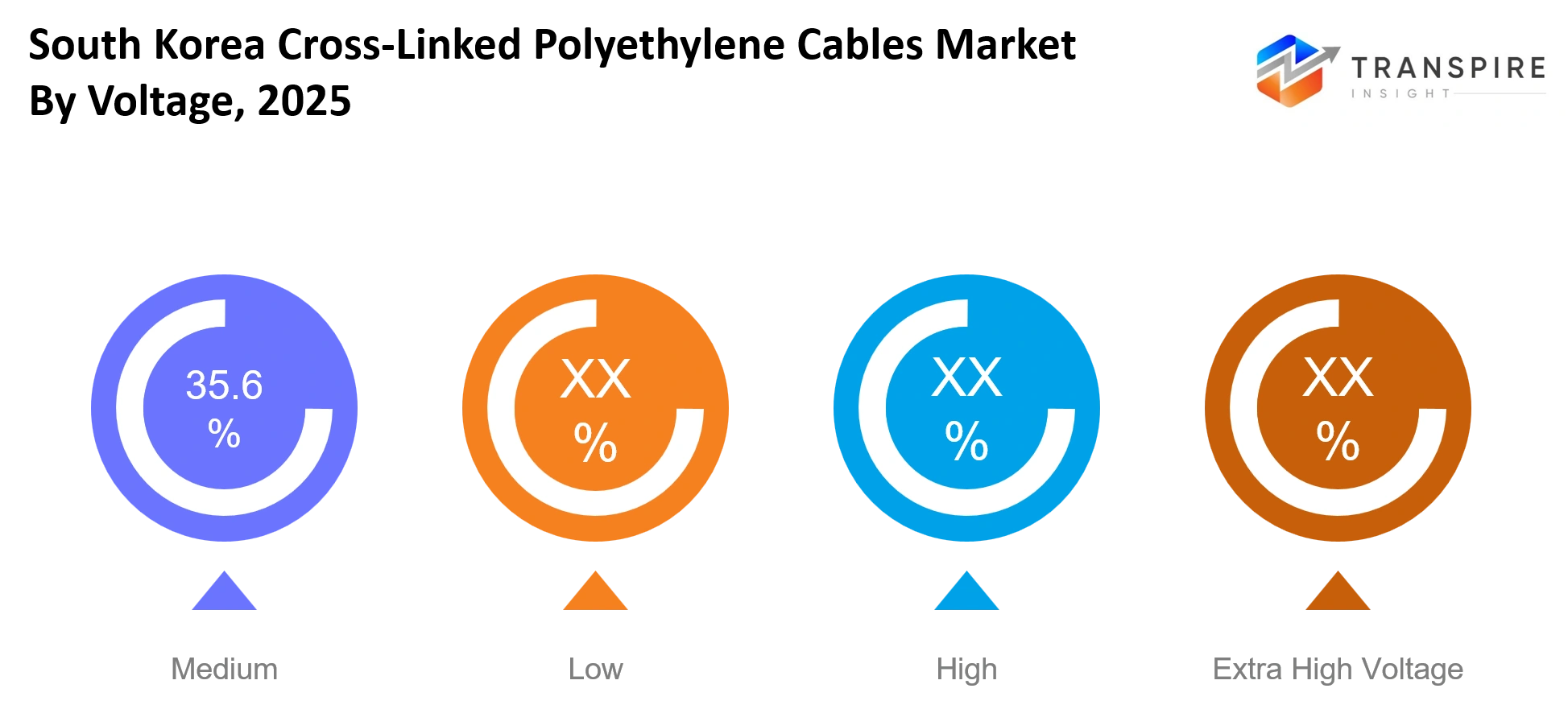
High voltage cables seem to take the biggest slice in the South Korea Cross-Linked Polyethylene Cables Market, mostly because utilities are still pushing transmission grid upgrades and all that. People choose high-voltage systems to reduce energy loss during long-distance electricity movement; it's pretty much the whole idea. After 2022, demand picked up a bit, maybe, due to infrastructure modernization programs that kept spreading through city centers and also industrial zones, not only one kind of location. Looking ahead, the adoption of high-voltage cable should keep climbing, alongside renewable energy integration and the related system changes.
Medium voltage cables, meanwhile, back up industrial facilities and commercial distribution setups across South Korea. Low-voltage cables are usually the default pick for residential sites and smaller infrastructure plans. Extra high voltage cables are also getting more attention for cross-border links and offshore transmission arrangements. Overall, the South Korea Cross-Linked Polyethylene Cables Market looks like it’s steadily moving toward higher voltage capacity systems, driven by efficiency pressure plus grid stability requirements.
To learn more about this report, Download Free Sample Report
By Application
Utilities are kind of the main use case in the South Korea Cross-Linked Polyethylene Cables Market, mostly because the grid modernization programs keep moving forward, so it feels like steady pressure. Industrial use comes after that, mainly since manufacturing electrification is rising, and automation upgrades keep getting put in place. After 2023, demand in utilities actually grew faster because the older transmission networks had to be swapped out with more advanced insulation cable solutions. For the long run, utilities will probably stay the largest buyer in procurement, overall, yes.
Renewable energy also looks like the fastest-growing application, largely linked to offshore wind programs and solar integration initiatives. Then, infrastructure projects bring a more consistent boost, driven by urban development and transport electrification, which keeps cable pulling active. There are other segments too, like defense and specialized energy systems, where the cable requirements are more particular, more niche by nature. All in all, the South Korea Cross-Linked Polyethylene Cables Market keeps expanding as clean energy adoption and smart grid development accelerate across different sectors.
What are the Key Use Cases Driving the South Korea Cross-Linked Polyethylene Cables Market?
Utilities are basically the main use case in the South Korea Cross-Linked Polyethylene Cables Market, because power transmission setups are shifting toward higher efficiency approaches. In other words, these cables let electricity move across longer distances, with fewer losses, which then makes them kind of crucial for keeping urban grids stable. They also help keep major infrastructure dependable over time, especially since the demand is still climbing. Meanwhile, industrial power use is rising from industrial clusters, and that continued growth keeps adoption moving along in a very steady way.
Then you’ve got industrial manufacturing facilities, plus infrastructure build-out projects, which keep broadening into additional use cases. At the plant level, operators rely on these cables to keep long running high load operations steady. At the same time, metro expansion efforts and smart city projects are increasing the need for underground installation, where available space and reliability are always in tight balance. There’s also offshore energy development, which adds extra pressure in coastal construction areas, where insulation performance and overall trustworthiness have to stay top-notch.
Renewable energy integration is gaining momentum, too, and it shows up as an emerging use case, especially around offshore wind farms and distributed solar networks. These systems need tough submarine cable links, able to deal with changing power loads without dropping performance. Separately, grid interconnection projects across regional energy networks are expected to grow as well, since South Korea is pushing harder on its clean energy transition goals.
|
Report Metrics |
Details |
|
Market size value in 2025 |
USD 82.4 Million |
|
Market size value in 2026 |
USD 88.6 Million |
|
Revenue forecast in 2033 |
USD 149.3 Million |
|
Growth rate |
CAGR of 7.47% from 2026 to 2033 |
|
Base year |
2025 |
|
Historical data |
2021 - 2024 |
|
Forecast period |
2026 - 2033 |
|
Report coverage |
Revenue forecast, competitive landscape, growth factors, and trends |
|
Regional scope |
United States; Canada; Mexico; United Kingdom; Germany; France; Italy; Spain; Denmark; Sweden; Norway; China; Japan; India; Australia; South Korea; Thailand; Brazil; Argentina; South Africa; Saudi Arabia; United Arab Emirates |
|
Key company profiled |
Prysmian, Nexans, LS Cable & System, Taihan Cable, Sumitomo Electric, Furukawa Electric, NKT, KEI Industries, Polycab, Southwire, Hitachi Energy, Riyadh Cables, Leoni, Bahra Cables, Finolex |
|
Customization scope |
Free report customization (country, regional & segment scope). Take advantage of customized purchase options tailored to meet your exact research needs. |
|
Report Segmentation |
By Voltage (Low, Medium, High, Extra High Voltage); By Application (Utilities, Industrial, Renewable Energy, Infrastructure, Others) |
Which Regions are Driving the South Korea Cross-Linked Polyethylene Cables Market Growth?
Seoul and the surrounding capital region kinda lead the South Korea Cross-Linked Polyethylene Cables Market, because the urban fabric is dense and the grid modernization is always ongoing. There’s also substantial government funding for underground transmission corridors, so utilities can handle large-scale replacements of older cable systems. On top of that, industrial electricity use stays high, especially from data centers, manufacturing zones, and commercial clusters, so overall consumption keeps going up. With a solid utility ecosystem and strong engineering know-how, high-voltage XLPE cable deployments happen regularly across important power routes.
Busan ends up as the stable second area, mostly since it’s a major industrial and port city, and electricity needs remain consistent. Power demand flows from logistics operations, shipbuilding, and heavy industry, so the pull is steady. Compared with Seoul, Busan’s growth feels more tied to industrial continuity and port-related energy, not a rapid “redo the whole grid” transformation. In practice, local utilities focus on reliability and routine maintenance for current transmission systems. And with continued industrial investment plus gradual grid upgrades, cable demand holds steady without dramatic swings.
Jeollanam-do is moving the fastest, mainly because offshore wind expansion is picking up fast, and coastal energy infrastructure is being built out. Recent renewable programs backed by government support have lifted submarine cable installation along the southern coast. That change is creating strong requirements for high-capacity XLPE cables made for marine conditions and related harsh settings. For new entrants, this region can look like a long-term opportunity, linked to renewable integration and offshore transmission expansion between 2026 and 2033.
Who are the Key Players in the South Korea Cross-Linked Polyethylene Cables Market and How Do They Compete?
The South Korea Cross-Linked Polyethylene Cables Market shows a pretty moderately consolidated pattern where only a handful of global and local manufacturers dominate most high-voltage and infrastructure-grade supply agreements. In practice, competition gets shaped mostly by technology leadership and compliance with strict utility standards, not so much by nonstop price pressure. The main players tend to protect their positions via long-term utility partnerships, and with proven outcomes in grid modernization plus renewable integration efforts. New entrants run into hurdles tied to certification needs, project magnitude, and the capital-heavy nature of cable manufacturing and installation services, too.
LS Cable & System leans hard into cost-efficient large-scale production supported by dependable domestic supply chains. Its differentiation is basically high-capacity manufacturing facilities that help them fulfill utility contracts quickly, like on shorter timelines. The company grows through government-backed grid programs and through rising involvement in offshore wind transmission infrastructure.
Prysmian Group competes using tech progress in high-voltage and submarine cable systems. Their edge comes from advanced HVDC solutions meant for long-distance delivery and offshore energy transfer. Expansion is pushed by planned investments across Asia-Pacific renewable energy corridors, along with cross-border interconnection programs.
Nexans emphasizes engineering specialization for offshore wind and smart grid cable solutions. Its differentiation includes built-in digital monitoring tools that support cable performance tuning over time. Growth is driven by partnerships in renewable infrastructure projects and by moving deeper into high-demand offshore transmission markets.
Company List
- Prysmian Group
- Nexans
- LS Cable & System
- Taihan Cable & Solution
- Sumitomo Electric Industries
- Furukawa Electric
- NKT
- KEI Industries
- Polycab India
- Southwire Company
- Hitachi Energy
- Riyadh Cables Group
- Leoni AG
- Bahra Electric
- Finolex Cables
Recent Development News
In May 2025, Borealis expanded its XLPE and semicon production capacity to support rising demand from power grid modernization and renewable integration projects. The expansion improved supply stability for high-performance insulation materials used in submarine and underground cable systems. [https://www.borealisgroup.com
What Strategic Insights Define the Future of the South Korea Cross-Linked Polyethylene Cables Market?
South Korea’s Cross-Linked Polyethylene Cables Market is kinda slowly but surely moving toward high-capacity, digitally monitored, and even more renewable-integrated transmission networks over the next 5–7 years. The overall push behind it is not just one thing; it’s accelerated offshore wind deployment combined with underground urban grid expansion, plus the constant pressure to cut transmission losses, especially in high-density industrial corridors. Because of that, utilities will likely lean harder into HVDC and submarine XLPE systems, since grid stability and long-distance efficiency become, basically, the core of national energy planning.
There’s also a risk that is less visible, more like quiet friction in the background. Supply chain concentration for specialty insulation materials and semiconductor-grade raw inputs used for advanced cable production can create a real bottleneck. If upstream chemical or polymer supply gets interrupted , it could delay big infrastructure rollouts. This matters a lot for offshore programs with strict timelines, even when the demand fundamentals still look solid. So the demand story can stay strong, but the delivery timeline still gets tangled.
On the opportunity side, the expansion of offshore energy interconnection hubs in Jeollanam-do and nearby coastal zones looks promising, because several renewable projects may end up sharing submarine cable infrastructure. That setup could drive demand for standardized high-voltage XLPE systems that work smoothly across multi-operator grids. Market participants should probably start investing early in HVDC technology partnerships, and also in local installation capabilities, so they can lock in long-term utility contracts as Korea continues scaling offshore renewable integration toward 2033.
South Korea Cross-Linked Polyethylene Cables Market Report Segmentation
-
By Voltage
- Low Voltage
- Medium Voltage
- High Voltage
- Extra High Voltage
-
By Application
- Utilities
- Industrial
- Renewable Energy
- Infrastructure
- Others
Frequently Asked Questions
Find quick answers to common questions.
The expected South Korea Cross-Linked Polyethylene Cables Market size for the market will be USD 149.3 Million in 2033.
By Voltage (Low, Medium, High, Extra High Voltage); By Application (Utilities, Industrial, Renewable Energy, Infrastructure, Others)
Major South Korea Cross-Linked Polyethylene Cables Market players are Prysmian, Nexans, LS Cable & System, Taihan Cable, Sumitomo Electric, Furukawa Electric, NKT, KEI Industries, Polycab, Southwire, Hitachi Energy, Riyadh Cables, Leoni, Bahra Cables, Finolex
The South Korea Cross-Linked Polyethylene Cables Market size is USD 82.4 Million in 2025.
The South Korea Cross-Linked Polyethylene Cables Market CAGR is 7.47% from 2026 to 2033.
- Prysmian Group
- Nexans
- LS Cable & System
- Taihan Cable & Solution
- Sumitomo Electric Industries
- Furukawa Electric
- NKT
- KEI Industries
- Polycab India
- Southwire Company
- Hitachi Energy
- Riyadh Cables Group
- Leoni AG
- Bahra Electric
- Finolex Cables
About the Authors

Pankaj Ghogare Patil
I am Pankaj Ghogare Patil, a Senior Research Analyst at Transpire Insight, specializing in the Pharmaceutical, Chemicals & Materials, Healthcare IT, and Biotechnology industry. My expertise lies in conducting comprehensive market research, analyzing industry trends, evaluating competitive landscapes, and translating complex data into actionable insights. At Transpire Insight, I closely follow emerging technologies, regulatory developments, and market innovations to create accurate, well-researched, and informative content that helps businesses and professionals make informed decisions. I am committed to producing credible, evidence-based articles that reflect industry best practices while making technical topics accessible and valuable for a broad audience.

Chakradhar Khansole
Chakradhar serves as the Research Director at Transpire Insight, bringing over 8 years of experience in technology, innovation, and strategic market intelligence. He specializes in transforming complex market data into actionable business insights that enable organizations to make informed, growth-oriented decisions. Recognized for his strategic vision and analytical expertise, Chakradhar leads high-impact research initiatives, delivering comprehensive market assessments, competitive intelligence, and forward-looking industry analysis.
Recently Published Reports
-
May 2026
Healthcare Polymer Packaging Market
Healthcare Polymer Packaging Market Size, Share & Analysis Report By Packaging Type (Syringes, IV Bottles and Pouches, Clamshells, Blisters, Bottles & Jars, Containers, Tubes, IV Parental Packaging, Others), By Type (Regulated, Non-regulated), By Polymer Type (LDPE (Low-Density Polyethylene), HDPE (High-Density Polyethylene), Homo-polymer (Homo), Random Copolymer (Random), Block Copolymer (Block), PET, Polystyrene, Polyvinyl Chloride, Polyamide/EVOH, Others), and Geography (North America, Europe, Asia-Pacific, Middle East and Africa, South and Central America), 2021 - 2031
-
Apr 2026
Hydrophilic Tape (Waterstop) Market
Hydrophilic Tape (Waterstop) Market Size, Share & Analysis Report By Type (Bentonite-Based Hydrophilic Tape, Rubber-Based Hydrophilic Tape), By Application (Residential Buildings, Commercial Buildings, Infrastructure Projects), and Geography (North America, Europe, Asia-Pacific, Middle East and Africa, South and Central America), 2021 - 2031
-
Apr 2026
Metalens Market
Metalens Market Size, Share & Analysis Report By Type (Visible Light Metalens, and Infrared Metalens), By Application (Consumer Electronics, Automotive Electronics, Industrial, Medical, and Others), and Geography (North America, Europe, Asia-Pacific, Middle East and Africa, South and Central America), 2021 - 2031
-
Apr 2026
PBT Resin Market
PBT Resin Market Size, Share & Analysis Report By Type (Reinforced PBT Resin, Unreinforced PBT Resin), By Processing Method (Injection Molding, Extrusion, Blow Molding, Others), By End-User (Automotive, Electrical & Electronics, Consumer Appliances, Industrial Machinery, Medical Devices, Packaging, Others), and Geography (North America, Europe, Asia-Pacific, Middle East and Africa, South and Central America), 2021 - 2031