
South Korea Credit Default Swap Market Size & Forecast:
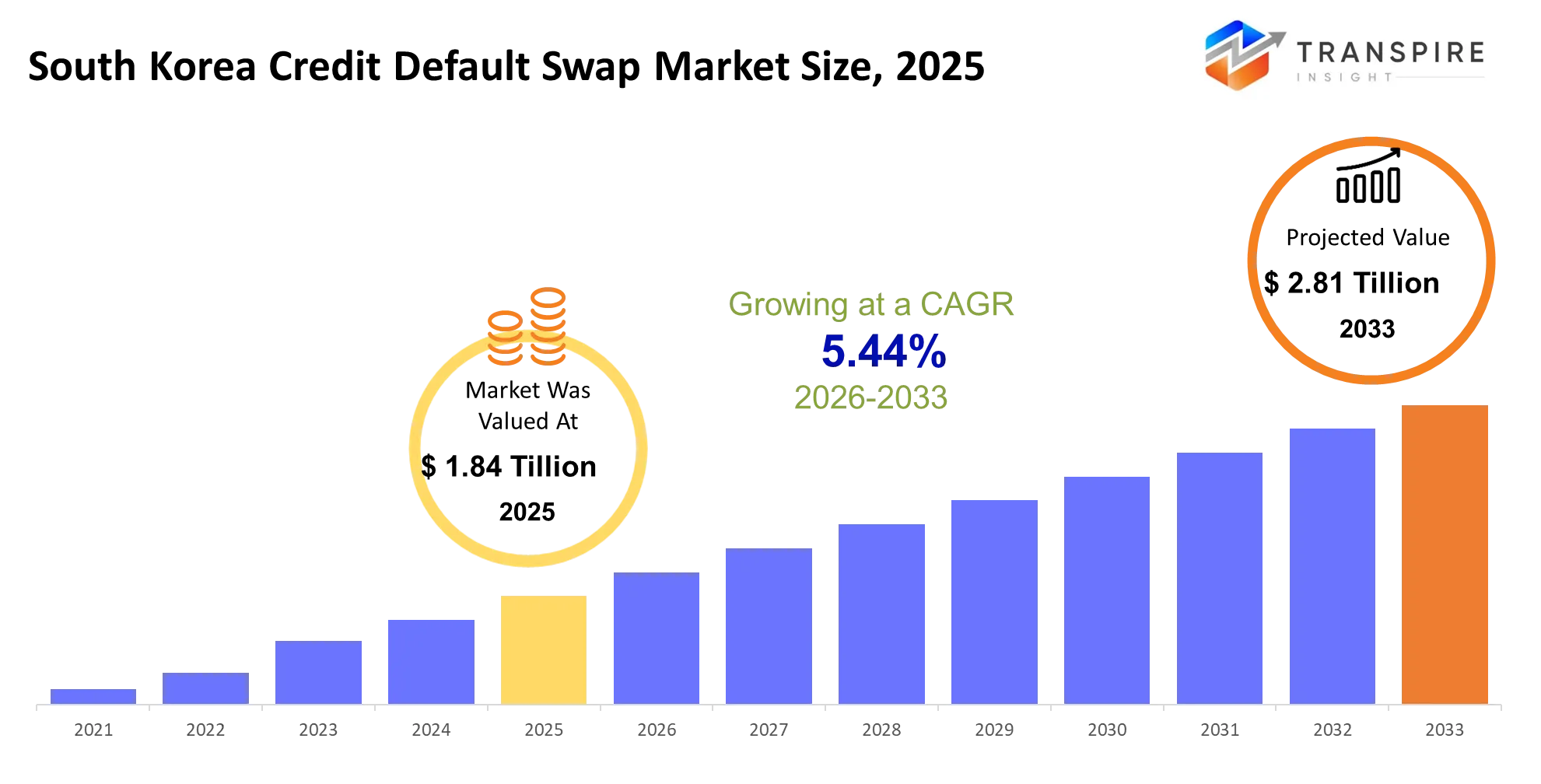
- South Korea Credit Default Swap Market Size 2025: USD 1.84 Trillion
- South Korea Credit Default Swap Market Size 2033: USD 2.81 Trillion
- South Korea Credit Default Swap Market CAGR: 5.44%
- South Korea Credit Default Swap Market Segments: By Instrument Type (Single-name CDS, Index CDS, Sovereign CDS, Basket CDS, Others); By Application (Risk Hedging, Speculation, Credit Risk Transfer, Portfolio Diversification, Others); By End User (Banks, Hedge Funds, Insurance Companies, Asset Managers, Others); By Tenure (Short-term CDS, Medium-term CDS, Long-term CDS, Others); By Trading Platform (OTC Trading, Electronic Trading Platforms, Others)
To learn more about this report,  Download Free Sample Report
South Korea Credit Default Swap Market Summary
The South Korea Credit Default Swap Market was valued at USD 1.84 Trillion in 2025. It is forecast to reach USD 2.81 Trillionby 2033. That is a CAGR of5.44%over the period.
The South Korea Credit Default Swap Market has this pretty critical role , in helping banks and institutional investors and even export oriented corporations handle credit exposure that comes from sovereign debt, corporate bonds, and cross border financing. In real life, CDS contracts let market participants shift default risk without actually selling or liquidating the underlying assets, and it’s become more and more important inside South Korea’s globally connected financial system where semiconductor exports, shipbuilding finance, and foreign currency borrowing can make institutions face quick credit repricing.
Over the last five years, things have moved away from mostly bank led hedging activity, toward more general institutional participation , and that shift has been supported by digital trading infrastructure plus stricter post crisis risk management standards. When global monetary tightening kicked in, and geopolitical volatility showed up (especially tied to supply chain disruptions between the U.S. and China) , CDS trading volumes picked up as investors tried to get faster protection when credit suddenly looked worse. In that kind of environment, Korean financial institutions started expanding derivatives clearing capabilities, improving liquidity access, and adopting data driven pricing models , and as a result transaction flow got stronger and fee based revenue generation across the market improved, too.
Key Market Insights
- In 2025, the South Korea Credit Default Swap Market did hit about USD 1.84 trillion, and by 2033 it’s expected to get close to USD 2.81 trillion. Kinda like a steady climb, just not in a perfectly smooth line.
- Most of the action, over 68% of CDS transaction activity in 2025, came from Seoul metropolitan financial hubs, mainly because trading infrastructure there is more concentrated. Not surprising, but it still matters.
- After 2023, cross-border sovereign CDS contracts showed up as the fastest-growing slice, driven by more geopolitical tension as well as currency linked credit volatility. That combination can really rattle pricing.
- Single-name CDS products kept the biggest market share, partly because Korean banks actively hedge exposure to export driven corporate borrowers. So the “who is covering what” is pretty clear.
- Index based CDS trading kept expanding steadily too, especially among pension funds, who wanted diversified protection against regional credit market instability. It was more than just a quick interest, more like ongoing rebalancing.
- Financial institutions remained the dominant end-user group, with more than 60% participation in 2025. Meanwhile, asset management firms logged the quickest adoption rate as alternative investment portfolios started using structured credit hedging strategies.
- Major global banks like JPMorgan Chase, Goldman Sachs, Morgan Stanley, and Citigroup pushed ahead with blockchain-enabled settlement and tokenization initiatives across their derivatives operations. Then again, everyone is chasing efficiency.
- After 2024 Korean institutions also accelerated partnerships with digital asset infrastructure providers, aiming to improve collateral efficiency and strengthen settlement transparency. Less friction, better visibility.
- Lastly, AI-driven risk analytics platforms started replacing manual credit assessment workflows more and more, which reduced pricing delays and improved trade execution accuracy. Fewer hold-ups, faster decisions, basically.
What are the Key Drivers, Restraints, and Opportunities in the South Korea Credit Default Swap Market?
The biggest growth driver in the South Korea Credit Default Swap Market is really this sharp rise in institutional credit risk management after global rate tightening cycles and the higher refinancing costs since 2022. Korean banks, insurers, and export- focused conglomerates had more exposure to bond market volatility as borrowing costs climbed across the United States, and also through Asia. Because of that, many institutions began adopting CDS contracts for sovereign and corporate risk coverage more aggressively, in particular those handling foreign currency obligations. With trading volumes moving up, investment banks saw better derivatives related fee income and the clearinghouses gained from extra transaction throughput, more or less.
The largest drag still sits in the structural complexity of derivatives rules and counterparty risk management. CDS trading leans a lot on liquidity depth, cross border settlement efficiency, and on tight collateral requirements that smaller domestic institutions often struggle to meet. South Korea’s regulatory oversight also keeps speculative participation lower than in the bigger Western derivatives markets, which in turn weakens market depth and slows down product innovation. So, trading flexibility gets reduced and revenue growth prospects for mid sized participants get capped.
A major opening is starting to appear via tokenized financial infrastructure and AI enhanced credit analytics. Korean securities firms are increasingly looking at blockchain enabled settlement mechanisms that can shorten transaction cycles and raise collateral transparency. If digital asset infrastructure gets integrated with institutional derivatives trading it could reduce operational friction and, at the same time, open wider participation paths for regional asset managers and pension funds.
What Has the Impact of Artificial Intelligence Been on the South Korea Credit Default Swap Market?
Artificial intelligence and advanced analytics platforms are kinda reshaping the way Korean financial institutions handle credit derivatives trading, pricing, and also exposure monitoring. Big investment banks and securities firms are increasingly adopting AI-powered trading engines to automate CDS spread analysis, evaluate counterparties, and balance portfolio risk across both sovereign and corporate credit holdings. In practice these systems ingest macroeconomic signals, bond yield movements, and market sentiment in real time, so traders can react quicker during times of volatility , even when things feel a bit unstable.
Machine learning models further help with forward-looking credit deterioration analysis, by spotting unusual shifts in liquidity, debt servicing strength, or sector-level stress indicators ahead of traditional rating changes. This improves hedging efficiency and also lowers the odds of unexpected portfolio losses for institutional investors. With AI-driven automation, trade execution timelines have become shorter , collateral optimization got stronger , and compliance reporting is more accurate as derivatives regulations keep evolving.
At the same time, digital settlement infrastructure is getting more attention. Some major global financial institutions active in South Korea are integrating blockchain-based payment and settlement approaches to cut down reconciliation delays and to reduce operational friction. Still, AI adoption isn’t completely smooth: high integration costs remain a hurdle, the data landscape is fragmented across multiple sources, and it can be hard to model real-world geopolitical shocks that suddenly and abruptly distort CDS pricing patterns.
Key Market Trends
- Korean banks upped their sovereign CDS hedging after 2022 , with higher U.S. interest rates really making foreign currency refinancing feel a lot more pressured.
- From 2023 to 2025, institutional investors started moving away from manual pricing models and into AI based credit analytics platforms, kind of like a practical shift rather than just an experiment.
- By this period, index CDS trading picked up noticeable momentum among pension funds, mostly because they wanted wider regional credit protection, not so much that heavy single name kind of exposure.
- In 2025, blockchain settlement pilots started accelerating too, as global banks targeted quicker derivatives clearing and tried to reduce that annoying collateral friction.
- Domestic securities firms also expanded partnerships with digital asset infrastructure providers , aiming to improve cross border transaction transparency without as much noise.
- Meanwhile, counterparty risk controls got tightened quite a bit , after regional banking stress events pushed up the need for real time exposure monitoring systems.
- Foreign investment banks leaned harder into Korean derivatives operations , because export sector volatility created more hedging opportunities across manufacturing ,and shipping industries too.
- Regulatory attention then shifted toward centralized clearing efficiency and stronger reporting standards, especially once institutional derivatives participation rose.
- Tokenization initiatives from firms like Mirae Asset Securities basically signaled a growing blend between digital finance and traditional derivatives markets.
- And CDS traders increasingly began weaving in geopolitical scenario modeling, since supply chain disruptions had started to affect Asian credit market stability , in a broader sense.
South Korea Credit Default Swap Market Segmentation
By Instrument Type
Single Name CDS is the most popular because of widespread application among financial institutions and investors to protect themselves against individual corporate names as well as export-related borrowers. Many large financial institutions in Korea are using such derivatives in order to mitigate their credit risks associated with manufacturing, transportation, and technology industries with high international indebtedness. High levels of liquidity and simpler price structures enable wider usage than complex derivatives.
Index CDS and Sovereign CDS are growing consistently as the number of diversified portfolios is rising along with the need for protection against macroeconomic volatility. Basket CDS is still underdeveloped because of a complicated pricing structure and insufficient disclosure on the composition of assets in question. Other types of derivatives include structured and customized derivatives aimed at specialized needs of institutional investors. Both sovereign and index contracts are likely to experience higher demand in the coming years amid geopolitical uncertainty and increasing risks related to cross-border refinancings.
By Application
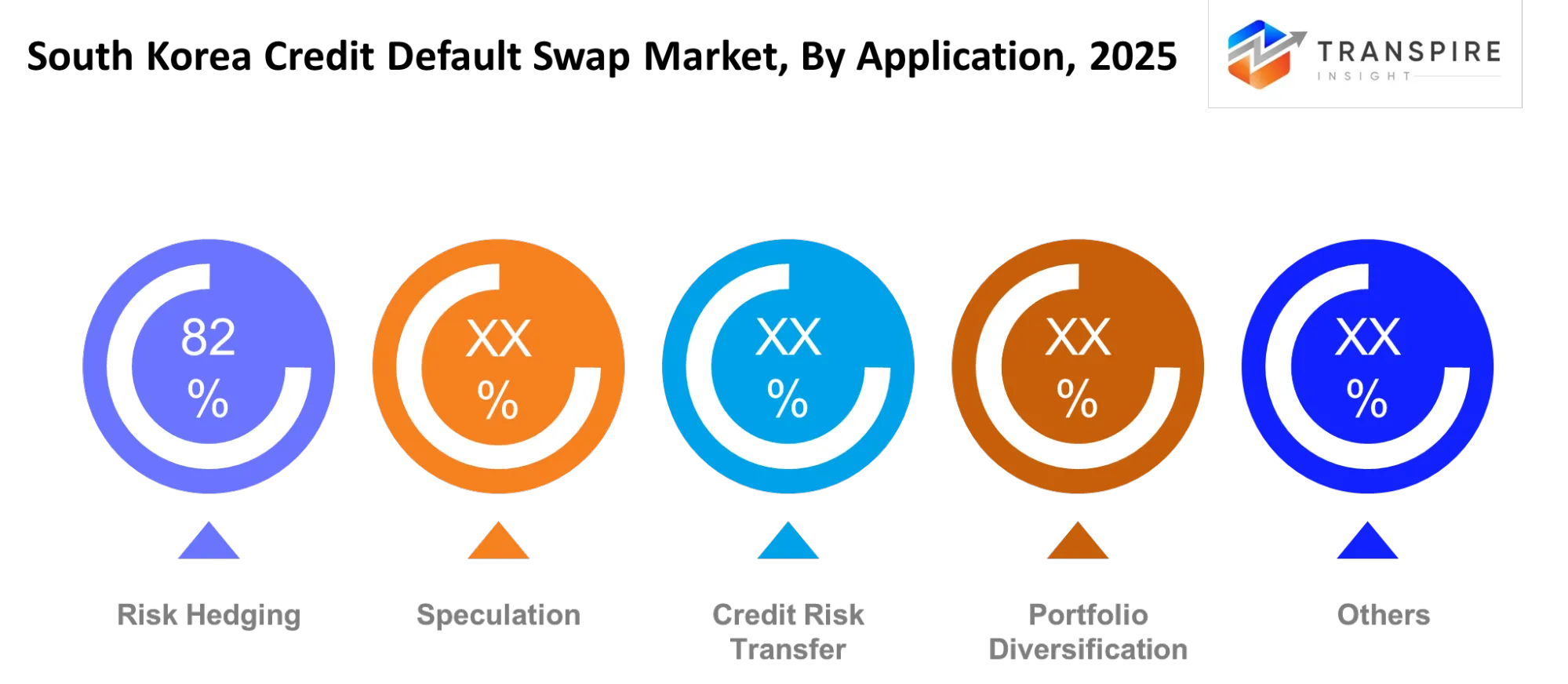
Risk Hedging still enjoys the biggest market share owing to the continuous focus of financial institutions on safeguarding themselves against corporate default risks and worsening sovereign credits. The trend of rising interest rates and the volatile nature of debt capital markets have boosted the demand for derivatives as a form of a defense strategy within banking and investing communities. The consistent use by export-financing institutions and bond holders ensures the continued dominance of the market share enjoyed by this segment.
Speculation and Credit Risk Transfer will see more adoption due to the increasing involvement of institutional investors interested in profiting from changes in spreads and economic dynamics. Credit Transfer and Portfolio Diversification will also witness increasing application by pension and portfolio management firms that want diversified exposure within various credit economies. Others include customized structures for project finance and structured investments. Credit transfers and credit diversifications will become more popular over time with the development of electronic trading platforms in the market.
To learn more about this report, Download Free Sample Report
By End User
The market share of banks is large due to the fact that commercial banks and investment banks have significant exposures to corporate debt, sovereign debt, and cross-border funding. There is a necessity of regulation and management of balance sheet risks by means of derivatives. Large domestic and international banks account for most transactions since they have higher capital and counterparty relationships.
Hedge Funds and Asset Managers will take part actively using their interest and credit derivatives strategies. The involvement of insurance companies remains unchanged as they mainly utilize CDS contracts for purposes of portfolio and liabilities management. Other participants include pension funds and dedicated investors participating via structured credit products. It is anticipated that asset managers will grow faster than other segments due to the increasing use of alternative investments and derivatives.
By Tenure
Short-term CDS contracts enjoy significant popularity owing to the preference of traders and other institutional investors towards hedge solutions that facilitate easy adjustment within an environment characterized by fast-changing interest rates and geopolitics. Such contracts allow for timely portfolio restructuring and minimize the risks associated with long-dated exposure. Short-term contracts also benefit from the high frequency and liquidity level of the market.
The popularity of medium-term CDS contracts is growing steadily as more institutions look for ways of risk coverage without having to roll over their positions often. The use of long-term CDS contracts is restricted to insurers and pension-related portfolios because they have long liabilities. There are also other customized duration structures depending on the type of financing and structure being considered. It is anticipated that in the coming years, the popularity of medium-term contracts will continue to grow.
By Trading Platform
OTC Trading remains dominant due to the tendency of institutions to require custom-made derivative agreements and negotiation-based pricing strategies. Good working relationships between banking institutions, brokerage houses, and international investing firms underpin OTC Trading’s continued dominance in the industry. Customizable settlement and structuring features continue to provide key competitive advantages for high-volume trades.
Electronic Trading Platforms are becoming increasingly popular amid the growing need for efficient execution of trades and timely provision of market information to financial institutions. Enhanced digital settlement systems and automatic risk management capabilities will boost the adoption of electronic trading platforms. Examples of alternative execution models include hybrid systems which combine electronic and direct institution-to-institution negotiations. In the coming years, electronic platforms are predicted to handle more trades owing to the growing demands of automated regulatory reports and AI-based trading.
What are the Key Use Cases Driving the South Korea Credit Default Swap Market?
In South Korea , the main way people use Credit Default Swaps is basically for hedging corporate and sovereign credit exposure, mostly across banks , securities firms, and export oriented conglomerates. In practice, financial institutions lean on CDS agreements to help manage risk tied to bond holdings, cross border lending, and foreign currency debt obligations. This is especially noticeable when interest rates are choppy, and trade disruption shows up , or just feels like it might.
Then there are the other, more secondary things too, like pension funds, insurance providers and asset managers. They’re starting to look at portfolio protection as a kind of shield against credit deterioration, but more at the sector level rather than everything at once. A lot of institutional investors also adopt index based CDS products. That lets them hedge exposure to regional manufacturing, shipping, and technology areas without having to sell off long term fixed income assets, which is usually the easier part.
Beyond that, some emerging use cases are getting attention, like blockchain enabled derivatives settlement, and AI assisted credit risk forecasting. Korean financial groups are even exploring tokenized collateral systems. The idea is that it could cut down settlement delays and make liquidity work more efficiently through complex derivatives transactions over the forecast period.
|
Report Metrics |
Details |
|
Market size value in 2025 |
USD 1.84 Trillion |
|
Market size value in 2026 |
USD 1.94 Trillion |
|
Revenue forecast in 2033 |
USD 2.81 Trillion |
|
Growth rate |
CAGR of5.44% from 2026 to 2033 |
|
Base year |
2025 |
|
Historical data |
2021 - 2024 |
|
Forecast period |
2026 - 2033 |
|
Report coverage |
Revenue forecast, competitive landscape, growth factors, and trends |
|
Regional scope |
South Korea |
|
Key company profiled |
JPMorgan Chase, Goldman Sachs, Morgan Stanley, Citigroup, Deutsche Bank, Barclays, HSBC, BNP Paribas, UBS, Credit Suisse, Nomura Holdings, Mitsubishi UFJ Financial Group, Korea Development Bank, KB Financial Group, Mirae Asset Securities |
|
Customization scope |
Free report customization (country, regional & segment scope). Avail customized purchase options to meet your exact research needs. |
|
Report Segmentation |
By Instrument Type (Single-name CDS, Index CDS, Sovereign CDS, Basket CDS, Others); By Application (Risk Hedging, Speculation, Credit Risk Transfer, Portfolio Diversification, Others); By End User (Banks, Hedge Funds, Insurance Companies, Asset Managers, Others); By Tenure (Short-term CDS, Medium-term CDS, Long-term CDS, Others); By Trading Platform (OTC Trading, Electronic Trading Platforms, Others) |
Which Regions are Driving the South Korea Credit Default Swap Market Growth?
Seoul is still the major regional center for the South Korea Credit Default Swap Market , mostly because it gathers the biggest banks, securities firms, clearing infrastructure, and institutional investors all in one place. In practice, most sovereign and corporate CDS trades seem to come out of Seoul-based financial institutions that handle international lending and bond exposure. The whole area also gets a boost from upgraded digital trading systems, strong liquidity access, and pretty tight coordination with national regulators. Because the derivatives ecosystem is so mature, global banks and domestic institutions can run big-scale hedging approaches more efficiently, without so much friction.
Busan shows up next, as the second-largest contributor, largely due to its maritime finance ecosystem and its growing role in international financial services. Instead of Seoul’s wide institutional mix, Busan’s CDS activity feels more connected to shipping finance, logistics companies , and export-linked credit protection plans. Steady port performance plus ongoing long-horizon infrastructure investment help keep derivatives demand relatively stable, especially where it relates to trade financing and vessel-related lending exposure. There is also some added support from government-backed initiatives that aim to make Busan a regional financial services hub.
Incheon is now the fastest-growing market , driven by logistics expansion, freer-trade infrastructure, and international investment movements. Recently, supply chain diversification plus technology-sector investment increased the need for advanced credit risk management tools among local firms and financial intermediaries. Cross-border funding that circles Incheon’s logistics corridors is also opening up new chances for CDS take-up, particularly tied to trade credit and industrial financing. Over the 2026–2033 period ,
Who are the Key Players in the South Korea Credit Default Swap Market and How Do They Compete?
Competition in the South Korea Credit Default Swap Market keeps looking moderately consolidated, around global investment banks plus large domestic financial institutions. They tend to have strong derivatives infrastructure and cross border settlement, capabilities that matter a lot in day to day execution, and well, even after adjustments. Market leaders usually go after advantage through pricing sophistication, liquidity reach, counterparty reliability, and technology integration, not just sheer transaction volume. International banks keep defending market share using advanced risk analytics and global trading networks, while Korean institutions start separating themselves with more digital finance integration and regional corporate relationships.
JPMorgan Chase is strengthening its position with blockchain enabled settlement infrastructure and AI driven liquidity optimization tools, which help improve transaction efficiency for institutional derivatives clients. The firm’s Kinexys platform and tokenized settlement initiatives give them some operational edge in collateral movement and cross border clearing. Goldman Sachs is leaning heavily into structured credit analytics and multi asset hedging solutions, designed for large institutional investors juggling complex portfolios across Asia. Morgan Stanley differentiates by offering integrated risk advisory services, where macroeconomic forecasting is combined with derivatives execution capabilities, pretty tightly.
Mirae Asset Securities is expanding aggressively into digital finance and tokenization infrastructure to support its institutional trading ecosystem, bit by bit but still quickly. KB Financial Group leans on domestic corporate banking relationships and stable funding access, to back CDS linked hedging activity among Korean enterprises.
Company List
- JPMorgan Chase
- Goldman Sachs
- Morgan Stanley
- Citigroup
- Deutsche Bank
- Barclays
- HSBC
- BNP Paribas
- UBS
- Credit Suisse
- Nomura Holdings
- Mitsubishi UFJ Financial Group
- Korea Development Bank
- KB Financial Group
- Mirae Asset Securities
Recent Development News
In January 2026, JPMorgan Chase announced the integration of JPM Coin with the Canton Network. The initiative supports real-time institutional settlement infrastructure and strengthens blockchain-based liquidity management capabilities relevant to derivatives and credit markets.https://www.coindesk.com
In January 2026, Mirae Asset Securities issued KRW 100 billion in digital bonds through HSBC’s blockchain-enabled Orion platform. The transaction improved multicurrency settlement efficiency and accelerated institutional adoption of tokenized financial infrastructure in Korea’s capital markets.https://koreajoongangdaily.joins.com
What Strategic Insights Define the Future of the South Korea Credit Default Swap Market?
One of the primary factors responsible for the development of the premium refined petroleum products market in South Korea is the country's strategic geographical position as a regional fuel exporter, combined with the return of demand for aviation and marine fuels in the region. After the negative impact caused by the coronavirus pandemic was overcome, the oil refineries shifted their focus on production towards the production of jet fuel and low sulfur marine fuels. Moreover, due to the unstable geopolitical situation in the Middle East, regional clients have a preference for Asian producers who have modern refineries.
A potential source of risk in the South Korea Credit Default Swap Market is connected to the issue of liquidity. This problem might arise in the case when there is liquidity concentration within a limited number of globally dominant financial institutions. In this case, a decrease in the involvement of foreign institutions, which may happen due to the fragmentation of regulations or geopolitical tensions, can cause a reduction in liquidity rather quickly. However, the tokenization of derivatives markets can be seen as an attractive solution in the long term.
South Korea Credit Default Swap Market Report Segmentation
By Instrument Type
- Single-name CDS
- Index CDS
- Sovereign CDS
- Basket CDS
- Others
By Application
- Risk Hedging
- Speculation
- Credit Risk Transfer
- Portfolio Diversification
- Others
By End User
- Banks
- Hedge Funds
- Insurance Companies
- Asset Managers
- Others
By Tenure
- Short-term CDS
- Medium-term CDS
- Long-term CDS
- Others
By Trading Platform
- OTC Trading
- Electronic Trading Platforms
- Others
Frequently Asked Questions
Find quick answers to common questions.
The estimated South Korea Credit Default Swap Market size for the market will be USD 2.81 Trillion in 2033.
Key segments for the South Korea Credit Default Swap Market are By Instrument Type (Single-name CDS, Index CDS, Sovereign CDS, Basket CDS, Others); By Application (Risk Hedging, Speculation, Credit Risk Transfer, Portfolio Diversification, Others); By End User (Banks, Hedge Funds, Insurance Companies, Asset Managers, Others); By Tenure (Short-term CDS, Medium-term CDS, Long-term CDS, Others); By Trading Platform (OTC Trading, Electronic Trading Platforms, Others).
Major South Korea Credit Default Swap Market players are JPMorgan Chase, Goldman Sachs, Morgan Stanley, Citigroup, Deutsche Bank, Barclays, HSBC, BNP Paribas, UBS, Credit Suisse, Nomura Holdings, Mitsubishi UFJ Financial Group, Korea Development Bank, KB Financial Group, Mirae Asset Securities.
The South Korea Credit Default Swap Market size is USD 1.84 Trillion in 2025.
The South Korea Credit Default Swap Market CAGR is 5.44% from 2026 to 2033.
- JPMorgan Chase
- Goldman Sachs
- Morgan Stanley
- Citigroup
- Deutsche Bank
- Barclays
- HSBC
- BNP Paribas
- UBS
- Credit Suisse
- Nomura Holdings
- Mitsubishi UFJ Financial Group
- Korea Development Bank
- KB Financial Group
- Mirae Asset Securities
Recently Published Reports
-
Apr 2026
3D Optical Profiler Market
3D Optical Profiler Market Size, Share & Analysis Report By Type (Desktop 3D Optical Profiler, and Portable 3D Optical Profiler), By Technology (Confocal Technology, and White Light Interference), By End-Use Industry (Manufacturing, Research Institutions, Automotive, Aerospace and Defense, Medical Devices, and Other), and Geography (North America, Europe, Asia-Pacific, Middle East and Africa, South and Central America), 2021 - 2031
-
Apr 2026
Depth Sensor Market
Depth Sensor Market Size, Share & Analysis Report By Type (Infrared Depth Sensors, Time-of-Flight (ToF) Sensors, Stereo Vision Sensors, Structured Light Sensors, Ultrasonic Depth Sensors), By Application (Automotive, Robotics, Gaming, Consumer Electronics, Industrial Automation, Healthcare, Security & Surveillance, Others), By End Users (Automotive Manufacturers, Consumer Electronics Companies, Healthcare Providers, Industrial Companies, Security Agencies, Gaming Companies, Robotics Companies, Others), and Geography (North America, Europe, Asia-Pacific, Middle East and Africa, South and Central America), 2021 – 2031
-
Apr 2026
Digital Manufacturing Market
Digital Manufacturing Market Size, Share & Analysis Report By Component (Hardware, Software, and Services), By Technology (Robotics, 3D Printing, Internet of Things (IoT), and Others), By Application (Automotive and Transportation, Aerospace and Defense, Consumer Electronics, Industrial Machinery, and Others), By Process Type (Computer-Based Designing, Computer-Based Simulation, Computer 3D Visualization, Analytics, and Others), and Geography (North America, Europe, Asia-Pacific, Middle East and Africa, South and Central America), 2021 – 2031
-
Apr 2026
Digital Visa Services Market
Digital Visa Services Market Size, Share & Analysis Report By Type (Individual Travelers, Group Travelers), By Application (Tourism, Business Travel, Others), and Geography (North America, Europe, Asia-Pacific, Middle East and Africa, South and Central America), 2021 – 2031