
South Korea Cooling Tower Market Size & Forecast:
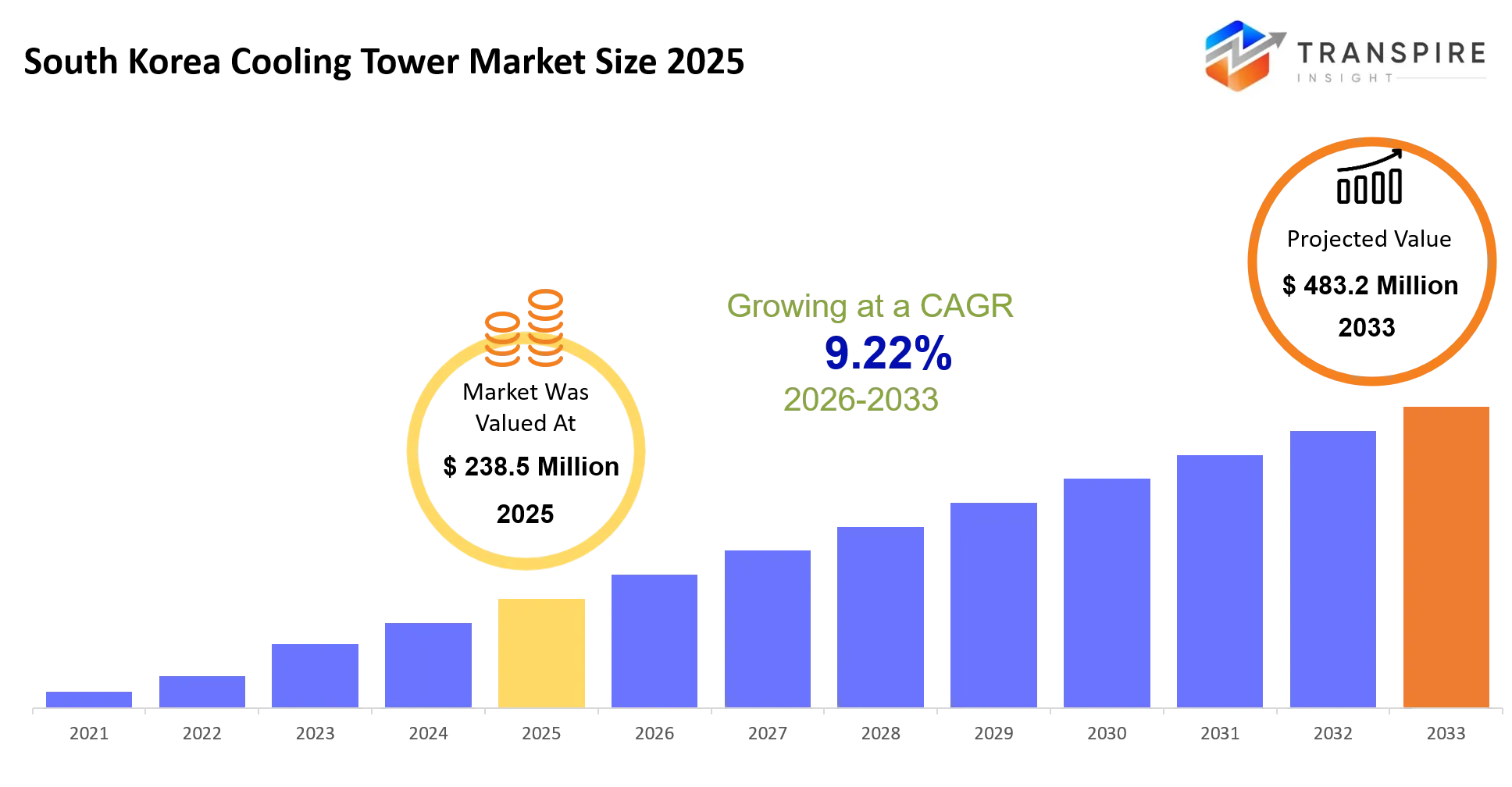
- South Korea Cooling Tower Market Size 2025: USD 238.5 Million
- South Korea Cooling Tower Market Size 2033: USD 483.2 Million
- South Korea Cooling Tower Market CAGR: 9.22%
- South Korea Cooling Tower Market Segments: By Type (Wet, Dry, Hybrid, Natural Draft, Mechanical Draft, Crossflow, Others) | By Material (FRP, Concrete, Steel, Wood, HDPE, Others) | By Application (Power Generation, HVAC, Chemical Processing, Manufacturing, Oil & Gas, Others) | By End User (Industrial, Commercial, Utilities, Data Centers, Others)
South Korea Cooling Tower Market Summary
The South Korea Cooling Tower Market was valued at USD 238.5 Million in 2025. It is forecast to reach USD 483.2 Million by 2033. That is a CAGR of 9.22% over the period.
The South Korea Cooling Tower Market , even if it sounds a bit technical it really is kinda important for keeping heat rejection working right across power plants, semiconductor fabrication facilities, petrochemical complexes, commercial buildings, and the more advanced manufacturing sites too. Basically these cooling towers remove the extra process heat so industrial teams can lower equipment stress, get better energy efficiency, and keep production moving without interruption in places where temperature has to be controlled. In the last three to five years, people have started leaning more toward energy efficient cooling tower systems, the ones that are digitally monitored and also water optimized. This shift happens because operators are facing tougher carbon reduction commitments along with higher operating cost pressures, you know the usual pressure points. After global supply chain disruptions, the whole situation sped up a bit, since companies saw how expensive equipment downtime can be, and also how inefficient utility infrastructure hurts financially, which pushed them to modernize their thermal management assets whenever facilities are upgraded or expanded.
And now , as South Korea grows semiconductor capacity, ramps up battery manufacturing, and increases high value industrial production , demand is less about just adding more capacity and more about dependable process cooling. Because of that, premium cooling solutions are getting pulled in faster, and this is also opening stronger aftermarket service opportunities. In the end , projects can support higher value revenues while keeping the critical cooling functions steady.
Key Market Insights
- Gyeonggi Province basically dominated the South Korea Cooling Tower Market, with an estimated 34% market share in 2025, and that was helped by semiconductor plus electronics manufacturing clusters.
- Chungcheong is projected to grow the quickest through 2032, mostly because of battery manufacturing investments, along with industrial park expansion and more or less “bigger capacity” plans.
- For tower type, closed-circuit cooling towers were the ones leading, taking about 46% of the market in 2025, mainly due to stronger water saving and tighter contamination control.
- Open-circuit cooling towers remained, in a way, the second-largest segment , because they are deployed pretty widely across petrochemical operations and thermal power facilities too.
- Hybrid cooling towers are projected to grow the quickest through 2032, since tighter energy efficiency expectations, and water management requirements, start showing up more often in projects.
- By application , industrial process cooling took up nearly 58% of the market share in 2025, driven by semiconductor fabrication, chemical processing, and heavy manufacturing lines .
- Data centers, and also high-performance electronics sites, are likely the fastest-growing applications as AI computing infrastructure keeps expanding across the nation.
- In end use terms, manufacturing industries held around 61% in 2025, which points to ongoing spending on production efficiency and thermal control, sort of a steady push.
- Meanwhile, data center operators are turning into the fastest growing end user group during the forecast period, because digital infrastructure investments keep rising.
What are the Key Drivers, Restraints, and Opportunities in the South Korea Cooling Tower Market?
The strongest force pushing the South Korea Cooling Tower Market along is the country’s continued commitment to semiconductor fabrication, rechargeable battery production, and more advanced manufacturing facilities. These sectors run with very strict temperature discipline, so even small thermal wiggles can lower production yields and also hurt equipment dependability. Government support for strategic manufacturing capacity , paired with private funding toward next generation fabrication sites , has basically lifted the need for high efficiency cooling infrastructure . With this kind of shift, suppliers can earn more from premium cooling towers, automation systems , retrofit services, and long term maintenance agreements instead of leaning only on new equipment sales.
One of the biggest structural obstacles is the steep capital expense involved in swapping out old cooling infrastructure, especially when you still have to keep industrial output running, without interruption. A lot of petrochemical plants, refineries, and power stations still lean on legacy cooling arrangements, because halting operations during replacement creates major losses and, yeah, the timing is hard.On top of that, older industrial zones usually demand tailored engineering work and civil modifications before brand new cooling towers can be installed. All of those limitations slow down modernization programs, stretch the replacement timelines, and clamp down on potential market revenue , even when the underlying technology is improving.
The strongest long term chance is in smart cooling infrastructure, for example for semiconductor fabs, hyperscale data centers and even battery manufacturing facilities , yeah a bit. With AI enabled monitoring, digital twins, and predictive upkeep platforms, you can keep tweaking airflow, water circulation , and overall energy use almost all the time. South Korea is also building out more AI computing infrastructure, plus a high value electronics manufacturing ecosystem, so the conditions feel pretty good for suppliers that can deliver integrated hardware and software, plus lifecycle services . In other words vendors that blend efficient cooling methods with real time operational analytics should be able to grab higher priced contracts , and also get recurring service revenues across most of the forecast period.
What Has the Impact of Artificial Intelligence Been on the South Korea Cooling Tower Market?
Artificial intelligence is reshaping cooling tower operations, in a way that keeps facility management from being stuck on scheduled maintenance only. Instead it trends toward continuous data driven optimization, it feels a little more like a living system than a calendar task. In newer cooling installations AI is increasingly tied with IoT sensors, those sensors watch things like water temperature, fan speed, vibration, water chemistry, flow rates, and even energy consumption all at once, and yes in real time.
From there automated control systems keep nudging fan operation, pump performance, and water circulation, so thermal conditions stay steady while electricity use and water usage are reduced across industrial sites. There is this continual adjustment that sort of smooths out variations in load ,which helps overall performance.
On the analytics side, machine learning algorithms kind of sift through past operating records to spot early hints of bearing wear, scaling, fouling, corrosion, and mechanical imbalance, before anything really fails. Predictive maintenance then usually helps cut down those sudden shutdowns, boosts equipment availability, stretches the useful life of the assets, and in general drives down maintenance costs since interventions can be more targeted, not just broad, or purely reactive. At the same time digital twin platforms can support further tuning by simulating operational conditions and offering efficiency improvements as production loads shift over time.
AI can also help with regulatory compliance, by continuously checking operational efficiency, water consumption, and equipment performance against set thresholds. This makes reporting faster and adds more operational transparency, which is often a major concern in audits.
Still, adopting AI isn’t simple. The biggest blockers are the cost of adding sensors, the friction of linking with legacy control systems, and the expense of cloud based analytics inside existing industrial facilities. Many older plants don’t have standardized operational data, so machine learning models can end up less accurate during early rollout, and that pushes the timeline longer before measurable improvements show up clearly.
Key Market Trends
- Semiconductor manufacturers are starting to ask for AI enabled cooling systems that sorta help keep thermal stability more steady and lower the chance of unplanned maintenance compared to the usual installs.
- Since 2021 , industrial buyers have been leaning toward closed loop and hybrid cooling setups, partly to stretch water efficiency and boost operational reliability.
- Variable speed fan tech is now kinda a standard line item in higher end projects because it cuts electricity use during the changing production loads.
- More manufacturers are folding IoT sensors into cooling towers, so they can do continuous performance tracking rather than those periodic manual checks, which honestly feel a bit outdated.
- EPC contractors now weigh lifecycle operating costs more heavily than the upfront equipment prices, when they look at bigger industrial cooling infrastructure deals.
- After 2022, supply chain disruptions pushed many buyers to favor domestic sourcing strategies, so suppliers have been expanding regional manufacturing, and also upping local service capabilities, to keep things moving.
- Data center construction has turned into a major growth engine , driving demand for precision cooling systems built for ongoing high density computing.
- Corrosion resistant composite materials are getting wider adoption too, because they extend the service life in harsh industrial settings where conditions are aggressive.
- Top suppliers are also differentiating with digital service agreements, remote diagnostics, and predictive maintenance platforms , not really competing only on equipment pricing like before.
South Korea Cooling Tower Market Segmentation
By Type :
Wet cooling towers are commonly used because water evaporation, somehow, gives a pretty efficient heat stripping effect, especially for large industrial setups. Dry cooling towers cut down water consumption by relying on air as the cooling medium , so their installation is often a better fit when water availability is limited. Hybrid cooling towers mix wet and dry cooling, to improve overall performance while also bringing water use down to a reasonable level. Natural draft cooling towers depend on natural airflow, so they’re typically placed at big power generation sites, whereas mechanical draft cooling towers use fans for a more controlled airflow, which helps keep the cooling steady and predictable.
Crossflow cooling towers let the water travel vertically, while the air moves horizontally , and that also makes upkeep a little easier in practice, plus it can reduce pumping demands. Other tower styles exist too, including specialized designs that are developed for particular industrial processes, where they need customized cooling power or a space saving arrangement. In the end selection comes down to operating conditions, available water resources, energy consumption targets, the plant size , and the longer term maintenance requirements.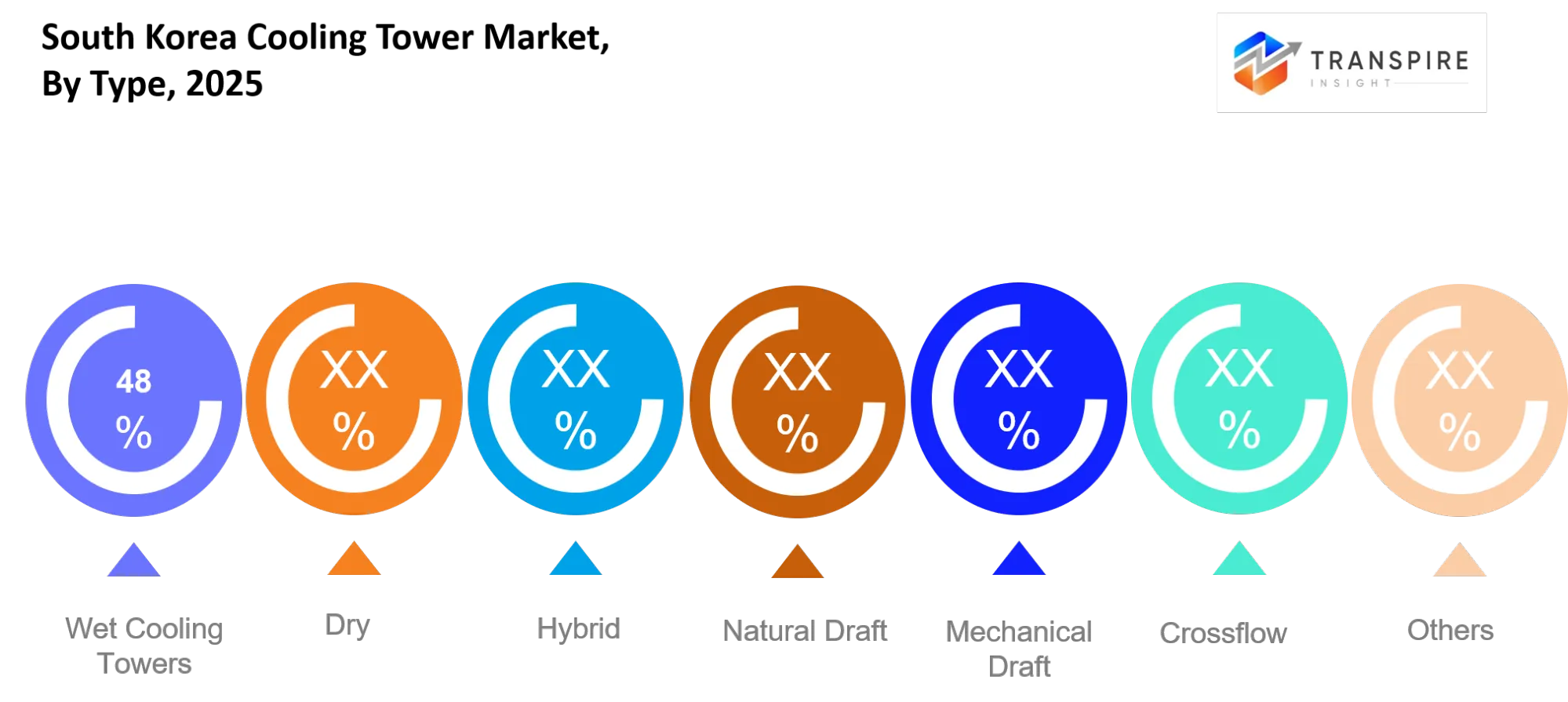
By Material :
FRP cooling towers are usually liked a lot because they’re light in weight, they resist corrosion really well, and they need not that much maintenance so they keep going for a long time even when the industrial environment is tough. Concrete cooling towers are often used in bigger utility and power generation jobs where you really need strong structure and a long service life, basically years and years. Steel cooling towers give solid mechanical performance and they work well for heavy industrial applications but you will need protective coatings , otherwise corrosion shows up after extended use and that becomes an issue.
Wood cooling towers still get picked for certain facilities, mainly because their natural insulation qualities and their operating track record stay useful in a few specific situations, even if it’s not for every place. HDPE cooling towers bring excellent chemical resistance, lower weight, and easier installation for compact industrial systems, so operators appreciate the simpler setup. Other material choices also exist and they help in specialized operating conditions, where extra durability, higher temperature resistance, or custom engineering solutions can make the whole system perform better overall.
By Application :
Power generation remains, still, one of the biggest uses, because thermal power plants need continuous cooling to keep efficient electricity production going and to shield the important machinery. HVAC systems rely on cooling towers to pull heat out of commercial buildings, hospitals, shopping centers, and office complexes, while also helping the indoor climate stay comfortable. Chemical processing sites count on steady cooling to keep process temperatures stable and to support safe manufacturing operations across the entire run.
Manufacturing environments use cooling towers for equipment heat management during metal work, semiconductor production, automotive manufacturing, and electronics fabrication. Oil and gas operations need dependable cooling setups for refining and processing tasks that create a lot of heat, so yeah it matters. Other uses include food processing, pharmaceutical production, mining activities, and district cooling projects, where consistent temperature handling supports dependable day to day operational performance.
By End User :
Industrial end users make up quite a big portion, mostly because manufacturing plants, refineries, chemical facilities and other processing industries really need constant heat rejection, for uninterrupted output. Commercial sites usually fit cooling towers to back HVAC systems in office blocks , hotels , hospitals , schools, and retail spaces where energy efficient climate control is basically required for day to day work.
Utility companies also rely on cooling towers, not just to shed heat but to help thermal efficiency inside electricity generation facilities and keep a reliable power feed. Data centers are another fast growing end user group, since modern computing equipment creates a lot of heat and it must be handled with continuous and efficient cooling.You can also find cooling towers used in public infrastructure initiatives, transport terminals, research organizations, and niche industrial operations, where dependable thermal handling helps with long term operational stability.
What are the Key Use Cases Driving the South Korea Cooling Tower Market?
The biggest share of cooling tower installations goes to semiconductor fabrication, chemical processing, and power generation sites, where dependable heat shedding is kind of a must for non stop running. When temperature control is tight it tends to boost production efficiency, safeguard high-value assets, and also lowers the chances of expensive process pauses, or interruptions that are hard to recover from.
On top of that, demand keeps widening in commercial HVAC systems and large manufacturing plants, especially across electronics, automotive and battery production. More money flowing into industrial modernization, plus energy-savvy building infrastructure, is pushing operators to swap older cooling units with higher-performance options that simply work better over time.
Newer use cases are now taking shape in hyperscale data centers, and in advanced artificial intelligence computing facilities, where packed server layouts really need steady thermal management. Hydrogen production initiatives and next-generation battery manufacturing lines look promising too, particularly as South Korea ramps up spending on advanced industrial infrastructure, and tries to speed up the entire supply chain.
|
Report Metrics |
Details |
|
Market size value in 2025 |
USD 238.5 Million |
|
Market size value in 2026 |
USD 260.7 Million |
|
Revenue forecast in 2033 |
USD 483.2 Million |
|
Growth rate |
CAGR of 9.22% from 2026 to 2033 |
|
Base year |
2025 |
|
Historical data |
2021 - 2024 |
|
Forecast period |
2026 - 2033 |
|
Report coverage |
Revenue forecast, competitive landscape, growth factors, and trends |
|
Country scope |
South Korea |
|
Key company profiled |
SPX, BAC, Evapco, Hamon, Johnson Controls, Delta Cooling, Paharpur, B&W, ENEXIO, Brentwood, Mesan, Shinwa, Liang Chi, BAC Japan, Doosan |
|
Customization scope |
Free report customization (country, regional & segment scope). Avail customized purchase options to meet your exact research needs. |
|
Report Segmentation |
By Type (Wet, Dry, Hybrid, Natural Draft, Mechanical Draft, Crossflow, Others) | By Material (FRP, Concrete, Steel, Wood, HDPE, Others) | By Application (Power Generation, HVAC, Chemical Processing, Manufacturing, Oil & Gas, Others) | By End User (Industrial, Commercial, Utilities, Data Centers, Others) |
Which Regions are Driving the South Korea Cooling Tower Market Growth?
Gyeonggi Province still remains the biggest regional market really, mainly because it contains South Korea’s highest cluster of semiconductor fabrication plants, electronics makers, and advanced industrial locations. Ongoing investment into industrial parks and utility infrastructure keeps pushing a steady need for high capacity cooling systems. There’s also solid government backing for the strategic manufacturing industries, so factories tend to expand and modernize in a regular way, not just once. Add to that a maturing supplier ecosystem, plus a capable engineering workforce and an established maintenance circuit, and the region can keep its long term market edge.
Chungcheong Province works more like a different kind of story, it grows by leaning into battery manufacturing, display output, and chemical processing rather than the very tight semiconductor base you see concentrated in Gyeonggi. Big industrial complexes keep drawing domestic and foreign investment too, because land supply is still there, so expansion is less constrained. With stable industrial momentum and continuous utility improvements, replacement demand looks predictable, while brand new installations show up as well. So cooling tower manufacturers, and engineering contractors too, get a fairly dependable set of revenue chances from this balanced investment setup.
Gyeongsang Province is showing up as the fastest-growing regional market because, lately, investments in data centers, hydrogen initiatives, petrochemical modernization, and advanced manufacturing are expanding the need for cooling across multiple sectors. Industrial operators are swapping out older thermal management systems for more energy-efficient, and digitally monitored equipment, so they can cut operating costs and also keep plant reliability steadier, not wobblier. With heavy industry still pushing forward, and clean energy infrastructure also filling in more space, it opens doors for advanced cooling solutions. From 2026 to 2033, this whole momentum is expected to pull in equipment suppliers, service providers, and technology investors who are trying to join in the bigger industrial modernization programs.
Who are the Key Players in the South Korea Cooling Tower Market and How Do They Compete?
Competition is still kinda moderately consolidated, but you see, established global manufacturers trading places with regional suppliers who bring localized engineering and upkeep services. What usually wins isn’t just the price tag, it’s more about energy efficiency, tailored or customized system design, digital monitoring ability, and lifecycle support. Industrial customers increasingly look at long-term operating costs, how well a project gets executed, and what the after-sales coverage looks like… instead of focusing only on the initial equipment pricing.
SPX Cooling Technologies stands out thanks to more advanced thermal engineering, high efficiency mechanical draft cooling towers, and digital performance monitoring. The idea is that industrial operators can cut down energy use. Baltimore Aircoil Company meanwhile leans into closed-circuit and evaporative cooling technologies, with better water management practices and also support for tough semiconductor and manufacturing settings. EVAPCO tends to win by providing modular cooling solutions that make installation easier, plus they offer flexible system expansion options for major industrial work.
Hamon Group specializes in big cooling infrastructure for power generation and heavy industry, so when projects get complex their engineering capability and customized project execution tend to become the advantage that matters. ENEXIO puts focus on water efficient cooling technologies, and it supports industrial decarbonization aims with offerings meant to reduce resource consumption overall. Together, these players keep expanding through technology partnerships, on-site or localized engineering support, and integrated maintenance services that build stronger customer relationships, and they also create recurring revenue that goes well past the first equipment sale.
Company List
- SPX
- BAC
- Evapco
- Hamon
- Johnson Controls
- Delta Cooling
- Paharpur
- B&W
- ENEXIO
- Brentwood
- Mesan
- Shinwa
- Liang Chi
- BAC Japan
- Doosan
Recent Development News
In June 2025, EVAPCO launched the new 4T and 5T series AT cooling tower models. The expanded product range increased cooling capacity through structural improvements, strengthening EVAPCO's offering for industrial and commercial cooling projects, including opportunities across Asia. Sourcehttps://www.evapcoasia.com/
In May 2026, EVAPCO launched the PuRe-JET™ pumpless adiabatic cooling technology. The new technology expands the company's portfolio with a water-efficient cooling solution that supports industrial facilities and data center applications seeking lower operating costs.
Source https://www.evapco.com/
What Strategic Insights Define the Future of the South Korea Cooling Tower Market?
Over the next five to seven years, the South Korea Cooling Tower Market is likely to move beyond just supplying stand alone equipment towards providing integrated thermal management systems , with digital controls, predictive maintenance, and water optimization technologies sort of woven together. The main force for this shift is sustained investment in semiconductor fabrication, artificial intelligence data centers, battery manufacturing, and other high value industries, where steady cooling really affects production efficiency , and overall operating costs too.
A more subtle risk is how demand is getting concentrated across a smaller set of big industrial sectors. If there is any slowdown in semiconductor capital spending or if major manufacturing projects run late, then cooling infrastructure investments can get pushed back, which in turn can cause uneven order cycles for suppliers.
An emerging chance is also showing up, with cooling solutions that are tailored for hydrogen production facilities and next generation AI data centers , where heat loads are rising faster than older conventional systems can efficiently handle. Firms that begin early with intelligent monitoring platforms, localized engineering assistance, and lifecycle service capabilities should be better able to lock in long term contracts and generate recurring revenue streams.
South Korea Cooling Tower Market Report Segmentation
By Type
- Wet
- Dry
- Hybrid
- Natural Draft
- Mechanical Draft
- Crossflow
By Material
- FRP
- Concrete
- Steel
- Wood
- HDPE
By Application
- Power Generation
- HVAC
- Chemical Processing
- Manufacturing
- Oil & Gas
By End User
- Industrial
- Commercial
- Utilities
- Data Centers
Frequently Asked Questions
Find quick answers to common questions.
The South Korea Cooling Tower Market size is USD 483.2 Million in 2033.
Key Segments for the South Korea Cooling Tower Market are By Type (Wet, Dry, Hybrid, Natural Draft, Mechanical Draft, Crossflow, Others) | By Material (FRP, Concrete, Steel, Wood, HDPE, Others) | By Application (Power Generation, HVAC, Chemical Processing, Manufacturing, Oil & Gas, Others) | By End User (Industrial, Commercial, Utilities, Data Centers, Others).
Major South Korea Cooling Tower Market Players are SPX, BAC, Evapco, Hamon, Johnson Controls, Delta Cooling, Paharpur, B&W, ENEXIO, Brentwood, Mesan, Shinwa, Liang Chi, BAC Japan, Doosan.
The Current South Korea Cooling Tower Market size is USD 238.5 Million in 2025.
The South Korea Cooling Tower Market CAGR is 9.22% from 2026 to 2033.
- SPX
- BAC
- Evapco
- Hamon
- Johnson Controls
- Delta Cooling
- Paharpur
- B&W
- ENEXIO
- Brentwood
- Mesan
- Shinwa
- Liang Chi
- BAC Japan
- Doosan
About the Authors

Kartik bhong
I am Kartik Bhong, a Senior Research Analyst at Transpire Insight, specializing in the Packaging, Manufacturing, and Construction industry. My work focuses on analyzing market trends, emerging technologies, industry regulations, and competitive landscapes to deliver accurate, data-driven insights. I am passionate about transforming complex industry information into clear, practical content that helps businesses, professionals, and decision-makers stay informed and make confident strategic decisions. Through continuous research and a strong commitment to accuracy, I strive to create reliable, well-researched content that reflects the latest developments across these dynamic industries and supports the vision of Transpire Insight in delivering valuable market intelligence.

Chakradhar Khansole
Chakradhar serves as the Research Director at Transpire Insight, bringing over 8 years of experience in technology, innovation, and strategic market intelligence. He specializes in transforming complex market data into actionable business insights that enable organizations to make informed, growth-oriented decisions. Recognized for his strategic vision and analytical expertise, Chakradhar leads high-impact research initiatives, delivering comprehensive market assessments, competitive intelligence, and forward-looking industry analysis.
Recently Published Reports
-
Apr 2026
Handling and Lifting Equipment Market
Handling and Lifting Equipment Market Size, Share & Analysis Report By Product (Cranes and Hoists, Forklifts, Conveyor Systems, Aerial Work Platforms, Others), By Application (E-Commerce, Automotive and Railway, Food and Beverages, Aviation, Others), and Geography (North America, Europe, Asia-Pacific, Middle East and Africa, South and Central America), 2021 - 2031
-
Apr 2026
HVAC Equipment Market
HVAC Equipment Market Size, Share & Analysis Report By Heating Equipment Type (Boilers and Furnaces, Heat Pumps, and Unitary Heaters), By Ventilation Equipment (Air Handling Units, Humidifiers and Dehumidifiers, Air Filters, and Fan Coiling Units), By Air Conditioning Equipment (Unitary Air Conditioners, Room Air Conditioners, Packaged Terminal Air Conditioners, and Chillers), By End User (Commercial, Residential, Industrial, and others), and Geography (North America, Europe, Asia-Pacific, Middle East and Africa, South and Central America), 2021 – 2031
-
Apr 2026
Refrigeration Valves Market
Refrigeration Valves Market Size, Share & Analysis Report By Type (Solenoid Valves, Expansion Valves, Check Valves, Service Valves, Others), By Application (Commercial Refrigeration, Industrial Refrigeration, Transport Refrigeration, Residential Refrigeration, Air Conditioning Systems), By End User (Food and Beverage Industry, Pharmaceutical Industry, HVAC Industry, Chemical Industry, Others), and Geography (North America, Europe, Asia-Pacific, Middle East and Africa, South and Central America), 2021 – 2031
-
Apr 2026
E-Commerce Packaging Materials Market
E-Commerce Packaging Materials Market By Material Type (Corrugated Boxes, Paper & Paperboard, Foam & Cushioning Materials, Plastic Packaging, Flexible Packaging, Protective Packaging, Others), By Product(Primary Packaging, Secondary Packaging, Tertiary Packaging), By Packaging Function (Protective Packaging, Branding & Presentation Packaging, Transit & Logistic Packaging, Sustainable Packaging, Tamper Evidence Packaging), By End-User (Retail & Consumer Goods, Electronic Appliances, Food & Beverages, Healthcare & Pharmaceutical, Fashion & Apparel, Home & Furnishing, Others); By Industry Analysis, Size, Share, Growth, Trends, and Forecasts 2021-2033